
[Before–Growing beds marked with flour and flags]

[Opening Circle]
I also realized how many layers of community are involved in such a project. One layer is this community of people who care about the earth, and who come together to give and receive, to learn, to share, to grow, to get to know each other. People connections are made.
Another layer is the community of the soil. During the blitz I was mostly working with several others on the project for creating new growing beds. We were adding nutrients through sheet mulching so that the soil could create a thriving fertile community. I have learned so much about the variations in soil communities from the book The Holistic Orchard by Michael Phillips.
What a food forest needs, what fruit trees need, is soil whose fungal community is stronger than its bacterial community. In contrast, annual vegetables and flowers and grasses prefer soil with a stronger bacterial community. A bacterial community is enhanced by tilling the soil and incorporating organic matter by turning it into the soil. A fungal community is enhanced by no tilling, but rather adding organic matter on the top of the soil to decompose, as it happens in the forest. (Similarly, compost that is left unturned will generate a stronger fungal community.)
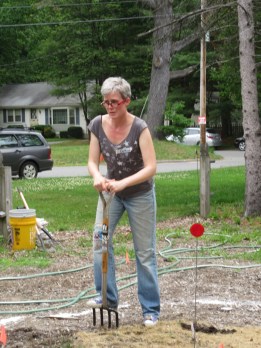
[Cathleen forking the soil]
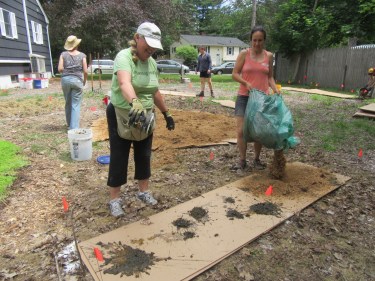
[Mihku & Heather adding manure and chaff]
We also made several pathways with cardboard and wood chips, and I will complete those bit by bit in the next days. Now, the process works on its own–I add some water or it gets rained on–and the microbes will work together over the next several months (and years) to create a thriving soil community. We will plant trees and bushes next spring. My friend Roger Paul said that the Wabanaki word for “soil” means giver of life.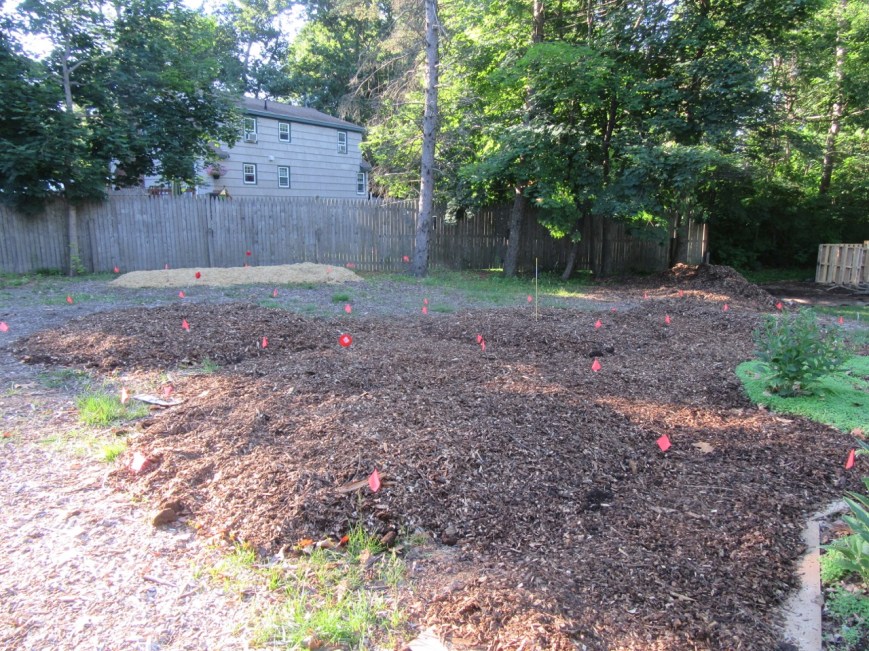

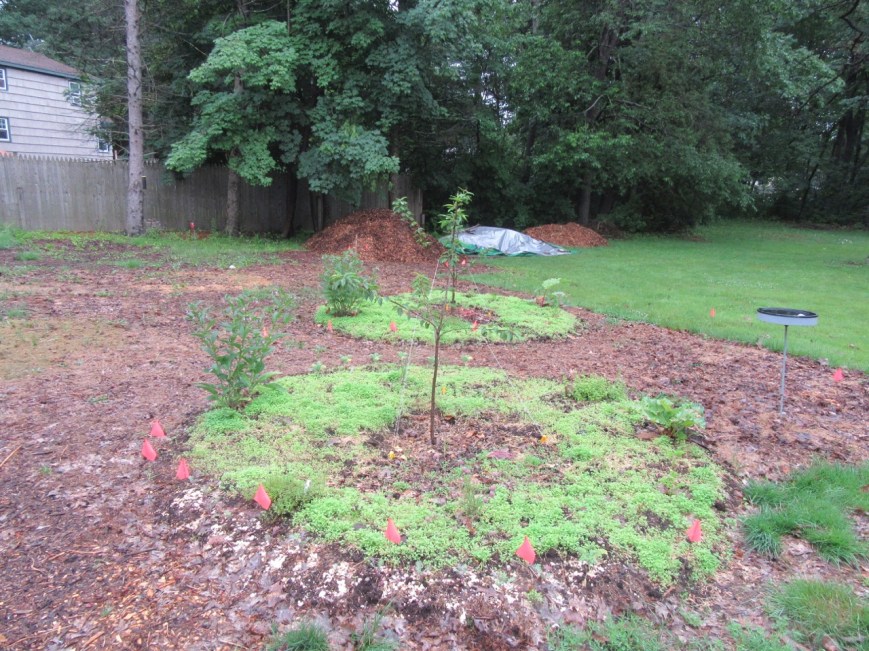
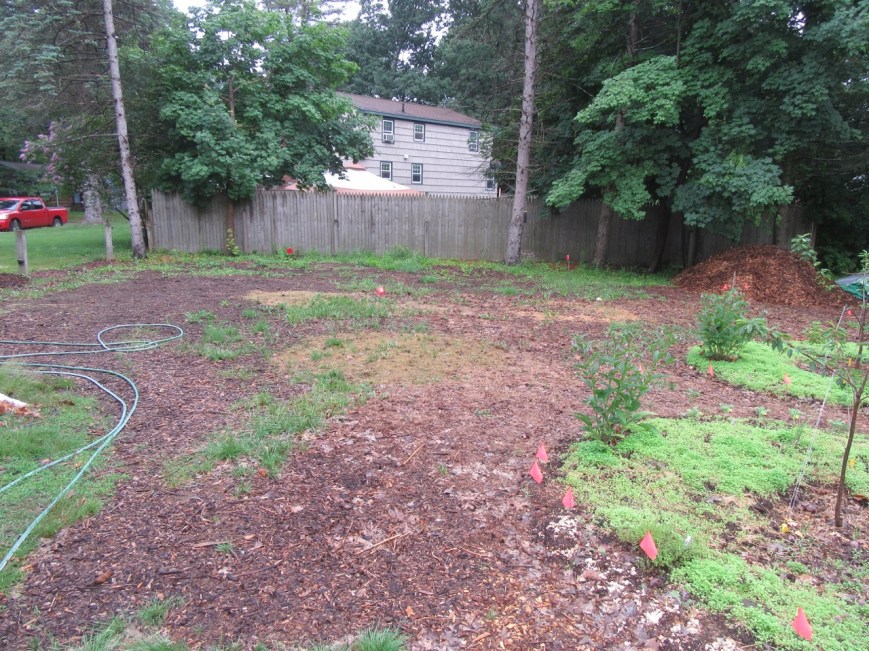



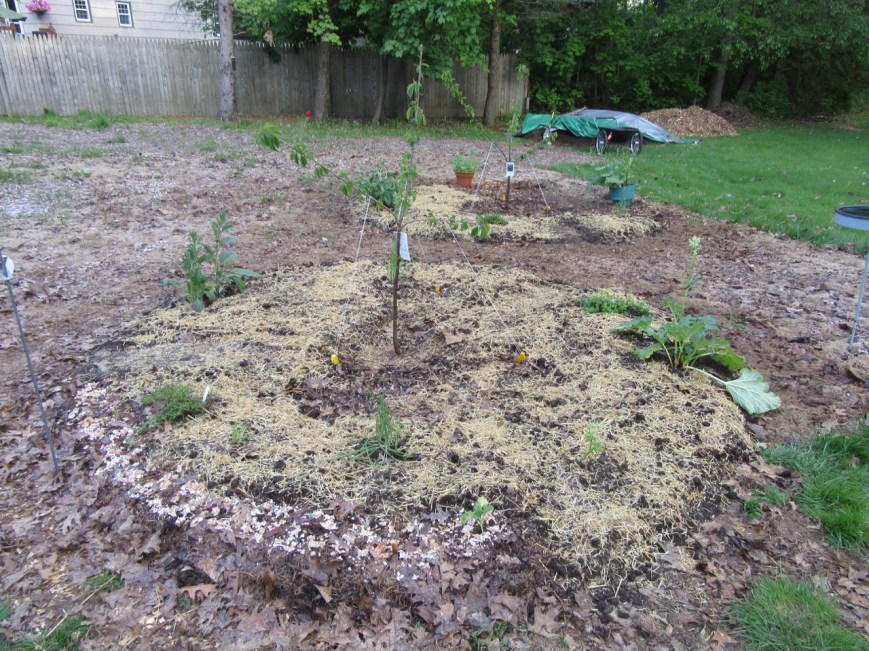 Today I almost finished soil work and guild plantings around each of the cherry trees–still 1/3 to do around the second tree. First I aerated the soil with our garden fork to a five foot radius around the tree. (The soil was already covered with mulch from last fall-wood chips, cut grass, sea weed, and dead leaves.) Then I put down newspaper or cardboard along the outer half of each circle, and covered it with compost. I planted the companion plants for each cherry tree guild. Guilds are plants that work together so that each does better than if they were planted alone. In this case, the primary focus is the health of the cherry tree.
 Today was a day for food forests! My friend Mihku and I went to a tour of
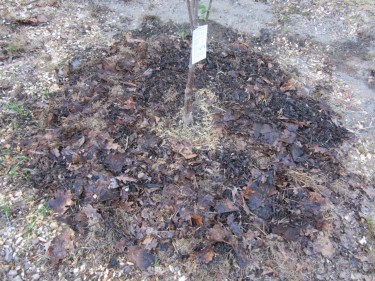 So the very next day, I went out and moved that evergreen mulch away, and dug up some of the starting-to-decompose deciduous wood & leaves mulch, piling it up in a six-foot diameter circle around each tree, careful to leave open space around the trunks themselves. Next time, Margy can ask our wood chip supplier to save us some of the ramial chips.
 The Portland Water District offers inexpensive rain barrels each year, so Margy and I ordered four barrels to supplement the few we already have. We picked them up amid dozens of barrels at the East End Water Treatment Facility. These are repurposed olive oil barrels so we’re glad to recycle rather than buy something created with new plastic.
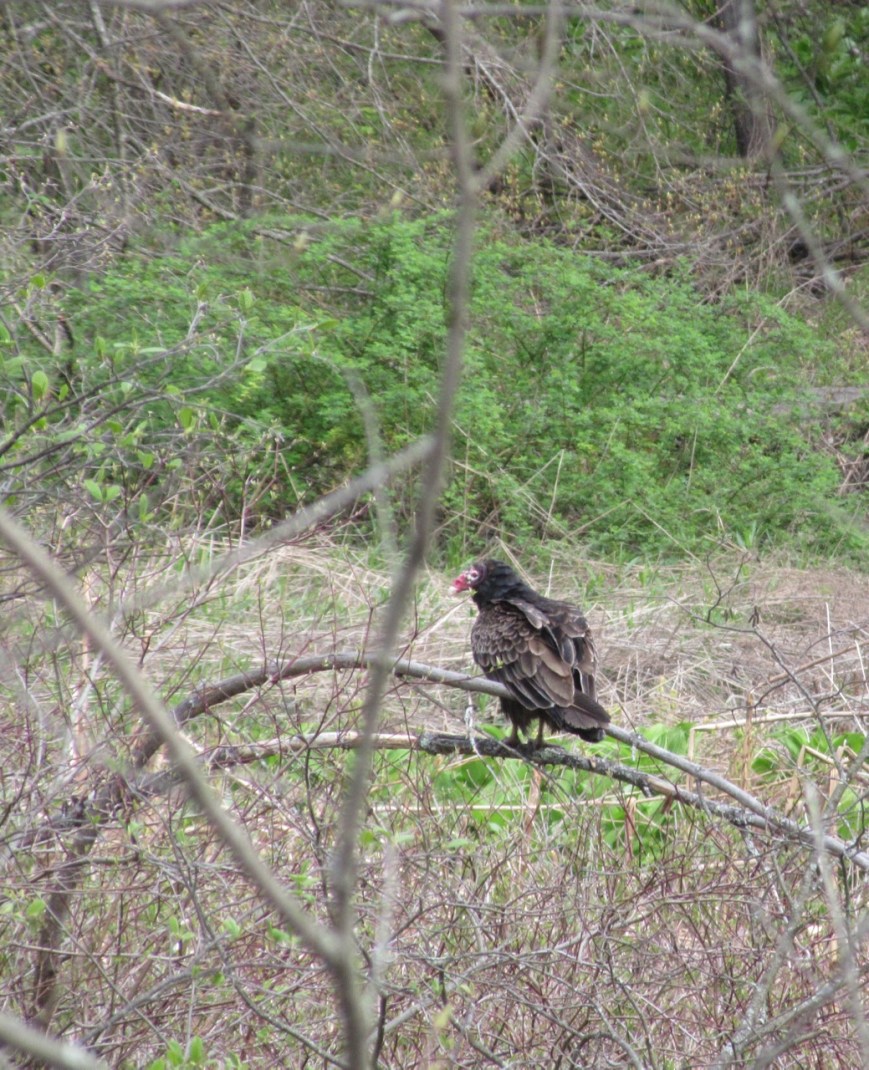
 On my walk yesterday, I followed the brook trail by the Hall School. Then, as I was going along the road that crosses over the brook, I happened to look through the chain link fence to my left, and saw these huge birds resting in the underbrush near the brook. They had not been visible from the trail–in fact I went back to see if I could get a closer look, and they were completely hidden. Turkey vultures. I had never seen them in the neighborhood before, but while watching for several minutes, another bird emerged–looking scruffy like a juvenile. So maybe this was mama and papa’s protected home for raising their baby.