Returning To the Present Moment

Our search for greener housing has brought me an intense focus on a worthy project and a burning desire to bring it to completion. But one of the side effects of this project has been that I easily lose track of my attention to this present moment. It is as if I am hovering between the present and the future, and my feet can’t find the ground.

I took a walk this morning in my neighborhood. A short way down the road, I found a frog that had been killed by a passing car. As I moved its body into the grass, I was reminded that we never know when we will meet our own end. It won’t wait for us to finish all our projects. This moment is all that we have for sure. How can I live in this moment, even when I am involved in working on a goal?

One of the best ways I know to return to the present moment is to enter through the door of gratitude. I am grateful for the full moon that was golden in the trees as it was rising last night. I am grateful for cuddling with my love after watching a movie together on the couch. I am grateful for diving into the ocean yesterday after time setting up rain barrels at a Permablitz in South Portland. I am grateful for people who care about the earth and each other enough to gather together to help new friends fulfill a permaculture design for their garden.

I am grateful for local sausage fried with green kale at breakfast. I am grateful for the sun shining through the clouds during my walk. I am grateful for the turkey who crossed the road in front of me. I am grateful for the chirping of the chipmunk who greeted me on my return, and then hid in the rain downspout extension. I am grateful for one more day to be alive in this beautiful earth.Chipmunk DSC00392

Waiting

After going back to the beautiful window house, we are feeling more confused than ever. We are hoping to simplify our lives, yet this house would need so much work before we could move in. And would it really get simpler after all that? I made a rough to-scale sketch of the floor plan, so we could try to imagine ourselves and our basic furniture fitting into the spaces, but there were complications there too.

As I fell asleep, I called to mind the face of my ancient grandmother who guides me, and it seemed she was shaking her head “no.” This morning I am also remembering that feeling confusion is itself sometimes a signal that the answer is no. If it were yes, there would be a sense of joy and clarity.

But letting go means leaping into the void–there is nothing on the market right now that fits the dream we created in our search for greener living. Still, that is the ultimate work of magic and mystery–to let our longings go out into that emptiness, and trust that the emptiness is like a dark womb in which beauty is born.  And so I leap into that void and wait. And the sun shines warm upon my face.

Later this morning, through the window I hear a ruckus and a loud chirping, and look to see a cardinal feeding her child. I am like that baby bird calling out and being fed by all that lives around me. I am like that mother bird, giving to the next generation in the ways I can. I am like the person who fills the bird feeder, making an offering to the cardinals who are beauty and hope in the flesh.Cardinal Feeding MJ DSC00761

Closets

Broom DSC00663It is funny what bubbles up. In our search for greener housing, there were some things that didn’t make it onto our dream list. Like closets. But after writing the post about the beautiful window house, as I lay in bed trying to go to sleep, I realized that that house had almost no closets–one big bedroom had an okay-sized closet, the other big bedroom had a very tiny closet, and there was one very tiny closet in the hall. That was it.

I began to try to imagine–where would we put our coats and boots and scarves and mittens? (We live in Maine after all.) Where could we put our bathing suits and beach bags? (Maine in summer!) Not to mention clothes and linens and shoes. Where would we put an ironing board or vacuum cleaner or broom? We are trying to simplify our lives, but we also need the tools that go into daily life, and a place to put them.

Then I started to notice other things about the house that weren’t very good. For example, there are two and one half bathrooms (we only really need one) but if a guest comes to stay, they have to go into another bedroom to use the shower. Isn’t that a little crazy? The big beautiful window can’t be opened, so what does that do to airflow? The basement was musty–will it freshen up with some attention so that we’d feel comfortable storing boxes down there, or will it be off-limits to us?

Our realtor reminds us that some of the features we do like about this house don’t come along very often. We are going back to the house today to see if we can imagine solutions that work. But at this moment, this morning, I am paying attention to the voice that says, “maybe not?” How do we find clarity? Perhaps the voice of wisdom will come through the silliest thoughts and feelings that creep into our hearts as we try to sleep.

A Beautiful Window

Window DSC00652 - Version 2Continuing our search for greener housing, today we saw a house that had a lot of features we liked. The rooms were full of light, even on a rainy day. The living room had this really great full length window that we fell in love with. The house could be made accessible by widening a couple doorways on the inside, and a ramp to the front porch which was only a step or two up. (Very unusual for the houses we have seen.) The house had character–it had two bedroom suites, each with their own bathroom and room for office/study space. There was a fireplace in the living room.  Wood floors and lovely windows throughout. A small but usable kitchen. A small guest bedroom. It had a front porch (visible through the cool window), and two back decks on different levels (which is both a positive for outdoor space and negative for access). Oh, and another half bath, with hook-up for washer and dryer on the first floor. Outside, it had a big side yard as well as a sweet back yard and small front yard. It had an apple tree. According to the listing it was .3 acres. A quiet street and close to a bus line.

On the negative side, it had only a one-car garage, but it looked like there would be room in the front of the side yard to build another garage. We weren’t sure about whether solar panels could be installed on the roof, but we would have to cut down an ash tree on the back property line for it to work. On the other hand, if we built the garage, it might be situated well for solar too. If we make an offer on this house, we’d put in a contingency that it would work for solar panels. We’d also need to buy a washer and dryer, a dishwasher, and a hot water heater. Along with the air-source heat pumps. I think we might use up our budget for all of this.

Other good news, we were approved for a home equity line of credit on our current house that will cover the initial costs of buying a house and renovations, so we don’t have to make an offer contingent on selling our current house. (Though we would put our house on the market once we have a house under contract.)

It is hard to make a decision. Margy and I talked it out tonight, and both of us are leaning toward making an offer, but now we are going to sleep on it. It is really nice to find a house that has character, that I feel like we could love. I feel a little overwhelmed by all of it right now. Mother Earth, please will you guide our hearts into clarity? Ash tree, are you willing to give yourself to this project of our search for greener housing?

I remember the words of the Tao:

Do you have the patience to wait 
till your mud settles and the water is clear? Can you remain unmoving 
till the right action arises by itself?

The Hope that Springs from Uncertainty

This week there have been no new houses to look at, but that is just as well because we are waiting to see what loan amount the bank will approve for us. I have also shifted from sabbatical time to a week of study and preparation for fall worship and return to full-time ministry. Today I’ve been reading books on Life Coaching, to learn strategies that coaches use to help people achieve their goals. I’ve thought that perhaps the tools of coaching might be useful for leadership in my congregation, and also useful personally to achieve our goal of finding greener housing, and living in ways that unite us with the living Earth.

I completed one book, whose author describes the most important tools for achieving coaching results as: motivation, positive frames of thinking, and confidence. I am going to be snarky for a moment and say it sounds a little like the worst of new age thinking–“just believe it and you can make it happen.” I do believe that we can access resourcefulness in ways that help us to achieve our goals. I like the tools that enable us to do that. But I don’t buy how everything seems to hinge on positivity and rejection of the possibility of failure. (I have two more books to explore, so perhaps I will discover that this one isn’t the best representation of the coaching philosophy.)

I am remembering Joanna Macy‘s advice to honor our pain for the world, to honor all the so-called “negative” emotions as well as the positive. Our pain is not just a hindrance to achieving our goals, but also a resource for compassion: our pain for the world comes from our deep interconnection with all of life.

Joanna speaks about the three stories of our time–the ways we understand what is happening in our world. The first is “business as usual” in the industrial growth society, believing we can just go on as we have been doing, and everything will sort itself out. But the industrial growth society is actually on a suicidal path because it is built upon destroying the natural world. The second story is called the “Great Unraveling,” a story of the destruction of our society, the mass extinction of species, climate disasters, and nightmarish post-apocalyptic scenarios in which people fend for themselves and turn on each other. The third story is called the “Great Turning,” in which human beings make a profound shift toward a life-affirming society, through major changes in our energy consumption, our social and economic structures, and especially in growing to understand that all beings are a part of one living Earth.

My desire for greener housing springs from my hope to be a part of a Great Turning. But Joanna points out that we have no assurance of success in our work to transform the world toward a life-affirming society. We could just as easily fail in our efforts, and witness the downfall of humanity and the extinction of our species along with so many others. Yet that very uncertainty can be the source of our hope and of our motivation.

Bald Eagle, photographer unknown

Bald Eagle, photographer unknown

I went for a swim at Winslow beach today, and as I floated on the ocean waters, I saw a beautiful bald eagle flying overhead. A small bird was chasing it at first, but then it soared on a long straight path towards the western sky.

As I ponder the concepts of motivation and hope, I realize that I don’t find my own motivation through messages of assured success and positivity.  I feel more resonance with the hope that springs from uncertainty.

There is no guarantee that Margy and I will find greener housing, and no guarantee that human beings can turn our society around toward a way of living in harmony with the earth. But for that very reason, we must give it our passion and our dedication and our best efforts. We must put our whole energy into the story that offers Life.
Stuff

Vase on Mantel DSC00542Today was one of those days when the idea of actually sorting through and giving away or packing our stuff seemed pretty overwhelming. Part of our search for greener housing includes this process of dealing with our stuff. How did I get so much stuff? I remember being able to put almost everything I owned into a backpack, along with a tent, and carrying it on a bus when I went to join the Women’s Encampment for a Future of Peace and Justice in 1985. I must have had a few boxes of stuff stored with a friend back in Chicago, but not much. Now, our stuff fills a house.

Maybe some people feel happy having lots of stuff, but I often feel uneasy about it. I grew up with St. Francis of Assisi as a role model, the patron saint of voluntary simplicity. I had to learn to appreciate the value of creating a beautiful and welcoming household. I was reminding of that value when a friend visited this weekend and remarked about how wonderful it was to be in such beauty. And I do love our home, and the stuff that helps to bring it alive. Some of it is practical–a kitchen table, chairs, beds, desks, bookcases, dishes. Some of it is sentimental–gifts from friends or a few cherished pieces from family. Some of it is just for beauty–the pitcher and cups on our mantel, a wall hanging of the tree of life.

But when I think about having to move it all from one place to another, it feels daunting. Today we were cleaning up some of our clutter in preparation for a visit from an appraiser. Not quite as daunting as preparing the house for showing to prospective buyers, but that will be coming up too. It is funny that as Americans have become more mobile, we have also accumulated more and more stuff. Is our attachment to our stuff trying to make up for our loss of attachment to land and community?

There are a lot of guides out there for helping to get rid of excess stuff. Common questions to help in the process include these: Have you used it within the last year? Does it give you joy? I have added another: Is this worth saving for my permanent personal archives? That one covers the fact that as a writer I am attached to keeping all of my personal journals. The last time we moved I even purchased archival quality boxes to store them in. I understand the process we need to go through. I just can’t imagine how we’re going to find the time to get it all done.

I am reminded of a quote by Wendell Berry. It isn’t really about stuff, but about anything that feels daunting or too big. I have it posted on the bulletin board next to my desk:

“It may be that when we no longer know what to do, we have come to our real work, and that when we no longer know which way to go, we have begun our real journey. The mind that is not baffled is not employed. The impeded stream is the one that sings.”

Or perhaps it would be helpful to take the advice of Dory in Finding Nemo:  “Just keep swimming.”

The Sacredness of In-Between

Circle Stone MJ DSC09547I love that there is a word for the sacredness of being in between one time and another, one place and another. It is called Liminal Time, or Liminal Space. It is the moment when magic can happen, when anything can happen.

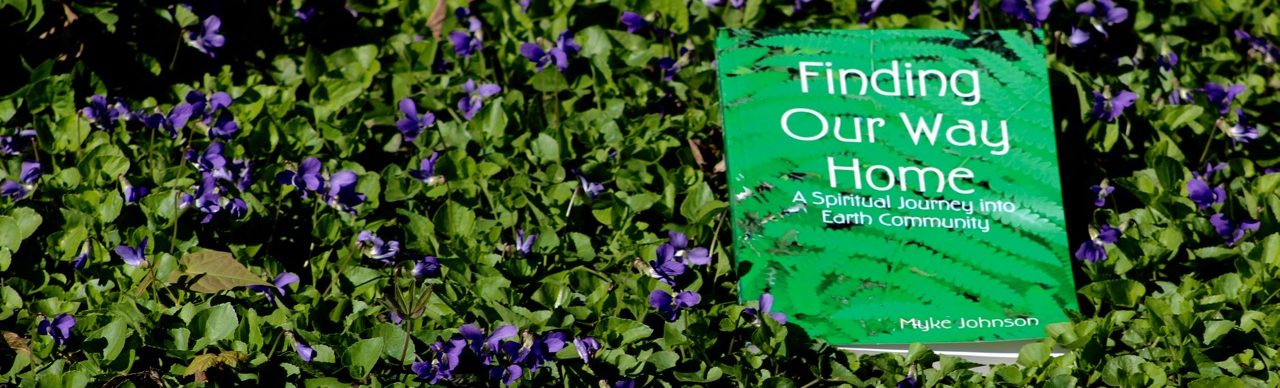
I am now in the last week of my four-month sabbatical, and I am noticing that I haven’t finished any of the big goals I set for myself at its beginning. But that is okay–I am in a liminal space with each of those goals.  One goal is to publish my book, Finding Our Way Home. I have completed another full edit, and sent out queries to some publishers and sent out the manuscript. Now I am in the time of waiting to hear back.

Another goal is to find greener housing. Again, Margy and I have started on that process–we talked about what we want in a new home, we engaged a green realtor, we looked at some houses that didn’t fit, we sorted out some financing options. I’ve begun the process of simplifying and letting go of things I no longer need. That process will take a lot more time, and we are waiting for the right house to show up on the market.

A goal that emerged during these months is to do more with the Work that Reconnects. I want to devote myself to making changes that will move human beings into a more beneficial relationship with all life on earth. That in itself is not a new goal, but rediscovering the tools that Joanna Macy has created for this work has been a true gift of these months. I am imagining how I can bring those tools to my ministry in the congregation, and beyond. I’ve had a chat with a local colleague who is also interested, and I look forward to plotting together.

I feel like I have been planting seeds and tending the soil, but the harvest time is still up ahead somewhere, unknown and unknowable. And for now, it is important to let it be unknowable. If I want to experience the sacredness of this time, I must open to its mystery and uncertainty, I must celebrate its possibility, I must wait for its unfolding. The Holy is right here.

Why find greener housing, anyway?

Oil furnace DSC01553We have to wean ourselves away from our dependence on fossil fuels. Think about petroleum. The industrial economy treats oil as a resource free for the taking, with a price based only on the cost of extraction and delivery. It shaped a world which became completely dependent on cheap oil. But we have passed the time when oil can be easily extracted, and now riskier and dirtier methods are required. Deep sea drilling like that which caused the spill in the Gulf of Mexico. Tar sands mining in Alberta Canada that destroys the forest, and devastates the health of the people and animals of the region. Arctic Sea drilling. Burning oil for fuel will increase greenhouse gasses and bring our climate closer to disastrous changes.

I know we have to stop burning oil. But when I look at my own life I see how big a challenge that will be. Our home is heated by oil. I drive a car than runs on gasoline made from oil, to buy food and other needed items, and also to go back and forth to the congregation I serve. It would take several hours to walk to these destinations from my house, and there is no public transportation nearby. The whole structure of suburban life is dependent upon oil. My congregation is a suburban congregation, and almost every person who comes to worship drives there in an automobile. Without oil, it is likely the church, and my house, would not have been built in these locations. The whole geographic structure of our society has been shaped by oil.

And not only that—many material goods in our lives are also fabricated from oil. Plastics are made from petroleum, and there is plastic in every room in our houses. I write on a computer with plastic components. Alarm clocks, toothbrushes, synthetic fabrics, telephones, televisions—all from oil. Modern agriculture is dependent on fertilizer made from oil, and machines that use oil, and a transportation system that uses oil. The asphalt on our roads is made from oil. If oil disappeared tomorrow, the whole system would collapse. And eventually, oil will run out. That is one of the realities we are learning in our time.

None of us have the ability to undo our dependence on oil individually. It is too entrenched, too societally enmeshed. But we can begin to imagine some partial solutions—in fact, the technology to live without oil already exists. I was inspired when I learned about “zero-carbon” houses that actually generate more energy than they use. We may not be able to fully achieve such a goal, but why not try to get closer to that ideal?

I know that even if we succeed beyond our wildest dream—even if we create a zero-carbon home from which we could walk to most functions of our lives, even if we could afford an electric vehicle that we charge from solar panels for other transportation—oil companies will still be breaking open the earth in Alberta, and spilling oil into the Gulf of Mexico. The children living near refineries will still be getting asthma. The ice of the arctic will still be melting, and thousands of species will go extinct each year. We need not only individual change, but a social will to transform our relationship to the earth. But I believe that each change we pursue as individuals also works its magic on that larger transformative process in ways that we can’t fully understand. And so we take the one step we are able to take.

In the Talmud it says, “Do not be daunted by the enormity of the world’s grief. Do justly, now. Love mercy, now. Walk humbly, now. You are not obligated to complete the work, but neither are you free to abandon it.”

Prayers at Dawn for our Housing Search

I wake today about 5 a.m. and feel called to come outside to pray in the dawn light. It rained during the night and the morning is misty and golden. I am visited by a cardinal, whose silhouette on a branch is dark against the eastern sky. I hear it chirping as another cardinal a bit further away trills their evocative songs. I am visited by a tiny toad or frog (I am not sure which), who moves quietly along the edge of the screen tent where I am sitting. I am visited by a golden slug my old teacher of slowness. A pileated woodpecker pounds away on some dead branches looking for breakfast. I hear the familiar songs of many tiny birds as they wake the sun, which is starting to appear through the branches of the spruce. Later, in the light, the chipmunks and squirrels dash about.

I feel so grateful for this place of trees and birds and critters. In our search for greener housing, I pray that we can find a home where I am called outside in the morning by the songs of cardinals, where Margy can find frogs and toads where they hide in the damp. I pray for this journey we are walking, hoping to move closer into harmony with all beings. I call on the magic of the dawn and the magic of all these beings to help us find our way. And, I open my heart to change, to what is hidden and cannot yet be seen.Morning Photo on 8-4-15 at 7.02 AM

The Search for Greener Housing, Part Two

After deciding it is the right time to start searching for a more ecologically friendly house, my partner and I sit down together and make a list of what we hope for in a home.

  • One-level living that can be made wheelchair accessible (because my partner can’t do a lot of steps, and we have friends who use wheelchairs, and universal design makes sense for a house we want to get older in.)
  • South facing roof that is solar energy suitable
  • Able to be retrofitted with more insulation and air-source heat pumps
  • Location closer to Portland and public transportation, near some sort of village center
  • Quiet street
  • An area safe for lesbians and people of color
  • Privacy in the back yard
  • About a quarter-acre lot, smaller than where we are now, but still room for permaculture gardening. Some parts shady with trees, some parts sunny, and flat enough for easy access. We want to get rid of lawn to mow, and have other kinds of plantings instead.
  • And, perhaps counter to our village center idea, a location close to woods and critters?
  • About 1200 square feet of house (this number to be adapted as we actually look at houses and see what the spaces feel like.)
  • Two bedrooms plus some office space and guest space
  • Living area that can hold ten people or so for gathering together
  • Some extra space, like a basement
  • Wood floors or equivalent–no carpet, no mold, no smokers. (We have allergies. If there is carpet, plan to replace with wood floors.)
  • Big windows, lots of light
  • Two-car garage (because of Maine winters, and for now we need two cars)
  • Laundry on first floor
  • Mudroom area
  • Fireplace or wood stove, more for the feeling of a hearth than for heat
  • Deck
  • No vinyl siding (That stuff is really bad for the environment! Watch the documentary Blue Vinyl!)
  • Electric appliances

Okay, that’s our list, that’s our desire. And of course, we want a sound, well-built house that will last. The other part of the equation is that we want the price to be enough less than our current house so we can afford to do the retrofits and add solar energy without taking on more debt. Our goal is to own it debt-free before we come to retirement, and to have the ongoing taxes and utilities and maintenance costs affordable to us on a low retirement income.

There is a strange magic to finding a new home. There are practical steps we need to take, but then, it all depends on what is out there. And what will emerge in the next day or week or month. I have moved dozens of times in my life, and it always brings up a lot of anxiety for me. Will we find a home that works for us? Will we recognize it when we see it? What is essential on our list, and where can we compromise? It took us four months to find our current home when we moved here to Maine. Will it take that long for this process? If we find a house we like, will we be able to bid for it successfully? My partner has her own list of fears.

In this magic of finding a new home, we are placing our desires up against our fears. That is why it feels important to me to name our very specific desires for a new home, and also to acknowledge and honor our fears. I know that magic works that way. But there is another deeper movement going on as well. It comes to mind again as I look at houses-for-sale online. In the listings, they don’t mention the orientation of the house, so I try to figure it out by looking closely at the maps. It is discouraging how few houses have a south-facing roof.

Then I remember that we are trying to do something new with this move–we are trying to re-orient our home environment into harmony with all life on earth. The current built environment is oriented around cheap oil and other fossil fuels. It can’t last. We are trying to take our own small steps closer to a whole new way of living that is about beauty and sustainability and a future for the generations yet to be born. There is a great Earth energy that is beneath our feet guiding our way down this path.

It says to me, “Remember to embrace the process. Enjoy the whole journey, right now! You don’t have to wait until everything is ‘settled.’ Keep taking small steps until you are ready to leap. Until the time comes when it is clear. You do not have to rush. Keep holding hands with the ones you love.”

Photo by Margy Dowzer

Photo by Margy Dowzer