

The last few weeks have been full of ordinary tasks around the house and yard. Sometimes we forget to be grateful for these very ordinary things. I think about people whose lives have been disrupted by war, by floods, by fire, by despots. Margy and I are able to do our ordinary tasks and ordinary meals and ordinary rest, undisrupted, and for that I am grateful.
A couple weeks ago, I painted the trunks of the orchard trees, to protect against winter sunburn and insects. This time I used a half and half mix of white milk paint and “Surround”–both powders that are mixed in water. I don’t know if it is really necessary–certainly I see fruit trees around the neighborhood without anything on them. But one morning, I had the energy and decided to try out the mixture. Surround is a kind of porcelain clay organic product that can disrupt certain insects. Last summer, I sprayed the fruit trees with it, and they remained light colored all winter. This summer I didn’t do any sprays like that, but why not try it as a winter paint? So that was one little project.
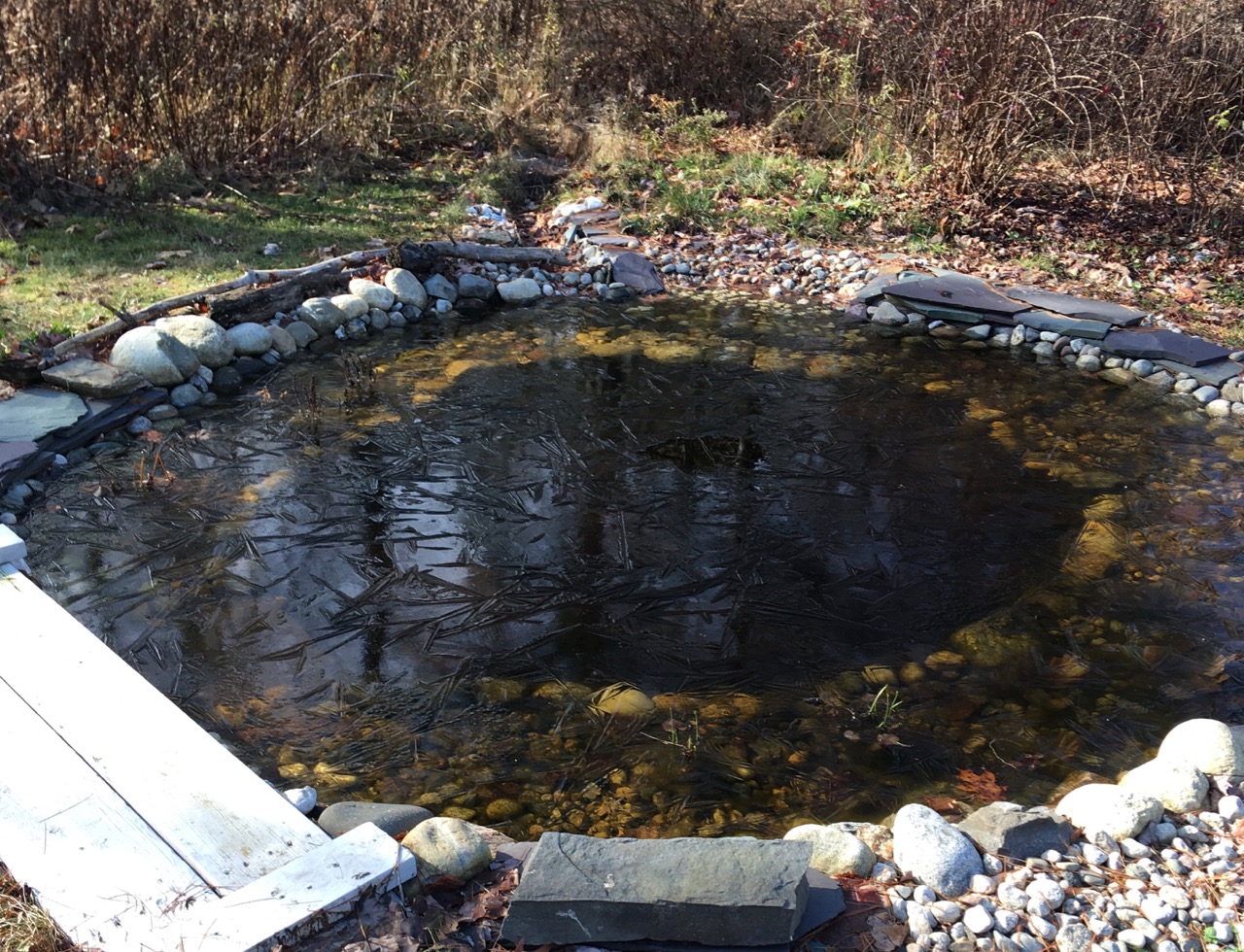
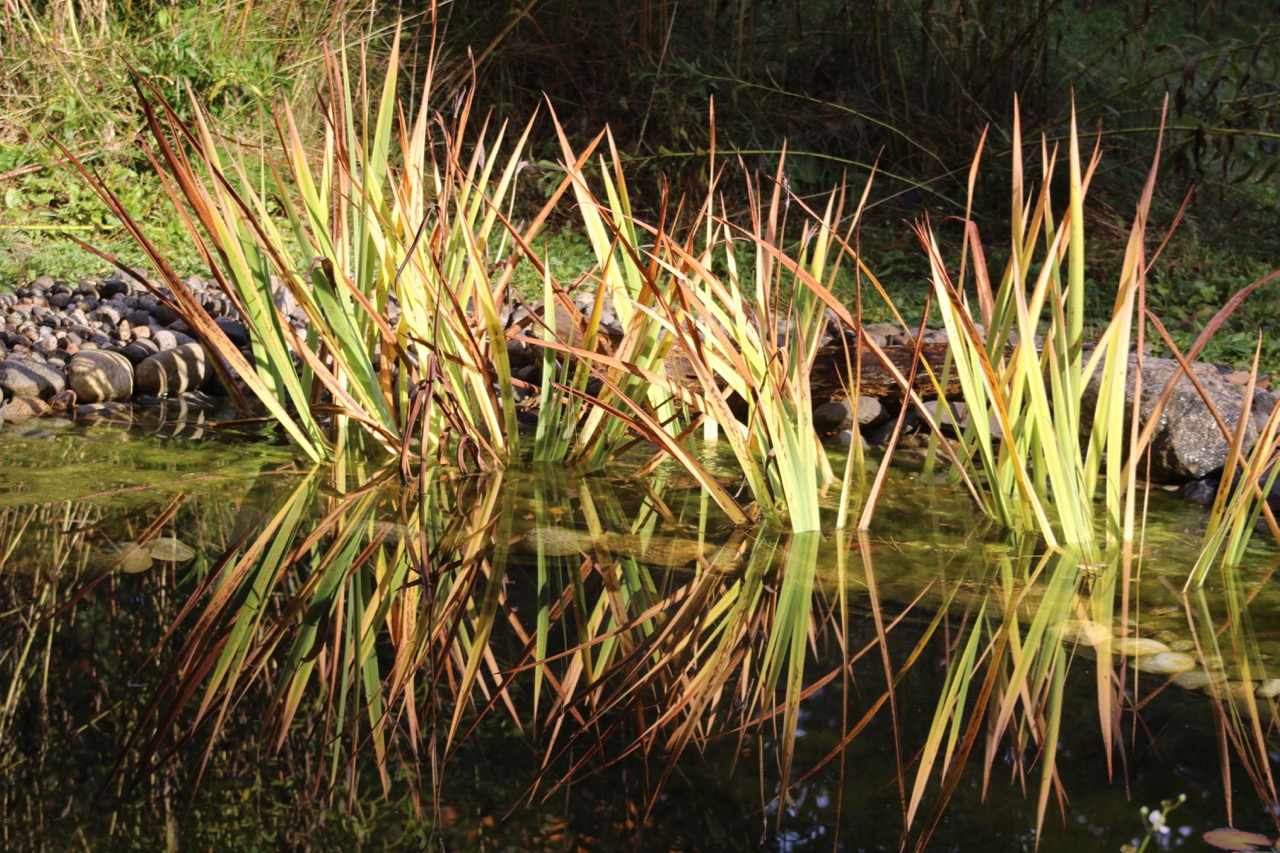
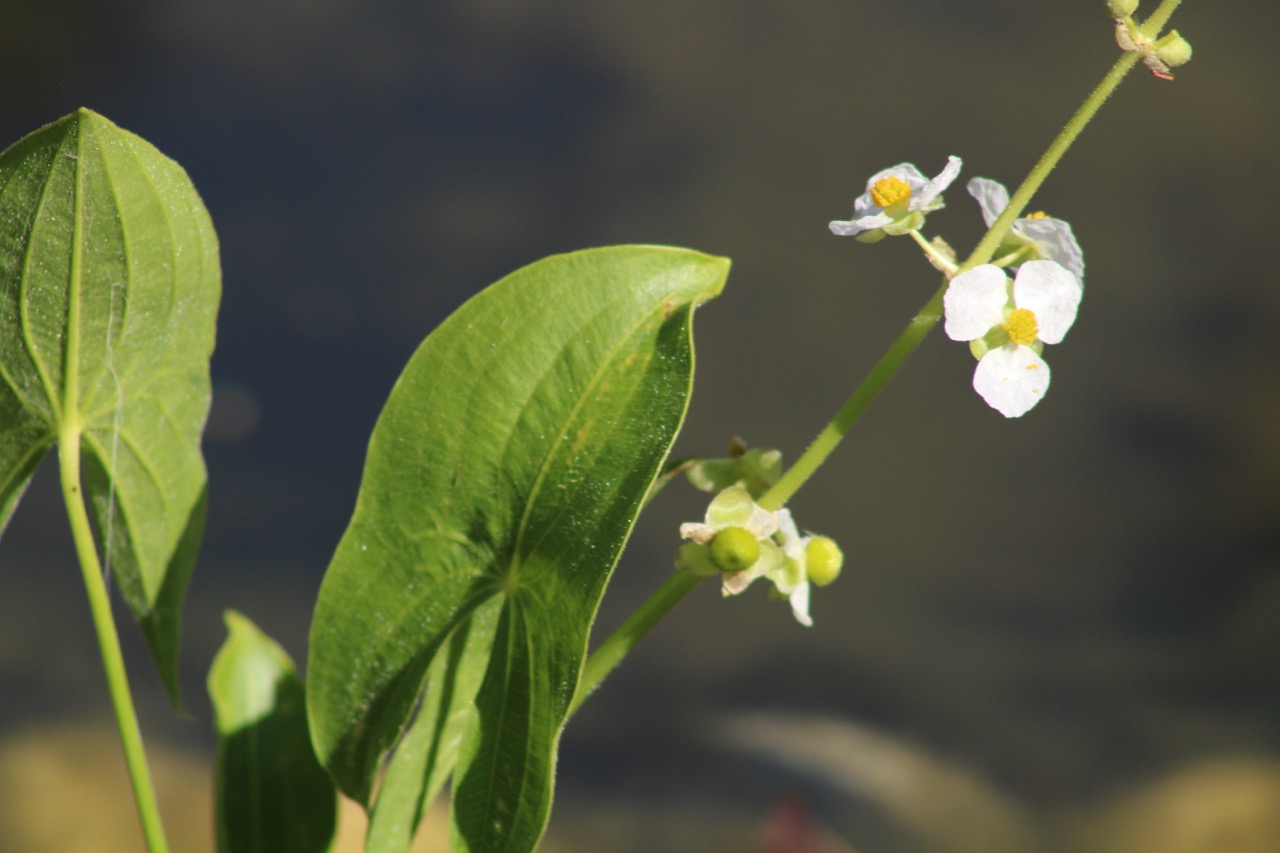
I’ve been using the skimmer to clear leaves off the pond, and then I also have been cutting off the dead stalks of pond plants. I got into the pond one day, placing my feet very carefully down to the second step in, and lifted the pond lily pot, then dropped it down to the deepest part of the pond. The deepest part is 2 1/2 feet, so I am hoping that the hardy lily might survive the winter this way. And maybe in the spring it will need to be lifted back out, or maybe it will just reach its leaves up to the surface from there. I asked Margy to watch with me, just in case I slipped. But I didn’t! A few frogs are still hanging out, since the weather has been unseasonably warm still.
Since we had an extra weekend of warm weather, I finally painted the upper beam of the roof on our deck. Some of the wood had been left bare when a friend put in the roof, a few years ago, so protecting it has been on the long-term to-do list. Happily, there was some primer in our basement that I could use, leftover from the prior owners. It took three days, and each day after working on it for only a couple hours I was dead exhausted. But it is done today!
Meanwhile, we’ve been filling in our absentee ballots, and researching the details of 13 referenda questions for our city of Portland, as well as the candidates running for office. I am grateful for democracy, as flawed as it might be practiced, and pray that we’ll still be able to have a democracy going forward. Rising fascism in our country has been alarming and discouraging, as well as the attack on the bodily autonomy of women, and the threats to such importance common goods as Social Security and Medicare. So much of my life’s work has been about expanding the benefits of democracy to those who have been excluded, fighting for equality and justice and liberation for myself as well as others. My work has included criticism of the way that our democracy has been incomplete, flawed, and unjust. But I think of voting as harm reduction–I may criticize candidates and policies, but I will vote for those who will do the least damage. Right now, with the Republican party being taken over by fascists, that means voting for Democrats across the board. So I am extra appreciative these days of the ordinary benefits we can take for granted, and pray that many many people will be moved to vote to keep those benefits.
You are a teacher for a time like this—
you who claim more than one home,
navigating each season by the compass
of yearning planted within your DNA
You know your destinations, no stranger
—I have heard it said—you return always
to the very sedges from which you depart.
You are a teacher for a people like this—
we who hesitate to claim any home,
yearning always, contrary wisdoms planted
like magnets in the dark, stretching
our souls across miles and languages
—strange cries echo in our throats—
tearing our arms apart with reaching.
You are a teacher for a journey like this—
your rhythms carry me through long stretches
in the white winter of my perennial flight
I remember there are seasons for departing
and returning, homes we locate by yearning
—planted like polar gravities in the wind—
your silent languages cry to my wandering wings.
The many-colored transformations of autumn plants remind me of the beauty in the spiritual practice of letting go. As the leaves let go of their green chlorophyl, so their deep colors are revealed. When I feel encumbered by heavy memories, mistakes, failures. When I feel regret for things undone, unsung, I pray in this way. I take all the feelings and memories and release them into the loving hands of Spirit. Ego desires for acknowledgement, success. I let go. Ego wounds from rejections, betrayals. I let go. Loneliness, weariness, I let go.
Spirit, here I am, all imperfect, yet gifted, all hungering for justice, yet broken with this land and country. I sit alone, yet I feel your presence, and I turn to you, again and again. I let go. I am small, but I am surrounded by and filled with your Love. There is a time for action, and there is also a time for surrender. I surrender to the River flowing. In this surrender there is trust and peace.
Someday, I will let go into the mystery of eternity, the mystery that is death. Each night, I let go into the mystery that is sleep. Each morning, I let go of what is not mine for this day, and I open to what blessings and what actions are here for me to take up. I am too small to try to carry the world. And yet, in this surrender, I am at one with all of the beings who surround me, people, animals, plants, spirits. We are all flowing in the River of Love.
I was stretched out, lying in the hammock, with my feet up, listening to an audio version of “Olive, Again.” Suddenly a chickadee landed on my black sneaker, and started pecking inquisitively around the seams. I wish I could have snapped a photo, but he was gone again in just a minute. I guess I must have seemed like a part of the landscape then. I can’t imagine a better way of being perceived!
Or maybe I might be seen as a friendly or annoying neighbor? The other day, a chipmunk was stuffing her cheeks at the bird feeder, and I decided to chase her away so the birds could get some too. I walked toward the feeder, and she just stayed put. I actually reached out and gently touched her back–at which point, she flew off the feeder and took off toward the pitch pine tree. Then, yesterday, I was lying in the hammock, and a chipmunk was perched on the trunk of the pitch pine, chattering at me. I wondered if it might be the same one.
Or maybe it was the one that a few weeks ago was walking across the patio in what seemed like a drunken haze–she would go a few feet and than fall over on her side. I thought perhaps she was injured, and wondered about taking her to a wildlife center. I set a small box into her pathway and she ran right into it. But after doing a bit of research, the recommendation seemed to be to generally let them take care of themselves, so I released her and she ran into a nearby chipmunk hole. I hope she recovered!
I’ve also been doing a few small projects in the yard. The biggest project was to change the level of the outflow channel for the pond. I removed the stones covering the channel near the edge of the pond, and lifted up the linings, and raised the opening a couple inches. I was thinking that perhaps having a couple more inches of water depth in the pond might help it over-winter better. Last year several plants didn’t survive. I filled it to the new level with water from two rain barrels and then put back stones over the channel top again. Probably no one else would notice the difference, but I am glad that I did it. I also went around and cut off dead leaves from the pond plants, and pulled out some more algae. I was sorry to disturb the frogs’ familiar habitat, but they seem to be doing fine now.
Today, I harvested some more thyme, rinsed it, and put it into the herb dryer. I’ve harvested kale and broccoli for cooking, chives to cut up and freeze. Last week I harvested licorice roots. I scrubbed them well, cut them up into tiny pieces and put them in the herb dryer too.
Today was a lovely warm day, so good to be outside, to be part of the landscape. Tomorrow it will be colder, and that is harder for me. But I am trying to enjoy this season of autumn, not just as a time of preparing for winter, but a graceful time of its own, all the golden leaves, harvest time. Harvest time for so many of the creatures all around us.
I am happy to be starting a new experimental adventure. After four years away following my retirement, I am venturing back into involvement with my former congregation, Allen Avenue Unitarian Universalist Church. In our faith community, a retiring minister traditionally stays away for a few years, to make room for a new minister to bond with the congregation, and to make real the fact that I am no longer their minister. If or when we return, we create a covenant with the current minister to clarify our relationship and offer our mutual support. I have done that with Rev. Tara Humphries who is now serving the congregation.
But it is still a delicate balance to negotiate. When I go back, I am not their minister, but I am also not just any other member of the church. I am still their Minister Emerita, an honorary designation expressing our mutual affection and connection. But with or without that designation, I still carry those thirteen years of affection and connection, and it gives me an influence different from other members. So for me, the experiment is measuring whether and how I might be a member of this community in that in-between zone. I am drawn back by a desire for the kind of community that church offers, I am drawn to that little village of care and support. Is it possible? Will it work for me, and for them?
Some parts of this feel very clear-cut. Dealing with chronic illness has made it impossible for me to carry out many ministry functions, like weddings, memorials, and leading worship, so I won’t even be tempted to be doing any of those. Another aspect clarified in our covenant recognizes that “since my position still carries some weight, I will decline to participate in the governance of the congregation, or take sides on any issue.” And both Tara and I will “decline to participate in, and will remove ourselves from, any conversations with church constituents which might try to evaluate each other’s ministries or contributions to church life.” All of that feels very down-to-earth and solid.
But more experimental are the personal interactions and connections. The first event I attended was an in-person, outdoor celebration of our 200th anniversary on September 10th. I am still being super cautious about COVID, so I wore a mask even though we were outside, though most others did not. This was the largest event to which I have gone at all since COVID. I would have loved to hug everyone, but I did air-hugs instead. It was wonderful to see people I knew, and meet a few I did not know. Heart-warming. It was also rather exhausting, and I had to rest afterward. Is that my chronic illness, or introversion, or somehow feeling once again all those threads of connection?
Worship services are now hybrid on Sundays–some people attend in person and others on Zoom, so I have attended a couple via Zoom, but I haven’t yet stayed for “zoom coffee-time.”
I went to the monthly “Elder Salon” and that felt really good. The structure made it easy for me to participate as others did, with a few minutes of check-in for each person, and a discussion following that. I like the reciprocity I felt in that group. The topics of concern to elders match many of the topics of concern in my own life right now. So it feels like I can join in as any other member might join in, and benefit from the collective wisdom in the group. I guess I am learning to be an elder. I like it.
All in all, I am taking it slow, and observing what comes up for me.
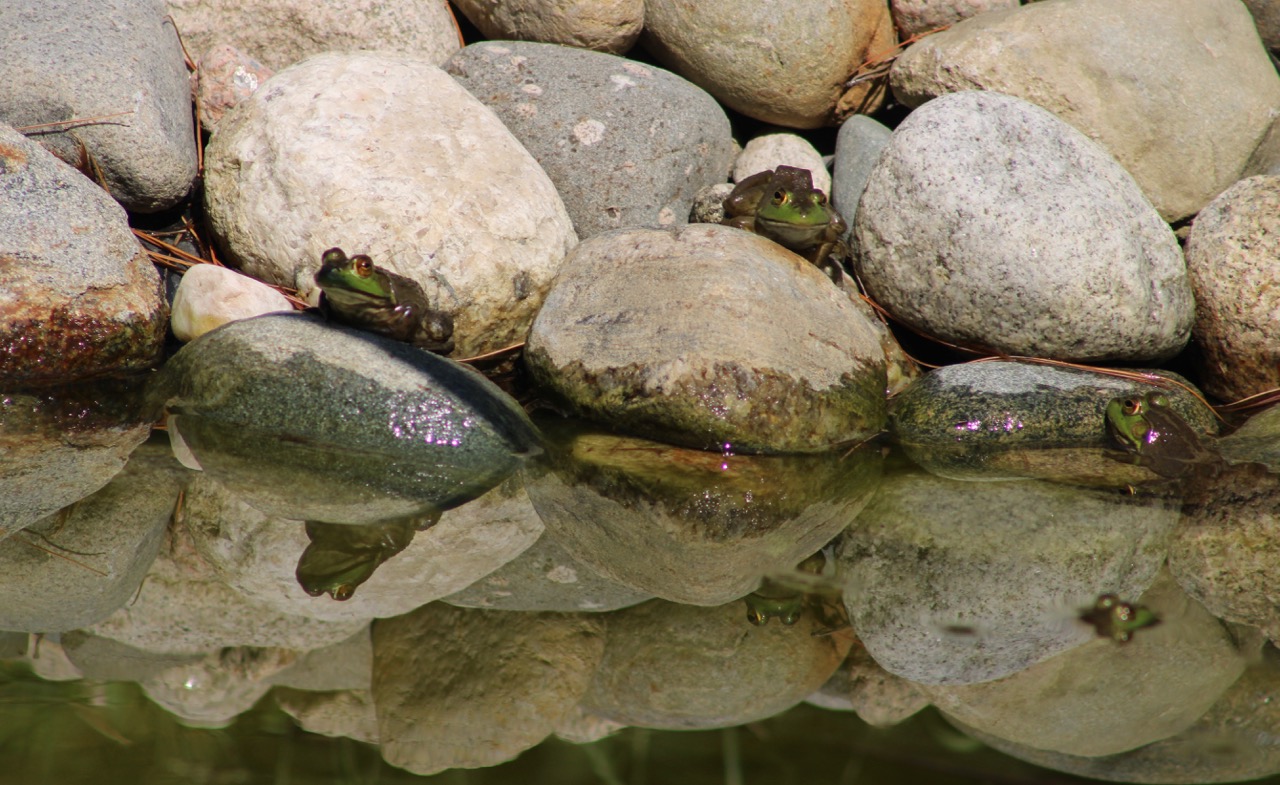
Lately, my life is small, as if I am looking on to life happening nearby, just like these frogs looking out over the edge of the pond. So many big things going on in the world, much frightening, some inspiring, but all of it feels somehow at a distance. I haven’t had a lot of words the past couple weeks.
But there was something I learned about that I wanted to mention here. It relates to my essay, on this site, called “Wanting to Be Indian.” I first wrote and published it back in 1995. I’ve learned a lot since then, and adapted the essay as I did. When I first wrote it, I described the history of my ancestry using the word “Metis.” I had no understanding of what that word meant in a Canadian context. I just had seen it in a French book about my ancestors, meaning of mixed ancestry, white and Innu. I thought maybe it might apply to me. But as I began to learn more, I stopped using that word, because historically it refers to the people in western Canada who have been a distinct Metis community for a long time. So I thought perhaps that was that. (Now I describe myself as white, with a distant Innu ancestor, my third great grandmother Marie Madeleine.)
But more recently, in the last year and especially this past week, I’ve been doing a lot more reading about the current situation in Quebec and the Maritime provinces. I have been horrified to learn about white people there claiming a “Metis” identity, in order to fight against the indigenous rights of Innu and other Native peoples. I found a website called Race Shifting, a “resource for people who are concerned with or want to find out more about the rise of the so-called “Eastern Metis” in the eastern provinces (Ontario, Québec, New Brunswick, and Nova Scotia) and in New England (Vermont, New Hampshire, Maine).”
Many of these so-called “Metis” organizations in Quebec have roots in white supremacist organizations, trying to impede the work that the government of Canada and Quebec were doing with Innu communities to negotiate agreements for their government-to-government relationships. (Some resources are in French, like the article about these negotiations toward Innu agreements. But I was able to read it with the help of Google translate.) The Innu never signed a treaty or ceded their land in the days of early colonization up through the end of the 20th century. Just after the turn of the century, when they were beginning to set parameters for these agreement, in public hearings there was resistance from some white people, especially those living near Saguenay and Sept-Iles. And then the tactics of those white people changed: they created “Metis” organizations, based sometimes on a very distant Indigenous ancestor (17th century), and often none at all. They tried to claim their own “Indigenous rights.”
I’ve written briefly about this issue before, but this time I saw that one of the Saguenay historians who is supporting this effort is someone who had done research on one of my ancestors, whose article I had requested and received in an email. That felt creepy. It made me wonder if probably a lot of these people are distant relatives of mine–I mean, that is sort of true for all French Canadians–we really are all related. But Saguenay is the region my great grandmother came from. Sometimes I hate being white. And certainly it was from my own experience that I wrote about the problems of white people wanting to be Indian. But this is something even deeper and more sinister–to claim Indigeneity to fight against Indigenous communities?
It’s hard to understand all these phenomena from outside of Quebec, from outside of Canada. And I don’t have a voice in that setting–I don’t even speak the language. Yet I understand enough to feel so sad. And even here in New England, I am looking on from the sidelines. I certainly have no role in identity policing. But it seems somehow important to try to understand it all, and important to support, in whatever small ways I can, the sovereignty struggles of Wabanaki peoples in Maine. This is where I am.
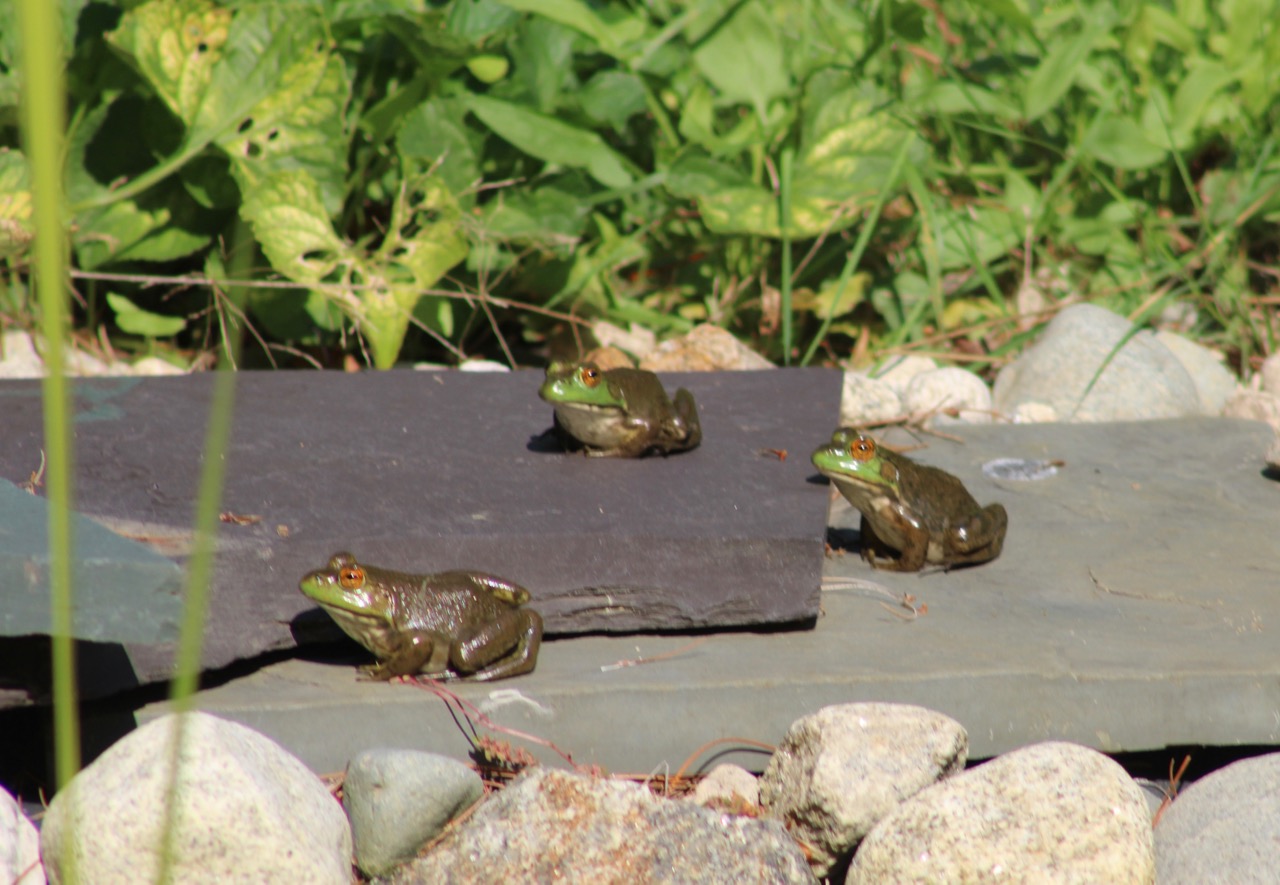
And now, for just a little beauty to counter the ugliness of racism, here are three more green frogs from our pond. (And the irony is not lost on me–frogs were used prejudicially against the French, and more recently a cartoon frog has been co-opted by white supremacists.) But these frogs are simply themselves.
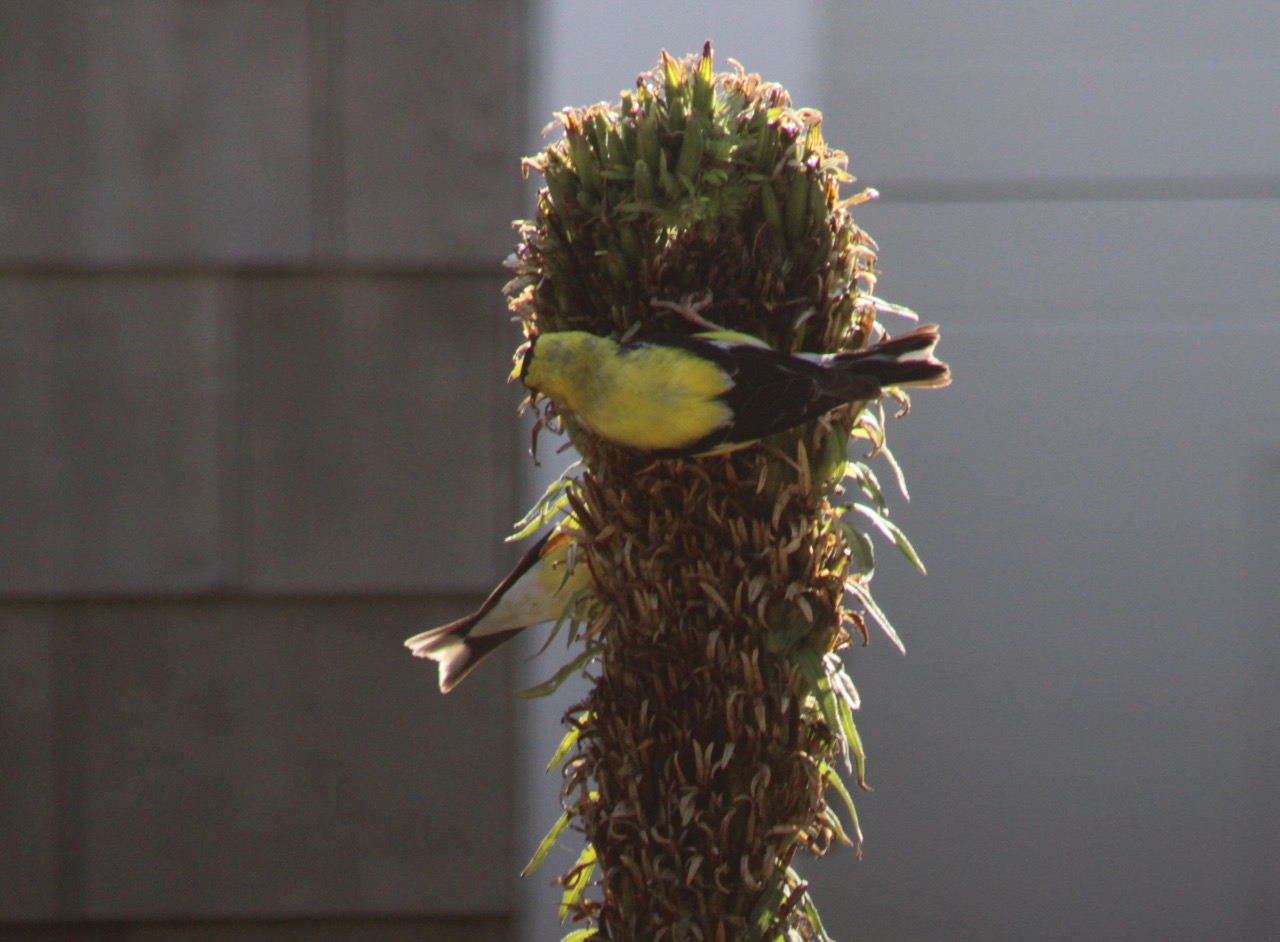
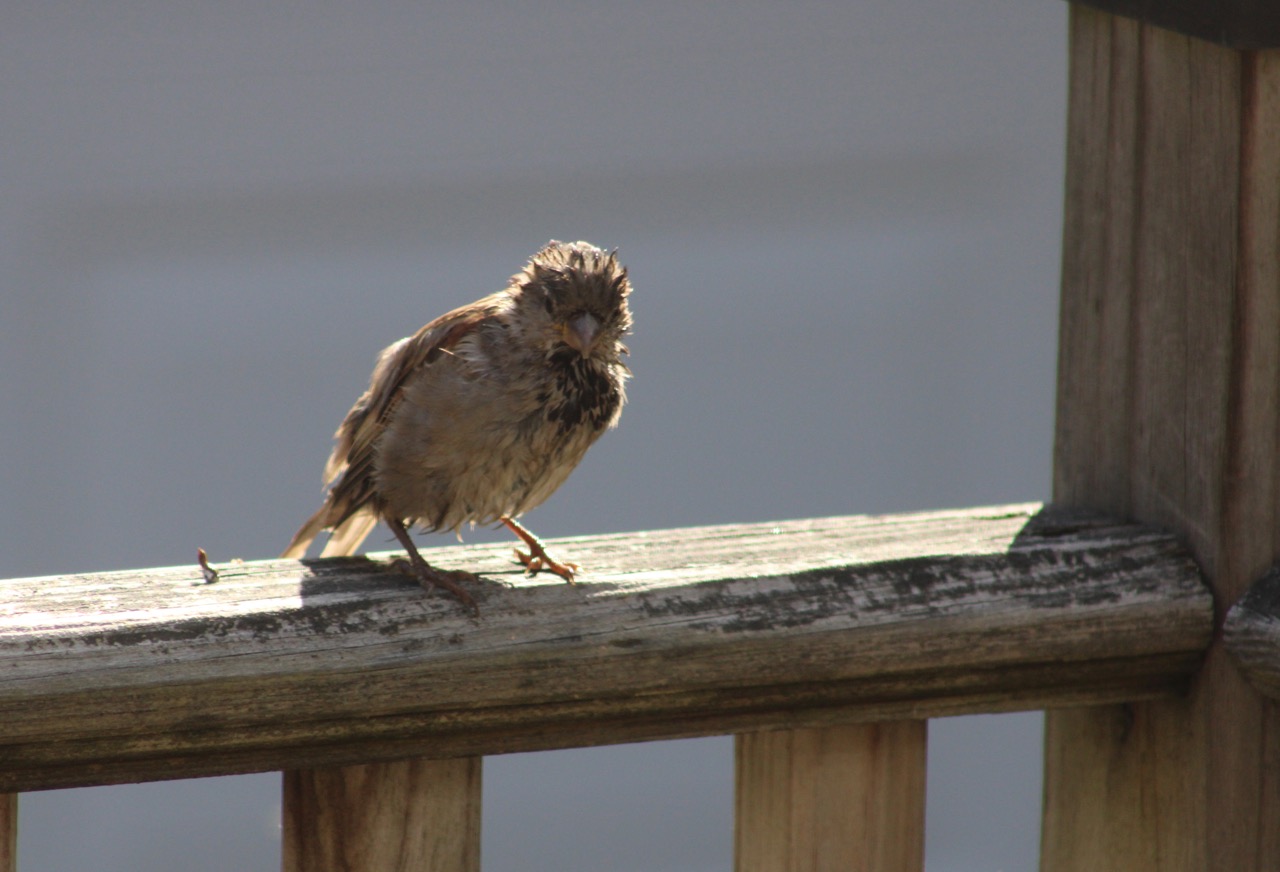
I feel such delight in all the small birds that love to be in our yard. Yesterday morning, the gold finches were all over the evening primrose stalks, eating seeds. Native self-seeded wildflowers for the win! Then I saw a few little brown ones–maybe sparrows–taking a bath in a puddle in the driveway, after the good rain we had the day before. Here is one drying off afterwards.
He turned around while I was looking from the back door. So cute I had to share both photos!
The little birds just love our garden, our trees and bushes, our wildflowers, and we love them. If I had to pick just one sort of critter, birds are my folks! It makes me so happy that they are happy here!
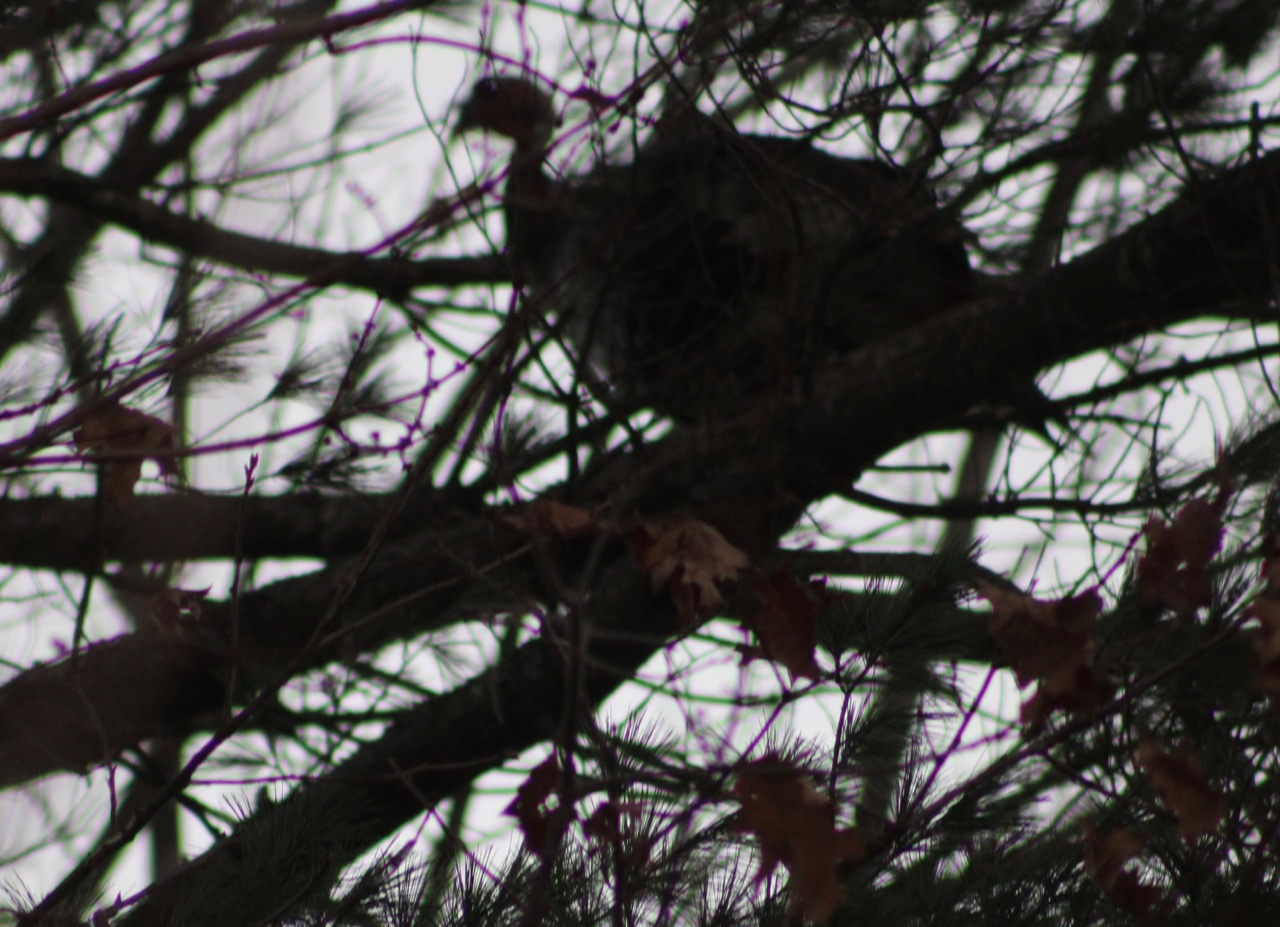
One more bit of good news. The mama turkey has come back a couple times with her baby, after the horrible incident in our yard where her other baby was killed by a neighbor cat. We’re glad to see they are doing well.
Those of you who perhaps followed my peach tree saga last year might remember that after hours and hours of tending–including several organic sprays, thinning the small green peaches, putting little mesh bags on the remaining ones–the squirrels ran off with every single green peach, or knocked them off the branches as they tried to get into the bags. We got zero peaches to eat.
Well this year, I didn’t have the heart or energy to do all that tending. I did one holistic spray early in the season. I felt very non-attached to any outcome, since one might assume that squirrels would eat them all again. But that didn’t happen. A few weeks ago, I started picking a few small random peaches, so that others would have more room to grow, and the branches wouldn’t break under their weight–but only a few at a time, not systemically. I put them in paper bags, which is the actual way to help them ripen. (Not on window sills as I had previously thought.) A few weeks ago, the squirrels started eating some peaches too, sitting in the tree, or taking ones with broken spots that I left on the patio table. I found their leavings on the deck railing. It was fun.
But they didn’t take all the peaches. And the peaches started to really ripen. Now they are bright red and yellow, crowded though they are on the branches. Now, we are processing all the bags of ripening peaches in the house, as well as gathering peaches literally dropping from the tree. I have cut them in slices to freeze–first on a tray, and then put into freezer bags. Yesterday I made a gluten free peach cobbler. We have invited friends and neighbors over to share in the abundance. More people are coming by this weekend. This morning, I saw this little bird pecking for its delicious breakfast. There is plenty to share!
I feel grateful and humbled by this turn of events. Sometimes gardening feels like a battle between the gardener and the “pests.” I didn’t have the heart to try too hard to fight this battle this season. (And our cucumbers and zucchinis are succumbing to bugs-so it goes.) I was surprised that the peaches thrived so well without my efforts. I was surprised that the squirrels took some, and it seems they felt okay about sharing. Maybe they sensed that we were not enemies this time. Margy and I feel so good to be able to give them away to others. The garden is such a great mystery! I continue to feel humble and grateful by all it teaches us.
Oh, and here is the recipe for gluten-free peach cobbler. I searched the internet, and then adapted this one from several I had seen:
Peach Cobbler: preheat oven to 375 degrees
Slice peaches and place in a lightly buttered 9 x 13 pan. Basically use enough to cover the bottom well, or more if you like. Sprinkle with cinnamon, and a tiny bit of ground cloves.
Whisk together 1 & 3/4 cup almond flour, 1/2 teaspoon salt, and 2 teaspoons baking powder. Blend together 1 large egg, 1 teaspoon vanilla, 1 tablespoon honey, 1/4 cup Greek whole milk yogurt, and 2 tablespoons softened butter. Add that to the flour mixture and blend, and then spoon over the peaches–it won’t cover them completely, but spread it around as you can. Bake 25-30 minutes or until golden and bubbling. Remove and let cool a bit so you don’t burn your tongue. You can serve as is, or with cream, whipped cream, or ice cream.
We finally got two solid rain storms this past week after a long drought. What a relief! And now four very tiny frogs have appeared in the pond. (I don’t know what happened to the one we had before that was a little bigger.) A few days ago, this new water lily flower started blooming, and today when I went out to see it, it had disappeared. But I found three of the tiny frogs perched on lily pads! The fourth was on the other side of the pond on a rock. I didn’t look too closely under the water to investigate the missing flower, so as not to scare the frogs.
But slowly I sat down near the edge of the pond and watched for a while. A dragonfly came and perched on blue flag iris leaves. The frogs stayed on their pads.
Taking close-up photos makes the frogs appear larger than they really are. They are only about an inch long nose to backside. I wonder if maybe it was the rain that enabled these small frogs to travel from some other place to our little pond? I feel refreshed by the rain too. Cool nights with windows open, listening to the dark sounds. Lovely.