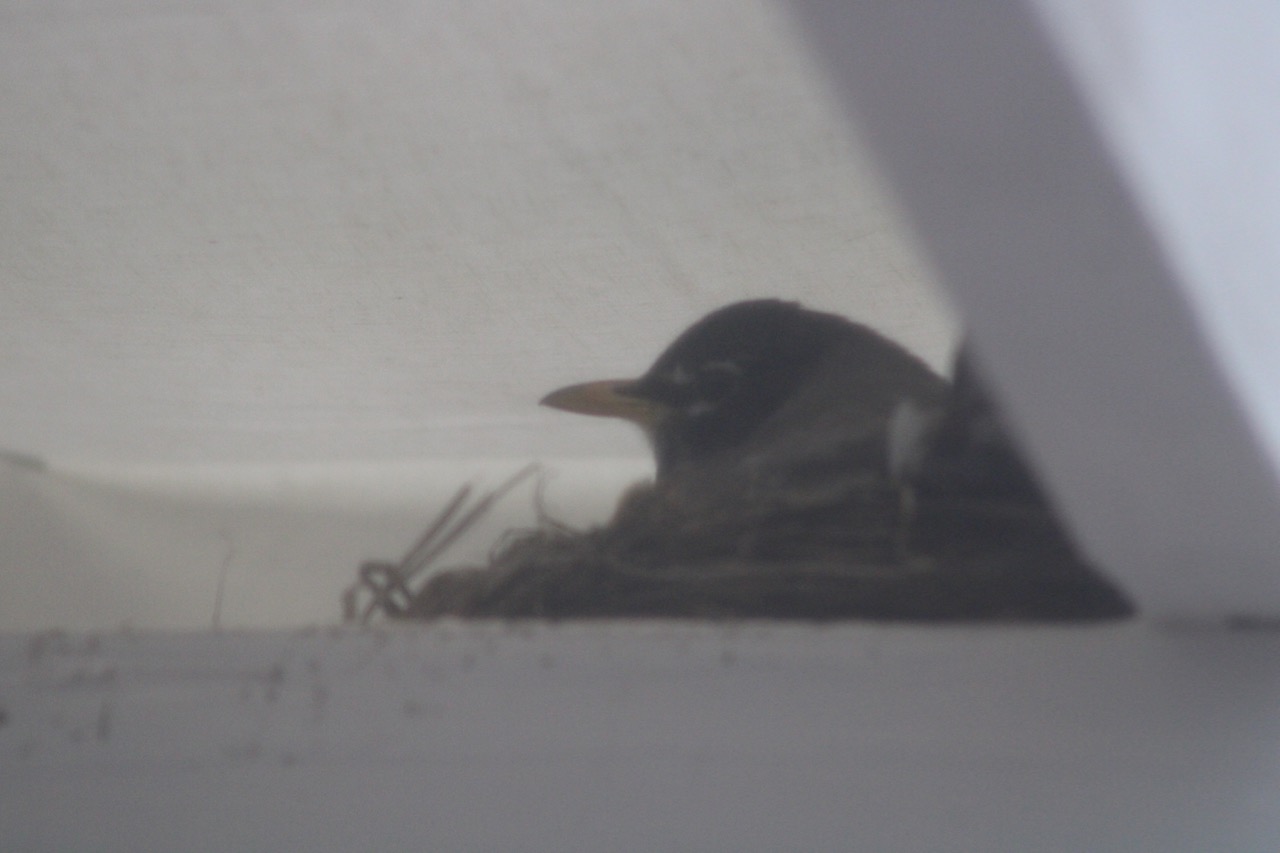
It was a quiet week, the robins had finished the nest, but were elsewhere in the yard. But this morning, one of them has come into the nest and has been sitting there a long time. I took a lovely little walk around the yard, just to look at things. There was a sparrow taking a bath in the shallow beach of the pond. The spice bushes were covered with tiny yellow blooms. I greeted the old pine, and the cedar tree, and the pitch pine. The sea kale has emerged, along with rhubarb leaves. The daffodils were blooming.
After breakfast, I went back outside–it is cold and gray today, with rain expected later, but I thought I might just do a few things. After reading some more information on pruning, I finally tackled that aspect of tending to the little apple trees, as well as I was able. Then I transplanted some chives and thyme to keep the baby trees company in their circles–companion plants.
After I came in, I saw the robin wasn’t in the nest, so I went out to check, and was delighted to find this: one blue egg. She came back a short time later, and is sitting there now. After last summer’s disappointments, I know there are no guarantees, but today is a day for hope. May the robin family be blessed with young!
Tree frog male, getting ready to sing his mating trill
Our first frog sighting in the pond yesterday, April 15! Much earlier than the last two years, when the first frogs came in June or July. It turned out to be a tree frog, rather than the green frogs that we’ve seen in prior years. We figured it out because in the afternoon, when my friend Francesca and I were sitting by the pond for a visit, suddenly, he sang the most amazing trilling sound, his white throat patch blowing out and in. And I remembered that Margy had heard that sound earlier in the day. Then, yesterday evening after dark, the night air was awash in these trilling calls, from all directions. A little internet searching identified those calls as tree frog mating calls.
Tree frogs live in trees, like their name suggests, and hunt on land most of the year, but they breed in water, in ponds and vernal pools. So maybe, just maybe, we’ll have some tadpoles to grow in our pond this spring. I learned that they eat algae, so that is another good, because our pond has got a bit too much algae in it. So exciting!
The other adventure of breeding is that of our robin pair. Even after three failed attempts to rear live young from eggs in a nest on the beam under the clear roof of our back porch, they were at it again, bringing nesting material to the same spot. That spot was just too hot in summer. It was so sad. So, first I tried telling them to go somewhere more suitable! Then I tried taking out the grasses to discourage them that way. But they kept at it. So then, I had a totally alternative idea. What about making something to shade that corner of the clear plastic roof? So it wouldn’t be so hot. This morning, I searched around and found some old cream-colored sturdy curtain material, and cut it to fit. Then I got up on a ladder and stapled it tightly to the wooden crossbeams.
I have already seen the robins return with more nesting material, so maybe they’ll put up with the changes to their location. After all, I had also painted the beams last fall. Now I am hoping that it will be enough–that the shade will keep the spot from getting too hot, that the robins can finally have a little family, in their chosen spot. And can I say that my heart is filled with joy after this little project? Some kind of ecstasy to help a fellow inhabitant of this place, to live together in mutual reciprocity.
Four years ago I attended an apple grafting workshop, and created four grafted plants to bring home. I planted them in a “nursery” bed in the orchard, a Black Oxford variety in the center to remain there, and the others to later transplant. The root stock was called M111, a semi-dwarf variety. But I wasn’t sure where to put them, so it has taken until now before I transplanted any. Two didn’t survive, but today I move this Blue Pearmain variety about 12 feet over to a new bed.
Both of these are heirloom varieties for New England. According to Fedco, Blue Pearmain is a fall/winter apple, “our favorite for baked apples—it was made to be stuffed. Moderately juicy flesh, firm, dense and slightly crisp, sweet with a bit of a tart background flavor. Incredibly beautiful medium to very large fruit is streaked and splashed with purplish red, mottled with russet and covered with a distinct dusty blue bloom. In a pie, it has just enough firmness and a good balance of sweet and tart with hints of pear. Tart coarse yellow sauce cooks up in a couple minutes. Tasty eaten out of hand. One of New England’s most famous varieties. Mentioned by Henry David Thoreau as a favorite in his wonderful essay “Wild Apples.” Grown throughout much of Maine for well over 200 years. Massive trees still found here and there. Keeps in the root cellar until midwinter. Blooms midseason.”
Black Oxford was created from Hunt Russet x Blue Pearmain, in Paris, Oxford County, Maine, about 1790. A winter apple, “this outstanding apple, a favorite long ago around much of Maine, has made a huge comeback. Medium-sized round fruit, deep purple with a blackish bloom. From a distance you might think you’d discovered a huge plum tree. Excellent pies, superb late cider. Leave the skins on for a delightful pink sauce. Best eating late December to March, but we’ve eaten them in July and they were still quite firm and tasty. They get sweeter and sweeter as the months go by. Good cooking until early summer. Some insect and disease resistance. Unusual light pink blooms early to midseason.”
According to the Holistic Orchard, Black Oxford is “A rare treat reminiscent of an exotic tropical fruit; exceptional sauce apple, stunning drying apple.” It is slow to come into bearing, but resistant to insect problems. It can tend toward biennial bearing. Ripens in late October into November.
Even though they are four years old from grafting, they still seem like baby trees to me. I still need to do some pruning to help them find good shapes. But I am excited that I was able to get the Blue Pearmain to a spot it can remain. This past winter, one of our old ornamental crabapples fell in a storm. The one that is left leans heavily toward the road, and we’re imagining that it might not survive for long either. So this Blue Pearmain is positioned about half way between the Black Oxford and the crabapple. As it gets larger, eventually the crabapple might not be there. But in the meantime, it won’t cast any shade and they should both do fine. I still need to do some weeding and probably use cardboard to keep unwanted plants from growing too close to the tree. It had been on the edge of our friend’s herb bed that she is not using so much anymore.
It feels so good to be outside, to be tending to plants, to be celebrating the spring!
Before: Black Oxford (left) and Blue Pearmain where they were growing close together before I transplanted the Blue Pearmain. There is a Honeycrisp tree exactly behind the Black Oxford, a little bigger.
Going through old files, I found this reflection poem from 2014. It feels even more fitting for today, especially living as I do in the "realm" of chronic illness. I cannot control how much energy I will have each day, and rarely can I take action that might have an influence in the world outside our home. But this morning I was reminded that I can still choose to love in all of my hours, and be grateful.

There are things we cannot control.
It is a long list.  The weather, the seasons,
the coming of day and night.
Another person's joy and sorrow, or love and grief.
We cannot control anything
	about another person, most of the time.
The things we cannot control
       are more numerous than the things we can.
The economy.  The price of milk.
The coming of storms or the blooming
       of lady slippers.
The return of the hummingbirds,
       or the death of poets.
If you are like me, you sometimes imagine
you have more power than you really have.
You try to control what you can,
and even what you cannot.  You worry.
You want your children to be happy and fulfilled.
You want your parents to be healthy and content.
You want your partner to be a good match, and loving.
You may want the members of your community
	to be enthusiastic and generous,
and your staff to be talented and never to move away.
Big things or small things, no matter.
There are long lists of things we cannot control.
We want for all children to be safe, and girls who are lost to come home again.
We want angry young men to work out at the gym
        and never to buy large amounts of guns and ammunition.
We want politicians to be dedicated to the common good,
        and news media to the truth.
We cannot control anything about another person,
        most of the time.
We cannot control another person's joy and sorrow, loss and grief.
We cannot control the ways that joy and sorrow come into our own life.

But there are a few things we can control.
We can choose the values we want to follow in our own lives.
We can choose to speak up and act
	in ways that share our values with the world.
We can choose to greet a stranger
	and listen to a friend.
We can choose kindness. No matter what.
We can choose to love.
	(and love ourselves too)
May you find the places of choice in your life,
      and be at peace about all that is out of our control.
Two people have reached out to me in the last few weeks to ask about the origins of the name of our little Capisic brook. They accurately assumed that it was a Wabanaki name, as are many waterways in what is now Maine, and wondered about its original meaning. I have wondered that too, though when I asked Wabanaki friends, no one was quite sure. So recently I began some research about it.
Capisic Brook has several branches winding through our neighborhood, with three headwaters: the north branch starts east of Forest Avenue near the intersection with Allen Avenue, the main stem in a wooded area within Evergreen Cemetery, and the west branch just east of I-95 near the intersection with Warren Avenue. Sadly, it receives run-off from development and roadways, and its water quality is significantly impaired. After these feeder branches join together it crosses under Brighton Avenue, flowing into Capisic Pond, which was originally created in the 1600s by a dam for a grist mill. Eventually Capisic Brook feeds into the Fore River. [I want to note here that the Fore River was called Casco by the Wabanaki people who lived here.]
All of this land is Wabanaki land. I wrote about its history in a previous post, noting that it was the chief Skitterygusset who first made an agreement for a settler to live near Capisic Brook and its uplands. While the settlers thought of these agreements as deeds of sale, a Wabanaki interpretation was something more like a treaty: an agreement to co-exist, and to render offerings each year for the use of the land and water. Unfortunately, the settlers kept taking more and more of the land and waterways. That is the painful legacy of colonization. Any story must include this legacy.
For those of us who live here now, if we are paying attention, the presence of the brook is everywhere in the neighborhood, showing up in the patterns of the roads, and the deep ravines with trees and brush. It most likely contributes to the wildlife that still frequents our yards. When I go for a walk, I seem to find myself heading to places where I can see the brook, in one segment or another. Despite the pollution and development, the brook has its own powerful presence in this place, that cannot be denied.
So what about the name? I have been privileged to study a Wabanaki language, Passamaquoddy/Wolostoqey, for the last five years with Roger Paul. One thing I learned is that the languages are polysynthetic–words are formed from the combination of smaller syllables, with root segments, prefixes, and suffixes, that combine to form new meanings. The word “Capisic,” as such, is not in the online Passamaquoddy/Wolastoqey dictionary. So I began to look at its parts. First of all, early spellings by settlers were not consistent or necessarily accurate to the actual Wabanaki words. It is likely that it has changed over the years. But I listened to how it sounded, and converted it as well as I could to the spelling system which has been used for the last 40 years–and is used in the online dictionary: ‘Kahpisik.
Now, it is more likely that the dialect here was Abenaki, and their recent spelling system is different, but I was working with what I knew best, and all of the Wabanaki languages are intelligible to each other, so that seemed not unreasonable. Here is what I was able to find: first of all, the final two letters “ik” are most likely a “locative” signifying that the word is a location. So then I looked at Kahpis. Sometimes, an “is” signifies something small, though that is less certain in this case. “Pis” can also mean “in” or “into.” I found the syllable “Kahp” in the prefix “kahpota” meaning to climb down or disembark, and also the verb “kahpotassu,” used in the context of transportation, meaning she or he gets off, gets out, disembarks, steps down. I couldn’t find other uses for “kahp.”
Many Wabanaki location words are the descriptions of what might take place there. Because of the physical characteristics of the brook, I am wondering if Kahpisik might refer to “the [small] place where we disembark [from our canoes].” The brook was unlikely to be a navigable stream, so people traveling on the Casco (Fore) River, coming to this brook, would have to disembark. So maybe that is what the name refers to.
I want to acknowledge that I am not an expert in the language, and merely hope to be a respectful and curious student. I checked in with Roger and he thought it was possible that this meaning might be on the right track. If others can tell me a more accurate meaning, or source for a meaning, I will update this post.
But in the meantime, it is helpful to think about this place in relation to its own history, to the people who lived here, live here still, and love this land and water. I imagine it used to be great drinking water, filtered as it was through gently sloping forest. Animals and birds still drink from it today, polluted though it is. I am grateful to be able to walk to the brook, to see the water and the plants, and sometimes birds and animals who visit. I am glad to see awakening environmental consciousness that seeks to purify its waters again, or at least mitigate its pollution. We belong to our watershed, and when we can imagine ourselves located in such a way, we are more likely to care for our home.
Pond has open water today, first time this spring!
Back in 1981, I wrote a poem that meant so much to me at the time–an expression of the spiritual path I was attempting to follow as a social change activist. It is interesting to me to read it today–do I still agree with it or not? Since that time, I have been involved in several organizations working for change. I would love to change the system, and I grew to think much more collectively. But after many years, and seeing the backlash against so many changes we tried to create, there is some grounding in remembering that we are creating a new way, no matter how the larger system reacts. I am curious what other activists or spirit kin might think about it all. (I do still love the word kin-dom.) (And one can make a small pond by digging a hole and pouring in water–it will never be the ocean, but it gives me joy none the less.)
We are not reformers
We are resisters
We are not reformers with a cause
We are resisters with a way
A reformer is one who tries to change the system
A resister is one who tries to change herself
A resister does not try to answer the question
    of what the system should be
A resister does not try to organize a new system
A resister resists the system
A reformer is like someone trying to make an ocean
    She digs a big hole and pours in water
A resister is like a river
A river doesn’t know what the ocean looks like
But it knows the way to the ocean


Now here is a mystery
The organizers of groups try to organize people
    into organization which resist the system
But only individual persons can become resisters
Only individual persons can change themselves
But when a person becomes a resister
    she finds a kinship with other resisters
She becomes part of the kin-dom
The kin-dom is always in the midst of the system
The kin-dom is always in resistance to the system
The kin-dom is not an organization to be joined
It is the kinship with other resisters one finds
    when a person becomes a resister
Only individual persons can change themselves
Only individual persons can become resisters


When resisters protest this or that evil
    we are not trying to change the system
A resister protests to strengthen the change
    in her own life
A resister protests to let other people know
    that there is another way
A resister protests to invite other people
    to become resisters
If everyone became a resister
	the system would collapse
But a resister is not waiting or working
    for that goal
The kin-dom is not waiting or working
    for that goal
The kin-dom is at hand.
Yesterday I finally got outside and pruned one of the cherry trees in our little orchard. Pruning has always baffled me. My trees never look like the trees in the pruning guides, and though they are dwarf trees, they grow quickly long and gangly. I wish I didn’t have to prune, but experts say it is part of the work of caring for fruit trees. There are differences of opinion about the best time to prune, but for me it was partly based on actually being able to get close to the tree–the snow cover has kept me away before now.
But this post is not a how-to guide, nor meant to offer any wisdom about pruning. It is about risk and relationship. Sometimes we have to risk doing it all wrong, to do anything at all. Yesterday I took that risk, and in doing so, I realized that pruning is also about relationship. I had to get up close to the tree, stand on a ladder and notice all of its branches, all of its patterns, all of the pre-buds starting to form. I talked to the tree while I worked, asking for advice or forgiveness or something like that. I had to acknowledge that I am not the wisest or best caregiver for the tree, but here I am–I am your person and you are my tree. We are here on this land together. In the task of pruning, I become closer to the tree.
Pruning is odd to me, yet it is a welcome phenomenon for many plants. They thrive with cutting back, they are energized by it, it sets their hormones racing and can spark new growth. There are many principles which vary between species, and which are hard for me to translate into action for particular trees. But I think the only way I can really learn is by doing it, taking the risk with these trees, and doing the best I can. Letting the tree be imperfect, and letting myself be imperfect in my relationship to the tree.
I guess my winter project has been a sort of pruning too, going through old papers and recycling a bunch of them, organizing the rest. I had to get close to those papers too, sifting through each document in each file folder. I had hoped to be further along with it all, as we’ve turned the corner on Spring, and the sun and warmth begin to call me outside. I am mostly all done with papers from before I moved to Maine in 2005. But I am just beginning to sort through my work in ministry at the Allen Avenue Unitarian Universalist Church and in Portland. More of these “papers” are actually documents on my laptop, rather than in boxes in the basement. (I guess I could sit outside with my laptop for that kind of pruning!) I wonder. By pruning away these “branches” from the past, might I find more energy for living in these days and moments of the present? Do I need the pruning as much as the trees do?
Yesterday, going through old files on my laptop, I found a letter from October 1994 that I never sent–so really, more of a letter to myself. It described how my Innu ancestors would interrupt my daily life with their insistence on being recognized and acknowledged. I hadn’t thought about that for a long time, and wanted to remember it by including some excerpts of those reflections here. What a magical time it was.
“A few weeks ago, a friend from Vermont told me he had heard a rumor that Yvette Michel, an Innu leader from Maliotenam, was coming to visit me in Boston. This was the first odd thing. I certainly hadn’t heard anything about it. I had met her very briefly but didn’t expect her to remember me. A few days later I learned from someone else that she was doing a speaking tour in New England for the Coalition for Nitassinan. The Coalition was a group of activist traditionalists. Nitassinan is the Innu name for Innu territory, meaning ‘our land.’
“Then, I got a message from Mary Frongillo, a white woman who has been living in the community of Maliotenam for a couple years. We had spoken once before by phone. She said they had heard there was a Native spiritual gathering of some kind in Boston the coming weekend, and someone had told them I would know about it. Well, I didn’t know anything, but I made a few phone calls and found out about a gathering a couple hours away from Boston. That’s when I got a hint that maybe I should go too. But I didn’t know how I’d be able to get there, and I couldn’t afford a donation (to help with food for the elders), etc.
“Still, it felt like spirits were interrupting my regularly scheduled programs for a special bulletin. So when I called Mary back, I told her all the info, and that I was thinking about coming. She said they would be near Boston before hand and could give me a ride there and back, and we could be a camp together. So that’s when I cancelled everything, and decided to go for it. By Friday afternoon I was sitting in the sun in front of our two little tents, watching eagles fly overhead, trying to follow French (Yvette speaks French and Innu) through a mixture of translation and memory. The weekend weather seemed totally in love with us–it was sunny and warm during the day, cold and clear at night. I felt afraid at first, being shy, and especially without my favorite power: easy words.
“But eventually, I relaxed into a bilingual state of consciousness, full of the earth again and taking in so many little stories and practices of Innu culture, in a way in which I had never before had the opportunity. Things like bannock, a simple Innu bread, which we ate with our meals. I watched Yvette make two loaves, stirring flour and salt and baking powder together with water, forming a flat round loaf, pressed into a cast iron pan with flour in it, cooked about half an hour on each side. Mary was a wonderful translator, in the wider sense of the term, for she told me many things from her experience, things which someone notices because they are not from that place.
“During the last two years, the more I reckon with being white, the more the Innu part of me asserts its presence. I now believe I need both of those parts. The better white person I can be, the better I can also be Innu. So the white person fights the racism I see in the New Age theft of symbol and ritual, and searches out the spiritual wisdoms of European ancestors. And I do believe white women need to be doing this–we need to search out our own ancestral traditions and powers of the earth, rather than turn to Native or African American women as a kind of ‘spiritual surrogate.’
“But in the meantime, whenever I have thought I should let go of my desire for the Innu part of me (‘I’m not Indian enough for it to count–five generations back.’ ‘Don’t be a wannabe.’ ‘I should just be white, acknowledge my privilege and leave it at that.’) it hasn’t been supported by the spirits. It was after I was learning the Runes, and creating a link to Freya, ancestor goddess of Northern Europe, that I first met people who were helping the Innu and learned about their struggle against hydrodams. I said to myself, I am chasing after my European ancestors, but the Innu ancestors are chasing after me. A month later I was in Quebec city testifying against the dams, and meeting members of the Coalition for Nitassinan. That was another spirit interruption.
“So even as I was trying to be more ‘successful’ as a white person–ie. using my educational privilege, trying to make more money than just barely getting by, still in service to my values–I was interrupted to spend a weekend on the earth, on Indian time, in a setting where people don’t have much at all but share what they have with who needs it–all these values that exist in Innu culture, (and in other Native cultures), and which I wish existed more in our culture.”
March 11 2004 Margy and Myke at a rally at the state house in Massachusetts, in support of equal marriage
This week in my basement archives I revisited my life in Massachusetts in 2003 and 2004, during the time when its Supreme Judicial Court declared that to deny civil marriage to same sex couples was unconstitutional. In the six months following their declaration, state legislators were arguing over trying to stop it from happening, or support it to happen, and we were at the state house too, lobbying, and rallying. I had forgotten many of the details of those months, but I had not forgotten the strange mix of joy and fear as we anticipated this unimaginable possibility. It is hard to believe that was only 19 years ago. Now marriage is accessible to same sex couples across the land, but it is still under threat. I found my remarks from a forum we held on Cape Cod that spring, and they still seem relevant today.
This was Civil Rights, Civil Marriage: A Forum on Equal Marriage Rights for Lesbian and Gay Couples, Cape Cod Community College, May 3rd, 2004, where I was part of a panel presentation. At that time I was a minister at First Parish Brewster, Unitarian Universalist. Linda Davies and Gloria Bailey were members of our church, and one of the plaintiff couples in the lawsuit. They also had just spoken at the event.
“I want to start by saying how much I am looking forward to signing the marriage license of Linda and Gloria on May 17th. When I sign that license, I won’t be acting merely on my own behalf, but representing the whole community of First Parish Brewster. I believe I speak for all of us when I say how grateful we are to Linda and Gloria for taking a risk with their lives to end discrimination against gay and lesbian couples, and what a joy it has been to join them at the front lines of this historic civil rights effort. I know that your courage and your transparent love for each other have touched people’s hearts and opened their minds.
“Our struggle is far from over. Many of our opponents use the teachings of Christianity to claim that gay and lesbian couples should be excluded from marriage. I think Jesus would be horrified to see how his message has been twisted.
“Someone once said that even the devil can quote the Bible. Every religious community that draws inspiration from the Bible has the challenge of interpreting a collection of documents that were written and gathered over 1800 years ago in languages and cultures not our own. Some people will tell you that they take the Bible literally word for word. I will tell you, following Karl Barth, that I take the Bible far too seriously to take it literally. As even my Catholic professors used to say, the Bible is ‘the word of God written in the words of men.’ It is full of contradictions and its heroes are entangled mixtures of good and evil. The Bible tells the stories of a community’s experience of the Holy in their midst. If we are to be true to its message, we must also pay attention to the working of the Holy within our midst.
“You know, Jesus actually said very little about marriage, and nothing about homosexuality. He wasn’t so concerned with family arrangements. He was concerned about love. He was concerned about how we care for each other, and especially, about how we care for those who are—what he called—’the least’ among us. He called on his followers to welcome the stranger, to take in the outcast; to bear witness to the kingdom of God within each person. He said, when we live in love, God is in our midst.
“I am a minister and I am a lesbian. So this moment in history is meaningful to me in two ways. I want to say that I respect how difficult this issue is for those who are religious. It was difficult for me when I was a young Catholic woman. It was easy to imagine that everyone could just follow the rules if they tried. It wasn’t until I became friends with a gay man in college that this ‘issue’ took on a human face—the face of a brother who was in deep pain because of the contradictions between the teachings of his religious tradition, and the inner truth of his own body and soul.
“When we risk honoring the truth in our own soul, we are entering dangerous ground. What if we are deluding ourselves? Some would say we are. But on the other hand, what if the truth in our souls is the voice of the Holy in our midst?
“The God of the prophets was always leading them beyond the comfort of the familiar in the direction of greater love. I believe that we are living in a prophetic moment. Something holy and miraculous is going on here. It has always been the Holy who has lifted up the downtrodden. It has always been the Holy who has filled the hearts of people with compassion. It has been the Holy who made strong the faint of heart, and transformed the lowly.
“Equal marriage is a civil rights issue, a legal issue, an issue of respect for diversity. But for my part, I want to take off my shoes, for I believe we are standing on holy ground.”
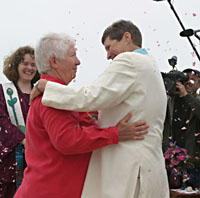
Gloria Bailey, left, and Linda Davies of Orleans rejoice moments after being pronounced married by First Parish Brewster Unitarian Universalist minister Rev. Dr. Mykel Johnson, left, on Nauset Beach during a 1:00 ceremony on Nauset Beach Monday. The couple, who have been together three decades, were married in front of a group of about 40-50 friends and press. Monday is the first day of legalized same-sex marriage in Massachusetts and the US. A dinner party is planned at a friends house to celebrate the event. (Dewitt photo 5/17/04)
A confession: there is a kind of envy that sometimes creeps up in me when I notice famous people, like authors with many popular books, or those widely praised or described as “influencers” and “visionaries.” (Especially when those books are most similar to my own one book.) I grapple with the fact that in the great scheme of worldly success I often feel like a nobody, and more so in my life today with chronic illness and retirement isolation. Margy reminds me that it is only human to feel such feelings. My critical thinking also notes that in the capitalist system, these hierarchies are meant to elicit self-hate and hunger. Hierarchy and domination are the underpinnings of all oppression.
Taking a brief walk today, I imagine my ancestors curious and baffled at this strange descendent who is a writer, who has strange cravings for fame. They never thought about such things. Then I remembered a poem I wrote many years ago, and went looking for it. I had titled it The Inner Wounds of Class Oppression. It is still a healing incantation for me.
Every day, envy gnaws at your fingers.
Your eyes watch the movers and shakers
climbing into dream cars, Going Places.
You want to be Somebody.  You would ride,
eyes averted from the rear view mirror
where all of the Nobodies recede
like small dark flies to brush away
from smooth shoulders.

Every day, anger fills your gut like a pile of bricks.
Your own hard shoulders ache to reach in
and hurl them forward one by one.
Your ears would strain to hear the glass
shattering and rubber squealing,
as the fine white shine of the dream machine
careens sidelong off the grade
into a deep obituary.

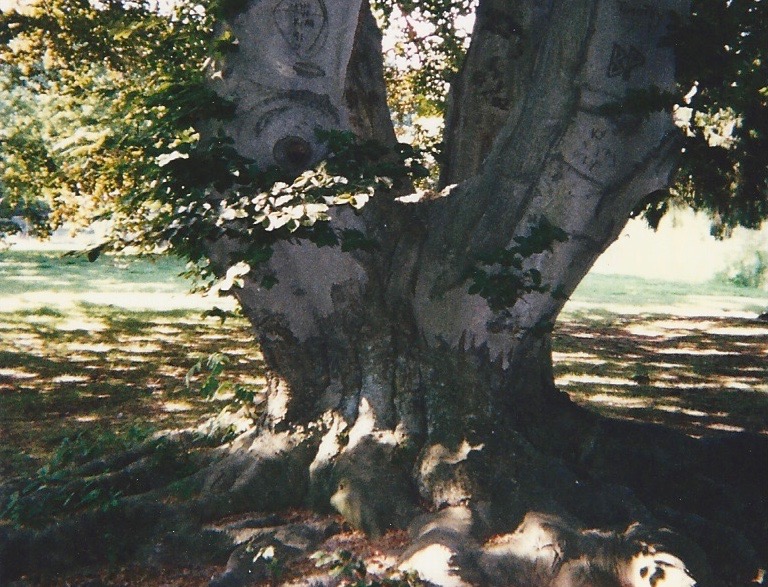
Every day, you clutch at the bark of trees,
knees trembling, moved and shaken.
Your fingertips feel for hidden messages
left there on some other blue morning when somebody
was repeating poems into gnarled crevices,
quiet voice seeping down the edges of roots
into rock under sand:  Remember who you are.
Precious as soil.  Worthy of the sun.