Bearing Witness for the Future

PUC Hearing Net-Metering Rules Oct 17

Photo by Livio Filice, via Facebook. (I am in the front row in a yellow solar shirt.)

Yesterday I participated in the public hearing held by the Public Utility Commission for new net metering rules in Maine.  From one testimony, I learned that these proposed rules are the most regressive, anti-solar rules in the nation.  In another testimony, Conservation Law Foundation attorney Emily Green questioned whether this process is even legal, since the changes are drastic enough that they are no longer really net-metering rules, but rather serve to eliminate net-metering–and thus are not within the purview of the Commission. Also noted was the fact that no economic impact statements had been prepared, prior to the hearing, as required by regulation.  Sadly, none of this made it into the story run by the Portland Press Herald today.

I gave testimony, too, but not on technical details or the effects on jobs or existing solar customers.  I spoke in my role as a minister, taking a look at the bigger picture.  Here is what I said:

I want to speak of our responsibility to the future generations, our grandchildren and their grandchildren.  Every gallon of oil we use today is a theft from the quality of life for those future generations.  If we take our responsibility seriously, we should be doing everything possible to shift all of our energy use to renewables, as soon as possible.

That responsibility to the future generations is why my family downsized from a 2000 square foot home to a 1000 square foot home–so we could afford to put solar panels on our roof and use less oil.  It only works for us because of some kind of net metering–solar produces energy during the day, and more during the summer, so we need to draw from the grid at night and in the winter, from the credits we build up during the sunshine. Net-metering makes it work.

But even so, there are only so many things I can do as an individual.  We need to be moving collectively toward an energy policy that will leave a livable future world for our grandchildren.  It is that serious!  We are creating in our time the story that the future generations of human beings will live.  Will it be a story of hardship?  Wars over declining resources? Chaos, and violence? Or will it be a story of human beings living in mutually beneficial relationship to each other and to all beings of the earth?

I know which story I am committed to–and I think we all want that.  It means doing everything possible to encourage the transition to renewable energy.  I pray that you will go home tonight and think of those future generations–our grandchildren and their grandchildren.  I pray that we might leave them a beautiful world–a world we know is possible.

We were told that all testimony was recorded and will be able to be seen at the website of the commission, but it is not posted yet, as far as I can tell.  The website is very difficult to navigate. If you want to find out more about this rule making case, you can follow this link.  If you want to make a comment on these proposed changes, you can do so at this page, using the case number 2016-00222.

There is a lot more to say about all this, but for today I will leave it with my prayer–that we might leave a beautiful world for the future generations.


Future Fruit Trees

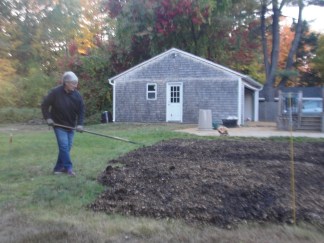
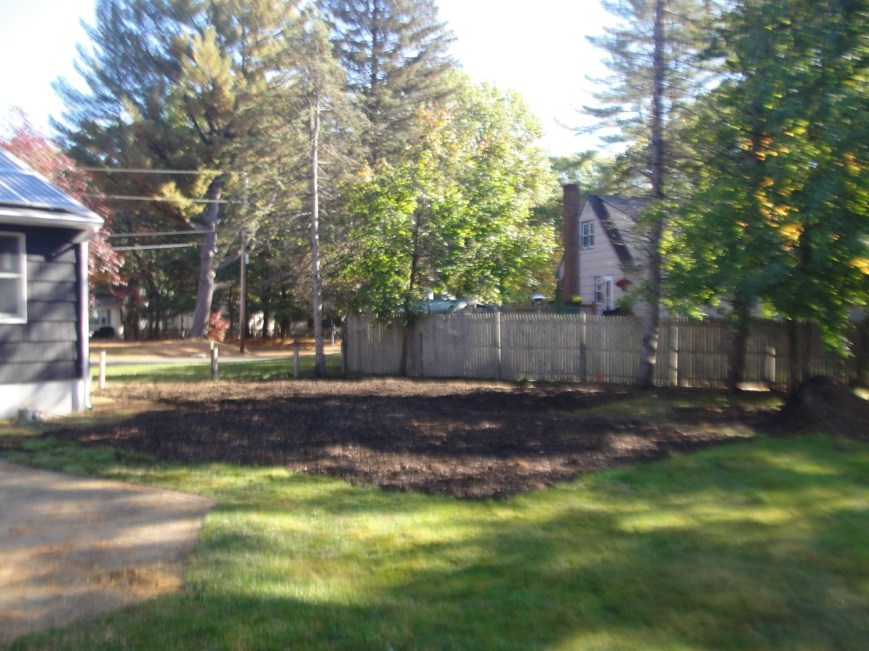
Wood chips JackWood chips LizThanks to help from Margy’s sister Liz and brother-in-law, Jack, we were able to spread wood chips over a part of our yard that we are envisioning for future fruit trees.  The soil in the yard is quite compacted, and we have a big pile of wood chips from the old maple tree that was cut down last year.  Lisa Fernandes of Resilience Hub had suggested that the best easy way to start improving the soil for growing trees was to spread wood chips now so they can percolate over the winter, and help the soil to develop fungal infrastructure.
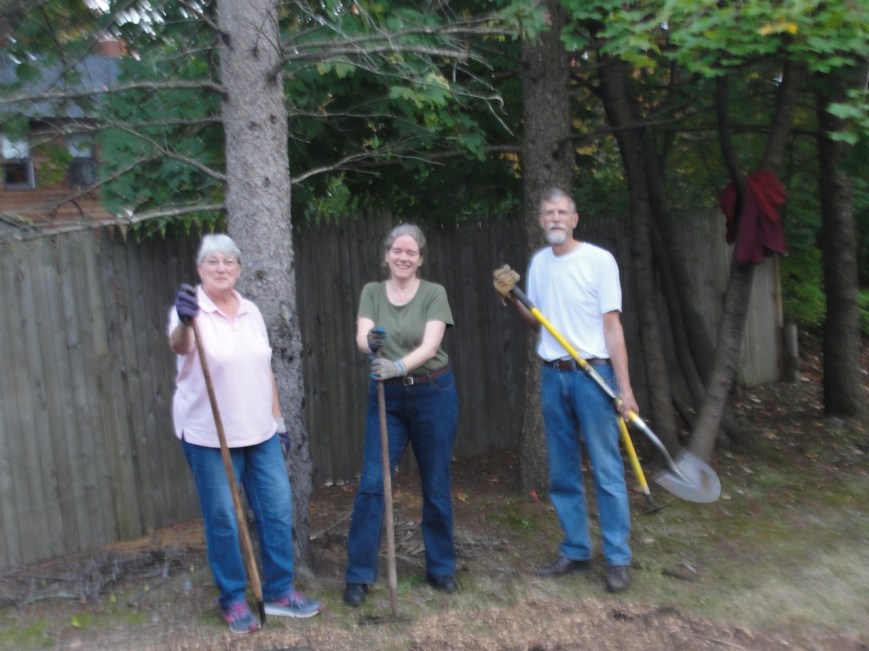
It seemed like a huge job, and Margy and I hadn’t been able to start it on our own.  But when Liz and Jack came to visit for the weekend, they offered to help with a project.  Margy immediately thought of the wood chips.  The three of them began on Saturday afternoon, and then we all worked on Sunday afternoon to expand it and finish it.  Margy coordinated our efforts and documented it with these photos.

We had a wonderful visit, and this morning I feel so happy looking at the space that is no longer raggedy lawn, but imagined and hoped for cherries, apples and peaches, imbued with the spirit of the old maple, and the loving hands of family.dsc06784


dsc06809

Why I don’t celebrate Columbus Day

Every October and November in the United States, we find ourselves once again in a season of false and misleading stories about European settlers and Native Americans.  First there is the story that Columbus discovered America in 1492.  (Later there is the story about the Pilgrims and the Indians at the first Thanksgiving.)  It is astonishing to me, after all the work done by Native activists and their allies in the last forty years, that these stories keep returning unchanged year after year.  In 1991, the organization Rethinking Schools published Rethinking Columbus, an excellent resource that pointed out for educators the fallacies of the stories we are told and offered practical alternatives.  Certainly in some places a lot has changed.  But there has also been a backlash.  Rethinking Columbus was one of the books banned from Arizona school systems in 2012.

Perhaps many people are willing to acknowledge, if pressed, that when Columbus supposedly “discovered” America, it was already full of people.  But the use of the word “discover” has a more sinister history that is not so often talked about.  Prior to 1492, European church leaders and monarchs had collaborated in a stunning series of proclamations, which became known as the Doctrine of Discovery.

In 1452, Pope Nicholas V issued a papal bull declaring that the Catholic king of Portugal had the right to conquer any Muslim and pagan peoples and enslave them.  A few years later he wrote a second letter, declaring all the Christian kings of Europe had the right to take the lands and possessions of any non-Christian people, and keep them in perpetuity.  If the pagan inhabitants could be converted to the Christian faith they might be spared, but otherwise they could be enslaved or killed.  The Doctrine of Discovery was also later claimed by the king of England in 1496, authorizing English explorers to seize any lands not already discovered by other Christian nations.

The Doctrine of Discovery became the legal basis for the “discoveries” of Columbus and others, and for the resulting attempts to conquer and colonize the western hemisphere, and unleash a genocide on its peoples.  It was also the legal basis for the slave trade.  And its influence did not remain in that distant past.  It is still a source of oppression to this day.  It became the basis of U.S. Indian Law, beginning in 1823, when Chief Justice John Marshall ruled that “Christian people” who had “discovered” the lands of “heathens” had assumed the right of “dominion,” and thus had “diminished” the Indians’ rights to complete sovereignty as independent nations.  He claimed Indians had merely a right of occupancy in their lands. This decision has never been overturned, and is still cited on a regular basis, as recently as 2010 in the Federal courts.

Responding to the requests of Indigenous peoples, several religious denominations have passed resolutions to repudiate the Doctrine of Discovery. Those of which I am aware are Episcopalians in 2009, Unitarian Universalists and the Society of Friends in 2012, and the United Church of Christ in 2013.  These resolutions are a first step toward reckoning with this history of stolen lands and stolen children.

But let’s go back to Columbus.  The stories of his “discovery” lead to another distortion of our European history in these lands.  This is the idea that the Europeans conquered the Native nations by their superior weaponry and military might.  This holds a partial truth.  The Europeans did try to conquer every Indigenous nation they encountered.  But it would not have been possible without another factor.  Between 1492 and 1650, possibly ninety percent of the Indigenous people of the Americas were killed by plague and other European diseases to which they had no immunity.  The Europeans, sometimes unwittingly but often purposefully, brought an unprecedented apocalypse to this land.

Estimates of the pre-contact population are hard to determine.  One scholar, William Denevan, tried to reconcile all the data and came up with fifty-four million in the Western Hemisphere.  But by 1650, the number had shrunk to six million.  Millions upon millions of people died.  In 1617, a few years before English settlers landed, an epidemic began to spread through the area that became southern New England.  It likely came from British fishermen, who had been fishing the waters off the coast for decades.  By 1620, ninety to ninety-six percent of the population had died.  Villages were left with so many bodies, the survivors fled to the next town, and the disease continued to spread.  It was a catastrophe never before seen anywhere in the world. Books on Shelf DSC00283


Decolonizing Faith, Part One

Dawn at the Pond

I am at a small gathering of Native and non-Native people exploring the topic of Decolonizing Faith.  We have been looking at the history of colonization on this continent, and the role of churches in that process, and the effects on Indigenous people’s lives.  We’ve listened to stories shared by Wabanaki folks of disrupted families, foster care, adoption, love and care of relatives, abuse by church leaders, the long path to healing…  We’ve been here since Friday evening, and will stay until Monday.

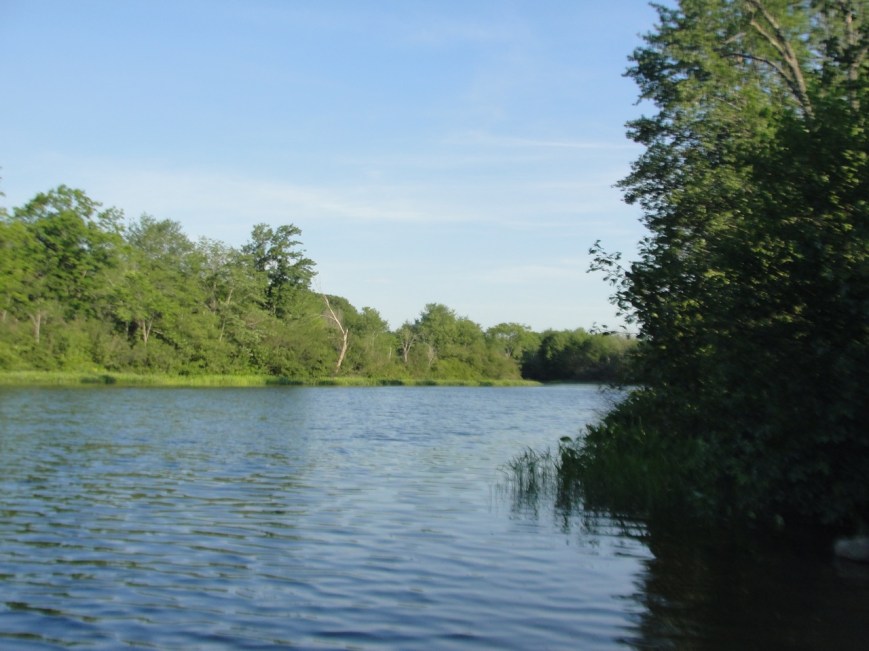
We are in a lovely house by Chemo Pond (pronounced Sheemo Pond) in Clifton Maine. The natural beauty of the pond is, in itself, healing.  The calls of the loons.  The breezes in the trees. The reflection of red leaves on the water. I took a swim in the pond on Friday, and Saturday morning I sat outside in the dawn watching the sky grow light in the east.  Today it is raining. Today we start to ask, what can be done to turn around the process of colonization (which has never stopped.)  And what might be the role of spirituality and the role of faith communities in that work? It is good to be here.

There will be much more to think about, to write.

Summer Lessons to Remember

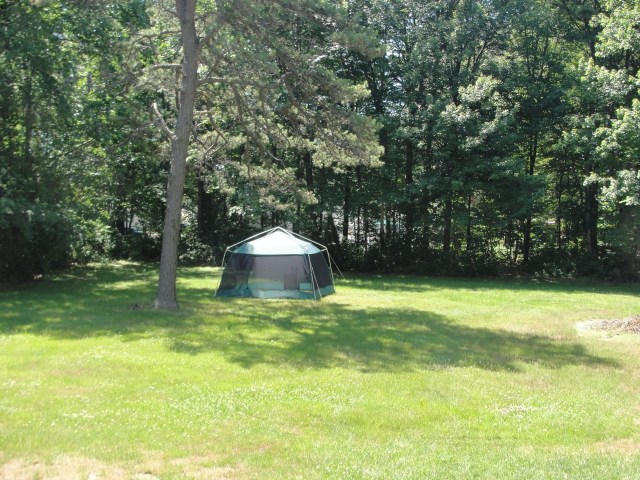
Screen TentMaybe this land on which we newly live can become a sacred center of learning earth spirituality, with a fire circle, a water pond, bird songs in the air.
Your journey on this small piece of land is valuable, not for some other purpose, but for this purpose–to restore your broken off heart to the land.

You have all the time you need.

This spiritual work is your work–writing about it, yes, teaching it, yes, but doing it, most important of all. Even if you do nothing else in your life, do this work.

Each step of the journey is holy. Remember the deer who appeared in the yard. Come outside. Dawn is the best time. “Vacation” really means “spiritual restoration” time.

Your calling now is to do the spiritual journey into Earth Community. That partially corresponds to your ministry at your congregation, and partially lies outside of that. (All congregations must go through transitions in this time.)  

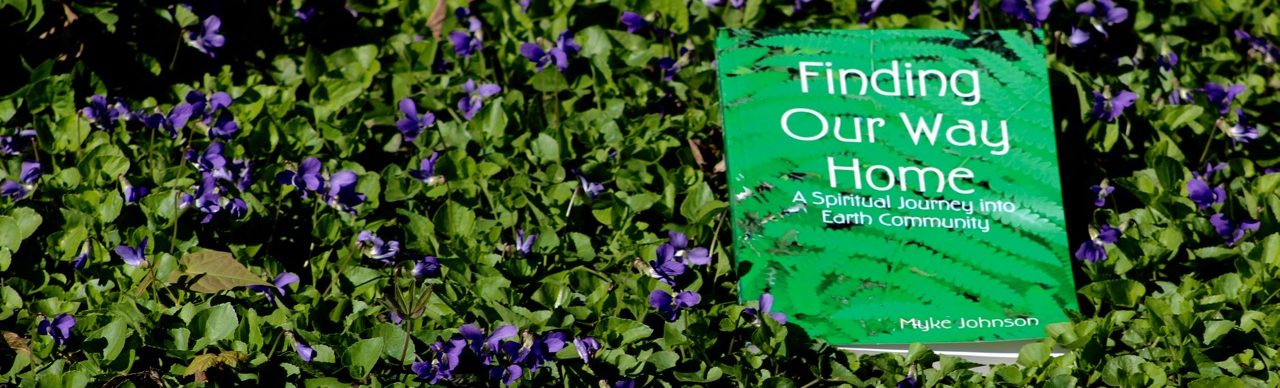
Teach a class this year on the Spiritual Journey Into Earth Community, based on the latest version of the book (Finding Our Way Home: A Spiritual Journey Into Earth Community).

Begin to explore self-publishing the book.

For health–rest, dance, walk, water, herbs, be outside.

Come outside, come outside, come outside.

There is no rush at all, just love, follow your deep passions.

The spirits are with you. Brokenness hurts–turn to the cardinals, the sun, weeping, diving into water.

Enjoy the beauty of each day. It is not all about goals and purpose and accomplishments–even green ones. See the beauty now. Feel the connections now. Be still.

Listen to your body.

You can find your joy and beauty when you sit outside in the morning and write–you know how to move into Presence. Write this down.

There is still more transformation that is possible. Your heart is in the universe and the universe is in your heart. I put my hand on your heart.

Think of how you get up each day in a world that is broken and anguished and live in a society that is divided and hurting. Think of how you feel the new sun and the songs of the birds.  You are learning to feel the land slowly, so the grief doesn’t overwhelm you, so you can find the source of strength, the many ancestors.

Keep dancing.

Today is a day, not a preparation for something else–a beautiful, painful, blessing-laden day. Let your heart’s pain be awash in this day.  

You are not an orphan. You are in the land where ancestor relatives were buried, the dawn places. Don’t panic. Don’t try to take the pain to someone else. Everyone is broken. Remember gratitude. Remember to honor the pain. Remember to see with new eyes.

Remember the magic. Breathe. Remember that a day may bring a beautiful surprise. Follow the Spirits’ lead. Flow with the River of Life.

Ten Ways to Help

10 ways you can help the Standing Rock Sioux fight the Dakota Access Pipeline:

1. Call North Dakota governor Jack Dalrymple at 701-328-2200. You can leave a message stating your thoughts about this.

2. Sign the petition to the White House to Stop DAPL: https://petitions.whitehouse.gov/…/stop-construction-dakota…

3. Donate to support the Standing Rock Sioux at http://standingrock.org/…/standing-rock-sioux-tribe–dakot…/

4. Donate items from the Sacred Stone Camp Supply List:
http://sacredstonecamp.org/supply-list/

5. Call the White House at (202) 456-1111 or (202) 456-1414. Tell President Obama to rescind the Army Corps of Engineers’ Permit for the Dakota Access Pipeline.

6. Contribute to the Sacred Stone Camp Legal Defense Fund: https://fundrazr.com/d19fAf

7. Contribute to the Sacred Stone Camp gofundme account: https://www.gofundme.com/sacredstonecamp

8. Call the Army Corps of Engineers and demand that they reverse the permit: (202) 761-5903

9. Sign other petitions asking President Obama to stop the Dakota Access Pipeline. Here’s the latest to cross my desk – https://act.credoaction.com/sign/NoDAPL

10. Call the executives of the companies that are building the pipeline:

a. Lee Hanse
Executive Vice President
Energy Transfer Partners, L.P.
800 E Sonterra Blvd #400
San Antonio, Texas 78258
Telephone: (210) 403-6455
Lee.Hanse@energytransfer.com

b. Glenn Emery
Vice President
Energy Transfer Partners, L.P.
800 E Sonterra Blvd #400
San Antonio, Texas 78258
Telephone: (210) 403-6762
Glenn.Emery@energytransfer.com

c. Michael (Cliff) Waters
Lead Analyst
Energy Transfer Partners, L.P.
1300 Main St.
Houston, Texas 77002
Telephone: (713) 989-2404
Michael.Waters@energytransfer.com

(Reposted from World Indigenous News)

Dawn Standing Rock

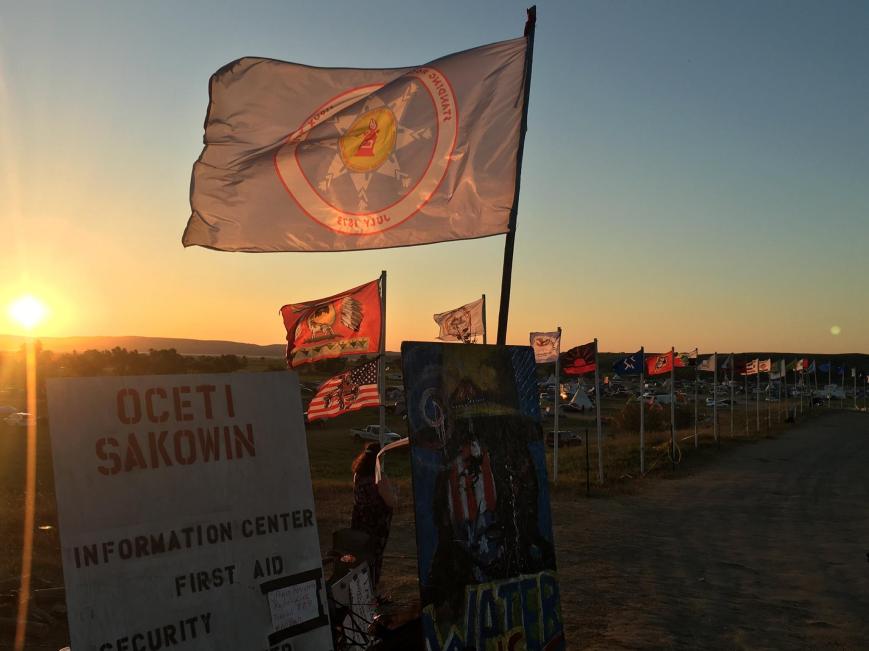
Dawn at Standing Rock, Photo by Benalex Dupris, Sept 3 2016 (Shared from FB)

#NoDAPL

One of the most important actions of our time is taking place right now.  The Standing Rock Sioux Tribe, and thousands of Native and non-Native allies are peacefully camping near the junction of the Cannonball and Missouri Rivers, to protect the water from contamination.  These are the waters that the Tribe relies on for its water supply.  Water is life, water is sacred. This is a non-violent gathering to pray and to stand up for life, named the Camp of the Sacred Stones.

But construction has already begun on the Dakota Access Pipeline, meant to carry fracked crude oil from the Bakken plains through North and South Dakota and Iowa to Illinois where it will be refined. The plan is for the pipeline to go underneath the river, despite the risk that creates for the tribe and for millions of others who rely on the Missouri for water.

As the tribal spokespeople remind us, oil pipelines break, spill and leak—it’s not a question of if, it’s a question of where and when. In fact, a route close to Bismarck was deemed not viable due to its proximity to Bismarck, and the fact that the route crossed through or in close proximity to several wellhead source water protection areas, including areas that contribute water to municipal water supply wells. Yet despite these real consequences, the Army Corps of Engineers never took a hard look at the impacts of an oil spill on the Tribe, as the law requires. No explanation has been provided as to why the health of, and protection of water resources on which, Standing Rock Sioux Tribal members depend are any less significant or vital as those of the City of Bismarck.

Instead, now the pipeline is set to run through land that is sacred to the Tribe. Federal law requires that sacred places be protected in consultation with the Tribe, but the Corps has not complied with that requirement, either.

That is the bad news.  But the good news is that thousands of people have rallied to stand in solidarity with the Tribe and for the water.  In August, 10,000 people joined in prayers with the elders from the Seven Council Fires of the Great Sioux Nation.  Representatives from over 180 indigenous nations have offered support, along with faith leaders, the United Nations, and Amnesty International.

I am happy to say that my Unitarian Universalist colleagues and I are among those supporters.  I sent a letter that was signed by 100 UU faith leaders.  Here is what it said:

Mr. David Archambault II, Chairman, Standing Rock Sioux Tribe, Building 1, N. Standing Rock Avenue, P.O. Box D, Fort Yates, ND 58538

August 29, 2016

Dear Chairman Archambault,

We write as Unitarian Universalist faith leaders to let you know that our prayers and support are with you in your courageous actions against the Dakota Access Pipeline.  We understand that the pipeline will cross treaty lands, burial grounds, and the Missouri River, the water source for the tribe as well as for millions of others.  We are appalled that this project was approved and construction begun without any meaningful consultation with the tribe, counter to federal law and treaty obligations. We support you in your effort to protect your sacred land and water, as well as to create a future for all of our grandchildren.

We speak as people of faith whose principles call us to respect the interdependent web of all existence of which we are a part.  In these times, when the well-being of our entire ecosystem is threatened, we honor the leadership of Indigenous peoples who are showing us a path toward creating a more beneficial relationship to the earth and all beings of the earth.

We are writing to you to offer our support, and to let you know that we are also contacting our government officials to call on them to follow treaty and federal law obligations, and to protect the water which is so utterly necessary for all life on earth.

Sincerely… (signed by me and 99 other Unitarian Universalist leaders)

Will human beings continue to destroy the water and earth, or will we open our hearts to live with respect and gratitude? The next moment of decision is when a federal court will issue a ruling on September 9th.  If you want to offer support for the earth, the water, and treaty obligations, you can find out more at the Standing Rock Tribal website.

River Magic

The Presumpscot River where we expressed our gratitude to our local river water, and prayed for the Sacred Stone camp and the waters of the Standing Rock Sioux Tribe.


Bittersweet Basket Weaving

Bittersweet Ugly Basket

My first “ugly” bittersweet basket.

What does it mean to make a relationship with parts of the natural world that we ordinarily think of as trouble?  I am wrestling with this question as we wrestle with the bittersweet vines that surround our yard.  Asian Bittersweet is classified as an invasive species, because it takes over an area and can wipe out other species.  It is very hard to get rid of it.  This has provoked some places, including Falmouth, Maine, to plan to use horrible pesticides in its eradication–which seems to me an even worse problem–and a never ending one, because they admit that they won’t be able to ever completely eradicate it.

Some folks are taking a different approach however.  Yesterday, Margy and I attended a workshop led by Zack De La Rouda about weaving baskets with bittersweet vines.  I loved  Zack’s attitude–since we brought this plant here, then we need to find ways to deal with the consequences.  And with climate change and other pests threatening species like ash and willow, which have traditionally been used for baskets, we need to keep looking for options.  So he brought us into his experiments with making useful items with bittersweet. Which, as he said, is everywhere. The vines had been cut, dried, and then soaked in water for a couple days. I have to say it was not an easy material to work with–hard to bend and shape, at least for a beginner.  But Zack assured us that everyone has an ugly basket–when our first attempts to learn the skills result in less than usable outcomes.  So I took a pic of my ugly basket.

Another presentation in April got me started on this question.  Tao Orion, author of Beyond the War on Invasive Species: A Permaculture Approach to Ecosystem Restoration spoke at the Resilience Hub.  We might think of getting rid of invasives as important to promoting a balanced eco-system.  But what she discovered is that in the professional world of land management, what usually happens first is a complete destruction of the “invaded” area with powerful pesticides.  She helped us to look beyond “the war” and explore other options for dealing with invasives.  For example, we can look at the function invasive plants are playing in the ecosystem where they have taken root, and address imbalances in the soil and other factors that may need attention.

Bittersweet shoots

Bittersweet vine shoots.

Orion was from the west coast, and didn’t specifically address bittersweet.  Margy started cutting off huge vine stems that are surrounding other tree trunks, to try to save those trees from choking.  But the vines are so resilient.  Tiny shoots start coming up in the lawn, from root networks spread beneath the soil. Non-pesticide ways to deal with them include pulling out what you can, cutting off what you can, and ongoing cutting, to keep the roots from getting the nourishment they need.  (Even people who use pesticides have to do all that, by the way.) In the final analysis, there is no way to completely eradicate them, so you have to learn to manage them.

On the plus side, bittersweet is a remarkable example of resilience.  They propagate by seeds, by roots spreading through the soil, and can re-grow from small root segments. You’ve got to admire that multi-functionality. And birds love the seeds in winter.  There are dozens of birds who live in the uncultivated area just west of our yard–which is overrun with bittersweet, as well as raspberries and blackberries and grape vines growing wild.

But on the other hand, I can’t help but compare it in my mind with the European peoples who invaded this continent, including my own ancestors from France and Scotland in Quebec, and my Germanic ancestors who came later–as immigrants being used to settle the west. Just like an invasive plant, the European invaders took over the landscape, wiped out other communities of people, and destroyed the balance of the eco-system.  On an even wider scale, modern human beings as a whole species have overrun our planet and are destroying our ecosystem.

So perhaps the most important lesson bittersweet might teach us is to look in the mirror, at our own invasions, and together we might learn about how to live within respectful boundaries with all of our siblings on this planet.

Permablitz

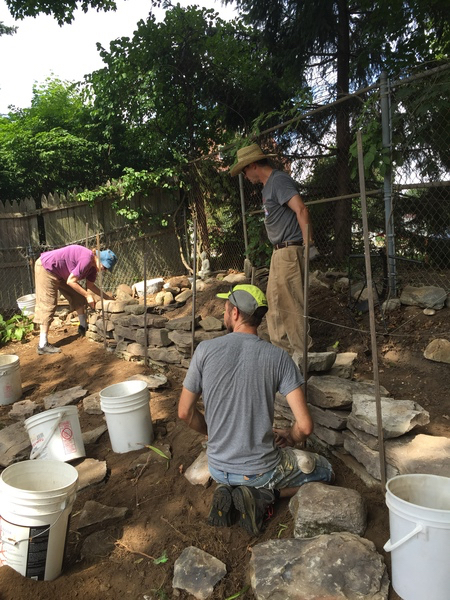
Permablitz

Photo by Julie, one of our organizers for the day

Yesterday, I helped build a rock wall at a Permablitz in Portland.  Permablitzes are groups of 15-30 people who show up to help one of our neighbors implement a permaculture design for their yard.  Organized by the Resilience Hub & Portland Maine Permaculture, they also provide an opportunity for learning more about permaculture options, connecting with others who share a love for the earth, and having a lot of fun doing a lot of hard work. By helping others, we also can put our names in the ring for future help with our own permaculture designs.

Yesterday was also Maine Permaculture Day, with statewide open houses and events.  I visited one yard nearby because they had fruit trees and hazelnuts, and I wanted to get a sense of what that might be like, since we’d like to do something like that for our yard.  They had peach, apple, pear and cherry trees.  They also had planted a row of hazelnut shrubs, hoping the row would eventually create a privacy wall as well as produce hazelnuts. You can learn so much more by seeing plants as they are being grown, than by reading about them. I look forward to the time when we start on our own gardens.

In the meantime, on Friday, we had gutters installed on our house.  We plan to add rain barrels but decided to wait until next year for that, since it will be a lot of work to build bases for them, and we won’t need them until we do more with a garden anyway.