No smoke here right now…

purple and pale lavender spiderwort blossoms in spiky green leaves, with rain drops clinging to leaves
Spiderwort blossoms after rain

We’ve had two weeks of very cool rainy weather, and that counter-clockwise low pressure weather system has kept away the wildfire smoke from Canada, while folks to our south are facing orange skies and unsafe air. Still, we’ve paid attention, following the news, and thinking about what might happen if it does come our way. It is easy enough for Margy and I to stay inside, or wear our N95 masks outside.

But now that we are deeper in relationship with our land, I am anxious about how such bad air might affect the robins and frogs and squirrels and other critters who live here with us. They don’t have masks and can’t get inside. I wonder if the babies of these critters wouldn’t make it, so vulnerable in those first weeks of life. My heart is wide open to our little microcosm of earth life.

And yet it is the macrocosm that emerges most in this story, because the smoke is coming from far away in Quebec, from wildfires made more destructive by climate change. We aren’t alone in our microcosm, we are all connected by the winds that blow across the globe, undeterred by artificial boundaries. I have been somewhat removed from wildfire problems. I have seen them on the news in California, Alberta, Australia. This is the first time they have come close to where I live. But truly we are all more and more vulnerable. And of course, some much more vulnerable than others. I worry about people without houses, struggling just to survive, in a tent or with a tarp. They can’t get out of the bad air.

There is so little I can personally do about these large issues at this time in my life. That is some of my motivation for trying to tend our little garden–to love this small place of earth in hopes that more and more people can learn to love the larger earth, our great mother. To share the beauty of this earth in writings and photos on this blog, that beauty might inspire love. But love includes grief, and the more we love the earth, the more we grieve for the destruction that human beings are perpetrating.

Irises in bloom, purple, with hints of paler purple and yellow.
Irises in bloom

Roadside Garden Flowers

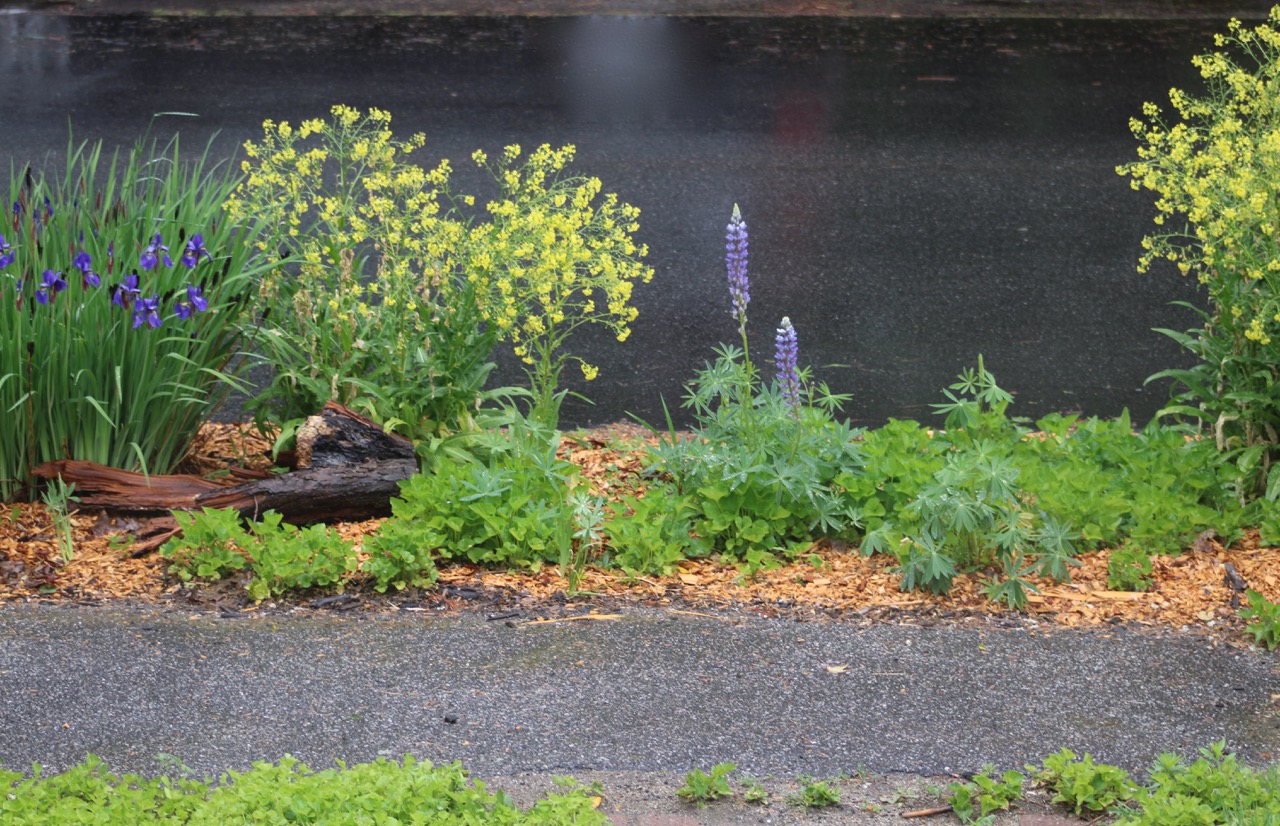
Roadside garden with siberian iris purple flowers, turkish rocket yellow flowers, lupine purple flowers.
Siberian iris, turkish rocket, lupines in bloom.

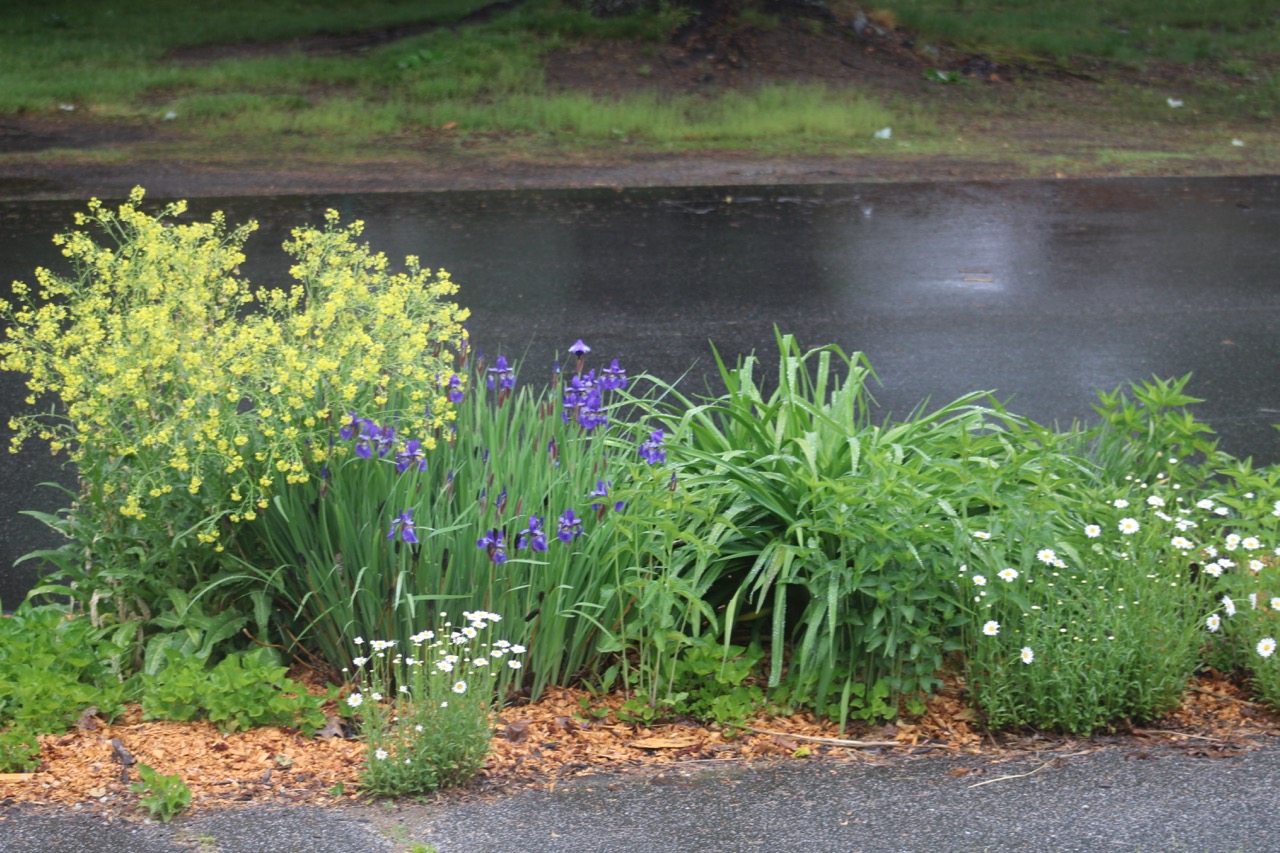
This is my favorite time of year for the roadside garden. The flowers are in contrasting colors of bright yellow, purple/blue, and white, with lovely green leaves of all shapes and sizes. Despite the cold and rain of the past week, it seems to send off a glow into the gloom. It was a garden formed originally from gifted hardy perennials, and others have naturalized to find their own places, like the white daisies.

Yellow flowers of turkish rocket, purple Siberian irises, daisies, in front of rain slicked pavement road.
Turkish rocket, Siberian iris, wild daisies in bloom.

Before the rain, we planted random and unknown flower seeds in one of the garden beds in the front, and carrot seeds in the other (next to broccoli seedlings). I had also planted zucchini and cucumber seeds in the hugelkultur mound. I hope the rain waters them gently and they sprout. Most of our seeds are from prior years, so it is a gamble. But it did seem like good timing.

And for those who have been following this blog, you might be delighted to learn that after the robins fledged, the parents are now starting a second batch of eggs. Once again, she laid one egg per day, but this time, there are four!

Four blue robin's eggs in nest

Pond lily surfacing

Pond, with stone edges, ninebark bush in back, spiky green blue flag leaves in front, and on surface of pond, two round red leaves of a pond lily.
The pond lily leaves have reached the surface of the water.

Last fall, I moved my pond lily plant, pot and all, to the bottom of the pond, from where it had been positioned on a step about 18 inches down. This was to help it survive freezing temperatures in winter. I wasn’t sure what would happen, but I was delighted to see red leaves starting to form around April 22, when I took the following blurry photo through the water.

blurry all over, through water, faint sign of red leaves forming in pot.
Red pond leaves seen through the water.

Thursday, the first leaf reached the surface on a tall thin stem, and others are following. They are red and round, but I imagine that they will turn green as the sun shines on them, since last year they were green. In the up and down world of gardening, it is thrilling when the perennial plants thrive on their own.

Red round leaves on surface of water.

The sweet flags I planted this year are also doing well–you can see them in the top photo near the stones. The blue flag irises are also coming back strong–their leaves are in the foreground. Meanwhile, the green frogs are happy–I’ve seen three so far. The bees are happy, and the tadpoles are still around. The maple trees scattered their seeds all over the yard, and many fell into the pond, but I didn’t scoop them out.

Green frog with stripey green and brown body sitting in water, with honey bee nearby on rock, drinking, and small tadpoles swimming.
Green frog, bee, and tadpoles in the pond.

Certified Wildlife Habitat

Small sign saying Certified Wildlife Habitat on metal post, near raised bed, and steps to front door of house.

It’s official. We’ve been designated by the National Wildlife Federation as a Certified Wildlife Habitat. This means that our garden “provides natural sources of food, water, cover, and places to raise young, and is maintained in a sustainable way that incorporates native plants, conserves water and doesn’t rely on pesticides.” We posted our sign in our front yard. We are one of over 227,000 such gardens in the United States, and they are hoping to reach 300,000 this year.

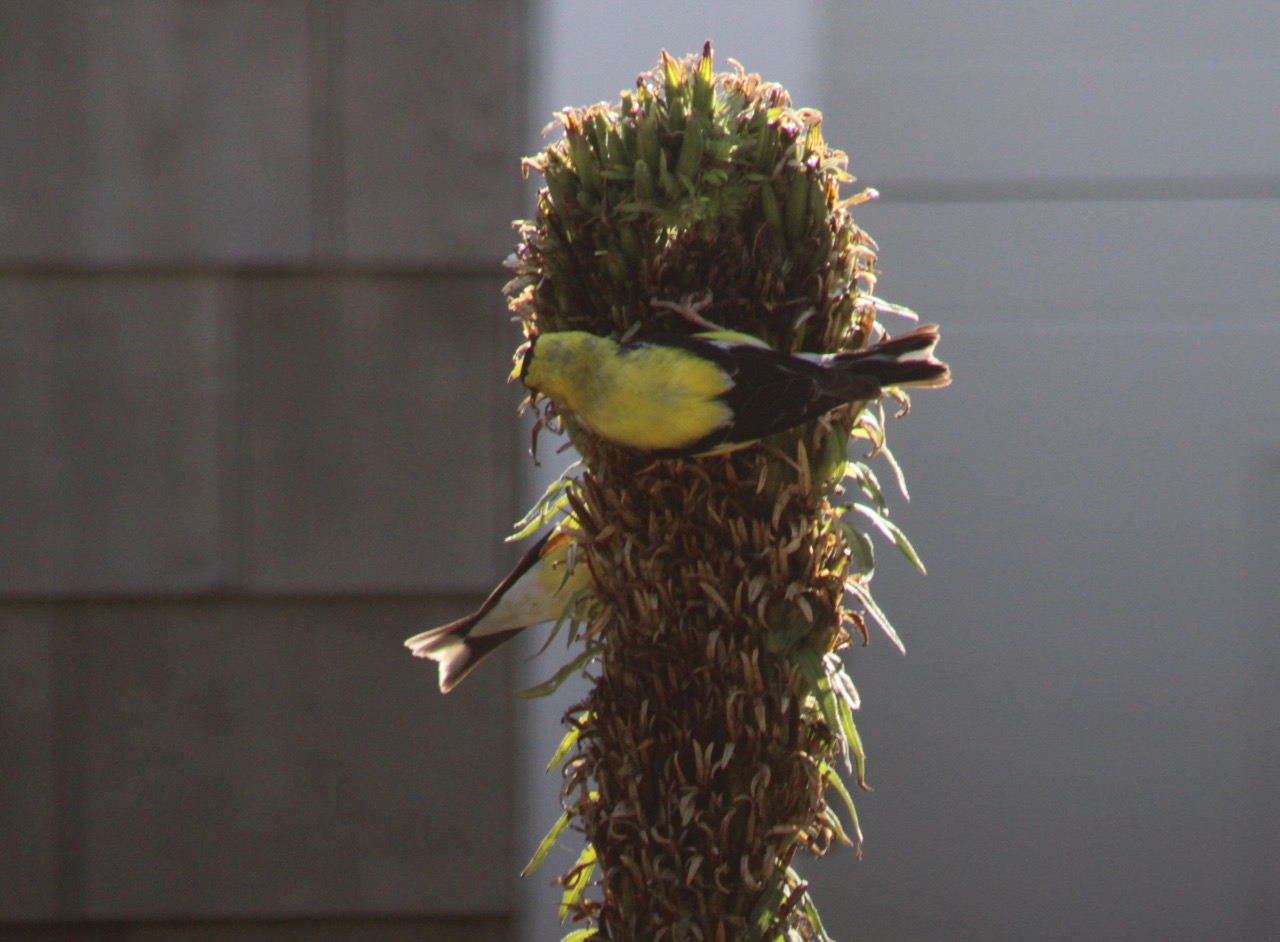
In order to be certified, you fill out a form at https://www.nwf.org/CertifiedWildlifeHabitat and give a donation to the organization. It’s on the honor system–you tell them the sources of habitat in your yard, in several categories. For food in our yard we have native plants, berry bushes, and fruit trees, as well as our bird feeder, and the pond. One of my favorites is evening primrose that grows wild. We keep several, only cutting in places that don’t work to have a tall plant–last year there were goldfinches all over this plant, and hopefully more this year.

Goldfinches eating seed on round plant head.

We provide water especially with the pond. The pond serves so many purposes–food, water, a place to raise young (the tadpoles!), cover for frogs. When I walk in the morning, I see birds bathing, bees taking a drink, frogs sunning and snatching flies. But any kind of water brings wildlife to a yard–small or large. We also have a bird bath near our patio, and see birds and squirrels getting drinks there.

Cover is used to protect from bad weather, hide from predators, or hunt prey. Around the edges of our yard there are trees and bushes, and piles of branches that provide cover for small critters, and places to raise young. Ever since the orchard trees and hazelnut bushes have grown up, birds are always perching there, sometimes on their way to the bird feeder, sometimes eating insects. I’ve posted about the robins raising young in a nest on our back porch. But we’ve also seen young squirrels in trees, and chipmunks coming from underground.

As for sustainable practices, we never use pesticides, and we compost our food waste and leaves. We conserve water with our rain barrels, and if the pond needs topping up, that comes from the rain barrels too. We try to incorporate native plants wherever we can–mostly by not pulling the weeds that emerge on their own: violets, pansies, daisies, wild strawberry, goldenrod among many others. I use an app to identify plants that come up. We do also have invasive plants that we are trying to get rid of.

The official designation and sign were a gift to ourselves, and to make our intentions more visible in the neighborhood. Most of the actual habitat is in the back and side yards. Have any of you participated in this program? Maybe you might like to check it out. There are little things that each of us can do to care for the earth community, and foster habitat for wildlife.

Roadside Garden

Roadside garden strip with green spikey leaves coming up, yellow flowered turkish rocket, and wood chips between plants, plus a broken wood log.

The last couple days I have been sprucing up the roadside strip in front of our house. I had left all the leaves and old dead plant droppings all spring, better for soil enrichment and habitat for insects. The hardy perennials have been greening up, and the turkish rocket is flowering now. I think of this as my no-work garden, and mostly just leave it alone. But two days ago I pulled up crabgrass, and then I have been adding fresh wood chips between plants and along the roadway. We just got a huge pile of wood chips from our favorite tree guy. Such an excellent and free resource!

I’ve also been watching the Chelsea Flower Show on Britbox, and maybe that inspired me to put some odd shaped logs in a few empty spaces between plants. An ornamental crabapple tree fell in a storm last winter, and our neighbor cut it up for us. Some of it can be seasoned for our wood stove, and I have been moving those to our wood pile. But some pieces are just the wrong size–but apparently they are perfect for garden decor. I can see this view above from our front living room window, and it makes me so happy!

Roadside garden with green spikey leaves, next to paved road, neighbors car in the background.

I also like that it now looks a bit prettier for the neighbors. I want folks to realize that wildlife friendly, organic, permaculture gardens can be beautiful too! In fact, someone walking by commented about how much they like our gardens. I hope we may be contributing to a trend. Our neighbors across the street just put in some raised beds in their front yard, and our neighbors to the side were getting heat pumps installed yesterday.

Finally, the other blooming plant right now is a blue mountain cornflower. I only wish I’d put it on the sidewalk side, because we can’t see it from the house. Maybe I’ll move it next year.

Mountain cornflower, or perennial bachelor button, with purplish blue flowers, green stems and leaves.

Frogs and tadpoles in the pond

Green frog, with green head and brown body, perched on gray stone facing the pond water.
Green frog on stone at the edge of the pond.

The green frogs are back in the pond. I saw one about a week ago, but yesterday I managed to get a photo. As I got near, another frog dove down to the bottom–so there are two. Once again it is lovely to sit by the pond quietly, watching them sit quietly. And we now have the added pleasure of hundred of little tadpoles. I stopped scooping out algae to avoid scooping out the babies, so the pond isn’t so “pretty” to human view, but the frogs, tadpoles and honey bees seem to really like the algae. The frogs like to hide under it, the bees land on it to drink, and apparently it is good food for the tadpoles.

I was also happy to receive three new plants of sweet flag–or kiwhoswasq, as I learned in Passamaquoddy class. That means “muskrat root”, since apparently muskrats eat it, and it is also a useful medicinal root. It should do well in the pond, and multiply itself there. It doesn’t look like much yet, so I will wait to post photos. Meanwhile the ferns are coming back on their own.

Green ferns in water with algae on surface.

Finally, one more picture of the frog, after it jumped down to the water, sitting on a white rock, surrounded by the tadpoles. They are all over the pond now, especially around the edges.

Green frog with brown stripey body, sitting on white rock in water, with tiny dark tadpoles swimming nearby.

And they’re gone!

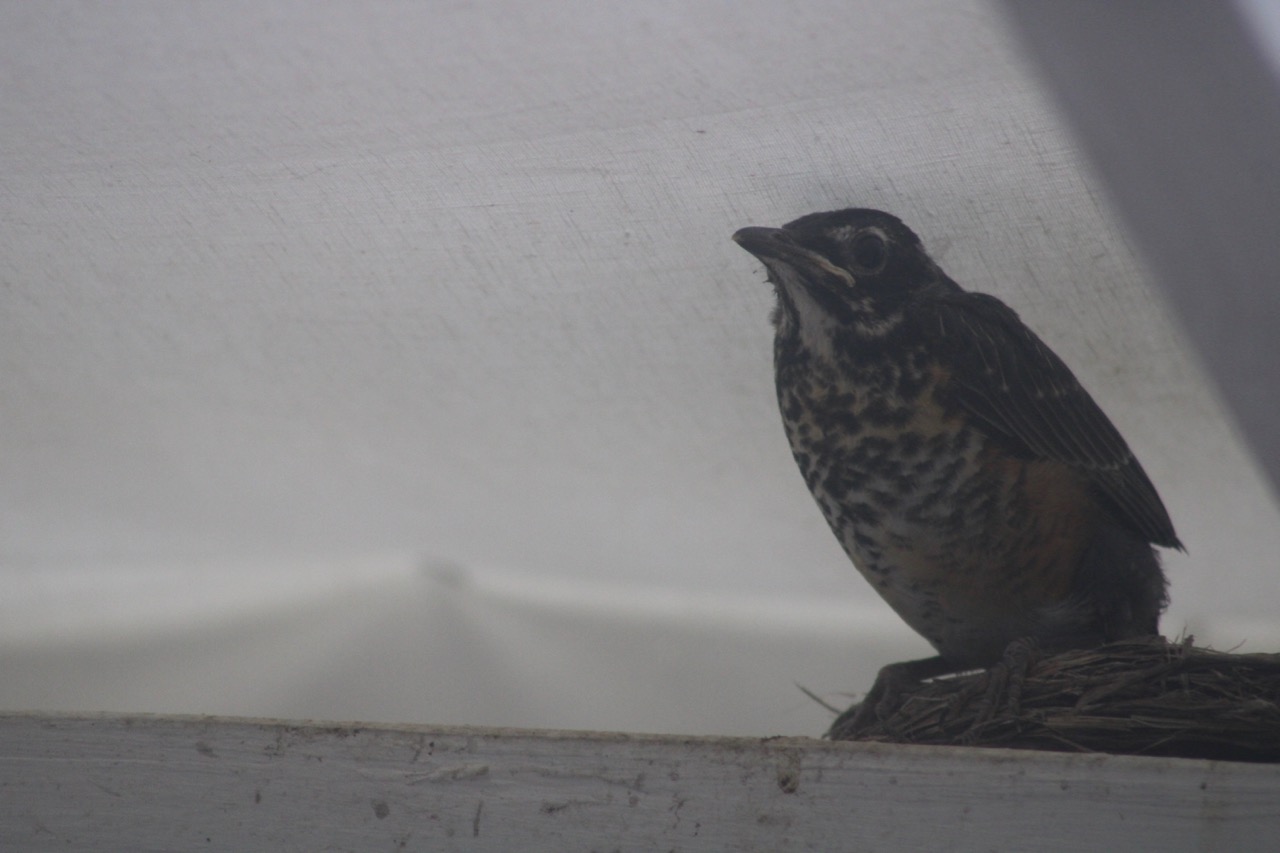
Fledgling robin with stripy breast feathers, perched on white beam, under shade cloth.
Baby robin perched boldly on the beam.

During the night the two baby robins were back cozy in the nest. This morning, they came back out on the beam, one of them perching boldly on the edge. I was sitting at the kitchen table watching through the window, and then a few minutes passed by and suddenly they were gone! I went outside on the porch, and then saw a small bird fly from the ground in the nearby orchard up to the trees by the fence. I was in a Zoom meeting, so I went back to do that for another 30 minutes, then went outside to look for the babies–I guess I should call them fledglings now. After walking around in the orchard a bit, I saw one of the parent robins in a tree near the fence.

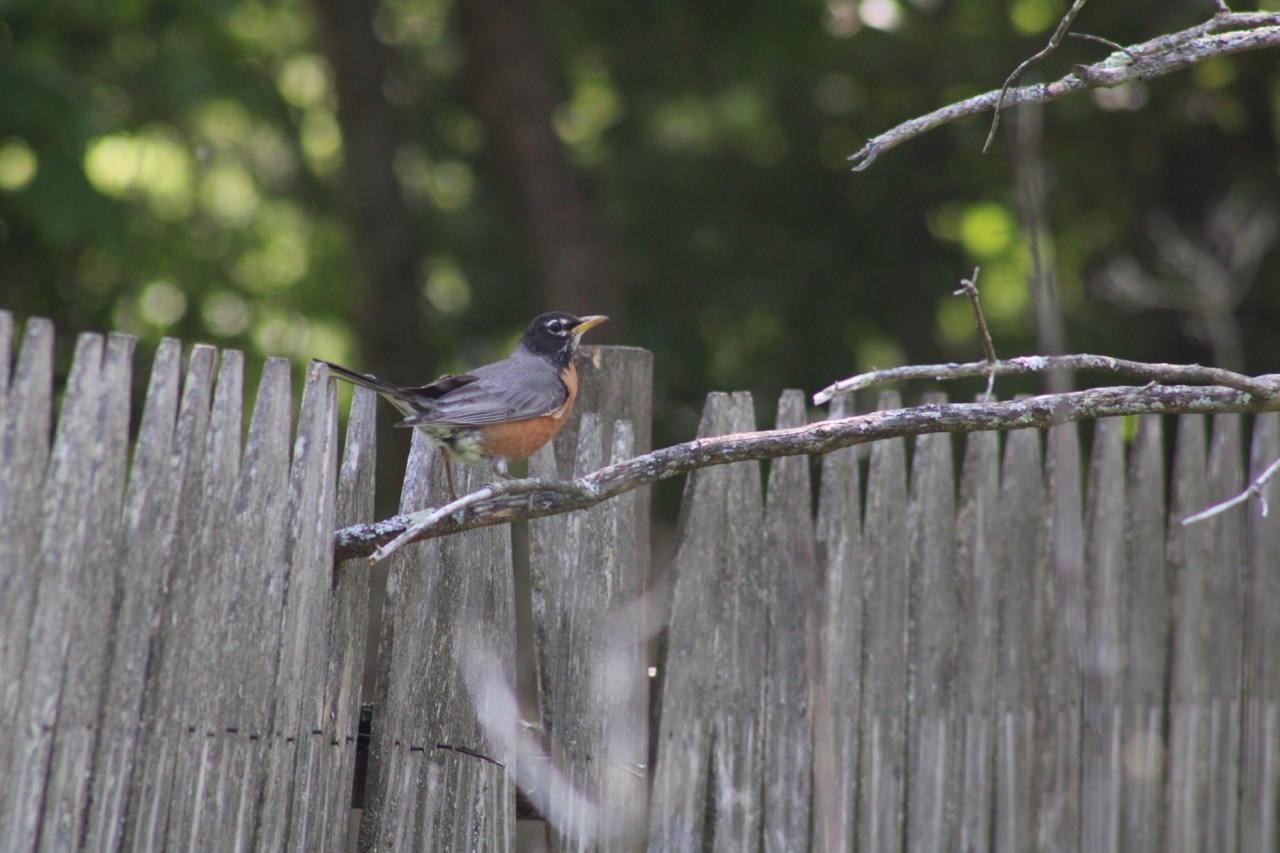
Robin on a bare gray branch in front of a gray wooden fence, with blurred green leaves in the background.
Parent robin near fence.

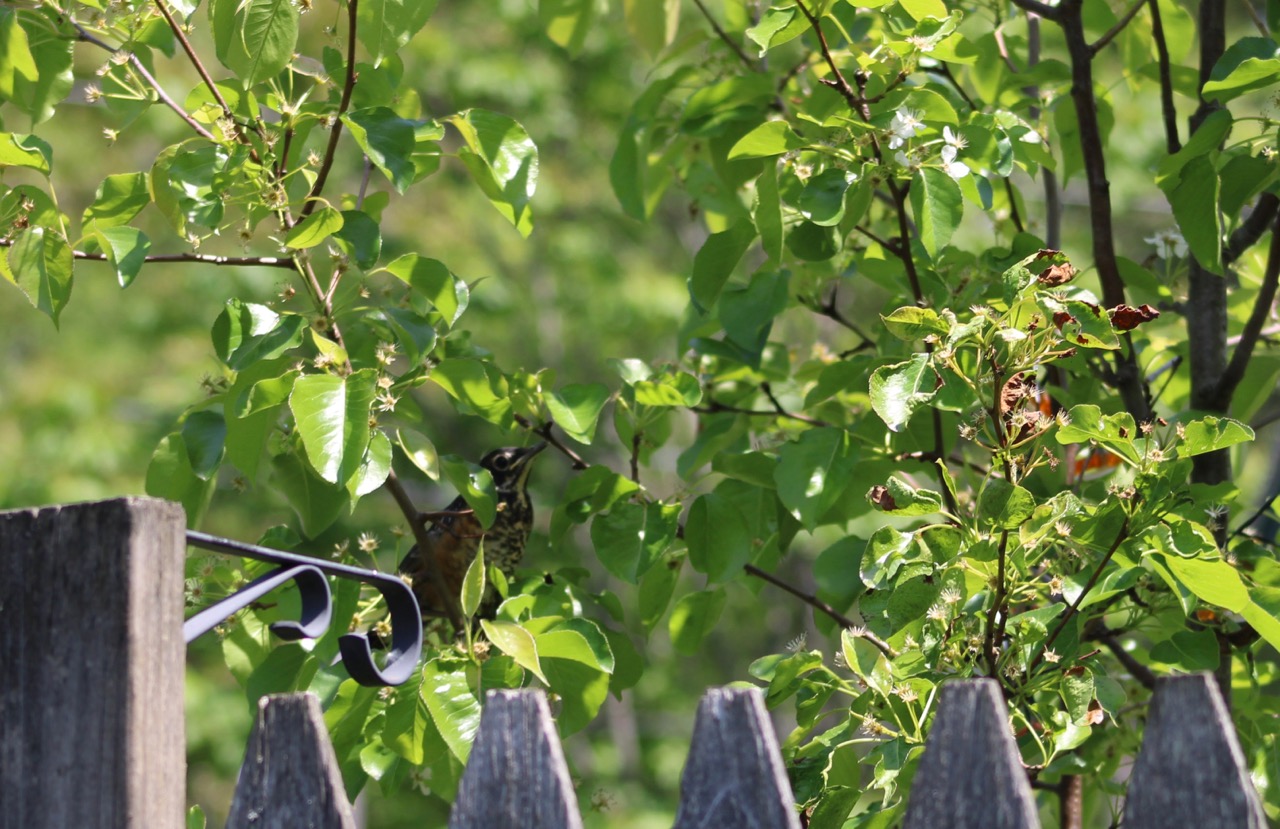
So I looked all over near the fence, and then stood on a little block of wood to see over the fence. There it was! I saw one of them in our neighbor’s young pear tree. It was being quite still and quiet, hiding among the leaves.

Tips of wooden fence showing at bottom, with green leafed tree above, and hidden among the leaves, a baby robin.
Robin fledgling hidden in the leaves of the pear tree over the fence.
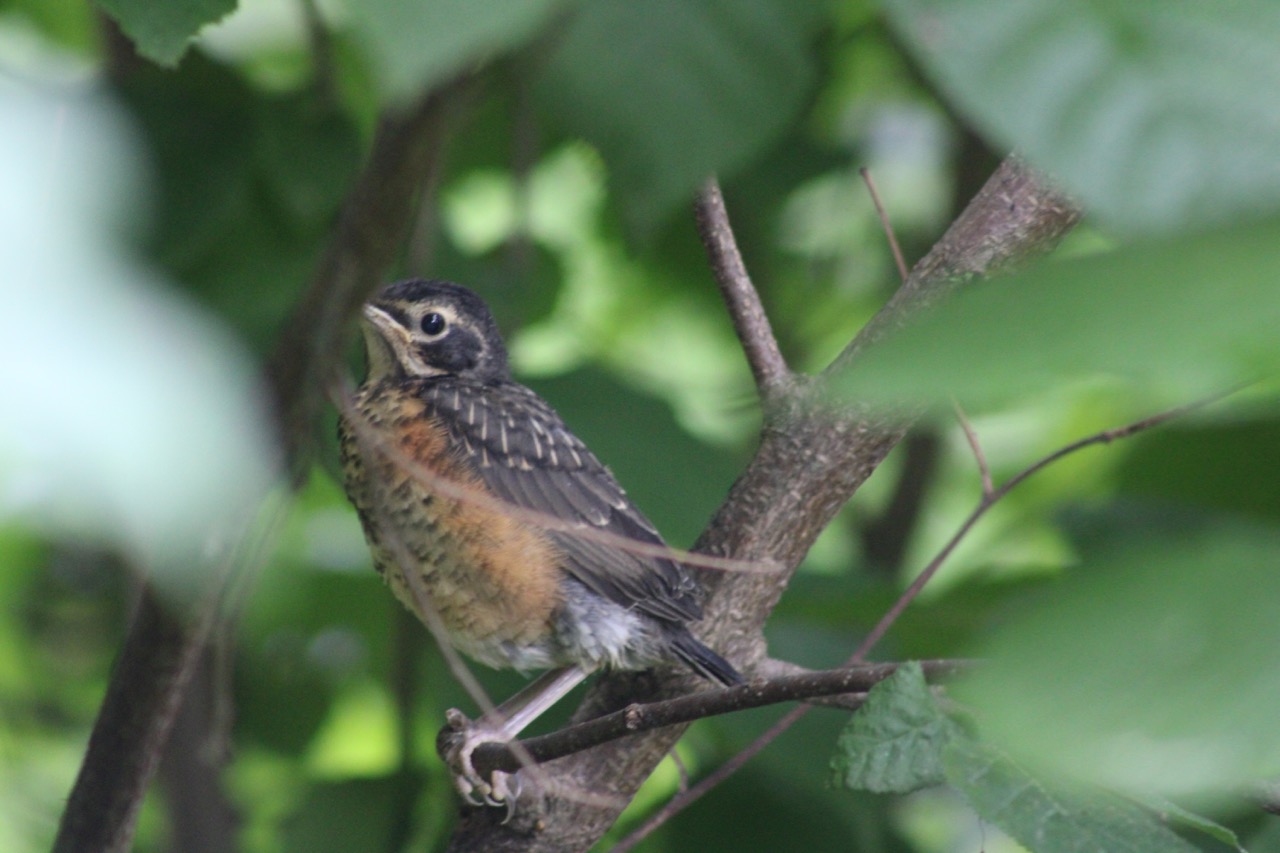
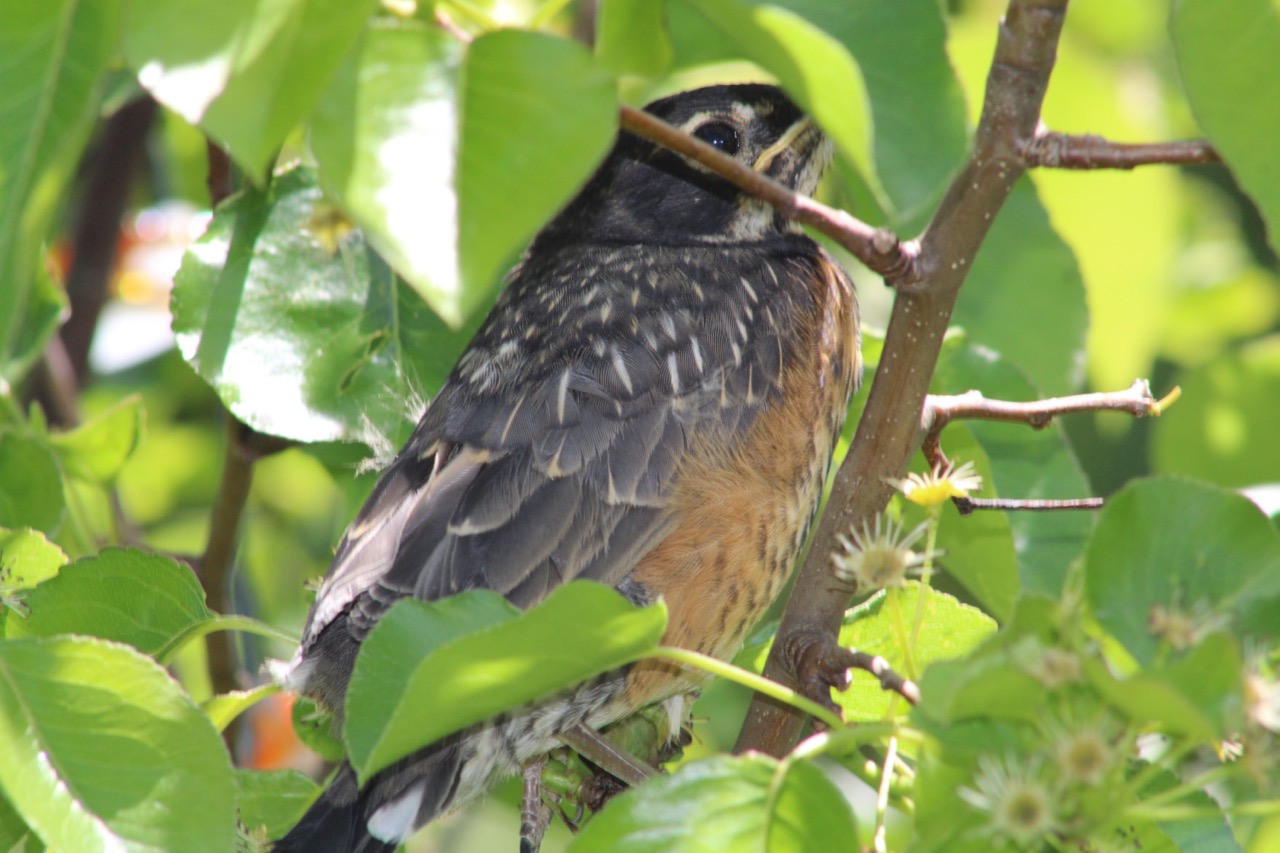
Close up of fledgling robin hidden among green leaves on branch of pear tree.
Close up of fledgling robin

I was reassured to see this one on its perch in the tree. I didn’t find the other one, but we have so many trees around our yard that it could be anywhere. When I went back to the fence a couple hours later, this one was gone too. And just like that, no more baby robins on our porch, at least for now. I am assuming they won’t come back to the nest. It has been one month since the first egg was laid. Most of that time they were hidden from sight, but every sighting was a joy. And I am so happy that the robin parents finally fledged their first youngsters!

Robin Excitement

Two baby robin heads peaking up from the nest, under a white beam.
Robins peaking over the edge of the nest!

What could be better than to watch baby robins venturing over the nest? Yesterday we saw their little heads popping up and then hiding back down in the nest. Today, they were out of the nest, onto the beam next to it! It is actually two beams with a lower beam between, so they can hide down and lift up there too. They are beginning to try out their wings, and explore the length of the beam. Still clamoring for food from parent! Their reddish color is starting to show. I wonder how long until they flutter a bit further. Can’t be long now.

Two robin heads facing forward, peaking over the edge of a white beam, next to the nest.
Robins peaking over the edge of the beam, out of the nest!
Two baby robins beaks up, one with worm, on beam, parent robin on nest to right.
Parent robin on the nest, babies next to it, eager, one has got the worm.
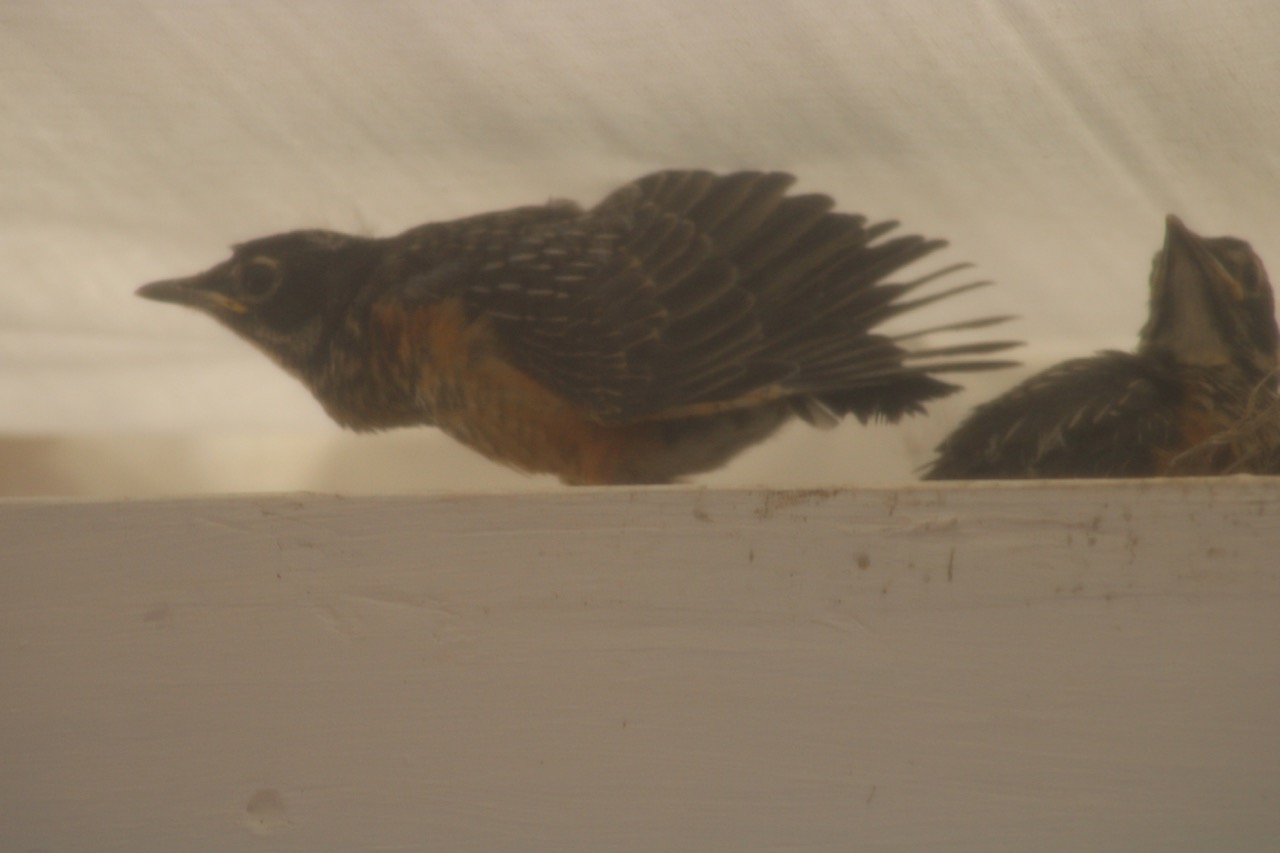
Baby robin folding its wings, while sibling looks on from the right.
Trying out the wings!

E-book Is Now Available!

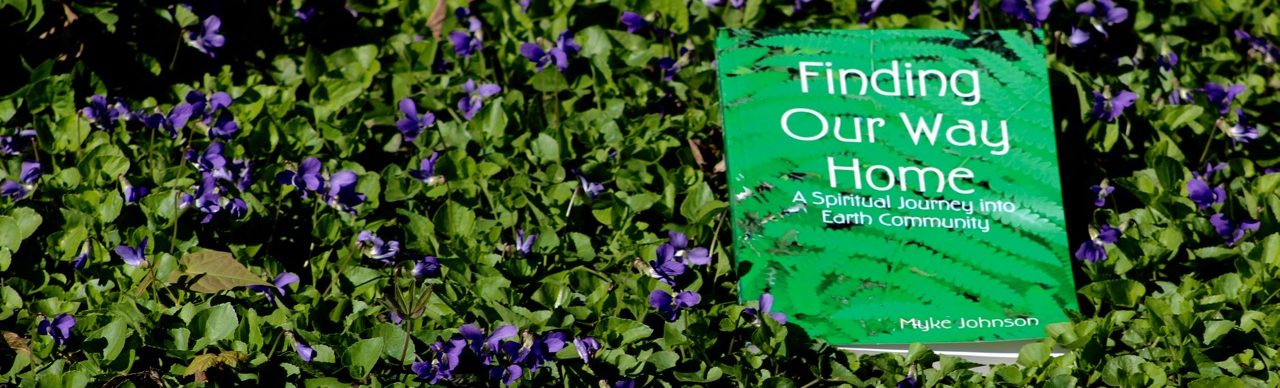
Finding Our Way Home: A Spiritual Journey into Earth Community, by Myke Johnson, front cover photo with cream print, background of green ferns.

The E-book of Finding Our Way Home is now available! You can get an EPUB version at lulu.com for $9.97. (The link should take you directly to the book, or you can search by author and title.) In 3-5 weeks there will also be versions on Amazon, Barnes & Noble, Kobo, and other ebook stores. EPUB is readable on Apple Books as well as Nook, Kobo and other readers.

In 2016, when I first published Finding Our Way Home: A Spiritual Journey into Earth Community, I was happy to use an ecologically oriented print-on-demand source for a paperback format. That is still available for $17.99 plus shipping. I have been told it is the kind of book that does well with slow reading, a chapter at a time, with spiritual practices offered at the end of each chapter. Personally, I enjoyed doing the layout and choosing the typeface, and creating all the formatting. I assumed I would also do an e-book at some point, but with chronic illness and not very much energy, it took longer than I expected.

For some mysterious reason, during the last few weeks, I was inspired to get back to it. The first step was reading “how-to guides” at lulu.com. I had to create a new document and undo all the formatting I had previous used, substituting standard formats. I checked all the internet links that showed up in the notes, to make sure they were still functioning. I also updated the author page, but did not change anything else in the content.

My hope is that this new format will make the book more accessible to more readers, both financially and visibly. I especially want to thank my friend Diane K. for her cheerleading and enthusiastic support. Just a little note to mention that when you purchase directly from the publisher more of your payment goes to me as the author. But another way you can help, if the message appeals to you, would be to leave a review wherever you purchased the book. In the end, most of all, in my small way I want to keep fostering a spiritual journey of waking up to interconnection—to the earth, to each other, and to the Mystery within and between all.

Babies in the Garden

Slightly behind a white crossbeam is a parent robin with two little babies with open beaks in a nest.
Two baby robins with open mouths waiting on parent.

I’ve waited to post about the baby robins because I didn’t want to presume anything or jinx it. But it seems after the mama robin laid three eggs in the nest on our back porch beam, we now have two babies who have feathers and are poking their heads up to be fed. They don’t make a sound, and most of the time they are hiding deep in the nest while the mom and dad go about getting food, or just sitting on top of them resting. When the parents were gone for a bit today, I snatched this “selfie” with my phone over the nest. We mostly try to leave them be and not make a lot of noise on the porch.

Two baby robins, a mass of brown and white feathers with beaks and eyes, barely distinguishable from brown nest.

While not as photogenic, I also discovered we have tiny tiny tadpoles in the pond. I was lifting some algae with my net, and uncovered a whole group of them. Here is a close-up, but just imagine them about 1/4 inch from head to tail. Apparently they eat algae, so they must be happy where they are. Hurray! I would guess they are tree frog tadpoles, since the tree frogs have been singing, but I couldn’t find any confirmation of that in online searching–we’ll have to wait until they get a bit bigger.

Tiny black tadpoles in green algae in the pond.
Tiny black tadpoles in algae in the pond.

Finally, I planted some kale and lettuce and broccoli seedlings this morning, after adding more compost to raised bed, then using chopped leaves as a mulch. I put netting over them to deter animal neighbors–it doesn’t keep away cabbage moths, but seems to work for groundhogs and squirrels and such. Plant babies finally in the ground!

Rectangle wooden raised bed with frame and black netting over it, planted with small kale and lettuce.