Frogs and tadpoles in the pond

Green frog, with green head and brown body, perched on gray stone facing the pond water.
Green frog on stone at the edge of the pond.

The green frogs are back in the pond. I saw one about a week ago, but yesterday I managed to get a photo. As I got near, another frog dove down to the bottom–so there are two. Once again it is lovely to sit by the pond quietly, watching them sit quietly. And we now have the added pleasure of hundred of little tadpoles. I stopped scooping out algae to avoid scooping out the babies, so the pond isn’t so “pretty” to human view, but the frogs, tadpoles and honey bees seem to really like the algae. The frogs like to hide under it, the bees land on it to drink, and apparently it is good food for the tadpoles.

I was also happy to receive three new plants of sweet flag–or kiwhoswasq, as I learned in Passamaquoddy class. That means “muskrat root”, since apparently muskrats eat it, and it is also a useful medicinal root. It should do well in the pond, and multiply itself there. It doesn’t look like much yet, so I will wait to post photos. Meanwhile the ferns are coming back on their own.

Green ferns in water with algae on surface.

Finally, one more picture of the frog, after it jumped down to the water, sitting on a white rock, surrounded by the tadpoles. They are all over the pond now, especially around the edges.

Green frog with brown stripey body, sitting on white rock in water, with tiny dark tadpoles swimming nearby.

And they’re gone!

Fledgling robin with stripy breast feathers, perched on white beam, under shade cloth.
Baby robin perched boldly on the beam.

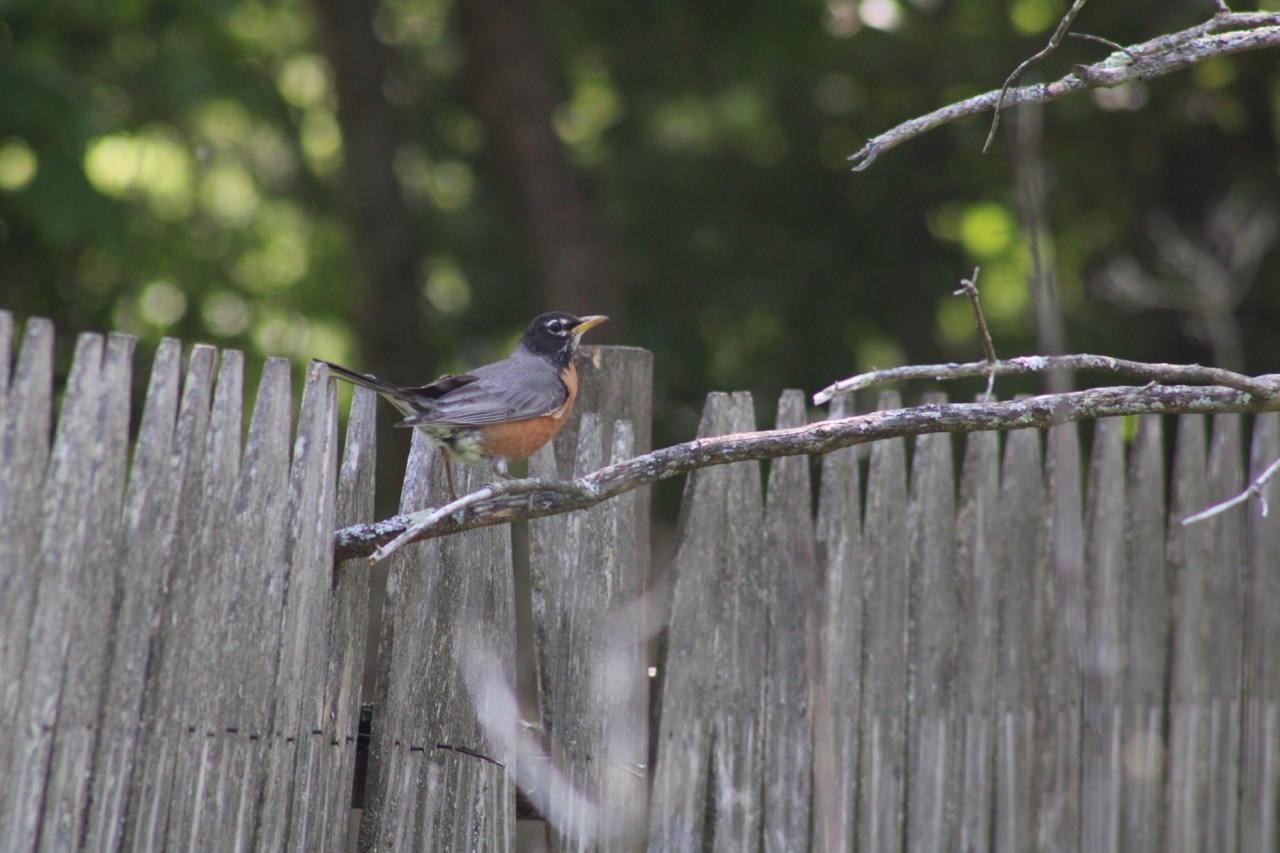
During the night the two baby robins were back cozy in the nest. This morning, they came back out on the beam, one of them perching boldly on the edge. I was sitting at the kitchen table watching through the window, and then a few minutes passed by and suddenly they were gone! I went outside on the porch, and then saw a small bird fly from the ground in the nearby orchard up to the trees by the fence. I was in a Zoom meeting, so I went back to do that for another 30 minutes, then went outside to look for the babies–I guess I should call them fledglings now. After walking around in the orchard a bit, I saw one of the parent robins in a tree near the fence.

Robin on a bare gray branch in front of a gray wooden fence, with blurred green leaves in the background.
Parent robin near fence.

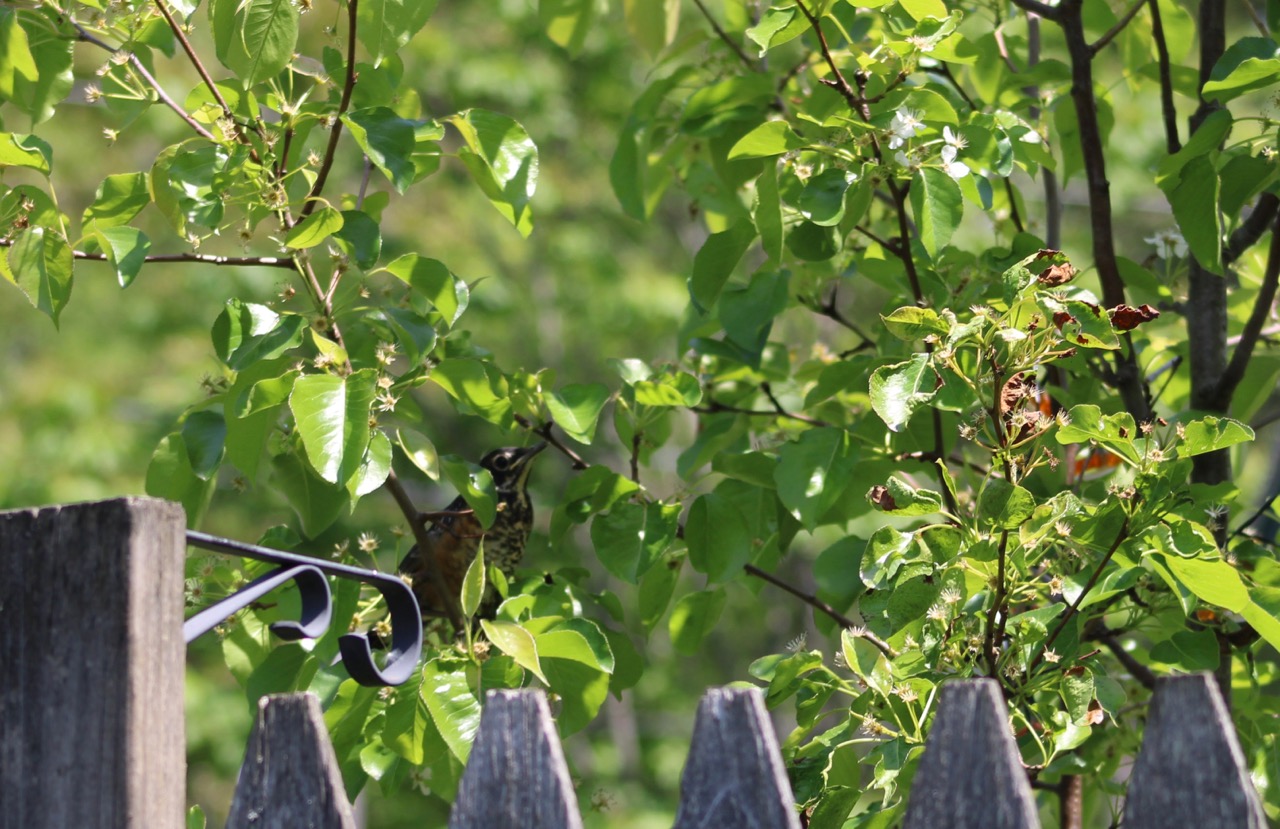
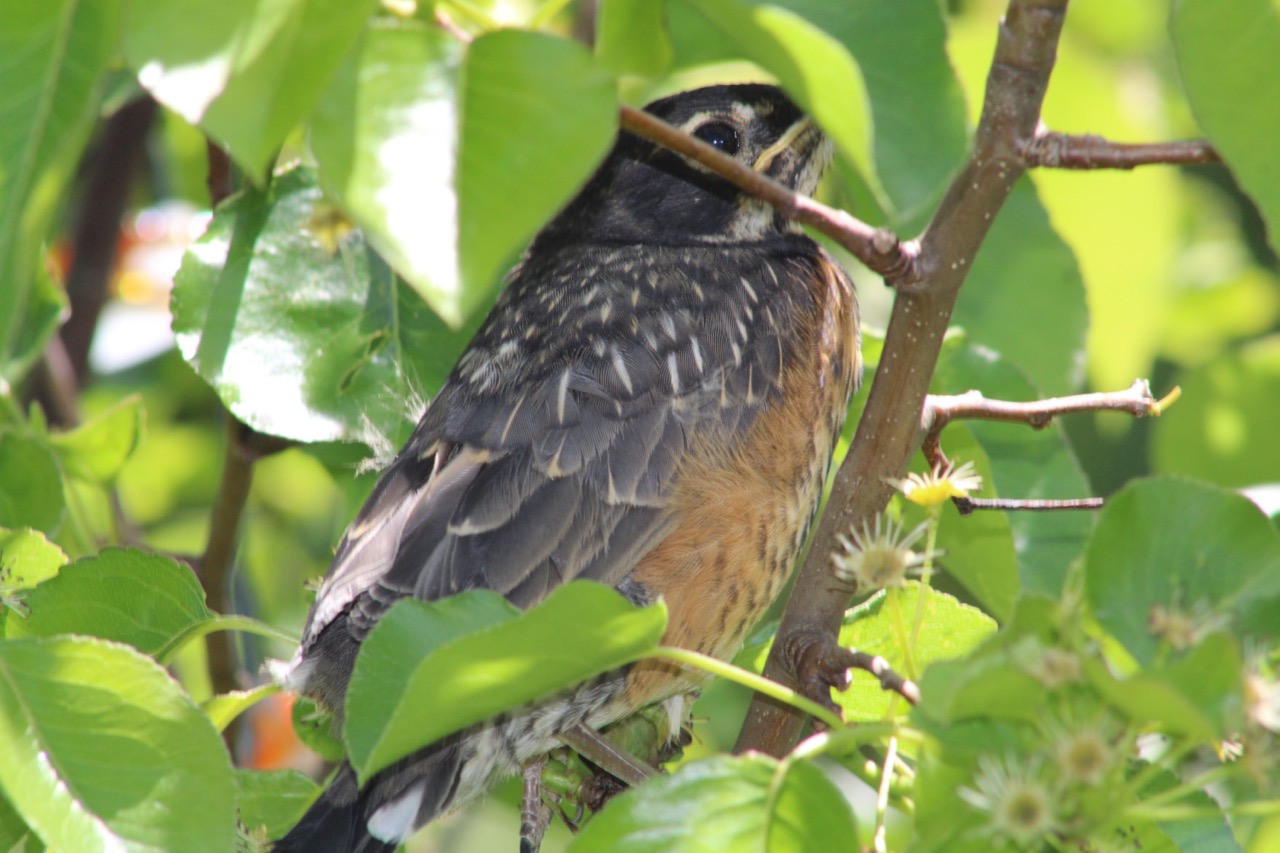
So I looked all over near the fence, and then stood on a little block of wood to see over the fence. There it was! I saw one of them in our neighbor’s young pear tree. It was being quite still and quiet, hiding among the leaves.

Tips of wooden fence showing at bottom, with green leafed tree above, and hidden among the leaves, a baby robin.
Robin fledgling hidden in the leaves of the pear tree over the fence.
Close up of fledgling robin hidden among green leaves on branch of pear tree.
Close up of fledgling robin

I was reassured to see this one on its perch in the tree. I didn’t find the other one, but we have so many trees around our yard that it could be anywhere. When I went back to the fence a couple hours later, this one was gone too. And just like that, no more baby robins on our porch, at least for now. I am assuming they won’t come back to the nest. It has been one month since the first egg was laid. Most of that time they were hidden from sight, but every sighting was a joy. And I am so happy that the robin parents finally fledged their first youngsters!

Robin Excitement

Two baby robin heads peaking up from the nest, under a white beam.
Robins peaking over the edge of the nest!

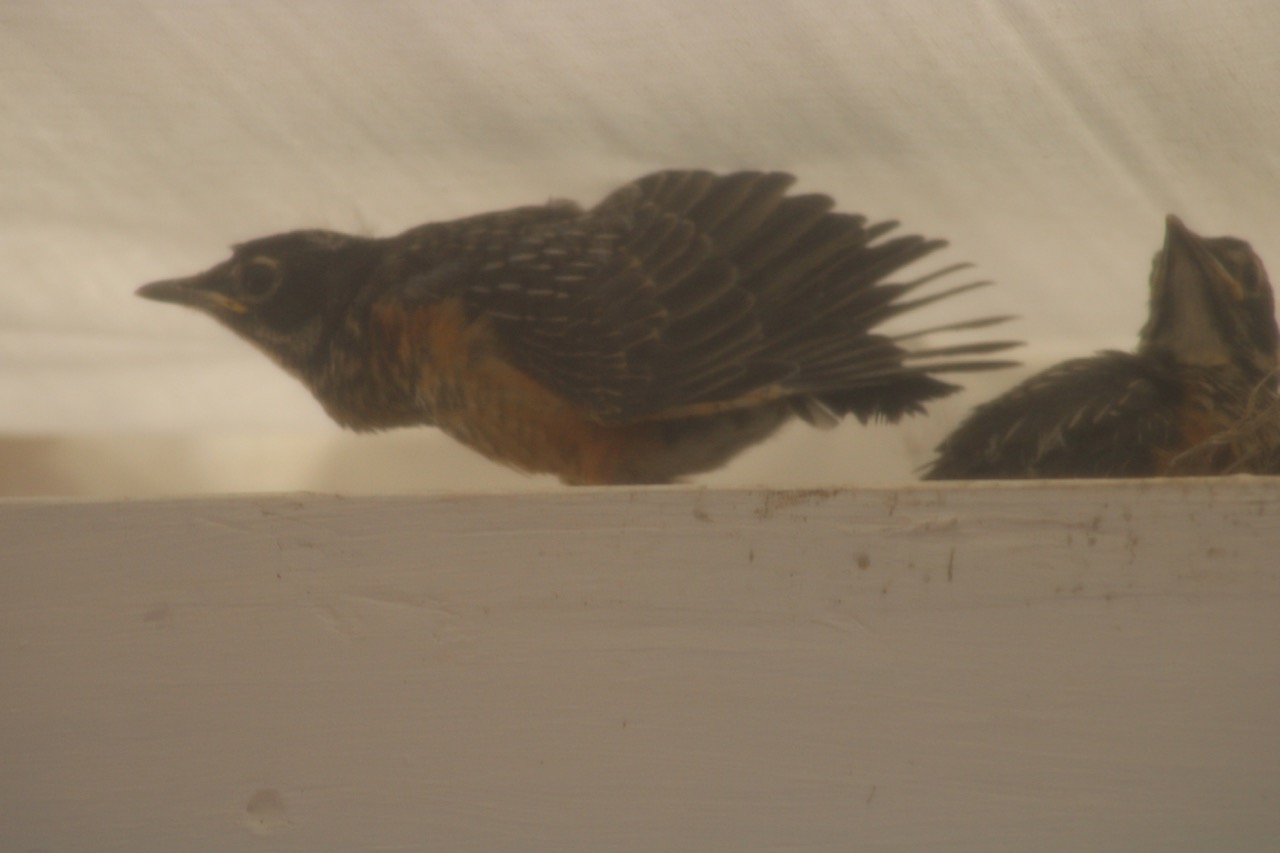
What could be better than to watch baby robins venturing over the nest? Yesterday we saw their little heads popping up and then hiding back down in the nest. Today, they were out of the nest, onto the beam next to it! It is actually two beams with a lower beam between, so they can hide down and lift up there too. They are beginning to try out their wings, and explore the length of the beam. Still clamoring for food from parent! Their reddish color is starting to show. I wonder how long until they flutter a bit further. Can’t be long now.

Two robin heads facing forward, peaking over the edge of a white beam, next to the nest.
Robins peaking over the edge of the beam, out of the nest!
Two baby robins beaks up, one with worm, on beam, parent robin on nest to right.
Parent robin on the nest, babies next to it, eager, one has got the worm.
Baby robin folding its wings, while sibling looks on from the right.
Trying out the wings!

E-book Is Now Available!

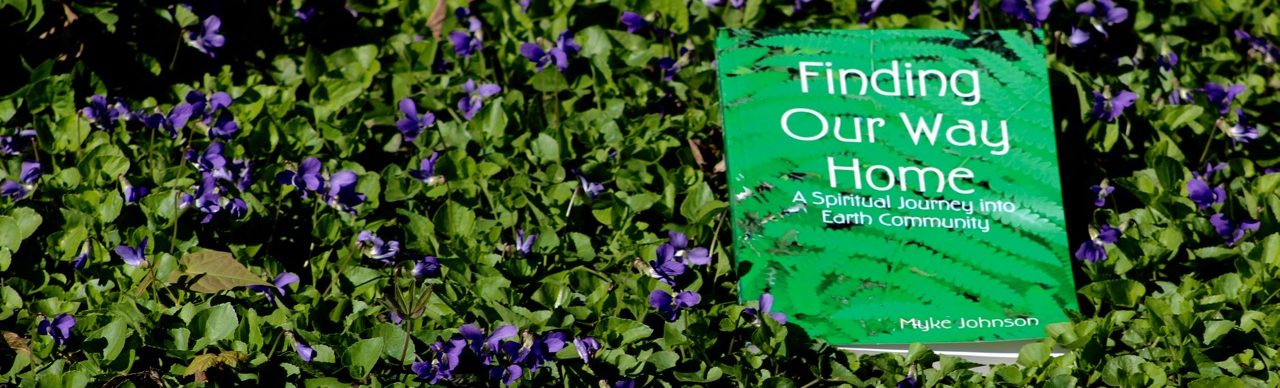
Finding Our Way Home: A Spiritual Journey into Earth Community, by Myke Johnson, front cover photo with cream print, background of green ferns.

The E-book of Finding Our Way Home is now available! You can get an EPUB version at lulu.com for $9.97. (The link should take you directly to the book, or you can search by author and title.) In 3-5 weeks there will also be versions on Amazon, Barnes & Noble, Kobo, and other ebook stores. EPUB is readable on Apple Books as well as Nook, Kobo and other readers.

In 2016, when I first published Finding Our Way Home: A Spiritual Journey into Earth Community, I was happy to use an ecologically oriented print-on-demand source for a paperback format. That is still available for $17.99 plus shipping. I have been told it is the kind of book that does well with slow reading, a chapter at a time, with spiritual practices offered at the end of each chapter. Personally, I enjoyed doing the layout and choosing the typeface, and creating all the formatting. I assumed I would also do an e-book at some point, but with chronic illness and not very much energy, it took longer than I expected.

For some mysterious reason, during the last few weeks, I was inspired to get back to it. The first step was reading “how-to guides” at lulu.com. I had to create a new document and undo all the formatting I had previous used, substituting standard formats. I checked all the internet links that showed up in the notes, to make sure they were still functioning. I also updated the author page, but did not change anything else in the content.

My hope is that this new format will make the book more accessible to more readers, both financially and visibly. I especially want to thank my friend Diane K. for her cheerleading and enthusiastic support. Just a little note to mention that when you purchase directly from the publisher more of your payment goes to me as the author. But another way you can help, if the message appeals to you, would be to leave a review wherever you purchased the book. In the end, most of all, in my small way I want to keep fostering a spiritual journey of waking up to interconnection—to the earth, to each other, and to the Mystery within and between all.

Babies in the Garden

Slightly behind a white crossbeam is a parent robin with two little babies with open beaks in a nest.
Two baby robins with open mouths waiting on parent.

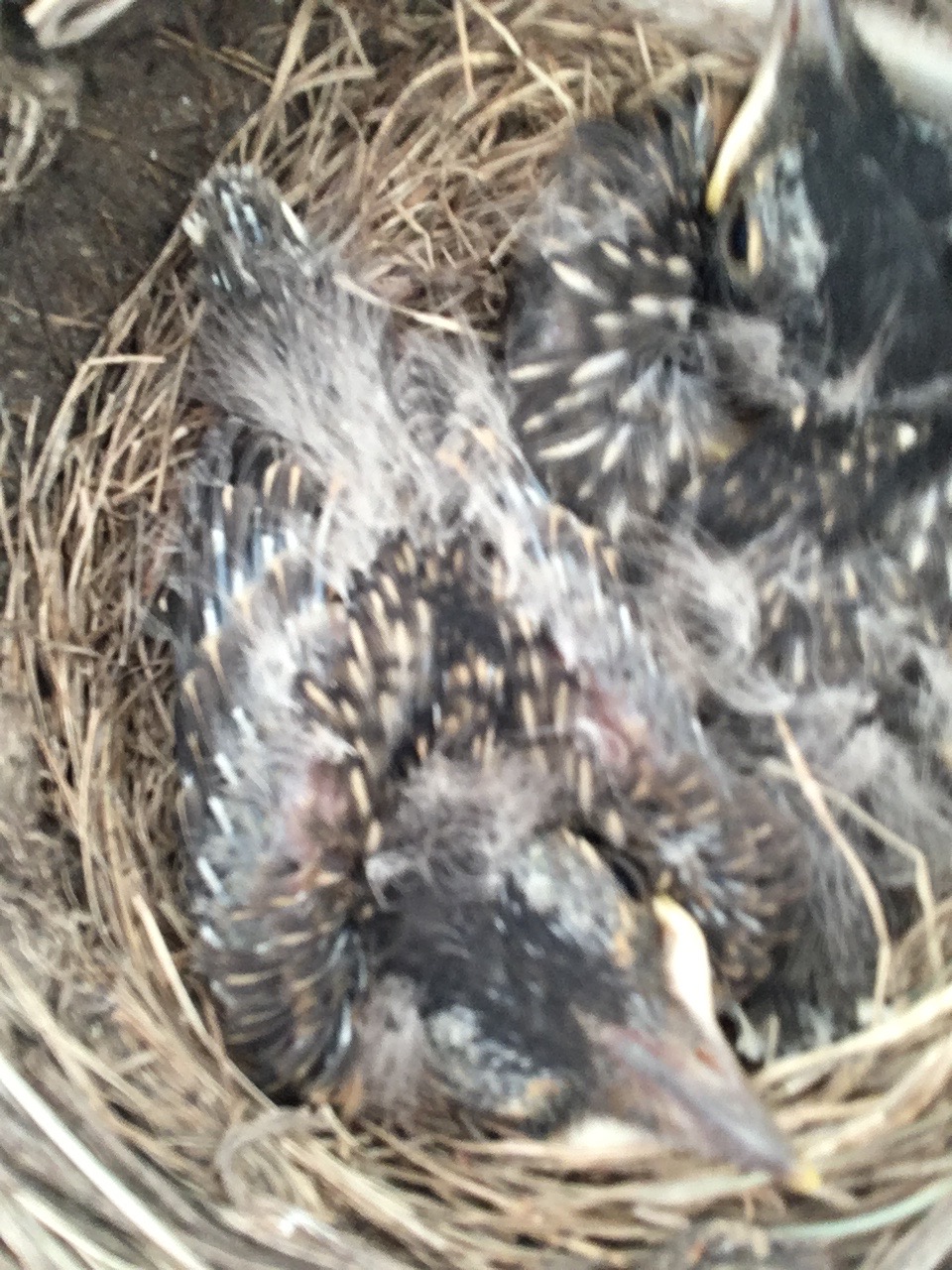
I’ve waited to post about the baby robins because I didn’t want to presume anything or jinx it. But it seems after the mama robin laid three eggs in the nest on our back porch beam, we now have two babies who have feathers and are poking their heads up to be fed. They don’t make a sound, and most of the time they are hiding deep in the nest while the mom and dad go about getting food, or just sitting on top of them resting. When the parents were gone for a bit today, I snatched this “selfie” with my phone over the nest. We mostly try to leave them be and not make a lot of noise on the porch.

Two baby robins, a mass of brown and white feathers with beaks and eyes, barely distinguishable from brown nest.

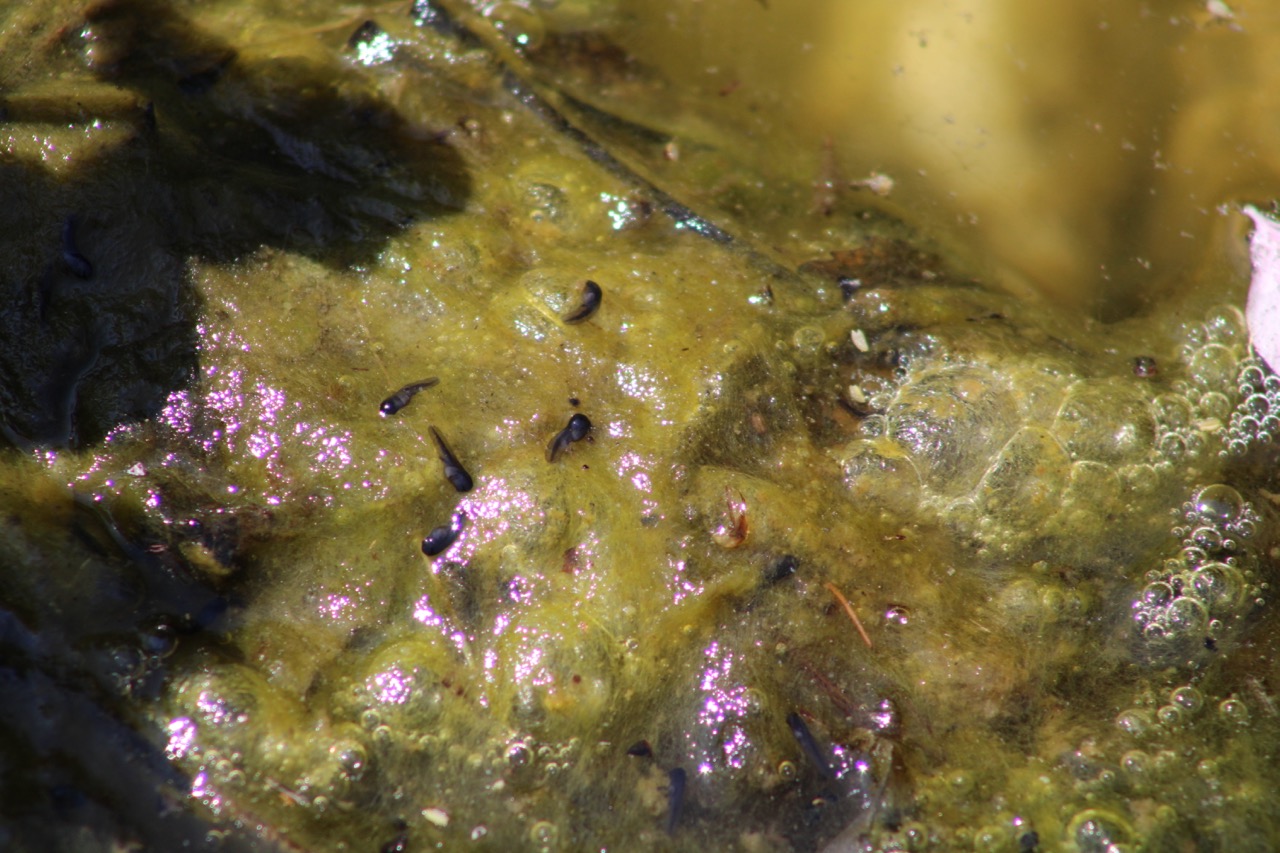
While not as photogenic, I also discovered we have tiny tiny tadpoles in the pond. I was lifting some algae with my net, and uncovered a whole group of them. Here is a close-up, but just imagine them about 1/4 inch from head to tail. Apparently they eat algae, so they must be happy where they are. Hurray! I would guess they are tree frog tadpoles, since the tree frogs have been singing, but I couldn’t find any confirmation of that in online searching–we’ll have to wait until they get a bit bigger.

Tiny black tadpoles in green algae in the pond.
Tiny black tadpoles in algae in the pond.

Finally, I planted some kale and lettuce and broccoli seedlings this morning, after adding more compost to raised bed, then using chopped leaves as a mulch. I put netting over them to deter animal neighbors–it doesn’t keep away cabbage moths, but seems to work for groundhogs and squirrels and such. Plant babies finally in the ground!

Rectangle wooden raised bed with frame and black netting over it, planted with small kale and lettuce.

So Much Beauty

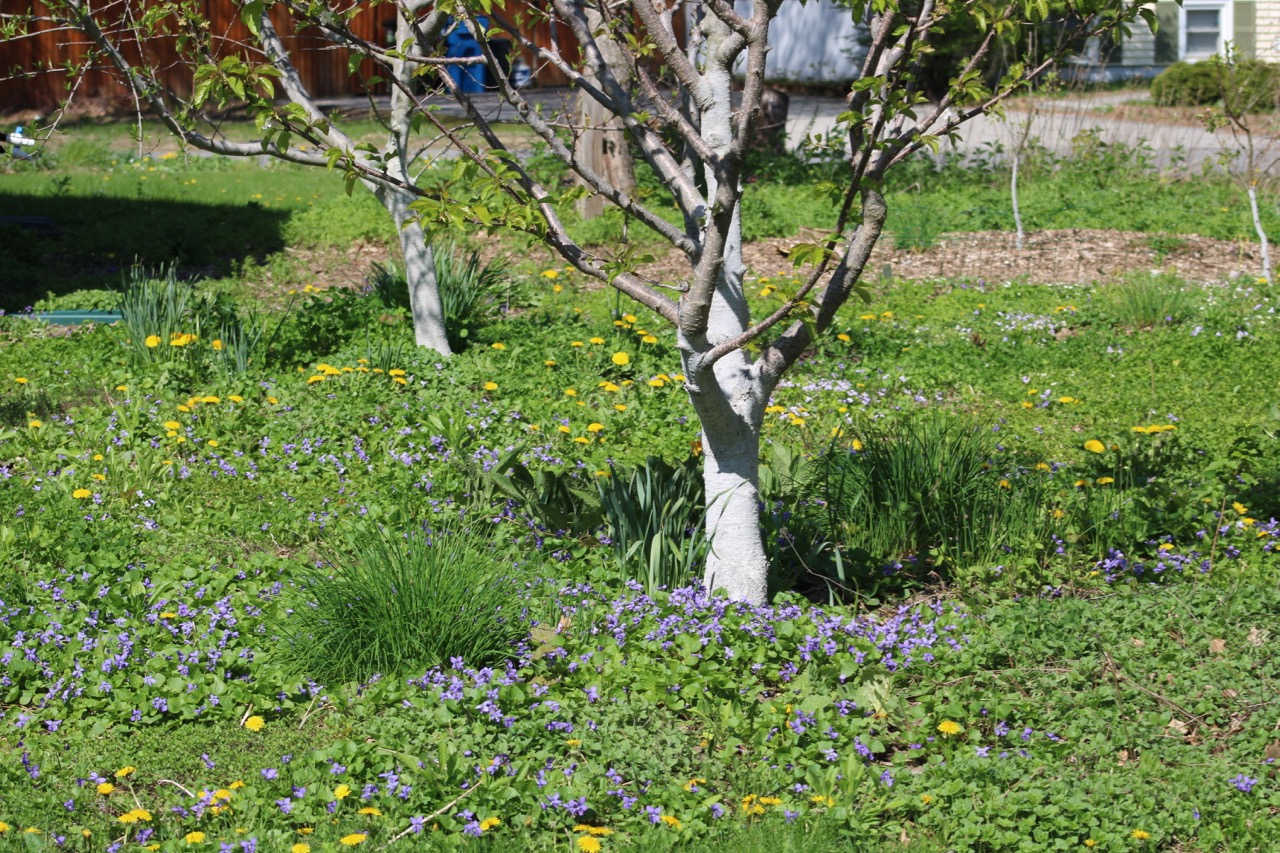
Orchard scene with tree trunks and branches painted white, surrounded by ground cover of violets, dandelions, and chives

I walk through the orchard and marvel at the beauty of violets which have naturalized all over the ground. Dandelions offer a scatter of yellow along with a few daffodils, and clover has spread over the beds and paths in a swath of green. Chives and oregano and thyme are coming up in their clumps. I can’t capture it in a photo, but perhaps the one above hints at how lovely it has grown, mostly all on its own.

The cherry trees actually now have a few blossoms–maybe a dozen new buds have opened after initially all of the buds were empty. Not enough really for a fruit crop, but I wanted to note it. However, our Honeycrisp apple tree is covered with buds, for the first time. Maybe this will be the year of our first apple harvest?

I haven’t tried to do any veggie planting yet. Mostly I just walk around enjoying how the wild flowers shine in the sun. Yesterday I lay in the hammock reading for a while, and we had a lovely visit with a friend by the pond. We haven’t seen any tree frog eggs there, despite the repeated singing in the night. It is all a process of discovery–will they choose our pond or not? Meanwhile, the marsh marigolds have bloomed! My favorite flower colors are yellow, blue, and violet, so right now I am in paradise!

Marsh marigolds have yellow buttercup style flowers on tall stems, with round green leaves. the background is pond water with out of focus reflections of trees.
Marsh marigolds in the pond.

Empty Buds

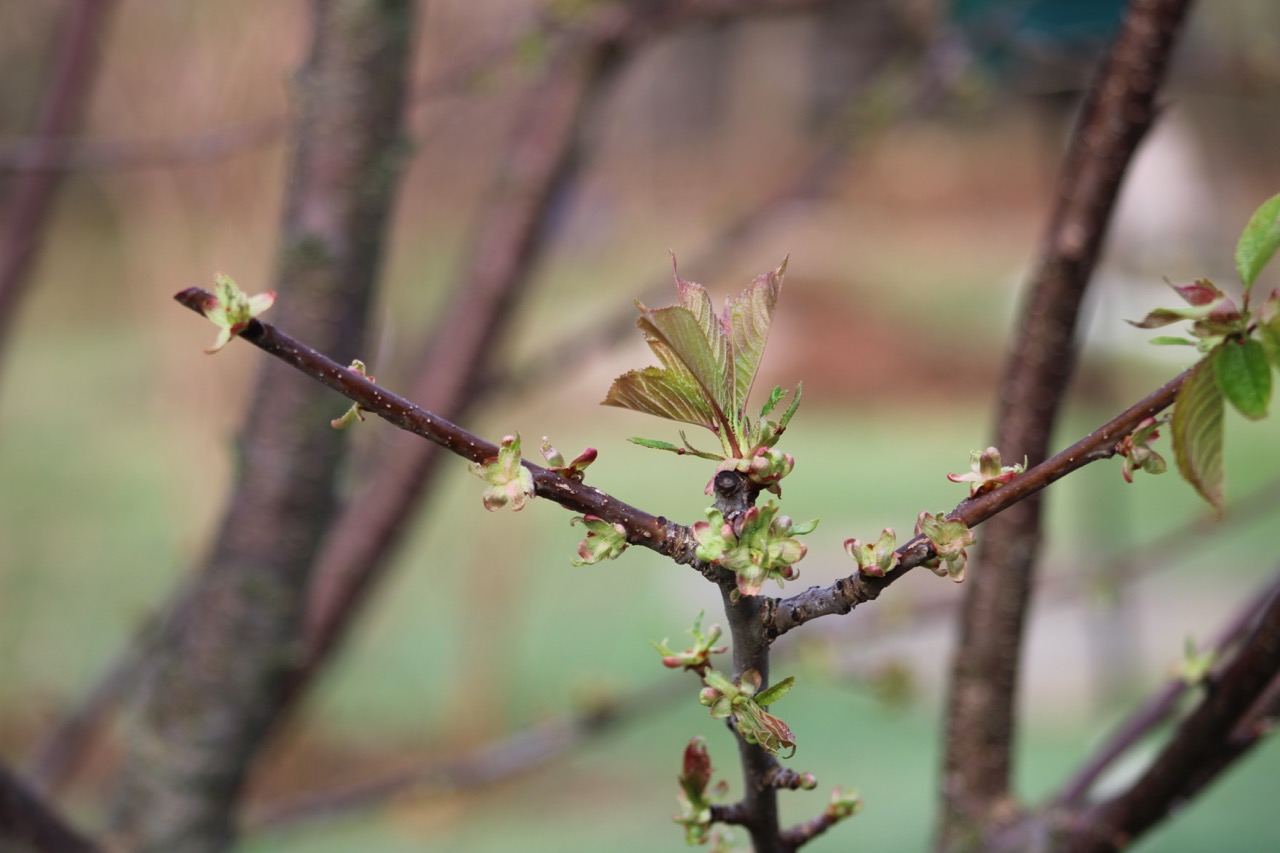
Branches against blurred green and brown background, with small leaves, and small empty buds opened.
Cherry tree open buds are empty.

The cherry trees and peach tree have no blossoms on them at all. The cherry trees had the buds that should open into blossoms, but when they opened, they were empty. At first I worried that I’d done something wrong. But on connecting with other gardeners in Maine I learned that many people are facing this problem with all their stone fruits. Apparently, the most likely cause is the weird weather over the winter, with mild times alternating with a deep freeze. They didn’t stand a chance.

I feel sad about it–there were really so many buds on the cherry trees this year. In prior years we just had a very few blossoms, and I was hopeful that this year we’d see our first real fruiting. I also feel glad that the leaves are opening–I heard that some people’s trees actually died. I am glad ours are alive. But this is a lesson about climate change. Global warming increases the unpredictability of the weather, and the temperature swings are part of that. What food we can grow becomes more unpredictable.

We don’t rely on our little garden for our food–we are really just learners in this process. When we get a harvest, it is exciting–and thankfully, we still have peaches from last year’s abundance in our freezer. It looks like the blueberries and raspberries will be fine. I’ve already eaten sea kale and some asparagus. But I can feel the vulnerability of what it means to face a shifting climate, even in these small ways. How many larger ways are unfolding all over our planet? Severe heat and drought in many places, floods in other regions. For too many people actual starvation is real. I feel so powerless in the face of these huge problems.

When we first moved to this place, our hope was to form a deeper connection to the earth and all her creatures, through our connection to this small piece of land. I have to say it isn’t easy. We know so little, and we are surrounded by challenges larger than we are. For just one example, Margy spends hours pulling and cutting invasive plants around the borders of our land–Asian bittersweet, multiflora rose, Norway maples. The way it is with invasives, that job will never be over. Plants have their own personalities, and some are very aggressive even if they are native plants or desired plants, so there is the endless pulling and pruning to keep things in some sort of balance. (Oregano and wood anemone, I’m looking at you! Everywhere!)

But maybe these are the lessons we are learning about making a deeper connection to the earth. Plant by plant is the only way we get to know them. Whole Indigenous communities were needed to foster the balance of all beings, and we are just two old non-Indigenous humans. Some of our neighbors seem to be in a similar venture to ours, and others seem just the opposite.

Still, I have to hope that the love we offer to this place can be a small seed of healing, maybe even its own “aggressive” form of healing, spreading into the broken places. I draw hope from the birds who seem to multiply and who enjoy the yard so much. I draw hope from the violets blooming everywhere they want to bloom. I draw hope from the turkey who visited the other day and made a dust bath in the patchy lawn. There is something so wonderful about a community of creatures who share one place.

Turkey sitting on patchy grass.

Robin’s Nest

Hazy picture of a robin's egg peeking out of a nest between white beams, with cream colored shade cloth behind.
Robin sitting in the nest this morning

It was a quiet week, the robins had finished the nest, but were elsewhere in the yard. But this morning, one of them has come into the nest and has been sitting there a long time. I took a lovely little walk around the yard, just to look at things. There was a sparrow taking a bath in the shallow beach of the pond. The spice bushes were covered with tiny yellow blooms. I greeted the old pine, and the cedar tree, and the pitch pine. The sea kale has emerged, along with rhubarb leaves. The daffodils were blooming.

After breakfast, I went back outside–it is cold and gray today, with rain expected later, but I thought I might just do a few things. After reading some more information on pruning, I finally tackled that aspect of tending to the little apple trees, as well as I was able. Then I transplanted some chives and thyme to keep the baby trees company in their circles–companion plants.

After I came in, I saw the robin wasn’t in the nest, so I went out to check, and was delighted to find this: one blue egg. She came back a short time later, and is sitting there now. After last summer’s disappointments, I know there are no guarantees, but today is a day for hope. May the robin family be blessed with young!

Blue robin's egg in brown nest grasses.

Breeding Tree Frogs and Robins

Tree frog with nobbly skin, perched on rocks with water of the pond visible on the left
Tree frog male, getting ready to sing his mating trill

Our first frog sighting in the pond yesterday, April 15! Much earlier than the last two years, when the first frogs came in June or July. It turned out to be a tree frog, rather than the green frogs that we’ve seen in prior years. We figured it out because in the afternoon, when my friend Francesca and I were sitting by the pond for a visit, suddenly, he sang the most amazing trilling sound, his white throat patch blowing out and in. And I remembered that Margy had heard that sound earlier in the day. Then, yesterday evening after dark, the night air was awash in these trilling calls, from all directions. A little internet searching identified those calls as tree frog mating calls.

Tree frogs live in trees, like their name suggests, and hunt on land most of the year, but they breed in water, in ponds and vernal pools. So maybe, just maybe, we’ll have some tadpoles to grow in our pond this spring. I learned that they eat algae, so that is another good, because our pond has got a bit too much algae in it. So exciting!

The other adventure of breeding is that of our robin pair. Even after three failed attempts to rear live young from eggs in a nest on the beam under the clear roof of our back porch, they were at it again, bringing nesting material to the same spot. That spot was just too hot in summer. It was so sad. So, first I tried telling them to go somewhere more suitable! Then I tried taking out the grasses to discourage them that way. But they kept at it. So then, I had a totally alternative idea. What about making something to shade that corner of the clear plastic roof? So it wouldn’t be so hot. This morning, I searched around and found some old cream-colored sturdy curtain material, and cut it to fit. Then I got up on a ladder and stapled it tightly to the wooden crossbeams.

I have already seen the robins return with more nesting material, so maybe they’ll put up with the changes to their location. After all, I had also painted the beams last fall. Now I am hoping that it will be enough–that the shade will keep the spot from getting too hot, that the robins can finally have a little family, in their chosen spot. And can I say that my heart is filled with joy after this little project? Some kind of ecstasy to help a fellow inhabitant of this place, to live together in mutual reciprocity.

A square of crossed beams, painted white, with a cream colored shade cloth over the top, and grassy nest material showing above the lower beam.
Robins’ nest beginnings under the shade cloth

Apple Tree Transplant

Blue Pearmain Apple small tree with wood chips on ground around it, and a garden hose lying nearby.
Blue Pearmain Apple transplanted into new spot

Four years ago I attended an apple grafting workshop, and created four grafted plants to bring home. I planted them in a “nursery” bed in the orchard, a Black Oxford variety in the center to remain there, and the others to later transplant. The root stock was called M111, a semi-dwarf variety. But I wasn’t sure where to put them, so it has taken until now before I transplanted any. Two didn’t survive, but today I move this Blue Pearmain variety about 12 feet over to a new bed.

Both of these are heirloom varieties for New England. According to Fedco, Blue Pearmain is a fall/winter apple, “our favorite for baked apples—it was made to be stuffed. Moderately juicy flesh, firm, dense and slightly crisp, sweet with a bit of a tart background flavor. Incredibly beautiful medium to very large fruit is streaked and splashed with purplish red, mottled with russet and covered with a distinct dusty blue bloom. In a pie, it has just enough firmness and a good balance of sweet and tart with hints of pear. Tart coarse yellow sauce cooks up in a couple minutes. Tasty eaten out of hand. One of New England’s most famous varieties. Mentioned by Henry David Thoreau as a favorite in his wonderful essay “Wild Apples.” Grown throughout much of Maine for well over 200 years. Massive trees still found here and there. Keeps in the root cellar until midwinter. Blooms midseason.”

Black Oxford was created from Hunt Russet x Blue Pearmain, in Paris, Oxford County, Maine, about 1790. A winter apple, “this outstanding apple, a favorite long ago around much of Maine, has made a huge comeback. Medium-sized round fruit, deep purple with a blackish bloom. From a distance you might think you’d discovered a huge plum tree. Excellent pies, superb late cider. Leave the skins on for a delightful pink sauce. Best eating late December to March, but we’ve eaten them in July and they were still quite firm and tasty. They get sweeter and sweeter as the months go by. Good cooking until early summer. Some insect and disease resistance. Unusual light pink blooms early to midseason.”

According to the Holistic Orchard, Black Oxford is “A rare treat reminiscent of an exotic tropical fruit; exceptional sauce apple, stunning drying apple.” It is slow to come into bearing, but resistant to insect problems. It can tend toward biennial bearing. Ripens in late October into November.

Even though they are four years old from grafting, they still seem like baby trees to me. I still need to do some pruning to help them find good shapes. But I am excited that I was able to get the Blue Pearmain to a spot it can remain. This past winter, one of our old ornamental crabapples fell in a storm. The one that is left leans heavily toward the road, and we’re imagining that it might not survive for long either. So this Blue Pearmain is positioned about half way between the Black Oxford and the crabapple. As it gets larger, eventually the crabapple might not be there. But in the meantime, it won’t cast any shade and they should both do fine. I still need to do some weeding and probably use cardboard to keep unwanted plants from growing too close to the tree. It had been on the edge of our friend’s herb bed that she is not using so much anymore.

It feels so good to be outside, to be tending to plants, to be celebrating the spring!

Two small apple trees growing close together with other trees in the background, and light green beginning to cover the ground.
Before: Black Oxford (left) and Blue Pearmain where they were growing close together before I transplanted the Blue Pearmain. There is a Honeycrisp tree exactly behind the Black Oxford, a little bigger.