Balance in the Garden

Raised bed with wooden sides, on left are pea plants on string and bamboo, middle is broccoli seedlings surrounded by pine cones, wire fencing around edge.

This earth love is a balancing act. We love critters in the yard, after all, they live here too, and have the right to be here. They bring so much joy to us. But we want to grow food too. The last time we bought organic broccoli at Hannafords, it was $8 for one crown. These twelve broccoli plants in this raised bed will be very valuable food for us. I’ve also planted cucumber seeds here. So we try to use gentle methods to discourage the critters from eating the plants we want for our food.

Margy saw a groundhog poke its head up out of a hole in the grass, over near the fence. There was a burrow underneath where a spruce tree fell before, and after it was removed there was still a mound of old roots and dirt. Groundhogs can be the worst for eating garden food, despite how cute they are. At times, we’ve used human pee to mark a line around the beds. Last year, we covered that bed with an old screen tent to protect the kale–and it did. All of it is a kind of communication, with respect.

This year, I am trying out a new method for deterring critters from the garden bed–putting pine cones in between the plants as mulch. (I saw it on Facebook.) Apparently many critters do not like the prickly feel of the pine cones under their feet–and these pine cones are very prickly. They come from our pitch pine, and we have tons of them everywhere. Margy had a bag full of them in the garage, so I used those first, and then started twisting them off fallen branches under the pitch pine. I had to wear gloves to do it, that’s how prickly they are. I’m putting them in the hugel mound as well.

We’ll see how it works.

In the meantime, in critter news, a few days ago we saw a mother turkey walk through the yard with about ten baby turkeys. Ducks stop in to take a dip in the pond. The frogs hang out there, and the tadpoles are getting big. They like to linger under the lily pads. The robin has four new eggs she is incubating. The chipmunks fill up on sunflower seeds at the bird feeder, but are also eating the maple seeds that blew all over the yard.

And sometimes, beauty emerges in unlikely ways–this is a dandelion after the rain washed away all the fluffy seeds. A perfect star.
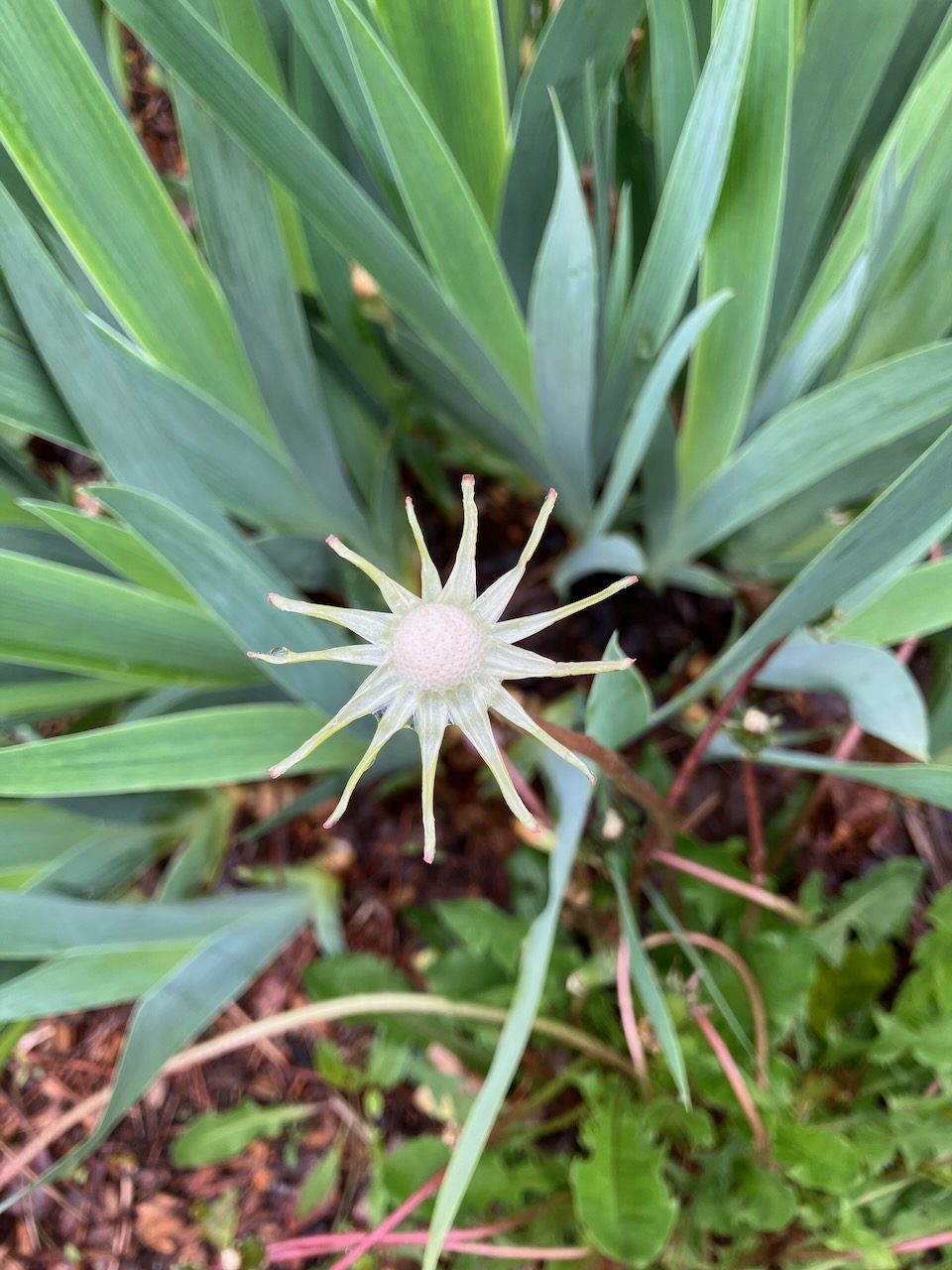
a white star shape of a dandelion plant, surround by angular green iris leaves.

River Otters at Evergreen Ponds

River otter eating a fish, within a small rock enclosure in the small pond.

Our area of Maine loves nature news. So when we heard in the news that there were visiting river otters in the ponds at Evergreen Cemetery, we joined many other Portland residents to go to the cemetery to see if we could see them. And we did! We saw this one in one of the small upper ponds, diving under the water to fish, and then emerging in this little rock cave to eat. We also saw one in the big pond, walking on the iced areas in between diving beneath the open water to fish.

River otter on the ice near a thawed opening in the water.

It has been a while since we’ve been to the cemetery. I used to walk over to these ponds frequently, but haven’t had the energy for an hour-long walk lately, so we drove over this time. Sometimes it is wonderful to be alone in the natural world, to see the secrets of plants and animals revealed to a quiet human visitor. But sometimes it is just as wonderful to be with other humans who love these secrets, and can’t resist our animal relatives. There is a sense of kinship with each other, we chat about the sightings, we notice how skilled the otters are at catching fish, we share our tales with new arrivals. There are children and elders, and every age in between. Outside with each other.

Finally, when the otters had hidden behind the back of a little island, I took a walk around the big pond, carefully making my way over tree roots. I couldn’t resist also taking photos of this lovely blue heron–much easier to catch than otters, since it likes nothing better than standing still on its perch on the log.

Great blue heron standing on one foot, perched on a dead log in the pond.

When we first arrived, before we saw the otters, I also happened to catch her scratching her head. Maybe wondering about the sudden abundance of humans wandering around her pond. But not letting that disturb her equanimity and perfect balance.

Blue heron scratching her head, while standing on a log in the pond.

May our animal relatives find all they need to thrive that they may live long upon the earth. May we human animals wake up to our interconnection with all beings, that we may find a way to turn from destruction to mutuality.

I Walk in Passamaquoddy

I have had the privilege of studying Wabanaki Languages this fall, taught by Roger Paul. For me it has been a small way to begin to decolonize my mind–to begin to think differently.  Our final project was to make a short presentation to our class, and I was inspired by the words we had learned to talk about the animals I see and hear on my morning walk. I also drew on the Passamaquoddy/Maliseet (Wolastoqe) Language Portal for further help with verb and noun forms, and I learned some new words along the way.  If any speakers of the language read this, edits are welcome! Roger encouraged us to jump in with using the language, even though we will make mistakes. 

For those who do not know about Wabanaki languages, you might find it interesting that animals are not referred to as “it,” and people are not referred to by “he” or “she.”  There are “animate” and “inanimate” forms, and both people and animals are referred to by animate, non-gendered verb and noun forms.  A lot of information is encoded into one word.  So, for example, “npomuhs” means “I walk.”  “Nutuwak” means “I hear (beings plural and animate.)

Ntoliwis Mayk. Nuceyaw Portland.  (My name is Myke. I am from Portland.)

Spasuwiw npomuhs. Wolokiskot.  (In the morning I walk. It is a beautiful day.)

Nolokuhs lahtoqehsonuk.   (I walk in the direction of the north.)

Nutuwak sipsisok.   (I hear small birds.)

Nomiyak mihkuwiyik oposik.  (I see squirrels in a tree.)

Apc, nolokuhs cipenuk.   (Next, I walk in the direction of the east).

Nomiya kisuhs musqonok.  (I see the sun in the sky.)

Nutuwak kahkakuhsok. Tolewestuhtuwok.  (I hear the crows. They are talking)

Nomiyak oqomolcin kehsuwok nehmiyik awtik.  (I see eight turkeys in the street.)

Apc, nolokuhs sawonehsonuk.  (Next, I walk in the direction of the south.)

Npomuhs sipuwahkuk, naka nomiya motehehsim sipuhsisok.   (I walk along the edge of the brook, and I see a duck in the brook.)

Nutuwa pakahqaha lamatokiw.  (I hear a woodpecker a little ways into the forest.)

Wahte, nomiya qaqsoss.  (In the distance, I see a fox.)

Apc, nolokuhs skiyahsonuk, naka ntapaci nikok.   (Next, I walk in the direction of the west, and I come back to my house).

WoodchuckNomiya munimqehs kihkanok. N’ciciya wot.   (I see a woodchuck in the garden. I know this one.)

Coness, Munimqehs! Musa micihkoc kihkakonol! Wesuwess!   (Stop, Woodchuck! Don’t eat the vegetables! Go back where you came from! )

Munimqehs qasku. Qasku asit kakskusik. Qasku lamatokiw.   (Woodchuck runs. S/he runs behind the cedar. S/he runs a little ways into the forest.)

Toke, ntop qotaputik qocomok.  (Now, I sit in the chair outside.)

Komac Wolokiskot! Woliwon!   (It is a very good day. Thank you)

Opossum sighting

Opossum

The photo came out a little blurry, but I was delighted to catch a glimpse of this little opossum neighbor, while I was sitting in the screen tent a few mornings ago. When it saw me, it speeded up its walk near the underbrush at the back corner of our yard. I understand that opossums eat ticks, among many other things, so I was glad to see it our neighborhood.

Reading more about them, I learned that they can also eat food from bird feeders and fruit trees.  They are nocturnal.  It will be an interesting balancing act–we intend to grow food for ourselves, yet we also love the critters that show up in this space we share. But perhaps that is the heart of the question–how do we live as neighbors in this land, rather than colonizers/occupiers/dominators?  How do we care for our own needs, while also caring for the needs of other beings on this earth?

Consciousness is an Attribute of Being

Remember the sky you were born under,
know each of the star’s stories…
Remember you are all people and that all people
are you.
Remember you are this universe and this
universe is you…
Remember.
                                   Joy Harjo

I think it was Laguna Pueblo author, Paula Gunn Allen, who said it, but now I can’t find the original quote. She said something like this: “Many people think of consciousness as an attribute of being human, but we know that consciousness is an attribute of being.”

I have been intrigued and transformed by her observation. What might it mean that human beings are not alone in perceiving, in awareness, in communication? Sometimes the scientists ask those questions about beings most like humans—the apes, the dolphins, the dogs. But beyond that—and not even merely for beings with eyes as we know them? I think about it. Trees are sensitive to light and plants turn toward the sun. Isn’t it less lonely to imagine that trees, birds, water, and stones are conscious, too.

Our culture has wanted to feel that human beings are unique. That we are above the rest of the created world, special. Even in our growing ecological understanding there is a sense that we are the privileged children of the universe. I think it was Carl Sagan who said it, though many ecologists have echoed the sentiment: “We are the universe becoming conscious of itself.” And it is a tremendous gift that we are able to perceive and explore and study the universe of which we are a part. But how do we know that we are the only ones? How do we dare to assume that we are the only ones? Why would we want to be the only ones?

I want to stay with this thought for a few days, and see what changes if we change that one assumption.  If we open to the idea that being itself includes consciousness.

Photo by Margy Dowzer

Photo by Margy Dowzer