September Musings

Four huge turkeys in the shade of some green grass, behind leaves of zucchini in the front corner of the photo

The summer garden had some successes and some fails. And it is sometimes hard to tell which is which. This turkey family visited the yard many days, and walked through the garden beds in the back. They mostly left the veggies alone, except they liked to eat the tops off the bean plants. We still got a few beans even so. And they left alone the zucchinis, which did well, the cucumbers which did fair, and the broccoli, also fair. We appreciated their visits–we want to support wildlife after all.

However, we tried to lessen our support for the chipmunks and squirrels that became such little rogues. Despite netting over the blueberries, once they figured out they could squeeze holes into it, they got the rest of the blueberries, though we did get a bunch before that. I am happy to say that the baffle on the bird feeder totally worked. They never got up to the feeder after the baffle was installed. So I am hoping that without all that extra food to stash, the population won’t explode like it did this year. The long game. And the birds keep coming back to the feeder.

In the front yard, we never had monarchs lay eggs on our milkweed plants, despite their visit. Maybe next year? The netting on our kale and carrot bed was a great success. It protected the kale from cabbage moths, and no one tried to get into it. We have a ton of kale harvested and still to harvest.
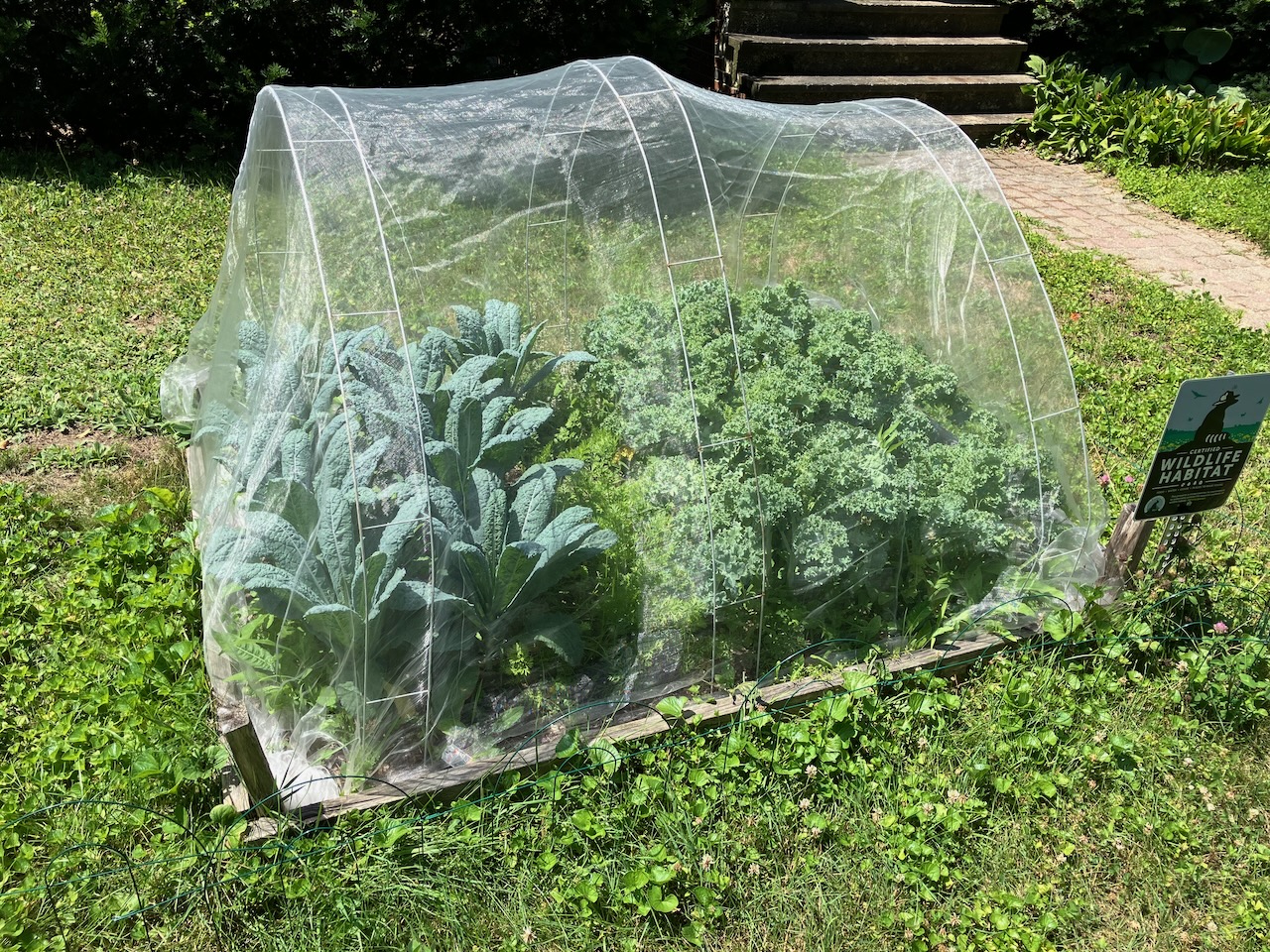
Rectangle garden bed filled with green kale of two kinds, covered over with a translucent net on white metal supports.

The robins never came back to their nest on our back porch after the babies had been attacked. Still so sad about that. We’ve had some lovely visits with human friends out by the pond. The pond water level went down with the drought, but this weekend’s rain helped, especially after adding water from the newly filled rain barrels. Still a few frogs, though I am not sure about the tadpoles. They hide under the lily pads, and it’s a lucky day to see them.

And… and… and… Gaza is still being attacked night and day, and starved by blockades. International resistance is growing but too slowly for the people killed each day. I keep bearing witness, and praying. It’s the same with the rising fascism of our country, and the attacks on immigrants both documented and undocumented, and citizens who are brown or black or speak Spanish. The only thing that gives me hope are the multiple levels of resistance from huge demonstrations to lawsuits to governors who slap back. Here we do the best we can to get by, day by day, accepting our situation as elders and those who are chronically ill. In the face of so much cruelty and hate, we add our little love to the mix, hoping to be part of the larger Love which is our only real hope.
Fighting with Squirrels (and Chipmunks)

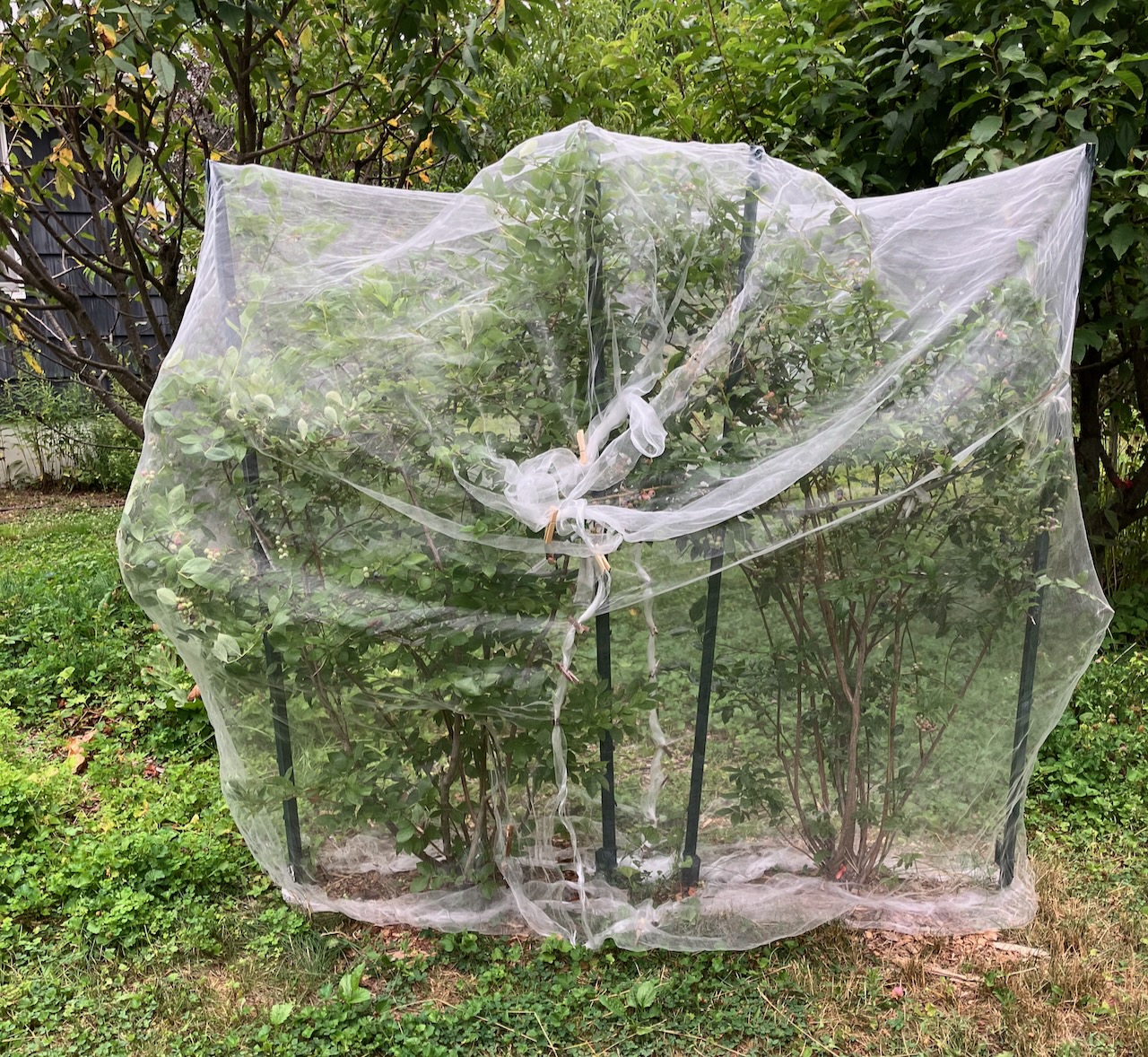
White netting draped over two blueberry bushes, using fence stakes

The intent of our permaculture gardening is to create a mutually beneficial relationship with the earth and all her creatures. But lately, it feels like a little backyard battle. The squirrels have literally eaten all of the green peaches off our peach tree. (Last year there seemed to be enough for all of us.) They have been also eating raspberries, hazelnuts (still green) and mulberries, but I sort of gave up on all of those. I have tried to protect these two blueberry bushes by covering them with netting, garden-stapled down, and using clothes pins to close the side opening. I have actually harvested some blueberries. But the last couple days, they’ve pushed their way through holes they make in the netting. When I see them, I run out yelling and clapping, and they dart around the edges to find their way out and run away.

To be fair, there is another variable this summer. I stopped filling the bird feeder some weeks back because the chipmunks would immediately climb up, fill their cheeks, climb down, and transport the seed to their underground lairs; and then repeat until all the seed was gone. The squirrels also took a fair amount. I wonder if the sunflower seeds were the tribute I had been paying to our little neighbors that ensured that they’d save us a few peaches? But yesterday, perhaps I upped the ante, because I installed a baffle on the feeder, and coated the pole with coconut oil. I really do want to feed the birds, not all the greedy chipmunks and squirrels. So here is the new set-up, (the bush is at least five feet away–I pruned it to make sure):

Green metal bird feeder with clear plastic baffle a few inches down, in front of a green bush background.

Margy and I have a little side bet going as to when they might be able to breach these new security measures. It has been up for twenty-four hours so far. No squirrels, chipmunks so far. But the birds haven’t come back yet either. The next few days will tell. And in case it isn’t easy to see, the original bird-feeder is also “squirrel-proof,” with a weight dependent bar that drops down to close the seed opening. But they figured that out long ago. They are so smart, and acrobatic. In many ways I love them. But I don’t love that they take all the fruit in our garden.

Anyway, I just needed to write about this other side of gardening. I am so impressed by the work farmers do! If we relied only on our own gardening skills, we would go hungry. But perhaps this is one of the lessons I am learning about how to be in a mutually beneficial relationship with the earth, and during climate warming too. We are all under a lot of stress, trying to survive. We don’t have complete systems in place, we don’t have our own ancestral knowledge, we are trying to recover from great imbalance. So we keep showing up, keep going outside, keep being grateful for the gifts of the earth.

And these days, I can’t write about anything food-related without also expressing rage at the intentional starvation of the Palestinians in Gaza by the state of Israel. They destroyed their farms and gardens, and destroyed access to water, and access to help from outside. How many more people will die before the world powers stop this genocide?

First harvests

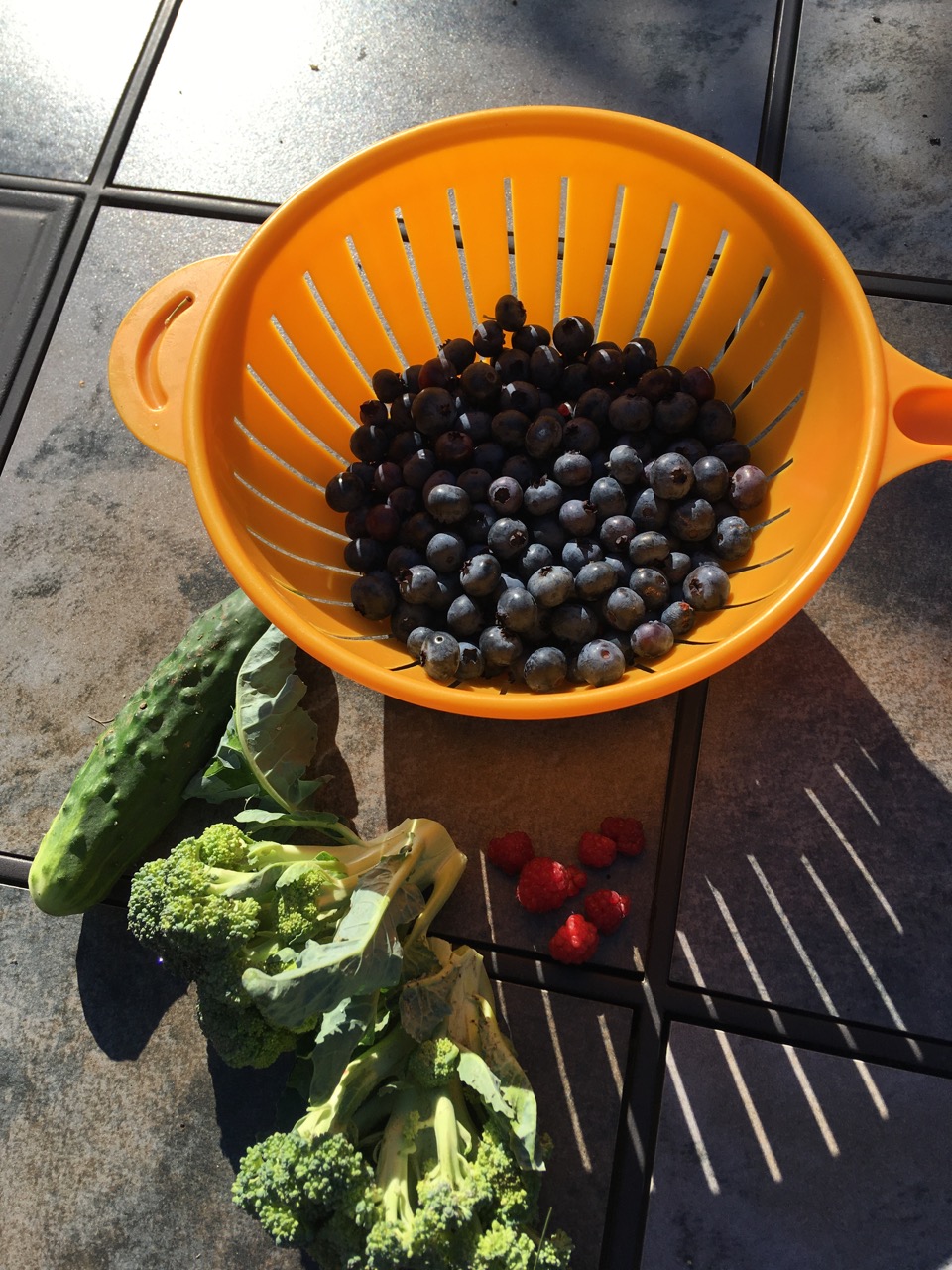
Orange slotted container with blueberries half full, and small cucumber, cut broccoli and a few raspberries.
Blueberries, cucumber & broccoli

In the excitement of the fledgling robins, I didn’t post about our Lammas harvest. The photo is of our fruit and veggie harvest of August 1st. It has been a great year for blueberries! We have also harvested some kale–there is more that wants to be cut today– some zucchini, some raspberries, and more cucumbers. Lammas is the first harvest festival of the season, and I am grateful and amazed that despite all our limitations, we actually receive food from this land.

We can’t control anything about this land. We can’t control what plants will thrive each season–no cherries or peaches this year, for example. But in partnership with the land, in our belonging to the land, these moments of yield emerge. So grateful!

The Gifts of Birds and Berries

Blueberries and raspberries from our garden

Right now the garden is happy with berries: the raspberries are loaded with fruit, and this is the first year for a blueberry harvest. We planted these blueberry bushes in 2017. This year, I put up some fence posts and draped the berry bushes with gauzy fabric after the berries started to form. (Tried it first without the posts, but the weight bent the bushes over when it rained.) This is to keep the birds from eating all the berries. But we have three younger plants in the back that I left open. And the raspberries do fine on their own. So every other day, I go out and pick a bowlful of ripe berries.

Blueberry bushes wrapped with tulle fabric

The fabric barrier is a bit ironic really. I don’t mean to discourage the birds at all. But expert gardener’s advice says that they will eat all the blueberries before we can. I think of myself as a very novice gardener. Our garden only provides us with a very modest harvest. Last year the squirrels took all the peaches, and cabbage moths are now eating a lot of the kale. I have given up on the idea of creating a food forest that will provide all our needs. This year, I haven’t had the energy to give any of it much attention at all.

But somehow, in the midst of it all, the garden keeps giving back to us in unexpected ways. The orchard has become a bird heaven. We now regularly see cardinals, a robin couple (who, after two failed attempts, are again playing with the nest on our porch), gold finches, house finches, sparrows, chickadees, catbirds, starling visitors, not to mention the turkey mom and her two babies that keep coming through, and so many more. The small birds love perching in the fruit trees–and I love seeing them there. They ate the few cherries, which I didn’t try to protect. I think they are also eating a lot of bugs. They even love perching on top of the stakes in the zucchini bed. We provide sunflower seeds in the bird feeder, and they planted sunflowers all around it with the droppings. So we are gifted with all this beauty.

Sunflowers in bloom around a green bird feeder with a small sparrow on it.

This has been a summer of much gifted beauty. Another example is the wild evening primrose. I pulled all of the primrose plants that had sprouted up in the orchard, because I knew they would be too tall and block the paths. But I purposely left the ones on the other side of our back porch, this one in front of irises that bloomed earlier. And now they sparkle a bit like a Christmas tree in July.

Tall evening primrose in bloom

Each year I do learn a bit more about how to garden. This year, it seems that what I am learning most of all is how much the earth gifts to us and to all her creatures, how generous and abundant she is, when we merely open to her and open to other creatures, and stop trying so hard to make something specific happen. I am feeling the interconnected family of beings, and especially the joy of birds who now find a home in our yard. It’s amazing! Finally, I just want to also express gratitude for a monarch butterfly who came to visit a few days ago.

Monarch perched on volunteer elecampane flowers

At Home

Picture by Arla Patch, James Francis

With these last few quiet days at home, Margy and I were finally (after almost four years) able to take down from the attic all of our wall pictures, and decide how we wanted to decorate the walls of our living room and kitchen. It was especially wonderful to place over our fireplace hearth this print, Stewardship of the Earth, by James E. Francis and Arla Patch. We had purchased it several years ago in a fundraiser for Maine Wabanaki REACH.  Here is more information about it from an article in the Friends Journal.

This work of art is a collaboration between James E. Francis, Penobscot artist and director of cultural and historic preservation for the Penobscot Nation, and Arla Patch, artist, teacher, and [at that time] member of the communications subcommittee of the Wabanaki Truth and Reconciliation Commission.

It was made for a western Maine community celebration of the native woman Molly Ockett (c. 1740–1816, Abenaki nation, Pequawket band). The theme of 2013’s MollyOckett Days Festival was “Stewardship of the Earth.” James created the central image of the tree that becomes the earth. Arla created the context based on the European American tradition of quilts. James provided the symbols, which represent the four remaining tribes in the Wabanaki Confederacy: the Penobscot, the Passamaquoddy, the Maliseet, and the Micmac.

A theme of the four directions, which comes from both Native American spirituality and ancient Celtic tradition, is depicted as the night sky for the north; the sun rising over “second island” next to the Passamaquoddy land of Sipayik; the midday sky for the south; and the sun setting over the White Mountains for the west. “Agiocochook” (home of the Great Spirit), also known as Mt. Washington, is included in the western sky.

Blueberries are included for the role they have played in sustaining Maine native peoples historically and to this day. Maple leaves are in the upper corners to honor the development of maple syrup by the Wabanaki.

When we put this picture on the wall, along with a few others around the room, I found myself feeling rooted and joyful, at home in a deeper way than before. It was as if some mysterious magic had created a circle around us, and we were aligning into harmony and beauty.

May that beauty bring us hope and strength as we enter a new decade, a decade that will be pivotal in our collective stewardship of the Earth. May we human beings find a way to live in harmony with all of our relatives on this planet that is our home.

Sunrise Calling

Screen Tent UpThe dawn wakes me up at 5 a.m. even though I went to bed after 11.  Part of me cries, “No! I’m tired!”  I’ve been weary and out of balance since my father died.  But then I remember that the morning is my proper habitat.  I remember that the dawn is full of magic.  So I get up and go outside, and finally set up the screen tent that functions for me in summer as a place of meditation and prayer.

The tent is getting old and faded–this might be the last year before it falls apart.  But it is a place I can come to in rain or shine, protected from mosquitos, a little sanctuary.  This year I set it up near the fire circle, and enjoy the feeling of that area taking shape as a circle of spirit and connection.  On the other side of the fire circle is what will eventually be a pond.  The old white pine is nearby.  And the hammock.

This place grounds me.  I water the vegetables and new plants with water from our rain barrels.  I pray for the mulberry tree which is still a stick–but are there tiny green buds just beginning to show?  It is our question mark tree–will it come to life or not?  I learned from Fedco that mulberries can be late bloomers, so we’ll give it a few more weeks.  I go round to bless the blueberry plants–both of them had had damage to one of their two branches the other day–little animals breaking them off?  It hurt to cut them off below the break, so that the plant could recover.

I water the asparagus plants–which although planted within a foot of each other, emerged at different times, with different strengths, some tiny and weak, others big and bushy–may these fronds give strength to the roots so that they can return year after year.  The other day I transplanted the licorice bush into its spot.  I made a little bed with cardboard over the grass, then compost, some coffee chaff, some soil, wood mulch on top.  It needs to grow for a few years before we can dig up the roots to use in medicinal teas.  I had to think about where to place it, but finally decided on a spot near the sea kale and turkish rocket plants, which are in full bloom right now.  I put a little fence around it to protect it from random water hoses or accidental mishaps.

Dear mother earth, dear trees, dear home, bless our human lives.  Bless this world with its many troubles.  Bless the parents who are being separated from their children, the children being separated from their parents.  Bless those who struggle for justice, for dignity, for the water, for the people, for the planet.Licorice sea kale rocket


Planting the Orchard

Peach Tree

[Contender Peach]

The new trees are here!  Once the frost was off the morning, I went out and started planting.  I took the eight bare root trees out of the box first and letting their roots soak in fish/seaweed solution, while I started digging in the beds we’d already prepared last June.

I had a fright before I went outside–I thought to take a look at planting suggestions in the Holistic Orchard book, and he suggests putting Rock Phosphate and Wood Ash in the holes–I hadn’t been thinking of that.  But then I found a bag of Rock Phosphate in the garage from last year, and we have a can of wood ashes, so we were all set.  These help the roots to get a good start.

I started with the “Contender” Peach tree, since it seemed to have the biggest roots.  It was a job to get all of them spread out and under the soil.  I feel my age when I am digging and kneeling in the dirt moving things around, and then getting up again.  I was happy to use water from our rain barrels to give it a good soaking.  This is a self-fertile tree, so one will do fine by itself.

Myke & Jersey Blueberry

[Myke & the Blueberry, Photo by Margy Dowzer]

After a short rest, I decided to plant the two blueberry bushes next–because they were little and easy.  We got one “Blueray,” and one “Jersey.”  Then I moved on to the “Honeycrisp” Apple.  The apple needs another tree for fertilization, but we’ve got a lot of wild crabapples around so that should do.

Finally, I planted three Hazelnut bushes. We decided to get an experimental hybrid hazelnut, Corylus Cross.  These shrubs are produced from crosses of three hazelnut species: American hazelnut, Corylus americana; beaked hazelnut, C. cornuta; and European hazelnut, C. avellana.  The nuts from these shrubs will likely be larger than American hazelnuts, because they are crossed with the European variety–(which is the kind that we usually can find in the store–small enough as it is.)

Margy diggingMeanwhile, Margy came out, and we talked again about where to position the “Illinois Everbearing” Mulberry tree.  We decided to get the mulberry because birds love them, and they can draw birds away from the other fruit. Plus the fruit is good for people too.  But we didn’t have a bed ready, and we decided to put this one further back in the yard–partly because it is a standard size and we don’t want it to shade the solar panels. Our other fruit trees are dwarf or semi-dwarf.  Margy took on this project and is still working on it.  After planting 7 trees or bushes, I am taking a break!  We still have the small plants to do, but I can hardly lift my arms.

Future blueberries

Blueberry bed complete.jpgThe last few days I have been working on a garden bed for two future high bush blueberry plants.  This was the toughest project so far, in terms of physical stamina.  I was following the guideline of Michael Phillips in the Holistic Orchard.  His first step is to dig a bed one foot deep and 3-4 feet in diameter per plant, (so for me that meant about 7-8 feet long and 3-4 feet wide).

Blueberry bed-bittersweet rootsOnce I had dug the hole, I came upon bittersweet roots, so then spent some time strategizing about what to do for that.  I eventually decided to clip them off where they emerged, and then line the sides of the hole with cardboard. Since I was also making paths around the bed, I bent the cardboard so that it covered the path as well.
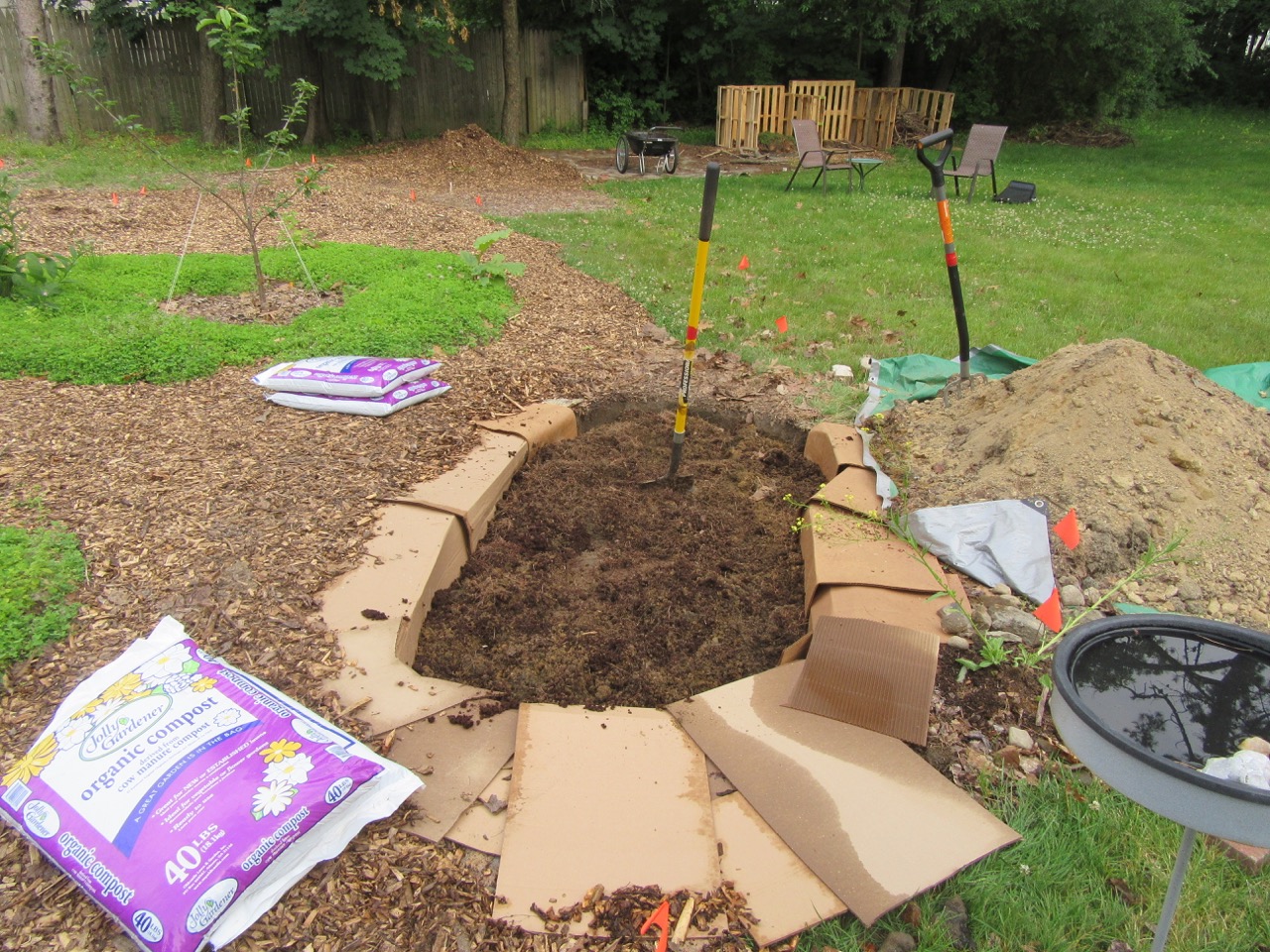
Then, the next steps are to fill the hole with 50% peat moss, 40% soil from that you had taken out, and 10% compost.  Peat moss is somewhat controversial (because of environmental questions raised about its extraction), but I did some reading and learned that the percent of peat moss taken in Canada is very tiny compared to the amount of peat moss bogs they have–so in that context it might be considered renewable.  I had to go back to the store to get more stuff, because it was hard to estimate how much I would need.

Blueberry bed-half doneAnd it is a lot of work to dig out a hole, then fill it with other stuff, and then “stir” it around, which really means turn the soil over and over.  I am glad I only have to do it once.  So I would do what digging I could, and then stop and rest for most of the day, and return to it in the evening if I could.  After the peat moss, soil, & compost mix was in, I added 2 cups elemental sulfur, 4 cups green sand, and 2 cups rock phosphate, all organic nutrients.  This whole mix is meant to create the type of soil that blueberries love, with an acid leaning ph, and the nutrients they need.  (You may notice that I purchased more composted manure, because we used up our big pile.)
I topped it off with a few inches of pine bark mulch that is also good for blueberries, and then some pine needles that Margy had collected last year.  After that, I hauled the rest of the unused sandy soil over to our materials area, and did the paths around the bed with more cardboard and hardwood mulch.  And watered all of it well.  Now it is all ready to do its own thing for several months:  the plan is to plant blueberries in the spring.

Wild Blueberries

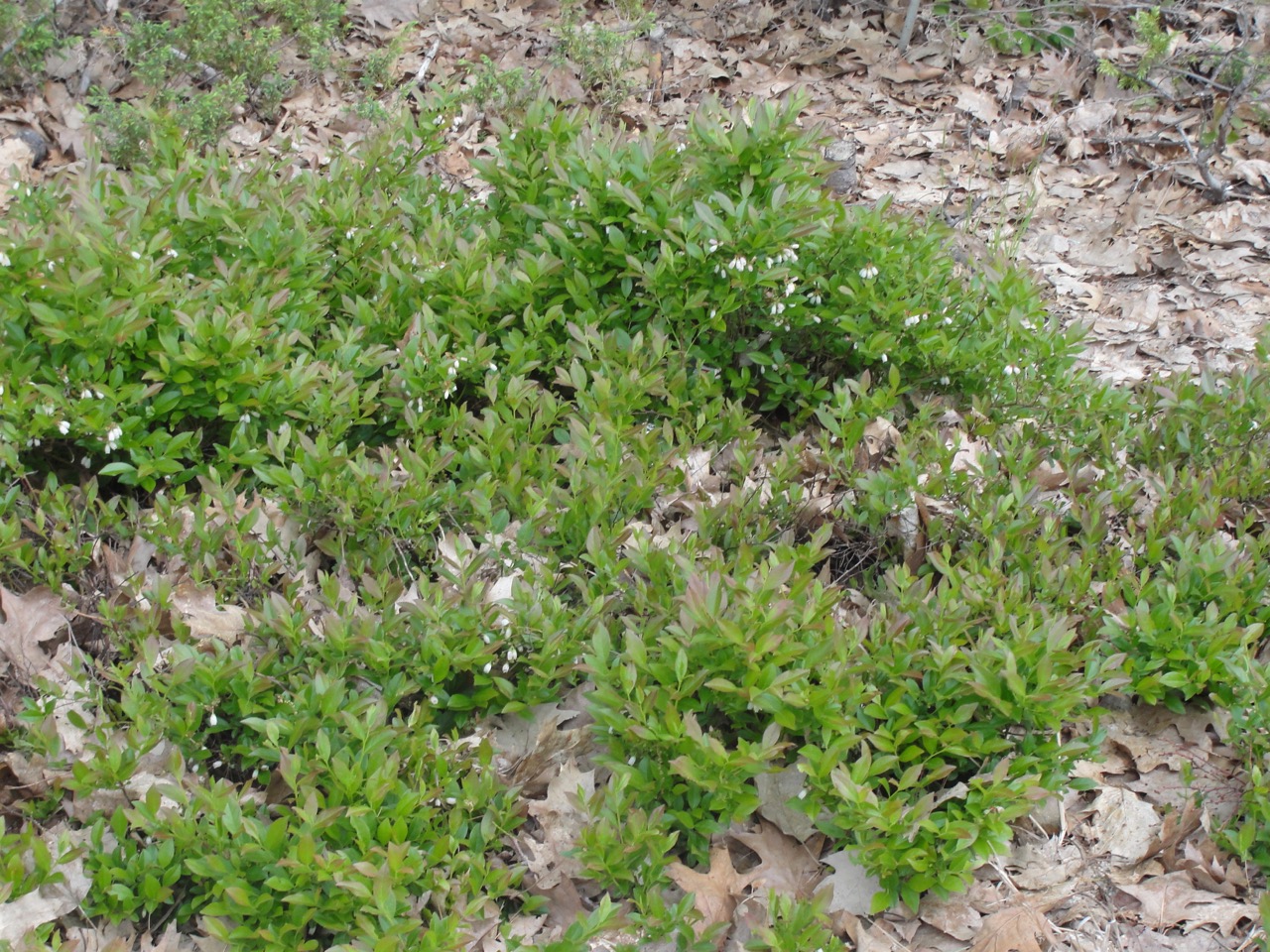
Wild Blueberry Patch

Wild Blueberry Patch

Wild blueberries plants don’t really photograph well–the plants are low to the ground and often in a large patch.  The flowers are tiny and bell shaped.  I have been trying to grow them in our yard for the last several years with minimal luck. But this May it seems they are bursting with life all along the the street we live on. They don’t really like the luscious bed I made for them… they seem to prefer the sand scrabble mess along the side of the road. There are blueberries flowers everywhere, along with wild strawberry, and I see volunteer raspberry plants greening out in many and diverse spots as well.

Blueberry flowers close DSC07502If we were gathering our food, we are living in the right place. One year I did gather a pint of wild strawberries. Most years we leave them for the chipmunks and birds to munch on…it is a lot of work to pick them and they are so tiny. Same with the wild blueberries. Now it is easier to buy the cultivated varieties at the store.

I think about how people used to give a lot of attention to finding their food, when they were gathering these little morsels in earnest.  It might take a long time to get enough for a real dish.  But here all around us is such abundance, and such a gift of nourishment, if we are willing to receive it in small bites. Could it be that life is like that in other ways? That there might be spiritual nourishment all around us, freely given, in small bites, to those who are willing to pay attention for a while?