Obscure/Reveal

Yesterday, a really sweet tree guy was taking down some dead/dying spruces at our home. Afterward, we were chatting about some confusion in the estimate for the work. We happened to mention being concerned about our future Social Security income, which has been threatened by the current regime in Washington. He was excited to tell us about a news source he had found that he felt was quite neutral in terms of reporting in the midst of the political divisions in our country. This news source had a chart that showed that social security was the largest item of government spending, much greater than military spending, for example.

This conversation brought back a long ago memory about how charts can be used to obscure as well as reveal, especially in regard to government spending. I did a bit of internet searching and found what I was looking for. The War Resisters League has created charts every year showing the percentage of the federal budget that goes toward war. They also compare their charts with the the government view of the budget. Ever since the Vietnam War, the government started including Trust Funds like Social Security in their budget pie chart pictures, to make it seem that the military spending was not as great a percentage as it was. They also did not distinguish past military spending from non-military spending. According to WRL calculations for FY2025:

“Current military” includes Dept. of Defense ($871 billion) and the military portion ($320 billion) from other departments as noted in current military box. “Past military” represents veterans’ benefits plus 80% of the interest on the debt.* For further explanation, please go to warresisters.org. The figures are Federal funds, which do not include Trust funds — such as Social Security —which are raised and spent separately from income taxes. What you pay (or don’t pay) by April 15, 2024, goes to the Federal funds portion of the budget. The government practice of combining Trust and Federal funds began during the Vietnam War, thus making the human needs portion of the budget appear larger and the military portion smaller.

Why does it matter? When I was younger, I didn’t really understand much about Social Security. It seemed sort of unfair that even if my partner and I made very little money, self-employed, some 15.3 percent of it was taken out for Social Security and Medicare. Shouldn’t there be a lower income level that wasn’t taxed at all? I didn’t understand that it was a form of collective care for people no longer able to work–we all contribute and we are eligible for benefits if we become disabled or when we are older. Now that I am older, and rely on Social Security to live, I think of it as one of the best things our government has done. I only wish it had been more clear to me when I was younger.

And now, that tendency of the government to obscure things by putting them all in one chart, has helped to break down the divide that was meant to exist between the trust funds and the federal budget. Now the regime is talking about cutting these funds to pass more tax cuts for billionaires. It would be illegal. The trust funds are “off-budget” and treated separately in certain ways from other federal spending, and other trust funds of the federal government. From the U.S. Code (according to Wikipedia):

EXCLUSION OF SOCIAL SECURITY FROM ALL BUDGETS

Pub. L. 101–508, title XIII, Sec. 13301(a), Nov. 5, 1990, 104 Stat. 1388-623, provided that: Notwithstanding any other provision of law, the receipts and disbursements of the Federal Old-Age and Survivors Insurance Trust Fund and the Federal Disability Insurance Trust Fund shall not be counted as new budget authority, outlays, receipts, or deficit or surplus for purposes of – (1) the budget of the United States Government as submitted by the President, (2) the congressional budget, or

(3) the Balanced Budget and Emergency Deficit Control Act of 1985.

Not that the current regime worries too much about the legality of their actions.

I don’t usually get so technical in these posts, but I felt angry this morning that even our really nice tree guy was being deceived by a supposedly neutral news source, that was obscuring the true nature of government spending and the relationship between the regular budget and Social Security. There is a lot more one could say about Social Security, and its limitations, but I am grateful to Frances Perkins who led its development 90 years ago. It is a testament to the values of interconnection and compassion, to our interdependent human family. May it long survive!

Oh, and tax the rich!

Already Broken

Broken measuring cup

Years ago I heard a Buddhist phrase–“The cup is already broken.” Its intent is for us to meditate on the transient nature of all of our reality. If we think of the cup as “already broken,” we can appreciate the cup now, and not be attached to keeping it in the future. At least, that is my brief paraphrase of what it means to me. Last night I knocked into a glass measuring cup and it fell to the floor, shattering into many pieces. Margy says she thinks that this measuring cup had originally belonged to her mother. But it was not really a sentimental piece, rather a long-lasting useful tool in our kitchen. Very long-lasting. Very useful. I locked the cats in the bedroom so they wouldn’t step on glass, and swept and vacuumed all the pieces from the floor into a paper bag to put into the trash. So it goes.

However, there is another version of “already broken” in modern American life–planned obsolescence. Manufacturers purposefully making products that are designed not to last, so that “consumers” will keep buying more products to replace them. This kind of “already broken” is so frustrating as we try to live in sustainable mutual relationship with the earth. We have these metal yard chairs whose weave has torn so that they are no longer useful, and not repairable. They were not long-lasting–maybe only a few years old. We’re likely going to call The Dump Guy, to come and pick up four of them plus a broken patio umbrella. It just makes me feel angry.

Broken yard chairs

Meanwhile, it seems to be an autumn full of broken mechanical things–but happily so far, most able to be repaired. The garage door was broken and then fixed a month later. A groundhog dug a tunnel under the garage that we needed to get filled, and a contractor worked on it. The clothes dryer stopped working and was able to be repaired. Now the heat pumps won’t work, and someone is coming on Tuesday. (We have a back-up oil boiler, so we are not cold.) I have felt burdened by all of this household decrepitude, yet also grateful–because we have been able to get repairs done, able to afford them, able to find repair people to tackle the jobs that are too big for us.

But I am also reminded of the larger brokenness all around us in our world. I always resonated with the Jewish concept of Tikkun Olam, “repairing the world.” I am not Jewish, but have learned so much from that tradition (and people from that tradition) about working for justice. So much of my life, I was involved in activism to end oppression and injustice. I dreamt of a world of freedom and equality and compassion. Now as I face the latest chapter of my life, with chronic illness, I don’t have the energy or ability to be so active. I feel discouraged about the backlash that has undone many of the hard won victories for the world that we dreamed about.

So I ask myself, what do we do when we cannot repair the world? What do we do when oppression and injustice and violence seem relentless. What do we do when the very earth we rely on is on a course for a mass extinction. What do we do when the world is “already broken?” I have been struggling over this writing for weeks now. I don’t have any answers, but it feels like a critical question for this time of my life. If I have attached my meaning, purpose, and value to improving the world, to repairing its brokenness, then who am I if that is not possible? Who am I if the world is already broken?

I still don’t really have an answer. I still am pondering the question, as I feel such sorrow and grief for those who are suffering right now in ways I cannot alleviate. I remember that many people have lived in times of great horror, have lived in situations which they did not have power to improve or repair. We are tangled in a web of broken relationship. We cannot escape. Yet in every situation, people have made choices to affirm their humanity and interconnection. What choices might I make during this next chapter?

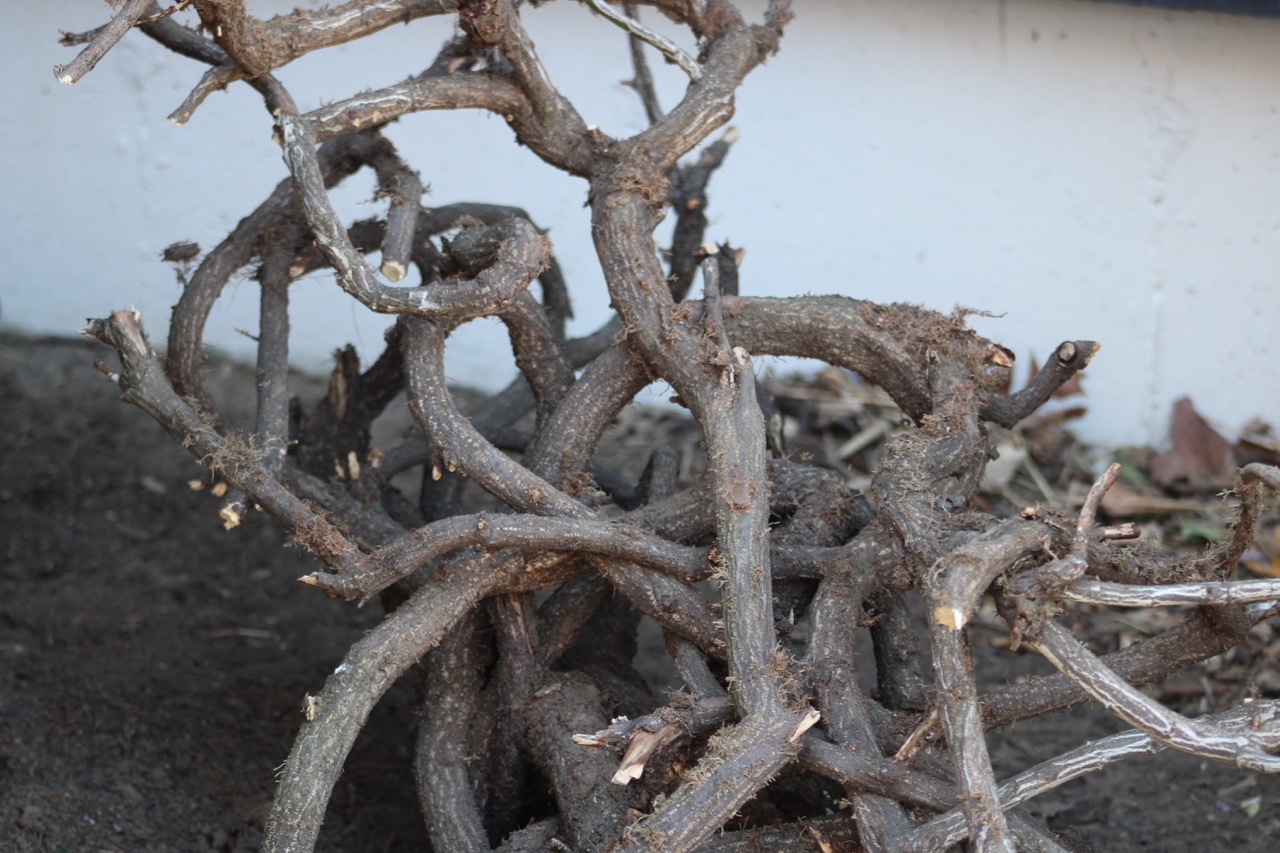
Tangled branches of cut “climbing spindle tree” (invasive in Maine)

From a distance

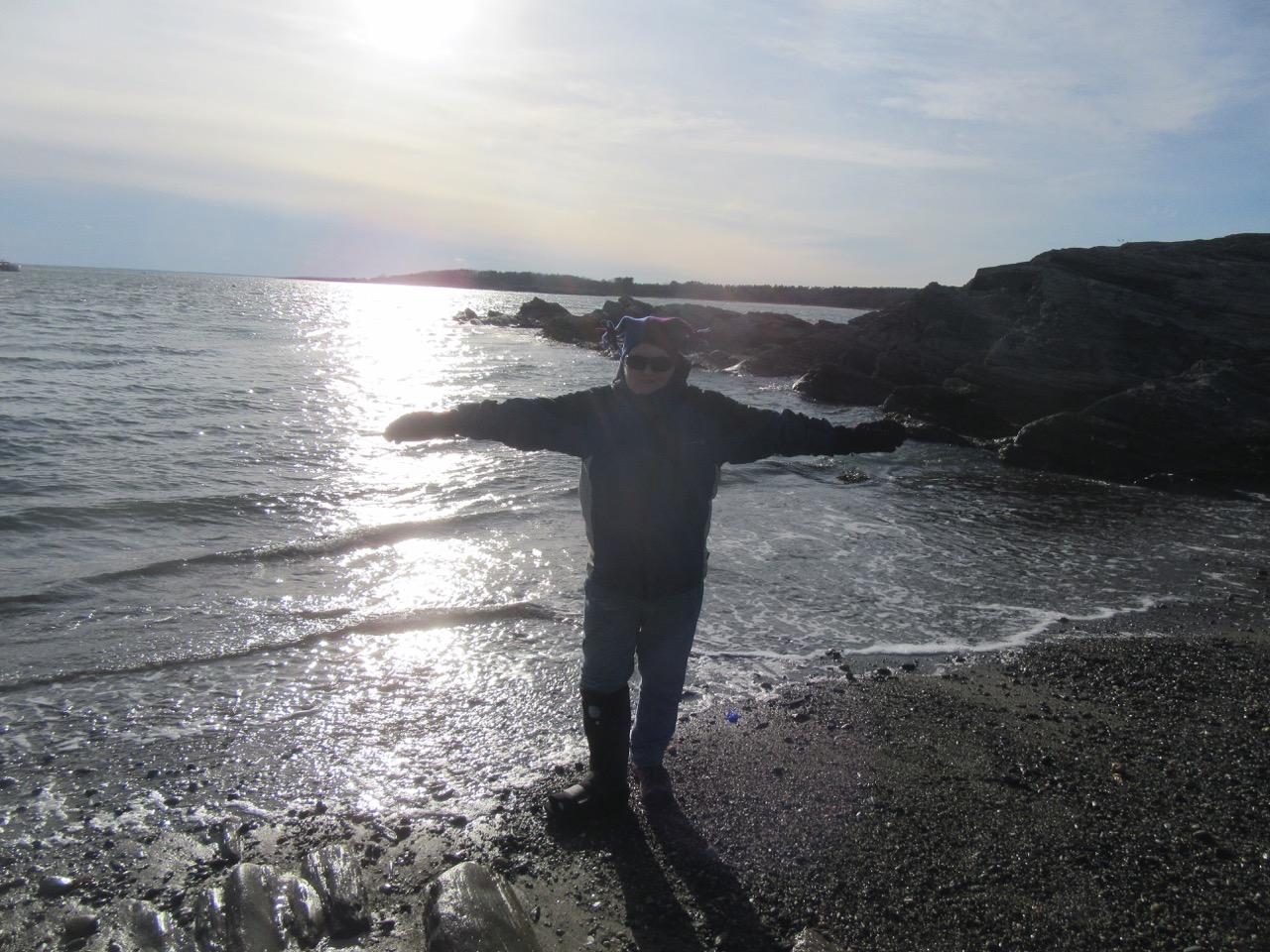
Margy at Kettle Cove

We’ve begun the time of social distancing in the age of COVID 19.  Someone else called it physical distancing, since we need to keep reaching out to each other in other social ways. Margy and I are both over sixty and have various health issues. So we are among those with elevated risk. But going outside is very much permitted and helpful during this time.  We went to Kettle Cove on Saturday–beautiful ocean, sunshine, stones on the beach. It was very windy and the brisk cool air felt bracing to our souls.

I often like to look for sea glass when I walk on the beach, but this time I only took photos–photos of water, photos of Margy, photos of stones. So I was surprised, when I was looking at the photos later, to notice what looked like two pieces of sea glass–and they were the rare red and orange ones! (I have never found them on the beach before.) Can you see them in this photo? I just want to reach in and pick them up. It is both exciting and a bit frustrating to see them right there.Sea glass?

But perhaps they are an apt metaphor for times like this–we can see (and hear), but not touch, all those we love and like, all those with whom we are bound together in community.  We still have the virtual connections of phone and internet. In the past few days, I’ve reached out to distant and local friends by phone and text and Facebook and email, and others have reached out to me: checking in on each other, reaffirming our bonds, our love. That is something else we can do in this age of COVID 19.

We are so interconnected, all of us, in such a myriad of interdependency. The last time I was out and about was to grocery shop on Thursday at the Portland Food Coop and Hannaford, trying to use hand sanitizer as much as possible of course. Thursday was the day Maine reported its first tested case of COVID 19.  (And of course, without testing available, there were likely many other cases unknown.)  But then we had an emergency–our hot water tank was suddenly spewing water out into the basement. So thankfully, a plumber came out Thursday night to help shut everything down, then came on Saturday to install a new hot water heater, with a helper. It reminds me that plumbing emergencies don’t take a break during pandemics.

So there will continue to be interactions that are vital for life. As we seek to limit such interactions, we notice them all the more.  I feel such gratitude for plumbers and electricians, for people working in grocery stores, for those delivering packages and mail, those keeping gas stations open so we can drive to the beach, those keeping phone and internet systems functioning.  And my prayers each day go to all the workers who have to keep on working, to put food on the table and pay the rent.  And my prayers go to those caring for elders in nursing homes, those working in hospitals, those bringing food and shelter to people without homes, and all the other front-line soldiers of compassion. My prayers to all the front-line soldiers of compassion.


What We Are Here For

IMG_3796

“Life is the expression and fulfillment and celebration of beauty. This is what we are here for.  We’re not here to do anything else.” (Sarah Susanka in The Not So Big Life)

Perhaps this is an odd sentiment, when so much in our country is going wrong these days. Aren’t we also here for justice, for compassion, for interconnection?  But what is beauty anyway?  Is it the unexpected sighting of a wild raccoon near the brook during a morning walk?  Is it the fluid colors of the sky in the dawn?  Is it a coating of ice or snow on the branches of every tree and bush in the neighborhood?

Why do these things enliven our souls?  Perhaps beauty is the mark of an essential wholeness, a harmony we can recognize with our eyes, our ears, our hearts, our whole being.  If that is the case, then I believe beauty also includes justice, compassion, interconnection.  We recognize instinctively the wholeness within justice, within acts of kindness, the miracle of our interconnection.

Beauty has something to teach us about how to work for justice as well.  To express and celebrate beauty is to turn our attention away from the ugly hatefulness we deplore, toward acts of creating what we aspire to.  This is why I love permaculture and solar panels and work parties and gardens.  We are bringing into being the wholeness we hope for.  I am not saying that protests are not important as well.  On the contrary.

But as Rebecca Solnit promises, in her book Hope in the Dark,

…if you embody what you aspire to, you have already succeeded. That is to say, if your activism is already democratic, peaceful, creative, then in one small corner of the world these things have triumphed. Activism, in this model, is not only a toolbox to change things but a home in which to take up residence and live according to your beliefs, even if it’s a temporary and local place… Make yourself one small republic of unconquered spirit.

May you be a beacon of beauty today!

Called to be Better: In Light of the Attacks on Paris

Heart Candle Flame DSC01573

How tragically ironic, as we approach the season of Christmas, (which celebrates a Middle Eastern refugee family seeking shelter), that so many in the Christian world are now, in response to the attacks in Paris, calling for shutting their boundaries to refugees from Syria. Haven’t people heard that these refugees are fleeing from the same terrorists who killed in Paris? I understand that people are afraid. That is the purpose and consequence of terrorist acts. But to extend that fear to all refugees, to all Muslims, to all Syrians is one of the worst forms of human cowardice.

We are called to be better than that. I am not saying it is easy. But I was inspired when I heard about Antoine Leiris, whose wife was shot in Paris. He posted this message to those responsible:

On Friday night you stole away the life of an exceptional being, the love of my life, the mother of my son, but you will not have my hatred. I do not know who you are and I don’t want to know, you are dead souls. If the God for whom you kill so blindly made us in His image, each bullet in my wife’s body would have been a wound in His heart.

Therefore I will not give you the gift of hating you. You have obviously sought it but responding to hatred with anger would be to give in to the same ignorance that that has made you what you are. You want me to be afraid, to cast a mistrustful eye on my fellow citizens, to sacrifice my freedom for security. Lost. Same player, same game.

We are only two, my son and I, but we are more powerful than all the world’s armies. In any case, I have no more time to waste on you, I need to get back to Melvil who is waking up from his afternoon nap. He’s just 17 months old; he’ll eat his snack like every day, and then we’re going to play like we do every day; and every day of his life this little boy will insult you with his happiness and freedom. Because you don’t have his hatred either.”

His is a beautiful example of what heroism looks like. Most of us are not being asked to be that heroic right now.  But are we perhaps being called to take a few small step of heroism ourselves?  A few small acts that ask only a small amount of bravery come to my mind. We could contact our governors and our Congressional delegations to let them know we don’t agree with those who want to refuse refugees. We could contact the President and encourage him to hold strong, and in fact to increase the numbers of people we welcome from Syria.  

On a more involved level, we might take it upon ourselves to learn more about the roots of the Middle East conflicts, and how U.S. foreign policy is linked to all of this. Some articles that I have found helpful include several interviews on Democracy Now that can be found on their website: www.democracynow.org. And perhaps, we could be active in welcoming those refugees who do arrive, helping them to get settled in a new and unfamiliar place.  Let us open our minds and hearts to the deeper realities of our world, and become our best selves—let us move beyond fear and hatred into compassion and hospitality toward those who are suffering.

Guilt or Love?

Steeple MJ DSC01914One of my hopes in this blog has been to expand our understanding of what God might be, what Mystery and Spirit might be, because so many people have been wounded by the false Gods of our culture. I want to take a closer look at one of those false Gods that I believe has hurt many people. If you have rejected the idea of God, perhaps you’ll recognize the one I am talking about. So I invite you to persevere with me as we explore it a little bit.

I think we can identify two approaches that people have taken to our relationship with the powers greater than ourselves. In one, the powers, the Gods, the Spirits were dangerous forces, and religious ritual was enlisted to appease these forces, and make the people safe from them. In the other, the Gods, the Spirits were benevolent forces, and religious ritual was enlisted to call upon the forces for help in dealing with the challenges of living. I am simplifying it of course, but still, there have been particular times in history when this battle between dangerous or fearful forces and kind and loving forces was in full blaze, and sometimes within the same religion.

When I was a child, I learned about one such conflict between a judging fearful God and a loving God. As a Catholic, I used to read about the lives of the saints, and one saint I liked a lot was Margaret Mary Alacoque. She lived during the 17th century in France. Just before her time, there had been a theologian named Cornelius Jansen who emphasized the idea of original sin. He believed that people were unworthy and evil, and only a few would be saved. Jansen discouraged people from participating in the communion ritual that happened every Sunday, saying it was reserved for only the very holy.

Sacred Heart

But Margaret Mary began to have visions—in her visions she saw Jesus, and she saw his heart, as if it were outside of his body, burning with love. He told her that God was full of love for people, and that God wanted to help people. Now, for those of you who have been Catholic, you may remember seeing pictures of the Sacred Heart of Jesus. It became an important devotion in Catholic life.

For me, this story was a gift—first of all, I thought it was cool that she had visions, and could talk to Jesus. But more importantly, this story told me that I was loved by God. All Catholic children learn a lot of guilt, and lessons about original sin, and mortal and venial sins, can weigh heavily upon us. But this story shifted the balance for me—it helped me to know deep in my heart that God was love, and that God loved me.

Now, I am guessing that very few people have ever heard of Cornelius Jansen or Margaret Mary, but perhaps you have your own memories of a church in which you felt guilt and shame, in which you learned that you were a sinner, or unworthy. Those ideas are just as pervasive today as in former centuries. The God of judgement has been a prevalent theme throughout the course of American history because of the teachings of someone much more famous that Jansen. More on that tomorrow.

Choosing Community

So often when we hear that we should love one another, it sounds like hard work, like a task, like a moral imperative that would be good to follow, but not very pleasant. And I admit there is something difficult about loving one another. But somewhere in the middle of it, comes a surprise. There really is divinity within each person—and when we see it, it is beautiful, joyful, mysterious, and wonderful. It is like the diamond that Dorothy Day was so quick to give to the homeless woman. 

And not only that, when we risk opening our hearts to others, sometimes we experience the divinity that happens in the connections between us. We experience something of that ancient belonging for which we have been yearning. Ubuntu. We experience the oneness of all beings, our part in the family of all things. We realize that we are all gathered in a circle already, we are all part of one dreaming.

Those moments give me energy for the work of creating circles of love and faithfulness. Because we really do have to work at community. We have to make a choice for community. In our society, the bonds are frayed, and the mainstream is drifting toward isolation and competition. There are people who have no one with whom to share their real feelings. So dreaming in circles is about choosing connection, choosing love, joining hands with one other, and then another, finding the people with whom we can cast our lot, those who are similarly looking to manifest ubuntu in our lives.

When we choose community, when we practice loving a particular group of people, we are letting the reality of the universe enter our hearts—we are learning how to experience the reality that we truly are all part of one another. Of course we don’t usually get it right. Otherwise we wouldn’t need to practice. We are not here to try to fix everything in order to create some sort of perfect circle—we are the circle right now, trying to wake up together. Every person is sacred, and we are all one circle. Stone Circle

Active Love

In the great Russian novel The Brothers Karamazov, a wealthy woman comes to seek advice from a holy and renowned priest, Father Zossima. She is anxious about eternal life, and wants to know how she can be sure of it. Father Zossima tells her, there is no proving the existence of God or eternal life. But there is one way she may be convinced of it. “How?” she asks. “By the experience of active love.” he replies. “Strive to love your neighbor actively and indefatigably. In as far as you advance in love, you will grow surer of the reality of God and of the immortality of your soul.”

The woman goes on to tell him that she loves humanity, so much in fact, that she dreams sometimes of leaving her privileged status and becoming a sister of mercy. She would nurse the afflicted and bind up their wounds. She tells the elder, “I close my eyes and think and dream, and at that moment I feel full of strength to overcome all obstacles.” But then she worries that if the patients did not respond with gratitude, if they were rude or abusive, she would be incapable of continuing to love them. And so she is in despair about her quandary.

He replies,

I am sorry I can say nothing more consoling to you, for love in action is a harsh and dreadful thing compared with love in dreams. Love in dreams is greedy for immediate action, rapidly performed and in the sight of all. Men will even give their lives if only the ordeal does not last too long but is soon over, with all looking on and applauding as though on the stage. But active love is labor and fortitude, and for some people too, perhaps a complete science.Person in shadow

Dorothy Day would often repeat the pronouncement of Father Zossima, “Love in action is a harsh and dreadful thing compared to love in dreams.”

We are here to awaken to that kind of active loving, that vision of divinity within each person. I remember an experience that happened one time when I was flying on an airplane, returning home from an event in Washington, DC. I had settled into my window seat, and started to read a book. I can’t remember now what the Washington event was or what the book was, but something had inspired me to be pondering this connectedness of all beings, this divinity within all beings.

Then, two young men climbed into the seats next to me. The man in the middle leaned his head against the back of the seat and closed his eyes. A while into the flight, he started to be sick—his friend gave him a paper bag, and he vomited, mostly into the bag, but also splashing his friend. I was a little horrified, and imagined them with hangovers from some drinking and partying.

But then it struck me that if I truly believed in the connectedness of all beings, I would realize that these men were my brothers. They were part of me, living in another lifetime, another journey. Something shifted within my heart. Instead of judging them, I was able to feel compassion. We didn’t go on to have a long conversation or anything like that—I think I just asked, are you okay? I remember a flight attendant coming by to check, and asking me if I wanted to change seats. But I said no. I was experiencing something deeper, something taught to me by these unlikely teachers.

Quotes from Fyodor Dostoyevsky, The Brothers Karamazov, translated by Constance Garnett, (New York: MacMillan, 1922), pp. 59-61.