Tiny and partial

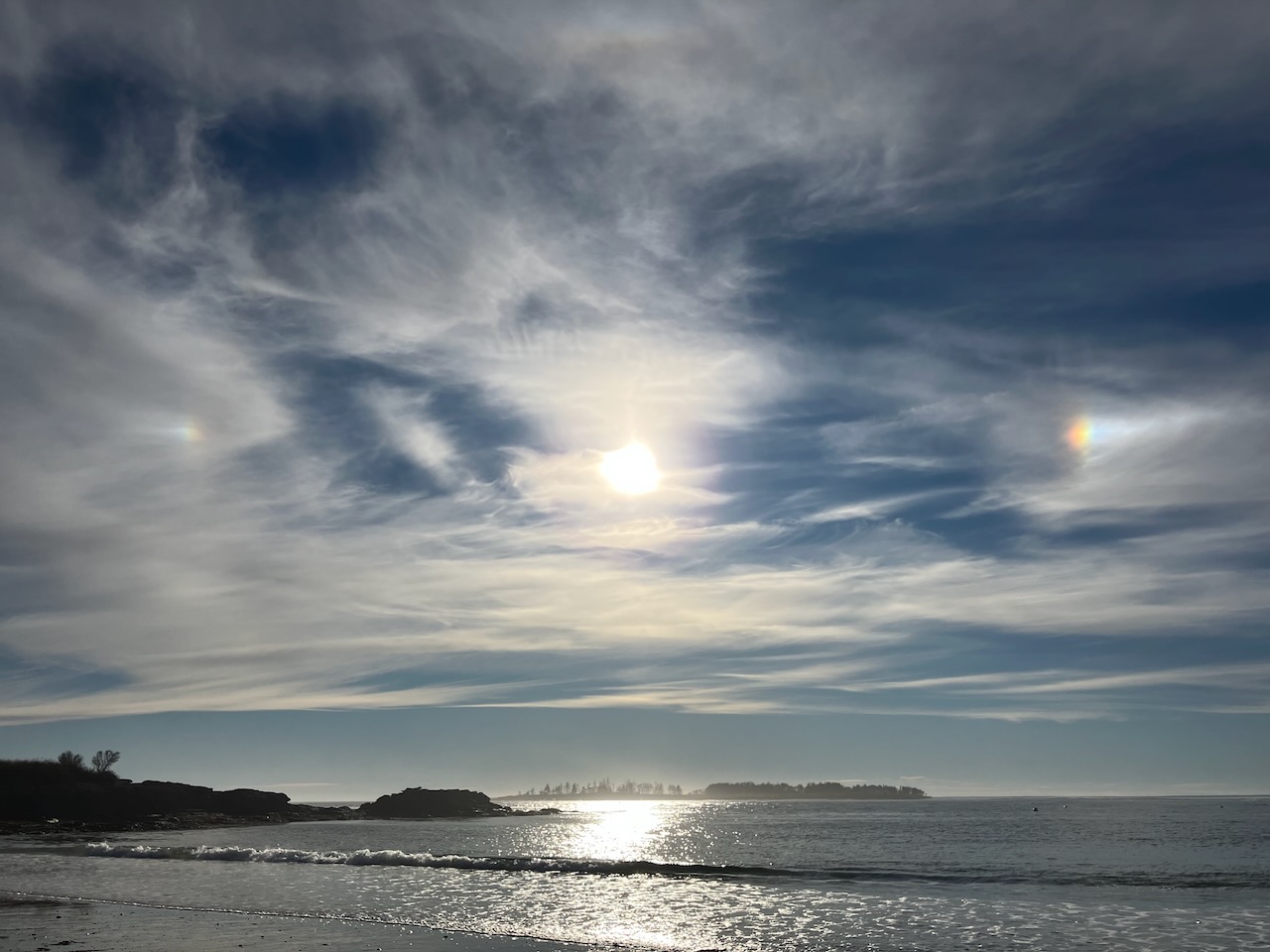
On the last day of 2024, Margy and I went to Kettle Cove beach. I saw this tiny partial sunbow in the sky, bursts of color hanging on either side of a bright sun. Tiny and partial are the words for today. There is so much suffering in the world, so much violence and evil. I can’t stop the devastation of Gaza, or the cruelty of the Israeli army continuing to kill scores of people even after a ceasefire has just been signed, to take affect on Sunday. Why not stop the killing today? All I can do is bear witness, share posts on Facebook. Tiny and partial.

What can we do to bring good to the world? I think about my visit to my friend at the nursing home yesterday. He was happy to see me–I went to wish him happy birthday and we had a good visit. But immediately afterward I felt a sense of guilt that I can’t visit more often than every months or so. What I can offer him is tiny and partial. But perhaps it is important, especially in the face of large and unrelenting troubles, to honor the tiny and partial acts of goodness we do? And what can he offer now, my old friend, after years of activism and kindness? Perhaps merely to receive with cheerfulness the help he now needs. We each bring goodness in the tiny and partial ways that we are able.

Each morning I take a walk. I have been able to take a little walk most days, after a message a year ago that “walking will be needed.” I have been able, ever so slowly, to increase my walk to about 20 minutes, no longer going directly to the brook and back, but making a little circle around the neighborhood, on my way there. It feeds my spirit, and reminds me to be in love with the earth, the sun, the water, the place where I live. It is a tiny walk as walks go, but by tiny increments, a little more.

Before I walk, I empty and refill the water that we have in a heated tray for the birds. Perhaps that is my tiny gift to the creatures who live here with us on this land. It feels like a prayer each morning. It reminds me of the importance of giving what we are able to this wider community of life. The other day I saw the crows laughing and jostling each other as they perched on the edge and dipped their beaks in.

We are living in very troubled times. Some will be called to wise analysis, and great acts of heroism, and energetically building the systems that honor our deepest values. But all of us, no matter how tiny, must still cling to kindness, cling to our interconnected earth community, and give what we can, no matter how partial. And I hope I remember to celebrate the brightness of the colors revealed in those gifts.

Be like the crows

Crow on the top of bare branches of a tree against a blue sky
[A crow is perched high in the bare branches of a tree outside my house. This photo is not from yesterday, but reminds me of the crow I saw yesterday in a similar perch.]

After blogging yesterday morning about Listening for Spirit, I bundled up in warm clothes to take a walk in the cold. As I stepped off the back porch, I heard the raucous calling of crows, and looked up to see a crow high in the branches of a tree. Then I saw two others, all of them agitated and calling. They flew over our back yard and kept calling and scolding.

I walked down the driveway, turned right onto the street, went past our neighbor’s house and then around the corner, on my usual route for a morning walk. I could still hear those crows! Then I saw the cause for the crows’ alarm–it looked like a huge hawk up in a tree near another neighbor’s house. I could see the white feathers of its belly as it perched and I crossed the street to confirm its identity. Then it suddenly flew off, obviously bothered by the relentless scolding of the crows. They didn’t stop, but kept after it until it was gone.

Then Spirit said, so clearly, “Be like the crows! Keep calling out to alert everyone to the presence of a huge predator! Keep calling out together.”

I was reminded of the line in a song that I have been singing and translating. “Even as the hour grows bleaker, be the singer and the speaker.” [from The Lost Words Blessing] In Passamaquoddy, verbs are more fundamental than nouns, so the end of that line became, “…ahtolint on ktahtolewestun” “…keep singing and keep speaking.”

I have watched people talking about facing encroaching fascism by deleting their public presence on social media, by using encrypted forms of communication like Signal, by using extreme caution about what is said and what is shared. And there are situations that definitely warrant those precautions. Definitely. But I believe that there are also reasons to keep speaking and keep sharing. Keep naming our values, keep claiming our experiences, keep identifying what we witness.

If we are called to that. And not alone, but in groups, even groups of three. Three crows can annoy a hawk enough to make it leave. I felt the presence of Spirit so strongly in those crows that it gave me courage to say, I can do that. I can keep speaking here, as long as I can.

Crows at the Pond

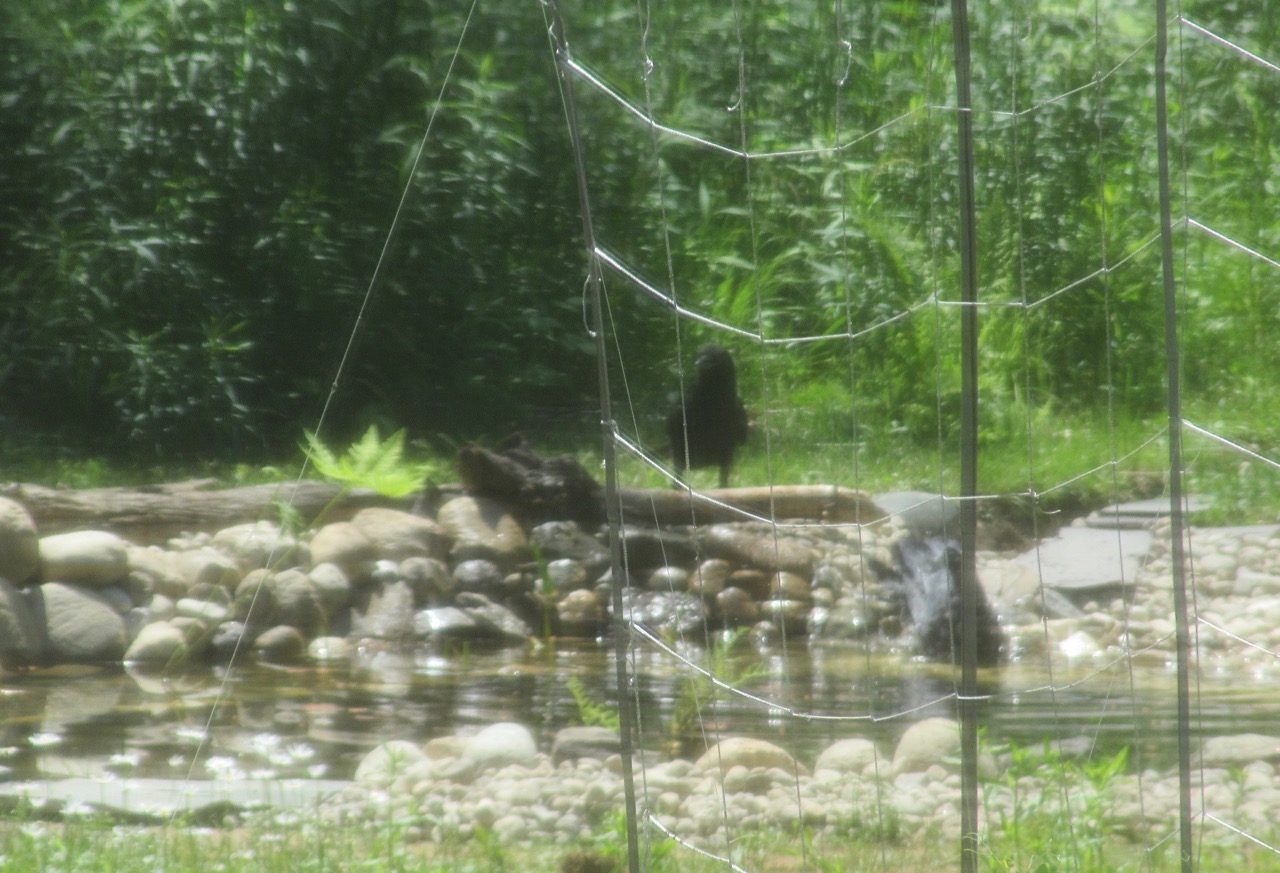
Photo: one crow perched, another below to his right, dipping her head in the water, tail up

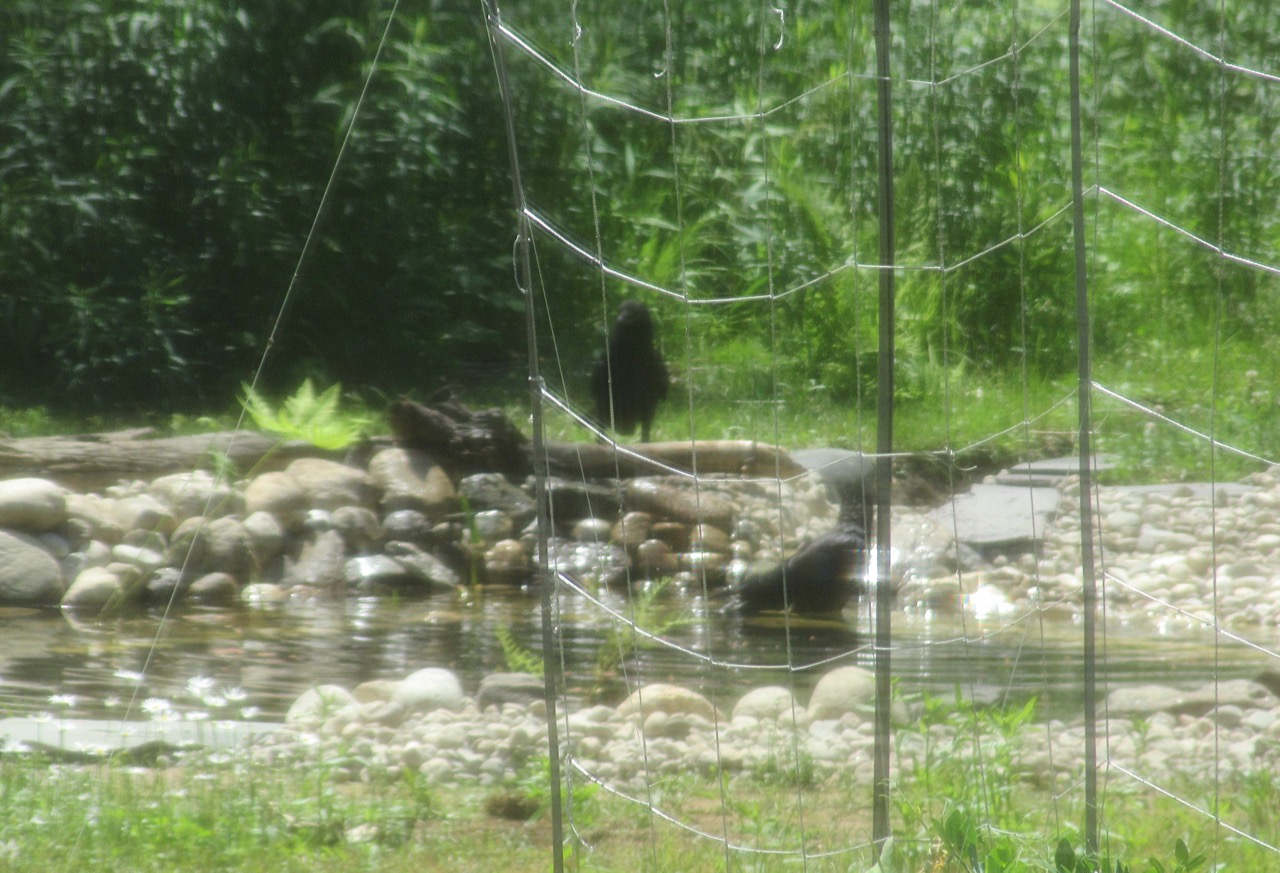
Yesterday, I was excited to see a few crows visiting the pond! I was looking out my window from the house, and there is a string-and-bamboo trellis (for our snap peas) about halfway between the house and the pond that partly blocks the view. But if you look carefully, you can see one crow taking a bath, while the other is perched on a log on the edge behind it.

Photo: Crow in the water lifts up its head

I have been slowly gathering more stones from country roads, and adding them to cover the pond liner all around the edge, along with placing some aging branches there, from around our land. Seeing the crows perched on the branches, I am so glad I included them. This process of covering the liner edge is about two thirds complete now, and the plants in the water are also beginning to grow some new leaves and shoots.

Photo: crows on the branch, one with a stone in his beak, one wet from her bath

I didn’t notice until I saw these photos, but one crow has picked up a little stone in his beak! He reminds me of me as I go around looking for stones the right size for the edge. I wonder if he brought it with him to place somewhere himself. (By the way, I don’t know whether these crows are male or female, but they are not “its” so I prefer to give them personal pronouns. I wish English was like the Wabanaki languages in that the personal pronouns are not gender specific.) After placing a new batch of stones in the morning, I felt really exhausted and rested for the afternoon. But in the evening, I came out and just sat down next to the pond, enjoying the reflections in the water.

Pond Progress

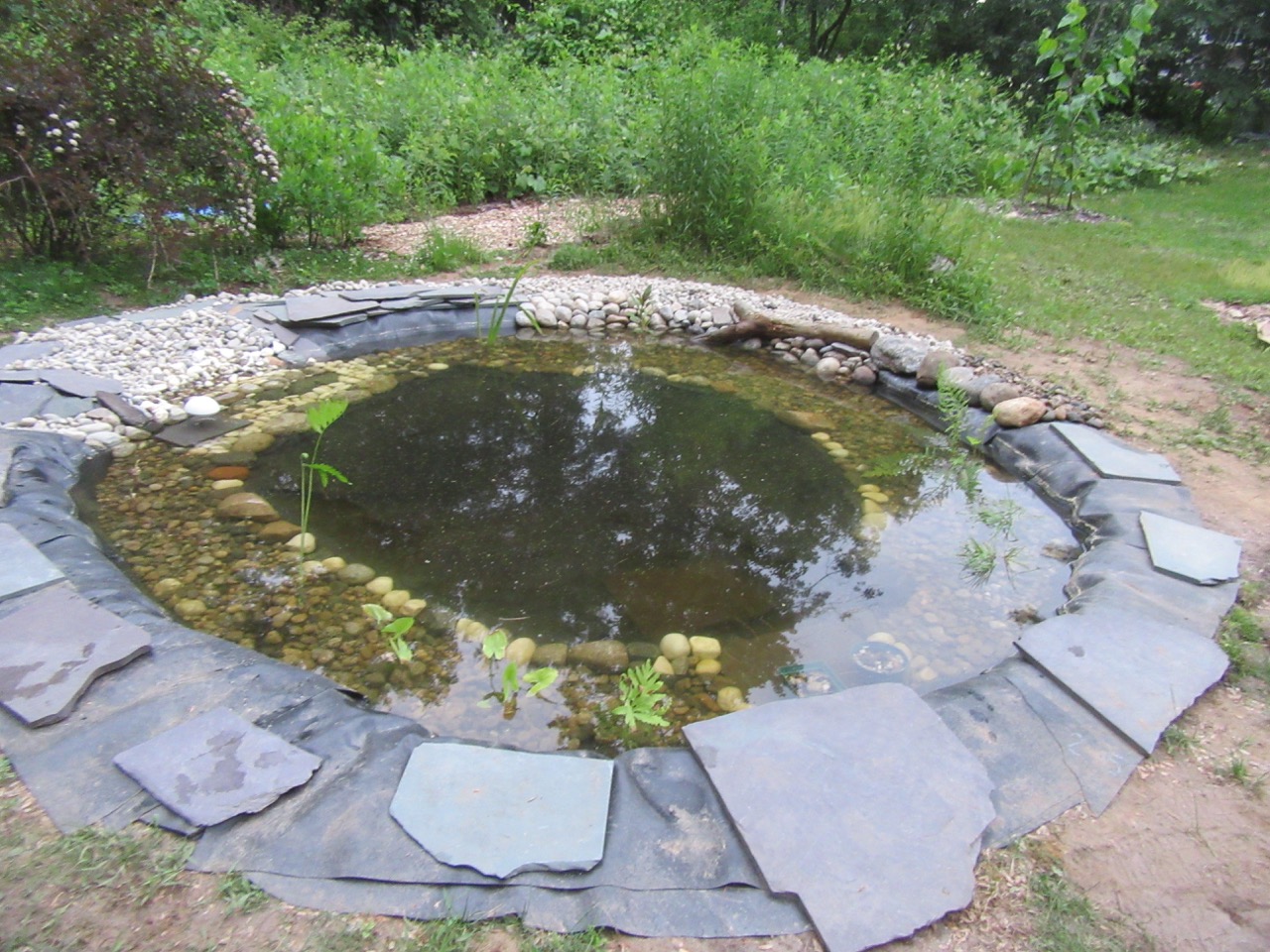
Photo: The pond on June 11

I am slowly adding stones and plants and developing the top edge of the pond, to cover up all the liner. I did a minor adjustment to the overflow channel to lower the water level by about an inch, and added some soil (underneath the liner and layers) to an edge that was a little bit lower than other parts. I’ve been using my pile of small stones for the edges, but stabilizing them behind larger stones. I decided to use the larger stones to also cover the vertical slope between the planting ledge and the top. This was in the original plan, but I didn’t think I would have enough stones to do it. And I don’t. The other day, Margy and I went to another rural road and brought home another batch of larger stones from the side of the road. But it doesn’t take long to use them up.

By the way, in the background, from left to right, you can see a ninebark shrub in bloom, a summer sweet shrub, and a little elderberry that’s barely visible. I am trying to start some hazelnut bushes from off shoots of our big ones. Also, there is a lot of goldenrod that will flower later in the season, and on the far right back, our mulberry tree–which after a couple rough starts is finally doing better this year.

Back to the stones for the pond, even though I don’t have enough of the larger stones, it seemed smart to do as complete a finish as possible, section by section. Here is a close up of the most completed section, behind the cardinal flower, where I also incorporated an old piece of a branch. I am enjoying this design process.

Photo: pond detail with stones and log

I also ordered and received some more plants–this time I got some pickerel rush (or pickerel weed), Pontederia cordata. This native plant will grow 2-4 feet tall and have blue flowers. I ordered five, but received eight little root and stem starts. So then I decided to rearrange the arrowhead plants, moving them closer to the “front” from where the photo is taken, and where we’ll sit to watch the pond. I planted the pickerel rush mostly where the arrowhead had been, on the back left, and then put a couple of the smallest ones in front of that log. Here is what it looks like right now, and this is the largest one. It takes faith and imagination to see them growing and flowering in the summer and fall.

Photo: Pickerel Rush held in place in the water by stones

In other news, I have twice seen (from my window) a crow walk up to the pond and get a drink of water. Tonight I also saw a few little water bugs of some kind swimming around. Animal life is starting to arrive. The other day, when it was so hot, there was some green algae in the water, which is to be expected until the plants grow bigger–but then it disappeared again today. Time to think of another place to find some more of the larger stones. It all feels magical.

Little Land Spirits

Sunrise after Solstice

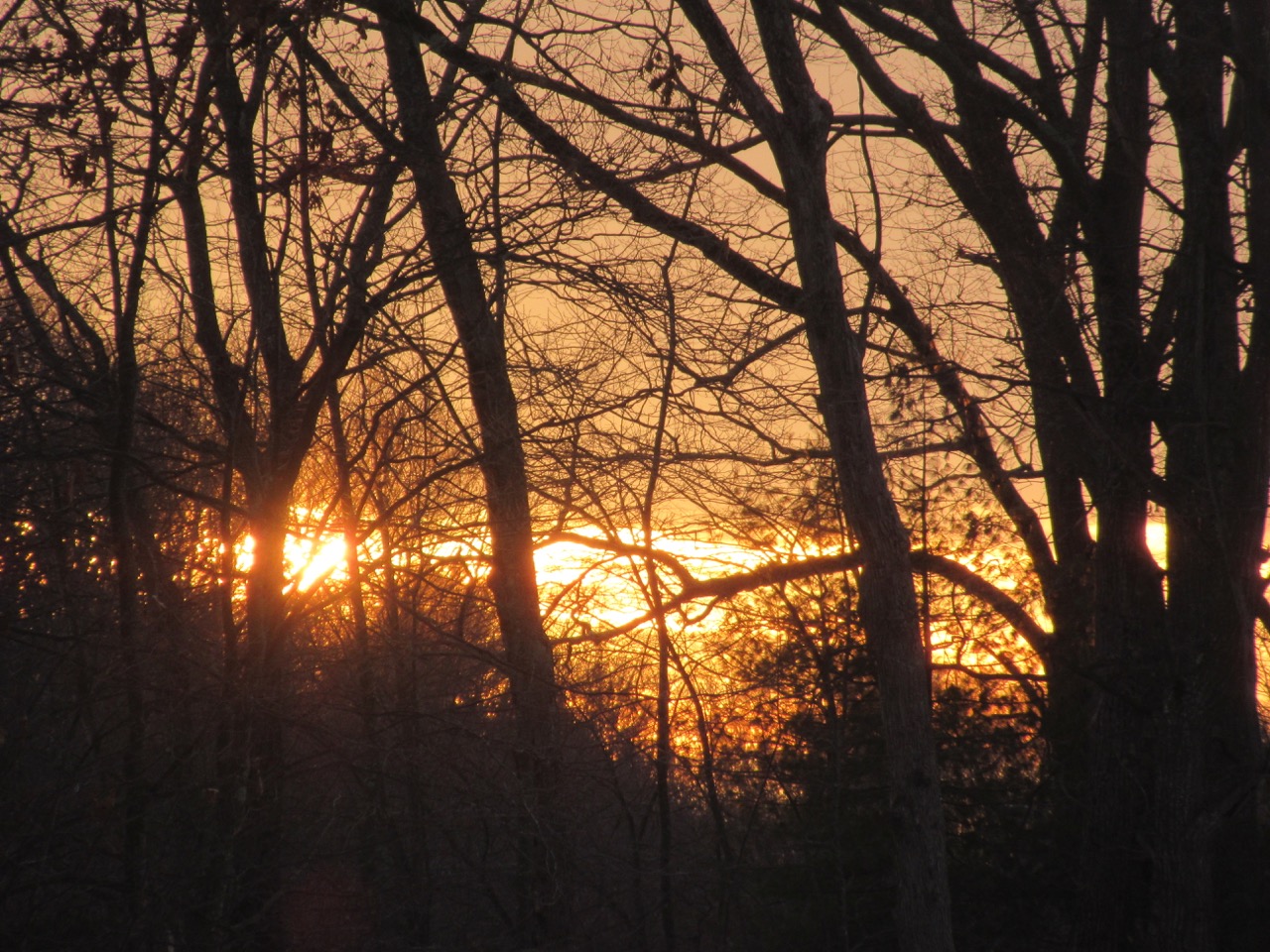
Sunrise, the morning after Winter Solstice.

In Scandinavia, there is a Solstice Eve tradition to leave a bowl of porridge outside for the Nisse, the little land spirit person who helps out with the work on the farm and serves as a guardian to the family and the animals. According to what I learned, it was very important to put a pat of butter on top.  The Nisse can be troublesome if not properly respected.

There are little guardian spirit people traditions in many other places, too.  Scots and English call them Brownies, there is the German Kobold, and I have learned about Wabanaki little people called Wonakomehsisok who were said to be spirit helpers who lived among rocks. The Wolastoqiyik spoke of Kiwolatomuhsisok, who were said to help people secretly at night, and have a breath that smells like mold.

All that said, on Solstice Eve, I put out a bowl of porridge in the back yard, with a big pat of butter on top, (which by the way is how I like my own porridge) as an offering for any little land spirits on our land that might appreciate it.  Perhaps it might be one more way to deepen our relationship with this land, to make friends with the spirits who protect and cherish the land.

Sadly, the next morning, it was still there, and frozen–but I moved it from the middle of the yard to the way back, where more wild creatures tend to go by. (We’ve put other food offerings out there in a similar way, and they disappear.) When I returned from my walk, I was happy to see a crow back there at the bowl, pecking at it with their beak.  They are also guardians of this land.

Crow eating butter – Version 2

Later, I discovered that the crow flew off with the pat of butter but left the porridge.  So I guess that our land spirits might not like porridge–which is after all a very European food tradition.  We’ll have to keep experimenting with other foods, to see what they prefer.  Still, I was happy to give a gift to the crow.

I Walk in Passamaquoddy

I have had the privilege of studying Wabanaki Languages this fall, taught by Roger Paul. For me it has been a small way to begin to decolonize my mind–to begin to think differently.  Our final project was to make a short presentation to our class, and I was inspired by the words we had learned to talk about the animals I see and hear on my morning walk. I also drew on the Passamaquoddy/Maliseet (Wolastoqe) Language Portal for further help with verb and noun forms, and I learned some new words along the way.  If any speakers of the language read this, edits are welcome! Roger encouraged us to jump in with using the language, even though we will make mistakes. 

For those who do not know about Wabanaki languages, you might find it interesting that animals are not referred to as “it,” and people are not referred to by “he” or “she.”  There are “animate” and “inanimate” forms, and both people and animals are referred to by animate, non-gendered verb and noun forms.  A lot of information is encoded into one word.  So, for example, “npomuhs” means “I walk.”  “Nutuwak” means “I hear (beings plural and animate.)

Ntoliwis Mayk. Nuceyaw Portland.  (My name is Myke. I am from Portland.)

Spasuwiw npomuhs. Wolokiskot.  (In the morning I walk. It is a beautiful day.)

Nolokuhs lahtoqehsonuk.   (I walk in the direction of the north.)

Nutuwak sipsisok.   (I hear small birds.)

Nomiyak mihkuwiyik oposik.  (I see squirrels in a tree.)

Apc, nolokuhs cipenuk.   (Next, I walk in the direction of the east).

Nomiya kisuhs musqonok.  (I see the sun in the sky.)

Nutuwak kahkakuhsok. Tolewestuhtuwok.  (I hear the crows. They are talking)

Nomiyak oqomolcin kehsuwok nehmiyik awtik.  (I see eight turkeys in the street.)

Apc, nolokuhs sawonehsonuk.  (Next, I walk in the direction of the south.)

Npomuhs sipuwahkuk, naka nomiya motehehsim sipuhsisok.   (I walk along the edge of the brook, and I see a duck in the brook.)

Nutuwa pakahqaha lamatokiw.  (I hear a woodpecker a little ways into the forest.)

Wahte, nomiya qaqsoss.  (In the distance, I see a fox.)

Apc, nolokuhs skiyahsonuk, naka ntapaci nikok.   (Next, I walk in the direction of the west, and I come back to my house).

WoodchuckNomiya munimqehs kihkanok. N’ciciya wot.   (I see a woodchuck in the garden. I know this one.)

Coness, Munimqehs! Musa micihkoc kihkakonol! Wesuwess!   (Stop, Woodchuck! Don’t eat the vegetables! Go back where you came from! )

Munimqehs qasku. Qasku asit kakskusik. Qasku lamatokiw.   (Woodchuck runs. S/he runs behind the cedar. S/he runs a little ways into the forest.)

Toke, ntop qotaputik qocomok.  (Now, I sit in the chair outside.)

Komac Wolokiskot! Woliwon!   (It is a very good day. Thank you)