Yesterday, I went over to the pond in the morning, and saw nine or ten dragonfly nymphs who had climbed up onto leaves. I didn’t see them climbing, but they were holding on to the leaves, and slowly emerging from the husk of their nymph bodies. They were on the sweet flag, the blue flag iris, and the arrowhead plants. They say that nymphs live for two years in the water, so perhaps these were deposited as eggs in the pond two years ago and survived over winters, and now were coming of age all together. Sometimes, the leaf stalks they were clinging to would shake a little, not from the wind, but from the effort of their struggle. Is the photo from later exactly the same, or did it progress a little bit more? Truthfully, I can’t tell.
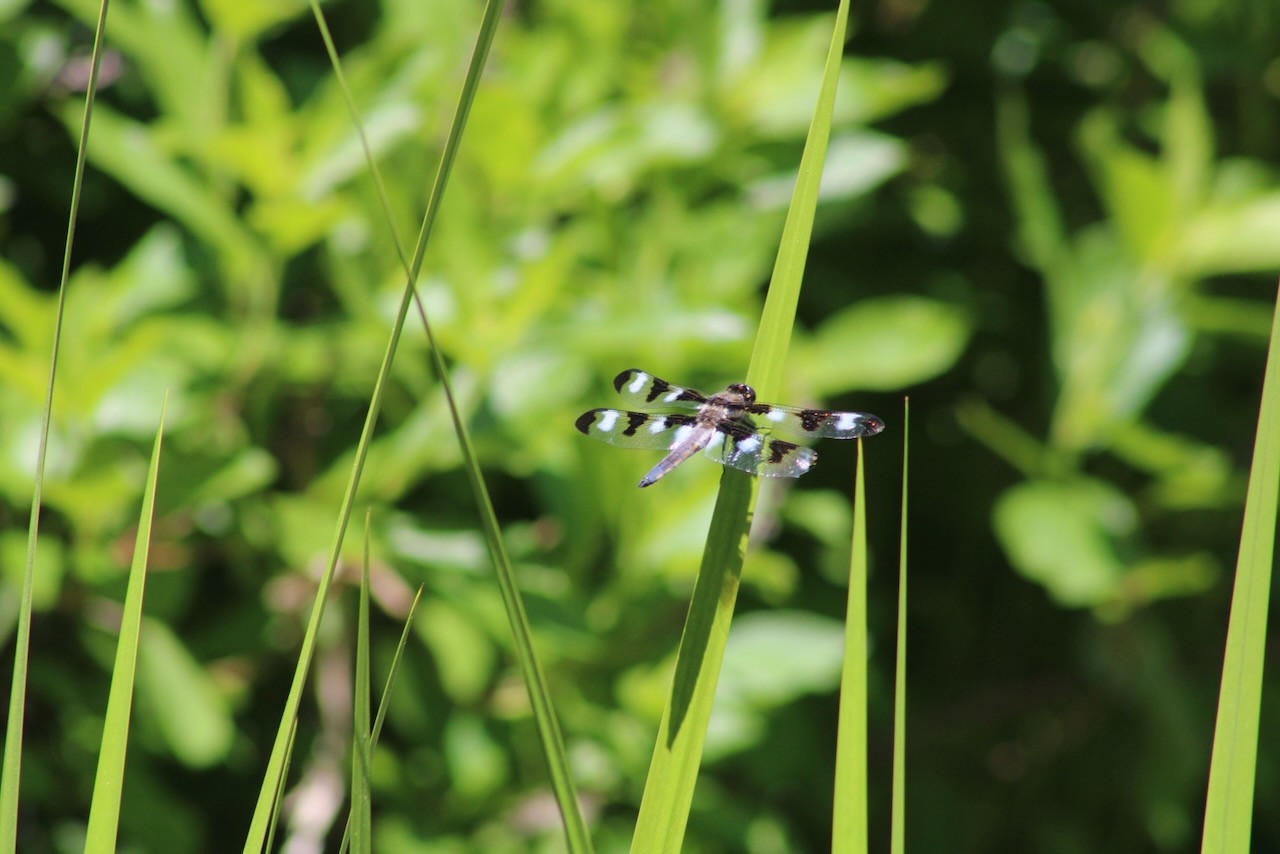
There was an adult dragonfly hovering around close by, it could have been the same one I had seen earlier in the summer. I wondered if it was watching over the nymphs protectively, or perhaps threatened by them, or interested in mating with them? It did stay close. A beautiful creature with black and white spots on its wings and a mostly gray body with black eyes.
I wasn’t able to watch all day, and then we had some rain in the evening. This morning, when I went back, it seemed like all of the creatures on the leaves were just husks of nymph bodies, and there was a new dragonfly at the pond. Turquoise eyes, mostly clear wings, white tail with a black end.
All of it felt quite magical, and also mysterious. An accident that I saw it at all, and yet amazing that I saw some of the process. In Passamaquoddy, the word for dragonfly is “apuciqaha.” According to my teacher, “apuci” means inside out, and “iqaha” refers to the way they fly in any direction. Seeing the adults emerge from inside of the bodies of the nymphs gave me a new sense of the meaning of “inside out.”
Once again, I see how the pond is home to all sorts of life that lives by its own rhythms, and what a privilege to witness some small aspect of that ongoing life.
I’ve seen dragonflies flying around the pond, mating above the pond, and dipping their tales into the water to lay eggs. I’ve seen dragonfly larvae in the pond swimming around. But until this week, I never knew if any of the larvae had lived long enough to transform into adult dragonflies. During the last few days I saw what I thought might be some sort of insect perched near the bottom of an iris stalk. But with a little research, I now realize that it is an empty husk from which a dragonfly larva has molted.
The pond never ceases to delight with the cycles of life of so many creatures. This month also saw these toads clasped in their mating posture, the male on the back of the larger female. I don’t know if any of the tadpoles from before have survived–just because I don’t see them doesn’t mean that they aren’t hiding somewhere. But they are low on the food chain, eaten by frogs, and also by dragonfly larvae. However, with more eggs in long strings, maybe more tadpoles are on the way.
The heavy rains of the last several days have delighted the tree frogs who are singing in the night. I haven’t seen any of them in the pond this year. Each year it seems that different species choose to inhabit this little pool of water. Thankfully, even on days when I don’t have the energy to tend to the many plants in the garden that would love some attention, I can sit by the pond and appreciate all that it holds.
Catbird in the mulberry tree-a dark silhouette amid green leaves and berries
Two weeks ago, I had terrible cramping in my lower abdomen. Over a few days, it gradually localized to the lower left of my abdomen, particularly when I had to poop. My medical practitioner did some blood tests, and found high inflammation, but not infection, and scheduled a CT scan. They determined that I was having a bout of diverticulitis, which, even as it was diagnosed, thankfully began to ease up. It was scary and discouraging to have yet another illness keep me down for over a week, and add to the complications I already have with eating food. A little research showed that 50% of people over 60 in the US deal with this disease. We must have a cultural taboo against talking about it, because I was very surprised to realize it was that common.
After all that, I explored some herbal options for healing, and discovered that licorice root is one of the recommended herbs–which I have already been using for energy issues. This spring I harvested and dried some from the plant in our yard that I had planted a few years ago. (I use much more than that in a year, but it is exciting to be starting to harvest it here.) I have been drinking tea made by boiling a couple tablespoons of the root in a quart of water.
Dried licorice root-first harvest
Because of all this, I was feeling discouraged, and then I remembered the challenging wise words of Indigenous writer Paula Gunn Allen, in an excerpt from “The Woman I Love Is a Planet; The Planet I Love Is a Tree,” from her book, Off the Reservation.
“Our physicality—which always and everywhere includes our spirituality, mentality, emotionality, social institutions, and processes—is a microform of all physicality. Each of us reflects, in our attitudes toward our body and the bodies of other planetary creatures and plants, our inner attitude toward the planet. And, as we believe, so we are. A society that believes that the body is somehow diseased, painful, sinful, or wrong, a people that spends its time trying to deny the body’s needs, aims, goals, and processes—whether these be called health or disease—is going to misunderstand the nature of its existence and of the planet’s and is going to create social institutions out of those body-denying attitudes that wreak destruction not only on human, plant, and other creaturely bodies but on the body of the Earth herself….
“Being good, holy, and/or politically responsible means being able to accept whatever life brings—and that includes just about everything you usually think of as unacceptable, like disease, death, and violence. Walking in balance, in harmony, and in a sacred manner requires staying in your body, accepting its discomforts, decayings, witherings, and blossomings and respecting them. Your body is also a planet, replete with creatures that live in and on it. Walking in balance requires knowing that living and dying are two beings, gifts of our mother, the Earth, and honoring her ways does not mean cheating her of your flesh, your pain, your joy, your sensuality, your desires, your frustrations, your unmet and met needs, your emotions, your life.”
Paula Gunn Allen
It is so easy to identify events in the yard, or in my body, as beautiful or ugly, gifts or challenges, positives or negatives. But coming into a harmonious relationship with all beings of this earth requires letting go of that polarity–not denying the difficulties or pains, but going deeper with my responses. How can I embrace all that life offers, in the yard, and in my body?
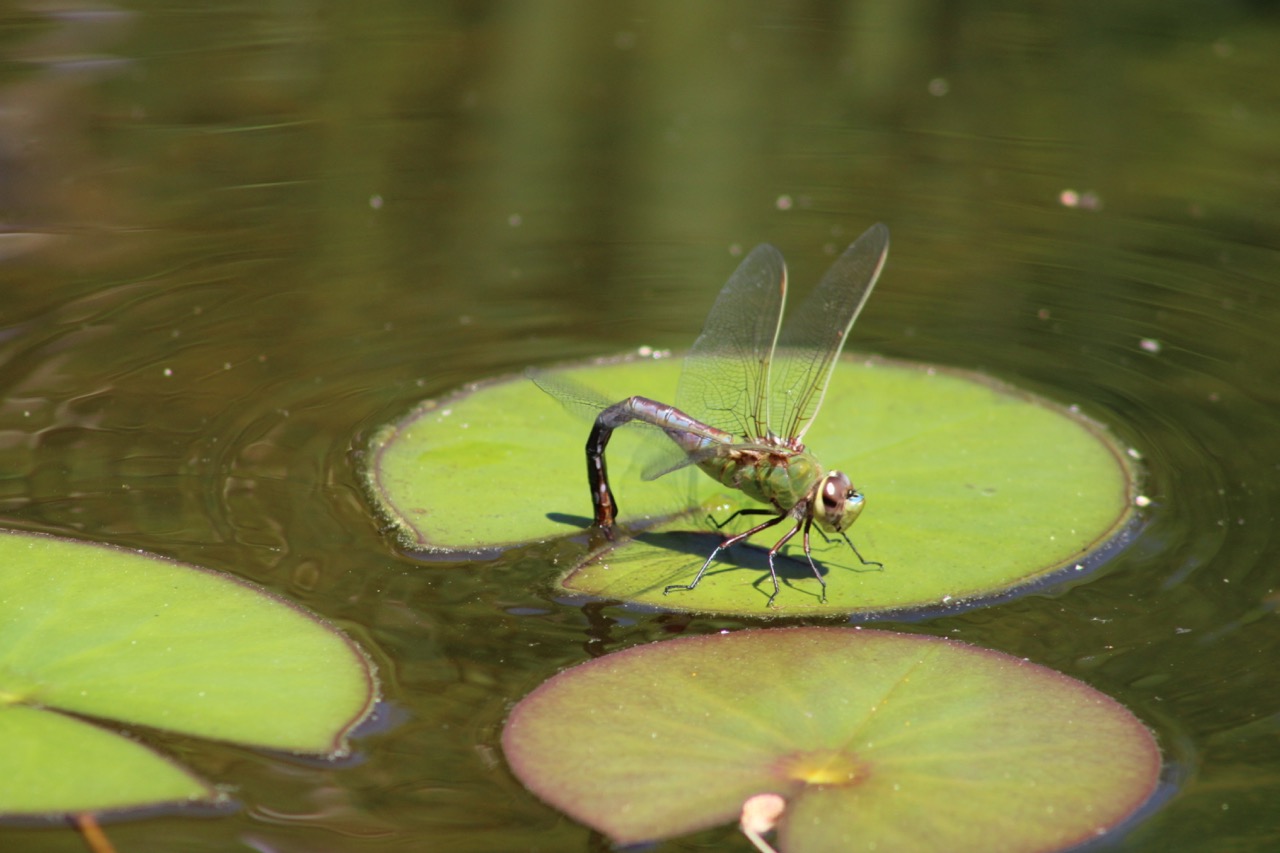
We have seen two frogs in the pond, one bold and the other cautious. Yesterday a neighborhood cat was stalking the pond. Today, I only saw the cautious one. Is the bold one gone? The cherries that appeared green in the trees are getting brown spots on them. The cardinal couple seems now to frequent the feeder every day. The robin that abandoned her nest, is back in the nest trying again with new eggs. Today I saw her partner bring her a bite to eat. A dragonfly was dipping her tail in the water, while perched on a lily pad–laying her eggs in the pond. Something took a few leaves off two of my kale plants, but did not destroy the whole plants. Can I begin to see all of it as wholeness, as beauty?
Dragonfly on a lily pad in the pond, dipping her tail in the water.




 Finding Our Way Home