Reblogged: Global Day of Prayer for the Water

I am reblogging this message from a Facebook event sponsored by Indigenous Peoples for December 21st:


Ocean Waves MD DSC07085

Photo by Margy Dowzer

Water is the one thing that all living beings require to survive. And, it is a resource that is rapidly disappearing. We have a fixed amount of water on this planet. Despite all of our technological advances, we haven’t figured out how to make more water. When it’s gone, it’s gone.

We have resorts in the desert and bottled water for sale. We have an industrial system that uses more water each day than it would take to support our entire civilization. Our waters have never been in greater danger. Practices like hydro-fracking and tar sands extraction pose the greatest threat to our water that our planet has ever seen. Our oceans are contaminated with waste, including the devastating amounts of radioactive materials that are being released by the Fukushima disaster.

We, as Indigenous peoples, have been speaking out against the destruction of our planet for decades. We have been working to address these issues spiritually, politically, legally and through direct action.

We now need the help of the global community to protect the continuation of life here on Earth. It is time for us all to come together to make a stand for the future generations. We need to use everything that we have to protect our waters, so that our children and grandchildren will have the ability to live. Today, we ask that you all stand with us.

We are asking everyone to invest in a day of prayer for the preservation and healing of the global waters and for a healing and elevation in the consciousness of those who are destroying our Mother, the Earth.

Please join us by organizing small groups in your local area to participate in this important event. If you can’t join a group then please take the time to add your prayers from wherever you are.

Here is what we are asking people to do: On December 21st, from sunup until sundown, please go to the ocean or to another major water source to pray, in whatever way is meaningful to you. Pray for the healing of the waters and for the healing of the hearts and minds of those who are destroying our water.

If you can’t gather at a water source then collect some water in containers and pray with it where you are, then choose someone to travel to a water source and pour the water that you have prayed with into that major water source. If you can’t reach the ocean or other large body of water then any body of water will do. If you can’t find a water source in your area then pour the water into the Earth at the end of your day of prayer.

We have a powerful ability to manifest change when we focus our energies. In order to create the type of change that is needed we must unite our prayers and energies and focus on healing the catastrophic destruction that humankind has created. We must shift the path that we are currently on, for the future of all life. Prayer is a powerful tool in creating that shift.

What we would like you to pray for:

1. Preservation and Healing of the global waters
2. Healing of the hearts and minds of those destroying our waters and an elevation in consciousness for all global leaders.

We ask that you keep your focus on these issues, so that we can keep the energy powerful.

Please share this with EVERYONE you know. We are all children of this Earth and we all have a responsibility to stand up and protect this vital source of our survival.

Looking forward to joining you all in prayer on December 21st!

Creatures of Time

Photo by Udo Kügel Wikimedia Commons

Photo by Udo Kügel Wikimedia Commons

The stars also form a pattern to our eyes in the night sky. They circle around the north star, so that when people take a time-lapse photo, you see the lines in circles around the north star. Of course, it is really the earth that is moving, spinning on its axis pointing toward our north star. Every spinning planet will have its own north star. The ancients used to tell time by the stars. If you were to track the big dipper, you could watch it move around the sky during the night, and if you watched it over many weeks, you’d see it was in a different place in the circle, each month of the year.

We are creatures of time. Our ancestors were watching all these patterns, learning them and tracking them so they might tell their children, marking them so we would know how to plant and harvest and hunt, and dance our own dance of time. They were much wiser than most of us at reading the natural signs of time, though our scientists have followed in their footsteps. And so we mark with our machines the minutes and the hours and the days and the seasons and the years. We look back and we look ahead.

Our relationship with past and future brings us the awareness of our own mortality—that for us, and for all living beings, someday, time will cease. Often, we feel pain about that. We feel broken-hearted when those we love are no longer with us, or when something threatens their lives. We can see that some animals grieve when their companions die, but they don’t seem to anticipate death like we do. Our ancestors also wondered about death, and passed on to us their questions about what happens when we die, and their speculations and beliefs about it.

Some ancestors believed that there was another dimension that opened up after time ended—they called it eternity. There were many theories about what eternity might be like, some of which included endless misery or endless joy, depending upon our actions during our time. Others spoke of a cyclical process of rebirth, that we end one lifetime and begin another, until we experience all that we need to experience. In our own era, all these beliefs survive, as well as more skeptical viewpoints that propose that as creatures of time, death is the end, that there is nothing of the individual consciousness that survives beyond time.

Imaginal Buds

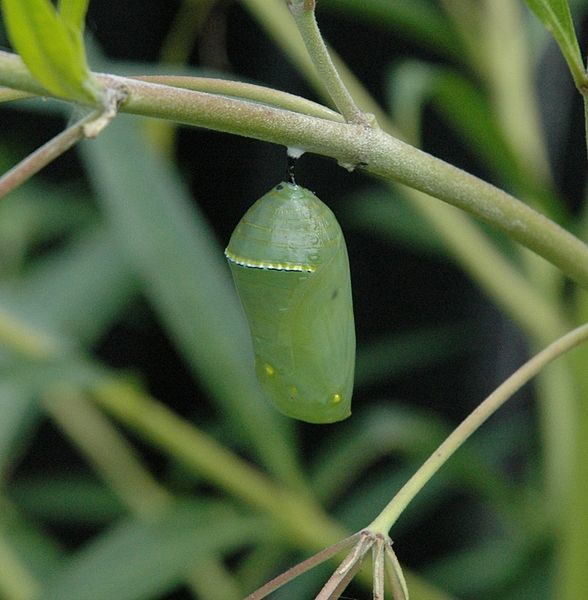
Change is already happening. There are millions of people and groups who are in some way involved in a new vision of community, and we can be a part of it. David Korten calls our attention to the familiar story of the caterpillar and butterfly. We all know the story. The caterpillar spends its days gorging itself on nature’s bounty. But then it attaches to a twig and forms a chrysalis around itself in order to become a butterfly. What we might not know is what’s happening inside the chrysalis to shape the butterfly.

Monarch Butterfly Chrysalis Photo by Armon, Licensed via Wikimedia Commons

Monarch Butterfly Chrysalis
Photo by Armon, Licensed via Wikimedia Commons

Korten, drawing on the work of evolution biologists writes:

The structures of its cellular tissue begin to dissolve into an organic soup. Yet, guided by some deep inner wisdom, a number of organizer cells begin to rush around gathering others cells to form imaginal buds, initially independent multicellular structures that begin to give form to the organs of a new creature. Correctly perceiving a threat to the old order, but misdiagnosing the source, the caterpillar’s still intact immune system attributes the threat to the imaginal buds and attacks them as alien intruders.

The imaginal buds prevail by linking up with one another in a cooperative effort that brings forth a new being of great beauty, wondrous possibilities, and little identifiable resemblance to its progenitor.

Korten sees our cultural transformation in a similar vein. Individuals wake up from the prevailing social systems, and begin to align their lives with the values of partnership and earth community. At first they experience a sense of isolation, but eventually they find others who share those values, and form what Parker Palmer calls “communities of congruence.” Those small beginnings attract others—they are like the imaginal buds of the new culture.

The old culture perceives them as a threat and often attacks their work. But as they network with others who share in the new cultural values, change begins to happen. Korten says that the cultural transformation we need is already in process—we can see the evidence of its beginnings in the great social change movements of the last half of the twentieth century—for civil rights, women’s equality, peace, environmental balance, and economic justice.

I saw a cartoon the other day. Four people were sitting in a boat that had tilted precariously and was filling with water at one end. The two people at that end were bailing furiously. The two people at the other end were sitting high and dry—and one said to the other, “It’s good that our end of the boat isn’t leaking.”

We are all in the same boat—this planet earth. The only real security we can create is a common security. When we finally realize that we are one family, one interconnected whole, essentially united with each other and with the earth, we will be able to find a way forward together. I believe we are already on the path. May we find the courage to take the next steps before us.

David Korten quotes from The Great Turning, p. 74-75, & 84-85.

The Work That Reconnects

Sunset Friends

Photo by Margy Dowzer

The Great Turning described by Joanna Macy is in essence a spiritual transformation. She has offered a process for people to work on that transformation together—The Work that Reconnects

It begins with the practice of gratitude. Macy says that gratitude is revolutionary in a world that tells us we are not enough, and we don’t have enough. Gratitude is a remedy for rampant consumerism. Gratitude is how we open our eyes to the beauty of what is now—the beauty of the shining sun and the nourishing rain. The gifts of creativity and relationship. The gifts of friendship and community, the food we eat, and the shelter over our heads. Gratitude can heal our souls, and give us strength to face the challenges of our time.

The second part of this spiritual work is to honor our pain for the world. When we open our eyes to the suffering being caused by the system as it is, we do feel incredible pain; we feel pain when we see how far we are from the future we can imagine. Macy reminds us that our pain comes from our sense of connection, and connection is what will save us. We hope to deepen our awareness of our connection with all people and all beings on this earth. And yet, as we deepen our awareness, we deepen our compassion, and we feel even more that pain of the world. We must choose not to run away from that, but to honor our pain as a signal of our connection.

That leads us directly into the third part of this spiritual work: to see with new eyes, to feel ourselves a part of the larger whole. We awaken to the reality that we are connected to all other human beings, that we belong to this earth, this beautiful living planet, and we have the power to make a difference on the earth.

The fourth part of the spiritual work is to go forth and use our gifts to participate in some way in the Great Turning. Macy identifies three areas of this work.

Tar Sands Protest

Tar Sands Protest
Photo by Margy Dowzer

There are what she calls “holding actions” like protests and lobbying on behalf of the environment, or against foreclosures. Some people need to be sitting in trees and marching in the streets.

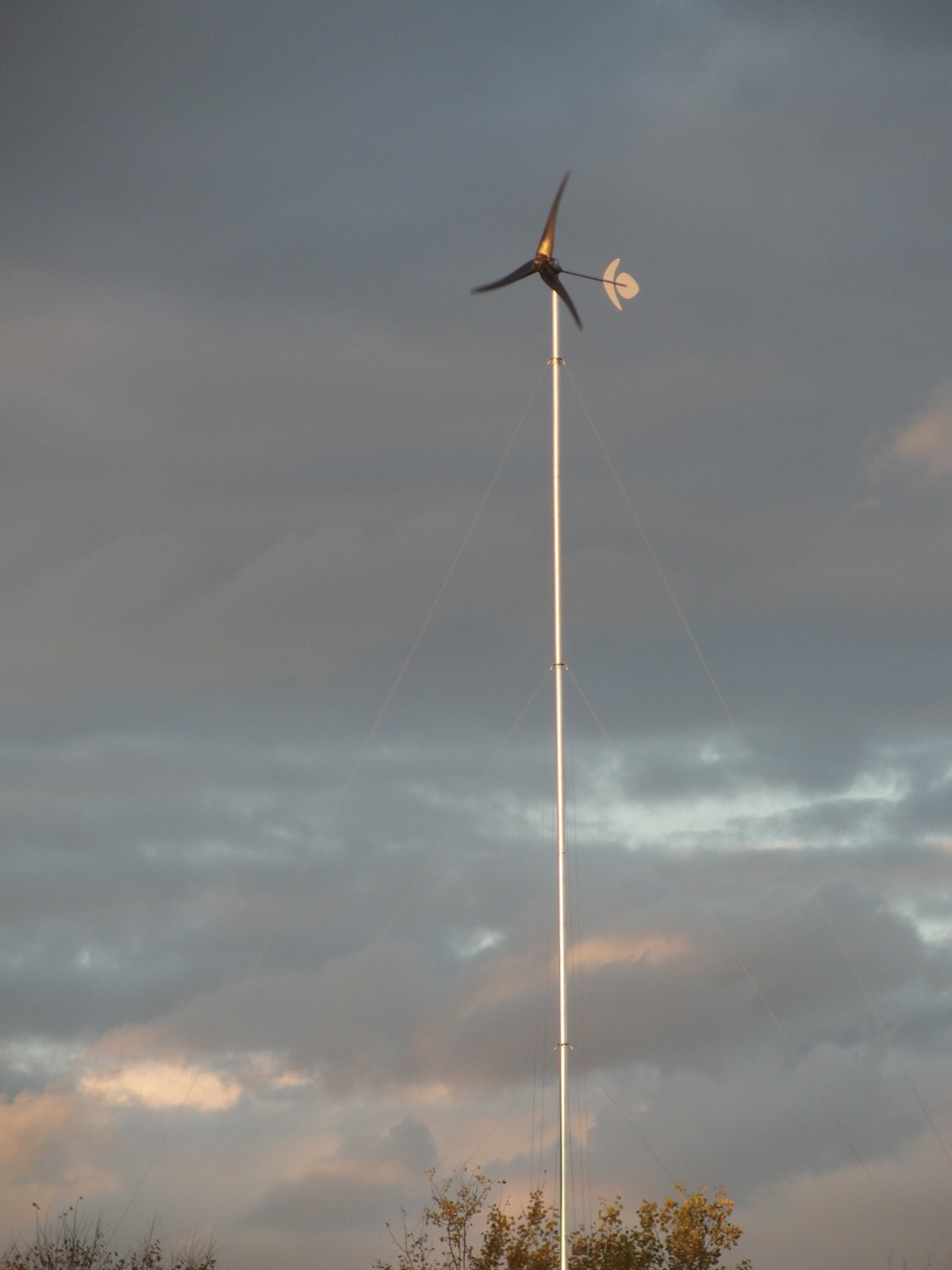
Wind Turbine

Wind Turbine

There are also experiments in what Macy calls, “Gaian structures,” new, or sometimes very old, ways to live that are sustainable and connected.  Some people need to be gardening, and building carbon neutral houses, and installing solar and wind power.

There is also the important work of shifting the consciousness of those around us. Some of us need to be writing books, and creating songs, and teaching young people about how to live as if we are a part of everything else.

Because there is so much to do, we can do that which most calls to us.

Turning Toward Partnership

A revolution is underway because people are realizing that our needs can be met without destroying our world. … Future generations, if there is a livable world for them, will look back at the epochal transition we are making to a life-sustaining society. And they may well call this the time of the Great Turning.   Joanna Macy


Planting the Seeds

Photo by Margy Dowzer

Joanna Macy believes that the essential adventure of our time is the shift from our industrial growth society to a life-sustaining civilization. She calls it the Great Turning. She says that “the ecological and social crises we face are inflamed by an economic system dependent on accelerating growth,” on “how fast materials can be extracted from Earth and turned into consumer products, weapons, and waste.” Based on this analysis, the mainstream arguments about how to revive the economy and the financial markets miss the point. Rather, the trouble in the markets is linked to a deeper trouble—a whole economic system based ultimately on the destruction of our environment.

In 2006, David Korten published a book, called The Great Turning, to further reflect on this transition that Macy had articulated. He describes our work in this time as a shift from the ways of Empire to the ways of Earth Community. He warns that even if we fail to change our ways, the world will change. But it will be known as the Great Unraveling, because “profligate consumption [will lead] to an accelerating wave of collapsing environmental systems, violent competition for what remain[s] of the planet’s resources, a dramatic dieback of the human population, and a fragmentation of those who remain into warring fiefdoms ruled by ruthless local lords.”

The other possibility, the Great Turning, involves unlearning the practices of empire, of systems based on hierarchy, competition, and domination, and adopting systems that support Earth Community: “a life-centered, egalitarian, sustainable way of ordering human society based on democratic principles of partnership.” If we recognize that we are all connected to each other and to the earth, we must embrace this sustainable, partnership path.

Fending for Ourselves?

There are strong pressures in our society to keep us fending for ourselves rather than finding common purpose with our neighbors. Think about some of the beliefs we have been taught about economic success and failure:

Economic struggles are a reason for personal shame.
You are on your own.
Don’t talk about your economic reality with anyone else.
You can pull yourself up by your bootstraps.
Watch out for people less fortunate than yourself—they will want to take your stuff.
Government programs will encourage laziness.

Sound familiar? These beliefs go back a long time. Chip Berlet, author of Right-Wing Populism in America, writes that the anti-collective attitudes currently expressed in the Tea Party movement find their roots in earlier Protestant theologies of America.

“If you read Protestant sermons from the late 1800s, they sound like Glenn Beck on a good day. They’re anti-government, anti-collective, anti-union. The idea is that good Protestants don’t depend on the government. Individualism and hard work and capitalism are seen as a kind of package deal.”

He goes on to describe how our social safety net was not constructed until Franklin D. Roosevelt pushed back against the banks and financial sector during the depression. “That was a real change in how Americans looked at government.” And even then there was “a campaign against Roosevelt, claiming that big government was the road to socialism and fascism.” These fears had a basis in the socialist movements in Germany and Russia that had produced totalitarian governments during the 1930s and 40s.

Individualists propose that we let the market work it out. Give free reign to businesses and corporations with the expectation that, unencumbered, they will restore the economy to prosperity. Then, stock prices and jobs will rebound, and all will be well again.

Unfortunately, the problems with this analysis are extensive. One problem is that it ignores the vital scaffolding of common resources that we share and take for granted. Our economic and personal well-being is directly dependent upon things like good roads, traffic control, public transportation, community fire departments, and public schools; police protection, libraries, and public parks—all of these commonly held resources make our individual and corporate initiative possible. Yet they are not figured into the cost and benefit accounting in the market economy.

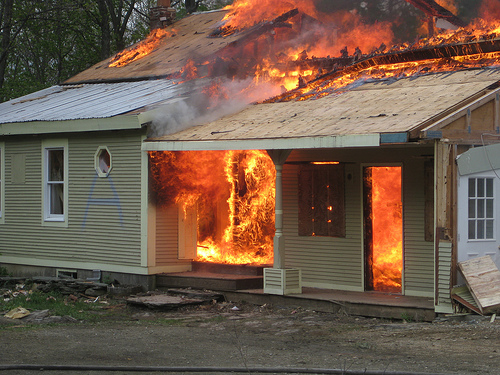
House Fire

Photo by dvs Licensed under Creative Commons

If these common resources are not protected, hazards abound. In 2010, a family in Tennessee lost their home to a fire because they had not paid their subscription cost to the local fire company. The fire fighters were under orders to let it burn down. Is that the future we want?

Another even more fundamental problem for the wellbeing of the human community is that we have treated the earth as a limitless resource to be used with no regard for future needs. Clean water, fresh air, thriving forests, and fertile soil are the underpinning of all economic and personal wellbeing, and human beings have been destroying them at an unprecedented speed. An economic model based on using up the water, air, forests, and soil is no longer feasible. An economic model based on continuous growth, as ours has been, is no longer feasible. There is only one earth, and its resources are finite. We cannot deal with this common crisis only as individuals.

Natural environmental limits are beginning to create tensions around the world. In just one of many examples, fierce battles are beginning to be waged over how we will manage increasing shortages of water in many places. While private interests are clamoring to control ownership of these resources, other are asserting that such fundamentals must belong to all Life. They cannot be separated and sold for the profit of a few.

Chip Berlet quotes from an Interview by David Barsamian, published in The Sun, November 2010: “Brewing Up Trouble: Chip Berlet on the Tea Party and the Rise of Right-Wing Populism”

Dawn Rhythms

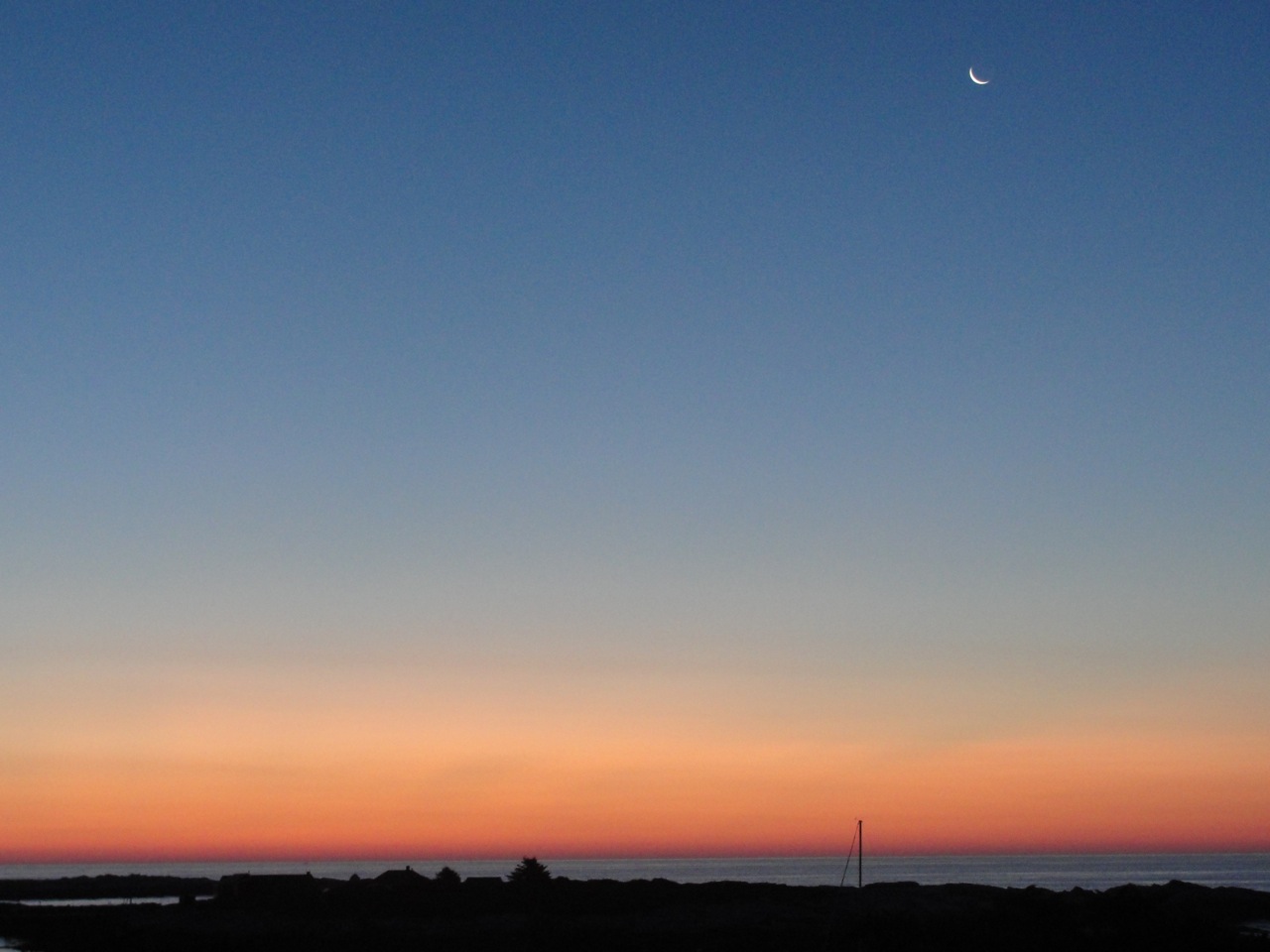
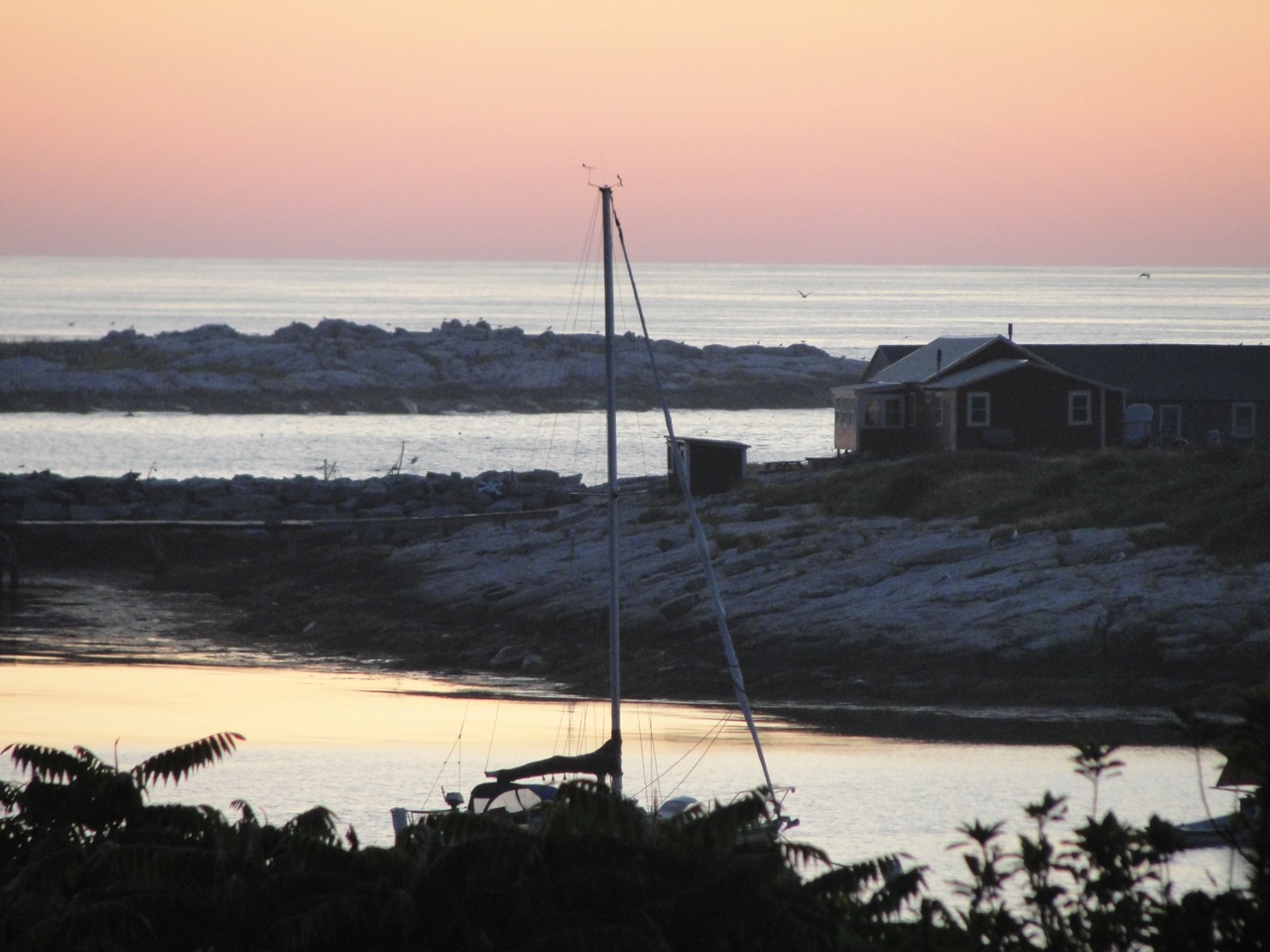
Crescent Moon at DawnOne morning on Star Island, I heard the cardinal at 4 a.m. Closer to first light. The waning crescent moon was hung over a deep pink rainbow of a skyline. I began to wonder why we don’t always get up with the light. It is actually quite bright in the hour between dawn and sunrise.

Before that summer, I had used the words dawn and sunrise interchangeably, but I learned that dawn refers to the first light that comes before sunrise. There is so much of it. Enough to read and write in my journal. We could save a lot of electricity if we got up at first light, and went to bed earlier. Of course, that is the logic behind daylight savings time, where we set the clock ahead so that we wake up an hour earlier during the longer days.

But what would it be like if our world was oriented to the rising and setting of the sun? Then every day we’d rise a little later or earlier than the day before. Because the sunrise changes every day. We’d have long days in the summer, and short days in the winter. The earliest sunrise in Maine comes in mid June, just before 5 a.m. daylight savings time. (That would be 4 a.m. Eastern Standard Time.) The latest sunrise comes about 7:15 at the end of December, except, because of time changes, it actually gets to 7:22 in early November, before we fall back with the changing of the clocks.

So, people might say that it wouldn’t be practical, in our world, to plan our day according to the sun. We plan our lives according to the clock. But what do we lose by that? While I was trying to discover the natural rhythm of dawn, I could feel how disconnected I was from all natural rhythms. Rising at dawn is a way to deepen my relationship with the seasons of the earth, and to the sun, and to the birds. But it makes me wonder, “Why do we try to shape the earth to our demands? Why don’t we try to shape ourselves to the rhythms of the earth?” And what might happen if we changed that pattern?

Cultures and religions the world over have honored the sacredness of dawn, the sacredness of the sun. Our word “sun” comes from the Old English, “sunne,” which was related to the Germanic sun goddess, “Sunna.” It shows up in our everyday language—the day of our worship is called Sunday. Christian monks, and Hindu priests rise at dawn; Muslims during Ramadan, as well as Indigenous peoples across many cultures. There is something in our human life that wants to be attuned to the life of the earth, which looks for beauty and joy in these simple rhythms.

Moving Toward East

I feel awe and wonder when I watch the sun come up in the morning and also when it goes down in the evening. Its beauty and grandeur can be breathtaking. It gives me even greater awe and wonder to realize that it is actually we on the earth who are moving, turning toward or away from our view of the sun. Science has taught us that. The earth spins on its axis once every twenty four hours, and this spinning creates our day and night. I may know all this intellectually, but I must use my imagination to experience it: see if you can, too. You can try this anytime, but it is most vivid at a sunrise or sunset.

Face the east just before sunrise.
Imagine yourself riding on the surface of the round earth sphere,
almost like riding in a car, looking out the front window.
We are speeding forward further and further until suddenly the sun comes into view. Feel yourself moving!

Later, just before sunset, face the west.
Again imagine yourself on the surface of this huge globe.
This time, like a child looking out the rear window of a car,
see that we are speeding away from everything until the sun slips from our sight.
We’re always moving toward the east!

It would make us dizzy to be aware of this motion all the time. But for a moment, we can be dizzy with the wonder of it all. Scientific knowledge can bring us to an awareness of reality beyond what we can see with our own eyes. Spirituality is when that awareness moves from the dry realm of intellect into the visceral experience of awe and wonder. The natural world is the original holy book, the original sacred text: the earliest forms of religion were responses to the mysteries of the earth and sky. As our ability to read this book of the universe grows, our spiritual practices are trying to catch up.

Dawn at Star IslandMargy and I traveled to Star Island, a conference center that is an island off the coast of New Hampshire. It is a rather small island—you can see the water from almost every place on it. It turned out that the windows in our tiny room faced the east. The next morning, through my open window, of course I heard a cardinal singing before sunrise. “Come outside!” it seemed to say, once again.

Right beyond the door of our room was a porch facing east, with rocking chairs on it. I could crawl out of bed wrapped in a blanket, and sit in a rocking chair to watch the sun rise over the ocean. That day, the clouds formed variegated patterns of pink and orange, blazing up through the whole eastern sky. The cardinals jumped from bush to bush close to where I was rocking in my chair.Rocking Chairs

Watching the beauty of the sunrise during the next several days, I was again thinking about how the sun generates its own energy, how all the stars do that. We on earth are more like children, we are utterly dependent on this light-being for all our needs. All of the energy human beings generate and use all over the earth relies on the sun as its ultimate source. The whole sphere of life on earth is a child of the sun. Yet the sun is so personal too. We can feel its touch on our faces—it is as personal as the vitamin D that it creates through our skin.

The poet Hafiz said,

Even
After
All this time
The sun never says to earth,
You owe
Me.”
Look
What happens
With a love like that.
It lights the
Whole
Sky.

 Poem from The Gift: Poems by Hafiz, The Great Sufi Master, translations by Daniel Ladinsky 

Sunrise Blessings

Mona Polacca, an indigenous elder of the Hopi and Havasupai people, spoke at my church one summer. She talked about how we come into relationship with all the elements of the earth, with water, and air, and fire and earth. She blessed us with the feather of a water bird. Someone at the talk asked Mona what gave her hope. She said, hope comes with each new dawn.

Feeling blessed by her words, the next day, I woke up at 5 a.m. and went outside a few minutes later. It was already so light! The sunrise was to be about 5:18. The birds were all singing their morning songs. I could see the red orange sphere through the branches of the spruce tree.Spruce Sunrise DSC03603 I felt anew the amazing power of the sun. All plants convert sunlight to energy, and animals eat the plants, and we eat the plants and animals and our bodies are formed of this. We are the sun. Every fiber of our being is created of sunlight. All the earth sings to this light, this star from which we are created.

And we can see the sun. We have been fashioned in such a way that we can recognize this parent—all the creatures of the surface of the earth feel and see the sunlight. I felt joined together with that song of the earth, a prayer of thanksgiving to the sun. Thanks for life! I chimed in. Thanks for vision to experience the life all around me of which I am a part, and for hearing and smelling and tasting and touching.

After such a magical moment, you might think that I would be awake every morning after that. But it wasn’t so easy for me to actually get up at dawn. To sustain it I would have to go to bed much earlier than I was used to. The very next morning I had planned to sleep in, because I was up late the night before. But in the middle of my sleeping, I heard a banging sound.

I stirred, and realized that one of our kittens was inside the closet, pushing against the sliding doors. I grumbled, but the clock said 5:15 a.m., exactly five minutes before sunrise. Feeling duly summoned by forces greater than myself, I crawled out from under the sheets, pulled on my shoes, and went outside once more, while the red ball was just appearing in the east.

The Magic of Dawn

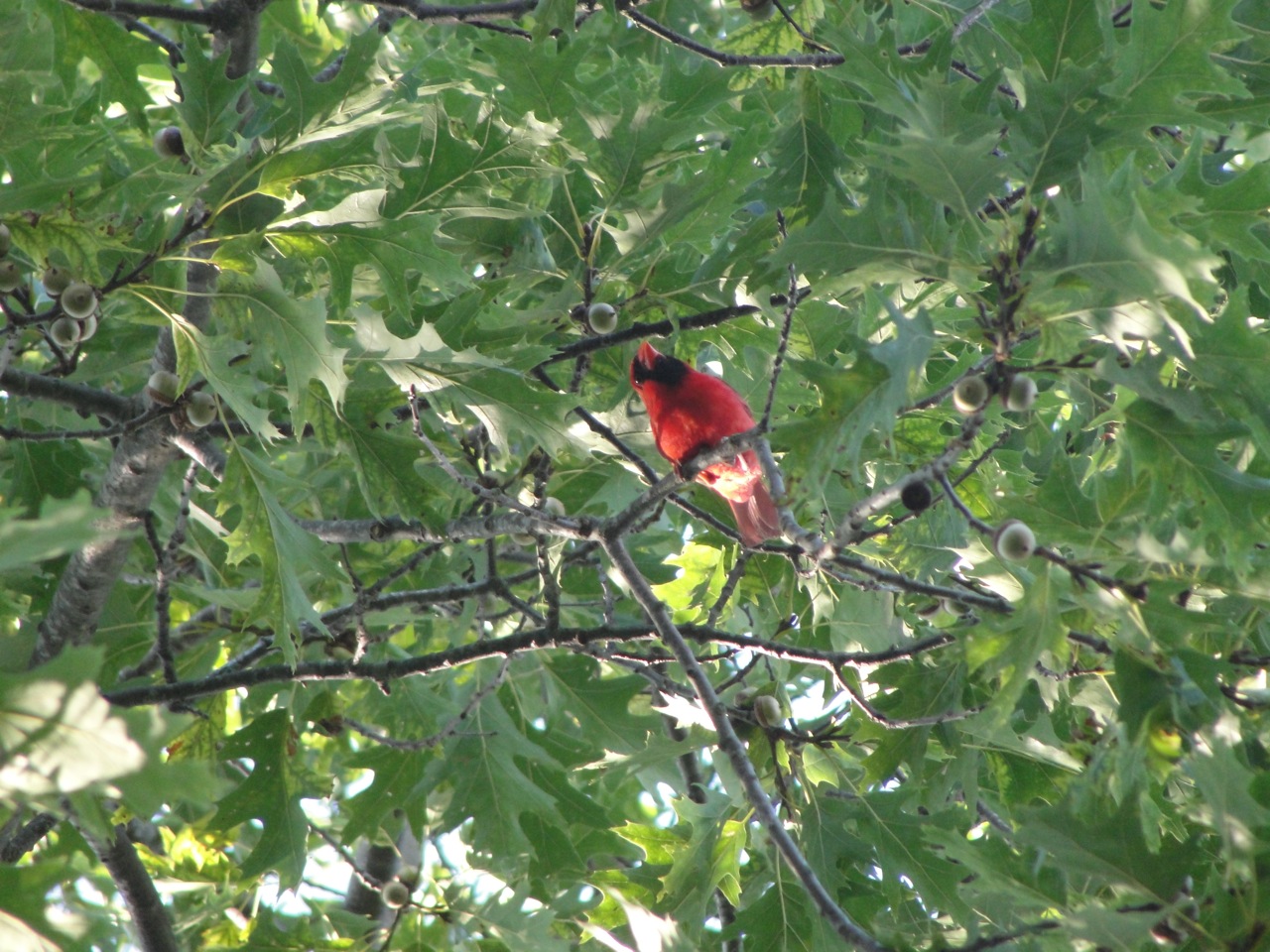
CardinalI was sitting on a blanket in a screen tent in the back yard, honoring the earth and all her creatures, when during my prayers, a cardinal started singing, and came to perch on the ground right near the tent. I felt so thankful for that visit.

I was pondering the big questions of my heart. I was asking, What is my greatest hope? And my heart answered, I hope that we find a way to live in harmony with all life on the earth, that our spirits wake up to experience the unity of all life, that we might join in that beautiful dance. But I also asked, What is my greatest fear? My heart answered, I am afraid that the greedy and powerful will kill all the trees, pollute the oceans, and destroy the animals and the people. I am afraid that humankind is broken beyond restoration, so cut off that we cannot find our way back to the unity.

And so my prayer was a prayer to find wholeness, to find joy. When the cardinal started to sing so close by, it reminded me of the magic of being outside, the place where my hope is restored. It also reminded me of the magic of waking up at dawn, the time when the cardinal and a host of other birds sing their most beautiful songs. They create together a dawn chorus.

I first learned about the magic of dawn from my Wampanoag friend gkisedtanamoogk. He had told me that the eastern peoples, called the Wabanaki, believed that dawn was the most sacred time of the day—the name Wabanaki means people of the first light, the first light of the sky before the sun rises over the horizon. This time was considered the best time to pray, to commune with the earth and the spirits within the earth.

A few days later, I woke early, and heard a cardinal singing outside my window, and that called me outside again. So I went out and sat on my blanket and tried again to open my heart to the world all around me. When I look at any writing in English, even the tag on the edge of the screen tent, I cannot help but read the writing there. Yet when I look at the plants or the mushrooms in our yard, I realize I do not know how to read the earth. I don’t know the names of many plants or their characteristics. Our species has become so isolated, so alone in our own thoughts and works. I wish I had a guide to teach me how to read the earth.

Slug in grassI saw a small slug moving slowly through the grass. As I was watching it, I wondered what it was reading about the earth, what chemical messages it found in the small trails through the grass. It was on its way toward a mushroom. I took photos of its small golden body, tried to pay attention to its slowness and intention as it climbed the mushroom stem. Even a slug can be a teacher.Slug on Mushroom

Listening to the cardinal singing, these words came into my heart: Whatever you do there is beauty in it: the work, the rest, the prayer, the play, the listening. Awaken to beauty, be present to it, the hidden beauty of the ordinary is like the muted beauty of the female cardinal. Dispel sadness, awaken to beauty and joy.