
Two people have reached out to me in the last few weeks to ask about the origins of the name of our little Capisic brook. They accurately assumed that it was a Wabanaki name, as are many waterways in what is now Maine, and wondered about its original meaning. I have wondered that too, though when I asked Wabanaki friends, no one was quite sure. So recently I began some research about it.
Capisic Brook has several branches winding through our neighborhood, with three headwaters: the north branch starts east of Forest Avenue near the intersection with Allen Avenue, the main stem in a wooded area within Evergreen Cemetery, and the west branch just east of I-95 near the intersection with Warren Avenue. Sadly, it receives run-off from development and roadways, and its water quality is significantly impaired. After these feeder branches join together it crosses under Brighton Avenue, flowing into Capisic Pond, which was originally created in the 1600s by a dam for a grist mill. Eventually Capisic Brook feeds into the Fore River. [I want to note here that the Fore River was called Casco by the Wabanaki people who lived here.]
All of this land is Wabanaki land. I wrote about its history in a previous post, noting that it was the chief Skitterygusset who first made an agreement for a settler to live near Capisic Brook and its uplands. While the settlers thought of these agreements as deeds of sale, a Wabanaki interpretation was something more like a treaty: an agreement to co-exist, and to render offerings each year for the use of the land and water. Unfortunately, the settlers kept taking more and more of the land and waterways. That is the painful legacy of colonization. Any story must include this legacy.
For those of us who live here now, if we are paying attention, the presence of the brook is everywhere in the neighborhood, showing up in the patterns of the roads, and the deep ravines with trees and brush. It most likely contributes to the wildlife that still frequents our yards. When I go for a walk, I seem to find myself heading to places where I can see the brook, in one segment or another. Despite the pollution and development, the brook has its own powerful presence in this place, that cannot be denied.
So what about the name? I have been privileged to study a Wabanaki language, Passamaquoddy/Wolostoqey, for the last five years with Roger Paul. One thing I learned is that the languages are polysynthetic–words are formed from the combination of smaller syllables, with root segments, prefixes, and suffixes, that combine to form new meanings. The word “Capisic,” as such, is not in the online Passamaquoddy/Wolastoqey dictionary. So I began to look at its parts. First of all, early spellings by settlers were not consistent or necessarily accurate to the actual Wabanaki words. It is likely that it has changed over the years. But I listened to how it sounded, and converted it as well as I could to the spelling system which has been used for the last 40 years–and is used in the online dictionary: ‘Kahpisik.
Now, it is more likely that the dialect here was Abenaki, and their recent spelling system is different, but I was working with what I knew best, and all of the Wabanaki languages are intelligible to each other, so that seemed not unreasonable. Here is what I was able to find: first of all, the final two letters “ik” are most likely a “locative” signifying that the word is a location. So then I looked at Kahpis. Sometimes, an “is” signifies something small, though that is less certain in this case. “Pis” can also mean “in” or “into.” I found the syllable “Kahp” in the prefix “kahpota” meaning to climb down or disembark, and also the verb “kahpotassu,” used in the context of transportation, meaning she or he gets off, gets out, disembarks, steps down. I couldn’t find other uses for “kahp.”
Many Wabanaki location words are the descriptions of what might take place there. Because of the physical characteristics of the brook, I am wondering if Kahpisik might refer to “the [small] place where we disembark [from our canoes].” The brook was unlikely to be a navigable stream, so people traveling on the Casco (Fore) River, coming to this brook, would have to disembark. So maybe that is what the name refers to.
I want to acknowledge that I am not an expert in the language, and merely hope to be a respectful and curious student. I checked in with Roger and he thought it was possible that this meaning might be on the right track. If others can tell me a more accurate meaning, or source for a meaning, I will update this post.
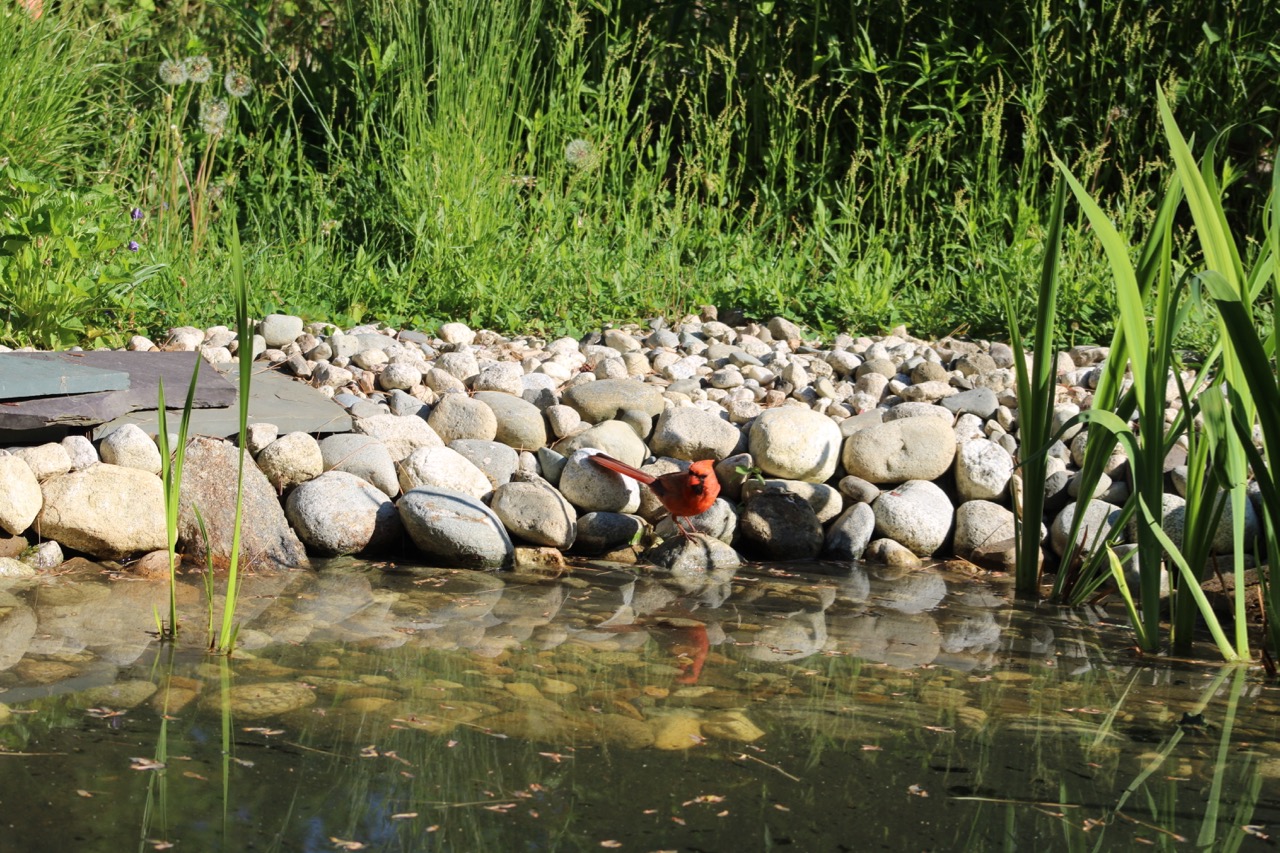
But in the meantime, it is helpful to think about this place in relation to its own history, to the people who lived here, live here still, and love this land and water. I imagine it used to be great drinking water, filtered as it was through gently sloping forest. Animals and birds still drink from it today, polluted though it is. I am grateful to be able to walk to the brook, to see the water and the plants, and sometimes birds and animals who visit. I am glad to see awakening environmental consciousness that seeks to purify its waters again, or at least mitigate its pollution. We belong to our watershed, and when we can imagine ourselves located in such a way, we are more likely to care for our home.

 Finding Our Way Home