The Lost Words

I haven’t had many words this autumn. Now, here we are in mid October. Leaves changing color, lovely cool days and cooler nights.

On the autumn equinox, we had a ritual with a few friends around our fire outside. I had gathered some acorns and we passed around a basket of them and each took out one acorn to express our thanks for some aspect of our lives, and then one for a wish or intention that we wanted for the next darker season. My intention was to bring back more music into my life. For whatever reason, I hadn’t been singing or playing my guitar for ages–I mean, years. So I put on new strings, and tuned the guitar, and then started singing a song here and there.

I found this hauntingly lovely song, Lost Words Blessing, originally shared by a colleague in a worship ritual. The song was inspired by a book The Lost Words created by by Robert Macfarlane and Jackie Morris. “The book began as a response to the removal of everyday nature words – among them “acorn”, “bluebell”, “kingfisher” and “wren” – from a widely used children’s dictionary, because those words were not being used enough by children to merit inclusion. But The Lost Words then grew to become a much broader protest at the loss of the natural world around us, as well as a celebration of the creatures and plants with which we share our lives, in all their wonderful, characterful glory.” [You can find out more about it on their website, and order books and albums there as well.]

One of my favorite things to do with songs is to figure out how I can sing and play them, and so I did with this one. And then, I found myself thinking about Passamaquoddy/Wolastoqey words, and how the language is in a fragile place, with original speakers growing older, and newer speakers trying to find their way into the language after long years thinking in English. How many of those words have been lost, or almost lost?

It has been a powerful gift for me to be learning the language with Roger Paul, via the University of Southern Maine during the last six years. Roger told us that the elders had given permission to share the language with outsiders, so that others might wake up to the world view hidden within. But I am always conscious that the language is filled with triggers of pain for all that was lost and taken by the violence of colonization.

There was something about the language that resonated for me with the song “The Lost Words Blessing.” So I decided to try to translate the song into Passamaquoddy–which I quickly found out isn’t really possible. It isn’t possible in part because the structure of English poetry is based on filling the lines with many words to evoke an experience, while the structure of Passamaquoddy, as well as I can understand it, is to use words that themselves are full of descriptive action. I learned a lot about how different the two languages are, by trying to create a version of the song in Passamaquoddy.

Still, I kept at it, not “translating” but pulling out words and sentences that created a similar experience in me, and also fit the phrasing of the music. While I am only an intermediate learner, I have learned how to research using the pmportal.org, to try to identify patterns and options and vocabulary. I couldn’t do it without that aid, and likely I made mistakes. I still don’t know if or when it might be respectful for me to sing this song. Can I, as a white woman, bring the language into this particular experience? When might it be appropriate to enter deeply into the language such that I can create a song with it? But to learn the language is, in a way, to fall in love with it. I want to honor Roger’s teaching by speaking as well as I can. Whether I ever sing the song for anyone but myself, I have learned so much by trying to create it.

Here is a sample, the first verse, with the original English, the Passamaquoddy, and then a more literal rendering of the Passamaquoddy into English. [Note: edited Dec 2024 with updated draft]

  • Enter the wild with care, my love
  • Kuli-nutahan elomahkiwik
  • In a good way, go out to the wilderness
  • And speak the things you see
  • on ktitomon keq nemihtuwon
  • and say what you see
  • Let new names take and root and thrive and grow
  • Piliwihtomun on kminuwiwihtomon
  • Name it/them newly and name it/them repeatedly
  • And even as you travel far from heather, crag and river  
  • Peci-te pihcehkomon nit sip weceyawiyin
  • Even when you go far from the river where you are from
  • May you like the little fisher, set the stream alight with glitter
  • Ansa pokomkehsis sipuhsis seskahtuweht
  • Like the little fisher make the stream sparkle brightly
  • May you enter now as otter without falter into water
  • Ansa kiwonik cupotomhat, kini-cupotomha
  • Like the otter slides into water, boldly slide into water

Hibernators Awake!

The chipmunks woke up from their hibernation earlier this week. Peeking out from their warrens beneath the garage. It’s a good thing we don’t have bears. My friend who lives in the woods had a bear arrive in the night to break apart their bird feeders this past week. Our chipmunks merely climb the pole and share in the bounty. The wake-up seems early this year, and probably is. The winter was too warm and too short. But here we are, in a climate changed world, loving the earth as well as we can.

Today is the Spring Equinox! Equal parts night and day. I want to take a moment, in the midst of the vast troubles of the world, to express delight at the turning of the seasons. Small bits of green emerging from the perennial plants. And I am grateful that after five sessions of physical therapy I am beginning to get some relief from my hip pain. My PT person uses Integrative Manual Therapy, and it is a miracle worker. There are still many sessions to go, and I am hopeful that healing will happen. I took a very short walk each of the last three days–my five minute walk to the end of the block–which actually takes ten minutes with my current walking status. It feels good to be outside.

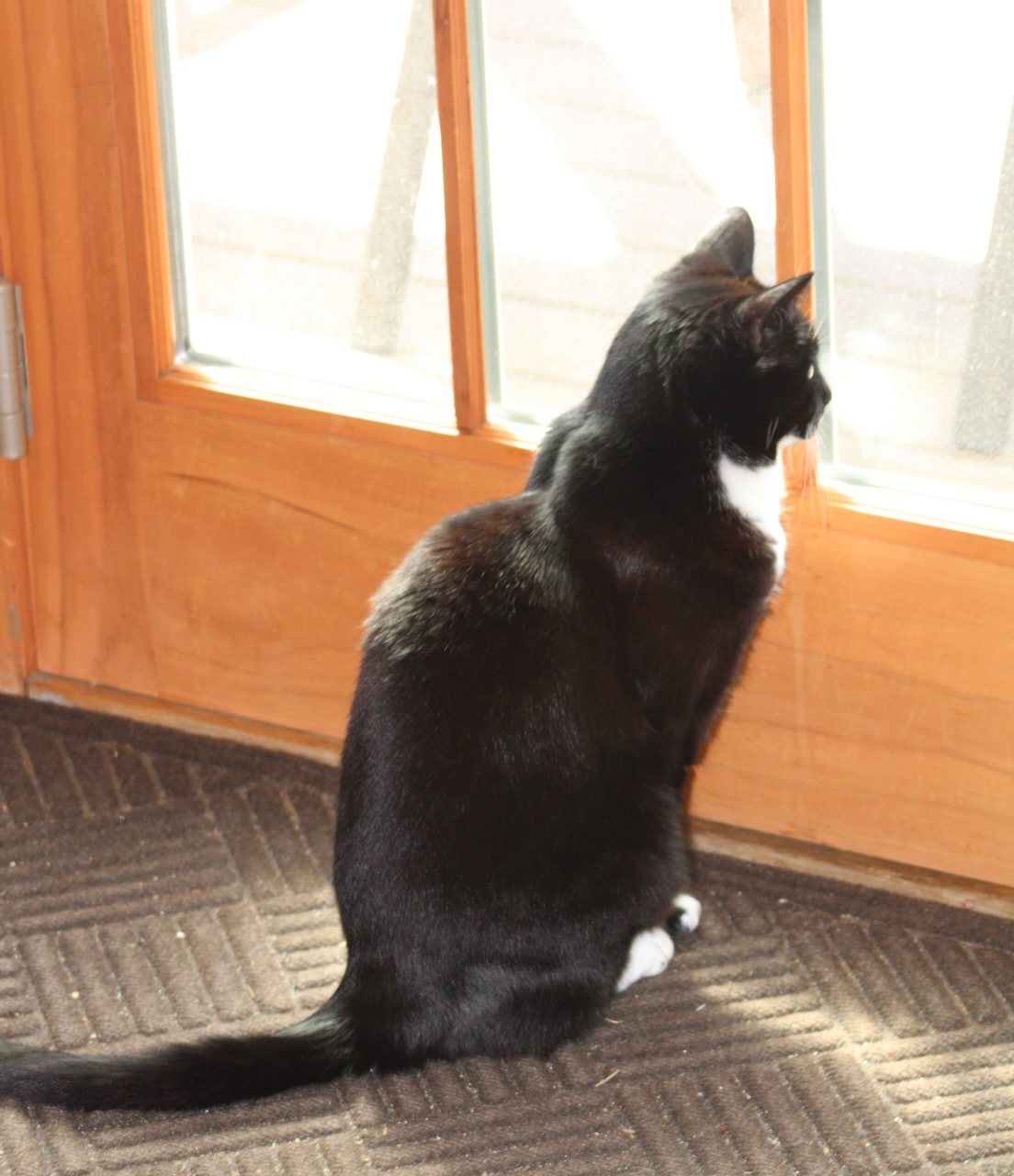
Meanwhile, the cats have new critters to watch through the windows. (They are indoor cats only.) Here is Billie looking out the back door.

I think about vulnerability. What it means for me to be 70 years old. I didn’t hurt my hip by falling or anything like that. I woke up one morning and there it was. It is a reminder to me to cherish the joys of each day. Who knows what tomorrow will bring? I can be prone to anxiety, and feel deeply the troubles of the world. I will keep bearing witness. But I will also find joy in these simple moments, these earth awakenings.

Disruptions of Spring

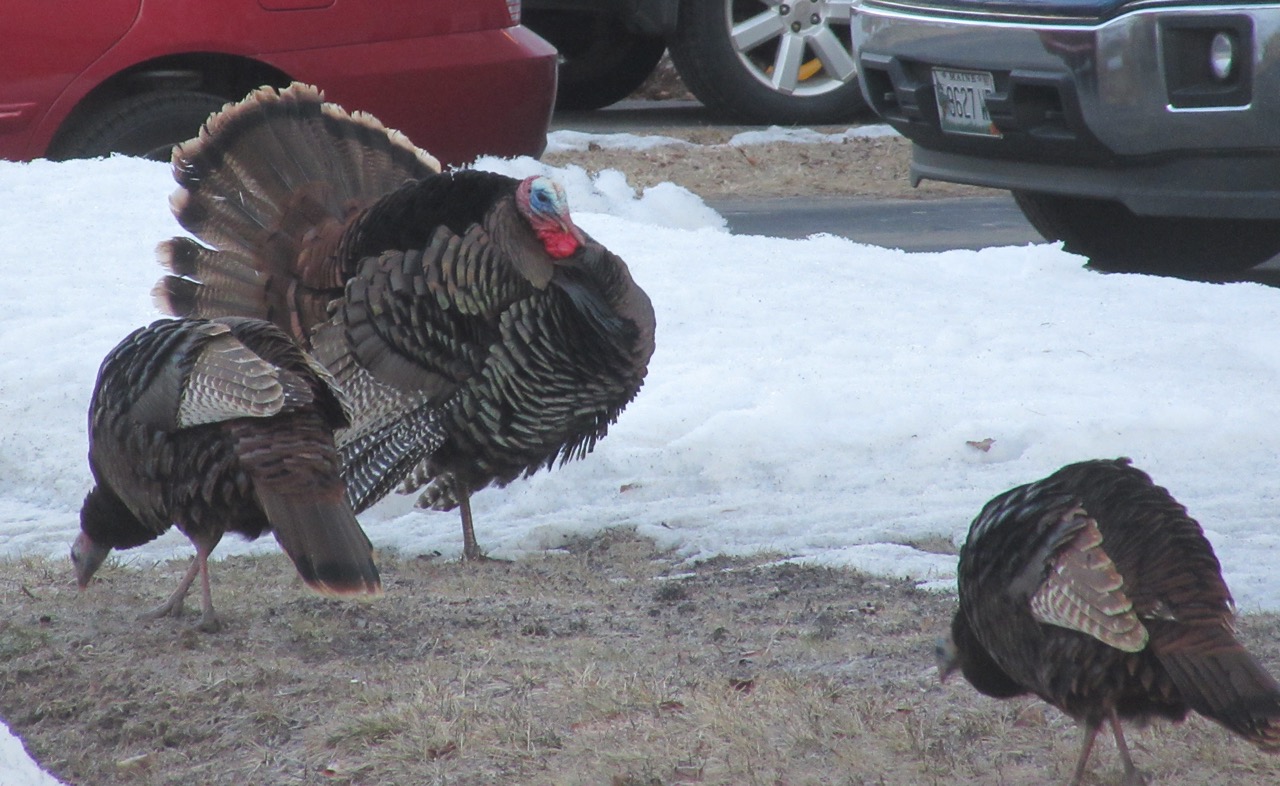
Turkey Tom display

Spring is here in its northern way, with unexpected delights and disruptions–the wild turkey toms proudly displaying in the midst of old snow and random automobiles–a flock of starlings taking over the trees in our yard—two ducks hanging out in the brook. A small group of us celebrated with ritual on the Equinox to welcome these disruptive forces into our lives, to undo the stuck places we’ve found ourselves, and make room for new growth, new movement. We used a frozen bowl of ice, in which we placed candles, to symbolize the thawing times.

We do still have snow or ice over most of the yard, but each day another small patch of brown grass appears; our neighbor was already out raking in her snow-free yard.  In the middle of this, two days ago, my car was rear-ended as I was driving the on-ramp toward the highway after grocery shopping in town. No one was hurt, thankfully, though my car is now in the shop waiting for the insurance bureaucracy to authorize repairs. I was able to drive it home from the scene, and take out the groceries, being careful to go through and watch for broken glass in the bags.

Still, it shook me up with the vulnerability that is life.  We never know which day might be the last.  And meanwhile I’ve been watching a show on Netflix called “Last Chance to See” which follows Stephen Fry and Mark Carwardine as they make a journey in 2009 to visit endangered animals that were first documented twenty years earlier by Mark and Douglas Adams (author of the Hitchhiker’s Guide to the Galaxy). Stephen Fry brings a comedic voice to their adventures as the urban klutz who doesn’t usually traipse about in nature. (I recognized his voice from the movie version of Hitchhiker’s Guide.)

But underneath that veneer of comedy is wonder and grief.  The final episode was originally going to be about the Yangtze river dolphin, but the dolphins were declared extinct in 2007.  So instead, they search for blue whales.  Mark tells Stephen that blue whales, the largest animals ever on the planet, have been here for forty million years.  Forty million years. And now they are endangered, along with so many others.

I was caught up in the awe Stephen and Mark experienced in getting up close to these majestic beings.  I was filled with amazement at the beauty of this complex interwoven planet that we have been blessed to inhabit.  And I tapped into the grief that has been haunting so many of us these days.  Grief for the demise of so many beings.  Grief for the losses that are being propelled by human activity.

I feel so powerless to stop this roaring train that “western civilization” has become.  Perhaps there is nothing we can do to save all that is dying.  All I could think to do was to let myself choose conscious gratitude and love–gratitude and love for the utter wonder of life on our planet.  Gratitude and love for the animals and plants that are our elders and companions.  Gratitude and love in the midst of grief.

Flock of Starlings

Starlings in the trees.


Quickening

At winter solstice, the sun begins to rise earlier each morning, but only by about one minute every couple days.  As we approach the spring equinox, the changes begin to quicken, each day the sun rises earlier by one or two minutes a day. It doesn’t sound like much of a difference, but I feel this sense of speeding up. This morning, I woke at 6, and found myself jumping out of bed, wanting to get outside as quickly as possible, so as not to miss the dawn.

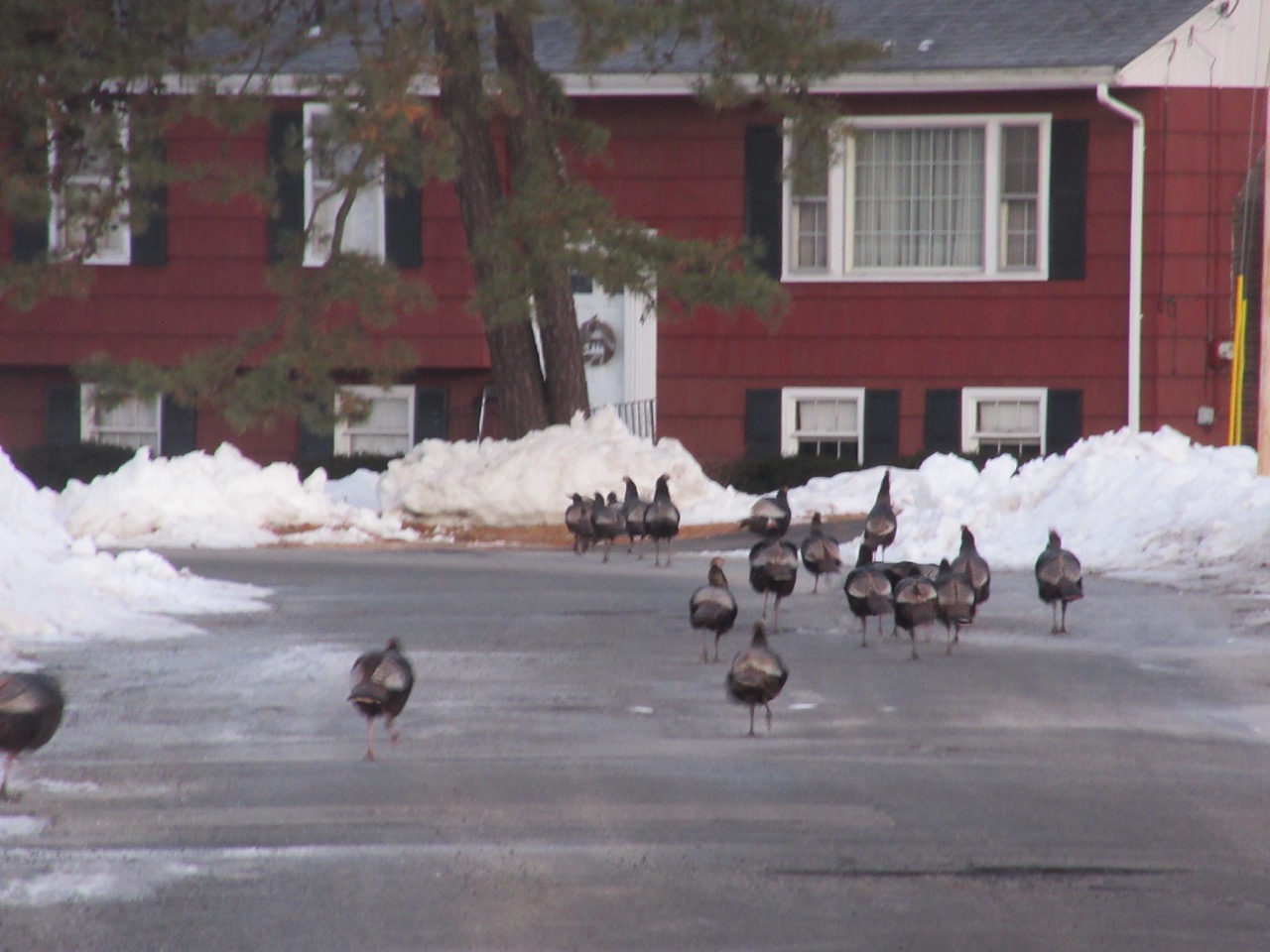
Gang of turkeysI was not disappointed. First of all, there was the waning moon shining bright in the western sky.  Then there was the gang of turkeys marching down the end of my street.  Twenty strong, they roam the place like they own it, and they do, as much as we do. Around the corner, a neighbor walks her little dog: Sparkles is still a puppy and just can’t contain herself when I approach.  She is trying to learn not to jump.  But she jumps. So we say our good mornings with enthusiasm.

Cardinal with tuftsOn my own again, around another corner, I hear a cardinal singing. He is already looking for a mate, or marking out his territory. I can see him in the tree, his characteristic shape visible with its tufted head, even though he is too far away to see the brightness of his red feathers.
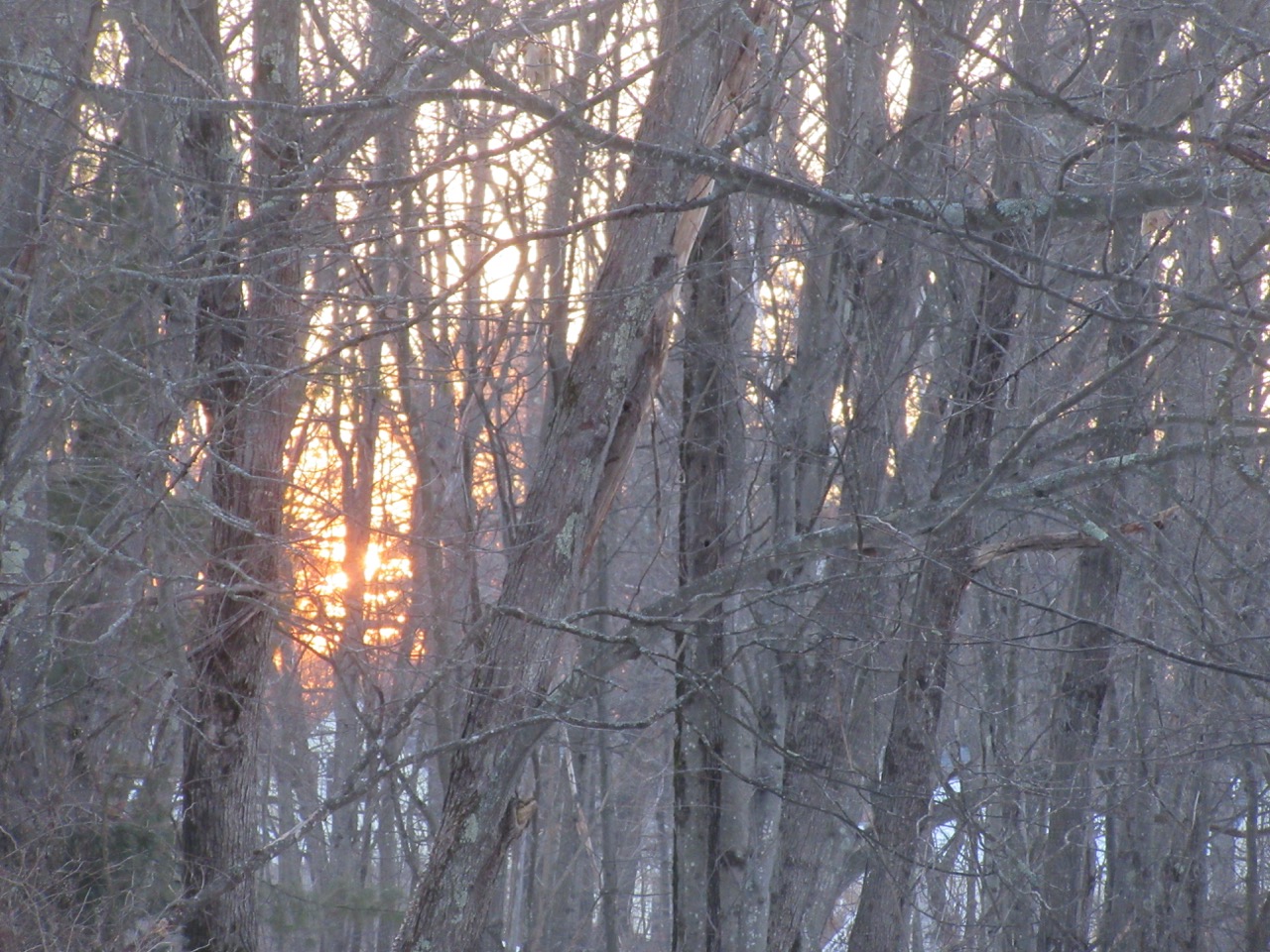
The streets are a mix of clear pavement and icy patches, so I make my way carefully, no rushing.  But I feel buoyant in the  early morning light.  Finally, I approach the brook, and look over to the east, where I catch my first glimpse of the sun rising through the thicket of trees.

I am a morning person, but I usually don’t like to get up before 6 a.m. Just before sunrise is my favorite time of the day, but if it gets too early, I have a hard time making it out of bed.  In this regard, I will be saved by Daylight Savings Time on March 10. The sunrise would have been at 6:03 that day, but we jump our clocks ahead, so it slides back to 7:03. Then we have all the days until April 15 before it approaches 6 a.m. again. Nonetheless, everything is starting to wake up now. Buds are starting to appear on the fruit trees. Birds are singing. They know.

Sunrise in trees

[True happiness is not in buying things, but in being thankful for all that we already have. You can ignore any ads that appear at the end of these posts.]

Spring Arrives in Maine

Spring Arrives in MaineToday is the first day of spring everywhere in the Northern Hemisphere.  What it looks like in my neighborhood is huge piles of snow and a really cold morning, but with a bright sun leading us into a clear day.

Margy and I hosted an Equinox ritual at our house last night.  It was a small group of five this time, and most of us were weary from the winter, so our ritual was simple and low key.  We named the friends who had joined us for Solstice and Imbolc, and sent blessings to all of them.  (You know who you are!)  We shared thoughts and readings about our lives and about winter and spring.  We talked about what we wanted to let go from the winter season, and what intentions we wanted to carry into this new season.

I thought about the next several weeks until Mayday.  The snow will disappear, and the ground thaw, and begin to fill with green.  Our plants will arrive from Fedco:  an apple tree, a peach tree, two blueberry bushes, three hazelnut bushes, a mulberry tree, a licorice plant, 25 asparagus plants, and 3 golden seal plants.  By Mayday, I hope they will be in the ground.  Our friends volunteered to help with the planting.

I remember when we first imagined this new home, when we began to lay out our intentions to find greener housing in the summer of 2015.  Our intentions included creating a permaculture garden, and having space in our living room for people to gather.  And here we are!  Living those dreams into reality.  The magic of deeply felt intentions can be surprisingly powerful.

Balance

Today at 4:21 a.m. marked the transition from Summer to Fall called the Autumn Equinox. Today the night is equal in time to the day. It is a festival of balance.

Photo by Margy Dowzer

Photo by Margy Dowzer

I feel a bit out of balance, staying up too late, waking with a headache, feeling like I have too much to do, and a bit rattled by all of it. But I took a walk in the beautiful cold crisp morning, and felt the warm sun on my face. I took time to journal, and listen to what the Mystery within might offer to me.

Here is what I heard from my old old grandmother: “You can always choose to step into balance at any moment. Do so now, on this day of balance between light and dark.”

And then I felt a sense of joy and peace in my heart. May you also find the way to step into balance today!

Sun and Moon

Campsite View

Morning View from our Campsite

One summer, I was sitting at our campsite at Winslow Park, watching the sun rise over the water. It was a day without a lot of plans, so I could sit and watch the sky and water for a long time. I noticed how fast the sun seemed to move up the sky. I heard somewhere that you can estimate the time by holding up your fist sideways, and counting each fist width from the horizon to the sun as an hour. In a simpler world, it was enough to tell time by noticing where the sun was in the sky.

Curious about this, I discovered that actually, if you took a picture of the sun at noon every day for a year, you’d find that it wasn’t in the same spot at all. Rather, you’d have a photo of an elliptical shape, like a lopsided figure eight. People call this path of the sun an analemma. It is formed from the fact that our orbit is not an exact circle, but an ellipse, and our planet is tilted relative to its orbit around the sun. So we have the seasons, and each day from June to December the sun rises a few minutes later, and a little bit further to the south, passing by due east on Equinox.

The natural world is full of these movements that follow their own intricate rhythms and orderly patterns. As I become aware of them, I begin to feel myself as a part of a vast dance with the sun, the earth, the moon, the stars. Our spiritual journey is such a dance—it too follows intricate rhythms and mysterious patterns. We may imagine that we are going forward, but perhaps we are dancing round and round like the moon.

Each day, the moon rises on average fifty minutes later than the previous day, and the high and low tides are changing at a similar pace. Winslow Park has a tidal beach, so we pay attention to the tides in the summer. You can only swim for about two hours before and after the high tide. One of our city friends didn’t understand about tides. We were planning to go swimming with her on a Wednesday. Two days before, she was visiting the beach and called us from there to make plans. “The sign at the beach house says high tide is at 2 p.m.,” she said, “Shall we meet at 2 on Wednesday?” We had to explain to her that the tide would be later in two days, closer to 3:40 p.m.; that it changes every day.

Once, years ago, I created a moon calendar for my stepdaughter Stephanie, who was six years old at the time. I was curious myself about why the moon was sometimes seen in the morning, and sometimes in the evening, and I thought it would be fun to learn about it and share it with her. So I tracked it, and began to understand its pattern.

The full moon rises at sunset and stays in the sky all night, setting at sunrise. Then, as the days go by, the moon begins to grow smaller, and it rises about fifty minutes later each day, until you can only see it in the morning just before and after dawn. About two weeks after the full moon, the moon rises unseen with the sun and sets invisibly with the sun. The night is dark. This is called the dark moon or the new moon. Then a day or two later, a thin waxing crescent appears in the western sky just after sunset and sets soon after. Each day it is seen in the evening for a little longer time until we come round to full moon again.

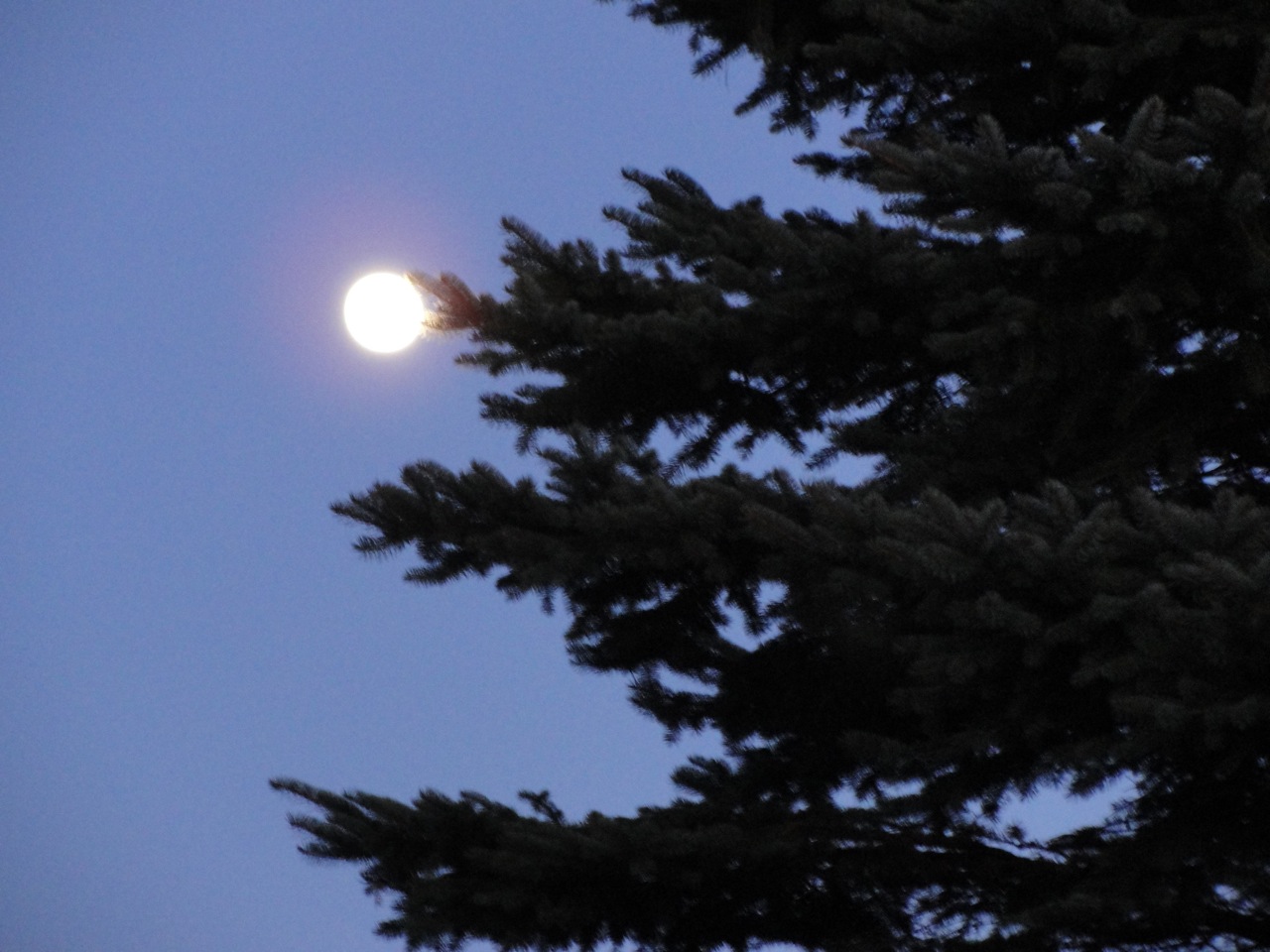
Full Moon