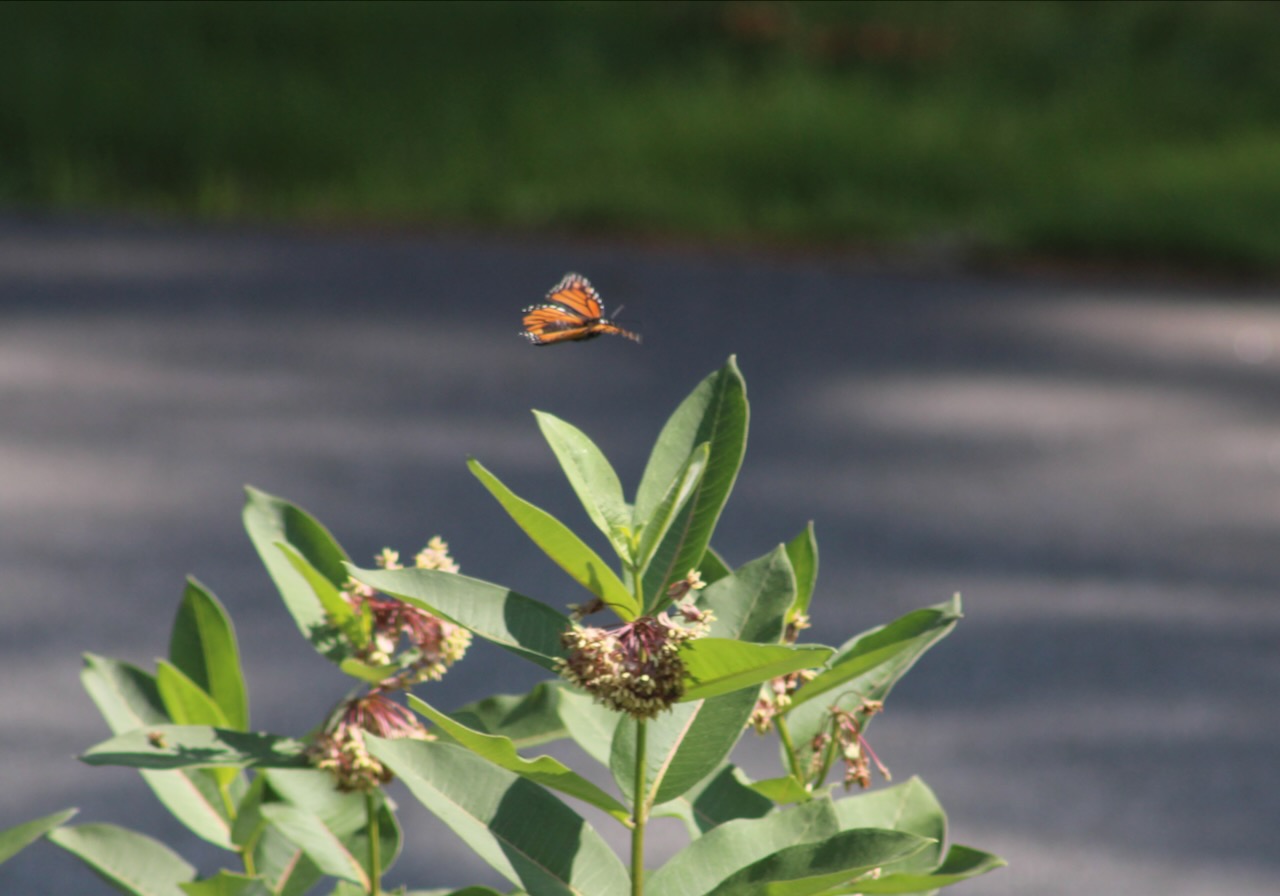
Today a monarch butterfly finally found our little milkweed patch in our roadside garden bed.
Last year, three plants appeared there on their own, and in late July we saw a caterpillar. In the spring we scattered some fluffy seedpods in the soil hoping to expand the numbers. This year we have a patch of about a dozen. As they grew and then bloomed, I’d look out the front windows, hoping to see a monarch. But nothing until today. It is amazing that the monarchs can find such tiny patches of milkweed, scattered in city neighborhoods.
In the midst of all that is heavy, it feels good to support these far-traveling little migrants.
My favorite color in the garden is this blue/purple of the Siberian iris. They’ve multiplied in the roadside garden bed, and blossomed all along the way. And now they are gone. So we had maybe a week to enjoy their beauty. I feel the time rushing by with all these spring and early summer flowers. Nothing goes on and on. With photos we try to capture the moment and make it last a little longer, but nothing really lasts in that way. If we don’t pay attention to the moment, we miss it.
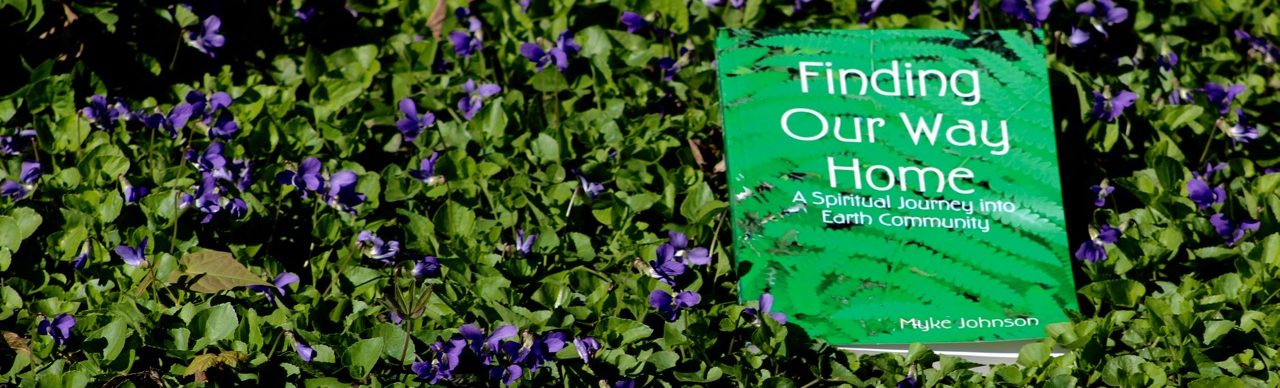
It is easy for me to get caught up in what needs to be done, the projects, the planting and watering, the weeding, the holistic sprays for the orchard. But probably what is most important is to walk around the yard noticing the flowers and plants and critters, noticing the birds and frogs and tadpoles. When we came to this yard, our hope was to nurture our relationship with the land, with all of the wisdom it had to teach us, with all of the tending that it asked of us. It was the tangible finding our way home that my spirit was hungry for.
We’ve been tending this particular small place for about nine years, and we feel such a bond with it. In these times of wars and rumors of wars, walking through the yard restores my soul. What must it be like to live for generations in a place? I can only begin to imagine. One of the crimes of the destruction of Gaza, along with the horrific killing of human beings, is the destruction of the land, the olive trees, the plants, the gardens. All those homes. It makes me weep.
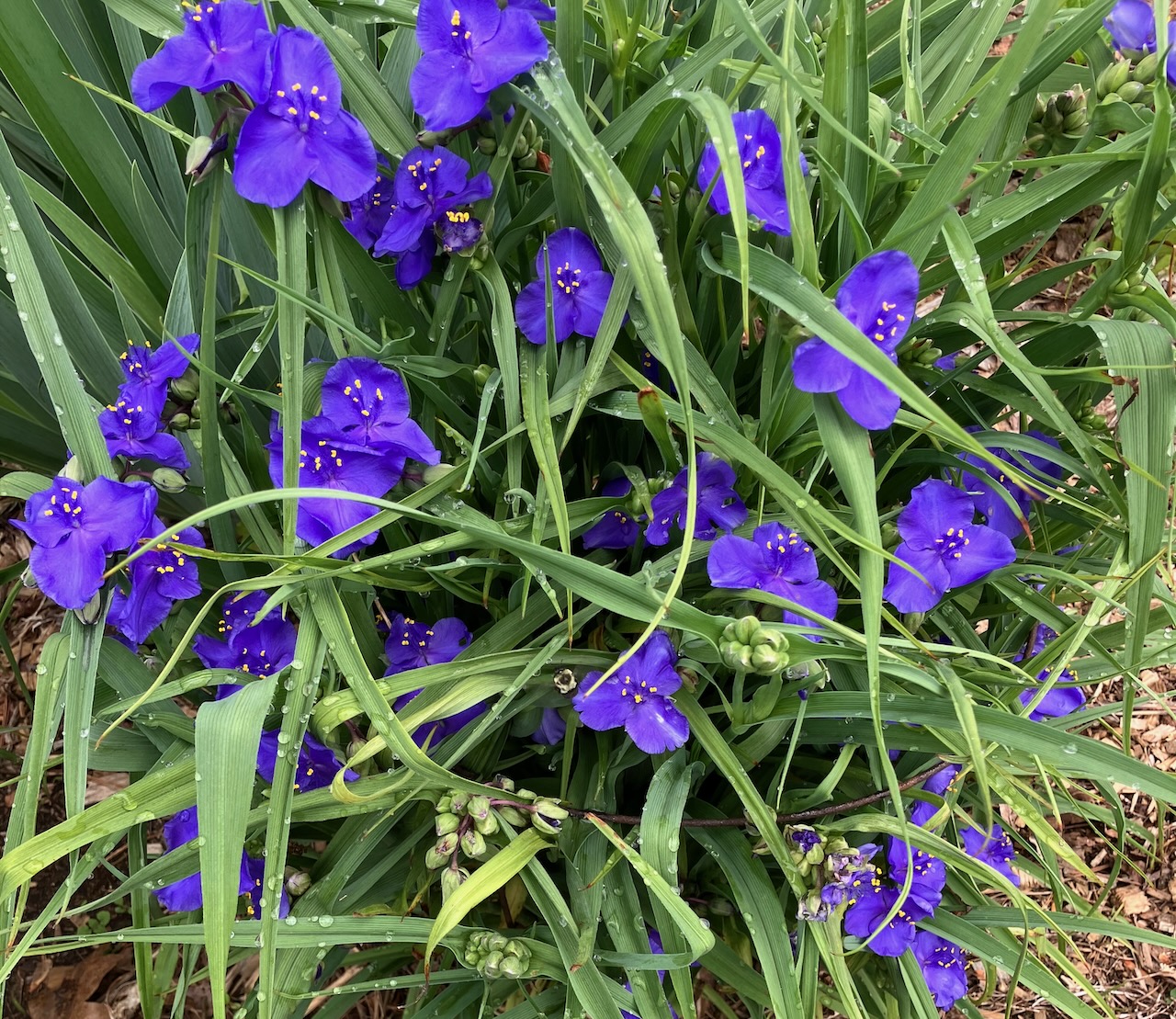
I walk around the garden in the mornings, and I pray. I give thanks for another day of living. Not just my life, but the life all around me, of which I am a part. I am happy to see that the spiderwort plants are blooming, another in that shade of blue/purple. This seems to be the very favorite flower of the bees, and it lasts for a long time, with multiple little buds on each stalk, taking their turn to shine. It is the very diversity and multiplicity of the plants that bring abundance to life in the garden.
There is so much beauty in the spring, but it all seems to be moving so fast. I can’t keep up. Mayday has come and gone. Already this season is half over. After two months of physical therapy for my hip and lower back, I am able to walk fifteen minutes and more again. The other day I walked to Capisic brook and onto the path nearby, and saw the trout lilies that usually grow there, a lovely spring ephemeral. American Heritage Dictionary defines ephemeral:
Lasting for a markedly brief time.
Having a short lifespan or a short annual period of aboveground growth. Used especially of plants.
Spring itself and all its beauty feels markedly brief. Is my love of photos a way of trying to hold on to all that is ephemeral? Is my need to write an attempt to halt the relentless flow of time?
I have been drawn outside more and more each day, excited to see daffodils and violets and green shoots coming up everywhere. And, happily, the peach tree is now covered with pink blossoms, and the cherry trees have many blossoms too. Last year, because of the weather, there were none–so these beauties seem fragile and extra special because of that vulnerability.
Peach blossoms on a foggy day.
There are many projects in the yard to attend to. Many branches fell from trees in the storms of winter and early spring. Margy has been cutting them up and hauling them around. Some of these we’re using to make a brush pile in the back corner for wildlife habitat. The other day, I cleared that space of invasive plants. I also set up our eight rain barrels again. We are going to get an new order of firewood, after using up our last old logs in the storms. So we are working on the space for the firewood, and purchased a rack to keep them off the ground.
Yesterday, I added two more pond lilies to the plants in the little pond, and as I was tidying up old dead shoots from other plants, I found strings of toad eggs attached to the old ferns. (So of course I left those.) We haven’t had toad eggs in the pond before. But there are a few frogs beginning to make an appearance–shy ones who have been diving under when they hear me approach.
The robins did not come back to the nest on our back porch that they had used for two years. Maybe that pair are no longer living. I read that their average life span in the wild may be just two years. I also read that they often don’t reuse nest sites–so we were lucky to have them in that spot for two years. Another ephemeral.
Then we discovered a nest in the yew bush near our front door–able to be partly seen from our living room window. So new robins are raising young nearby again. Maybe one of them fledged from the back porch.
Blue robins egg barely visible behind branches.
Is my love of photos a way of trying to hold on to all that is ephemeral? Is my need to write an attempt to halt the relentless flow of time?
I was cuddling with my cat Billie on the couch and suddenly felt a deep sense of our own impermanence. She is 13, I am 70. Senior cat, senior human. How much more time do we have? Someday, I won’t be able to feel her warm little body, with its soft fur and sweet smell, curling up on the pillow near my face. Someday, she will be gone; someday, I will be gone. We too are ephemeral. I want to hold on, but life seems to be about movement, about letting go into the next moment.
My favorite part of gardening is when native plants show up and bloom all on their own! Asters are all around the edges of our yard, and in so many other Maine yards in our neighborhood right now. Different varieties, all beloved by pollinators, tiny beautiful blossoms when you look closely.
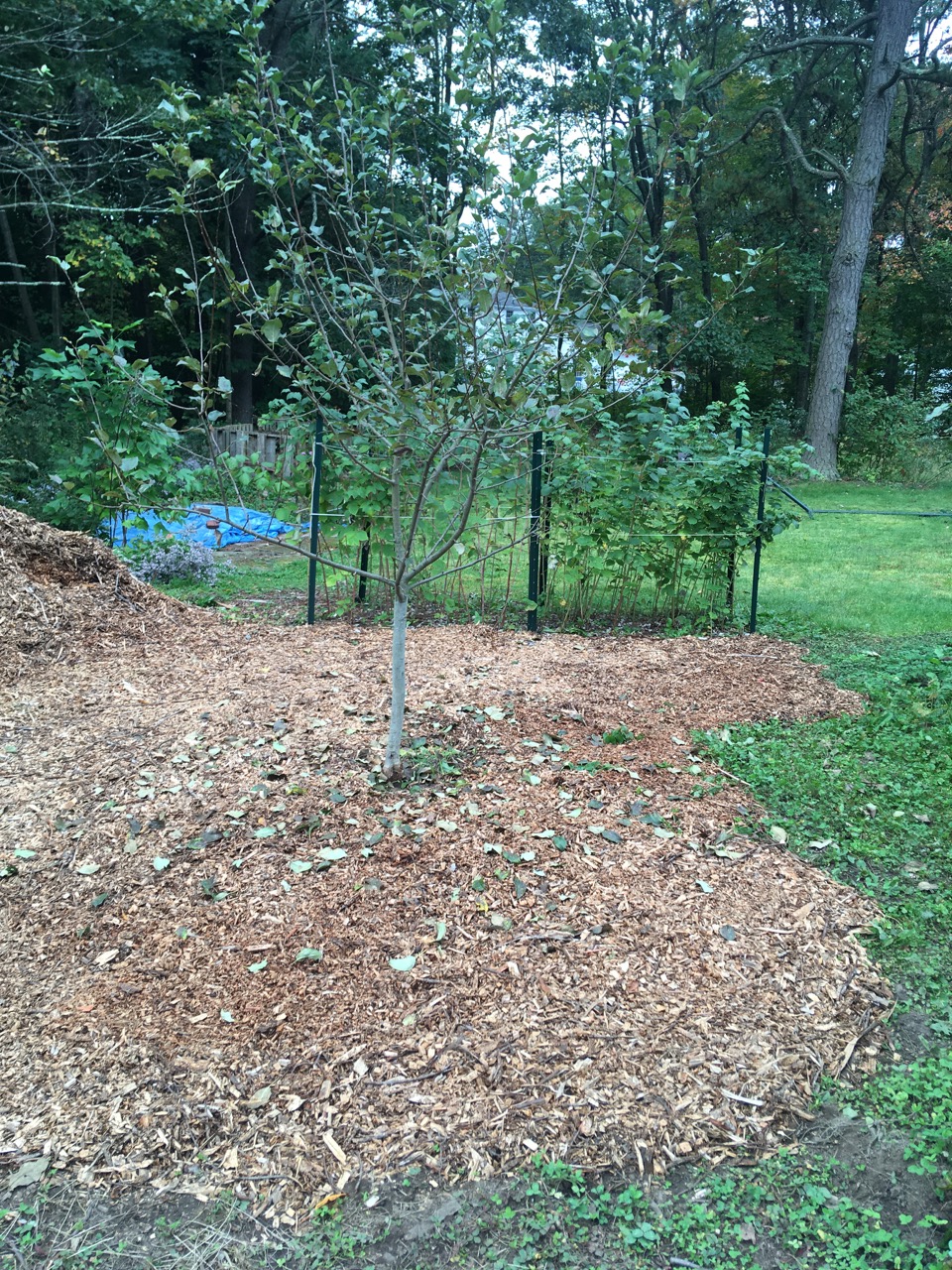
My least favorite part of gardening is wrestling with the invasive species that show up on their own. For the last three weeks I’ve been pulling buttercupplants that spread all over under the honeycrisp apple tree, and were also just starting to infiltrate the raspberry patch. So first I pulled up all the plants I could, in sections, then I set down cardboard over the area, watered it, and spread a thick layer of wood chips on the cardboard. Handily, the tree is right next to our pile of wood chips. The hope is that the cardboard and wood chips will smother the rest of the buttercup roots that I am not able to eradicate.
Halfway done pulling buttercup plants and layering cardboard.
While I was at it, I also pulled up all the oregano under that tree–my other nemesis, though it has its uses as an herb. It was intermixed with the buttercup. I was sad that I had to cover other ground plants like wild strawberry, and I hope they will spread again over the wood chips once things settle down. But finally, it was finished. (For now–I imagine I will have to be on the lookout next season for sneaky little survivors.)
Completed!
Meanwhile, the other least favorite thing about gardening is watching how climate change is disrupting the patterns that nature usually unfolds in each season. Yesterday, I discovered that there were open blossoms on the cherry trees–just a few–but this is October in Maine! Last winter’s unseasonable warming and freezing killed all the blossoms that should have come out in the spring. We have yet to harvest any cherries from these trees beyond one or two. And now this. I have heard that other people are noticing weird blooming out of season on other plants too. I don’t know if the cherry trees will survive. I hope they will. I tend them as well as I can, but there are forces far beyond the little garden here in our yard.
Meanwhile, I try to be grateful for the gifts that still emerge, the asters and goldenrods, the frogs and birds, and that I am able to go outside to watch and learn.
Since beginning to blog, I have loved taking photos of creatures and plants. It is like a third eye that helps me to see the beauty all around me. Sometimes it helps me to look more closely, later. Like with the frogs in our pond–I think these three might be bullfrogs, because of the ridge that goes behind their tympanum (their external ear drum for hearing), but not down their backs. I tried comparing them with images online, which helped, but then I noticed how often frogs have actually been misidentified in photos on the web. So I am not sure. They are bigger than some of the frogs that have been in the pond.
But when I look back to earlier photos of frogs that I identified as green frogs, I am confused. I knew those were green frogs because they were very small, and their little squeak as they dove into the water was distinctive. But they also seemed to have the ridge behind their ears and not always down their backs. Photos enable me to keep looking and wondering. I’ll have to wait and hear what these frogs sound like. They were out on those same rocks today.
Pink cosmos blooms
Sometimes, photos help me see beauty that is ephemeral yet durable. This cosmos was a volunteer by the side of the road, and started tall, with just one blossom. In the winds of last weekend, it fell over, but it keeps blossoming, and the bees keep coming by for nectar. It just keeps on blooming. It makes me smile.
Then, the other morning these turkeys wandered into the orchard, the sun making a little halo around their funny heads and big bodies. I was sitting in my chair and saw them outside the window. So I jumped up to go outside to take photos. The camera motivates me to watch them on their travels through the back yard. Then I can enjoy them once again in the photos.
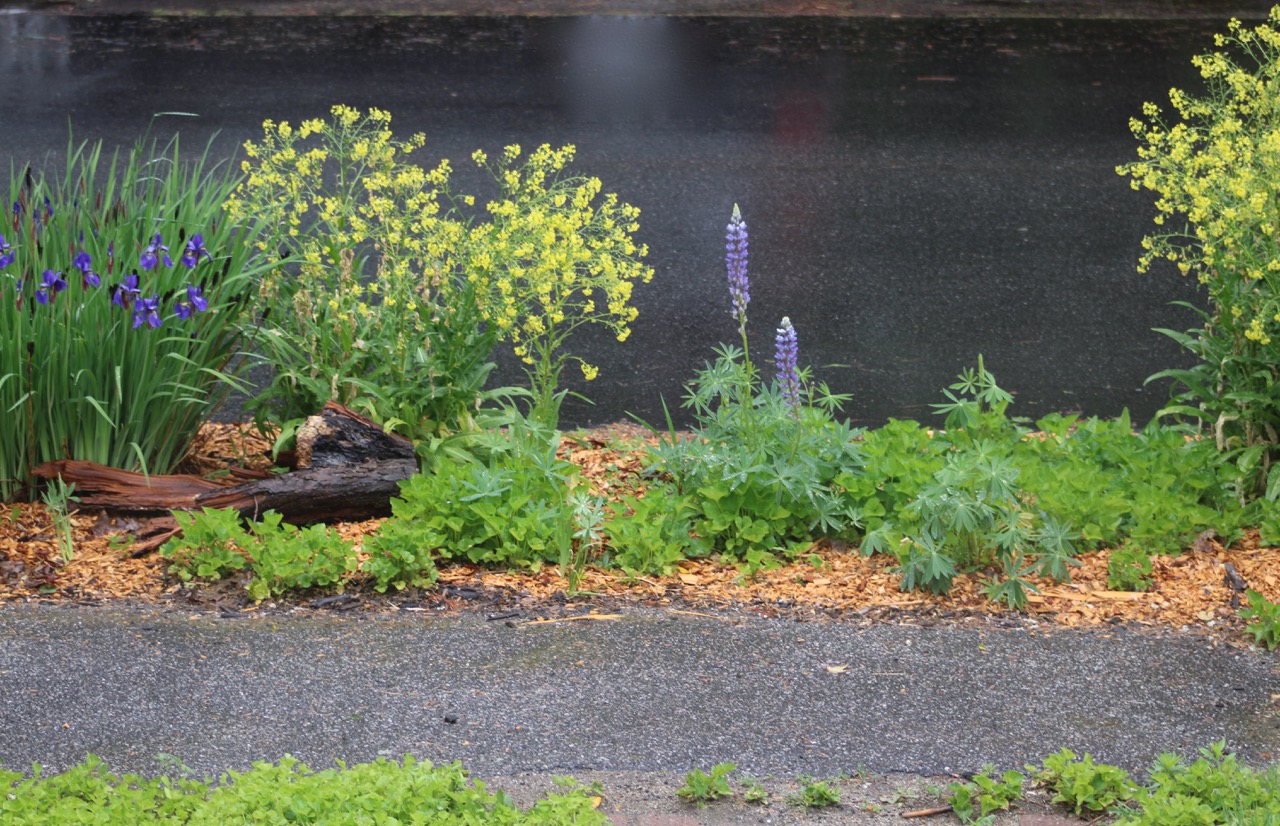
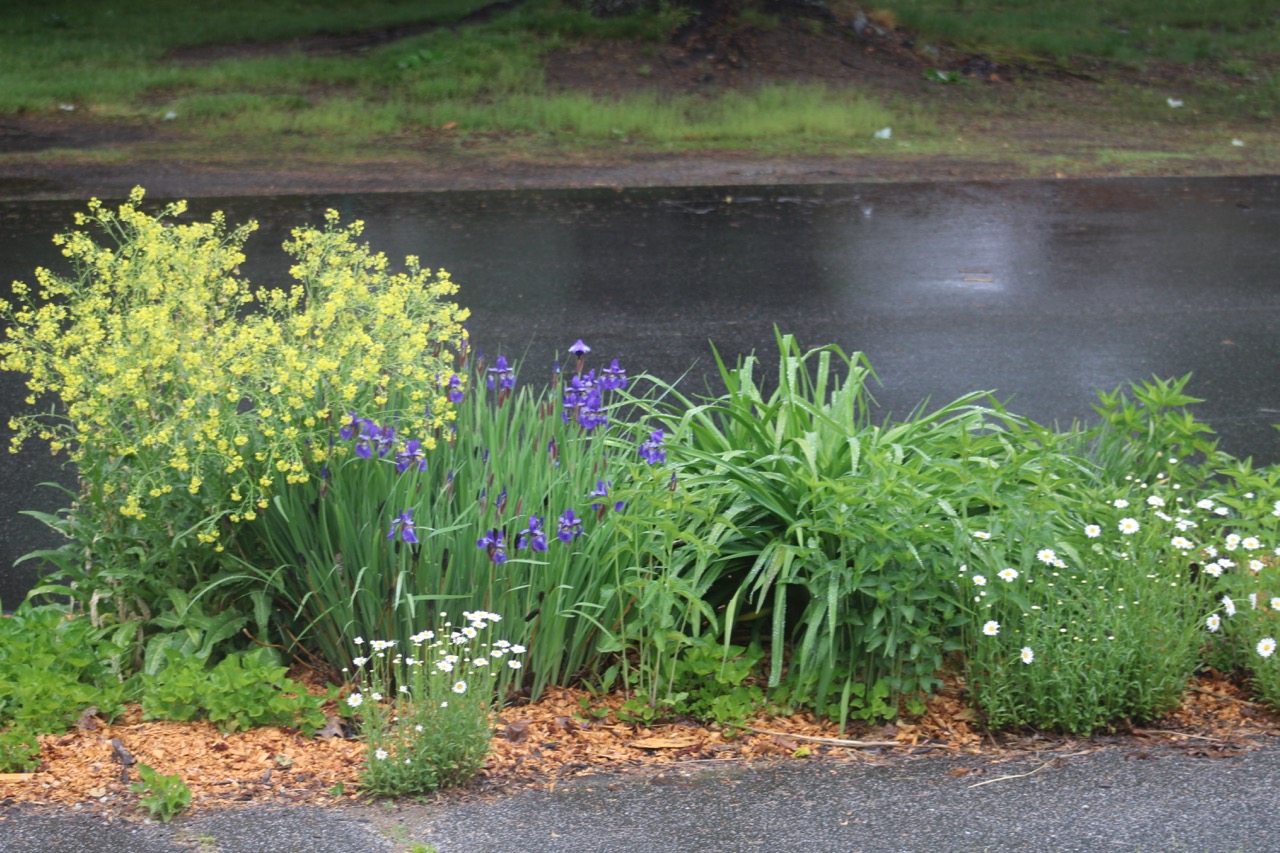
This is my favorite time of year for the roadside garden. The flowers are in contrasting colors of bright yellow, purple/blue, and white, with lovely green leaves of all shapes and sizes. Despite the cold and rain of the past week, it seems to send off a glow into the gloom. It was a garden formed originally from gifted hardy perennials, and others have naturalized to find their own places, like the white daisies.
Turkish rocket, Siberian iris, wild daisies in bloom.
Before the rain, we planted random and unknown flower seeds in one of the garden beds in the front, and carrot seeds in the other (next to broccoli seedlings). I had also planted zucchini and cucumber seeds in the hugelkultur mound. I hope the rain waters them gently and they sprout. Most of our seeds are from prior years, so it is a gamble. But it did seem like good timing.
And for those who have been following this blog, you might be delighted to learn that after the robins fledged, the parents are now starting a second batch of eggs. Once again, she laid one egg per day, but this time, there are four!
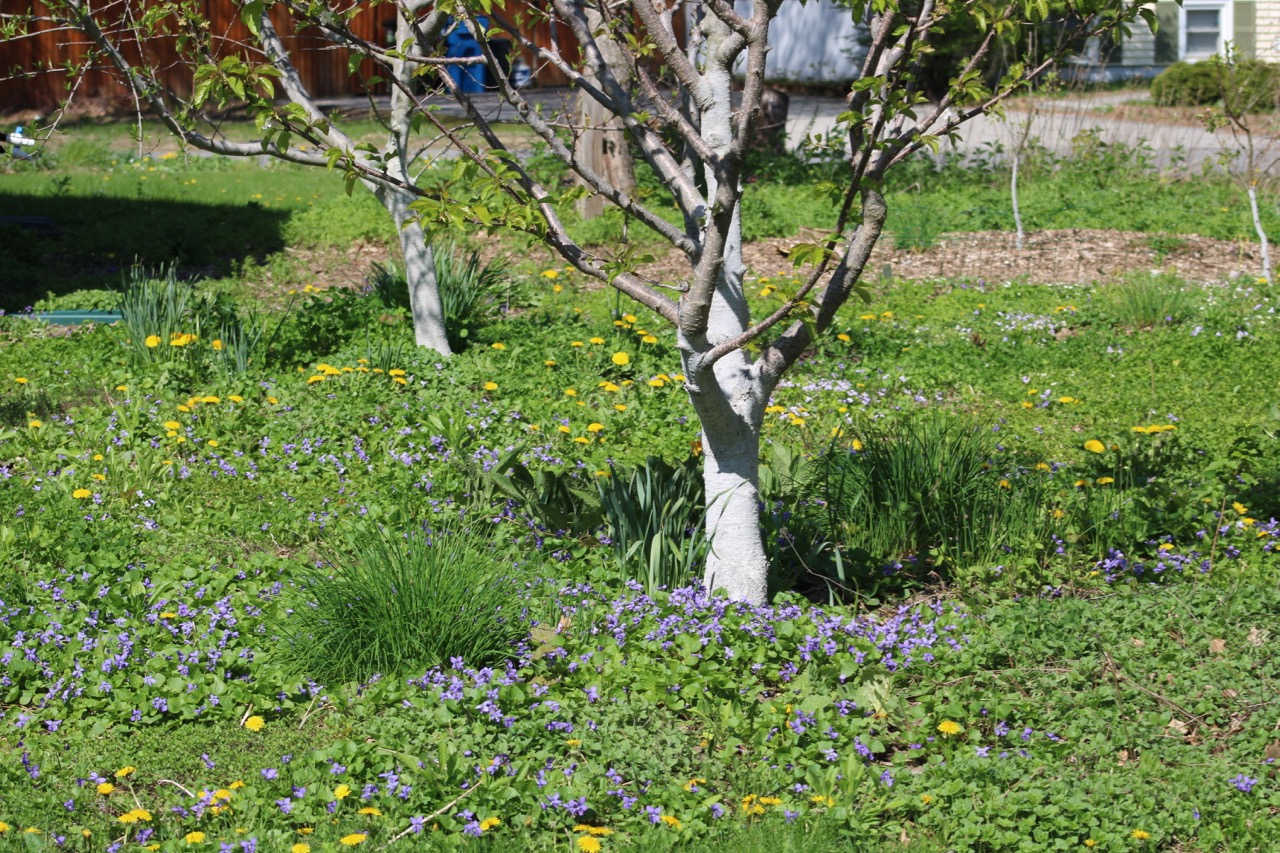
I walk through the orchard and marvel at the beauty of violets which have naturalized all over the ground. Dandelions offer a scatter of yellow along with a few daffodils, and clover has spread over the beds and paths in a swath of green. Chives and oregano and thyme are coming up in their clumps. I can’t capture it in a photo, but perhaps the one above hints at how lovely it has grown, mostly all on its own.
The cherry trees actually now have a few blossoms–maybe a dozen new buds have opened after initially all of the buds were empty. Not enough really for a fruit crop, but I wanted to note it. However, our Honeycrisp apple tree is covered with buds, for the first time. Maybe this will be the year of our first apple harvest?
I haven’t tried to do any veggie planting yet. Mostly I just walk around enjoying how the wild flowers shine in the sun. Yesterday I lay in the hammock reading for a while, and we had a lovely visit with a friend by the pond. We haven’t seen any tree frog eggs there, despite the repeated singing in the night. It is all a process of discovery–will they choose our pond or not? Meanwhile, the marsh marigolds have bloomed! My favorite flower colors are yellow, blue, and violet, so right now I am in paradise!
There are two robins in or near the nest on our back porch.
The robins are trying once again–for the third time–to raise young in a nest on our back porch. The two previous times either the eggs never hatched, or the young died very soon after. I hesitate to even post this, for fear they will fail again–but, this time, both the father and mother are staying close to each other, and seem to be taking turns on nest duties. I have learned that they open their beaks as a way to cool off in the heat. I wonder if they are new parents, and just didn’t get their parenting act together before? I hope they make it this time!
Meanwhile, goldfinches are enjoying the sunflowers that planted themselves under the bird feeder, as well as the evening primroses that planted themselves near our porch. This little female was perched on that sunflower for at least twenty minutes, just taking her time with a meal.
Female Goldfinch eating seeds of the sunflower.
In these hot dry days here in Maine, I just go outside in the early morning to water the veggies or trees, and to pick blueberries or raspberries, now almost done. But looking out the window brings many moments of joy because of these birds who live in our yard. I learned the Passamaquoddy words for goldfinch–wisawiyehs–and robin–ankuwiposehehs. (wisawi refers to yellow and ankuwi refers to farther, perhaps because they migrate) For them I am always grateful.
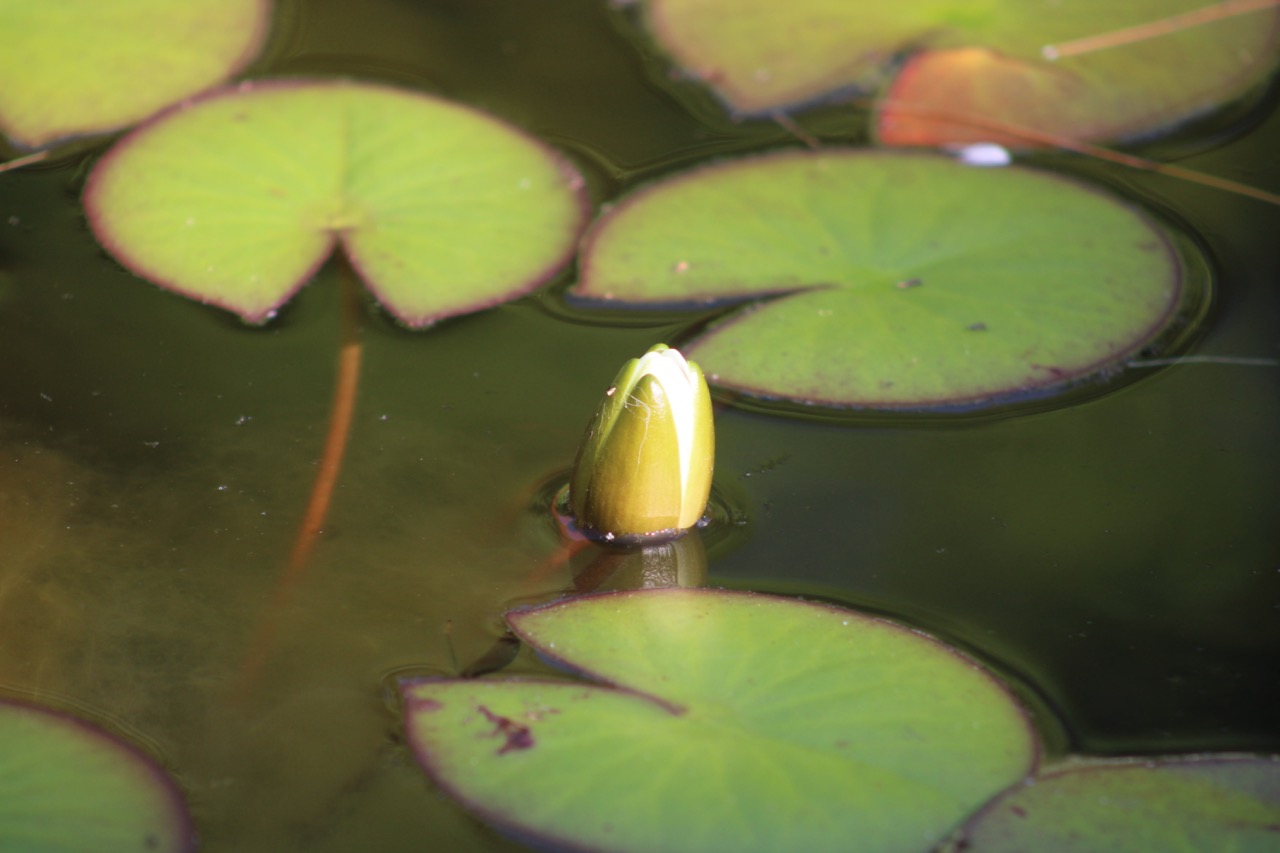
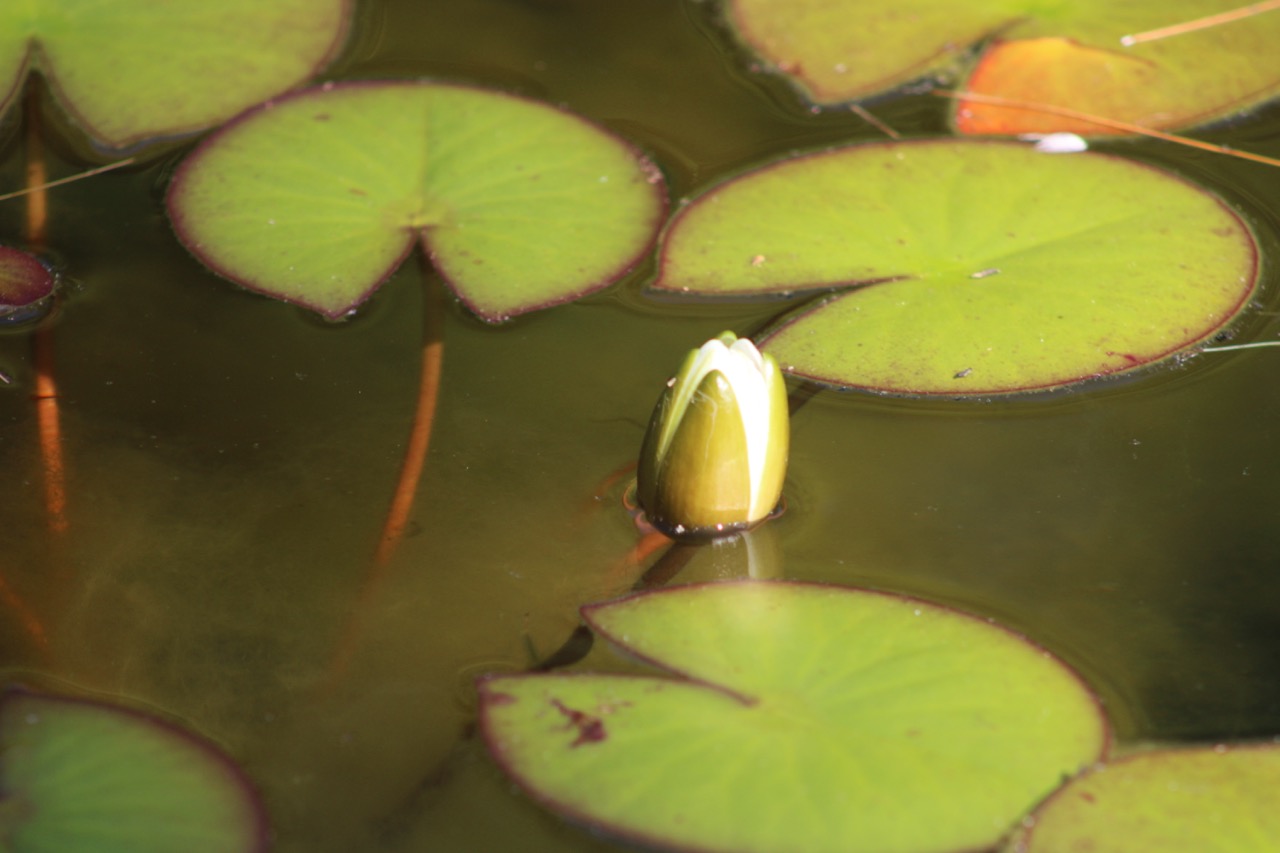
The first pond lily bud appears on Saturday in our pond.
It starts to open slowly on Sunday.
I sit by the pond during the morning to watch it as it changes.
very slowly…
It is so meditative to sit by the pond watching the lily. I also see a frog, and some dragonflies. I add some water to the pond from the rain barrel, which is why the lily now seems deeper in the water.
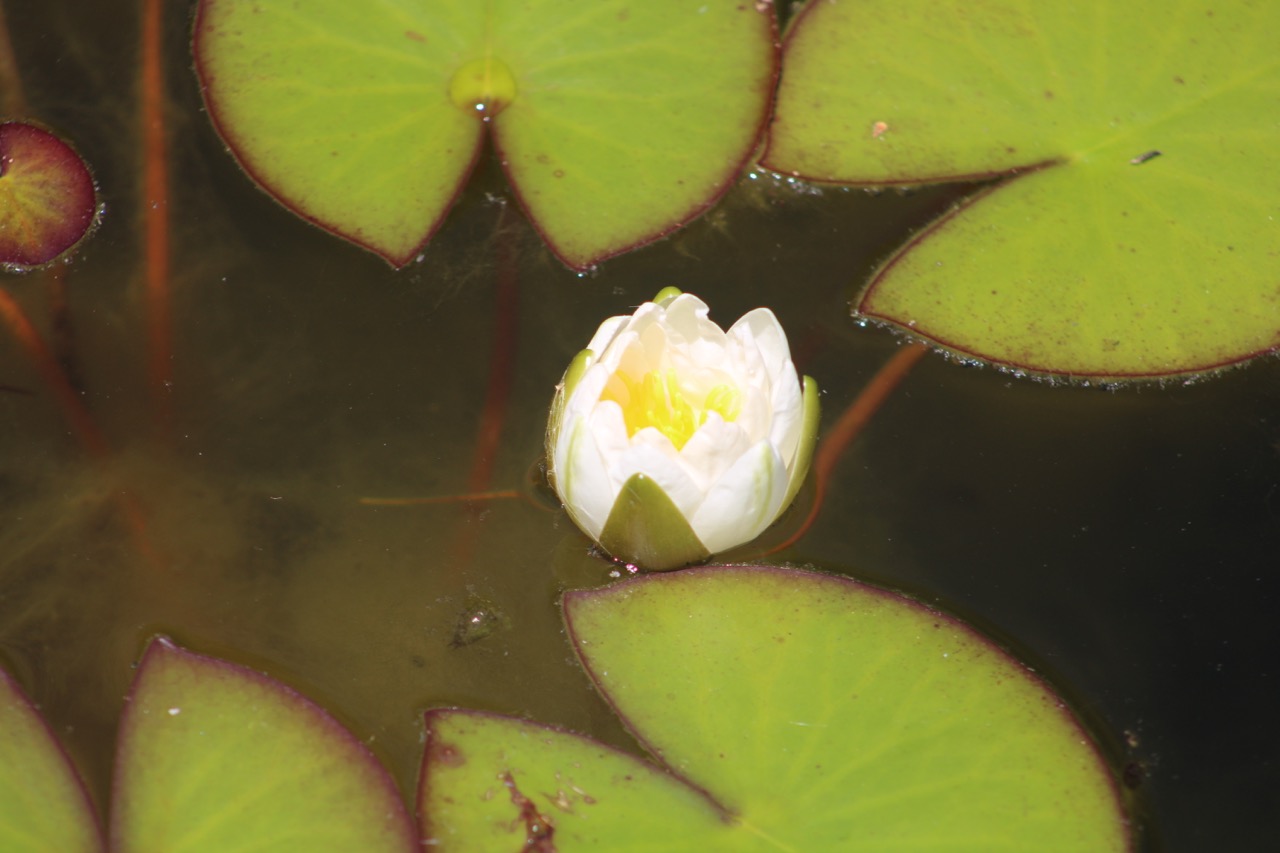
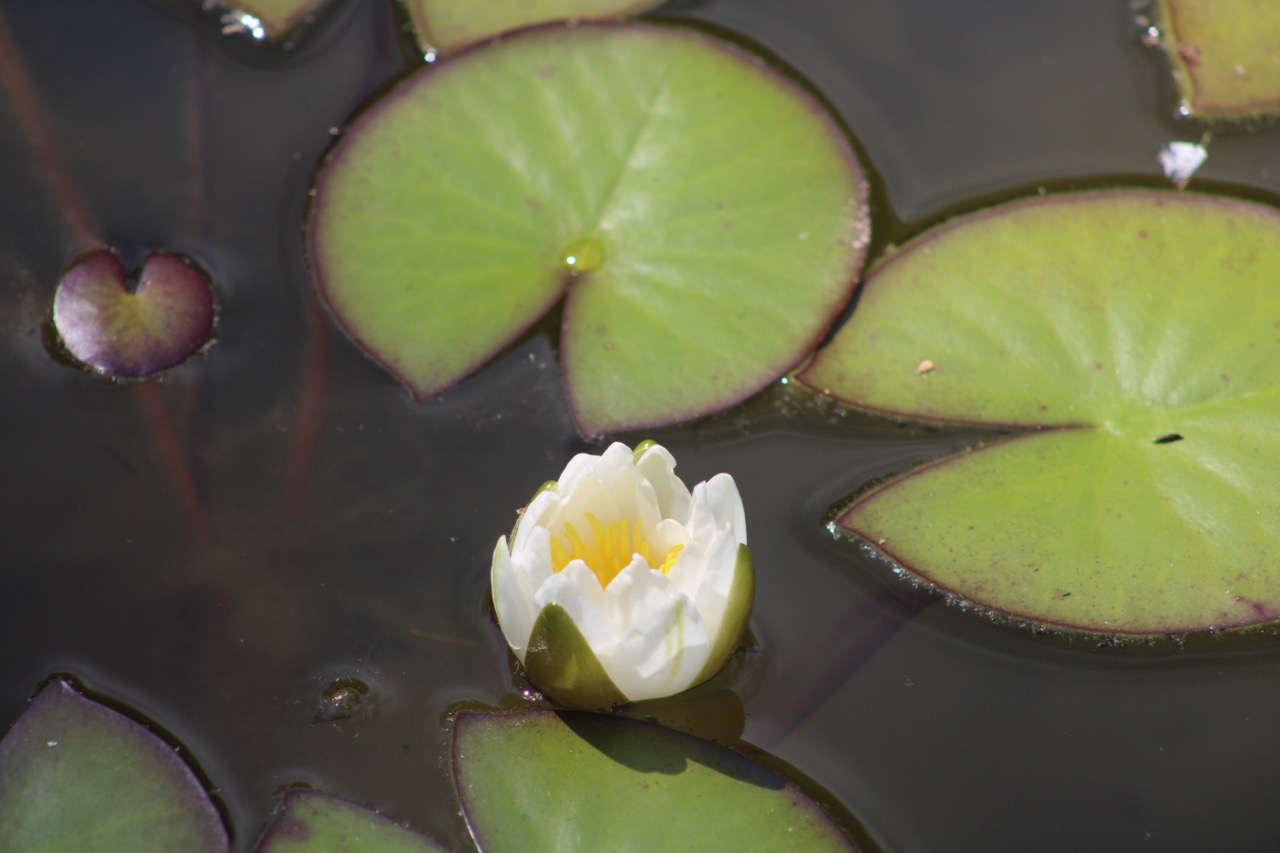
As it opens it forms a little white cup, with yellow peaking out from the center.
It reminds me of an egg.
It doesn’t fully open on Sunday, and once the shade of the trees cover the pond in the early evening, it closes up again.
This morning, early, it is still closed up. I watch for a while, and then go inside to eat breakfast.
When I come back out mid-morning, here it is in all its beauty!
What we see out our front door: purple, yellow and white flowers on the esplanade
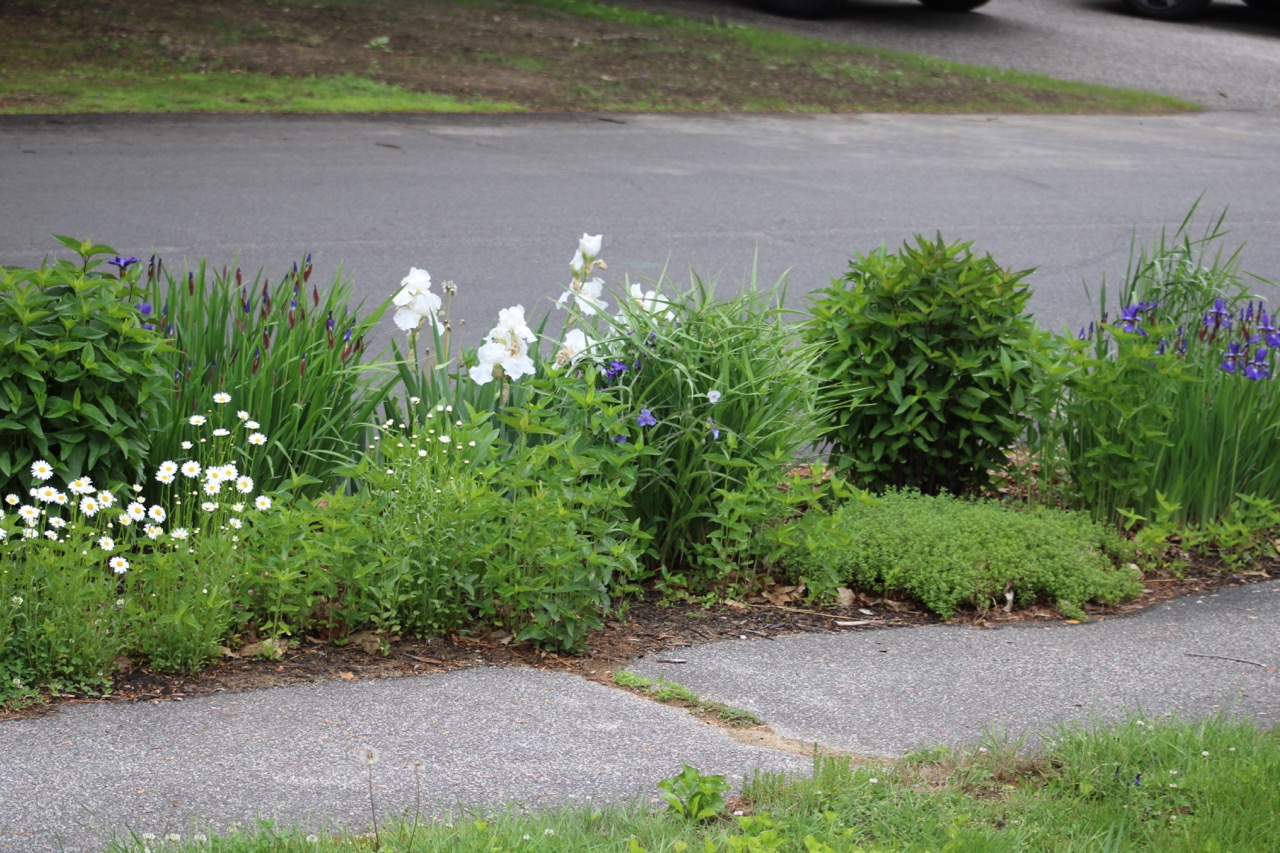
I have been marveling at the beauty of our front esplanade–formerly known as the hell strip. I planted it four years ago, with help from donated plants, and some donated labor too. Right now it is a stunning palette of white, blue/purple, and yellow, over green leaves: Blue/purple Siberian irises, yellow turkish rocket flowers, purple lupines, white bearded irises, and lots of white volunteer daisies are blooming, while other plants’ spiked leaves are filling in with green. Later in the season there will be other blooms. I can’t describe how joyful I feel to see it.
Close up of turkish rocket, purple/blue irises and white daisies
Close up a little further to the right, with white daisies, purple/blue irises, white irises, and a few tiny blue/purple spiderwort flowers just beginning to bloom. Low ground cover of thyme.
I am so grateful for these hardy perennials that require a minimum of care for this abundance of pleasure!











 Finding Our Way Home