Garden Blue

My favorite color in the garden is this blue/purple of the Siberian iris. They’ve multiplied in the roadside garden bed, and blossomed all along the way. And now they are gone. So we had maybe a week to enjoy their beauty. I feel the time rushing by with all these spring and early summer flowers. Nothing goes on and on. With photos we try to capture the moment and make it last a little longer, but nothing really lasts in that way. If we don’t pay attention to the moment, we miss it.

It is easy for me to get caught up in what needs to be done, the projects, the planting and watering, the weeding, the holistic sprays for the orchard. But probably what is most important is to walk around the yard noticing the flowers and plants and critters, noticing the birds and frogs and tadpoles. When we came to this yard, our hope was to nurture our relationship with the land, with all of the wisdom it had to teach us, with all of the tending that it asked of us. It was the tangible finding our way home that my spirit was hungry for.

We’ve been tending this particular small place for about nine years, and we feel such a bond with it. In these times of wars and rumors of wars, walking through the yard restores my soul. What must it be like to live for generations in a place? I can only begin to imagine. One of the crimes of the destruction of Gaza, along with the horrific killing of human beings, is the destruction of the land, the olive trees, the plants, the gardens. All those homes. It makes me weep.

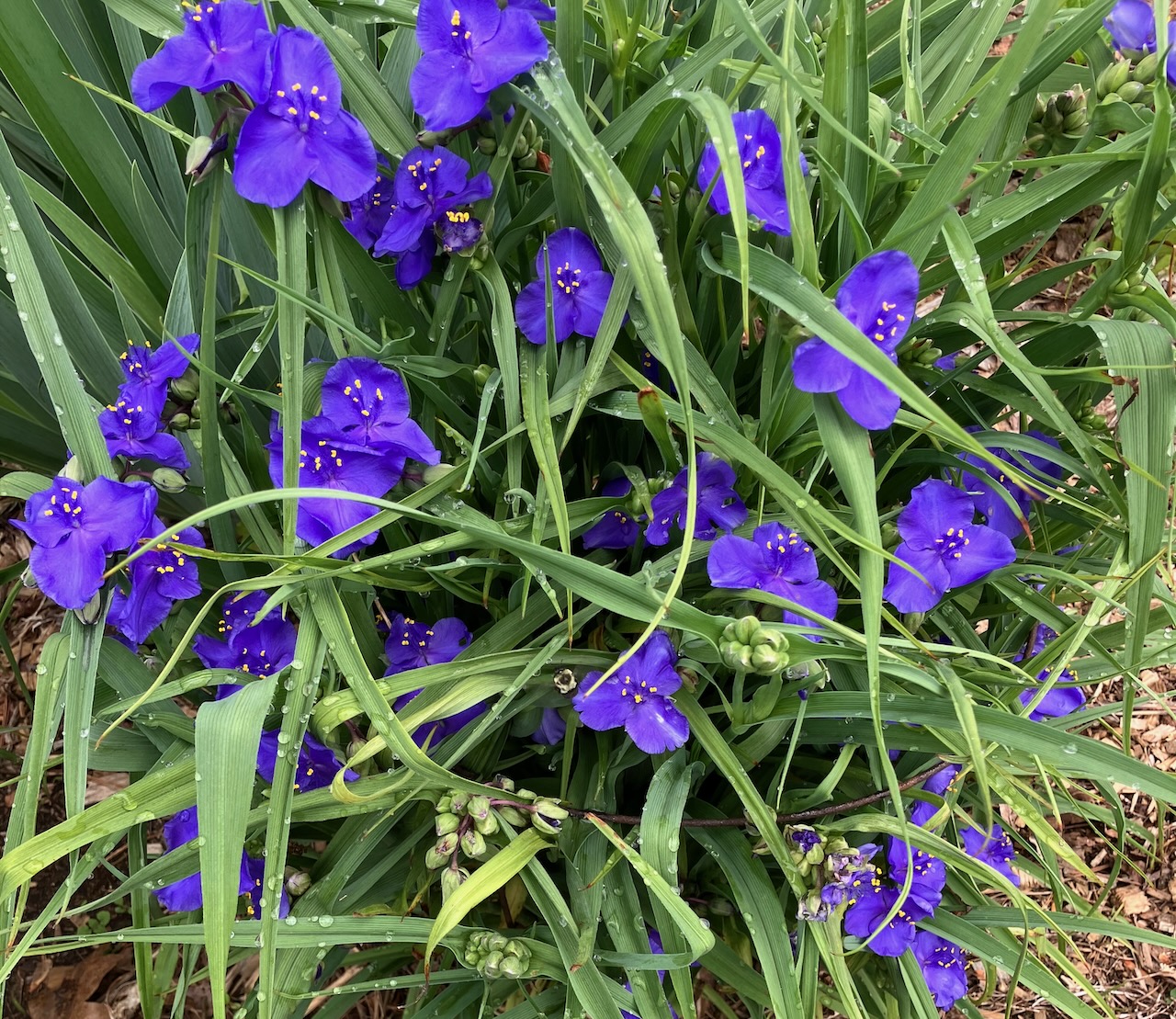
I walk around the garden in the mornings, and I pray. I give thanks for another day of living. Not just my life, but the life all around me, of which I am a part. I am happy to see that the spiderwort plants are blooming, another in that shade of blue/purple. This seems to be the very favorite flower of the bees, and it lasts for a long time, with multiple little buds on each stalk, taking their turn to shine. It is the very diversity and multiplicity of the plants that bring abundance to life in the garden.

Three new little frogs

We’ve had a string of very hot weather and then lots of rain, and I hadn’t seen our three bullfrogs in the pond for a while. I wondered what that might indicate? Today, I went out and a pond lily was blooming, and there were three new tiny green frogs sitting on lily pads. Who knows where they came from?

I woke this morning feeling heavy and sad with all the problems in the world, with isolation, with a lack of direction or purpose. So I brought myself outside and this little surprise happened and it lifted my spirits. I am grateful for that.

Native wild flowers

glowing yellow goldenrod flowers on tall stalks, with dark green background
Goldenrod flowers are in bloom.

We have now lived in our home in Portland for 7 years, and are gradually getting to know the plants around us. We have our share of invasive plants, but today I want to highlight a few of the beautiful native wildflowers that are blooming right now in our yard. They come up on their own, and Margy has encouraged them by pulling invasive species, and leaving certain areas alone as she mows paths around the back yard.

I believe our goldenrod might possibly be the solidago sempervirens, or seaside goldenrod, native to eastern North America. This identification fits with our sandy pine forest soil, and photos online look similar. But it is very difficult to distinguish between species of solidago. Solidago is considered a keystone species, and has been called the single most important plant for North American pollinator biodiversity. They are very loved by many bee and butterfly and moth species. We love them too.

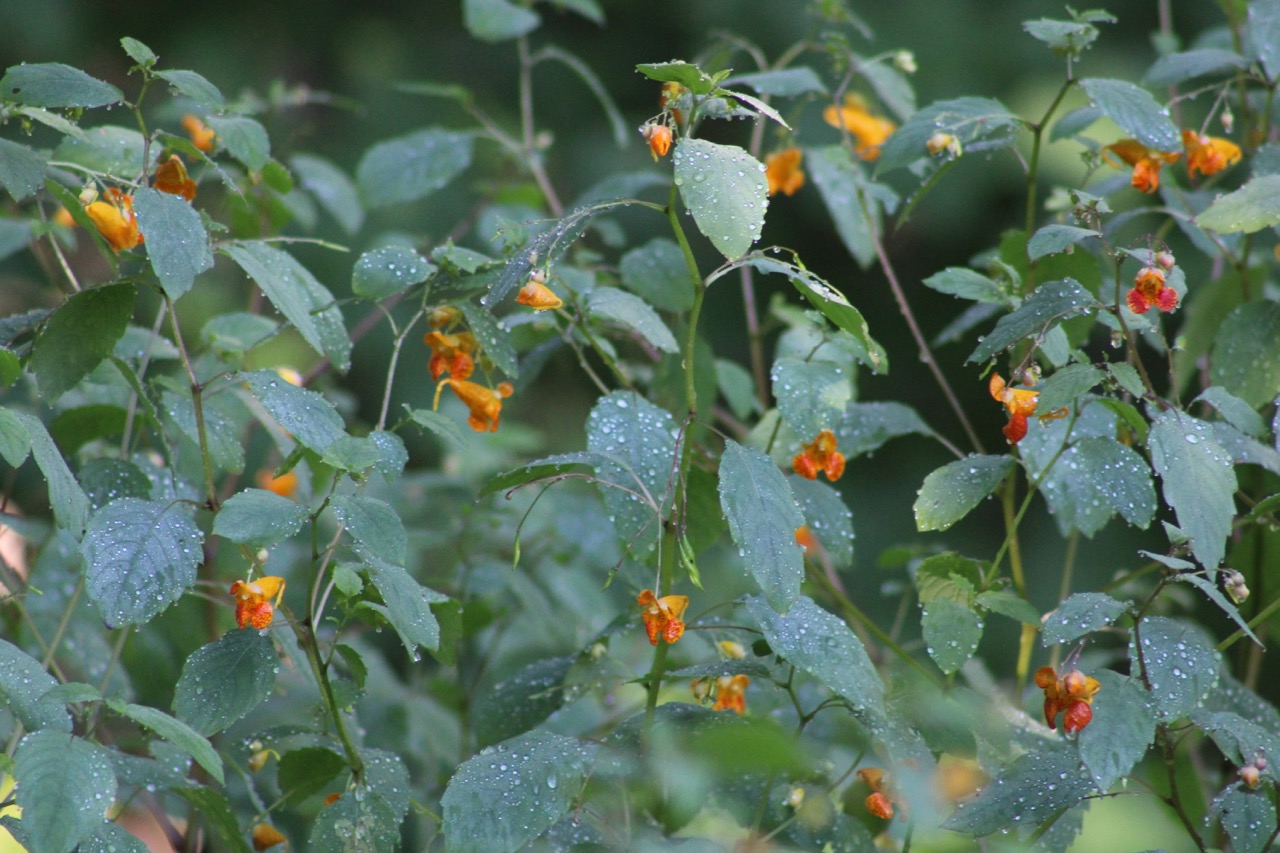
Tiny orange flowers on thin stems with oval serated leaves, droplets of water on the leaves.
Jewelweed after a rain.

Jewelweed grows profusely at the back and sides of our yard. Impatiens capensis is also called touch-me-not, because of the way the ripe seeds pop open when touched. It often grows near poison ivy (which we don’t have) and has traditionally been used as a remedy to prevent the rash caused by exposure to poison ivy. This year it has gone a little crazy all around our old white pine, and in Margy’s mound bed nearby. Hummingbirds and bumble bees are their major pollinators.

tall stems with small yellow flowers at the tips, many plants in 1/2 wine cask planter, on patio near deck railing.
Evening primrose in an old half wine cask container.

I got to know evening primrose last year, when it was the favorite plant for goldfinches after it had gone to seed. This year, it has self-propagated into two containers, as well as all around the patio and orchard. Oenothera biennis is a biennial plant, forming a small rosette the first year, and then in the second year shooting up to great height before blooming. It is native to eastern and central North America. Evening primrose oil is considered medicinal for a variety of conditions, though we haven’t tried harvesting it for such.

evening primrose closer
Evening primrose, closer look at the blooms.

What I love about these three species is that they grew on their own. We didn’t plant them, we just began to notice them and appreciate their presence. True gifts from the earth. There are many others we have begun to notice as well. It takes a while to learn about them and to identify them. It feels like such an important part of finding our way into earth community.

First harvests

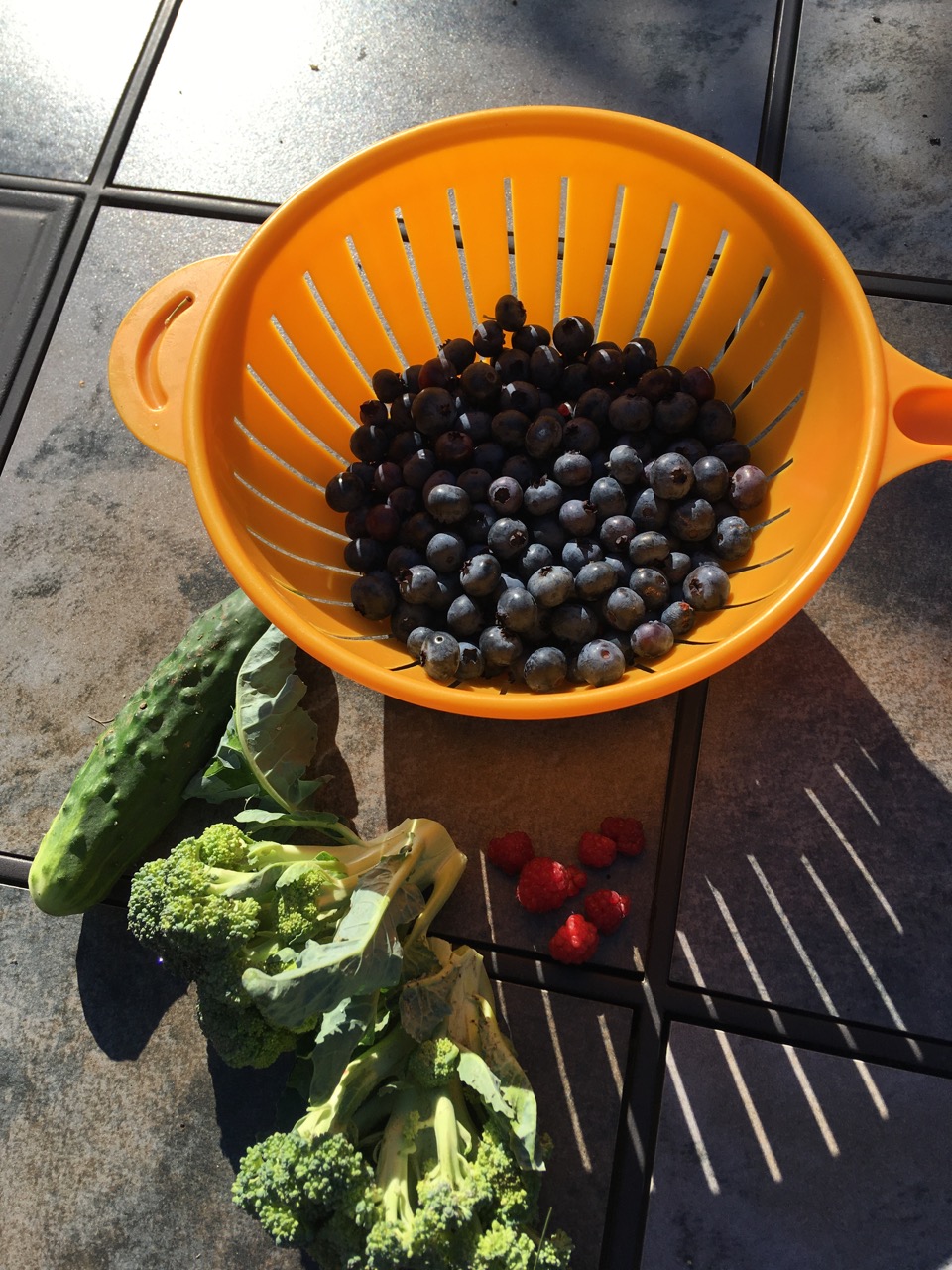
Orange slotted container with blueberries half full, and small cucumber, cut broccoli and a few raspberries.
Blueberries, cucumber & broccoli

In the excitement of the fledgling robins, I didn’t post about our Lammas harvest. The photo is of our fruit and veggie harvest of August 1st. It has been a great year for blueberries! We have also harvested some kale–there is more that wants to be cut today– some zucchini, some raspberries, and more cucumbers. Lammas is the first harvest festival of the season, and I am grateful and amazed that despite all our limitations, we actually receive food from this land.

We can’t control anything about this land. We can’t control what plants will thrive each season–no cherries or peaches this year, for example. But in partnership with the land, in our belonging to the land, these moments of yield emerge. So grateful!

And they’re gone!

Fledgling robin with stripy breast feathers, perched on white beam, under shade cloth.
Baby robin perched boldly on the beam.

During the night the two baby robins were back cozy in the nest. This morning, they came back out on the beam, one of them perching boldly on the edge. I was sitting at the kitchen table watching through the window, and then a few minutes passed by and suddenly they were gone! I went outside on the porch, and then saw a small bird fly from the ground in the nearby orchard up to the trees by the fence. I was in a Zoom meeting, so I went back to do that for another 30 minutes, then went outside to look for the babies–I guess I should call them fledglings now. After walking around in the orchard a bit, I saw one of the parent robins in a tree near the fence.

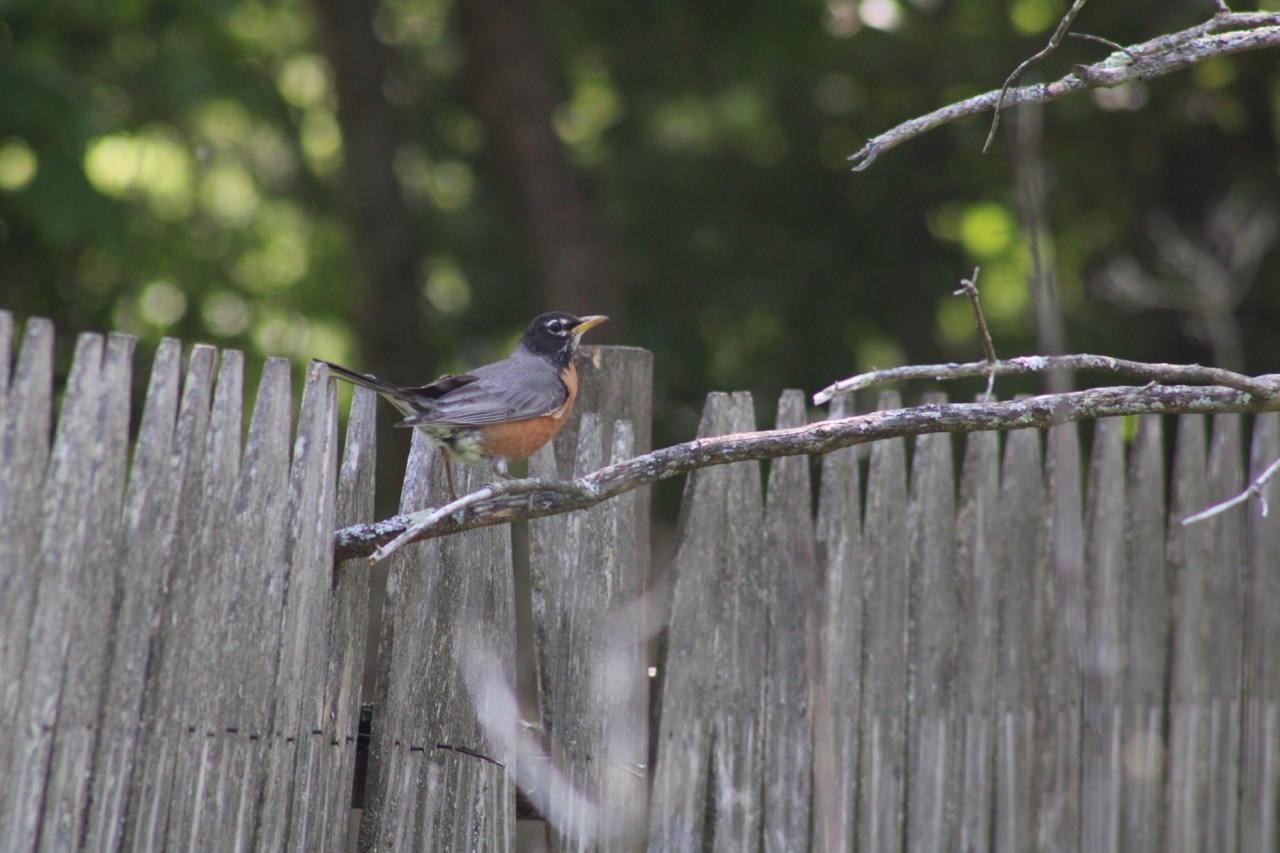
Robin on a bare gray branch in front of a gray wooden fence, with blurred green leaves in the background.
Parent robin near fence.

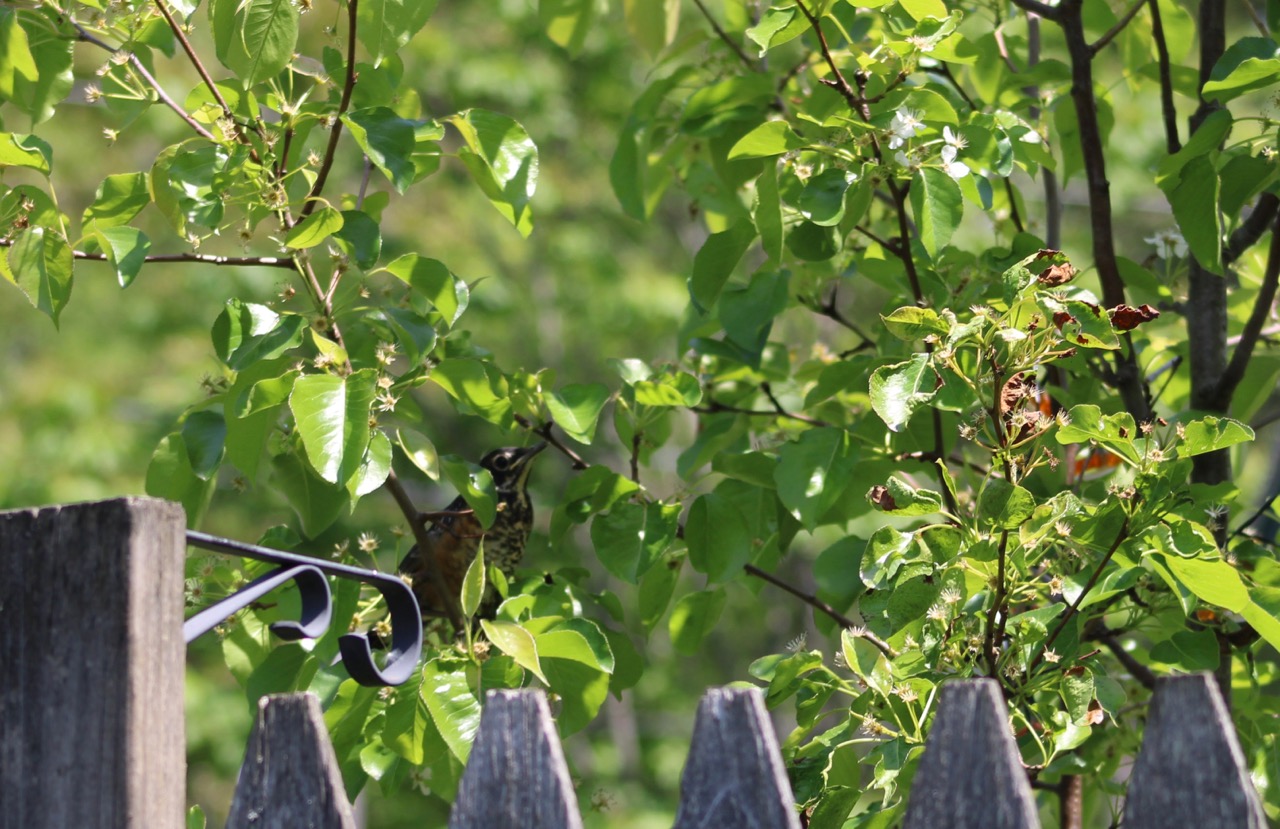
So I looked all over near the fence, and then stood on a little block of wood to see over the fence. There it was! I saw one of them in our neighbor’s young pear tree. It was being quite still and quiet, hiding among the leaves.

Tips of wooden fence showing at bottom, with green leafed tree above, and hidden among the leaves, a baby robin.
Robin fledgling hidden in the leaves of the pear tree over the fence.
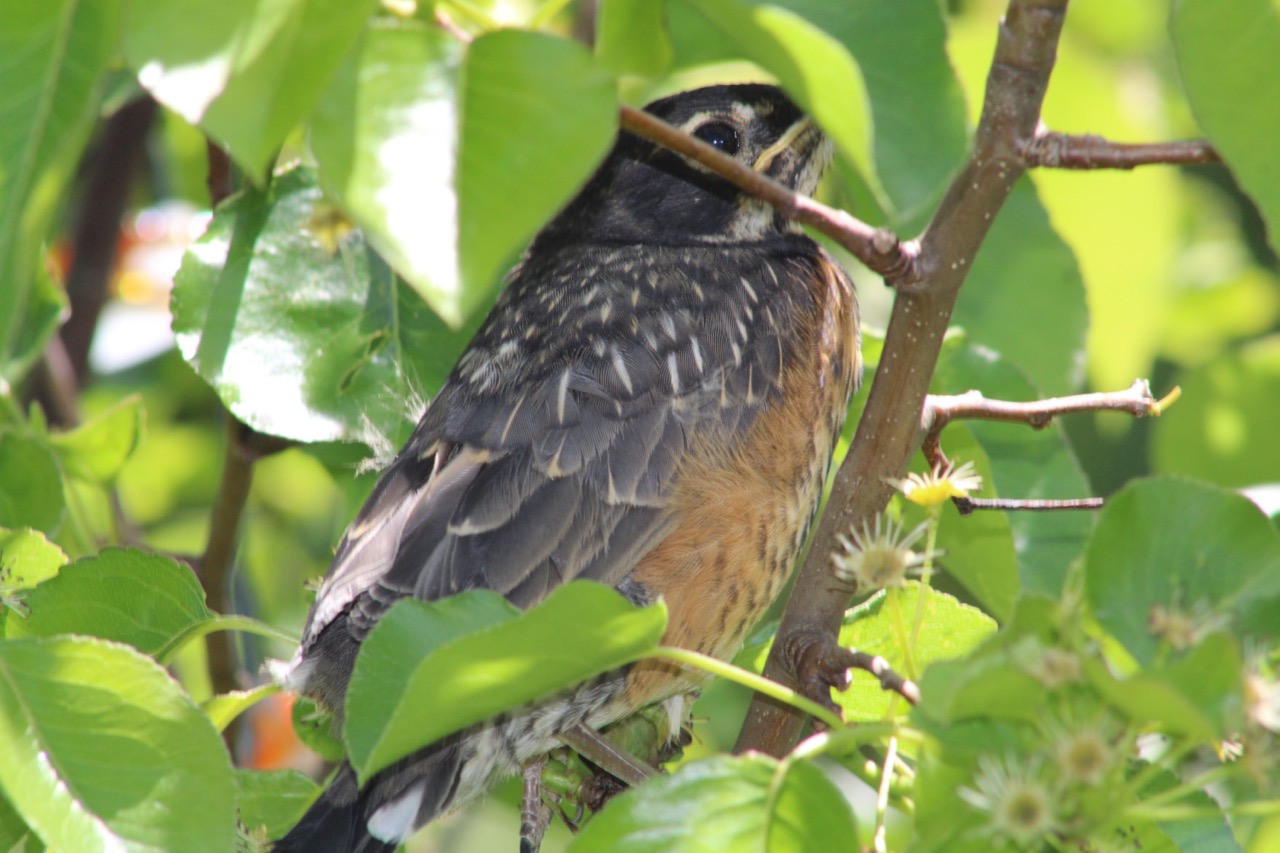
Close up of fledgling robin hidden among green leaves on branch of pear tree.
Close up of fledgling robin

I was reassured to see this one on its perch in the tree. I didn’t find the other one, but we have so many trees around our yard that it could be anywhere. When I went back to the fence a couple hours later, this one was gone too. And just like that, no more baby robins on our porch, at least for now. I am assuming they won’t come back to the nest. It has been one month since the first egg was laid. Most of that time they were hidden from sight, but every sighting was a joy. And I am so happy that the robin parents finally fledged their first youngsters!

The Beach in Winter

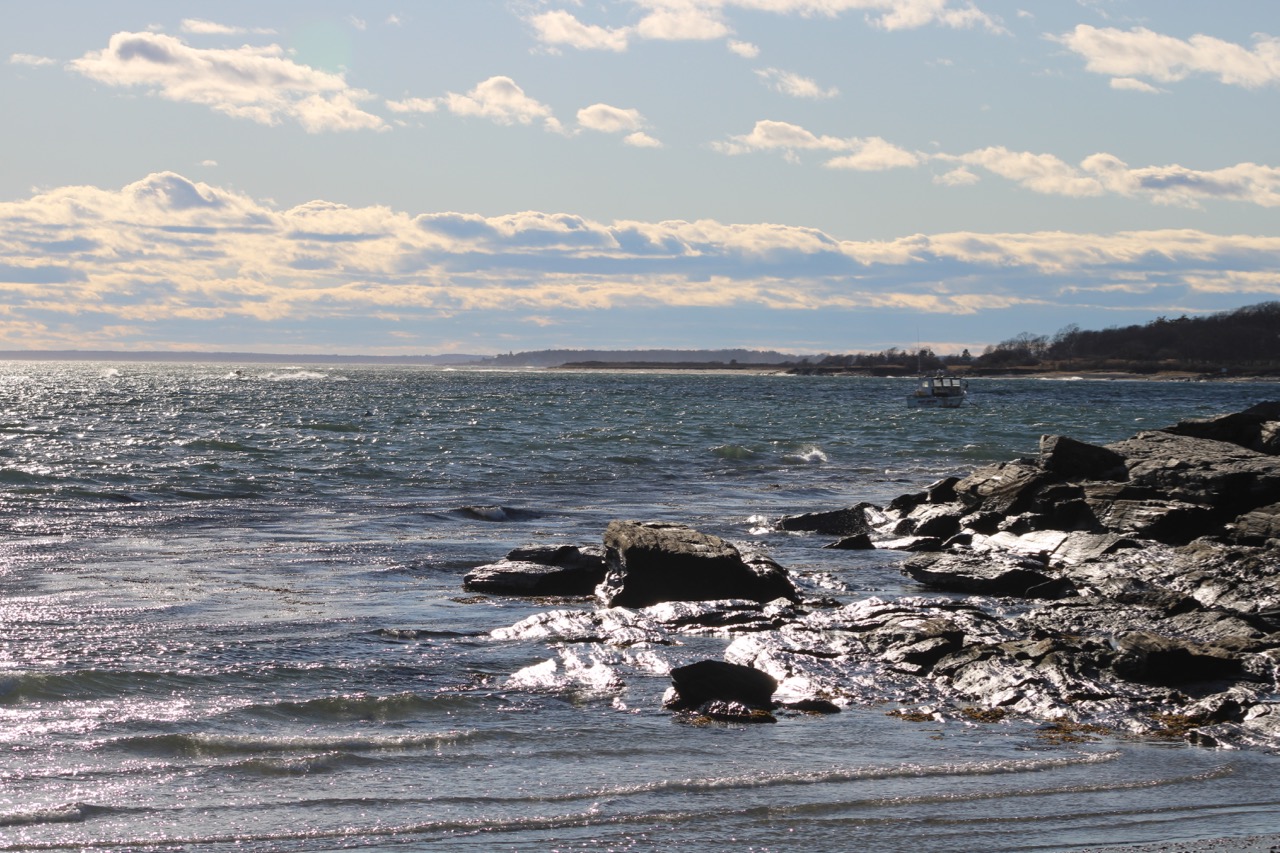
Ocean waves coming in against rocks bright with sunshine. In the distance, island trees, clouds and blue sky.
Ocean, rocks, sky, sun, clouds

I needed this winter afternoon at the beach. We went to Kettle Cove, where it was windy, sunny, and warm–well, in the forties anyway. So now my heart is calmed and refreshed. There is a quiet that comes from the sound of waves and wind, the feeling of our feet walking on sand. We always say we should go more often, but it takes some push, some energy to get ourselves there. Funny that, because it always feels so good once we arrive.

Even though I am retired, I’ve been doing too many days of projects–still plugging away at the boxes for the archive, among other things. Don’t we need this other rhythm? The one of being in the presence of all that is bigger than we are?

And there was evidence that the wind and the waves had been bigger than the beach recently, maybe when the recent huge storm came through. The wooden walkway was broken apart, and there was erosion in parts of the shore. We are so small, and what we can build is so puny. But all of that is okay–it’s part of what brings the feeling of magic to our walks on the beach.

Broken wooden walkway with brush behind and a stream of water underneath, through the sand.
Broken walkway

So we come home again, and the great quiet is within, the mysterious gratitude for life, in the midst of all its challenges. Can you feel it? How does it come to you?

Gratitude for the Ordinary

Goldenrod gone to seed.
Goldenrod gone to seed

The last few weeks have been full of ordinary tasks around the house and yard. Sometimes we forget to be grateful for these very ordinary things. I think about people whose lives have been disrupted by war, by floods, by fire, by despots. Margy and I are able to do our ordinary tasks and ordinary meals and ordinary rest, undisrupted, and for that I am grateful.

A couple weeks ago, I painted the trunks of the orchard trees, to protect against winter sunburn and insects. This time I used a half and half mix of white milk paint and “Surround”–both powders that are mixed in water. I don’t know if it is really necessary–certainly I see fruit trees around the neighborhood without anything on them. But one morning, I had the energy and decided to try out the mixture. Surround is a kind of porcelain clay organic product that can disrupt certain insects. Last summer, I sprayed the fruit trees with it, and they remained light colored all winter. This summer I didn’t do any sprays like that, but why not try it as a winter paint? So that was one little project.

Peach tree with white paint on trunk.

I’ve been using the skimmer to clear leaves off the pond, and then I also have been cutting off the dead stalks of pond plants. I got into the pond one day, placing my feet very carefully down to the second step in, and lifted the pond lily pot, then dropped it down to the deepest part of the pond. The deepest part is 2 1/2 feet, so I am hoping that the hardy lily might survive the winter this way. And maybe in the spring it will need to be lifted back out, or maybe it will just reach its leaves up to the surface from there. I asked Margy to watch with me, just in case I slipped. But I didn’t! A few frogs are still hanging out, since the weather has been unseasonably warm still.

Since we had an extra weekend of warm weather, I finally painted the upper beam of the roof on our deck. Some of the wood had been left bare when a friend put in the roof, a few years ago, so protecting it has been on the long-term to-do list. Happily, there was some primer in our basement that I could use, leftover from the prior owners. It took three days, and each day after working on it for only a couple hours I was dead exhausted. But it is done today!

Deck beam half painted and half still undone bare wood, with a ladder underneath.
Deck beam half painted and half still undone bare wood.

Meanwhile, we’ve been filling in our absentee ballots, and researching the details of 13 referenda questions for our city of Portland, as well as the candidates running for office. I am grateful for democracy, as flawed as it might be practiced, and pray that we’ll still be able to have a democracy going forward. Rising fascism in our country has been alarming and discouraging, as well as the attack on the bodily autonomy of women, and the threats to such importance common goods as Social Security and Medicare. So much of my life’s work has been about expanding the benefits of democracy to those who have been excluded, fighting for equality and justice and liberation for myself as well as others. My work has included criticism of the way that our democracy has been incomplete, flawed, and unjust. But I think of voting as harm reduction–I may criticize candidates and policies, but I will vote for those who will do the least damage. Right now, with the Republican party being taken over by fascists, that means voting for Democrats across the board. So I am extra appreciative these days of the ordinary benefits we can take for granted, and pray that many many people will be moved to vote to keep those benefits.

Peach Abundance

Peaches are ripening, bright red and yellow, crowded together on the branches.

Those of you who perhaps followed my peach tree saga last year might remember that after hours and hours of tending–including several organic sprays, thinning the small green peaches, putting little mesh bags on the remaining ones–the squirrels ran off with every single green peach, or knocked them off the branches as they tried to get into the bags. We got zero peaches to eat.

Well this year, I didn’t have the heart or energy to do all that tending. I did one holistic spray early in the season. I felt very non-attached to any outcome, since one might assume that squirrels would eat them all again. But that didn’t happen. A few weeks ago, I started picking a few small random peaches, so that others would have more room to grow, and the branches wouldn’t break under their weight–but only a few at a time, not systemically. I put them in paper bags, which is the actual way to help them ripen. (Not on window sills as I had previously thought.) A few weeks ago, the squirrels started eating some peaches too, sitting in the tree, or taking ones with broken spots that I left on the patio table. I found their leavings on the deck railing. It was fun.

Broken peach bits on the deck railing.

But they didn’t take all the peaches. And the peaches started to really ripen. Now they are bright red and yellow, crowded though they are on the branches. Now, we are processing all the bags of ripening peaches in the house, as well as gathering peaches literally dropping from the tree. I have cut them in slices to freeze–first on a tray, and then put into freezer bags. Yesterday I made a gluten free peach cobbler. We have invited friends and neighbors over to share in the abundance. More people are coming by this weekend. This morning, I saw this little bird pecking for its delicious breakfast. There is plenty to share!

Bird eating a peach on the tree.

I feel grateful and humbled by this turn of events. Sometimes gardening feels like a battle between the gardener and the “pests.” I didn’t have the heart to try too hard to fight this battle this season. (And our cucumbers and zucchinis are succumbing to bugs-so it goes.) I was surprised that the peaches thrived so well without my efforts. I was surprised that the squirrels took some, and it seems they felt okay about sharing. Maybe they sensed that we were not enemies this time. Margy and I feel so good to be able to give them away to others. The garden is such a great mystery! I continue to feel humble and grateful by all it teaches us.

Oh, and here is the recipe for gluten-free peach cobbler. I searched the internet, and then adapted this one from several I had seen:

Peach Cobbler: preheat oven to 375 degrees

Slice peaches and place in a lightly buttered 9 x 13 pan. Basically use enough to cover the bottom well, or more if you like. Sprinkle with cinnamon, and a tiny bit of ground cloves.

Whisk together 1 & 3/4 cup almond flour, 1/2 teaspoon salt, and 2 teaspoons baking powder. Blend together 1 large egg, 1 teaspoon vanilla, 1 tablespoon honey, 1/4 cup Greek whole milk yogurt, and 2 tablespoons softened butter. Add that to the flour mixture and blend, and then spoon over the peaches–it won’t cover them completely, but spread it around as you can. Bake 25-30 minutes or until golden and bubbling. Remove and let cool a bit so you don’t burn your tongue. You can serve as is, or with cream, whipped cream, or ice cream.

Peach cobbler in a glass pan, with some pieces removed.

To Be of Use

Chipmunk drinking at the pond

Yesterday morning, I was sitting next to the pond, writing in my journal. After I’d been there, and quiet for a long time, this chipmunk approached the other side of the pond, climbed down the rocks and took long drinks of water. After a couple minutes, it quickly climbed back up the rocks and ran back into the field behind.

If you’ve been following my posts recently, you know that I’ve been dealing with chronic illness causing me to have much less energy this summer. So my relationship with the garden has changed. It has been less purposeful and project oriented, and more, “Let’s see what the yard wants to do this season.” To listen more, to do less, to observe more, to try less–and I’ve learned so much, actually.

It’s true that we had already done a lot to shape the yard–we planted many fruit trees and bushes, let wildflowers grow, planted perennials, pulled invasives, and created the pond last year. Some of the plants that were in the pond didn’t survive the winter, and I did add a few more this spring. But it wasn’t enough to prevent algae from flourishing. So periodically, I get inspired to pull out as much as I can. But I’ve also noticed that bees love to perch on the algae, to get a drink of water presumably. (There is always enough algae left for them.) It gives me gratitude to know that this pond, imperfect though it is, has been of use to these creatures in a drought-burdened summer.

Bees on green algae

Lately, my old nemesis the squirrel has come back to start eating peaches. But since I was doing so much less to nurture the peach tree–less holistic sprays, less thinning of peaches, and so on–and since I had somewhat resigned myself to having no peaches after last year, I haven’t been stressed out about that. And the squirrel or squirrels seem more mellow as well. The peaches are actually very crowded together, and every couple days, I twist off a few tightly squeezed ones, even though they are not ripe yet, to make room for the others to grow bigger. I’ve put a few on window sills in the house to see if they will ripen. I tell myself the squirrel is also thinning the peaches. We are collaborators, rather than enemies. Who knows, maybe there will be enough for all of us?

Squirrel sitting on a branch in the peach tree nibbling on a green peach.

In a world with so many horrors that I can do nothing to stop, or even to protest, I am grateful to be of use to these small companions who share our back yard with us.

[And thanks to Marge Piercy‘s poem, To Be of Use, for its evocative and helpful title.]

Bird Joy

There are two robins in or near the nest on our back porch.

The robins are trying once again–for the third time–to raise young in a nest on our back porch. The two previous times either the eggs never hatched, or the young died very soon after. I hesitate to even post this, for fear they will fail again–but, this time, both the father and mother are staying close to each other, and seem to be taking turns on nest duties. I have learned that they open their beaks as a way to cool off in the heat. I wonder if they are new parents, and just didn’t get their parenting act together before? I hope they make it this time!

Meanwhile, goldfinches are enjoying the sunflowers that planted themselves under the bird feeder, as well as the evening primroses that planted themselves near our porch. This little female was perched on that sunflower for at least twenty minutes, just taking her time with a meal.

Female Goldfinch eating seeds of the sunflower.

In these hot dry days here in Maine, I just go outside in the early morning to water the veggies or trees, and to pick blueberries or raspberries, now almost done. But looking out the window brings many moments of joy because of these birds who live in our yard. I learned the Passamaquoddy words for goldfinch–wisawiyehs–and robin–ankuwiposehehs. (wisawi refers to yellow and ankuwi refers to farther, perhaps because they migrate) For them I am always grateful.