Something got at our baby robins… of the four in the nest, we just found three on the deck floor, two were dead, and one still alive–I gently put that one back in the nest, but not sure if it is really okay or how it might survive, we hope the parents will come back for it. They were calling loudly, but not around now. We don’t know what happened. One had disappeared entirely. So heartbreaking… We wondered if it might have been a chipmunk.
This is not the way I hoped to mark the Solstice. How fragile all of life is right now.
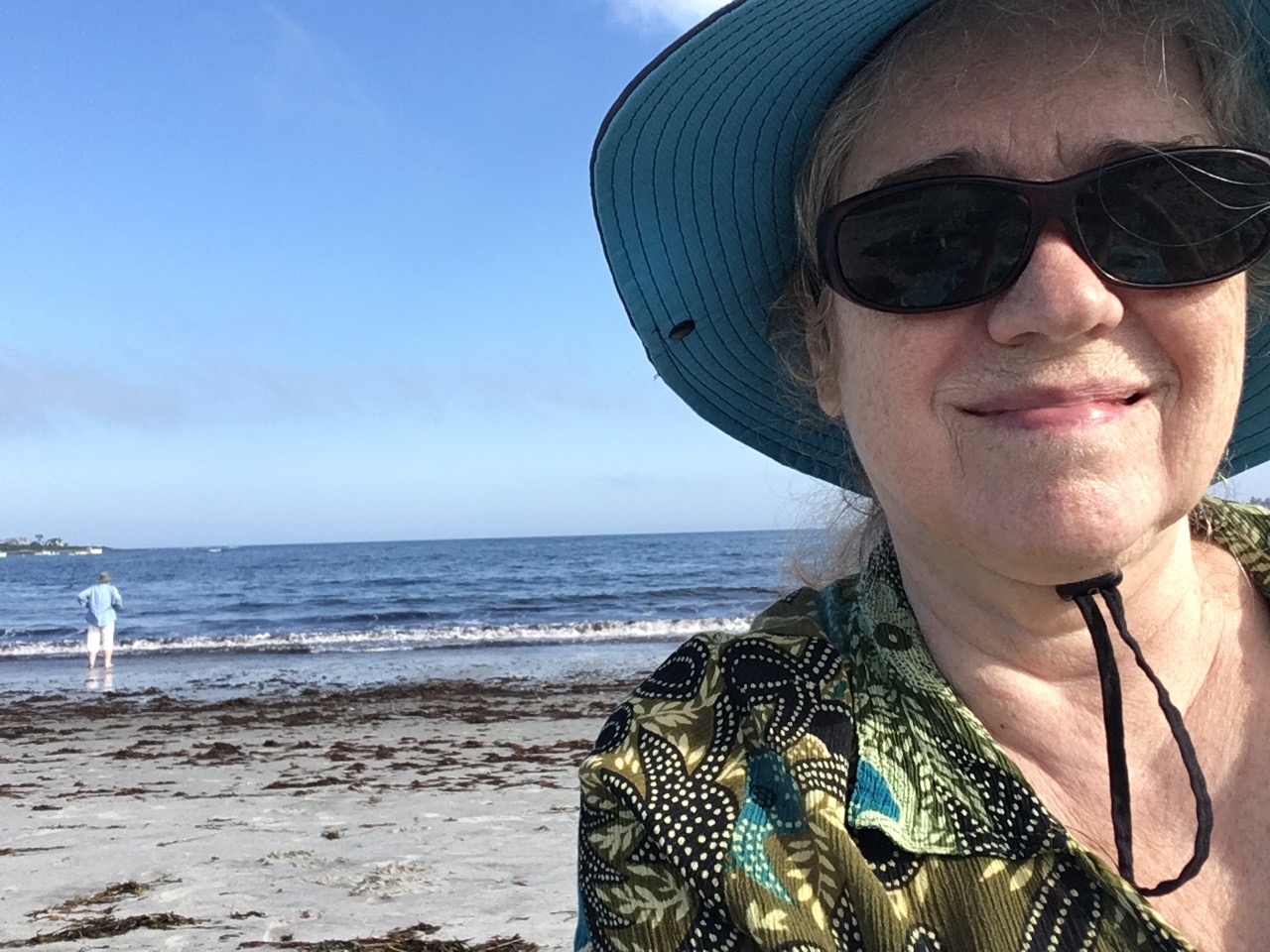
A week ago we finally made it to the beach. We’ve had so many rainy days this summer, alternating with a few very hot muggy days. That day was hot and muggy, but less so at Crescent Beach, so we got ourselves over there. The water was totally full of seaweed, and somehow that dampened my enthusiasm for swimming, but the wading was lovely, and lying on a blanket in the sand. I’m smiling in the selfie, but this post is more about the challenges of this summer.
It feels like a summer in which it is very hard to love the earth, or to feel loved by the earth. It is hard to even go outside! According to the weather report for Maine, June had only 7 days without rain. And July the rainy patterns have continued. But what makes it worse is that the days without rain have gone to the opposite extreme of muggy and hot. I don’t think we’ve had even one dry, sunny, moderately warm day. The other challenge has been air quality–many days of smoke particles making their way from Canada–not to an extreme, but enough to bump the meter from “good” to “moderate”.
And I have to acknowledge that we’ve been lucky here. No flash flooding of town centers, like in Vermont this week. No over-100-degree heat for days on end like in Arizona. No forest fires on our doorstep. But still…
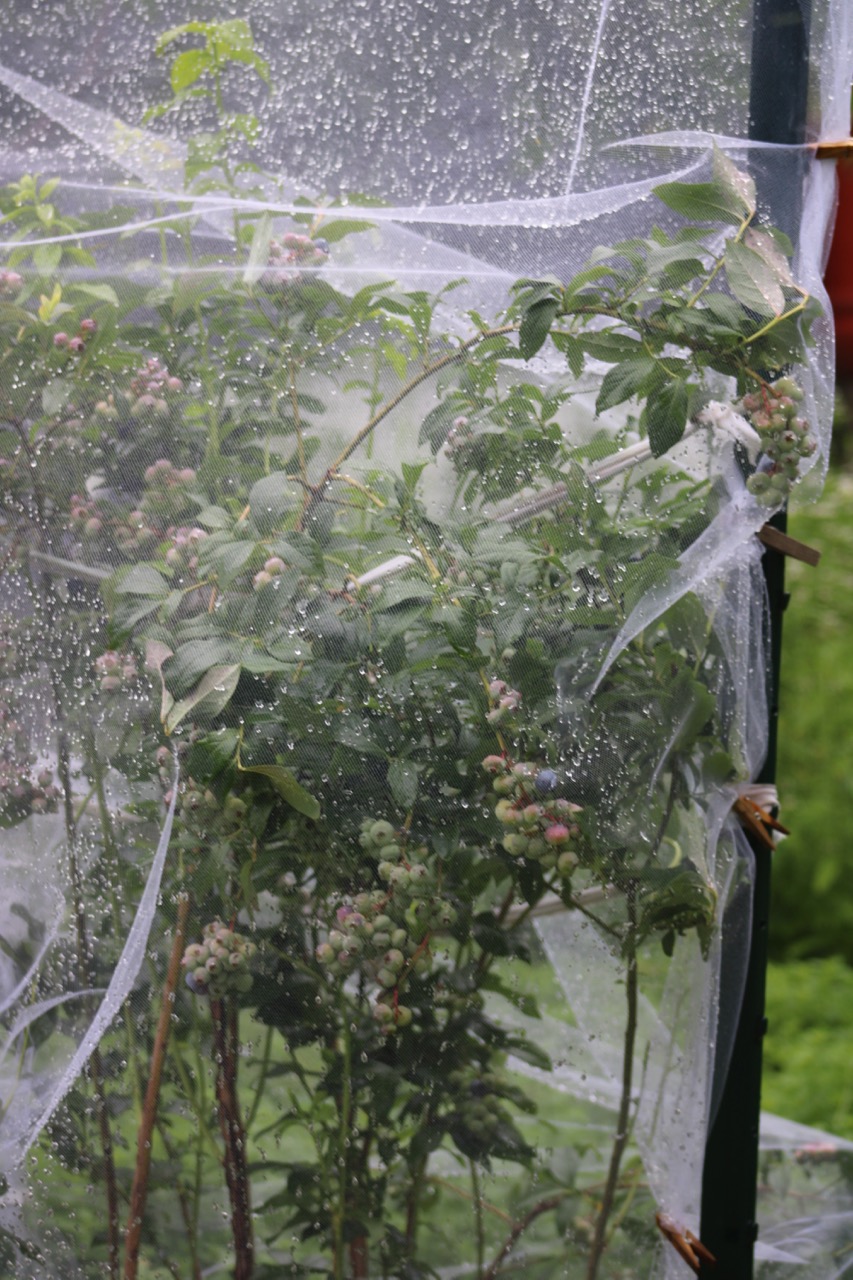
I’ve been feeling like a failure in my deep intention to build relationship with the earth. It’s not that the garden is doing so badly (except for maybe the cherry tree). It is just that I feel unable to tend to it, unable to even sit outside and appreciate it. (The cherry tree needs some attention because of, perhaps, black cherry aphids and sooty mold.) If I manage to do one small garden thing in a day, I count that as gain. For example, the other day, I put some tulle netting over the ripening blueberry plants.
I do try to walk around for ten minutes in the morning if I can. But none of it feels like the nurture that the garden had been for me during the last several years. Instead I feel a vague sense of overwhelm, I feel uncomfortable in my body, I feel grief and deep weariness.
And the truth is, because of climate change, because of the destructiveness of our larger society, we are all facing unimaginable loss, we are all facing a time of unknowable earth transformation that may lead to our doom. With this looming around us, no wonder these small weather challenges feel so overwhelming.
So today I am making space for that overwhelm, for grief, for rest. But even in the midst of those feelings, there are parts of the garden that still seemed determined to bring beauty to my eyes. I look out the front window, and the roadside garden is now awash in yellow heliopsis flowers and day lilies. They brighten even a gray day.
We’ve had two weeks of very cool rainy weather, and that counter-clockwise low pressure weather system has kept away the wildfire smoke from Canada, while folks to our south are facing orange skies and unsafe air. Still, we’ve paid attention, following the news, and thinking about what might happen if it does come our way. It is easy enough for Margy and I to stay inside, or wear our N95 masks outside.
But now that we are deeper in relationship with our land, I am anxious about how such bad air might affect the robins and frogs and squirrels and other critters who live here with us. They don’t have masks and can’t get inside. I wonder if the babies of these critters wouldn’t make it, so vulnerable in those first weeks of life. My heart is wide open to our little microcosm of earth life.
And yet it is the macrocosm that emerges most in this story, because the smoke is coming from far away in Quebec, from wildfires made more destructive by climate change. We aren’t alone in our microcosm, we are all connected by the winds that blow across the globe, undeterred by artificial boundaries. I have been somewhat removed from wildfire problems. I have seen them on the news in California, Alberta, Australia. This is the first time they have come close to where I live. But truly we are all more and more vulnerable. And of course, some much more vulnerable than others. I worry about people without houses, struggling just to survive, in a tent or with a tarp. They can’t get out of the bad air.
There is so little I can personally do about these large issues at this time in my life. That is some of my motivation for trying to tend our little garden–to love this small place of earth in hopes that more and more people can learn to love the larger earth, our great mother. To share the beauty of this earth in writings and photos on this blog, that beauty might inspire love. But love includes grief, and the more we love the earth, the more we grieve for the destruction that human beings are perpetrating.
The good part, for which I am grateful, is that our neighbor came to our door to talk to us. He asked whether we would mind if they took down trees in the area between our two properties. He wasn’t sure of its status, but I told him it was a “paper road” that likely would never be built. I told him we would NOT want those trees taken down, that they provide privacy between the two yards. The neighbors want to garden in the way back of their yard, but don’t get enough sun. I suggested that the boundary trees are to their north, so wouldn’t affect their sun. He said it was just as a way for the machinery to get into the back, but they could do it a different way and not take down those trees. He wanted to respect our wishes. So that is the good part. And I like that they want to garden.
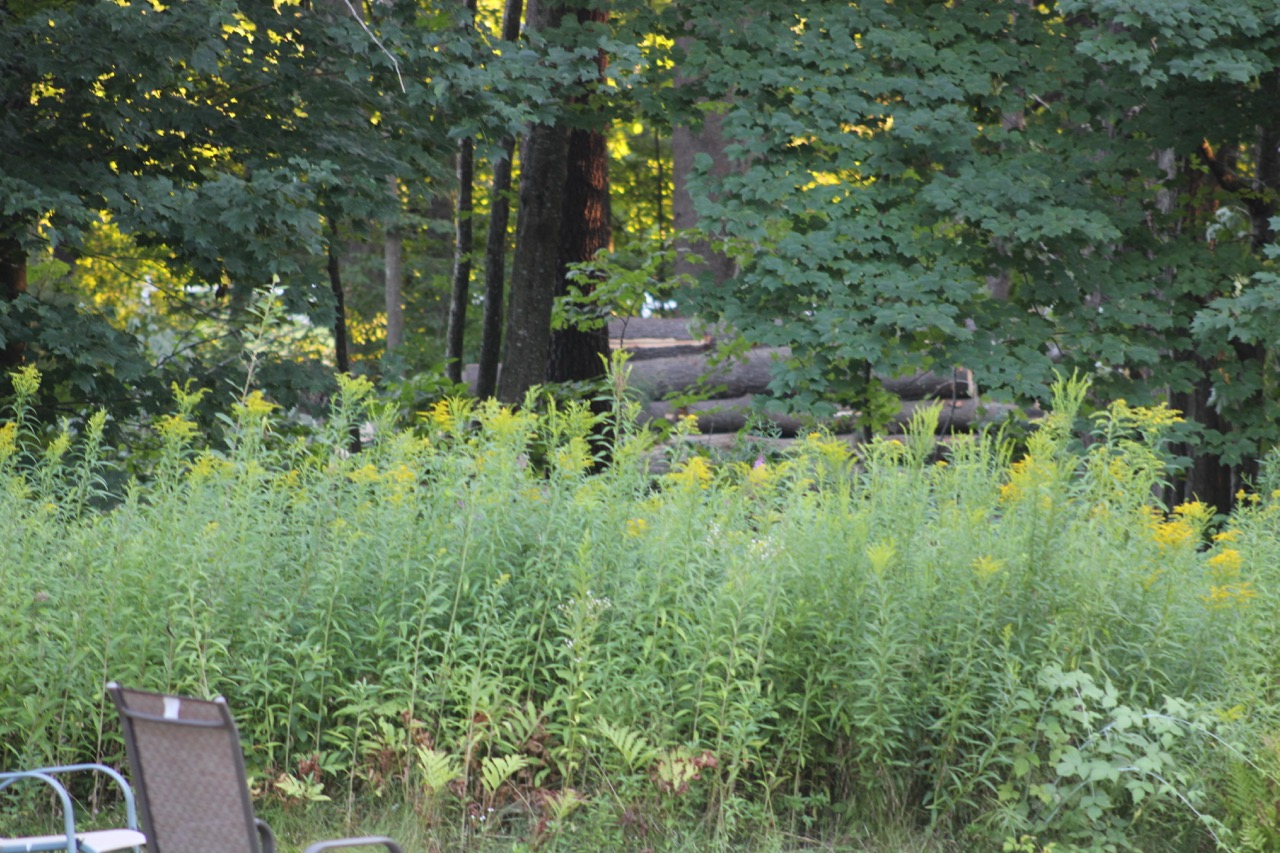
Felled pines behind our big pine, behind our back yard, with goldenrod in front.
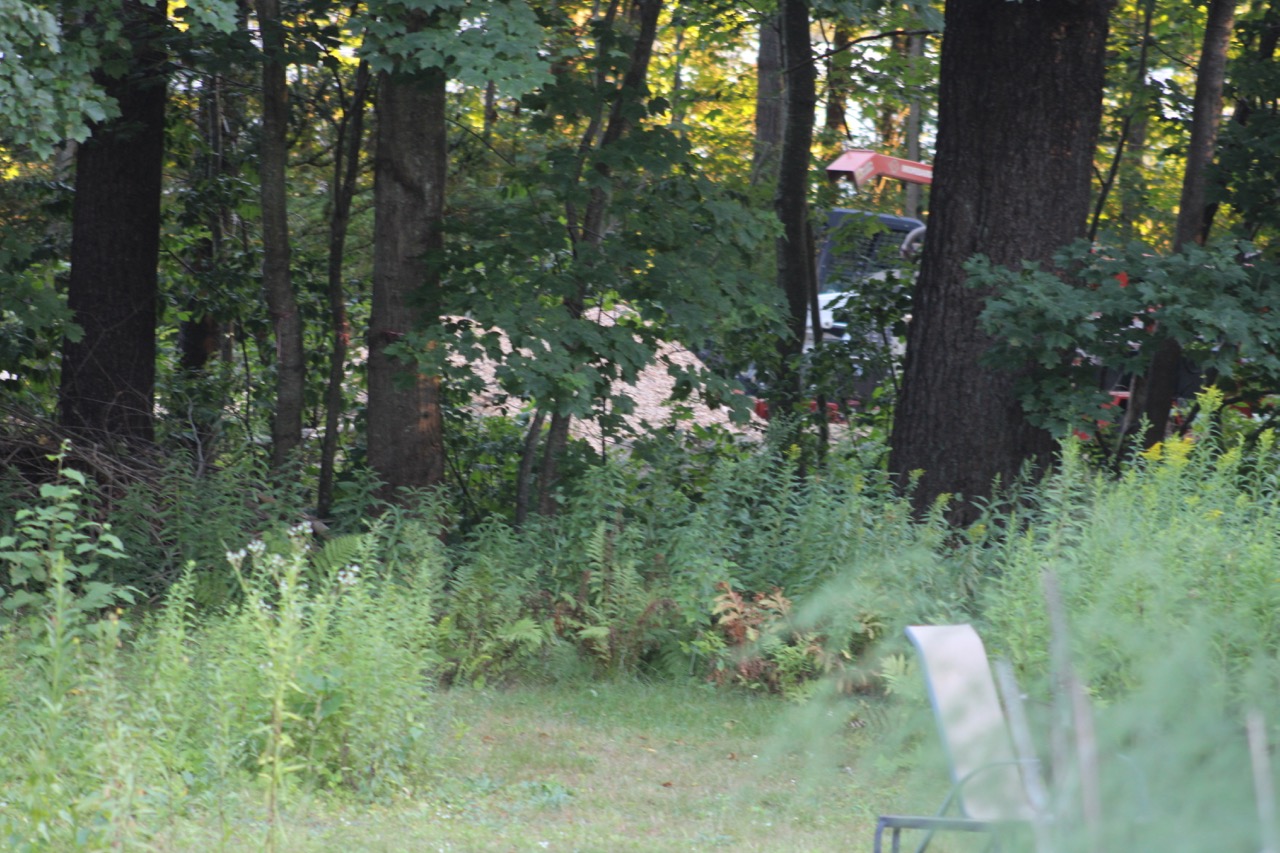
But the rest is so bad. Loud machines have been working all day yesterday and today, felling tall pines, and chipping up branches. Sometimes we feel the ground shake in our house when the trees fall. Our thin strip of protected trees does not hide what they are doing, light comes through and all the visuals of machines, and trees being cut down. The cherished privacy of our back yard is no longer what it was. But most of all, I think about all that habitat lost and wonder how many birds’ nests have been destroyed. Many many birds yesterday were making alarm calls. Early this morning, a pungent skunk-spray smell came through my windows. I imagine that the skunk has been dislodged in some way, and perhaps came across our yard and encountered one of the little cats that hunt here. I think about how we love the wildlife that come through our yard, and how the trees and underbrush, on the so-called “undeveloped” land, have been a mini-wildlife corridor for deer, turkeys, skunks, groundhogs, sometimes even foxes.
Through the trees, we can see the big machines, the pile of wood chips.
I try not to make the neighbor an enemy in my mind–after all, he wants to create a garden, so there is love for the earth there too. We live in the city, in a neighborhood near little brooks in sunken areas that continue to provide wildlife a refuge. But just in the six years we have lived here, acres of trees have been cut down in our neighborhood. Each tree down means more carbon in the atmosphere, more warming, more drought. I think about the long history of cutting the great forests of North America for settlers’ farms and gardens and cities.
And this is how the wider world feels to me right now as well. Slowly falling down around us, more and more “developed,” less and less room for wildlife and trees. I don’t even know how to feel this sadness. It is too deep, too fundamental. Even as Margy and I try to love this small piece of land, to learn from it how to live in mutuality with the earth, all around us the path of destruction seems to hold sway. I think about the great pine in our back yard on the paper road, the one that is over 100 years old, and how she must feel to sense the destruction of her family of trees nearby. I think the trees know. They know that we are destroying our only home, our only planet. And so we grieve together.
Tonight I feel grateful to participate in the virtual opening ceremony for the Healing Turtle Island gathering. Songs, prayers in Indigenous languages, stories of grief, woundedness, devastating loss, and yet, gratitude. How do we bring healing, bring back balance in our relationships, with each other, with the earth, with spirit? This weekend will be filled with many speakers… (anyone can join on Facebook, or on Zoom, just follow the link). I don’t have a lot of words right now but one of the strange blessings of the pandemic is that because this gathering is virtual, I am able to participate. I was present for the very first gathering here in Wabanaki land, the eastern door. There will be 21 gatherings all together.
This photo is of two deer whom we sighted in our backyard on Tuesday–there were four all together. They were a gift in the midst of a painful week. I found myself just sitting on the back porch watching as they took their time amidst the trees and brush. Sitting still and watching. I feel the presence of such a compassionate Spirit through these visitors from the natural world.
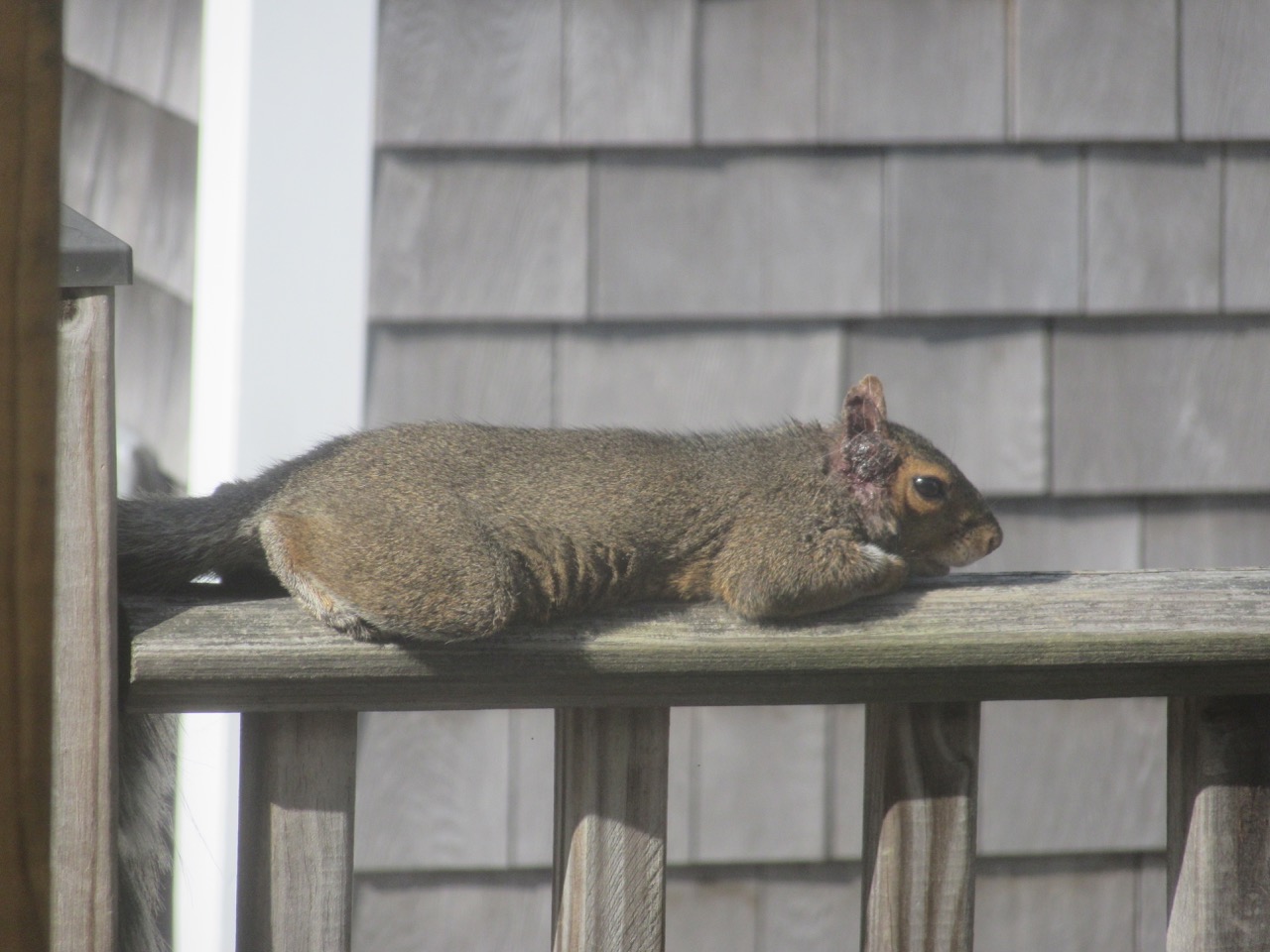
Squirrel relaxed and resting on the railing of our deck
This morning, I watched out my window as a squirrel climbed into the branches of the peach tree, going up and down several branches until she or he stopped at a bagged peach. She nibbled through the small branch it hung from, cutting the branch right off. I could see the leaves and twigs fall to the ground, even though the squirrel was hidden by other branches. Then, she took the unripe peach in her mouth–still in the bag–and carried it down and away from the orchard to some other roosting post in another tree. I didn’t yell or bang on the screen or try to stop her, as I have done on other mornings, because all the peaches have already been destroyed.
Over the last couple weeks, I had to remove over twenty of the bagged peaches after birds or squirrels left bite marks and the fruit had dropped off its stem, to the bottom of the bag. Some of the peaches had only a c-shaped mark that made me wonder about curculio. A couple seemed untouched. But I had seen the squirrels in the trees going after them. Then, a couple days ago I discovered that virtually every peach in a little protective bag had dropped to the bottom of the bag, and all of the peaches that I hadn’t bagged had disappeared completely. The peaches were all still green and hard, nowhere near ripe. I had just read about people using a spray made with peppermint oil and cinnamon sticks to deter squirrels, and was about to try it, when I discovered there were no peaches left to save.
Green peach with a bite missing, dropped to the bottom of a mesh bag, with another nearby.
I’ve been grieving the last few days. I put so much effort into this peach tree all through the spring and summer. Pruning it carefully. Six holistic sprays with beneficial nutrients. Three “Surround” kaolin clay sprays. Picking off leaves with peach-leaf-curl one by one. I was so hopeful when hundreds of little peach-lets started growing! I thinned the peaches so that none was too close to another. I put 80 little protective mesh bags on individual peaches. I even bought toy snakes and an owl to try to scare off the birds and squirrels. None of it stopped them. I had gotten only 3 cherries from the cherry trees, but the peaches seemed to be the saving grace for the little orchard I have been tending so carefully. Last year Margy and I had been able to eat only one ripe peach–and it tasted so good. So this year, I tried all the things to care for and protect them, imagining that taste in my mouth. And now they are gone.
I’ve also felt deeply shaken in my capacity as a permaculture gardener. Here is this little food forest with 2 cherry trees, one peach tree, and two baby apples. And no food. (Well–the raspberries did fine–but I already knew how to tend raspberries. And there were a few blueberries on our young plants. We thought we might get some hazelnuts but the squirrels also grabbed those before they were even close to ripe.) I do come away with a deep respect for organic gardeners and farmers.
But I have been harboring much anger and hate in my soul for these squirrels, and I feel very troubled about that. The original purpose of tending this land–this small place on the earth–was about finding our way home to earth community. Putting into practice the desire for healing the broken relationship between our society and the natural world. But when I try to grow food, so many critters become my enemies. Well, they probably don’t share the enmity–they probably think I run a fabulous restaurant. But meanwhile, I am watching them and hating them.
This morning, after the squirrel ran away with the bagged peach, another squirrel started playing with a stick on the path in the orchard. Literally playing–rolling over and over, turning the stick this way and that, chewing on it, then rolling over again. In a very cute way.
There is a lesson in this, I am sure. So I am trying to grieve, to let go, to open my heart. But I am still not sure I know how to forgive the squirrels. I am trying to listen to the deeper lessons.
It is snowing right now, so lovely. We have had very little snow this winter in Maine. Today’s snow will be turning to rain in a couple hours they say, so I take some moments to appreciate it. But mostly right now I am thinking about sorrow and grief. A dear friend’s loved one who just died from COVID. Another friend who is sick from some unknown thing. People within my circle of friends and relatives who are struggling with loneliness and depression and worry. I am holding all of them in my heart today, as the snow falls so gently and kindly.
In Maine, they are opening up vaccination appointments to people in our age group next week. For us personally, this is both good news and not quite so good. We would have already been in the next age group, 65-69, but instead they’ve opened it up to everyone 60-69, so there will be 200,000 people looking for appointments in the next weeks, instead of 90,000. Maine has switched to an entirely age-based plan, aside from health care workers and congregate living elders who also have priority. I feel for my younger friends dealing with precarious medical situations in themselves or their families. Lots of folks are feeling upset that they will have to wait longer, though the hope is to vaccinate all adults by midsummer, and sooner if more vaccine becomes available.
Apparently, from a public health perspective, more lives can be saved by using age-based criteria, age being a major indicator of possible death and serious illness from COVID. (At least here in Maine, which has a significantly older population than some other states.) And more vaccines can be given out sooner if providers don’t have to deal with all sorts of paperwork and screening issues, which would be needed if they were to account for medical conditions. I had my moments of frustration about our spots in the long line, but then was able to shift focus to a wider lens. We, like everyone else, look forward to the day when we can more safely navigate our lives, go back to physical therapy, or catch up on delayed medical care. Not to mention gathering with friends, seeing loved ones, or just going out for a meal. But we’re all waiting, and we are in this together, even as we are feeling so much alone.
So I come back to a sense of patience, gentle like the falling snowflakes, letting go of the merely individual view and taking the wider view of all of us as a people, navigating this terrible pandemic in the best way we are able, together. I feel this patience especially now that our national government is also concerned with the health of the people, and is responding with a coordinated and extensive response. I still feel so angry that the previous administration ignored all the wisdom of public health, left local and state governments to fend for themselves, and abandoned half a million people to die. If they had responded immediately and cooperatively, so many lives could have been saved. Unforgivable. Unforgivable.
I weep for those who have died, and for those who are left behind in grief. I weep for our country, in the throes of its struggle between individualistic power grabbing and collective compassion for all. Today, my sadness is my prayer, and the gentle falling of snowflakes.
What elements are necessary for me to experience joy? What if the forests are burning in the west? Can I feel joy here in the east where the forests are not burning? What if fascism has stolen the possibility of democracy? Can I smile and sing a song about humbling ourselves before the trees? What if migrant children are still locked in cages without their families? Can I steal a moment of joy in the morning when the mist covers the sun? When I know my beloved is asleep in our home?
Today there are mushrooms again in the food forest, wine cap mushrooms that we inoculated into our wood chips over a year ago in the spring. We started something, but we don’t have any control over what they now do. I don’t know what elements are necessary for the mycelium to decide, after these months of invisibility underground, now is the time for mushrooms. The mist in the morning? Only they seem to know, and only they decide.
Last night I fell asleep asking the question, “What elements are necessary for me to experience joy?” Or perhaps I was asking its heavy twin question, “How can I dare to feel joy while the earth is suffering, so many people are suffering, the nation is suffering?” How can I be permitted any moments of joy given the reality of our world right now?
I remember when I was part of the Women’s Peace Camp, a peaceful protest next to a nuclear weapons military base–we had many moments of joy–despite the serious nature of our witness: evenings full of music, exciting sexual liaisons, long talks planting seeds of friendship that have grown and endured through time, delicious meals. I remember our wild dance parties and Emma Goldman’s words we often paraphrased: “If I can’t dance, I don’t want to be part of the revolution.”
Someone commented on Facebook the other day that we need to prepare for a disaster–they were worried about the possibility of civil war after the November elections. But when this idea rolls around in my head at 3 in the morning, I am not even sure what disaster to imagine preparing for: no electricity? food systems cut off? hurricanes? loss of social security income? no water? no internet? people in the streets with guns? evacuation? There are so many possible disasters that cannot be “prepared” for.
With age and illness, Margy and I are more isolated now, though certainly not all alone. But I miss being at some sort of front line in community. I can say to myself–we are trying to live a dream of a life more in harmony with the Mother Earth–the downsizing, the solar panels, the food forest. And I don’t forget the importance of choosing to love a woman in the face of patriarchy. Imagining decolonization in the face of white supremacy. But I feel helpless in the face of the destruction of so many people and landscapes across the nation.
It is almost as if all I have to offer now is my profound grief.
So, is it still possible to find joy in this grief time? Is it hiding underground like mycelial networks? Can it spring forth like mushrooms when something decides there is room for it now? Is it me who decides? Can I fully honor the grief that our times require, and yet still find those moments of song, smile, lightness, beauty, gratitude?
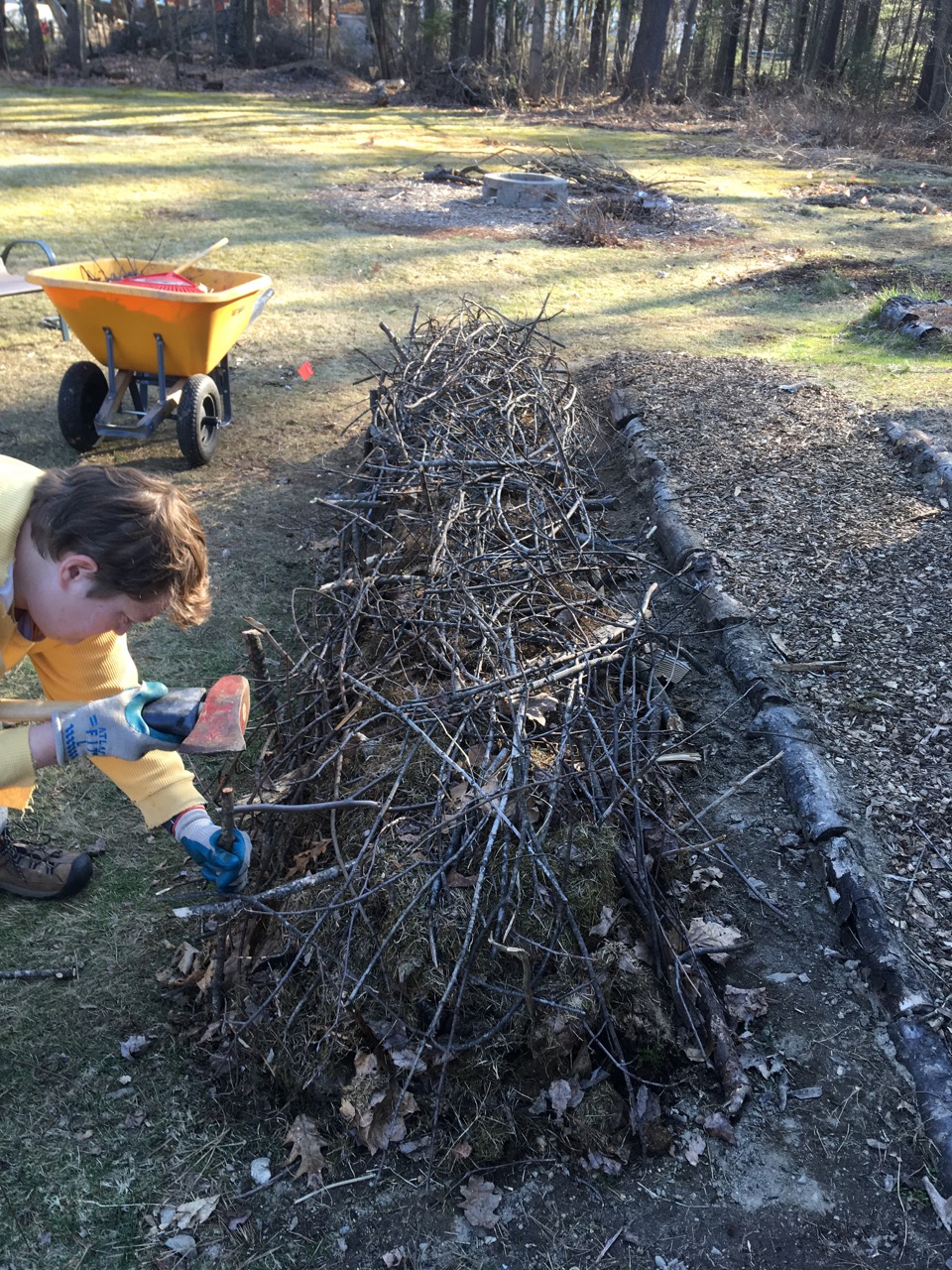
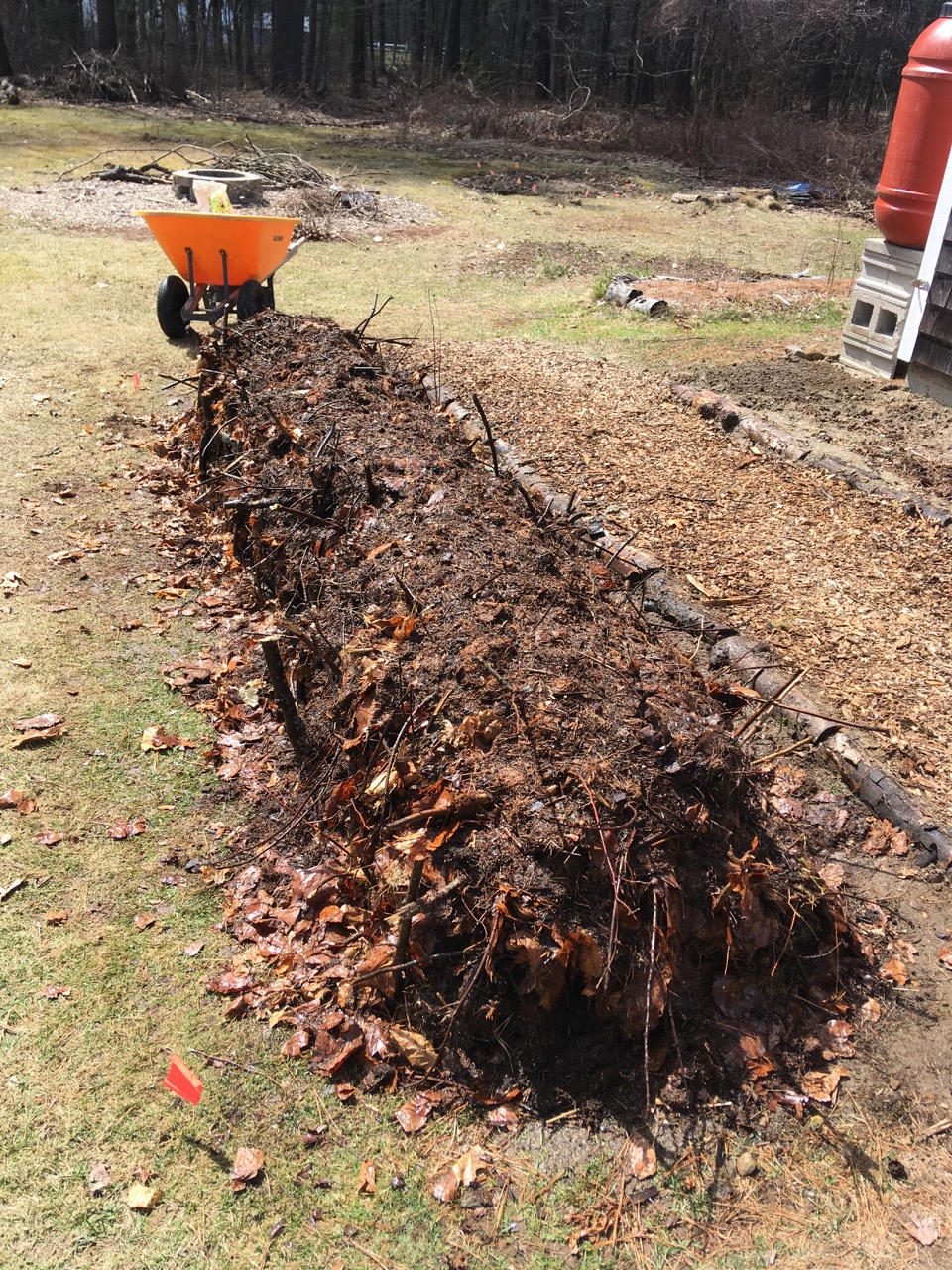
Continuing to build a hugelkultur garden bed, yesterday, we added some brush to the top and sides of the mound, over the cut grass layer. Margy pounded some branches into the ground on the side as stakes for further stabilization.
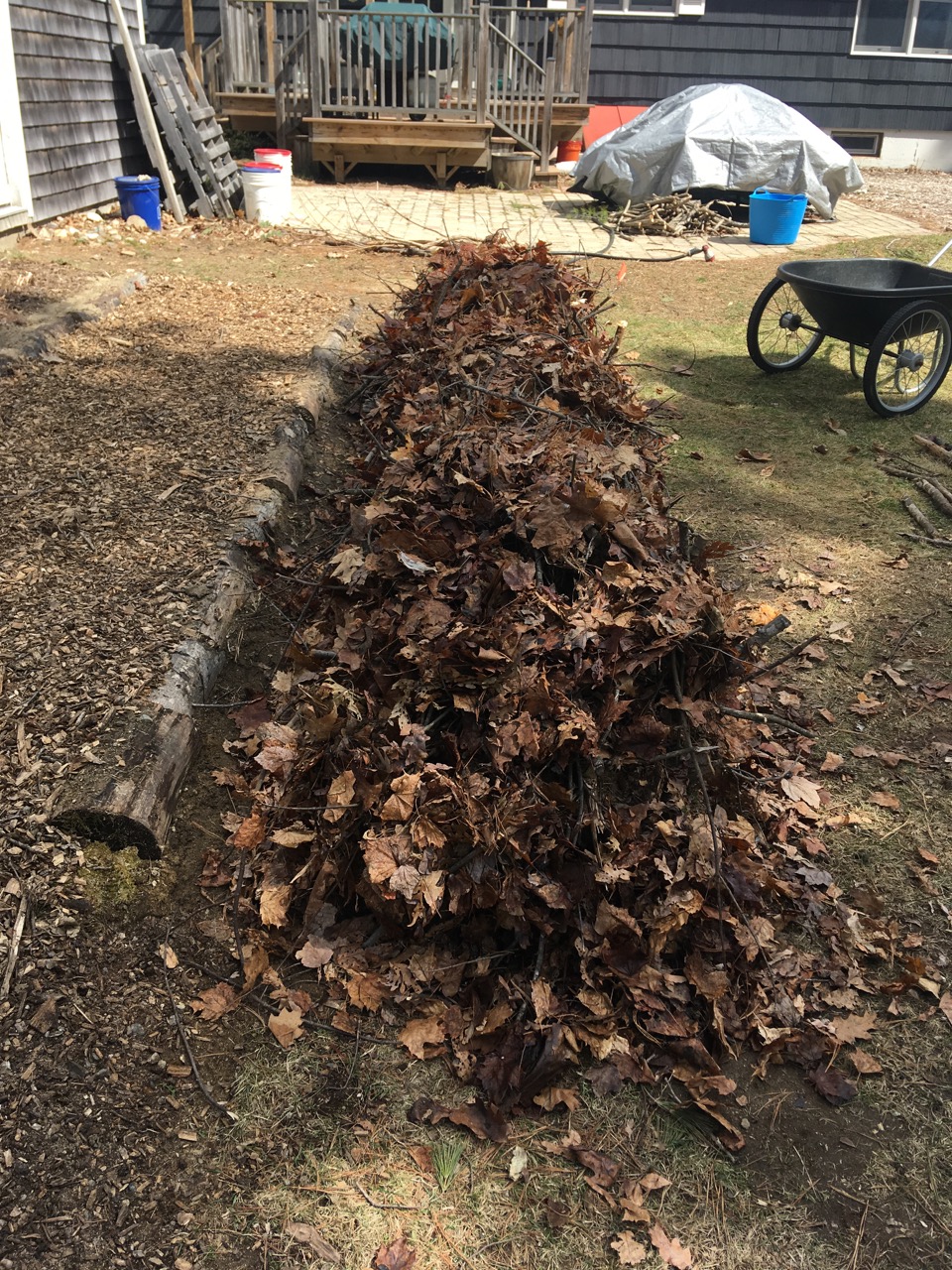
Next, today, I covered it all with dried leaves, one full wheelbarrow plus a big garbage bag full, saved from last fall.
Finally, I added about 3 wheelbarrow loads of yard waste compost, and watered all of it. But this stage of adding compost is going to need many more loads before it is finished. I should be adding several more inches of compost. The mound is about 15 feet long, and will be 4 1/2 feet wide when complete. I had one of those moments when I thought, “Why did I make it so big?” I think this stage is going to take a while.
Meanwhile, I was pondering the fact that I often feel anxious when I am trying new things in the garden. I was realizing that my parents and grandparents were urban or suburban people. My dad wanted to get back to the land, and was a cowboy for a while, but mostly he worked as a draftsman for the auto industry. His parents tried to homestead in Wyoming, but that fell through and they came back to Detroit. My mom’s parents came from Linz, Austria and Quebec near Ottawa, Ontario, and lived most of their lives in Detroit. She had flower gardens while I was growing up. So I didn’t learn how to grow food from my family. It has only been as an adult that I’ve tried to learn about food gardens, off and on as circumstances allowed it.
The more I learn, the more aware I am of how much I don’t know. Each plant is like a stranger to me, then perhaps an acquaintance, and I hope in a while it might be a friend. It is hard to believe that we could be relatives to each other. (Well, except for kale–kale already feels like a relative, since I have grown it for a long time.) But I try to remember to embrace this beginner’s mind, to be present and attuned to the process. It is good to be outside, to feel the spring, to forget for a while the grief and fear that this pandemic is unleashing.
This morning, I have been reading Farming While Black, by Leah Penniman. It is a marvelous book on so many levels–history lesson, gardening guide, liberation manual–and it feels a privilege to learn so much from a work that is actually focused toward Black farmers and gardeners. I knew so little about the skills of enslaved Africans who brought with them to these lands African plants and knowledge of growing them. I knew so little about the work of George Washington Carver who was one of the first to study and promote regenerative land practices. I know so little about multiple plants and their habits and their gifts for us. Get this book!
But then, after reveling in reading all morning, I find myself opening to multiple layers of deep grief underneath the joy of reading the book. Grief for the African peoples who were stolen from their land and enslaved. Grief for these Turtle Island lands, whose balanced ecosystems and soils were so depleted by the cutting of forests, and the plowing under of the soil, as well as by the war waged on their people. And grief for myself and my communities–that we have lost our connection to the ecosystems, we have lost our connection to the wisdoms, we have lost our connection to the plants.
I get overwhelmed with the abundant knowledge in the book, and I remember this feeling in other wonderful books I have read, the feeling that I have no hope of learning everything I need to learn, in the limited years left to me on this planet. I get the feeling that I have no hope of regaining access to the collective wisdom that has been cut off in so many ways. And I realize that this too is part of colonization.
My East Frisian ancestors were some of those who plowed over the fertile prairies back in the 19th century. Grief. But at least they knew how to grow their own food, and provide for their families from their land. I read online recently that in the last two generations, most Americans have lost the capacity to do that. More grief. I don’t know how to do that. And I can’t envision getting to that ability before I die. Plus, it is not really something we can learn from books.
In Farming While Black, I was reading about herbs and their healing properties, and there were too many to take in–even though it was a limited list of the herbs they grow and find to use in their community. I feel lucky if I can learn about two or three herbs in a season. All of us should have been learning the herbs since the early days of childhood wandering in the woods. The plants are our elders, our guides, the wise beings who know how to feed us and heal us and care for us. This separation from the plants is also a part of colonization.
One answer to my dilemma is about community. No one is meant to have all the knowledge on their own. It is okay that I can’t learn it all on my own. But I feel grief too for the fragmentation of communities that has kept us from sharing this learning and wisdom with each other. And I feel grateful for each person who has shared their knowledge of plants with me. I feel grateful for organizations like the Resilience Hub, who bring people together to share so much wisdom of soil and plants and ecosystems.
But for this moment, I want to honor the pain of colonization, honor the pain of what has been lost, honor the pain of so many threads of connection that were torn apart and destroyed, never to be rewoven. It is a long journey to healing.






 Finding Our Way Home