This earth love is a balancing act. We love critters in the yard, after all, they live here too, and have the right to be here. They bring so much joy to us. But we want to grow food too. The last time we bought organic broccoli at Hannafords, it was $8 for one crown. These twelve broccoli plants in this raised bed will be very valuable food for us. I’ve also planted cucumber seeds here. So we try to use gentle methods to discourage the critters from eating the plants we want for our food.
Margy saw a groundhog poke its head up out of a hole in the grass, over near the fence. There was a burrow underneath where a spruce tree fell before, and after it was removed there was still a mound of old roots and dirt. Groundhogs can be the worst for eating garden food, despite how cute they are. At times, we’ve used human pee to mark a line around the beds. Last year, we covered that bed with an old screen tent to protect the kale–and it did. All of it is a kind of communication, with respect.
This year, I am trying out a new method for deterring critters from the garden bed–putting pine cones in between the plants as mulch. (I saw it on Facebook.) Apparently many critters do not like the prickly feel of the pine cones under their feet–and these pine cones are very prickly. They come from our pitch pine, and we have tons of them everywhere. Margy had a bag full of them in the garage, so I used those first, and then started twisting them off fallen branches under the pitch pine. I had to wear gloves to do it, that’s how prickly they are. I’m putting them in the hugel mound as well.
We’ll see how it works.
In the meantime, in critter news, a few days ago we saw a mother turkey walk through the yard with about ten baby turkeys. Ducks stop in to take a dip in the pond. The frogs hang out there, and the tadpoles are getting big. They like to linger under the lily pads. The robin has four new eggs she is incubating. The chipmunks fill up on sunflower seeds at the bird feeder, but are also eating the maple seeds that blew all over the yard.
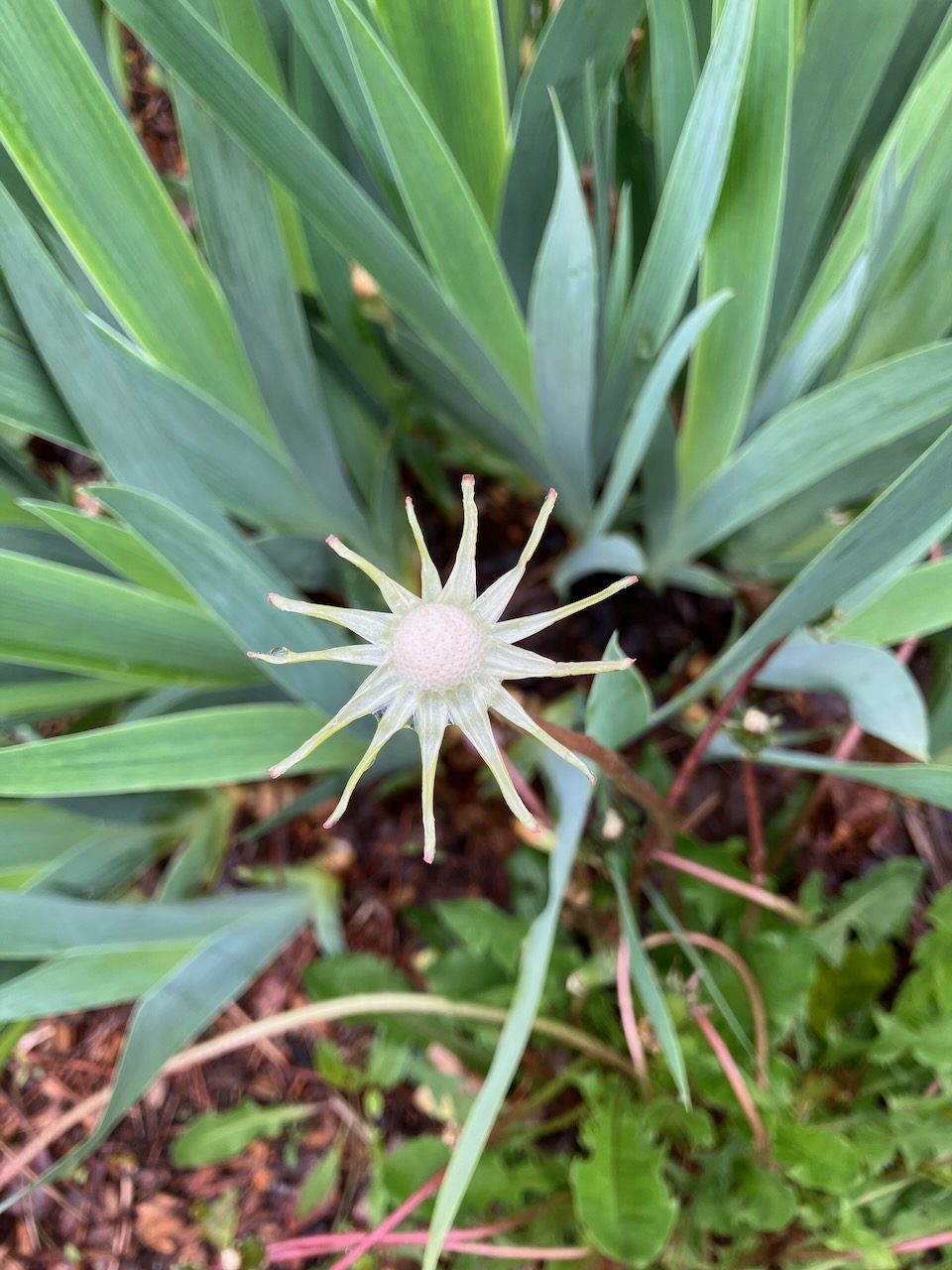
And sometimes, beauty emerges in unlikely ways–this is a dandelion after the rain washed away all the fluffy seeds. A perfect star.
Three goldfinches were perched on this volunteer sunflower!
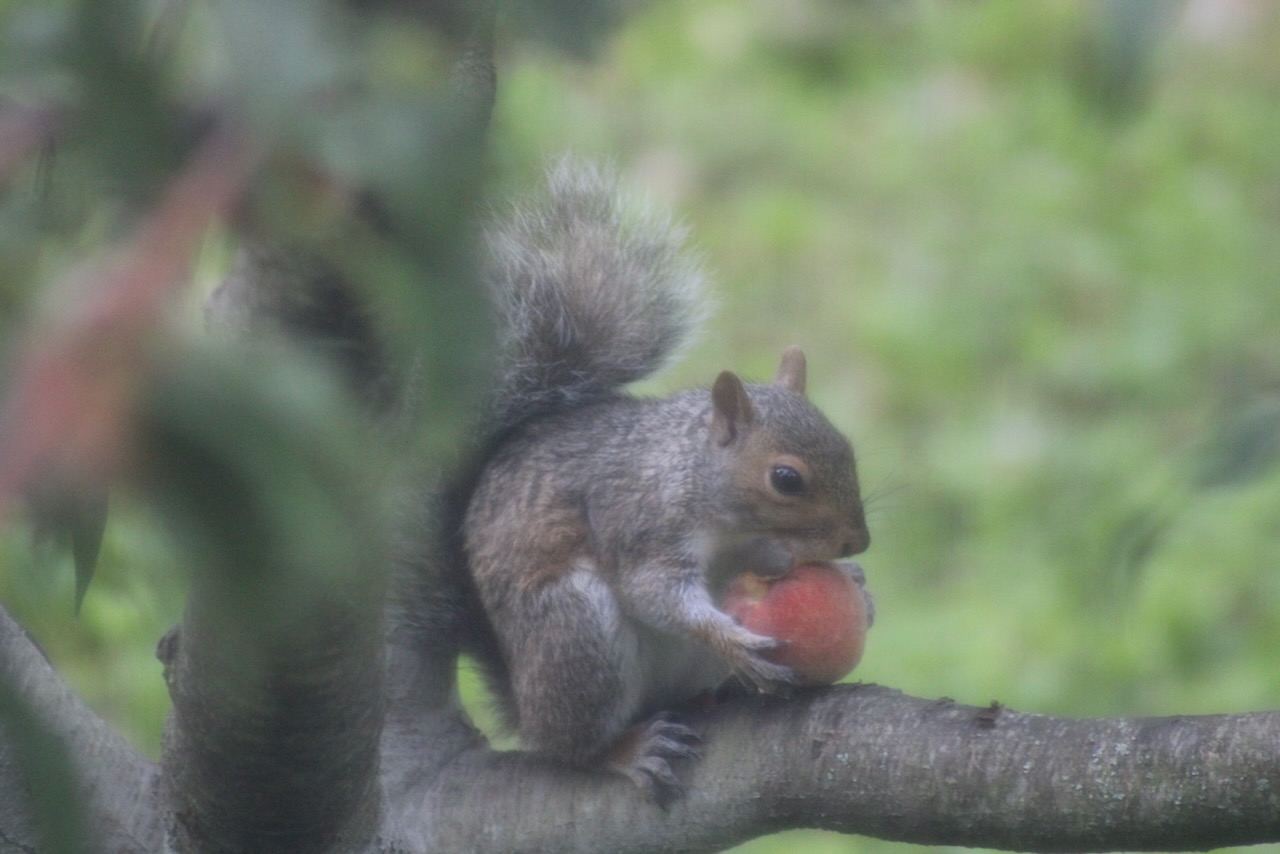
We haven’t been that successful in growing food for ourselves in the garden. (Yes, the experiment with the kale worked well. And we harvested blueberries and raspberries.) But right now the peaches are getting mold on them just as they ripen. Another fungal issue. I’ve started harvesting some that are not yet quite ripe, and just cutting them up to put in the freezer. But in the meantime, the squirrels and a groundhog are happily coming to the tree each morning to eat a peach. The squirrel climbs up the branches to pick her own, but the groundhog takes one that has dropped off.
The squirrels are always fairly bold, but the groundhog is shy and runs away as soon as she sees us on the back porch. So this photo was from a back window.
The more I try to garden, the more I realize what I don’t know. But it makes me happy that critters feel at home with us here. Unfortunately, the groundhog has dug a few holes to get under our garage–we don’t want her to feel that at home, such that she undermines the foundation. So I refill the holes any time I see them, and then pour some human urine on the area, hoping it will discourage her from more digging. Marking our territory, so to speak. We’ll see if that keeps working.
Meanwhile, the birds are relishing the volunteer sunflowers and evening primroses that are blooming and going to seed in lots of places. Also the elderberry bush. They seem to like everything about our yard. That makes me really happy.
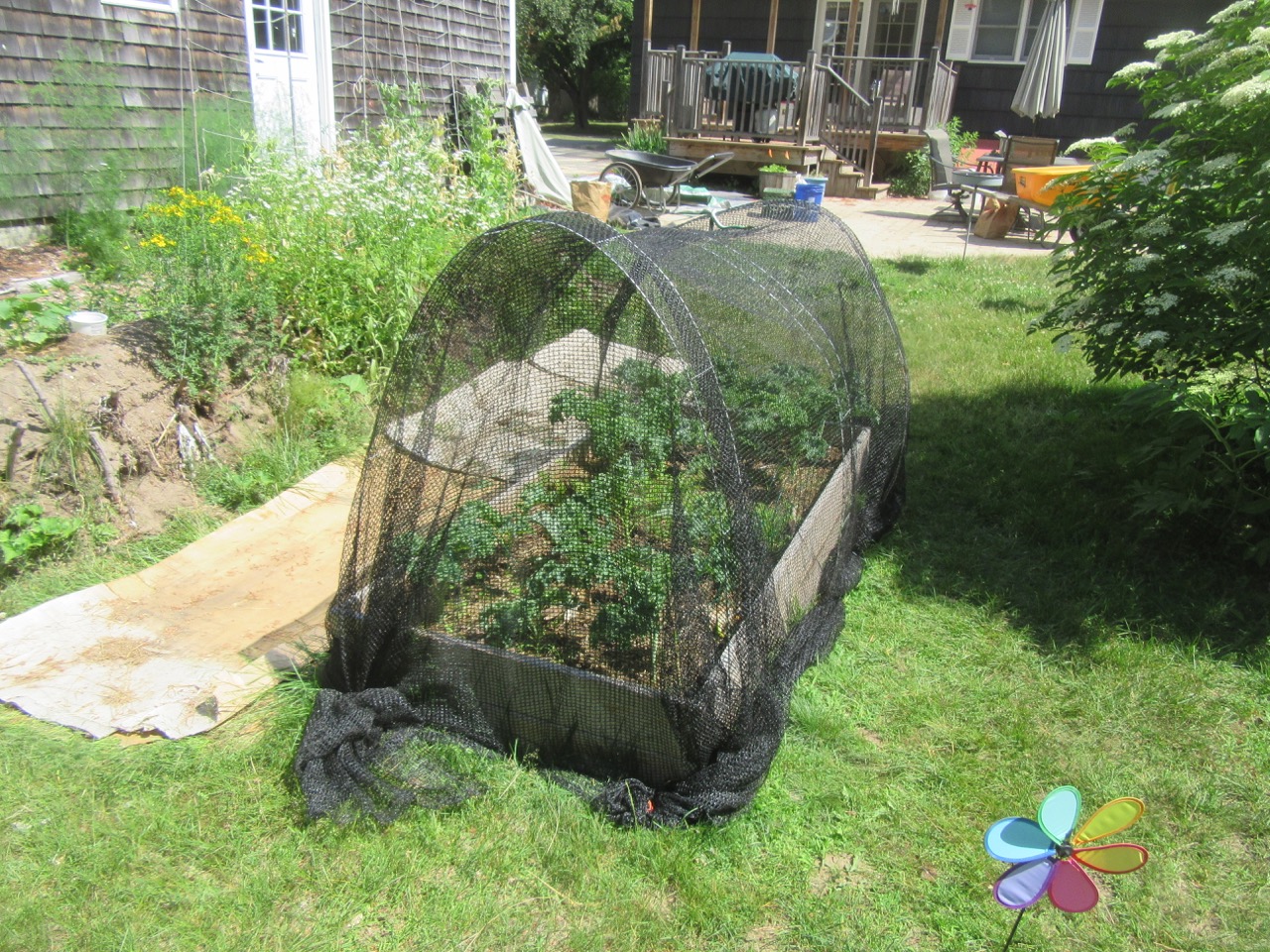
They call it “upcycling” now, but I always think of it as the remnant of my time as a Catholic Worker when we always made practical use of whatever was on hand for what was needed. So this week, I upcycled an old screen tent to make a covering for this raised bed. I almost didn’t plant anything this summer, I’ve been so tired. But I happened to stop by the Portland Food Coop and they had organic kale seedlings for sale, and I got drawn in. I added compost and seaweed and turned over the soil in the bed.
This bed has often in past years been visited by critters such as groundhogs who love to chomp on greens, so I knew I had to protect it. (It has chicken wire underneath so that protects it as well.) The groundhog has always been easily put off by some sort of covering over the top. Many years ago I had purchased metal framing that I had repurposed for this bed. I had some netting that I covered it in years past (see a photo here), but I couldn’t find it. I did find the old screen tent in the garage–no longer usable because it had no frame anymore. So then I wondered–maybe this would be better than the netting, which had never kept out cabbage moths that liked to lay their eggs on the kale. Maybe the screen would keep out those pests as well?
So I took a scissors to the old tent, and cobbled it back together in a new shape, using a little superglue and paperclips. I tried to minimize any fabric that would block the sun. On the south end, is the zipper opening, and on the north end I folded over the larger remnants of screening.
To anchor the bottom, I placed some logs that we’d cut from fallen branches of our pitch pine. Once everything was in place, I planted my kale seedlings and watered everything well.
The experiment asks whether they’ll get enough sun through the screen, which does shade them a little, and whether they’ll be protected from cabbage moths? I hope it turns out well!
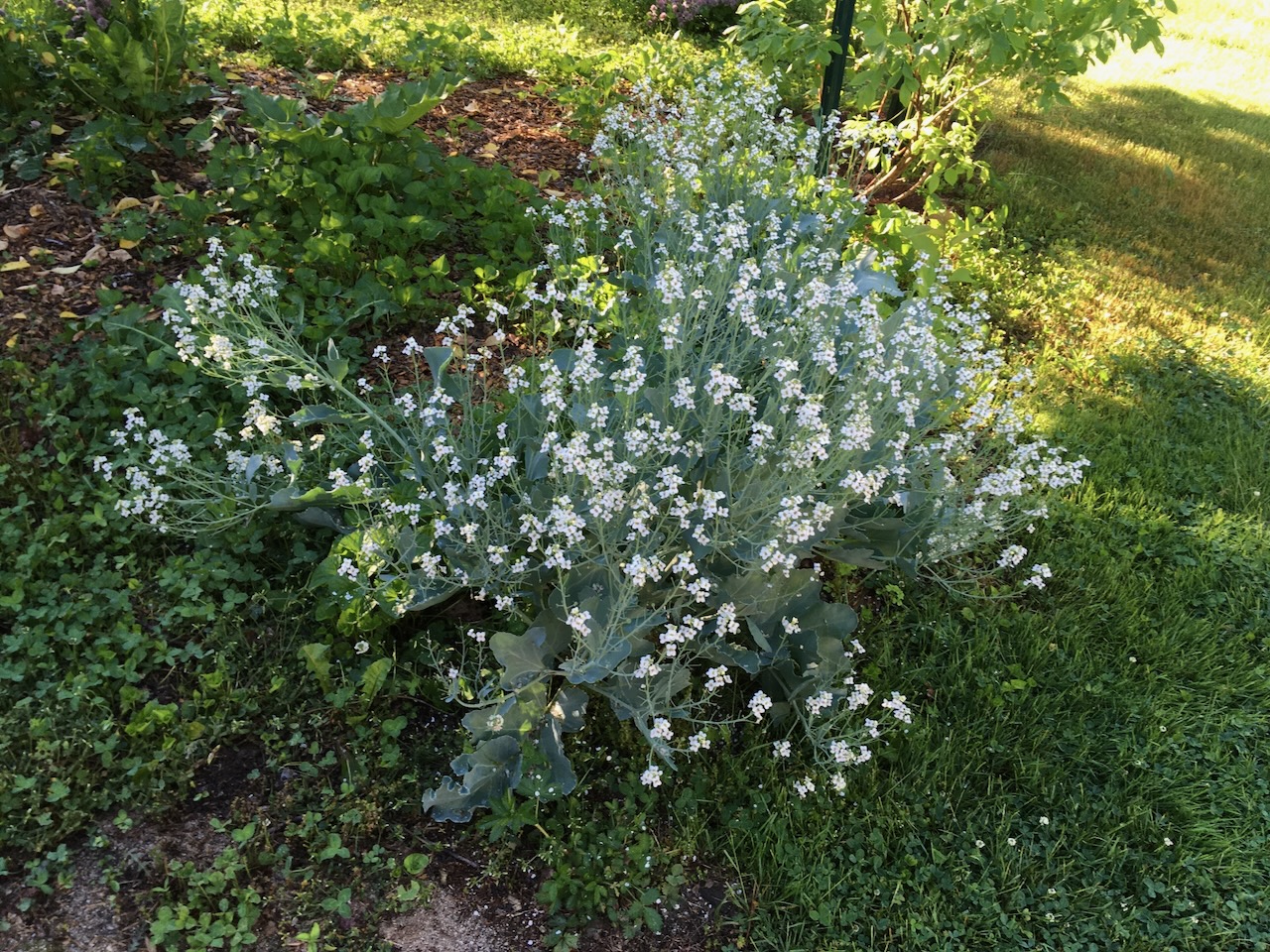
In the meantime, here is a picture of our perennial sea kale, from which we ate several small leaves and buds before it quickly turned to flowering. I love its honey smell.
Well, after all my efforts with the sweet cherry trees, I harvested a total of three cherries. Very sad. That is all for the season. I had given them foliar sprays, compost and seaweed on the ground, and companion plants. I sprayed them with kaolin clay to guard against pests, put out yellow sticky paper for black cherry aphids, and hung about 50 red wooden fake cherries to deter birds coming round. I watered them when we were having this drought. We didn’t start out with a lot of blossoms, and I think there were only 10-20 cherries that started forming this season–not very many. But by the time they ripened, I could only find three. I ate one, and the other two are in the photo next to the raspberries.
The raspberries, on the other hand, I do hardly anything for–I pruned out the old canes in the fall, and they got a couple foliar sprays when there was some left from the trees. I watered them a couple times during the drought. But now they are producing abundant berries, and this harvest was just the one day’s worth. So frustrating. Especially since I like cherries more than raspberries. I’ve grown raspberries before, but cherries are still new. I do not seem to know the secret. If anyone can tell me, please comment!
I also harvested a big bunch of kale today. After the groundhog sighting, I covered that raised bed with netting and stakes. And a good thing I did! The next day, I caught sight of the groundhog standing up against the framing looking through the netting at the kale. I chased him off, and I haven’t seen him the last few days. I’ve also put urine liquid around the area. So far it seems to be working.
Today, I took off the netting, harvested a bunch of the lower leaves of the kale, did a bit of weeding, and finished thinning the carrots that are also growing there. With kale, I will sauté a bunch of it, and then immediately freeze, for use in winter. I eat kale almost every day! I’m so happy it is doing well. But if you know the secret for sweet cherries, please tell me!
Margy and I were chatting in the coolness of our kitchen, when suddenly I thought I saw a squirrel on our back deck, running right under the plastic “owl” that I had bought, supposedly to scare squirrels away from the orchard. That’s what caught my attention. But looking closer, we realized it wasn’t a squirrel, it was a groundhog! I ran outside onto the deck, and it ran too, but I managed to catch this slightly blurry picture to confirm our suspicions. It ran across the patio, through the back yard and over to the trees on the edge.
Photo: Groundhog running across the patio, in the shadow of the bird bath, near a chair.
Margy and I are often torn between totally loving the critters that come into the yard, but also wanting to eat the food we are growing. Munimqehs is the Passamaquoddy word for groundhog, which I learned in the fall of 2018. In Wabanaki stories, Munimqehs is the wise grandmother who has many lessons to teach us about how to be good human beings. How desolate we would be without our animal neighbors!
We haven’t had any groundhogs in the yard for the last few summers. The last one disappeared, we believe due to the intervention of a neighbor. With a groundhog in the yard, however, it is a whole new ballgame for gardening. I immediately went out in the heat, and put together a netting contraption to try to protect our bed of kale, from which I had harvested the first leaves earlier this morning. I happened to have these metal arches and nylon netting, and fastened the netting to the ground with metal stakes. There is already a wire mesh under the raised bed, so no animals should be able to dig up from underneath. We’ll see if this deters our little friend. I might have to also go back to the pee protection scheme that I used to partial success a few years ago.
Raised bed with kale, covered by metal arches and nylon netting
Meanwhile, today I am grateful for the excitement of a critter on the deck, a young one it seems. Let’s see what lessons she/he will have to teach us. We have lots of clover that we’re happy to put on her table. Let’s see if we can be good neighbors.
I have been having a few days in the garden that humble me to my core. This process of finding our way home to earth community is so difficult. Trying to care for fruit trees involves learning about so many insect pests and disease processes. Observing the trees carefully every day. Yesterday and today I was thinning the tiny peaches leaving only one every 6 inches, so that the branches can support them to grow. Often I am trying to figure out which organic solution goes with which problem. And yesterday morning, I saw one of our squirrel neighbors climbing the peach tree–a whole other issue. Will we get to eat any peaches, or will the squirrels take a bite out of each one? Or will birds peck holes in them? Or some other insect pest eat them from the inside?
I hate how gardening sets me at odds with the other critters on this land–figuring out which are “beneficial” (to us) and which are “enemies” (to us.) I remember that when I first had a little garden, many years ago now, I was surprised that so much of it was about killing–pulling weeds, drowning slugs in beer, and so forth. And now that I am caring for an orchard, a permaculture food forest, it’s the same thing. A constant battle. So how is that teaching me how to live in a mutually beneficial relationship with this land?
I start to wonder if human beings should ever have shifted from hunting/gathering to agriculture. Hunting and gathering certainly included the taking of animal life, but it seems like it was more in balance, it was received with gratitude, it was a kind of partnership. I am thinking about the different role of the groundhog in the lives of different cultures. The bane of many gardeners’ lives, groundhogs are incredibly inventive and persistent garden eaters. It was amazing to me that here on our land, the groundhog whose den was next door seemed to respect the orchard as our place, while the garden bed behind the garage she claimed for her own. But I have a friend who built a fence deep into the ground around her entire garden, and still the groundhog family dug a tunnel and emerged right in the center of the garden to eat her vegetables.
However, the groundhog played a different role in Wabanaki cultures, in tribes that were traditionally hunting and gathering. I only know a few of the stories about the legendary figure for good, Koluskap (Glooscap), the creator of human beings. But I learned that his grandmother was the groundhog, Munimqehs, and she guided him and taught him the wisdom he needed. What a different perspective! She taught him that people and animals relied on each other, that hunting was necessary for the people to be strong, but that taking more than was needed was destructive to both.
Photo: The groundhog who used to live near our yard.
Likewise, deer might be a blessing for hunters, but destructive to trees and gardens. We see about one deer each year passing through the back of our yard. We used to have a gang of turkeys that roamed the streets of our neighborhood. They are gone now. Eventually, the groundhog disappeared too–I think a neighbor had something to do with that. Now, it seems, along with birds, we only have squirrels and a little star-nosed mole that tunnels under our wood chip paths, and an occasional chipmunk. But the squirrels are very adept at causing trouble to our garden. All winter long, for example, they climbed up our hazelnut bushes, eating the catkins that would pollinate the flowers in spring. After, they would act drunk and run around wildly in circles. Eventually I put some nets over the two smaller shrubs, to try to protect them. Maybe it worked? The smallest shrub now for the first time has some “future hazelnuts” forming on the end of its branches. I don’t know why the larger two do not.
Photo: Future hazelnut?
Sometimes I am amazed at what grows, what we can harvest. I just cut a whole bunch of soft thyme to dry, and I’ve been finding wine cap mushrooms hiding under clover to add to meals. The sea kale was delicious, and now its flowers smell like honey. There are green berries on the blueberry plants. I got the advice to buy some fake rubber snakes and hang them in the trees to scare off the squirrels–as long as I move them every few days. Last night, Margy and I sat in the back of the yard and watched fireflies signaling to each other in the tall grasses and weeds. In this garden, I am bewildered, sometimes discouraged, often exhausted, and always humbled by how little I know, and how difficult it is. What are you trying to teach me, little squirrels?
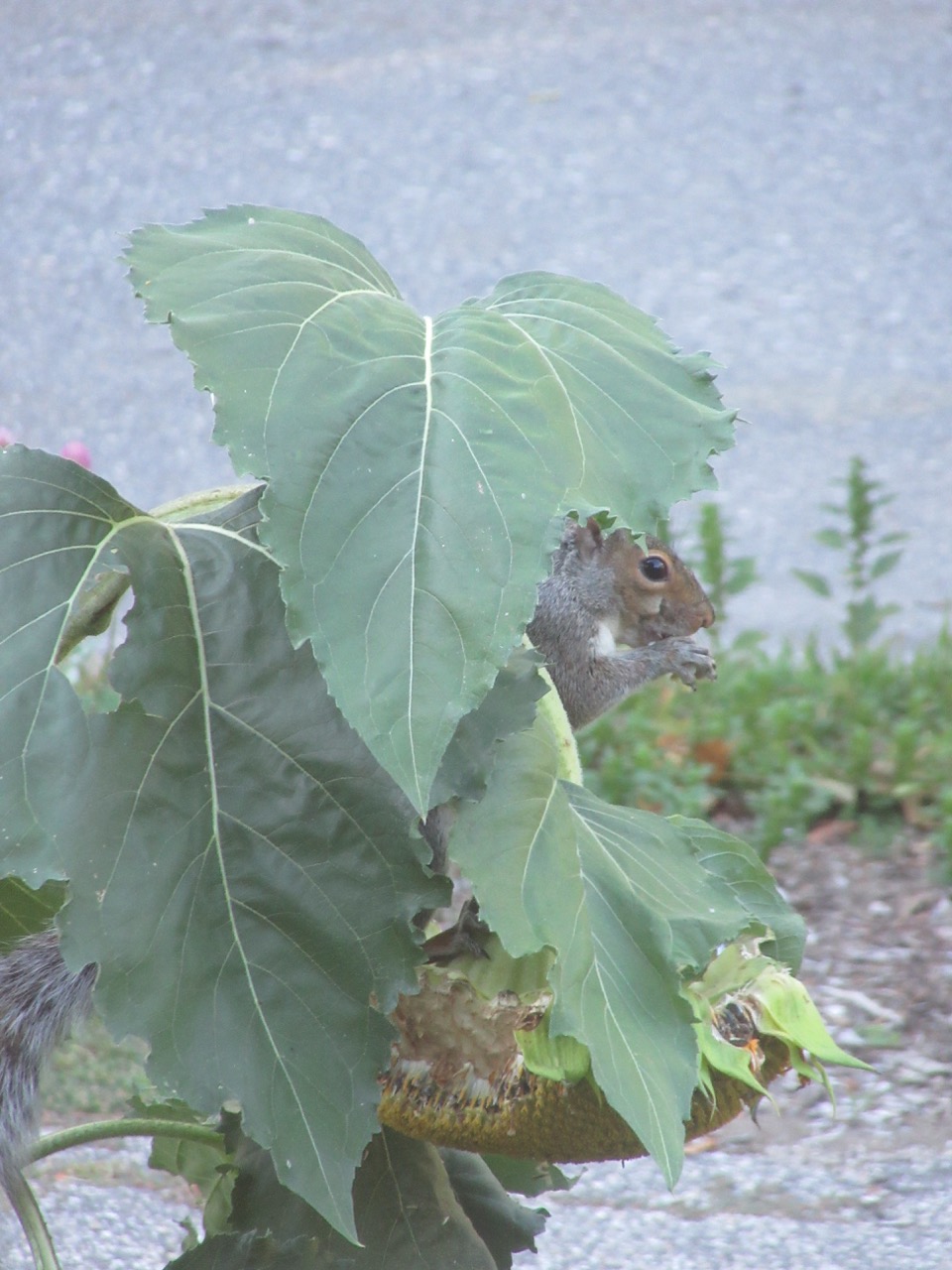
Photo by Margy Dowzer: Squirrel sitting, eating, on a sunflower last fall
I had a revelation! I have been thinking I was having a tug of war with a groundhog, because despite the fact that I had been using a very potent deterrent liquid, each morning I would discover this mess around my cherry tree beds. But no more plants were being eaten. So what to do? I did more research and discovered that the mess in my garden was likely not caused by a groundhog at all. Because the digger is nocturnal, and groundhogs are not.
Rather, it is likely a skunk (who is a nocturnal digger) is rooting in the mulch for the grubs of Japanese beetles. And then I realized that the rooting appeared about the same time as the Japanese beetles on the cherry tree leaves (which I have been picking off and dumping in soapy water). So I don’t really have a digger problem, I have a grub problem. In fact, the skunk is helping get rid of the Japanese beetles. But I’ve ordered some Milky Spore disease to inoculate the soil to create a more permanent and organic solution to the Japanese beetle problem and that will eventually deal with the digger problem.
I learn so much every week about gardening, usually through problems. But I haven’t seen the groundhog lately! (Knock on wood chips.) Thank you, skunk!
Our neighbor mentioned this little woodchuck (aka groundhog) had eaten her flowers when she planted them, and now she or he has been visiting our yard. When we saw him the other day through the side window, he was eating something in the grass between our two houses. I went outside to take a photo and he lumbered over to hide below the neighbors woodpile. So cute. But the next morning, some of my kale plants had been eaten. Coincidence? I don’t think so.
Ever since we’ve been planting trees and making new garden beds, we’ve had many more birds and other critters come into the yard. So mostly that is a wonderful thing. But we are hoping to grow food! So I will be searching the internet for natural ways to repel them. Have any good ideas?








 I had a revelation! I have been thinking I was having a tug of war with a groundhog, because despite the fact that I had been using a very potent deterrent liquid, each morning I would discover this mess around my cherry tree beds. But no more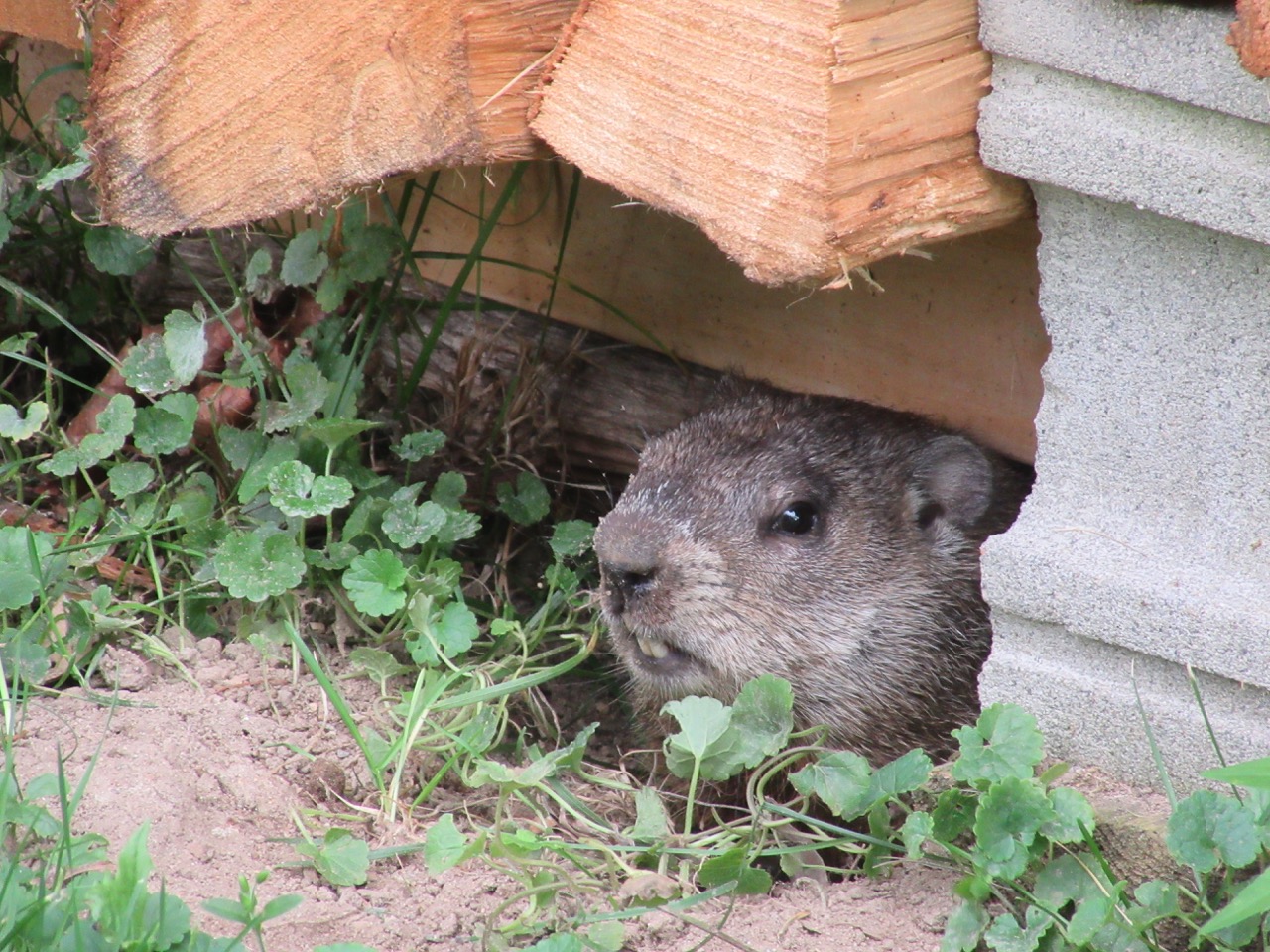

 Finding Our Way Home