Despair

Almost every day I walk down to Capisic Brook, and most days, all through the winter, I saw a pair of ducks who lived in the water there. I saw them today too. My whole body felt heavy as I walked this morning, and I almost turned back before I reached the brook. I feel such a crushing sense of sadness and despair. I feel for the people who are suffering and dying in a genocide in Gaza. I feel for the foreign students and others who have been detained without warning or due process. I feel for the thousands hurt by the dismantling of government programs that feed people, and in conjunct with that, support farmers. And so much more. So much more is being broken and destroyed by the regime in Washington.

To be an activist has been an empowering thread throughout my life. I followed the advice of Audre Lorde: “Use what power you have to work for what you believe in.” When I feel powerless, I still search around for some small work I might do for what I believe in. And yet, the destruction continues.

As I cast about for some hope to cling to, some antidote to this despair, I find myself remembering the life of Jesus. He lived in a time and place under oppression by an empire that cared little for his life and the lives of any of the people around him. He had no power to change that evil regime, (or if he did, he did not use it–that was one of the temptations he rejected, as described in the gospels). Somehow, he lived his entire prophetic life in the shadow of this evil empire, and taught and healed nonetheless, usually with the most marginalized and the outsiders.

I get especially angry by the people who promote “Christian nationalism.” Jesus preached the opposite of nationalism. He often contrasted the divine “kingdom” with earthly kingdoms. Perhaps there is no story with more clarity about this than the story of the final judgment at the end of the world. According to the book of Matthew, (chapter 25) the divine king said to those judged as righteous: 35 “for I was hungry and you gave me food, I was thirsty and you gave me drink, I was a stranger and you welcomed me, 36 I was naked and you clothed me, I was sick and you visited me, I was in prison and you came to me.’ 37 Then the righteous will answer him, ‘…when did we see thee hungry and feed thee, or thirsty and give thee drink? 38 And when did we see thee a stranger and welcome thee, or naked and clothe thee? 39 And when did we see thee sick or in prison and visit thee?’ 40 And He will answer them, ‘Truly, I say to you, as you did it to one of the least of these my brethren, you did it to me.’”

The divine is with the least of these. And what this means to me is that the divine is in the torture prison in El Salvador with the gay Venezuelan barber. The divine is under the rubble with the emergency medical workers in Gaza. The divine is with the HIV patients in Africa who longer have medicine. The divine is lined up at the food bank. The divine is waiting with the woman miscarrying in Texas unable to receive medical help. The divine is with the sick person feeling isolated at home.

And maybe sometimes that is me, too, feeling the isolation and powerlessness of chronic illness, maybe the divine is here with me in my despair for the world.

Still COVIDing

Screened in pop-tent situated near trees and grassy yard.
Our new screened in pop-up tent is set up, ready for summer visits.

There is a phrase I’ve seen online that applies to Margy and I–we are “still COVIDing.” It means that we know the COVID virus is still circulating, still dangerous especially to elders and those with other health issues, and we are still taking all precautions. This despite the end of the declared public emergency and the end of mask mandates. So we always wear N95 masks if we have to go inside stores or offices, we don’t eat inside restaurants, and we don’t go inside where crowds are gathered. We try to keep a six foot distance even outside.

Sadly, we feel more isolated now that so many people have chosen to live with or ignore any risk. (It felt so different to be in it all together, even alone in our homes.) I am sure that many people are very carefully weighing the risks and benefits to make their choices, but I am guessing that many others are just following along with the culture’s decision that the emergency is over. We are often the only people masked in a store or even a doctor’s office.

I read an excellent article in The Conversation.com which explores how ageism plays a role in this issue.

“COVID is not over, but we are acting like it is. Many COVID research programs are winding down. Can you imagine winding down research into any other condition on the top five mortality list? The reason for not doing more to prevent COVID-19 appears to be ageism, plain and simple. There is no logical explanation for accepting an unnatural degree of hospitalization and premature deaths in elders except that we value the lives of younger people more.”

https://theconversation.com/ageism-and-the-pandemic-how-canada-continues-to-let-older-adults-suffer-and-die-from-covid-19-201630

It is baffling to me, even with this analysis. Because even programs for elders are dropping precautions. I try to understand why people make the choices they make, but it also fills me with sadness. It seems there is a great divide between us.

In the midst of all this, we decided to treat ourselves to a screen tent, a pop-up gazebo. (I have had screen tents before, but they had all worn out a while ago.) We have been looking forward to the possibility of more visits with friends during the summer, when we can sit outside in our yard. But the weather has been so rainy all of June, and the forecast predicts more of the same. With this gazebo, we can visit during more kinds of weather, and still be safe together. It is an investment in our happiness. How are you keeping safe and happy during these hard times?

“Your body is also a planet”

Catbird in the mulberry tree-a dark silhouette amid green leaves and berries

Two weeks ago, I had terrible cramping in my lower abdomen. Over a few days, it gradually localized to the lower left of my abdomen, particularly when I had to poop. My medical practitioner did some blood tests, and found high inflammation, but not infection, and scheduled a CT scan. They determined that I was having a bout of diverticulitis, which, even as it was diagnosed, thankfully began to ease up. It was scary and discouraging to have yet another illness keep me down for over a week, and add to the complications I already have with eating food. A little research showed that 50% of people over 60 in the US deal with this disease. We must have a cultural taboo against talking about it, because I was very surprised to realize it was that common.

After all that, I explored some herbal options for healing, and discovered that licorice root is one of the recommended herbs–which I have already been using for energy issues. This spring I harvested and dried some from the plant in our yard that I had planted a few years ago. (I use much more than that in a year, but it is exciting to be starting to harvest it here.) I have been drinking tea made by boiling a couple tablespoons of the root in a quart of water.

Dried licorice root-first harvest

Because of all this, I was feeling discouraged, and then I remembered the challenging wise words of Indigenous writer Paula Gunn Allen, in an excerpt from “The Woman I Love Is a Planet; The Planet I Love Is a Tree,” from her book, Off the Reservation

“Our physicality—which always and everywhere includes our spirituality, mentality, emotionality, social institutions, and processes—is a microform of all physicality. Each of us reflects, in our attitudes toward our body and the bodies of other planetary creatures and plants, our inner attitude toward the planet. And, as we believe, so we are. A society that believes that the body is somehow diseased, painful, sinful, or wrong, a people that spends its time trying to deny the body’s needs, aims, goals, and processes—whether these be called health or disease—is going to misunderstand the nature of its existence and of the planet’s and is going to create social institutions out of those body-denying attitudes that wreak destruction not only on human, plant, and other creaturely bodies but on the body of the Earth herself….

“Being good, holy, and/or politically responsible means being able to accept whatever life brings—and that includes just about everything you usually think of as unacceptable, like disease, death, and violence. Walking in balance, in harmony, and in a sacred manner requires staying in your body, accepting its discomforts, decayings, witherings, and blossomings and respecting them. Your body is also a planet, replete with creatures that live in and on it. Walking in balance requires knowing that living and dying are two beings, gifts of our mother, the Earth, and honoring her ways does not mean cheating her of your flesh, your pain, your joy, your sensuality, your desires, your frustrations, your unmet and met needs, your emotions, your life.”

Paula Gunn Allen

It is so easy to identify events in the yard, or in my body, as beautiful or ugly, gifts or challenges, positives or negatives. But coming into a harmonious relationship with all beings of this earth requires letting go of that polarity–not denying the difficulties or pains, but going deeper with my responses. How can I embrace all that life offers, in the yard, and in my body?

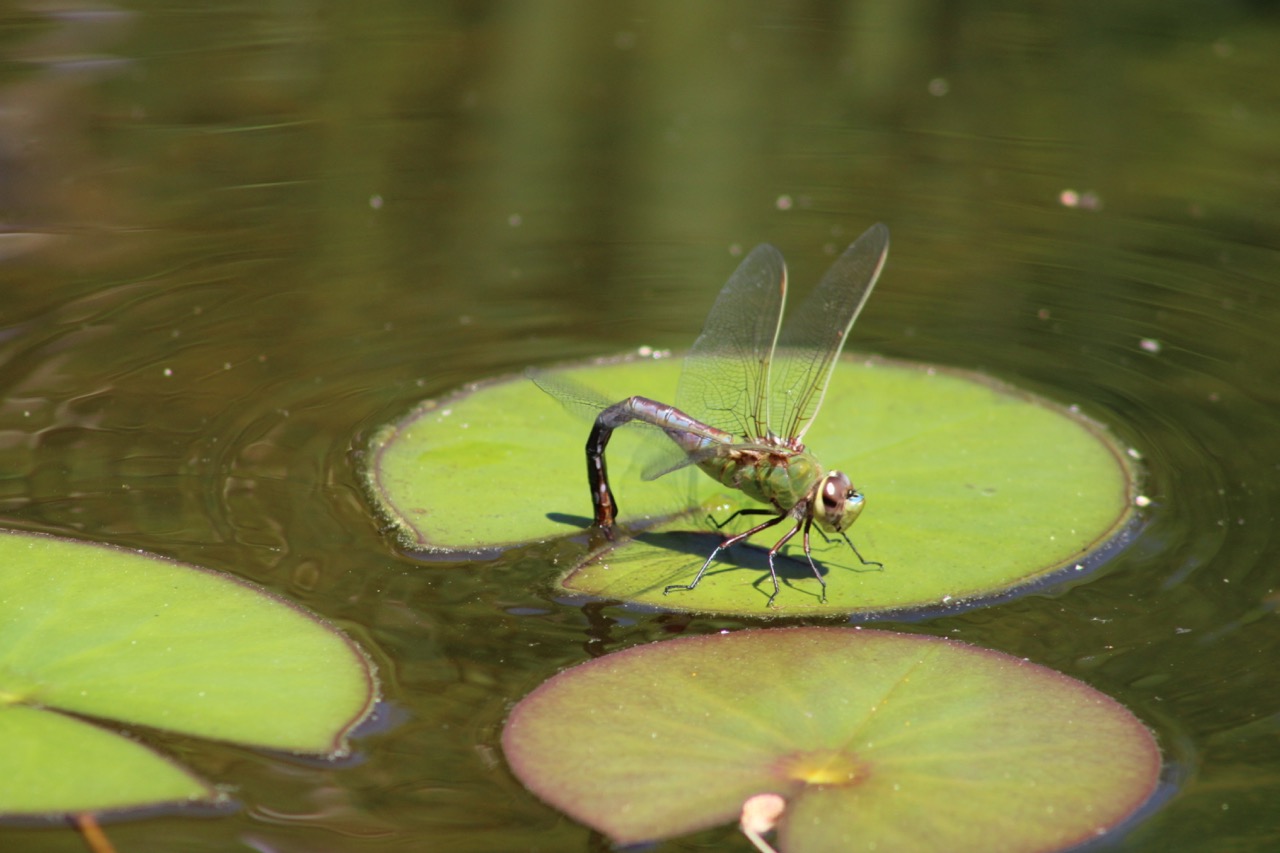
We have seen two frogs in the pond, one bold and the other cautious. Yesterday a neighborhood cat was stalking the pond. Today, I only saw the cautious one. Is the bold one gone? The cherries that appeared green in the trees are getting brown spots on them. The cardinal couple seems now to frequent the feeder every day. The robin that abandoned her nest, is back in the nest trying again with new eggs. Today I saw her partner bring her a bite to eat. A dragonfly was dipping her tail in the water, while perched on a lily pad–laying her eggs in the pond. Something took a few leaves off two of my kale plants, but did not destroy the whole plants. Can I begin to see all of it as wholeness, as beauty?

Dragonfly on a lily pad in the pond, dipping her tail in the water.

Magic in the midst of illness

Woke up to a misty morning on this new moon day, and started reading my journal from the last new moon until today. It is a ceremony I honor each new moon, and it is a way for my life to teach me.

I was struck by some passages from the time of Halloween/Samhain, that special time of connections to the ancestors. Because of chronic illness and its deep fatigue, I haven’t felt very spiritually focused lately, not much energy for deep ritual. Plus in COVID times, we don’t have our seasonal gatherings either. But it seems like the ancestors and spirits are reaching out to me nonetheless.

I did manage to cook salmon and potatoes for dinner on Samhain to honor some of Margy’s and my various ancestors. I listened to Quebecois music while doing dishes, and drank East Frisian tea. During the night of the full moon/blue moon I suddenly woke at 4 a.m. and saw the moon shining brightly outside my window. The next day, I saw a cardinal–my healing messenger bird–at the bird-feeder–the only time I’ve seen one there all this season. I was watching TV a couple days later and stumbled upon the movie Coco, which (despite its flaws) got me into the mood of Dia de los Muertos.

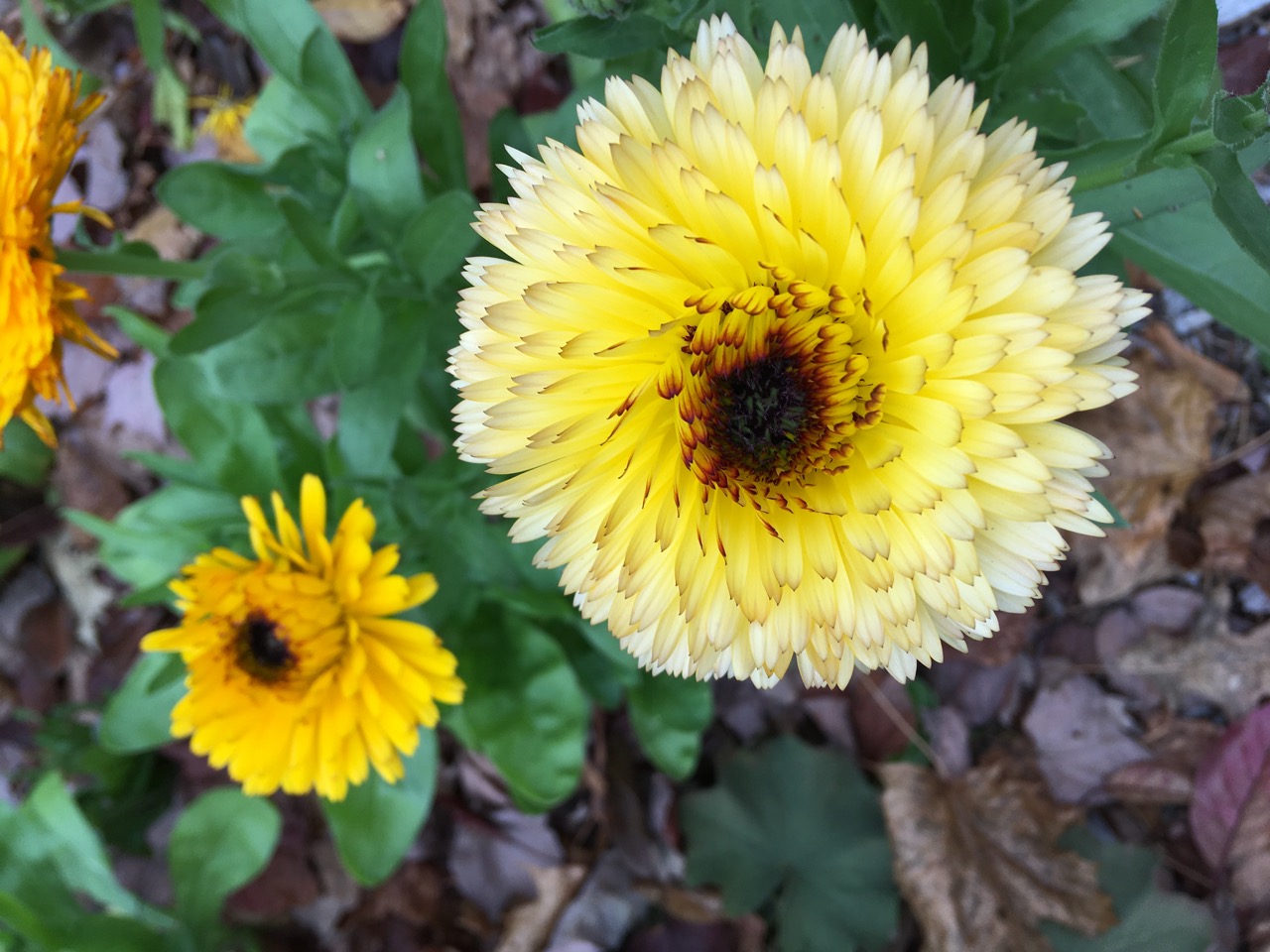
Marigolds growing self-seeded in our garden strip near the road.

I was looking for things to watch on our Roku and stumbled upon a series on Canadian Rivers. The best episode was on the Moisie River, or Mishtashipu in the Innu language. I had first learned about this river from Innu people who were fighting to protect it from a hydrodam planned by Hydroquebec. They won that fight, partly because there were also rich white people trying to protect their own salmon fishing. It was beautiful to see the river, and to listen to the Innu people who call it home. (And by the way, the word-segment “ship” in Mishtashipu is a cognate to “sip” in Passamaquoddy, which means river. I feel happy to know that.)

All these little threads meandering unexpected through my days, pulled from me this prayer: “Ancestors, are you reaching out to me from the other side of the veil? Even though I have so little spiritual concentration or focus right now? I open my heart to your presence.” I remembered magical moments of other times when I felt the presence of spirit close by. When my Innu ancient-grandmother, Nukum, first appeared, holding a bowl full of the universe. When I was able, despite all odds, to find the grave of my great-grandmother Claudia in Ottawa. When I was sitting right next to my dad as he took his final breath on this earth.

At the tiny headstone of my great-grandmother Claudia.

During those Samhain days, I was also working on a testimony about my family’s role in colonization. I was feeling the weight of the ancestors–the migrations, the wars, so much. I was feeling overwhelmed by that weight, I was feeling that I could not carry that weight, or imagine ways to find healing for this aspect of my heritage. I feel weary even from the weight of my many living relatives who seem trapped in a cult of lies, there is much estrangement between us. And so once again I reach back to spirit kin.

Finally, I hear: “You don’t have to carry the weight. Let go. Remember trust. I am here even when you cannot hear me, in this dark night of the mind and body. You are already in my hands. It was never a question of guilt or innocence. It was always about love. It is okay to trust my love. Breathe in love.”

And so, today, day of the new moon–this new moon which is also considered part of the time of closeness to the ancestors and spirits–I let myself hear those words again. There is room for magic to intervene, even in the midst of illness and fatigue, even when I cannot dance or sing or build a fire. And I am filled with gratitude.

Mushrooms Again

Wine Cap Mushrooms in our garden

What elements are necessary for me to experience joy? What if the forests are burning in the west? Can I feel joy here in the east where the forests are not burning? What if fascism has stolen the possibility of democracy? Can I smile and sing a song about humbling ourselves before the trees? What if migrant children are still locked in cages without their families? Can I steal a moment of joy in the morning when the mist covers the sun? When I know my beloved is asleep in our home?

Today there are mushrooms again in the food forest, wine cap mushrooms that we inoculated into our wood chips over a year ago in the spring. We started something, but we don’t have any control over what they now do. I don’t know what elements are necessary for the mycelium to decide, after these months of invisibility underground, now is the time for mushrooms. The mist in the morning? Only they seem to know, and only they decide.

Last night I fell asleep asking the question, “What elements are necessary for me to experience joy?” Or perhaps I was asking its heavy twin question, “How can I dare to feel joy while the earth is suffering, so many people are suffering, the nation is suffering?” How can I be permitted any moments of joy given the reality of our world right now?

I remember when I was part of the Women’s Peace Camp, a peaceful protest next to a nuclear weapons military base–we had many moments of joy–despite the serious nature of our witness: evenings full of music, exciting sexual liaisons, long talks planting seeds of friendship that have grown and endured through time, delicious meals. I remember our wild dance parties and Emma Goldman’s words we often paraphrased: “If I can’t dance, I don’t want to be part of the revolution.”

Someone commented on Facebook the other day that we need to prepare for a disaster–they were worried about the possibility of civil war after the November elections. But when this idea rolls around in my head at 3 in the morning, I am not even sure what disaster to imagine preparing for: no electricity? food systems cut off? hurricanes? loss of social security income? no water? no internet? people in the streets with guns? evacuation? There are so many possible disasters that cannot be “prepared” for.

With age and illness, Margy and I are more isolated now, though certainly not all alone. But I miss being at some sort of front line in community. I can say to myself–we are trying to live a dream of a life more in harmony with the Mother Earth–the downsizing, the solar panels, the food forest. And I don’t forget the importance of choosing to love a woman in the face of patriarchy. Imagining decolonization in the face of white supremacy. But I feel helpless in the face of the destruction of so many people and landscapes across the nation.

It is almost as if all I have to offer now is my profound grief.

So, is it still possible to find joy in this grief time? Is it hiding underground like mycelial networks? Can it spring forth like mushrooms when something decides there is room for it now? Is it me who decides? Can I fully honor the grief that our times require, and yet still find those moments of song, smile, lightness, beauty, gratitude?

Loving the Body

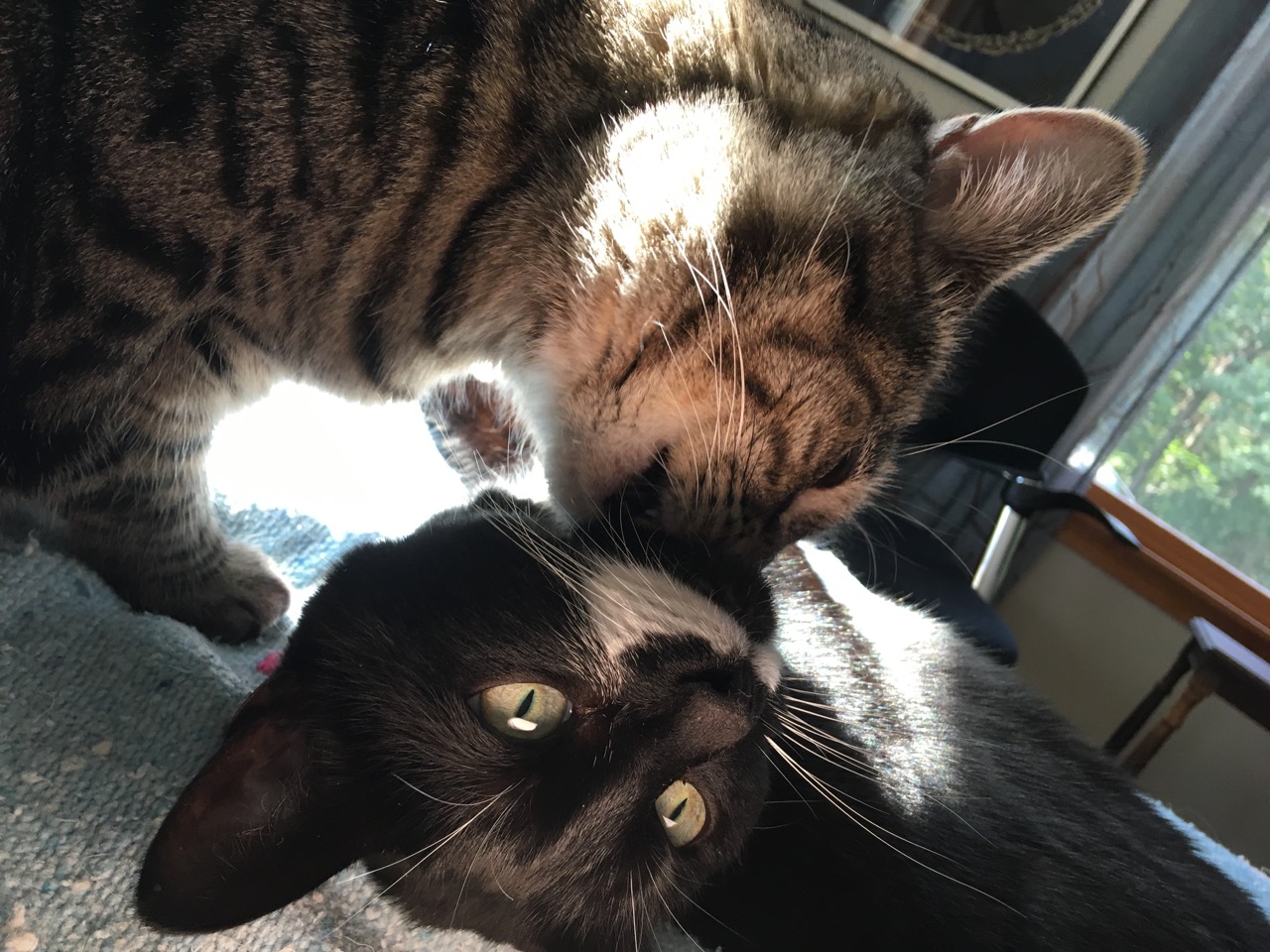
Sassy and Billy bath

Today is a day when I chose to stop my plans and just love my body and follow what it needed.  My teachers were our cats Billie and Sassy who were having a cuddle and a nap in the sun on the bed, washing each other’s faces.  I lay down next to them, and took a few photos with my phone.  Sometimes, even in this desperately wounded world, we must honor the demands of our bodies, first of all.  This I what I am learning about illness or whatever it is that has taken hold of my body.  My own tendency is to want to figure it out and fix it. But some things can’t be easily figured or fixed.  And so we are faced with other choices.

When my partner Margy and first I got to know each other, she had been dealing with chronic illness for a long time already.  She has been my teacher in what that means, and how to cope, how to live in the midst of it all.  But in that process, I took on the role of the “well” one, the one who would carry things when she could not. But now, I also have some sort of chronic illness, and it’s a new chapter for us, a new chapter for me.  I haven’t really ever identified myself as having a chronic illness, because that was her identity.  I know that sounds a bit illogical, but it never seemed that I had it bad enough to call myself ill.

But then there are these days, more now than before, when I just can’t follow my plans, can’t work in the garden, can’t go to the beach.  When I ache all over, or feel weary and slow.  As I said, mostly my impulse has been to try to figure it out–what did I eat? what did I do?–that might have triggered all this. What can I do to make it better? But today, I thought, just follow the lead of the body, just love the body and do what it wants to do.  Rest, lay in the sun, watch mysteries on the television. No shoulds.

I am remembering Paula Gunn Allen writing about this, and I found the quote, an excerpt from “The Woman I Love Is a Planet; The Planet I Love Is a Tree,” from her book, Off the Reservation.  I love how she links our love of the body to our love of the planet–even when we can’t even go outside.

Our physicality—which always and everywhere includes our spirituality, mentality, emotionality, social institutions, and processes—is a microform of all physicality. Each of us reflects, in our attitudes toward our body and the bodies of other planetary creatures and plants, our inner attitude toward the planet. And, as we believe, so we are. A society that believes that the body is somehow diseased, painful, sinful, or wrong, a people that spends its time trying to deny the body’s needs, aims, goals, and processes—whether these be called health or disease—is going to misunderstand the nature of its existence and of the planet’s and is going to create social institutions out of those body-denying attitudes that wreak destruction not only on human, plant, and other creaturely bodies but on the body of the Earth herself….

Being good, holy, and/or politically responsible means being able to accept whatever life brings—and that includes just about everything you usually think of as unacceptable, like disease, death, and violence. Walking in balance, in harmony, and in a sacred manner requires staying in your body, accepting its discomforts, decayings, witherings, and blossomings and respecting them. Your body is also a planet, replete with creatures that live in and on it. Walking in balance requires knowing that living and dying are two beings, gifts of our mother, the Earth, and honoring her ways does not mean cheating her of your flesh, your pain, your joy, your sensuality, your desires, your frustrations, your unmet and met needs, your emotions, your life.

Sassy and Billy nap

Healing Waters

Healing Mineral Waters Jemez Hot Spring

I am on retreat with my friend in Albuquerque, and we started off by visiting the Jemez Hot Springs, and soaked for an hour in their healing mineral waters.  All of our tensions floated away, and our bodies and souls felt renewed and relaxed. I loved that we were under the watchful arms of an ancient Egyptian river Goddess.

My intention for this time of retreat is to re-emerge myself in Spirit after a long hard winter, to prepare myself for the transition ahead as I retire this summer from my work as a parish minister, and venture into the next phase of my journey.

Times of big changes are liminal times, sacred times, but perhaps also times of anxiety and danger.  I want to stay true to the leadings of my body and spirit that have brought me to this crossroads.  One of those leadings came from the weariness of my body, its chronic illness and auto-immune flare-ups that left me bedraggled and exhausted. I know it is time to stop pushing it so hard.  How fitting for my first day here to bring my body to these healing springs.

I am also already absorbing so much nurture from deep conversations with a sister in spirit who understands the call of ministry and justice, and who understands the lessons of the body, the lessons we learn from limitation and illness.  I am nurtured by this sister traveler into the country of elderhood.  River Goddess