First Harvest & Human Rights

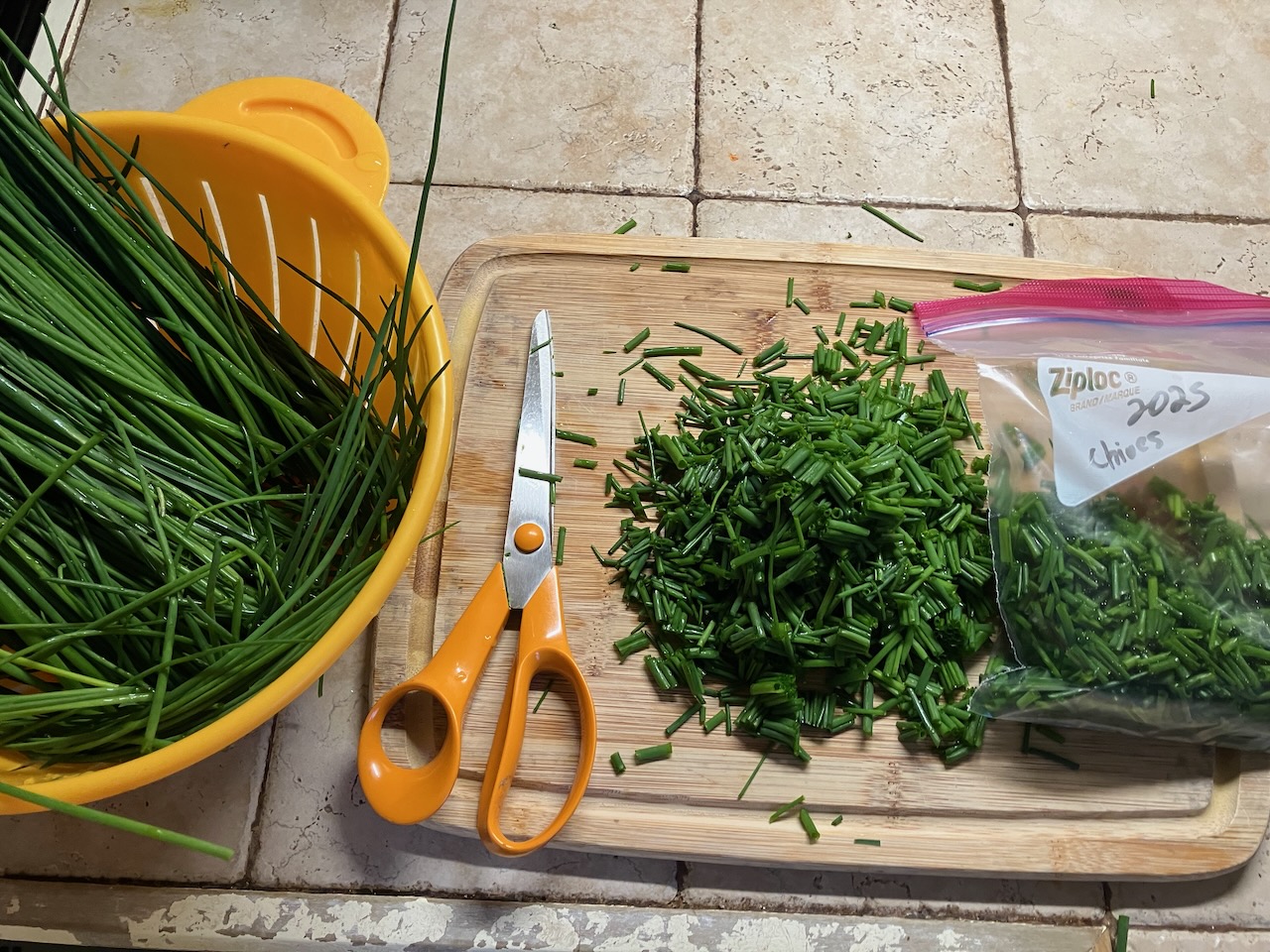
chives, in orange colander, scissors on cutting board, cut up chives and plastic labeled bag for cut chives

Today I harvested chives! The first harvest of the 2025 season. I cut them up in small pieces with a scissors and then freezed to use anytime. Today I also want to speak up for human rights! Continuing from the first seven articles of the Universal Declaration of Human Rights in my last post, I want to write out the next articles here. Over 75 years in existence, I weep that so many of these rights are not upheld in our world today.

Article 8: Everyone has the right to an effective remedy by the competent national tribunals for acts violating the fundamental rights granted him by the constitution or by law. [Note: I am using the original language, the pronouns of which, at that time, while “masculine”, were understood to refer to every person.]

Article 9: No one shall be subjected to arbitrary arrest, detention, or exile.

Article 10: Everyone is entitled in full equality to a fair and public hearing by an independent and impartial tribunal, in the determination of his rights and obligations and of any criminal charge against him.

Article 11: (1) Everyone charged with a penal offense has the right to be presumed innocent until proven guilty according to the law in a public trial at which he has had all the guarantees necessary for his defense. (2) No one shall be held guilty of any penal offense on account of any act or omission which did not constitute a penal offense, under national or international law, at the time when it was committed. Nor shall a heavier penalty be imposed than the one that was applicable at the time the penal offense was committed.

I can’t help but think of the 238 Venezuelan men detained and transported to the prison in El Salvador, with no trials, no hearings, and definitely not presumed innocent until proven guilty. I don’t usually do lengthy blog posts, but today I want to say their names. They are human beings with human rights.

The names of Venezuelans deported to El Salvador per CBS News. [Plus there is Kilmar Abrego Garcia, a Salvadoran living in the U.S. for 14 years, who was sent “by error.”]

Agelviz Sanguino, Widmer Josneyder

Aguilar Rodriguez, Nolberto Rafael

Aguilera Aguero, Gustavo Adolfo

Albornoz-Quintero, Henrry

Alvarado Borges, Neri

Angulo-Aparicio, Jinder

Aray-Cardona, Jose

Arregoces Rincon, Jose

Azuaje Perez, Nixon Jose

Barreto Villegas, Rolando

Bastidas Venegas, Jose

Basulto-Salinas, Marcos

Batista-Arias, Elvis

Belloso Fuenmayor, Alirio

Benavides Rivas, Yornel Santiago

Blanco-Bonilla, Andry

Blanco-Marin, Angel

Bolivar Cruz, Angel

Bracho Gomez, Victor

Brazon-Lezama, Javiar

Briceno-Gonzalez, Jose

Briceno-Gonzalez, Jean

Bustamante-Dominguez, Robert

Cabrera-Rico, David

Canizalez Arteaga, Carlos

Caraballo Tiapa, Franco

Cardenas-Silva, Johan

Carmona Bastista, Yorbi

Carmona Hernandez, Jose

Cedeno Contreras, Bruce Embelgert

Cedeno-Gil, Andrys

Chacin Gomez, Jhon

Chirinos Romero, Wild

Chivico Medina, Carlos

Colina Arguelles, Rosme

Colina Caseres, Miguel

Colina-Suarez, Alejandro

Colmenares Solorzano, Leonardo Jose

Colmenarez Abreu, Aldo

Contreras-Gonzalez, Yordano

Cornejo Pulgar, Frizgeralth De Jesus

Corrales-Moreno, Emilio

Davila Fernanadez, Luis

Delgado Pina, Aldrin

Depablos Requena, Jheison

Diaz-Lugo, Kleiver

Duarte Rodriguez, Richard

Duran Perez, Joseph Gregory

Echavez-Paz, Leonel

Elista-Jimenez, Robert

Escalona Carrizo, Yender

Escalona Sevilla, Angelo

Escobar Blanco, Pedro

Escobar Falcon, Yolfran

Fernandez Sanchez, Julio Rafael

Fernandez, Yohan

Fernandez-Subero, Mikael

Flores Jimenez, Wilken Rafael

Flores Rodriguez, Jose

Flores-Lopez, Jose

Fonseca Daboin, Cristhofer

Fuenmayor-Crespo, Roneil

Garcia Casique, Francisco

Garcia Prado, Leonardo

Giron Maurera, Richard

Gonzalez Troconis, Julio

Gonzalez Frailan, Jose Leon

Gonzalez Fuenmayor, Angel Jesus

Gonzalez Pineda, Oscar

Gonzalez-Rodriguez, Charlie

Graterol-Farias, Winder

Gualdron Gualdron, Luis

Gualtero Quiroz, Deibin

Guerrero Padron, Keivy

Guevara Munoz, Wilvenson

Guiterrez-Sierra, Wilker

Gutierrez Flores, Merwil

Hernandez Carache, Yeison

Hernandez Carache, Darwin Gerardo

Hernandez Herrera, Edwuar Jose

Hernandez-Hernandez, Jhonnael

Hernandez Gonzalez, Manuel

Hernandez Hernandez, Angel

Hernandez Juarez, Yorby

Hernandez Romero, Andry

Hueck Escobar, Jesus

Hung Mendoza, Jordan

Hurtado Quevedo, Eddie Adolfo

Indriago-Alvarez, Donovan

Izaguirre-Granado, Randy

Jaimes-Rincon, Yeison

Jerez-Hernandez, Yohendry

Justo Garcia, Jose

Laya-Freites, Jefferson

Leal-Bautista, Keiber

Leal-Estrada, Kervin

Lemus Cagua, Diego

Lizcano-Basto, Josue

Lopez Bolivar, Jose

Lopez Lizano, Maikol

Lopez-Rodriguez, Geomar

Lozada Sanchez, Wuilliam

Lozano-Camargo, Daniel

Lugo Zavala, Johendry

Lugo-Acosta, Yermain

Machado Martinez, Onaiker

Machado-Rodriguez, Jose

Manrique, Edson

Manzo Lovera, Lainerke

Marcano Silva, Luis

Marea-Medina, Ronald

Marin Zambrano, Jhonervi Josue

Marquez Pena, Jose

Marrufo Hernandez, Uriel David

Martinez Vargas, Kerbin

Martinez Vegas, Rafael

Martinez-Borrego, Tito

Martinez-Gonzalez, Yohangel

Mata Fornerino, Wilfredo Jose

Mata-Ribeiro, Yoswaldo

Mathie Zavala, Hotsman Ricardo

Medina-Martinez, Alexis

Melendez Rojas, Edwin

Mendez Boyer, Alex

Mendez Mejias, Angel

Mendez-Gomez, Luis

Mendoz Nunez, Carlos

Mendoza Ortiz, Maikol Solier

Mendoza Pina, Jean Claude

Mendoza Ramirez, Jonathan

Mogollon Herrera, Henry

Molina-Acevedo, Roger

Montero Espinoza, Ervinson

Montilla-Rivas, Jose

Mora-Balzan, Jose

Morales-Rolon, Andres

Moreno-Camacho, Cristopher

Moreno-Ramirez, Maikel

Morillo-Pina, Luis

Moron Cabrera, Yuber

Munoz Pinto, Luis

Navas Vizcaya, Ali

Navas-Diaz, Obed

Nieto Contreras, Kevin

Nunez-Falcon, Luis

Olivera Rojas, Maikel

Orta-Campos, Junior

Ortega Garcia, Felix

Otero Valestrines, Luis

Palacios-Rebolledo, Leoner

Palencia-Benavides, Brayan

Parra Urbina, Eduard

Paz-Gonzalez, Daniel

Pena Mendez, Jose Antonio

Penaloza Chirinos, Ysqueibel Yonaiquer

Perez Perez, Cristian

Perez-Llovera, Juan

Perfecto La Rosa, Moises

Perozo-Colina, Carlos

Perozo-Palencia, Andy

Petit Findlay, Andersson Steven

Petterson Torres, Christean

Pineda Lezama, Jesus

Pinto Velasquez, Cristhian

Plaza-Carmona, Jonathan

Primoschitz Gonzalez, Albert

Querales Martinez, Anderson Jose

Quintero Chacon, Edicson

Ramirez Ramirez, Jonathan Miguel

Ramos Bastidas, Jose

Ramos Ramos, Juan Jose

Reyes Barrios, Jerce Egbunik

Reyes Mota, Frengel

Reyes Ollarvides, Ronald

Reyes-Villegas, Arlinzon

Rincon Bohorquez, Omar

Rincon-Rincon, Ringo

Rios Andrade, Jesus

Rivera Gonzalez, Luis

Rivero-Coroy, Jean

Rodriguez, Edwin

Rodriguez Goyo, Alejandro

Rodriguez Lugo, Luis Gustavo

Rodriguez Parra, Alber

Rodriguez Rojas, Kenlyn

Rodriguez-Da Silva, Fernando

Rojas, Deibys

Rojas-Mendoza, Miguel

Romero Chirinos, Ildemar Jesus

Romero Rivas, Erick

Roos Ortega, Jesus

Rosal-Gelvez, Hector

Rubio-Petrola, Jose

Saavedra-Caruci, Robinson

Salazar-Cuervo, Pedro Luis

Sanchez Bigott, Yorbis

Sanchez Paredes, Idenis

Sanchez-Arteaga, Fernando

Sanchez-Bermudez, Marco

Santiago Ascanio, Ronald

Sarabia Gonzalez, Anyelo

Semeco Revilla, Darwin Xavier

Sierra Cano, Anyelo

Silva Casares, Jason Alfredo

Silva Freites, Carlos Julio

Silva-Ramirez, Aaron

Soto Manzana, Omar

Suarez-Fuentes, Joen

Suarez-Nunez, Luis

Suarez-Salas, Nery

Suarez-Trejo, Arturo

Tapia Colina, Jesus

Teran Aguilar, Carlos

Testa Leon, Orlando Jesus

Toro Noguera, Yonel

Torrealba Torrealba, Yonathan

Torres Archila, Amber

Torres Herrera, Euder Jose

Torres-Polanco, Carlos

Tortosa Guedez, Jorge

Tovar-Marcano, Cesar

Travieso Gonzalez, Kleiver

Troconis Gonzalez, Yhon Deivis

Uzcategui Vielma, Carlos

Vaamondes Barrios, Miguel

Vargas Lugo, Henry

Vazquez Morillo, Nicola

Vega Sandia, Wilmer

Vera Villamizar, Wladimir

Villa-Montano, Enson

Villafranca Rincones, Carlos Eduardo

Villegas-Frites, Ilels

Yamarte-Fernandez, Mervin

Yanez-Arangure, Luis

Zabaleta-Morillo, Keiber

Zambrano Perez, Julio

Zambrano Torrealba, Gabriel

Zarraga Rosales, Jorge

A Child in Gaza

I haven’t been able to write for a while. My heart is shattered by the continued assault on the people of Gaza by the government of Israel, supported by my own US government. If you follow this page, you know that I have chronic illnesses that keep me unable to go out to demonstrations or vigils or do much of anything. All I have been able to do is to bear witness, to keep looking for news, to keep posting on Facebook photos and stories of the devastation. Every day more devastation. Every day, bearing witness and sharing.

I want to tell you about Lama Jamous, a nine year old child in Gaza who is documenting and interviewing and posting on Instagram–she has become the youngest journalist in Gaza.

You can follow her here on Instagram. (I first found her on Facebook, but now I am not sure if that was a real account or a copycat account. Still, it led me to know about her.) In another post she writes:

My name is Lama Jamous and I was born on November 24, 2014. I have a sister Aya and two brothers Mohmmed and Kareem. I’m the youngest of the family. I am a great student in school and I have lots of friends. I enjoy working as a group with my classmates, participating in activities. My favorite subject is Arabic. Every weekend I would go visit my grandma in Khan Younes. Then we were going to see our farm by the beach. We were going on picnics too. Our apartment on the roofs in Gaza was magnificent.
Then came October 7, 2023 and our lives changed 180 degrees. No more school, no more education, no more picnic… Very difficult to live as situation. We went to Rafah to live in a tent. From now on, we have nothing of the basic of living well like no privacy for the toilet. My whole family live right beside us.
My aunt Sana was killed along with 14 yr old Malk, 11 yr old Brea, 16 yr old Malek and 10 yr old Salam. They were civilians, my friends, my family… I have suffered tremendously from this situation and being evacuated from one place to another. So I decided to be a journalist to show the world what’s happening.
We love our country very much and would like to stay but the reality is that we are facing genocide against civilians… Many witnesses told horrible things that happened or are happening. Media is not covering this.
It’s very expensive to evacuate a family… every person needs $5,000 to $7,000 but it depends. We hope to be safe soon and we will come back when the war is over. I want the war to stop so we can get back to normal life. So many of my friends and classmates are missing and we don’t know what happened to them… Everything has gotten worse than before. This war needs to be stopped.
Lama Jamous

https://www.instagram.com/reel/C3CTcxeM-bs/?utm_source=ig_web_copy_link&igsh=MzRlODBiNWFlZA==

Lama Jamous is a child, my friends. She is now in Rafah, which was to be the safe evacuation zone, but is under attack.

I first heard about Lama through the work of Motaz Azaiza, a photo journalist who has been documenting the atrocities. He was recently evacuated from Gaza, and was interviewed in the Guardian. He expresses it so eloquently:

“To be clear, this is not a war against Hamas,” says Azaiza. “This is and has always been a war against the Palestinian people. Israel’s plan is to bury us or push us out – as we have just seen with the Rafah bombing. There is literally nowhere else for us to go.”

Azaiza urges the world not to look away. “As humans, we all have a responsibility to bear witness to what is happening in Gaza,” he says. “I tried my best to show the world our reality, now the world needs to show where it stands. It is ordinary people, men and women, who have the power to save what remains of Palestine. Our plea is simple – we just want to live.”

https://www.theguardian.com/global-development/2024/feb/16/motaz-azaiza-interview-gaza-ghosts-photojournalist

Please bear witness with me. Please do whatever you can to stop this genocide.

Already Broken

Broken measuring cup

Years ago I heard a Buddhist phrase–“The cup is already broken.” Its intent is for us to meditate on the transient nature of all of our reality. If we think of the cup as “already broken,” we can appreciate the cup now, and not be attached to keeping it in the future. At least, that is my brief paraphrase of what it means to me. Last night I knocked into a glass measuring cup and it fell to the floor, shattering into many pieces. Margy says she thinks that this measuring cup had originally belonged to her mother. But it was not really a sentimental piece, rather a long-lasting useful tool in our kitchen. Very long-lasting. Very useful. I locked the cats in the bedroom so they wouldn’t step on glass, and swept and vacuumed all the pieces from the floor into a paper bag to put into the trash. So it goes.

However, there is another version of “already broken” in modern American life–planned obsolescence. Manufacturers purposefully making products that are designed not to last, so that “consumers” will keep buying more products to replace them. This kind of “already broken” is so frustrating as we try to live in sustainable mutual relationship with the earth. We have these metal yard chairs whose weave has torn so that they are no longer useful, and not repairable. They were not long-lasting–maybe only a few years old. We’re likely going to call The Dump Guy, to come and pick up four of them plus a broken patio umbrella. It just makes me feel angry.

Broken yard chairs

Meanwhile, it seems to be an autumn full of broken mechanical things–but happily so far, most able to be repaired. The garage door was broken and then fixed a month later. A groundhog dug a tunnel under the garage that we needed to get filled, and a contractor worked on it. The clothes dryer stopped working and was able to be repaired. Now the heat pumps won’t work, and someone is coming on Tuesday. (We have a back-up oil boiler, so we are not cold.) I have felt burdened by all of this household decrepitude, yet also grateful–because we have been able to get repairs done, able to afford them, able to find repair people to tackle the jobs that are too big for us.

But I am also reminded of the larger brokenness all around us in our world. I always resonated with the Jewish concept of Tikkun Olam, “repairing the world.” I am not Jewish, but have learned so much from that tradition (and people from that tradition) about working for justice. So much of my life, I was involved in activism to end oppression and injustice. I dreamt of a world of freedom and equality and compassion. Now as I face the latest chapter of my life, with chronic illness, I don’t have the energy or ability to be so active. I feel discouraged about the backlash that has undone many of the hard won victories for the world that we dreamed about.

So I ask myself, what do we do when we cannot repair the world? What do we do when oppression and injustice and violence seem relentless. What do we do when the very earth we rely on is on a course for a mass extinction. What do we do when the world is “already broken?” I have been struggling over this writing for weeks now. I don’t have any answers, but it feels like a critical question for this time of my life. If I have attached my meaning, purpose, and value to improving the world, to repairing its brokenness, then who am I if that is not possible? Who am I if the world is already broken?

I still don’t really have an answer. I still am pondering the question, as I feel such sorrow and grief for those who are suffering right now in ways I cannot alleviate. I remember that many people have lived in times of great horror, have lived in situations which they did not have power to improve or repair. We are tangled in a web of broken relationship. We cannot escape. Yet in every situation, people have made choices to affirm their humanity and interconnection. What choices might I make during this next chapter?

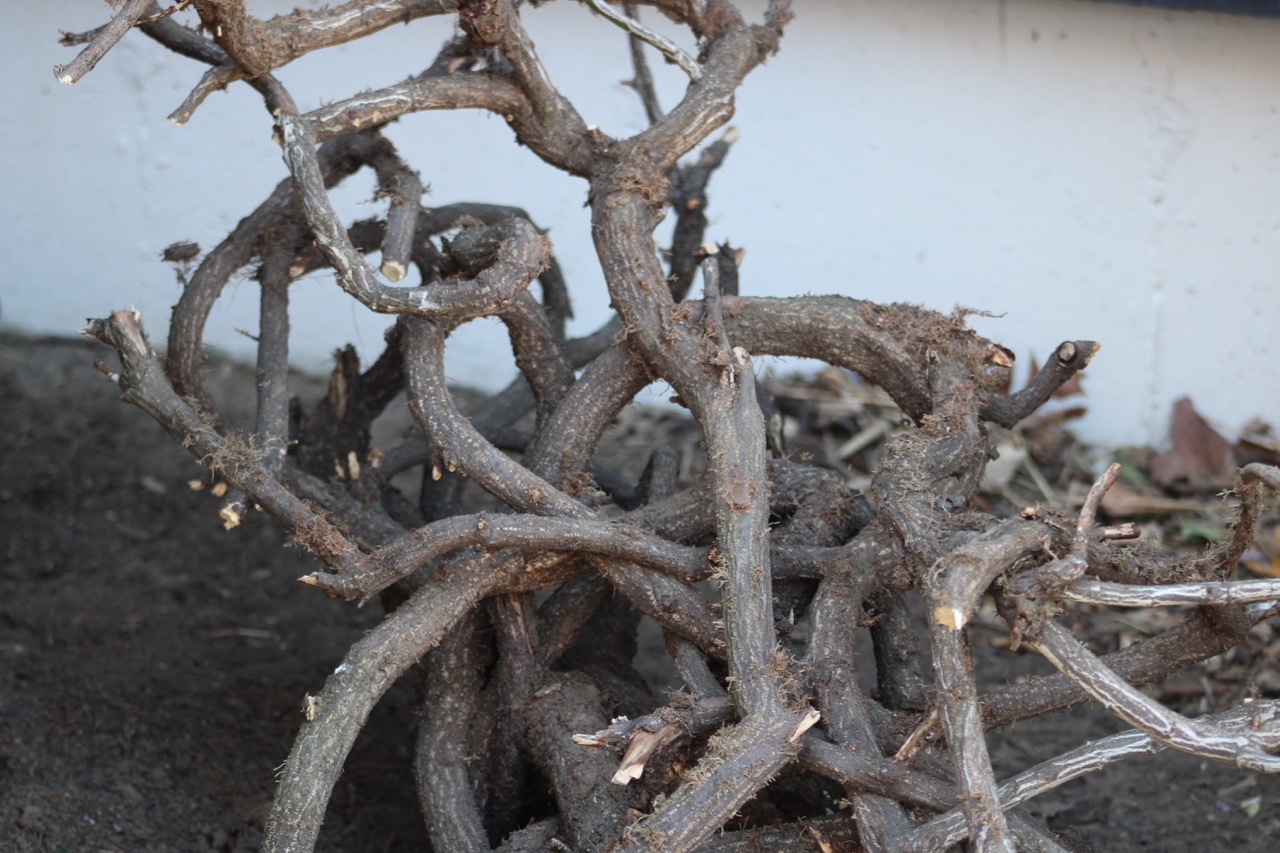
Tangled branches of cut “climbing spindle tree” (invasive in Maine)

Our Love Is Holy

Mar 11 2004 Margy and Myke at a rally at the state house in Massachusetts, for the constitutional convention trying to take away equal marriage, holding a poster that says Our Love Is Holy
March 11 2004 Margy and Myke at a rally at the state house in Massachusetts, in support of equal marriage

This week in my basement archives I revisited my life in Massachusetts in 2003 and 2004, during the time when its Supreme Judicial Court declared that to deny civil marriage to same sex couples was unconstitutional. In the six months following their declaration, state legislators were arguing over trying to stop it from happening, or support it to happen, and we were at the state house too, lobbying, and rallying. I had forgotten many of the details of those months, but I had not forgotten the strange mix of joy and fear as we anticipated this unimaginable possibility. It is hard to believe that was only 19 years ago. Now marriage is accessible to same sex couples across the land, but it is still under threat. I found my remarks from a forum we held on Cape Cod that spring, and they still seem relevant today.

This was Civil Rights, Civil Marriage: A Forum on Equal Marriage Rights for Lesbian and Gay Couples, Cape Cod Community College, May 3rd, 2004, where I was part of a panel presentation. At that time I was a minister at First Parish Brewster, Unitarian Universalist. Linda Davies and Gloria Bailey were members of our church, and one of the plaintiff couples in the lawsuit. They also had just spoken at the event.

“I want to start by saying how much I am looking forward to signing the marriage license of Linda and Gloria on May 17th. When I sign that license, I won’t be acting merely on my own behalf, but representing the whole community of First Parish Brewster. I believe I speak for all of us when I say how grateful we are to Linda and Gloria for taking a risk with their lives to end discrimination against gay and lesbian couples, and what a joy it has been to join them at the front lines of this historic civil rights effort. I know that your courage and your transparent love for each other have touched people’s hearts and opened their minds.

“Our struggle is far from over. Many of our opponents use the teachings of Christianity to claim that gay and lesbian couples should be excluded from marriage. I think Jesus would be horrified to see how his message has been twisted.

“Someone once said that even the devil can quote the Bible. Every religious community that draws inspiration from the Bible has the challenge of interpreting a collection of documents that were written and gathered over 1800 years ago in languages and cultures not our own. Some people will tell you that they take the Bible literally word for word. I will tell you, following Karl Barth, that I take the Bible far too seriously to take it literally. As even my Catholic professors used to say, the Bible is ‘the word of God written in the words of men.’ It is full of contradictions and its heroes are entangled mixtures of good and evil. The Bible tells the stories of a community’s experience of the Holy in their midst. If we are to be true to its message, we must also pay attention to the working of the Holy within our midst.

“You know, Jesus actually said very little about marriage, and nothing about homosexuality. He wasn’t so concerned with family arrangements. He was concerned about love. He was concerned about how we care for each other, and especially, about how we care for those who are—what he called—’the least’ among us. He called on his followers to welcome the stranger, to take in the outcast; to bear witness to the kingdom of God within each person. He said, when we live in love, God is in our midst.

“I am a minister and I am a lesbian. So this moment in history is meaningful to me in two ways. I want to say that I respect how difficult this issue is for those who are religious. It was difficult for me when I was a young Catholic woman. It was easy to imagine that everyone could just follow the rules if they tried. It wasn’t until I became friends with a gay man in college that this ‘issue’ took on a human face—the face of a brother who was in deep pain because of the contradictions between the teachings of his religious tradition, and the inner truth of his own body and soul.

“When we risk honoring the truth in our own soul, we are entering dangerous ground. What if we are deluding ourselves? Some would say we are. But on the other hand, what if the truth in our souls is the voice of the Holy in our midst?

“The God of the prophets was always leading them beyond the comfort of the familiar in the direction of greater love. I believe that we are living in a prophetic moment. Something holy and miraculous is going on here. It has always been the Holy who has lifted up the downtrodden. It has always been the Holy who has filled the hearts of people with compassion. It has been the Holy who made strong the faint of heart, and transformed the lowly.

“Equal marriage is a civil rights issue, a legal issue, an issue of respect for diversity. But for my part, I want to take off my shoes, for I believe we are standing on holy ground.”

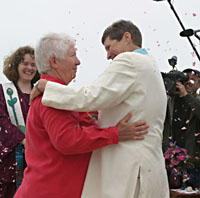
Gloria Bailey, left, and Linda Davies of Orleans rejoice moments after being pronounced married by First Parish Brewster Unitarian Universalist minister Rev. Dr. Mykel Johnson, left, on Nauset Beach during a 1:00 ceremony on Nauset Beach Monday. The couple, who have been together three decades, were married in front of a group of about 40-50 friends and press. Monday is the first day of legalized same-sex marriage in Massachusetts and the US. A dinner party is planned at a friends house to celebrate the event. (Dewitt photo 5/17/04)

The Mystery Seed

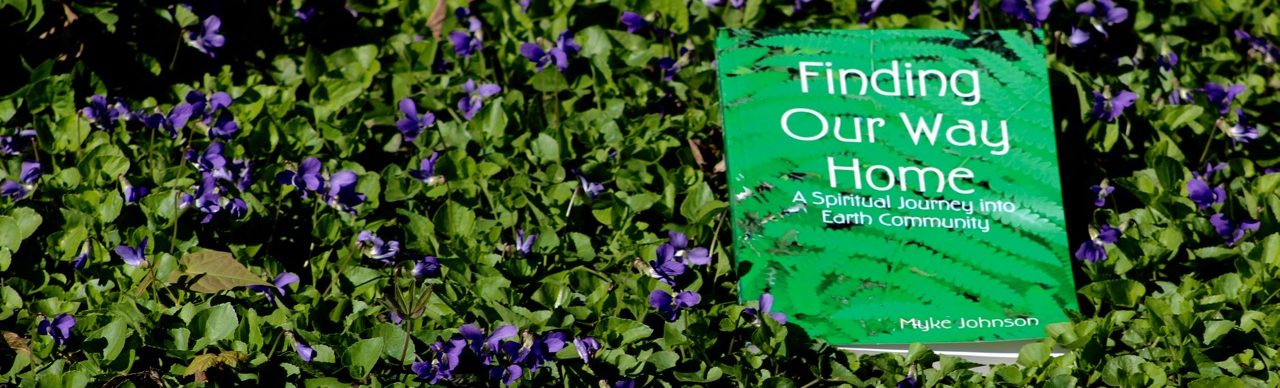
On March 14th, at 1 p.m. Queer Spirit will broadcast an interview with me, done by Revs. Marvin Ellison and Tamara Torres McGovern. Queer Spirit is a regular feature of OUT Cast, a forum for LGBTQ+ issues broadcast on community radio every Monday. WMPG 90.9 FM from 1:00 – 1:30 p.m. (Livestream: WMPG.org) One of the questions they asked: “What do you think has been your generation’s unique struggle with sexuality and spiritualty – and what would you say is your generation’s contribution to these matters?” I thought about what I had written in my book, Finding Our Way Home, in a chapter called “The Mystery Seed.” I want to share an excerpt with you today.

Bean seeds

Do you remember the fairy tale of Jack and the Beanstalk? When he and his mother are in desperate straits, Jack trades their cow for some magical bean seeds. The bean seeds grow overnight into a vine that reaches up to the sky. He climbs the vine and encounters an evil giant, who eats human beings, but Jack is able to escape with a magical hen that lays golden eggs, and a golden harp that plays by itself. He learns from a fairy that the giant’s castle is actually his very own—he is really a prince whose father was killed by the giant. In the end, he kills the giant, and recovers his hidden inheritance.

So what does this have to do with us? The bean seeds enable Jack to connect with who he truly is, and with a larger reality beyond the small cabin he shares with his mother. Within each one of us is something like those magical bean seeds. We are so much more than we can imagine. We might say inside each of us is a Mystery seed, a seed of what we might become. This Mystery seed is our potential to connect with the larger Mystery of which we are a part; it is the Divine within us that connects to the Divine beyond us, it is the fractal pattern of life and love and creativity. This seed is not only in some of us, not only in fairy tales or kings or saints, but in every one of us.

What evidence do I have for this seed of divinity within each human being? How have I personally experienced this might be so? Ironically, it has been illuminated when I faced situations where people were treated as if they had no dignity or value at all. But something within and between people transpired to bring forth a light that could not be extinguished.

When I went to college, one of my best friends slowly revealed to a few of us that he was homosexual. This was a great torment for him and for all of us who loved him, because we were very devoted Catholics. According to Catholic teaching, homosexuality was against the laws of nature. Tom would try hard to live celibately, and then crash, and go out and “get debauched.” He was depressed and often despaired of his life. I felt a painful contradiction in all of this—I knew he was a deeply spiritual person, so why should he suffer in this way? But I didn’t have an answer at that time.

Before I met Tom, in the reality of my youth, it was as if gay people did not exist. When I was growing up, during the 1950s and 60s, I never even heard the word lesbian, and gay only meant happy. I never saw gay people on TV, read about them in a book or newspaper, or learned about them in school. As a girl in a Catholic family there were two possibilities for my life path: I could become a wife and mother, or I could become a nun. I never even imagined the possibility of lesbian.

Tom’s dilemma introduced to me a whole category of people who were considered unworthy of sacredness. Gay people were not supposed to exist. And if they did exist, they were identified as unnatural, disordered, a mistake, a problem. African American lesbian poet Audre Lorde writes, “We were never meant to survive.”[i]

At that time it never even occurred to me I might have something in common with that group of people. I didn’t come out as a lesbian until years later, at the age of thirty-one, after a five-year process of struggle and transformation… Gays and lesbians have often been excluded or disparaged even by those who are closest to us. After I came out, one of my sisters refused to let me stay in her home because she didn’t want her children to know about gay people. I received a letter from another sister. She wrote, “I pray for you night after night… Homosexuality is wrong! And as your sister I don’t want to lose you to the devil.” Her words were those many of us have heard from parents or siblings, or from the institutions of our society.

How much guilt, despair, and shame have gay people carried in our hearts because we were not welcome in the reality defined by our culture and religion? Because we could not see the sacredness within? How many gay people have killed themselves in the pain of that reality? How many gay people have been killed, through the violence and hate of a society that has refused to include us in their definition of reality?

But so much has changed. Now it is hard to imagine I didn’t know about the existence of lesbians or gay men. Now gay people are in prime-time television. There are supportive high school groups for Gay, Lesbian, Bisexual, Transgender, Questioning, and Straight youth. My friend Tom eventually was able to embrace his sexuality, and share his life with a long-time partner. In 2004, Massachusetts became the first state in the U.S. to allow same sex couples to be legally married, and in the years since, marriage has been won throughout the whole country.

Even language became transformed. Words like lesbian, or queer—once painful putdowns—were reclaimed as words of honor. I remember we young activists marching and shouting, “We’re here, we’re queer, get used to it.”

So much has changed. For me, it seems like a miracle—in fact, two miracles. First, I still can be amazed I exist as a lesbian at all. How did I cross over into a whole new reality? It is as fantastical as Jack climbing a bean stalk into a castle in the sky. Second, it is remarkable that we who are queer can celebrate being queer. How did we go from being outcasts, to celebrating and believing in ourselves? How did we go from being outcasts, to demanding that reality make a place for us? To celebrate ourselves as queer we often have had to risk every other valuable thing in our lives. We’ve risked family, friends, jobs, safety. Yet this thing which was considered a problem became the “pearl of great price,”[ii] as the gospel says. This heavy burden became the hen that laid golden eggs. And it has been incredible to see!

What happens within people that they can claim the power to celebrate themselves? …What happens inside people when they refuse the rejection of society, and claim the right to name themselves valuable. When people who have been told all their lives “You are no good,” find within themselves a different voice that says, “You are sacred.” To me, this is powerful evidence of the divinity within us. And this is the premise of the work of those of us who call ourselves Liberation Theologians: the Divine is revealed in the struggle of oppressed people for liberation.[iii] It is the Mystery seed within us growing like a vine into the sky.

…That is what happened for me, too. Within a community of women, I experienced a new reality coming into being. With women who were celebrating lesbian existence, I encountered the Divine in a new way. Sometimes we called it the Goddess. Sometimes we had no name to describe it. But we felt a sacred and holy power when we seized the courage to embrace the body of another woman. Everything shifted. It no longer mattered whether we were welcome at the table of the society that excluded us. We were in a new reality and could no longer be denied.

Me and Rev. Marvin Ellison, back in 2009, as co-leaders of the Religious Coalition for the Freedom to Marry, getting ready for the public hearing.

[i] Audre Lorde, “A Litany for Survival,” The Black Unicorn: Poems (New York:  W. W. Norton, 1978), 31.

[ii] Matthew 13:45-46.

[iii] Liberation Theology was first articulated in 1971 by the Catholic Peruvian priest Gustavo Gutierrez, in his book, A Theology of Liberation: History, Politics, Salvation (1971 in Spanish, English edition Maryknoll, NY: Orbis Books, 1973).

Rainbow Visit

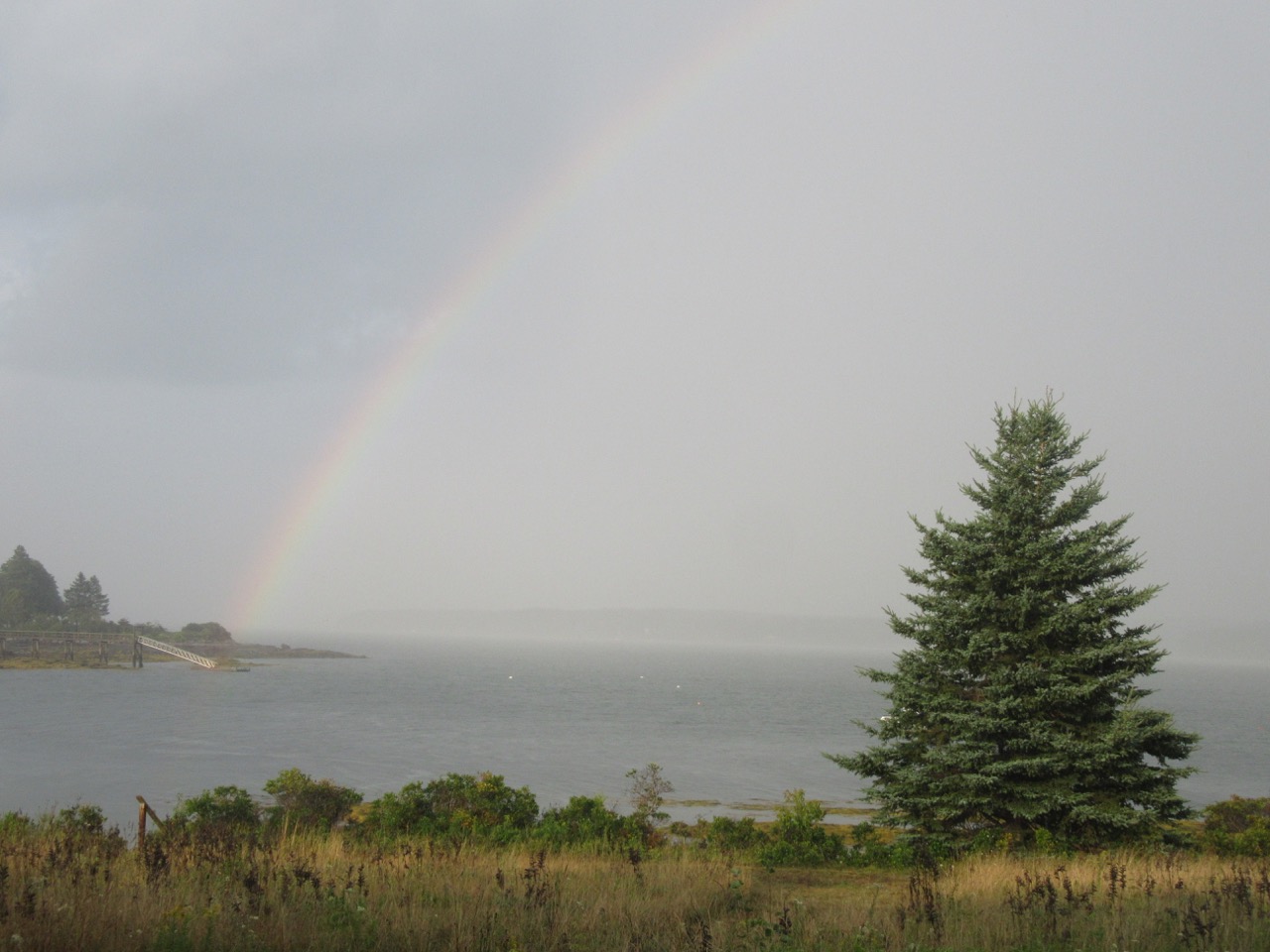
Rainbow in Cushing

Margy and I have been visiting with friends in a cabin on the water in Cushing, Maine. This was the view from the cabin the other day, as a rain shower passed through, quickly followed by bands of sunshine, creating a magnificent full rainbow.  It has also been a “rainbow” visit because we are lesbians of a certain age just hanging out and talking and laughing and sometimes bemoaning the state of the country.  While I would never want to lose the wealth that comes from loving friends of all ages and experiences, I have also been appreciating this time filled with the familiarity of shared life experiences.  It is a sense of being understood and understanding, that we “get” each other, from our coming out stories to the advertising jingles that got stuck in our brains long ago.

What is the role of identity in our social justice struggles?  Maybe too big a question to ponder while on this mini-vacation.  But we got talking about the Michigan Women’s Music Festival, which was so empowering and life changing for so many women–including me–but has more recently been the subject of attacks from those who claim it excluded and oppressed Trans women.  And then I also happened to read an article posted yesterday by a friend on Facebook that raised this challenge:

Identity politics have made organizing in social movements almost impossible, as division and suspicion are increasingly encouraged and groups splinter as a result.

That article linked to another, by Lauren Oates, “How Identity Politics is Destroying the Left and Being Used By the ‘Alt-Right.”  I liked some of her points, but I couldn’t rest easy with her concluding question, which seemed to me to misunderstand our struggle to end racism:

It’s about whether you want the world to be perpetually hyper in tune to race — the position identity politics advocates — or whether you want the world to eventually be blind to race.

I don’t think the goal of ending racism is to eventually “be blind to race.”  However, she linked to another article from last year that offered a more nuanced and compelling analysis, Safety Pins and Swastikas by Shuja Haider.  I was particularly drawn in by his critique of the idea of cultural appropriation, since I have been deeply involved in raising that issue in regards to non-Native people’s use of Indigenous spiritual practices.  (In 1995, I first published the essay, Wanting to Be Indian: When Spiritual Searching Turns into Cultural Theft.)

He talks about how the Right has mocked it, “Among the many silly ideas of young leftists who want to appear good without the hassle of doing good, ‘cultural appropriation’ stands alone,” quoting the National Review.  But then, of more import, he points out that “the rhetoric of mainstream antiracism is itself susceptible to appropriation by the Right.”

The eligibility of people to make certain kinds of claims is dependent on the set of criteria that fall into the category of “identity.” Your right to political agency is determined by your description.  We’re left with a simple rubric for determining the truth-value of a statement. Who said it, what group do they belong to, and what are members of that group entitled to say?

…It should go without saying that left-liberal identity politics and alt-right white nationalism are not comparable. The problem is that they are compatible.

I am pulling these quotes a bit out of context, and I encourage anyone concerned with the struggle for justice to check out the full articles.  I would be interested in your thoughts in response to them.  I am genuinely curious about the role of identity in liberation struggles–it has been a compelling question throughout my years as an activist.  Hierarchy, power, liberation, alliance…How do we acknowledge our location? How do we come together with those whose struggles are different from our own?

Forgive me for this meandering thought journey, in which I haven’t fully unpacked anything. But before I conclude for now, I want to come back to one of the most hopeful examples of people working together, both acknowledging and moving beyond “identities,” to face the crisis of our country, the moral fusion movement started in North Carolina by the Rev. Dr. William J. Barber II.

Rev. Barber laid the groundwork for a state-by-state movement that unites black, white, and brown, rich and poor, employed and unemployed, gay and straight, documented and undocumented, religious and secular. Only such a diverse fusion movement, Rev. Barber argues, can heal our nation’s wounds and produce public policy that is morally defensible, constitutionally consistent, and economically sane.

This quote is from the description of Barber’s book, The Third Reconstruction:  How a Moral Movement is Overcoming the Politics of Division and Fear.  You can find out more about this movement at Repairers of the Breach.  Oh, let’s not forget that a rainbow is a sign of hope!

Fathers

Victor Carpenter

[Rev. Victor Carpenter] 

I learned yesterday morning of the death of my mentor, Rev. Victor Carpenter.  He was my internship supervisor in 1998-99 at the First Church of Belmont, MA, and truly a ministry “father” to me.  He was the same age as my dad, and taught me all the practical ins and outs of life in the ministry, especially a ministry infused with a passion for justice. But the best gift he gave me was his expression of belief and confidence in me–through Victor, I felt I could do everything!

I was ordained at the Belmont church on Fathers Day, June 20 in 1999.  Victor preached the sermon at my ordination, and I was grateful that my dad was also among the many people who participated in the laying on of hands that blessed me for my work in ministry.  That work took me away from the Boston area, so I only saw Victor during occasional visits after that internship year, but his love and belief stayed with me through all the years of my ministry.

I should say a little more about him for those who do not know him.  Victor was a graduate of the Harvard University Divinity School class of 1959.  Along with Belmont, where I knew him, he served churches in Norwell, Massachusetts; Philadelphia; Arlington Street Church in Boston; and The First Church of San Francisco.  He also served The Free Protestant Church of Cape Town, South Africa; perhaps pivotal in shaping his own passion for social justice. After retirement, he was an interim minister in Dorchester, Carlisle, and Hingham, MA.

He received an honorary Doctor of Sacred Theology degree from Starr King School for the Ministry in 1987. In 2011 he received the Unitarian Universalist Association Distinguished Service Award.  (You can read more about his amazing ministries at that website.)  He was active for racial justice, peace in the middle east, access for people with disabilities, and an end to oppressions of all kinds. He was also kind, funny, savvy, and did I say passionate? He was a mentor and support to many others in ministry.

Today I am thinking about his wife Cathe, who herself has been a fierce and loving advocate and educator, and his children and grandchildren, and all of us who were touched by his life and ministry, and feel his loss.  I am also pondering this unlikely juxtaposition for me personally–his death occurring in the very same week as my own dad’s death.  I had known that Victor was terminally ill with cancer, so it wasn’t a complete surprise.  But I feel the double loss of these two father figures in my life, in many ways so different from each other, yet each so pivotal in my spiritual journey. I feel so grateful for the gifts I received through their fathering.


What We Are Here For

IMG_3796

“Life is the expression and fulfillment and celebration of beauty. This is what we are here for.  We’re not here to do anything else.” (Sarah Susanka in The Not So Big Life)

Perhaps this is an odd sentiment, when so much in our country is going wrong these days. Aren’t we also here for justice, for compassion, for interconnection?  But what is beauty anyway?  Is it the unexpected sighting of a wild raccoon near the brook during a morning walk?  Is it the fluid colors of the sky in the dawn?  Is it a coating of ice or snow on the branches of every tree and bush in the neighborhood?

Why do these things enliven our souls?  Perhaps beauty is the mark of an essential wholeness, a harmony we can recognize with our eyes, our ears, our hearts, our whole being.  If that is the case, then I believe beauty also includes justice, compassion, interconnection.  We recognize instinctively the wholeness within justice, within acts of kindness, the miracle of our interconnection.

Beauty has something to teach us about how to work for justice as well.  To express and celebrate beauty is to turn our attention away from the ugly hatefulness we deplore, toward acts of creating what we aspire to.  This is why I love permaculture and solar panels and work parties and gardens.  We are bringing into being the wholeness we hope for.  I am not saying that protests are not important as well.  On the contrary.

But as Rebecca Solnit promises, in her book Hope in the Dark,

…if you embody what you aspire to, you have already succeeded. That is to say, if your activism is already democratic, peaceful, creative, then in one small corner of the world these things have triumphed. Activism, in this model, is not only a toolbox to change things but a home in which to take up residence and live according to your beliefs, even if it’s a temporary and local place… Make yourself one small republic of unconquered spirit.

May you be a beacon of beauty today!

Prophecy, #5

To be a community of prophecy, to see what is happening, we must listen to the voices that are speaking the truths we cannot see ourselves. We must listen to history, we must listen to the earth, we must listen to people of color, and we must listen to the voice from within, the power in our spirits.

And then we must say what is happening, and act in accordance with what we know. I am reminded of the words of Holocaust survivor Elie Wiesel, who said, “I swore never to be silent whenever and wherever human beings endure suffering and humiliation. We must always take sides. Neutrality helps the oppressor, never the victim. Silence encourages the tormentor, never the tormented.”

There are many ways to speak and act. I was inspired by the Hollywood actors and singers who refused to perform for the Inauguration—in this way using their influence and their silence, as a voice to send a loud message that they could not support the racism and misogyny of the new president. I was inspired by the woman who tendered her resignation from the Mormon Tabernacle Choir, when they chose to participate—because she could not condone a presidency that went against all her values.

We have more power than we know. We can’t lose sight of that. It is so easy to get swept up in horror over what the leaders are doing, that we can forget to use our own power for good. African American lesbian activist Audre Lorde said, “Use what power you have to work for what you believe in.”

One kind of power is to march and protest, and it was heartening to learn that 10,000 people marched in the streets of Portland on Saturday January 21st—10,000 in our small city!  There were also more than 10,000 in Augusta, Maine. Hundreds of thousands marched in DC and many more in other cities around the world. That is a lot of marching power.

Myke in Hat

[Photo by Barbara Freeman]

Another kind of power is to knit, and I was thrilled to know that members of our congregation were knitting pussy hats for marchers. I wasn’t able to march, but they gave me a hat too.

Not everyone can march, but Michael Moore suggests that we all commit to calling our congregational representatives every day for the next 100 days. Or if that 3 minutes a day is too hard, call them on Tuesdays, Wednesdays, and Thursdays, when congress is in session. 

Not everyone can put their bodies on the line, like those who go to Standing Rock to protect the water there. But some people have been moving their money out of banks that support the Dakota Access Pipeline, or the tar sands in Alberta, and opening accounts with local credit unions instead. We have only begun to explore how to act for justice in our time.

To be a community of prophecy is to see what is happening, to say what is happening, and to act in accordance with what we know. Not that it will be easy. We are in for some hard times ahead. As the great African American abolitionist, Frederick Douglass once said,

“Those who profess to favor freedom and yet deprecate agitation are people who want crops without ploughing the ground; they want rain without thunder and lightning; they want the ocean without the roar of its many waters. The struggle may be a moral one, or it may be a physical one, or it may be both. But it must be a struggle. Power concedes nothing without a demand; it never has and it never will.”

This is what we are facing, dear ones. My colleague, Wayne Arnason, said “Take courage, friends. The way is often hard, the path is never clear and the stakes are very high. Take courage, for deep down there is another truth: You are not alone.”

Prophecy, #3: The Limits of Fact Checking

For those who love the truth, the current administration can be maddening.  I just think about the rejoinder used by Counselor to the President, Kellyanne Conway, in which she defended White House Press Secretary Sean Spicer’s false statements about the numbers of people attending the inauguration.  She said, they had “alternative facts.

But, then I found this post on Facebook at Rising Tide North America, which put a new layer into the equation for prophetic witness.  When Trump or his staff make outrageous untrue statements, these are not statements of fact, but statements of intent, stating what would have to be true to justify their next actions. Thus, we should not be trying to fact-check their big lies, but rather read into them what we can expect will be the next assaults on all that we hold dear.

Fact checking inadvertently legitimizes Trump.

For ex., Trump is not saying that 3 million undocumented people voted. What he’s saying is: I’m going to steal the voting rights of millions of Americans.

16195352_1301162426573194_5020501278727002556_n