Orchard Learning

Mottled red apples in green leaves and branches
Our first Honeycrisp apples are almost ready to pick!

Our semi-dwarf apple tree is bearing fruit for the first time this year, and we are excited for the dozen or so apples that will be ripe soon.

How naive I was when I first decided to plant an orchard in our back yard. We started with two dwarf cherry trees in 2017, of the varieties Lapins & Black Tartarian. The next spring we planted a Contender peach tree, the Honeycrisp apple, two blueberry bushes, some raspberries, and three hazelnut bushes. In 2019 I grafted two other apple trees, Black Oxford and Blue Pearmain, this last just transplanted to its new bed this year. (Not to mention our mulberry tree further back in the yard, and three more blueberries planted later.)

I think I imagined that one would put in a lot of effort at the beginning, with preparing the ground, planting the seedlings, adding companion plants, tending, and so forth, then the work would ease and the fruit would be there for the picking in the years to come. Maybe that was some of what attracted me to permaculture and a food forest. Little did I realize that an orchard requires even more tending as the seasons go on.

And there are the ups and downs–the first peach harvest went entirely to the squirrels-we were so sad. Then we had an amazing crop last year, that we ate fresh, shared with the neighbors, and froze, some packages of which are still in the freezer. This season, no peaches at all. We have yet to have a cherry harvest. This would have been the year, I think, but the abundant flower buds were empty from the deep winter freeze. On the other hand, the raspberries are very reliable, and the blueberries have begun to come into their own. And the number of birds have multiplied in our yard, whether or not there is any fruit on the trees. They love the orchard.

All that preamble to say, I did some more pruning this past week! After watching a whole bunch of Youtube videos about summer pruning, I gained the courage to go and cut off a whole lot of branches that were vigorously seeking the sky on the peach tree and the Black Tartarian cherry. (I had already done some pruning on the Lapins because of its black cherry aphid problems.) When I post the “after” pictures below, you might not believe how many branches were piled up on the patio waiting for me to take them to the compost. The trees still look flush with abundance green, though I think their tops might be about three feet lower than before.
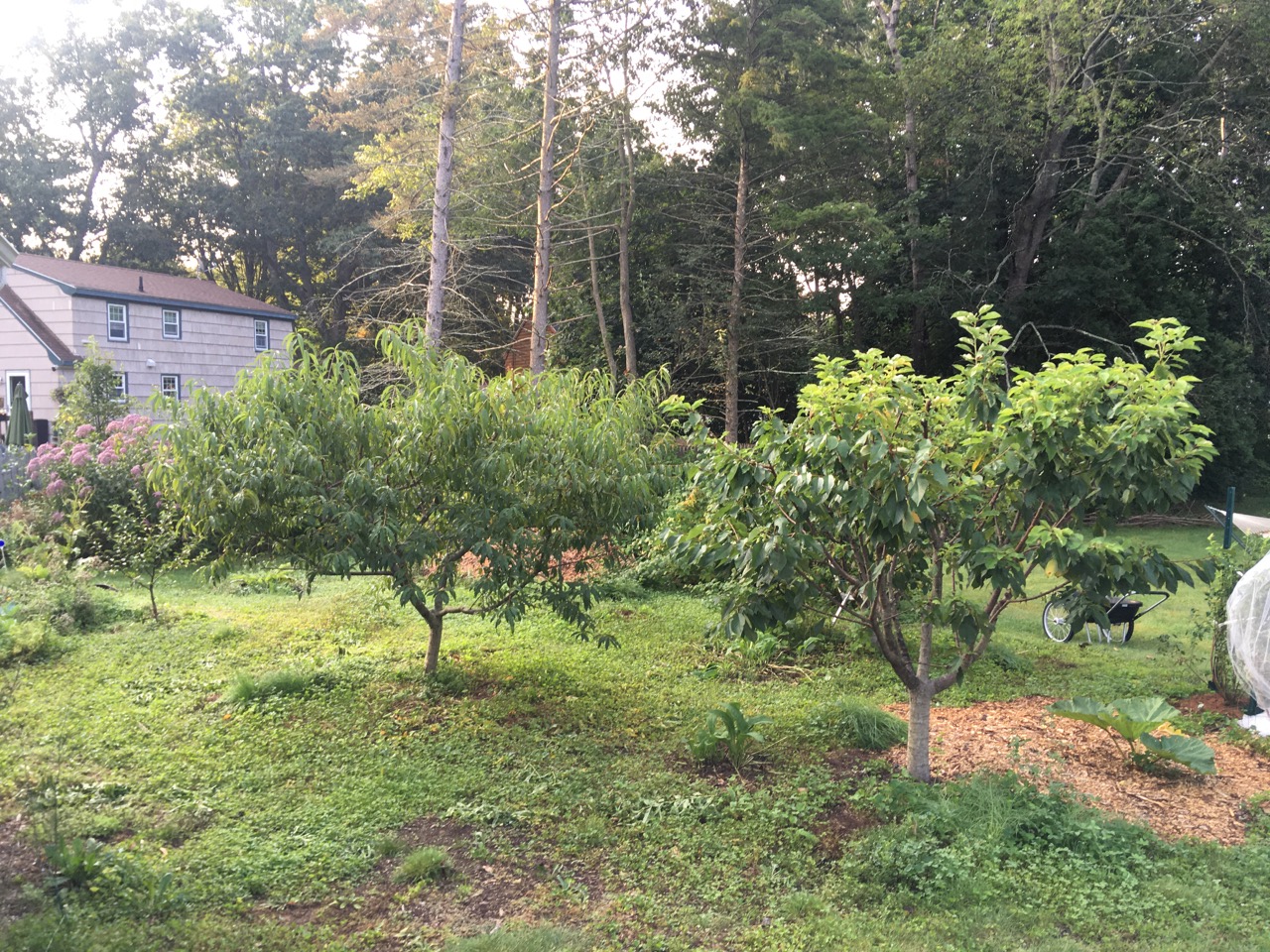
Peach tree and Lapins cherry after pruning.

I also discovered a lot of small curled leaves on the Black Tartarian, without any evidence of aphids. After some research I learned that there is a fungal disease, cherry leaf curl, similar to the peach leaf curl that I dealt with by picking off the affected leaves. I can’t be certain what it is, but I went back around and pruned off any branch ends with those curled leaves on both cherries. All the pruned cherry branches I cut up and put into garbage bags to go out with the trash–three bags full–so they wouldn’t spread the problem.

You might notice from the photo that the companion planting under the trees is now very low to the ground. I have taken to mowing most of it, including the oregano that spreads everywhere, and I put the cuttings in the compost to bring back later. The mowing doesn’t seem to bother anything, it all comes back. Under the Lapins cherry tree, I actually put down some cardboard to inhibit the oregano and then covered it with wood chips. It is an experiment.

Pruned Black Tartarian cherry tree.

This is not to say that the trees won’t also need winter pruning. That is the thing. They will always need lots of pruning, summer and winter. The work is never done. I might do less of it or more of it, depending on my own energy levels. But there is always more work that I could do to tend to their care. Even with my trying-to-be-minimalist approach. (I have read that there are people who secretly plant fruit trees in random places, to great environmentalist applause; but I wonder about who will do the tending.) So while I often wax eloquent about permaculture and gardening, please be warned about the other side: this relationship with garden trees requires a lot of work, more than I ever expected.

I should end this post with a caveat: I consider myself a learning gardener, and none of these reflections should be taken as advice. I have no idea what I am doing at least 50 percent of the time. My intention is creating a mutual relationship with the earth and the plants, and reflecting on that process. As always, I am humbled by it all.

Pruning

Cherry tree with empty branches on brown ground with some snow patches, and a green step ladder nearby.
Sweet “Lapins” Cherry tree and ladder for pruning

Yesterday I finally got outside and pruned one of the cherry trees in our little orchard. Pruning has always baffled me. My trees never look like the trees in the pruning guides, and though they are dwarf trees, they grow quickly long and gangly. I wish I didn’t have to prune, but experts say it is part of the work of caring for fruit trees. There are differences of opinion about the best time to prune, but for me it was partly based on actually being able to get close to the tree–the snow cover has kept me away before now.

But this post is not a how-to guide, nor meant to offer any wisdom about pruning. It is about risk and relationship. Sometimes we have to risk doing it all wrong, to do anything at all. Yesterday I took that risk, and in doing so, I realized that pruning is also about relationship. I had to get up close to the tree, stand on a ladder and notice all of its branches, all of its patterns, all of the pre-buds starting to form. I talked to the tree while I worked, asking for advice or forgiveness or something like that. I had to acknowledge that I am not the wisest or best caregiver for the tree, but here I am–I am your person and you are my tree. We are here on this land together. In the task of pruning, I become closer to the tree.

Pruning is odd to me, yet it is a welcome phenomenon for many plants. They thrive with cutting back, they are energized by it, it sets their hormones racing and can spark new growth. There are many principles which vary between species, and which are hard for me to translate into action for particular trees. But I think the only way I can really learn is by doing it, taking the risk with these trees, and doing the best I can. Letting the tree be imperfect, and letting myself be imperfect in my relationship to the tree.

I guess my winter project has been a sort of pruning too, going through old papers and recycling a bunch of them, organizing the rest. I had to get close to those papers too, sifting through each document in each file folder. I had hoped to be further along with it all, as we’ve turned the corner on Spring, and the sun and warmth begin to call me outside. I am mostly all done with papers from before I moved to Maine in 2005. But I am just beginning to sort through my work in ministry at the Allen Avenue Unitarian Universalist Church and in Portland. More of these “papers” are actually documents on my laptop, rather than in boxes in the basement. (I guess I could sit outside with my laptop for that kind of pruning!) I wonder. By pruning away these “branches” from the past, might I find more energy for living in these days and moments of the present? Do I need the pruning as much as the trees do?

Planting the Cherry Trees

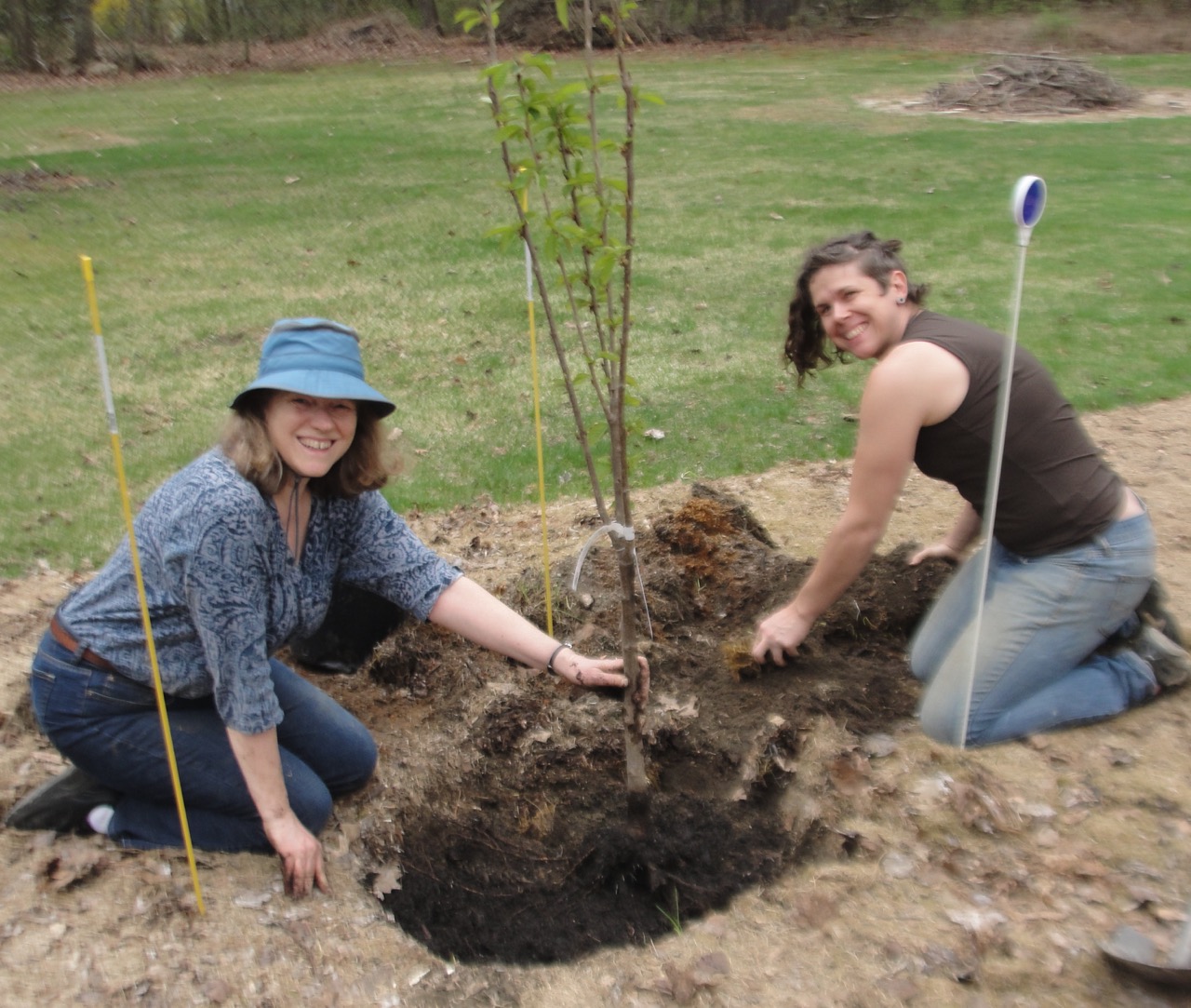
Today was the perfect day to plant our cherry trees, May Day Eve.  I had figured out the locations, and marked them the day before.  Our friend Sylvia came to help with strength and muscles.  She dug the holes!  Thanks, Sylvia!

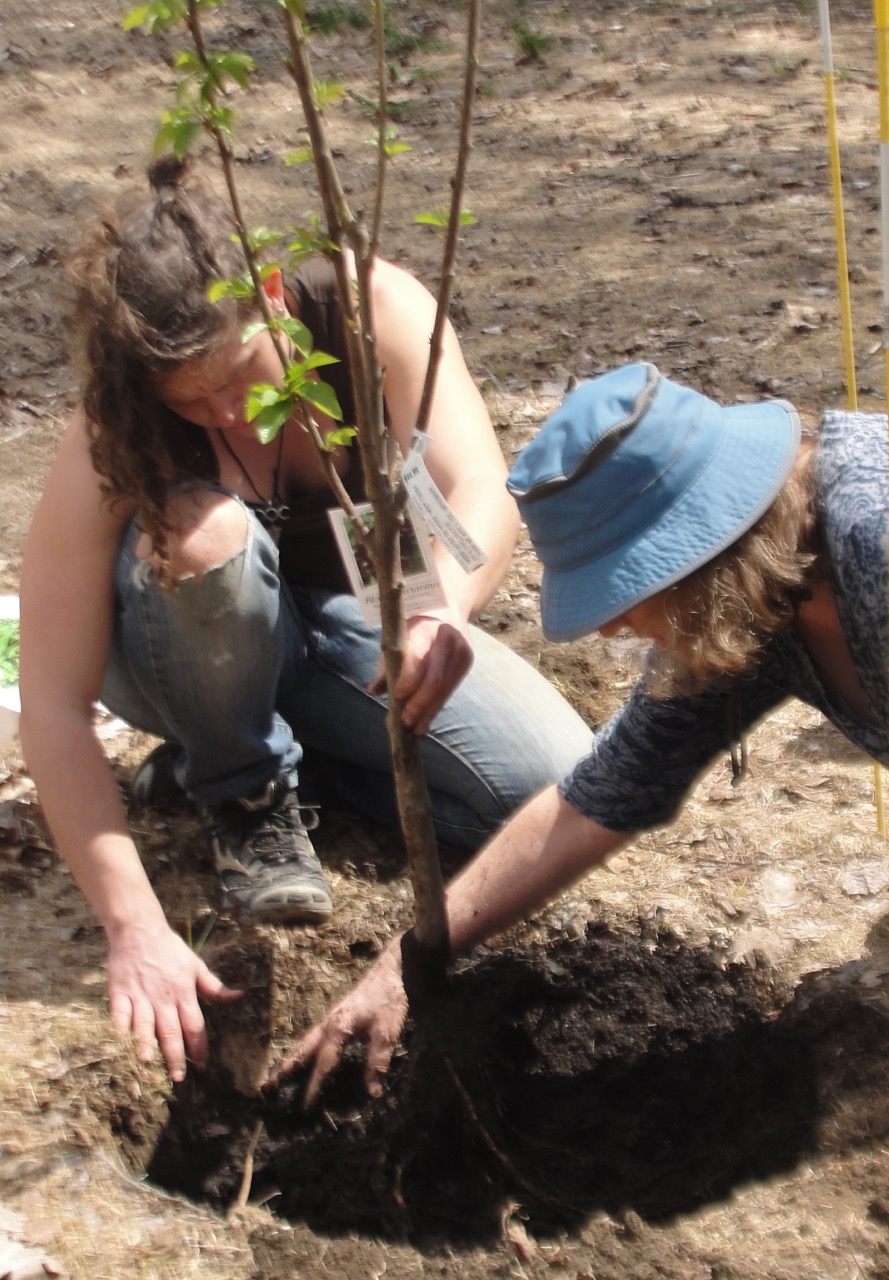
Our friend Mihku had given us compost from her garden (Thanks, Mihku!) and we realized we needed even more, so Margy drove to buy some, while Sylvia and I positioned the first tree.  I applied mycorrhizal inoculant to the roots (from the wisdom of Mihku), while Sylvia held the tree.  Then we filled in what we could.

Cherry Planting Hands in Dirt

[Photo by Margy Dowzer]

When Margy returned, she took photos while Sylvia and I finished filling the hole with compost and dirt.  I placed the Lapins Cherry closest to the patio, and the Black Tartorian Cherry about twelve feet beyond. We discovered the soil under the Black Tartorian was darker and richer, so we used some of that to fill the first hole too.

It felt so good to have my hands in the dirt, to give good energy and nutrients to these young beings that will live with us in our home.  It also felt good to have help from a younger stronger friend, my aging body just not able to do as much physical labor as I used to do.  It felt really good to share the process, to create a celebration of earth and sun and soil and friendship and the fertility of the land.

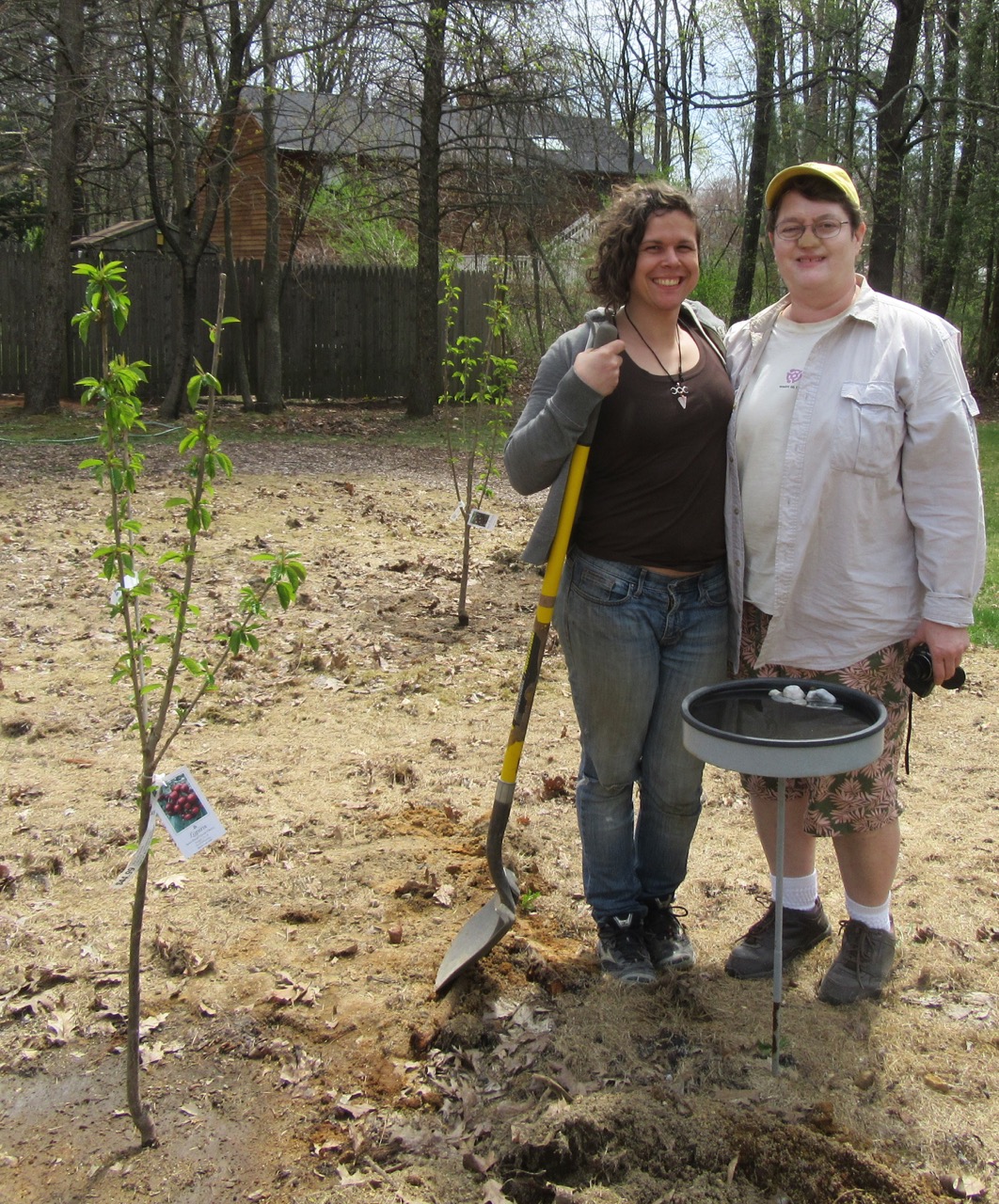
More photos:Sylvia starts digging

Myke & Sylvia – Version 2

[Photo by Margy Dowzer]

Cherry Trees in the Ground

Sylvia and Margy