Three goldfinches were perched on this volunteer sunflower!
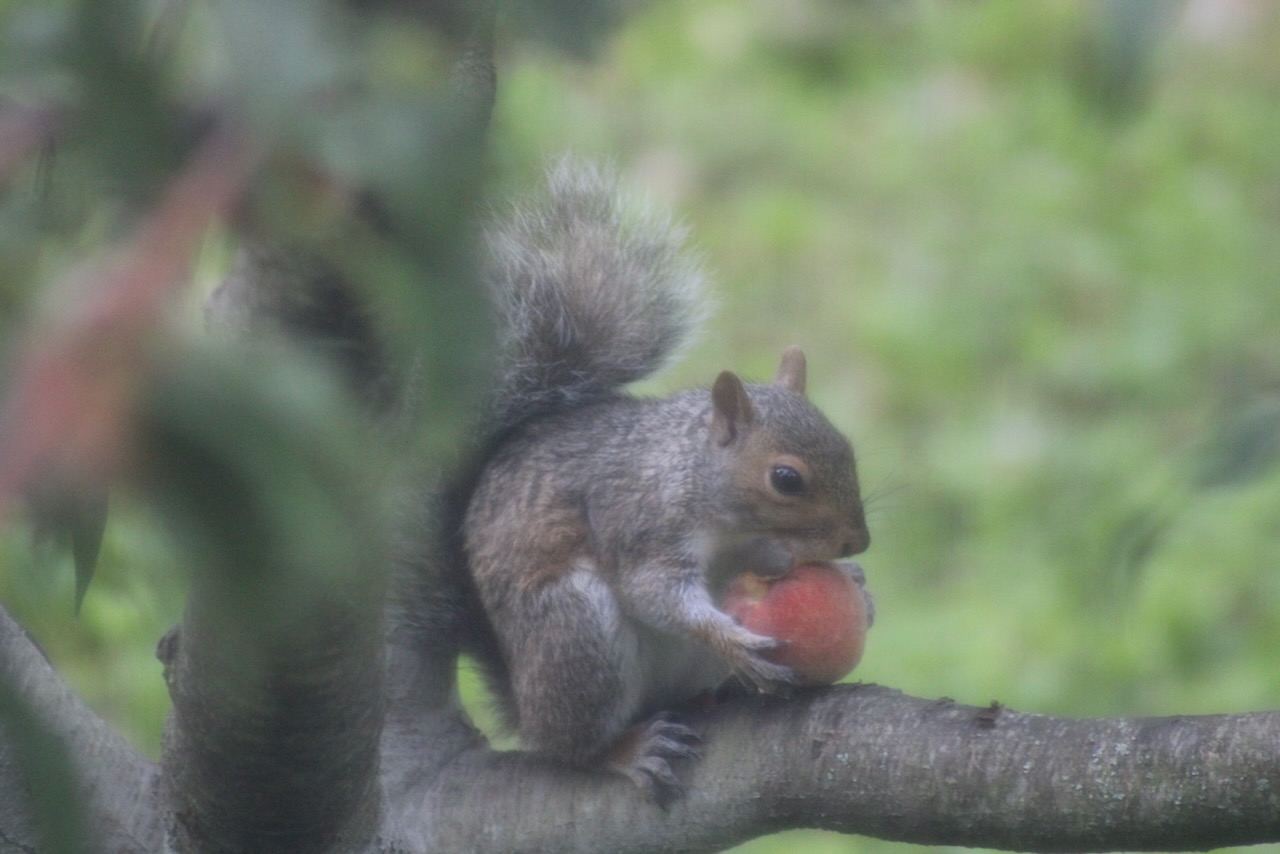
We haven’t been that successful in growing food for ourselves in the garden. (Yes, the experiment with the kale worked well. And we harvested blueberries and raspberries.) But right now the peaches are getting mold on them just as they ripen. Another fungal issue. I’ve started harvesting some that are not yet quite ripe, and just cutting them up to put in the freezer. But in the meantime, the squirrels and a groundhog are happily coming to the tree each morning to eat a peach. The squirrel climbs up the branches to pick her own, but the groundhog takes one that has dropped off.
The squirrels are always fairly bold, but the groundhog is shy and runs away as soon as she sees us on the back porch. So this photo was from a back window.
The more I try to garden, the more I realize what I don’t know. But it makes me happy that critters feel at home with us here. Unfortunately, the groundhog has dug a few holes to get under our garage–we don’t want her to feel that at home, such that she undermines the foundation. So I refill the holes any time I see them, and then pour some human urine on the area, hoping it will discourage her from more digging. Marking our territory, so to speak. We’ll see if that keeps working.
Meanwhile, the birds are relishing the volunteer sunflowers and evening primroses that are blooming and going to seed in lots of places. Also the elderberry bush. They seem to like everything about our yard. That makes me really happy.
There is so much beauty in the spring, but it all seems to be moving so fast. I can’t keep up. Mayday has come and gone. Already this season is half over. After two months of physical therapy for my hip and lower back, I am able to walk fifteen minutes and more again. The other day I walked to Capisic brook and onto the path nearby, and saw the trout lilies that usually grow there, a lovely spring ephemeral. American Heritage Dictionary defines ephemeral:
Lasting for a markedly brief time.
Having a short lifespan or a short annual period of aboveground growth. Used especially of plants.
Spring itself and all its beauty feels markedly brief. Is my love of photos a way of trying to hold on to all that is ephemeral? Is my need to write an attempt to halt the relentless flow of time?
I have been drawn outside more and more each day, excited to see daffodils and violets and green shoots coming up everywhere. And, happily, the peach tree is now covered with pink blossoms, and the cherry trees have many blossoms too. Last year, because of the weather, there were none–so these beauties seem fragile and extra special because of that vulnerability.
Peach blossoms on a foggy day.
There are many projects in the yard to attend to. Many branches fell from trees in the storms of winter and early spring. Margy has been cutting them up and hauling them around. Some of these we’re using to make a brush pile in the back corner for wildlife habitat. The other day, I cleared that space of invasive plants. I also set up our eight rain barrels again. We are going to get an new order of firewood, after using up our last old logs in the storms. So we are working on the space for the firewood, and purchased a rack to keep them off the ground.
Yesterday, I added two more pond lilies to the plants in the little pond, and as I was tidying up old dead shoots from other plants, I found strings of toad eggs attached to the old ferns. (So of course I left those.) We haven’t had toad eggs in the pond before. But there are a few frogs beginning to make an appearance–shy ones who have been diving under when they hear me approach.
The robins did not come back to the nest on our back porch that they had used for two years. Maybe that pair are no longer living. I read that their average life span in the wild may be just two years. I also read that they often don’t reuse nest sites–so we were lucky to have them in that spot for two years. Another ephemeral.
Then we discovered a nest in the yew bush near our front door–able to be partly seen from our living room window. So new robins are raising young nearby again. Maybe one of them fledged from the back porch.
Blue robins egg barely visible behind branches.
Is my love of photos a way of trying to hold on to all that is ephemeral? Is my need to write an attempt to halt the relentless flow of time?
I was cuddling with my cat Billie on the couch and suddenly felt a deep sense of our own impermanence. She is 13, I am 70. Senior cat, senior human. How much more time do we have? Someday, I won’t be able to feel her warm little body, with its soft fur and sweet smell, curling up on the pillow near my face. Someday, she will be gone; someday, I will be gone. We too are ephemeral. I want to hold on, but life seems to be about movement, about letting go into the next moment.
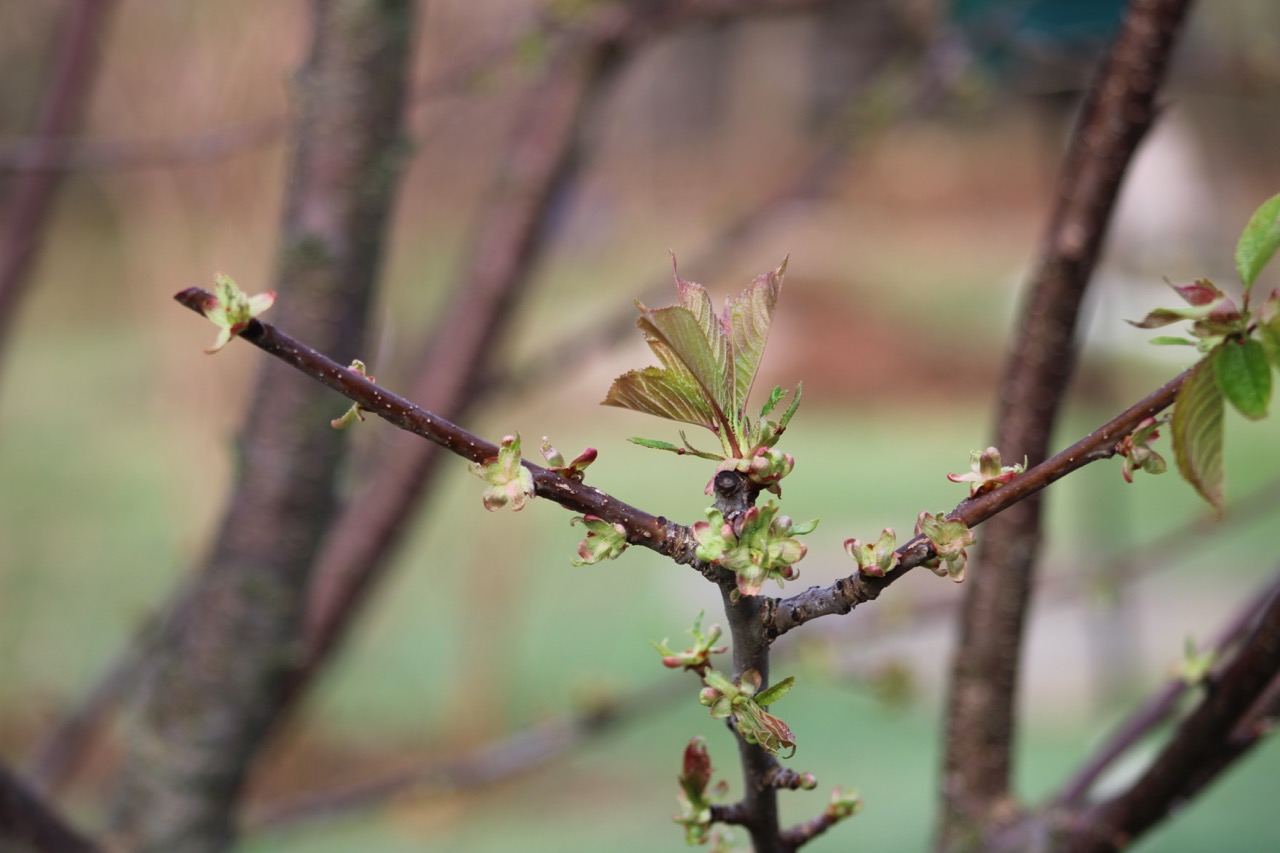
The cherry trees and peach tree have no blossoms on them at all. The cherry trees had the buds that should open into blossoms, but when they opened, they were empty. At first I worried that I’d done something wrong. But on connecting with other gardeners in Maine I learned that many people are facing this problem with all their stone fruits. Apparently, the most likely cause is the weird weather over the winter, with mild times alternating with a deep freeze. They didn’t stand a chance.
I feel sad about it–there were really so many buds on the cherry trees this year. In prior years we just had a very few blossoms, and I was hopeful that this year we’d see our first real fruiting. I also feel glad that the leaves are opening–I heard that some people’s trees actually died. I am glad ours are alive. But this is a lesson about climate change. Global warming increases the unpredictability of the weather, and the temperature swings are part of that. What food we can grow becomes more unpredictable.
We don’t rely on our little garden for our food–we are really just learners in this process. When we get a harvest, it is exciting–and thankfully, we still have peaches from last year’s abundance in our freezer. It looks like the blueberries and raspberries will be fine. I’ve already eaten sea kale and some asparagus. But I can feel the vulnerability of what it means to face a shifting climate, even in these small ways. How many larger ways are unfolding all over our planet? Severe heat and drought in many places, floods in other regions. For too many people actual starvation is real. I feel so powerless in the face of these huge problems.
When we first moved to this place, our hope was to form a deeper connection to the earth and all her creatures, through our connection to this small piece of land. I have to say it isn’t easy. We know so little, and we are surrounded by challenges larger than we are. For just one example, Margy spends hours pulling and cutting invasive plants around the borders of our land–Asian bittersweet, multiflora rose, Norway maples. The way it is with invasives, that job will never be over. Plants have their own personalities, and some are very aggressive even if they are native plants or desired plants, so there is the endless pulling and pruning to keep things in some sort of balance. (Oregano and wood anemone, I’m looking at you! Everywhere!)
But maybe these are the lessons we are learning about making a deeper connection to the earth. Plant by plant is the only way we get to know them. Whole Indigenous communities were needed to foster the balance of all beings, and we are just two old non-Indigenous humans. Some of our neighbors seem to be in a similar venture to ours, and others seem just the opposite.
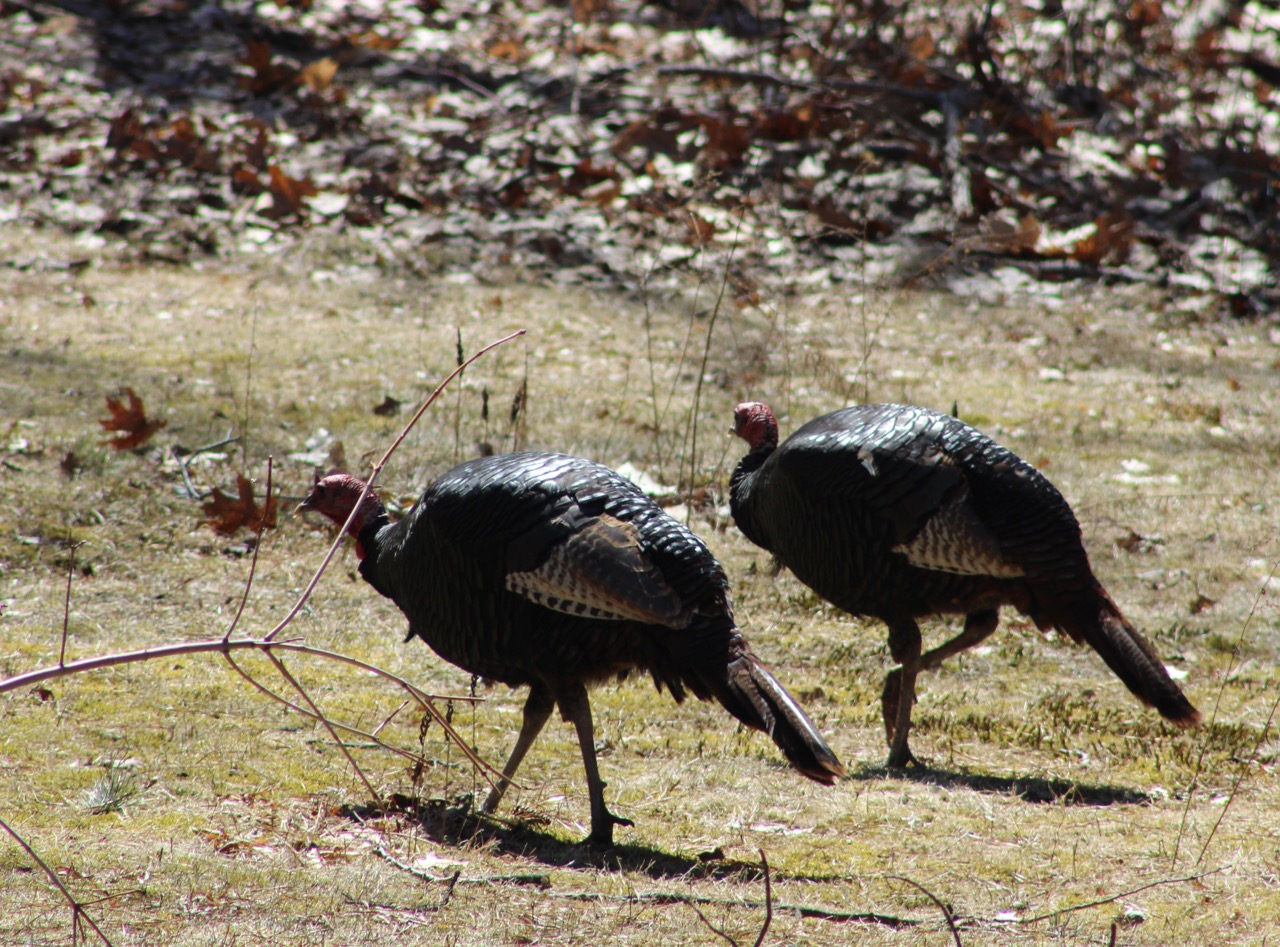
Still, I have to hope that the love we offer to this place can be a small seed of healing, maybe even its own “aggressive” form of healing, spreading into the broken places. I draw hope from the birds who seem to multiply and who enjoy the yard so much. I draw hope from the violets blooming everywhere they want to bloom. I draw hope from the turkey who visited the other day and made a dust bath in the patchy lawn. There is something so wonderful about a community of creatures who share one place.
Peaches are ripening, bright red and yellow, crowded together on the branches.
Those of you who perhaps followed my peach tree saga last year might remember that after hours and hours of tending–including several organic sprays, thinning the small green peaches, putting little mesh bags on the remaining ones–the squirrels ran off with every single green peach, or knocked them off the branches as they tried to get into the bags. We got zero peaches to eat.
Well this year, I didn’t have the heart or energy to do all that tending. I did one holistic spray early in the season. I felt very non-attached to any outcome, since one might assume that squirrels would eat them all again. But that didn’t happen. A few weeks ago, I started picking a few small random peaches, so that others would have more room to grow, and the branches wouldn’t break under their weight–but only a few at a time, not systemically. I put them in paper bags, which is the actual way to help them ripen. (Not on window sills as I had previously thought.) A few weeks ago, the squirrels started eating some peaches too, sitting in the tree, or taking ones with broken spots that I left on the patio table. I found their leavings on the deck railing. It was fun.
Broken peach bits on the deck railing.
But they didn’t take all the peaches. And the peaches started to really ripen. Now they are bright red and yellow, crowded though they are on the branches. Now, we are processing all the bags of ripening peaches in the house, as well as gathering peaches literally dropping from the tree. I have cut them in slices to freeze–first on a tray, and then put into freezer bags. Yesterday I made a gluten free peach cobbler. We have invited friends and neighbors over to share in the abundance. More people are coming by this weekend. This morning, I saw this little bird pecking for its delicious breakfast. There is plenty to share!
Bird eating a peach on the tree.
I feel grateful and humbled by this turn of events. Sometimes gardening feels like a battle between the gardener and the “pests.” I didn’t have the heart to try too hard to fight this battle this season. (And our cucumbers and zucchinis are succumbing to bugs-so it goes.) I was surprised that the peaches thrived so well without my efforts. I was surprised that the squirrels took some, and it seems they felt okay about sharing. Maybe they sensed that we were not enemies this time. Margy and I feel so good to be able to give them away to others. The garden is such a great mystery! I continue to feel humble and grateful by all it teaches us.
Oh, and here is the recipe for gluten-free peach cobbler. I searched the internet, and then adapted this one from several I had seen:
Peach Cobbler: preheat oven to 375 degrees
Slice peaches and place in a lightly buttered 9 x 13 pan. Basically use enough to cover the bottom well, or more if you like. Sprinkle with cinnamon, and a tiny bit of ground cloves.
Whisk together 1 & 3/4 cup almond flour, 1/2 teaspoon salt, and 2 teaspoons baking powder. Blend together 1 large egg, 1 teaspoon vanilla, 1 tablespoon honey, 1/4 cup Greek whole milk yogurt, and 2 tablespoons softened butter. Add that to the flour mixture and blend, and then spoon over the peaches–it won’t cover them completely, but spread it around as you can. Bake 25-30 minutes or until golden and bubbling. Remove and let cool a bit so you don’t burn your tongue. You can serve as is, or with cream, whipped cream, or ice cream.
Peach cobbler in a glass pan, with some pieces removed.
Yes! The robin has been sitting on the nest more consistently and today I confirmed that she has laid three eggs! She stays in place when we go out the back door, as long as we go down the steps near the driveway, which is on the opposite side of where she is nesting. But she does occasionally go away, and in one of those moments, I lifted my phone up above my head and was able to take this photo of the eggs. Little joys in the midst of the lovely day outside.
Peach blossoms
In other developments, the peach tree blossoms are beginning to open, and many sorts of bees are hovering around the cherry tree blossoms, the violets, the pansies, and the dandelions. I’ve been slowly cutting down dead stalks of the oregano plants that have proliferated around the trees, and noticing how the low growing herbs and flowers are spreading onto former paths–but maybe it’s time to let them be the path ground covers. I’ve used wood chips for the paths, but living ground covers are actually the most ideal. Clover, pansies, oregano, thyme, violets. I’m trying to listen to the plants, to the land, to see what might be the happiest.
I didn’t have a ton of energy today, so mostly I lay in the hammock just noticing the orchard and how it is changing. I’ve been going through old blog posts to archive them as pdf files, and was looking at photos of the yard before we planted most of the trees, (the cherries were the first). So much has been transformed. It is a good feeling.
I am writing this outside on the back porch, listening to cardinal songs from the trees at the edges of our yard both right and left. It’s cooler today than yesterday, partly cloudy, but spring feels like it’s waking everything up, including me. I was delighted yesterday to look out the back windows and see a whole family of turkeys wander through the back of our yard. Seven of them! We haven’t seen any turkeys here for a few years. Wild visitors make me smile. I came outside and started tending the now thawed pond: I skimmed off leaves and trimmed off dead stems and leaves from the pond plants. The blue flag irises have new green shoots emerging, and the fern is also starting to show green shoots.
My energy was depleted after finishing only a part of the work, but then was rejuvenated by drinking licorice root tea with ice and a cut lemon at lunch. It truly is a miraculous plant for me. I didn’t drink it during the winter–maybe I should have. I have been growing a licorice plant for about five years now, so if all goes well, it should be ready soon to let me harvest some of the roots. The small bush dies back in winter, but regrows in spring, and sends out runner roots to create new plants nearby. So, rejuvenated by the licorice, I came back outside and set up our hammock (after rearranging some things in the garage so I could reach it–every project is really a few projects, it seems.)
This season, the hammock is most important to me of all the tools in the yard. I have been feeling so overwhelmed by the garden this past year–the problems were starting to outway the pleasures. I mean, the squirrels took all the green peaches, the oregano was out of control spreading all over, and the hugel mound is full of weeds and small critters, I think, and won’t really work except for zucchini and cucumbers, because the water just runs off the sides. I am tired of the feeling of working so hard to get food, and like I am fighting in a battle. I have been searching for a way to be at peace here, as we were when we started. Our hope was to find relationship with this land, and to be a healing presence for the land. To learn from the land.
So I brought myself to the hammock, to rest, to listen, to see the tree tops, and to be open. I was noticing the green moss beneath the hammock, and everwhere in the back half of our yard, and wondered, “Why does it like to grow here? Is it a good thing?” (I am always asking that when random plants pop up–because we have so many invasives like bittersweet, you never know, friend or foe? And I know so little.) I did some research on my phone. “Methods to get rid of moss in your lawn.” On the other hand: “Methods to grow a lawn made entirely of moss.” People have lots of opinions about moss. But our yard likes it. It likes to grow in compacted soil, shady, moist, it doesn’t need nutrients from the soil. It is at home in acidic places, like a pine forest. We have our lovely pine trees here, that is probably our basic ecology. It seemed to me that lying in the hammock, I was able to let go of doing, and enter into the mindset of learning from this place. It was good. Here I am humbled and grateful.
So even though it was cooler today, I found myself outside again, tending to the pond, pulling out dead tree leaves, cutting old plant leaves to make room for new. Going slow. Noticing two robins in the orchard right now. The wild pansies that were blooming in December are blooming again, and dandelion greens are showing. Chives are emerging under the fruit trees. I am trying to remember to balance the tending with the being tended.
Hammock under the pitch pine tree, moss on the ground.
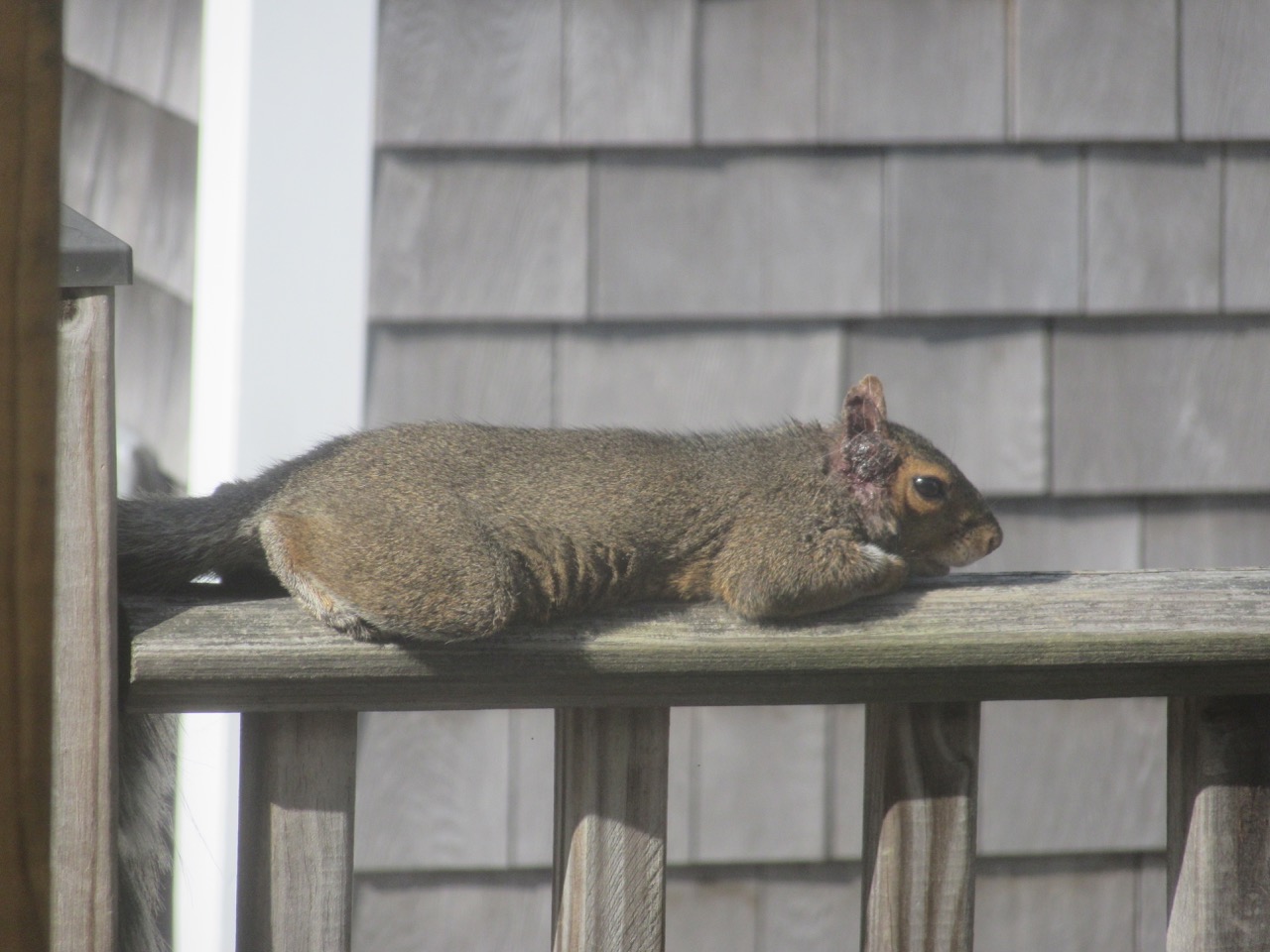
Squirrel relaxed and resting on the railing of our deck
This morning, I watched out my window as a squirrel climbed into the branches of the peach tree, going up and down several branches until she or he stopped at a bagged peach. She nibbled through the small branch it hung from, cutting the branch right off. I could see the leaves and twigs fall to the ground, even though the squirrel was hidden by other branches. Then, she took the unripe peach in her mouth–still in the bag–and carried it down and away from the orchard to some other roosting post in another tree. I didn’t yell or bang on the screen or try to stop her, as I have done on other mornings, because all the peaches have already been destroyed.
Over the last couple weeks, I had to remove over twenty of the bagged peaches after birds or squirrels left bite marks and the fruit had dropped off its stem, to the bottom of the bag. Some of the peaches had only a c-shaped mark that made me wonder about curculio. A couple seemed untouched. But I had seen the squirrels in the trees going after them. Then, a couple days ago I discovered that virtually every peach in a little protective bag had dropped to the bottom of the bag, and all of the peaches that I hadn’t bagged had disappeared completely. The peaches were all still green and hard, nowhere near ripe. I had just read about people using a spray made with peppermint oil and cinnamon sticks to deter squirrels, and was about to try it, when I discovered there were no peaches left to save.
Green peach with a bite missing, dropped to the bottom of a mesh bag, with another nearby.
I’ve been grieving the last few days. I put so much effort into this peach tree all through the spring and summer. Pruning it carefully. Six holistic sprays with beneficial nutrients. Three “Surround” kaolin clay sprays. Picking off leaves with peach-leaf-curl one by one. I was so hopeful when hundreds of little peach-lets started growing! I thinned the peaches so that none was too close to another. I put 80 little protective mesh bags on individual peaches. I even bought toy snakes and an owl to try to scare off the birds and squirrels. None of it stopped them. I had gotten only 3 cherries from the cherry trees, but the peaches seemed to be the saving grace for the little orchard I have been tending so carefully. Last year Margy and I had been able to eat only one ripe peach–and it tasted so good. So this year, I tried all the things to care for and protect them, imagining that taste in my mouth. And now they are gone.
I’ve also felt deeply shaken in my capacity as a permaculture gardener. Here is this little food forest with 2 cherry trees, one peach tree, and two baby apples. And no food. (Well–the raspberries did fine–but I already knew how to tend raspberries. And there were a few blueberries on our young plants. We thought we might get some hazelnuts but the squirrels also grabbed those before they were even close to ripe.) I do come away with a deep respect for organic gardeners and farmers.
But I have been harboring much anger and hate in my soul for these squirrels, and I feel very troubled about that. The original purpose of tending this land–this small place on the earth–was about finding our way home to earth community. Putting into practice the desire for healing the broken relationship between our society and the natural world. But when I try to grow food, so many critters become my enemies. Well, they probably don’t share the enmity–they probably think I run a fabulous restaurant. But meanwhile, I am watching them and hating them.
This morning, after the squirrel ran away with the bagged peach, another squirrel started playing with a stick on the path in the orchard. Literally playing–rolling over and over, turning the stick this way and that, chewing on it, then rolling over again. In a very cute way.
There is a lesson in this, I am sure. So I am trying to grieve, to let go, to open my heart. But I am still not sure I know how to forgive the squirrels. I am trying to listen to the deeper lessons.
Photo: a nest in the branches of the peach tree, surrounded by leaves mottled with kaolin clay
Life is getting exciting in the orchard. The other day, a friend noticed an empty nest in the branches of the peach tree. It must have just appeared that day–the Summer Solstice–because I had been spraying the tree a couple days before with an herbal foliar spray and would have noticed it. But it seemed like it might be abandoned, and I wondered if perhaps its creators had noticed the toy snake I had hung from the tree the day before to warn off squirrels.
Today, I began to wrap and tie little woven net bags around the peaches–another strategy to keep them protected from burrowing bugs and poking birds and of course, squirrels. This year, I am trying all the things!
Photo: Peach tree, somewhat whitened by kaolin clay, with net bags around some peaches.
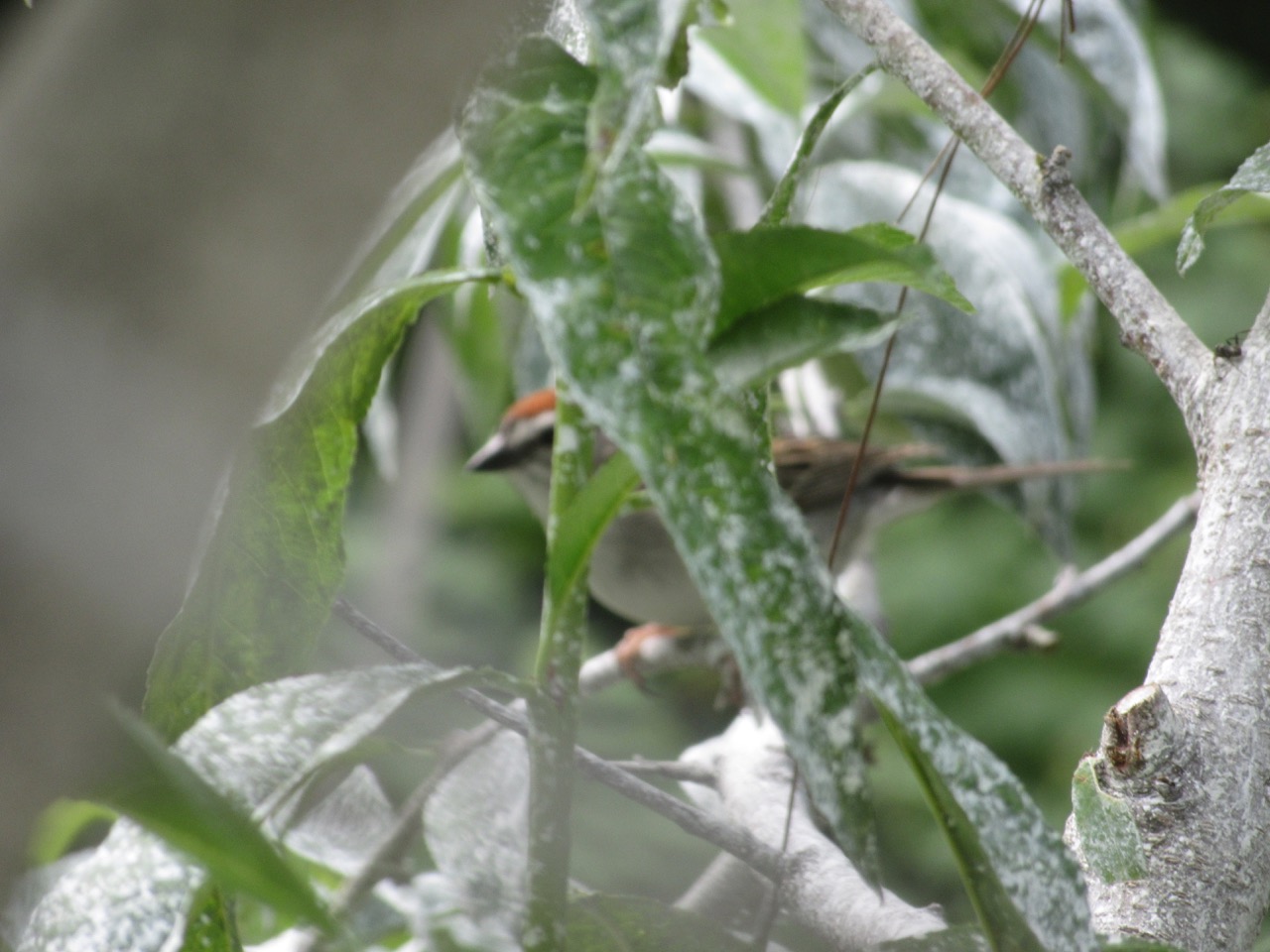
While I was slowly adding a few more bags, this little sparrow was chirping in the next tree over, as if she were trying to get my attention. (Later, I did some research, and she seems to be a native chipping sparrow.)
Photo: chipping sparrow behind leaves
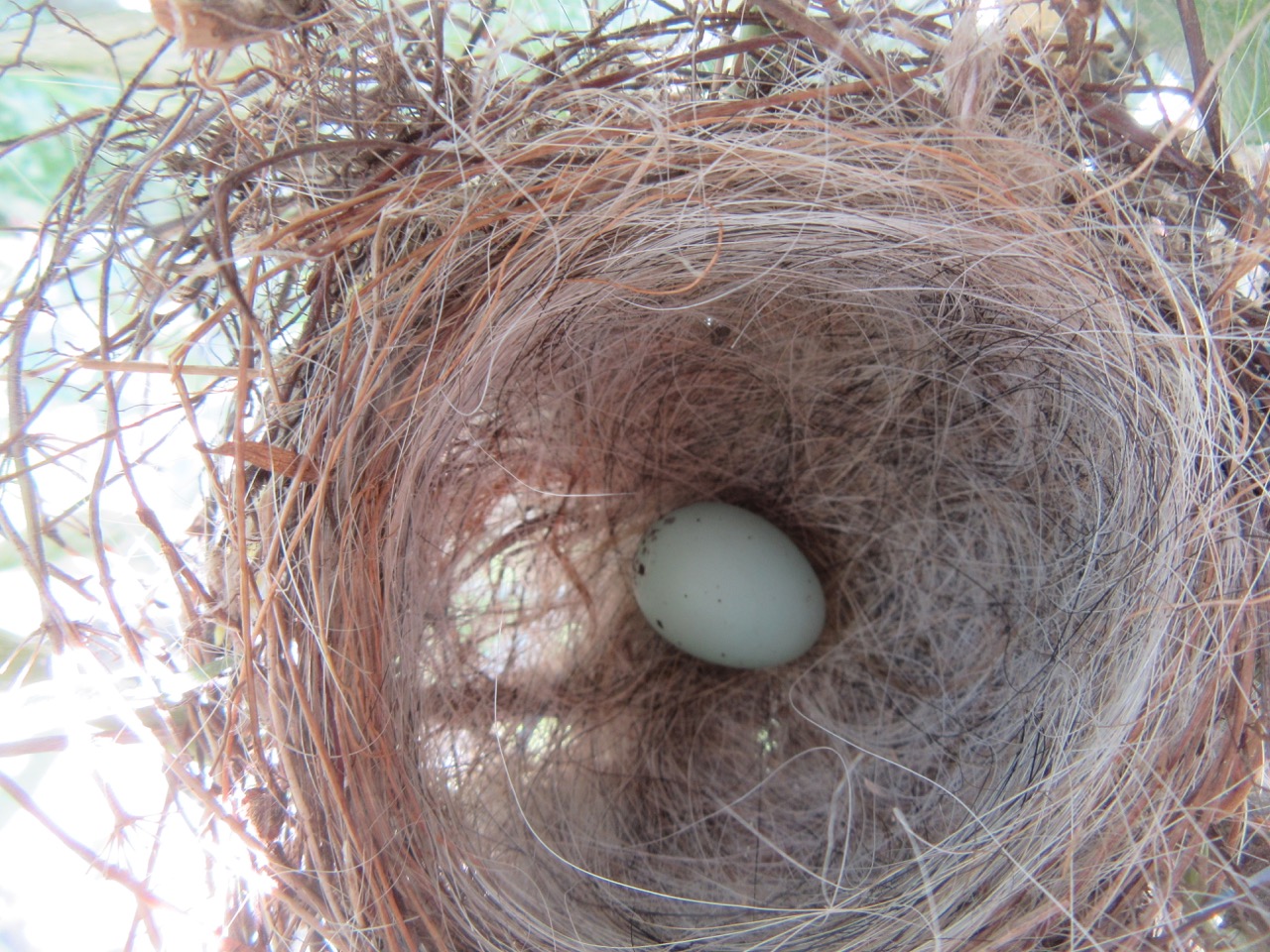
Curious, I carefully put my finger into the nest (which had been empty the day before) and ever so gently touched the smooth shell of an egg. Holding my camera above the nest, I confirmed it.
Photo: one light blue egg with spots inside a nest
Of course, this left me with a dilemma. Do I pay attention to protecting the peaches? Or do I take care not to disturb the chipping sparrow and its nest? Hoping to do a bit of both, I kept putting more net bags around the peaches, but only on the side of the tree away from the nest.
With the bags around the peaches, I won’t need to spray the tree again with kaolin clay, and that seems like a good idea as far as the nest is concerned. These net bags require quite a labor intensive process though. The design of the bags could have been better. I decided to make a small cut in the top of each bag, on the opposite side of where the drawstring tie comes out, so I can pull the tie string out from two sides. That way I can secure it across the branch closest to the peach. (Otherwise, if I just tied it around the stem, I am afraid it would pull the delicate peach right off the branch.) So bit by bit I added perhaps 15 to 20 bags on peaches. I have many more to go.
And then I saw that the sparrow had returned to her nest. Maybe to lay more eggs? Maybe to keep one or more eggs nice and warm until they hatch. I read that it takes two weeks for the eggs to hatch, then 9-12 days for the young to fledge. I think we’ve reached a truce. I hope so.
Photo: head of sparrow is just visible over nest, behind bright green leaves
I have been having a few days in the garden that humble me to my core. This process of finding our way home to earth community is so difficult. Trying to care for fruit trees involves learning about so many insect pests and disease processes. Observing the trees carefully every day. Yesterday and today I was thinning the tiny peaches leaving only one every 6 inches, so that the branches can support them to grow. Often I am trying to figure out which organic solution goes with which problem. And yesterday morning, I saw one of our squirrel neighbors climbing the peach tree–a whole other issue. Will we get to eat any peaches, or will the squirrels take a bite out of each one? Or will birds peck holes in them? Or some other insect pest eat them from the inside?
I hate how gardening sets me at odds with the other critters on this land–figuring out which are “beneficial” (to us) and which are “enemies” (to us.) I remember that when I first had a little garden, many years ago now, I was surprised that so much of it was about killing–pulling weeds, drowning slugs in beer, and so forth. And now that I am caring for an orchard, a permaculture food forest, it’s the same thing. A constant battle. So how is that teaching me how to live in a mutually beneficial relationship with this land?
I start to wonder if human beings should ever have shifted from hunting/gathering to agriculture. Hunting and gathering certainly included the taking of animal life, but it seems like it was more in balance, it was received with gratitude, it was a kind of partnership. I am thinking about the different role of the groundhog in the lives of different cultures. The bane of many gardeners’ lives, groundhogs are incredibly inventive and persistent garden eaters. It was amazing to me that here on our land, the groundhog whose den was next door seemed to respect the orchard as our place, while the garden bed behind the garage she claimed for her own. But I have a friend who built a fence deep into the ground around her entire garden, and still the groundhog family dug a tunnel and emerged right in the center of the garden to eat her vegetables.
However, the groundhog played a different role in Wabanaki cultures, in tribes that were traditionally hunting and gathering. I only know a few of the stories about the legendary figure for good, Koluskap (Glooscap), the creator of human beings. But I learned that his grandmother was the groundhog, Munimqehs, and she guided him and taught him the wisdom he needed. What a different perspective! She taught him that people and animals relied on each other, that hunting was necessary for the people to be strong, but that taking more than was needed was destructive to both.
Photo: The groundhog who used to live near our yard.
Likewise, deer might be a blessing for hunters, but destructive to trees and gardens. We see about one deer each year passing through the back of our yard. We used to have a gang of turkeys that roamed the streets of our neighborhood. They are gone now. Eventually, the groundhog disappeared too–I think a neighbor had something to do with that. Now, it seems, along with birds, we only have squirrels and a little star-nosed mole that tunnels under our wood chip paths, and an occasional chipmunk. But the squirrels are very adept at causing trouble to our garden. All winter long, for example, they climbed up our hazelnut bushes, eating the catkins that would pollinate the flowers in spring. After, they would act drunk and run around wildly in circles. Eventually I put some nets over the two smaller shrubs, to try to protect them. Maybe it worked? The smallest shrub now for the first time has some “future hazelnuts” forming on the end of its branches. I don’t know why the larger two do not.
Photo: Future hazelnut?
Sometimes I am amazed at what grows, what we can harvest. I just cut a whole bunch of soft thyme to dry, and I’ve been finding wine cap mushrooms hiding under clover to add to meals. The sea kale was delicious, and now its flowers smell like honey. There are green berries on the blueberry plants. I got the advice to buy some fake rubber snakes and hang them in the trees to scare off the squirrels–as long as I move them every few days. Last night, Margy and I sat in the back of the yard and watched fireflies signaling to each other in the tall grasses and weeds. In this garden, I am bewildered, sometimes discouraged, often exhausted, and always humbled by how little I know, and how difficult it is. What are you trying to teach me, little squirrels?
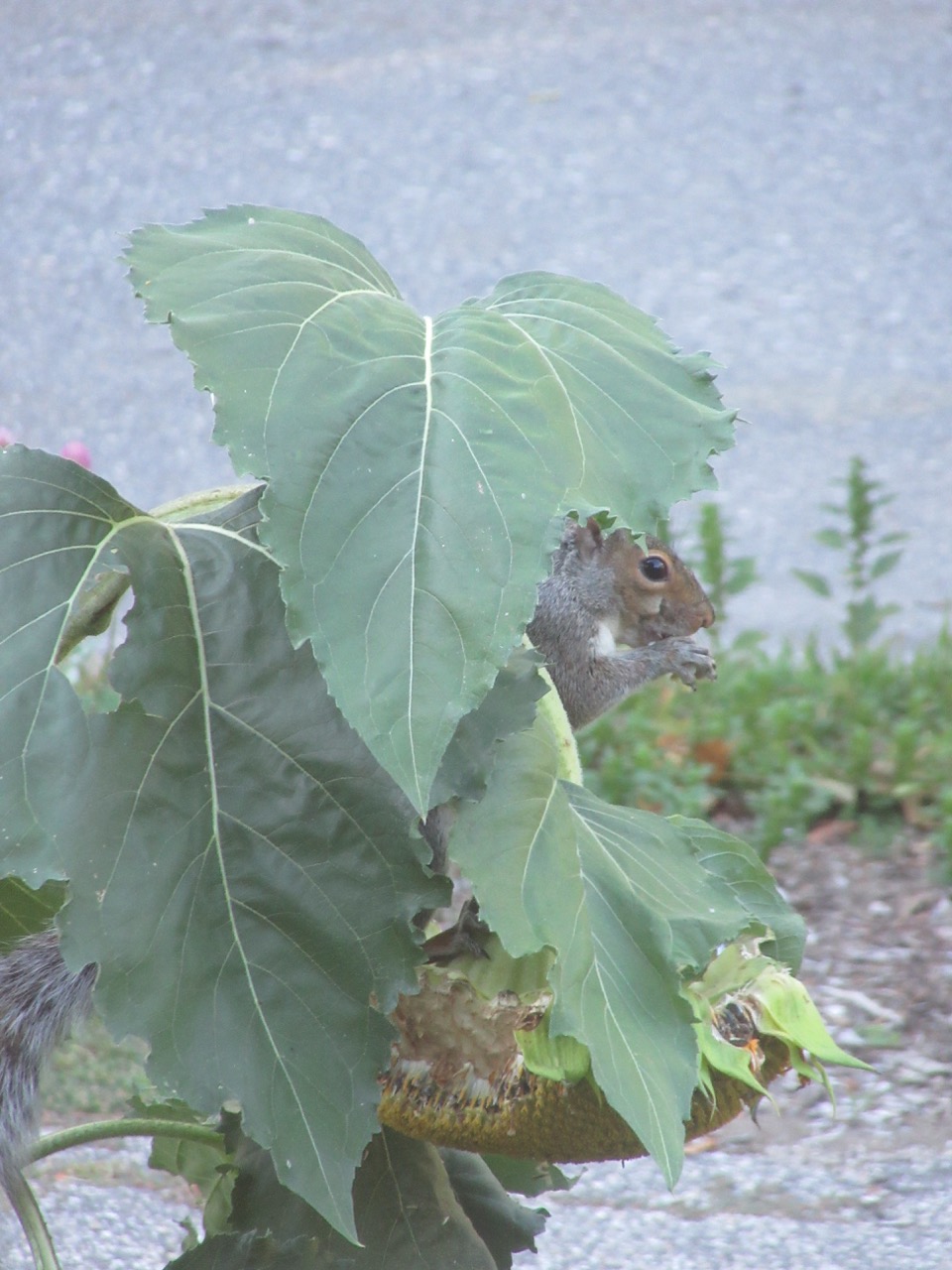
Photo by Margy Dowzer: Squirrel sitting, eating, on a sunflower last fall
If you’ve been following my work on digging the pond, I will mention that I took a little break, first to find out what to do about the water that has seeped into the bottom, and then because I twisted my ankle on Friday while I was digging. So annoying! My ankle is not so bad–after a couple days of rest, I can hobble around now, and I will be digging again soon.
In the meantime I wanted to share this photo of the flowering peach and cherry trees in our food forest. They flowered a bit earlier this year than last. In the photo, the peach blossoms are pink, and it is hard to see the white cherry blossoms amid their green leaves in the photo. But they are so beautiful! There are more cherry blossoms this year than last, when we got just a few.
However, I’ve been concerned about pollination. Our neighbor keeps honey bee hives, and usually we have lots of her bees visiting over here, drinking nectar and drinking water from our bird baths. But this year, it has been very sparse for bees. I found out that our neighbor’s hives died in a cold snap earlier in the spring and she hasn’t replenished them yet with new bees.
One day, I did see bees of all sizes in the Lapins cherry tree (on the right in the photo), but I didn’t see them in the peach tree. (Not that I sit and stare all day.) But I’ve been doing so much TLC with the trees this year, with Kaolin clay, and holistic foliar sprays. It would be a shame if we didn’t get fruit because of pollination problems. It is too late now to try to hand-pollinate. The other potential glitch is that while the Lapins cherry is self-fertile, the Black Tartarian cherry needs the Lapins to cross-pollinate. They are both sort of blooming now, but the Lapins had peak blooms earlier, and the Black Tartarian has new blooms that just came out yesterday. So we wait and see.
It reminds me of the sad danger to pollinators everywhere because of climate change, environmental pollutants, pesticides, and development. All of our human food is dependent on these little creatures who pollinate the plants. If the bees die, so do the humans.
Today I pray for the pollinators, with gratitude and humility. Part of this prayer is offering to the bees so many other plants in our food forest: daffodils, dandelions, and violets are blooming now; soon we will also have chives, oregano, clover, thyme, and many more. All of us can do more to provide food for bees and other pollinators throughout the season. Only then can they also provide food for us. May this circle of life be blessed.











 Finding Our Way Home