September Musings

Four huge turkeys in the shade of some green grass, behind leaves of zucchini in the front corner of the photo

The summer garden had some successes and some fails. And it is sometimes hard to tell which is which. This turkey family visited the yard many days, and walked through the garden beds in the back. They mostly left the veggies alone, except they liked to eat the tops off the bean plants. We still got a few beans even so. And they left alone the zucchinis, which did well, the cucumbers which did fair, and the broccoli, also fair. We appreciated their visits–we want to support wildlife after all.

However, we tried to lessen our support for the chipmunks and squirrels that became such little rogues. Despite netting over the blueberries, once they figured out they could squeeze holes into it, they got the rest of the blueberries, though we did get a bunch before that. I am happy to say that the baffle on the bird feeder totally worked. They never got up to the feeder after the baffle was installed. So I am hoping that without all that extra food to stash, the population won’t explode like it did this year. The long game. And the birds keep coming back to the feeder.

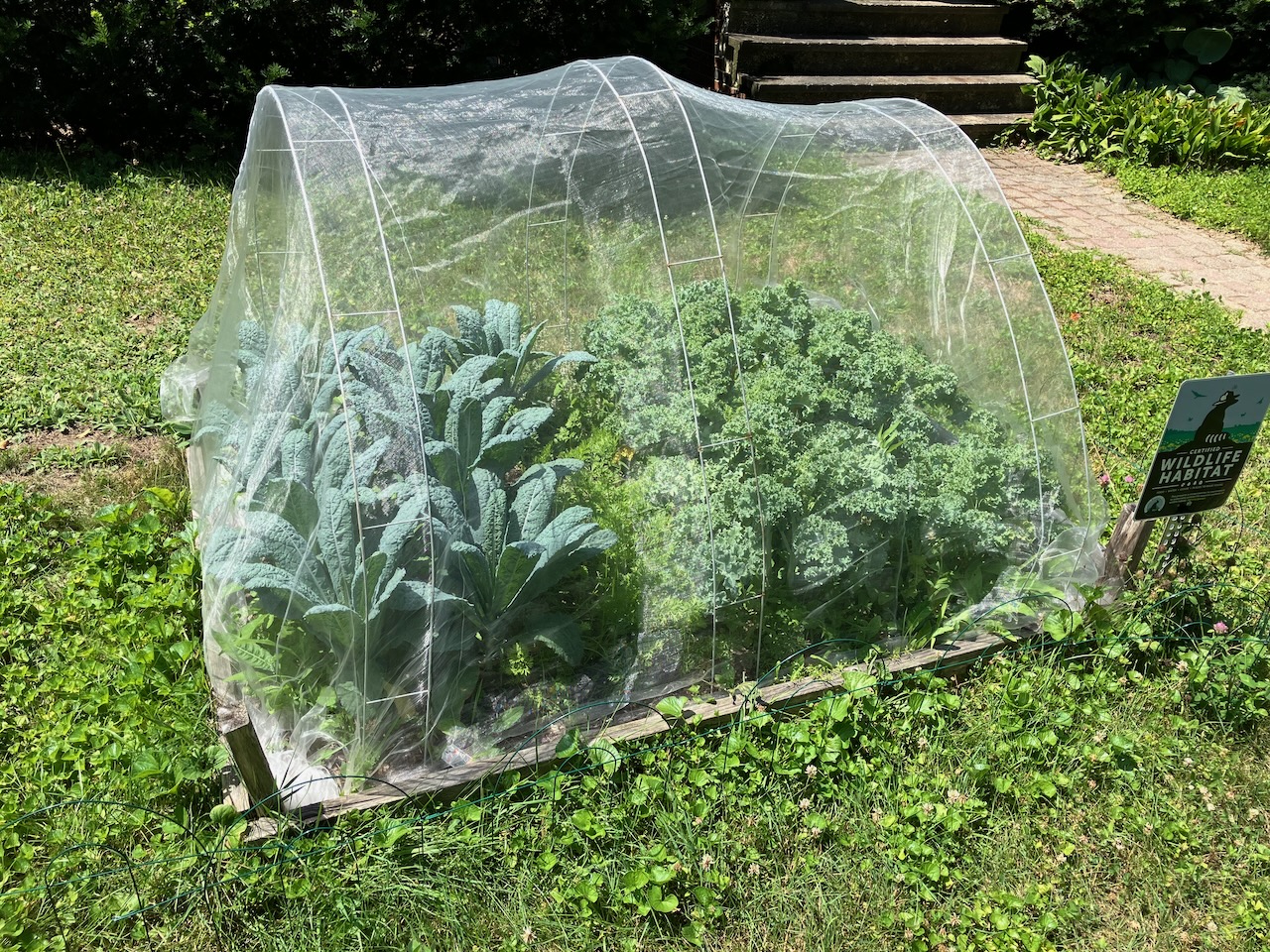
In the front yard, we never had monarchs lay eggs on our milkweed plants, despite their visit. Maybe next year? The netting on our kale and carrot bed was a great success. It protected the kale from cabbage moths, and no one tried to get into it. We have a ton of kale harvested and still to harvest.

Rectangle garden bed filled with green kale of two kinds, covered over with a translucent net on white metal supports.

The robins never came back to their nest on our back porch after the babies had been attacked. Still so sad about that. We’ve had some lovely visits with human friends out by the pond. The pond water level went down with the drought, but this weekend’s rain helped, especially after adding water from the newly filled rain barrels. Still a few frogs, though I am not sure about the tadpoles. They hide under the lily pads, and it’s a lucky day to see them.

And… and… and… Gaza is still being attacked night and day, and starved by blockades. International resistance is growing but too slowly for the people killed each day. I keep bearing witness, and praying. It’s the same with the rising fascism of our country, and the attacks on immigrants both documented and undocumented, and citizens who are brown or black or speak Spanish. The only thing that gives me hope are the multiple levels of resistance from huge demonstrations to lawsuits to governors who slap back. Here we do the best we can to get by, day by day, accepting our situation as elders and those who are chronically ill. In the face of so much cruelty and hate, we add our little love to the mix, hoping to be part of the larger Love which is our only real hope.

Families

robin feeding 3 babies in nest, whose beaks are pointing up
Parent feeding the babies on May 18

The robins raise their young so quickly, just a few weeks and they are already fledging from the nest. But they treasure their little family, and take utmost care to give the babies everything they need. We feel privileged to watch from our windows. So I will take my theme from this little family, to speak about the human rights of families.

In the Universal Declaration of Human Rights, Article 16 says:

(1) Men and women of full age, without any limitation due to race, nationality, or religion, have the right to marry and to found a family. They are entitled to equal rights as to marriage, during marriage and at its dissolution.

(2) Marriage shall be entered into only with the free and full consent of the intending spouses.

(3) The family is the natural and fundamental group unit of society and is entitled to protection by society and the State.

Now, in these few sentences, we can also see the foundations of the right to marriage for same-sex couples and transgender persons, because this article affirms “free and full consent”–that we choose our intended spouses, rather than being assigned a spouse by parents or society. At the time it was written in 1948, sexual orientation wasn’t fully understood or protected. But I was happy to be a part of the changes made in the last decades that extended this right to all couples.

And today, I am especially thinking about Mahmoud Khalil, being held in ICE detention in Louisiana, since March 8th. A legal green-card resident of New York, he was detained for previously speaking up about the human rights of people in Gaza. He was not permitted to be with his wife for the birth of their child, and today immigration officials have denied a request for him to hold his newborn son during a visit from his wife. This cruelty robs him and his baby of a bonding that is so humanly necessary. He should be free, and able to go home to his family.

I’ll close with a few photos from the baby robins.

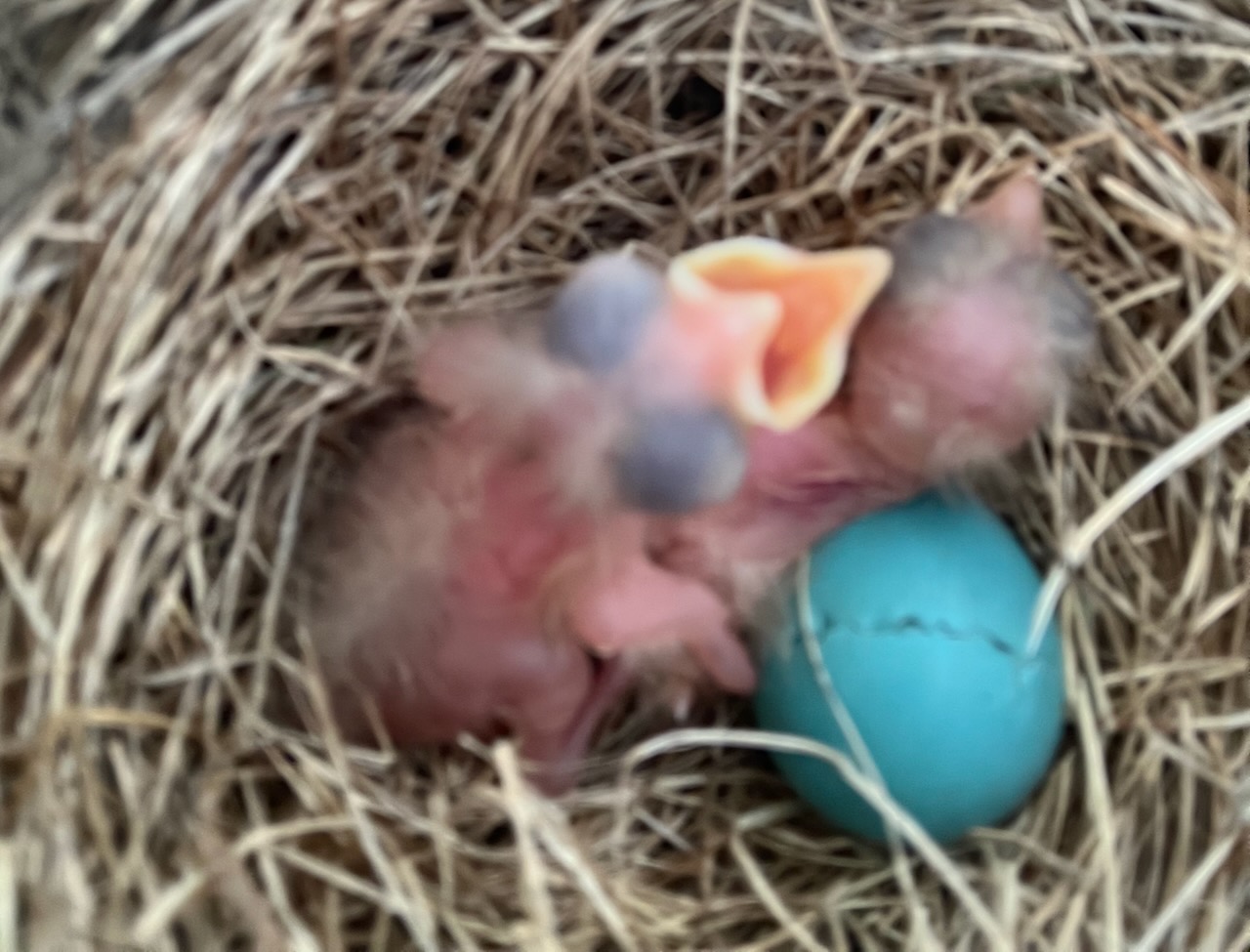
2 newly hatched robins and one blue egg with crack in it.
Newly hatched robins on May 7th
Three robins peeking out of nest today.
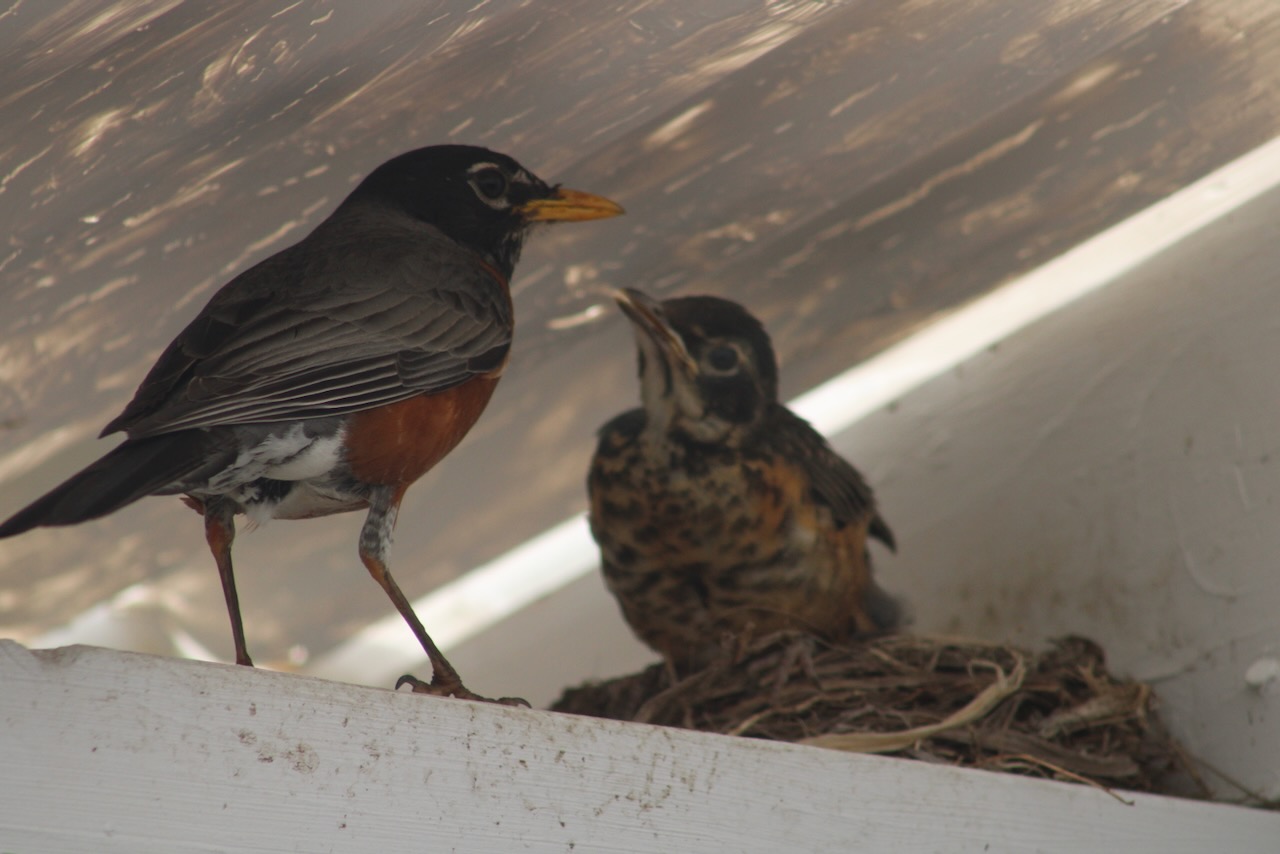
Parent encouraging one baby robin, the last fledgling.
Parent encouraging the last fledgling.

Declaration of Human Rights 1948

Bluebird perched on top of turquoise colored umbrella

As I was cleaning out files in the basement, I came across a copy of the Universal Declaration of Human Rights, adopted December 10, 1948 by the United Nations General Assembly. It feels timely to post sections of this declaration here. There are 30 articles in the Declaration, along with its preamble. (I’ll post more in future days.) We’ve got to speak up for what we believe! Our current government is betraying these ideals in multiple ways, particularly by denying due process to immigrants arrested and imprisoned, or renditioned to foreign prisons. Resist!

Article 1: All human beings are born free and equal in dignity and rights. They are endowed with reason and conscience and should act toward one another in a spirit of brotherhood.

Article 2: Everyone is entitled to all the rights and freedoms set forth in this Declaration, without distinction of any kind, such as race, color, sex, language, religion, political or other opinion, national of social origin, property, birth, or other status. Furthermore, no distinction shall be made on the basis of the political, jurisdictional, or international status of the country or territory to which a person belongs, whether it be independent, trust, non-self-governing, or under any other limitation of sovereignty.

Article 3: Everyone has the right to life, liberty, and security of person.

Article 4: No one shall be held in slavery or servitude; slavery and the slave trade shall be prohibited in all their forms.

Article 5: No one shall be subjected to torture or to cruel, inhuman, or degrading treatment or punishment.

Article 6: Everyone has the right to recognition everywhere as a person before the law.

Article 7: All are equal before the law and are entitled without any discrimination to equal protection of the law. All are entitled to equal protection against any discrimination in violation of this Declaration and against any incitement to such discrimination.

Your silence will not protect you

Multiple bluish white flowers with green leaves in a bunch on the grass.

I am living in the strangest of paradoxes. A hateful dictator has taken over our country, but today my life looks about the same as yesterday. I wake up in the morning, the sun is shining through my windows, and the birds are singing. I see these bright spring flowers on my walk. And yet, US-made bombs are being targeted on children in Gaza, they are dying in flames or slowly starving because food aid has been locked out by the Israeli government. International students (here in the U.S. on legitimate visas) are being kidnapped and jailed by ICE and threatened with deportation for having spoken up against this genocide in Gaza.

And I can’t stop thinking about Kilmar Abrego Garcia being detained by “administrative error” and sent to the one country his immigration status said he could not be sent to (El Salvador), because of danger from gangs; and now he is trapped in a hellish prison there because the president will not bring him back. This regime is renditioning hundreds of people without trial to this “prison” in El Salvador–and really, without trial it is not a “prison” but an extra-judicial concentration camp. All the people the president sent there should be brought back to the U.S. If some of them are gangsters and criminals, they should face trials–everyone has human rights, or no one does. But the president jokes instead about sending “homegrowns” to El Salvador next.

So since I’ve spoken up publicly about genocide in Gaza, and about immigrants being deprived of human rights, does that mean that they will come for me one day? Maybe it does. But I can’t live my deepest ethics without bridging the gap between the bright sunshine of today’s ordinary morning and the nightmare that is going on all around us, just at a little distance from my house at the moment. Every day I read about more atrocities taking place, and I try to do the little that I can do: to bear witness, to speak up about them, to share my outrage, to protest the injustice. The temptation is to get quiet, to try to hide under the radar. But I do believe, as lesbian poet warrior Audre Lorde said, “Your silence will not protect you.”

The more of us who resist, the more chance we have to reverse this nightmare.

Listening for Spirit

Dawn colors and clouds, pink and blue over trees and shadow of a house

Our house isn’t best situated for seeing the beauty of sunrise or sunset. Too many trees and buildings. But the other morning, when I opened the blinds in my room, I saw this outside my window. Dawn magic.

Yesterday I was so sleepy and almost napping on the couch when I happened upon a documentary on PBS about Howard Thurman, Backs Against the Wall. I knew of Dr. Thurman but I don’t remember if I knew so much about him as was shared in this film. African American theologian, author, and teacher, he was deeply spiritual, became dedicated to nonviolent activism, and was the mentor to Dr. Martin Luther King, Jr. and other civil rights leaders. The film stirred something in my soul.

First of all, I found myself feeling a bit of envy–my old sin. I always wanted to “be somebody.” You know, one of those people you heard about, a saint, a well-loved thinker and author, an influential leader, recognized by the world. And I wasn’t that, except, to be fair, in the most local context. I was, for a while, a local spiritual leader. I saw something in Dr. Thurman that reminded me of myself, except writ large.

Most importantly, he reminded me of my own mysticism, my own deep connection to spirit. And I asked myself, am I listening to the voice of the spirit within me, am I paying attention to what the spirit is telling me right now, in this time? The truth is, illness dampens the energy of the body, but it also dampens the energy of the soul. It has been harder to hear the voice of spirit since my retirement due to chronic illness. I remember at first, spirit said, Rest and Joy, let that be your guide. And I did rest, and chose activities that linked to joy in me.

But I still wrestle with questions all the time. What is this chapter of my life all about? What can I do in the face of the brokenness of our world, in the face of war and oppression? If I can’t resist by marching in the streets, how can I resist such evils as the genocide in Gaza, the rising hatred toward immigrants in our own country, the demonization of trans and queer people by those coming into power?

At different times in my life, I was guided by an evolving sense of purpose. When I was in college, my friends and I would ask, “How would Jesus live in our times?” A few years later, I found the Catholic Worker movement, and to live and serve in houses of hospitality for people without homes–that felt like the embodiment of that purpose. When I woke up to the oppression of women in the church and in society, when I began to form community with other women waking up, I voiced this desire, this intention: “We mean to incarnate the goddess!” When I came out as a lesbian, I felt a deep sense of purpose in loving and affirming all of our beauty as women, as lesbians, to find the goddess in ourselves and each other.

There was always this pattern for me, listening and following the spirit as I was led into new understandings and new ways of living a purpose in the world. Following the distant voice of my ancestors into solidarity work with Indigenous peoples. Finding a home in Unitarian Universalist ministry, and serving in congregations as I was called, bringing together wider understandings of spirituality, and commitment to the work of justice activism in community. Coming to a deeper understanding of interconnection with all of life, and permaculture gardening, and a spiritual journey into earth community.

I see how lucky I have been, to be able to follow an inner stirring, to live and work from a sense of calling and purpose. Whether known or unknown. But I am still wrestling with questions now. What is my calling now? Can I hear the voice of spirit to guide me now? Here is something Dr. Thurman wrote about all this:

“How good it is to center down!
To sit quietly and see one’s self pass by!
The streets of our minds seethe with endless traffic;
Our spirits resound with clashings, with noisy silences,
While something deep within hungers and thirsts for the still
moment and the resting lull.…
The questions persist: what are we doing with our lives?—
what are the motives that order our days?
What is the end of our doings? Where are we trying to go?…
Over and over the questions beat in upon the waiting moment.
As we listen, floating up through all the jangling echoes
of our turbulence, there is a sound of another kind—
A deeper note which only the stillness of the heart
makes clear.
It moves directly to the core of our being. Our questions are
answered,
Our spirits refreshed, and we move back into the traffic of
our daily round
With the peace of the Eternal in our step.
How good it is to center down!”

I guess that is what I am trying to do, even now, to center down, to hear the deeper note. To let the questions come into that stillness. Even when it feels empty and dark, before the dawn has come.

Resisters

Small open water pond, with stones surrounding it and small white dock on left.
Pond has open water today, first time this spring!

Back in 1981, I wrote a poem that meant so much to me at the time–an expression of the spiritual path I was attempting to follow as a social change activist. It is interesting to me to read it today–do I still agree with it or not? Since that time, I have been involved in several organizations working for change. I would love to change the system, and I grew to think much more collectively. But after many years, and seeing the backlash against so many changes we tried to create, there is some grounding in remembering that we are creating a new way, no matter how the larger system reacts. I am curious what other activists or spirit kin might think about it all. (I do still love the word kin-dom.) (And one can make a small pond by digging a hole and pouring in water–it will never be the ocean, but it gives me joy none the less.)

We are not reformers
We are resisters
We are not reformers with a cause
We are resisters with a way
A reformer is one who tries to change the system
A resister is one who tries to change herself
A resister does not try to answer the question	
    of what the system should be
A resister does not try to organize a new system
A resister resists the system
A reformer is like someone trying to make an ocean	
    She digs a big hole and pours in water
A resister is like a river
A river doesn’t know what the ocean looks like	
But it knows the way to the ocean


Now here is a mystery
The organizers of groups try to organize people	
    into organization which resist the system
But only individual persons can become resisters
Only individual persons can change themselves
But when a person becomes a resister	
    she finds a kinship with other resisters
She becomes part of the kin-dom
The kin-dom is always in the midst of the system
The kin-dom is always in resistance to the system
The kin-dom is not an organization to be joined
It is the kinship with other resisters one finds	
    when a person becomes a resister
Only individual persons can change themselves
Only individual persons can become resisters


When resisters protest this or that evil	
    we are not trying to change the system
A resister protests to strengthen the change	
    in her own life
A resister protests to let other people know	
    that there is another way
A resister protests to invite other people	
    to become resisters
If everyone became a resister
	the system would collapse
But a resister is not waiting or working 
    for that goal 
The kin-dom is not waiting or working 	
    for that goal
The kin-dom is at hand.

Grounding

Range Pond October 1

A shift has happened in my spirit, and I feel grounded in a way I haven’t felt for several weeks. I’m not sure why, but a few things have happened this week that might be related.

Three days ago, after windy rain, the power went out about 9:30 in the morning. Happily, I’d already eaten breakfast and installed a new shop light in the garage. (As a friend framed it on Facebook one day, it was a project that took two months and fifteen minutes.) So I took a short walk and discovered a few blocks away that a tree had fallen on some wires. It might be a while. I had an appointment to pick up groceries from the store, but also happily, when I called, they said it would be okay to wait until our power was back on.

Waiting for the next several hours, I noticed that my mind was in a kind of tormented withdrawal from its usual access to constant stimulation. No social media (saving my phone battery for more important things), no book to read (saving my phone, etc.), no television shows. Not enough energy to do a project. A really uncomfortable stillness. Margy and I ate lunch on the patio, and I noticed it was much easier to deal with my mind outside, so after lunch I pruned out some raspberry canes. Finally, the electricity came back–and then it was groceries to pick up and process.

Two days ago, in the morning I facilitated a very productive meeting of our Decolonizing Faith Project. We are moving toward completion of a Zoom version of our workshop for faith communities. That felt good.

Later that day, Margy and I decided to go on a rare outing. We took a drive to search for beautiful autumn color, and found our way out to Range Pond, about forty minutes from where we live. (And by the way, for those who aren’t from around here, I don’t know why but Range Pond is pronounced Rang Pond.) I took my shoes off and waded in the still warm water, delighted to watch the sun ripple off the sand. Sun, water, trees: a healing balm for our souls.

Yesterday morning, after a long night’s sleep, I woke quite early and was writing in my journal, surprised at how peaceful and grounded I felt. I remembered–and this is key I think–I remembered that throughout my adult life there has never been a time I did not hate the atrocities committed by our government. (Wars, empire, ravaging the earth for profit, oppression of people of color, you know the list.) Yes, lately, those atrocities have intensified. But I had protested every administration, and realistically, felt little power to stop those atrocities.

I also remembered that when I was part of the Catholic Worker movement, I learned that resistance can take the form of personalism: we attempt to live out our values personally, and in community–we fed the hungry, housed the homeless, welcomed the “stranger.” We treated all people with respect, and practiced peaceful ways to resolve conflicts. We also protested, not merely to try to change the government, but also to keep clarity in the values we affirmed.

And I remembered that that has always been my own best path of resistance. (That’s why Margy and I chose to green our own living situation, to plant a garden, to learn to more deeply love the land we are living on.) When I was active as the minister of a congregation for many years, I needed to widen my perspective, to hold and affirm many ways of living our values. But now that I am retired, now that I am chronically ill, I am coming back to the core of my own journey. And it is okay to do what I can, and not to be tormented by what I have no power to change.

So all of that was grounding my spirit as the sun was rising yesterday.

And then, later, I did check Facebook, and saw everyone posting about the president getting a positive test for COVID19, and speculating about whether it was true, and what it might mean. And I really do honor the angst that people are feeling about the state of our country, and the election coming up, and the possible undermining of democracy, and so much more. But this time, I didn’t lose my balance. I didn’t get hooked into the chaos. I remembered that I don’t have to loudly condemn every atrocity or agonize over all the pain that I cannot alleviate. It is not a moral necessity to be panicked and despairing over all the evil in the world.

I remembered my own path, my own calling, the small ways that I can live into a vision of mutuality, of respect, of healing. I am writing to help myself remember, for those times that I forget again and again. And perhaps to help you remember your own calling, if you have forgotten in the midst of these strange times. May our many small actions be joined together by the great Mystery into the beauty that is possible.

Mushrooms Again

Wine Cap Mushrooms in our garden

What elements are necessary for me to experience joy? What if the forests are burning in the west? Can I feel joy here in the east where the forests are not burning? What if fascism has stolen the possibility of democracy? Can I smile and sing a song about humbling ourselves before the trees? What if migrant children are still locked in cages without their families? Can I steal a moment of joy in the morning when the mist covers the sun? When I know my beloved is asleep in our home?

Today there are mushrooms again in the food forest, wine cap mushrooms that we inoculated into our wood chips over a year ago in the spring. We started something, but we don’t have any control over what they now do. I don’t know what elements are necessary for the mycelium to decide, after these months of invisibility underground, now is the time for mushrooms. The mist in the morning? Only they seem to know, and only they decide.

Last night I fell asleep asking the question, “What elements are necessary for me to experience joy?” Or perhaps I was asking its heavy twin question, “How can I dare to feel joy while the earth is suffering, so many people are suffering, the nation is suffering?” How can I be permitted any moments of joy given the reality of our world right now?

I remember when I was part of the Women’s Peace Camp, a peaceful protest next to a nuclear weapons military base–we had many moments of joy–despite the serious nature of our witness: evenings full of music, exciting sexual liaisons, long talks planting seeds of friendship that have grown and endured through time, delicious meals. I remember our wild dance parties and Emma Goldman’s words we often paraphrased: “If I can’t dance, I don’t want to be part of the revolution.”

Someone commented on Facebook the other day that we need to prepare for a disaster–they were worried about the possibility of civil war after the November elections. But when this idea rolls around in my head at 3 in the morning, I am not even sure what disaster to imagine preparing for: no electricity? food systems cut off? hurricanes? loss of social security income? no water? no internet? people in the streets with guns? evacuation? There are so many possible disasters that cannot be “prepared” for.

With age and illness, Margy and I are more isolated now, though certainly not all alone. But I miss being at some sort of front line in community. I can say to myself–we are trying to live a dream of a life more in harmony with the Mother Earth–the downsizing, the solar panels, the food forest. And I don’t forget the importance of choosing to love a woman in the face of patriarchy. Imagining decolonization in the face of white supremacy. But I feel helpless in the face of the destruction of so many people and landscapes across the nation.

It is almost as if all I have to offer now is my profound grief.

So, is it still possible to find joy in this grief time? Is it hiding underground like mycelial networks? Can it spring forth like mushrooms when something decides there is room for it now? Is it me who decides? Can I fully honor the grief that our times require, and yet still find those moments of song, smile, lightness, beauty, gratitude?

The Lottery

fallen-needles.jpgI had almost forgotten about the incredible doom of the draft lottery of 1969 and the years following.  But recently, I happened upon two fictional accounts of lives being undone by this lottery, and it all came back to me.  One came in the television drama This Is Us, in an episode about the back story of Jack’s time in Vietnam. (Spoiler alert!) Jack and his younger brother Nicky are at a bar on December 1, 1969, waiting to see what birthdays will be chosen for the draft call-ups. Nicky is portrayed as a gentle, glasses-wearing kid, not tough, not cut out to fight. Jack is his protector. Nicky’s birthday, October 18th, is chosen as number 5, which means he is sure to be inducted. Their dad tells him only, “Make me proud.”  Jack and Nicky consider options, maybe Canada, but Nicky succumbs to the pressure and joins up.  We learn that Jack himself had had a deferment because of a rapid heartbeat condition.  But when Nicky writes from Vietnam that he has gotten himself into trouble, Jack finds a way to enlist, so he can watch over his brother.

I had almost forgotten about the lottery.  The feeling of foreboding, its random terrors.  My own age peers were affected by the lottery of February 2, 1972.  We were freshman in college, then, and my male friends would have received college deferments, but if they dropped out, or when they graduated, they would once again be vulnerable to being called up.  My friend Tom’s birthday was September 16th. He was sorting out what options he might have as a conscientious objector to the war.  When his number was above 200, we all breathed a sigh of relief.

Before watching that episode of This Is Us, I had been reading the novel, The Rules of Magic, by Alice Hoffman.  She introduces us to a family of young witches: two sisters, Franny and Jet, and their younger brother, Vincent.  Their history included an ancestor tried for witchcraft back in the 1600s in Massachusetts, and continuing suspicion towards their magical family.  Vincent is an artist, a singer, and a young playboy, though he eventually comes out as gay and finds true love with a man.  He has eerily known for years that he faced doom: it comes in the form of the number 1 pick in the draft lottery of 1969. His birthday is September 14th.  (The actual number 1)  The family is devastated and knows he cannot serve in the military–a witch must “harm none” lest it come back three-fold.  They try to figure out a way for him to escape, but ultimately it means that he is forever cut off from his family.

Hoffman compares the lottery to the witch hunts of earlier times, and writes the most haunting description of its effects.  Her words stirred that memory in me of our fear and our relief, of the randomness of horror cast upon the lives of young men and those who loved them. How we were divided into the lucky and unlucky. How we almost took it for granted.

It came on the wind, the way wicked things must, for they are most often weighted down with spite and haven’t the strength to lift themselves.  On the first day of December 1969, the lottery was held.  Men between the ages of eighteen and twenty-six would be drafted to fight in Vietnam according to their birthdates. Lives were interrupted and fortunes were exchanged. A cold drizzle hung down and flurries of snow fell in swirls. There were no stones thrown or drownings, no pillories or burnings. Those chosen were computerized, their fates picked at random.

Life went on in spite of the lottery: traffic headed down Broadway, men and women showed up for work, children went to play. The world breathed and sighed and people fell in love and got married and fell out of love and never spoke to one another again. Still the numbers drawn had the weight of ruin and sorrow; they turned young men old in an instant. A breath in and a man was chosen to walk on a path he’d never expected to take. A breath out and he must make the decision of a lifetime.  Some would leave the country, some went to jail, some were ready to take up arms and die for the country they loved despite the heartbreak of leaving families and friends.  All were torn apart.  It was said that fate could not be altered, except by one thing, and that was war.

After Vincent watches the lottery, he gets drunk, and is brought home by two veterans, who “pitied him the war of his time. Theirs had been terrible, but it had also been just and worth fighting.”  From Vietnam onward, I believe that none of the wars fought by our country have been just or worth fighting.  In each war, so many were wounded, so many broken in body or spirit.  And always, some resisted.  So strange to recall these old tragedies that linger beneath the surface of so many new tragedies.  And as always, some resist.