Beyond Language

If God is God, if that concept is to have any meaning for me, then I need to go back to the language of mythos—the language that leads us through language into that which lies beyond language.

Karen Armstrong describes a ritual that used language in this way, during the tenth century BCE in India. The Indians of that time gave the name Brahman to the unseen principle beyond the gods, the sacred energy that held all the world together, and in fact was the all of reality. The Brahmin priests developed the Brahmodya competition.

The contestants began by going on a retreat in the forest where they performed spiritual exercises, such as fasting and breath control, that concentrated their minds and induced a different type of consciousness. [The] goal [of the contest] was to find a verbal formula to define the Brahman, [but then it went beyond that.] The challenger asked an enigmatic question, and his opponent had to reply in a way that was apt but equally inscrutable. The winner was the contestant who reduced his opponents to silence–and in that moment of silence, when language revealed its inadequacy, the Brahman was present; it became manifest only in the stunning realization of the impotence of speech.

How often do we carry language to the very limits of language, and enter that kind of silence?Sunlight in Water

I remember something I learned when I was an undergraduate student at Aquinas College. The very wordy Catholic theologian Thomas Aquinas had said, at the end of his days, that all of his work was like grass, and should be burned in the fire. There was no way to put the true reality into words. I was lucky enough to grow up reading the words of the Christian mystics like John of the Cross and Teresa of Avila, who moved beyond the dogmatic Catholicism of their time and my time, into a relationship with the divine that was beyond all dogma, beyond all images.

One of those mystics was a Dominican preacher, Meister Eckart. In the pre-modern 13th century he wrote:

For if you love God as he is God, as he is spirit, as he is person, and as he is image–all this must go! Then how should I love him? You should love him as he is nonGod, a nonspirit, a nonperson, a nonimage, but as he is–pure, unmixed, bright “One” separated from all duality; and in that One we should sink eternally down, out of “something” into “nothing.”

I think my experience was rather unusual for kids my age. But it reminds me that even in the most dogmatic of situations, that element of mythos is not totally lost from our world. Even among the fundamentalists, I know that there are people who move beyond narrow literal images into something beyond—something more silent and mysterious and expansive. So when I criticize that system, I do not mean to imply that there can be no authentic spirituality among them. I do mean to challenge the solidification of those images of God into an idol, and into a weapon to condemn those of us who choose a different path.

Quotes cited in Karen Armstrong, A Case for God

Exchanging God for an Idol?

Stone TowerIn the story of Exodus, we read that Moses led the Hebrew people out of their slavery in Egypt, with the help of great miracles performed by their God. As they traveled through the desert, they survived with the help of more miracles. They made an agreement with God—he would continue to protect and lead them and they would serve him forever. Then Moses went up the mountain to talk to God, to receive the law.

But after forty days and nights, the people grew restless, and asked Moses’ brother Aaron to build them another God to worship, saying “we don’t know what has happened to this Moses.” Aaron asked for all their gold earrings, melted them down, and formed them into the shape of a golden calf. Then the people brought sacrifices and burnt offerings, and began to create a great celebration for this calf God.

Well, the story goes on to tell us that God was angry, and Moses was angry, and many lives were lost, before the people repented and reconciled. But that is not what is most interesting to me about this story. What I find most curious is that even though this group of people had been up close and personal with God, even though God freed them, and did miracles to feed them—they still forgot all about that after only forty days. They wanted something solid that they could worship—and so they exchanged their God for an idol.

It is an old story, but it still rings true today. Human beings have a perennial problem. We are very quick to turn any idea or experience of God into an idol—something solidified, defined, predictable, and under control.

Think about the image of God that many of us absorbed as children from our American culture. This God is an old white man with a beard and a long white robe who sits on a golden throne in heaven. Remember him? He is supposed to control things on earth and grant favors to the good people who pray to him, while punishing the people who do bad things. There are plenty of preachers who will tell you that if you are good and give your life to Jesus and your money to them, that God will make you prosperous and successful and healthy.

And if you don’t follow their prescriptions, well, you’d better beware. A certain televangelist I won’t name blamed a number of disasters on pagans, feminists, and gays and lesbians. After the devastating 2010 earthquake in Haiti, he claimed that the Haitian people had been cursed by God, because they had made a deal with the devil during their 19th century liberation struggle.

I don’t believe in that God. Maybe that televangelist doesn’t want to see it, but I have noticed that goodness can go hand in hand with poverty, illness and misfortune, and those who are wealthy can more than occasionally be selfish, greedy, and downright mean. I don’t believe in a God who blesses the prosperous people and curses the misfortunate people. I think that particular God is a kind of idol, a golden calf, created by people to prop up their own prejudice or insecurity, and apparently, to put other people down.

Emptiness

What comes next? If we wait in the darkness, if we succeed in opening our heart to awareness of the present moment, we may discover within us certain empty feelings, a kind of spiritual hunger. That does not mean we have failed in our search. Rather, it means we have found the next step. An experience of yearning may feel like a hole deep in our being. Hole in RocksWe may be tempted to try to fill it quickly with some new type of ritual or escape into some other sensation. It may feel painful and lonely, like an absence of something we need. But this emptiness is itself a kind of window or doorway.

The Buddhist teacher Kinrei Bassis says:

“the deepest form of prayer is really just the willingness to be still and let the longing in your heart go out without defining or understanding where it is going. Meditation is the willingness to let go and learn to trust so that we may enter into this seeming darkness.”

The emptiness itself, if we embrace it fully, can become the doorway into the larger reality. The practice of paying attention to the present moment helps us to cultivate the capacity to remain present to our feelings. We grow more at ease with anger, fear, sadness, and longing. We are able to breathe into these feelings, rather than run away from them.

If we breathe into the longing, breathe into the emptiness, there comes a time when it may open up into an experience of communion, an experience of our connection with the earth, with each other, with the Mystery within all reality. It may feel something like dissolving into Mystery. This experience goes beyond the capacity of words to describe. We may feel deep joy, even ecstasy, an intense awareness of being one with Love. An old hymn described it as “Leaning on the Everlasting Arms.”

Sometimes, that feeling may come unexpectedly, without any spiritual practice at all. The Mystery is funny like that. It surprises us. Sometimes it comes when trouble or grief has opened a chasm in our hearts and the pain of yearning fills our being to the core. It has been in the lowest moments of my life, that I most experienced the presence of the Mystery, holding me in love and connection and carrying me through.

Quote from “The Buddha Calling the Buddha,” by Kinrei Bassis, in Parabola, Summer 2006.

No One Way

If some of this talk about spirituality doesn’t make sense for you, remember that we bring our diverse personalities to our experience of spirituality. We will not all resonate with every approach to spirituality. My colleague, Rev. Peter Richardson, outlined four possible approaches to spirituality corresponding to traits from the Myers Briggs personality inventory.  His framework is just one example of how our spiritual experience might be diverse. We all have natural inclinations to tune into different frequencies.

He suggests that those of a more intellectual bent may be primarily drawn to the search for great truths. Einstein is one such mystic of the scientific realms. He felt awe and wonder at the mysteries of life revealed through science. A first step for an intellectual might be to appreciate the intricacy and beauty of the natural world, to pay attention to those moments of wonder.

Those of a more practical bent may be drawn to the works of goodness. They might find inspiration in the path that Gandhi shaped, to live out the connectedness of life by organizing for justice on behalf of the oppressed. A first step might be to volunteer for a soup kitchen, to pay attention to the larger reality in the gift of soup that connects us to someone who is hungry.

Those of an emotional bent are more likely to be drawn by love and devotion to divine or spiritual beings. The Sufi poet Rumi wrote thousands of love poems to the divine Friend, whom he felt most closely through his relationship with his human friend Shams. These are the folk who might especially benefit by reading the poems of the mystics, by music and incense and sacred ritual.

Finally, there are those of an intuitive bent, who may be drawn to the unfolding and transformation of the self into the larger self. The writings of Ralph Waldo Emerson might be a guide for those in this visionary orientation. These folk may be drawn to a diversity of practices and rituals, and may find their spiritual experience changing greatly over time.

There is no one way to practice spirituality. We begin by being aware of the present moment, by inviting our hearts to pay attention. We can notice those activities that help us to feel a sense of connection and wonder and gratitude, that help our hearts to feel most alive. We can invite the larger reality into our lives, by choosing to bring more of these activities into our daily lives.

Path

Photo by Margy Dowzer

Peter Richardson, Four Spiritualities, (1996.) Find it here.

Face to Face

Clouds DSC04297When I was a devoted Catholic child, I learned about the saints who had visions of angels or the Blessed Mother Mary or even Jesus himself. There were the children in Fatima, and Bernadette of Lourdes, and Margaret Mary Alacoque, and Joan of Arc. I wanted to have a vision, too. I prayed for Jesus or Mary to come and show themselves to me and speak to me directly. I imagined spirituality should include a holy person coming down from the sky and standing in front of me. It never quite happened that way. Why not, I wondered? Why tell us these stories if we could not have those experiences?

Ralph Waldo Emerson, the most famous of the 19th century intellectuals who became known as the transcendentalists, wrote something similar in 1849:

The foregoing generation beheld God and nature face to face; we, through their eyes. Why should not we also enjoy an original relation to the universe? Why should not we have a poetry and philosophy of insight and not of tradition, and a religion by revelation to us, and not the history of theirs?”

A spiritual journey is our search for our own “original relation to the universe.” A spiritual journey is our search for our own face to face, personal experience of “God and nature,” whatever those might turn out to be. A spiritual journey brings us to our own experience of the larger reality of which we are a part, our awareness of connection to the earth, to each other, and to the Mystery within and between all life.

When I was growing up, it seemed that only a few special people might have such a personal experience of that Mystery. But now I believe that I was confused about what I was looking for. Let me use an analogy here. I was looking for something like a trip to a great auditorium to see “The Mystery” in concert; but the Mystery really emerges more like the sound of a tune in one’s own imagination.

Quote from the Introduction to Nature; Addresses and Lectures (1849).

Humility and Confidence

What do we do with people’s different understandings about God and the religious battles that go along with it? I believe we must begin by affirming that difference is real. People—in the same town and all over the world—think differently about the idea of God and have different experiences of God. That is real, and we can choose to fear it, or we can choose to welcome it, explore it, and even celebrate it.

But what does that do to our ideas about truth and reality? We might ask, for example, “Can God both exist and not exist at the same time?” That isn’t logical. But the truth is: both kinds of human experience exist! There are humans who experience or affirm God and there are humans who do not experience or affirm God. There are humans who experience or affirm certain images and ideas of God, and reject other images and ideas of God. We must take into account that all of our understanding about God comes through our human experience.

When my images and ideas about God began to change, something opened up before me. I embarked on a journey that demanded a deeper humility and a deeper confidence. I needed humility to recognize the incompleteness of my spiritual experience and the validity of truth beyond my understanding. I also needed to have confidence to claim my own experience as valid, whether or not others agreed with me.

I believe that each person’s experience is valid, at least in part, and the fullest truth is that which is weighed in community with the experience of others. This is one reason why I later chose to find a home within a Unitarian Universalist spiritual community that welcomes diverse beliefs. There is a Hebrew proverb: “Hospitality to strangers is greater than reverence for the name of God.” To live within a diverse spiritual community, we must cling more strongly to an open heart, than to specifics images and beliefs about God.

Heart StoneWhat this means for me is that the real God might be everywhere—hidden within each person, in each plant or animal, in each sunrise or stormy day, in the ordinary and the spectacular alike. Or God might be no where at all. It means that revelation is continuous and always unfolding. It means that words and images like God or Spirit or Mystery are metaphors trying to describe what is indescribable. The Sufi poet Rumi said,

“Just remember: it’s like saying of the king, he is not a weaver… words are on that level of God-knowing.”

My colleague the Rev. Forrest Church has said:

“The power which I cannot explain or know or name I call God. God is not God’s name. God is my name for the mystery that looms within and arches beyond the limits of my being. Life force, spirit of life, ground of being, these too are names for the unnamable which I am now content to call my God.”

Quote from The Soul of Rumi: A New Collection of Ecstatic Poems, translated by Coleman Barks, p. 77.

Re-imagining God?

If we seek some larger truth, we need to be open to our human experience. This approach sets me apart from people of some faiths, who have an idea of God that is mediated through external religious authority. Some religions believe that certain leaders or scriptures have the truth about God and reality, and the role of other persons is to follow and obey their authority. In these religions, a person may be instructed to discount their own experience as faulty or sinful, in favor of the wisdom of the leader. But that is not what I believe.

Perhaps I have been hurt too deeply by the misused authority of religious leaders. The very idea of God has felt corrupted by the betrayals of religious institutions. Alice Walker explores this question in her novel, The Color Purple. Two black women, Celie and Shug, talk about the God that they find in the white man’s Bible. Shug says, “Ain’t no way to read the bible and not think God white… When I found out I thought God was white, and a man, I lost interest.”

There was a time in my life, too, when the God of the churches didn’t work for me. At first, when I was a child, God was like a perfect father. I learned about this God from my Catholic family. My idea of God helped me as a child: I felt held in the care of a strong and loving presence. Later, when my family and I became a part of a Pentecostal movement among Catholics, this community also believed that God was a loving father. They emphasized that the Spirit would communicate with us directly and would guide us on our path. It opened a beautiful door to a spirituality of direct experience.

But by and by, a problem occurred for me. This Spirit seemed to be guiding people in really different directions. One man heard the Spirit say that men should be stronger leaders, and women should be only in supportive roles. But the Spirit in my heart was saying that men and women were equal. So why were my gifts and energy not valued? I didn’t feel equal enough in that group to express my truth, so I left instead. I felt like my heart was broken.

Later, the work of feminist philosopher Mary Daly helped me better understand how culture influences our most personal images and experiences. A white male-dominated culture will create white male-dominant images of God. We draw a picture of God shaped by our cultural expectations. And those images in turn reinforce the cultural values by which we live. The father God was white and male and reinforced a system of domination by white men. So where did that leave me and other women and those who were oppressed by racism?

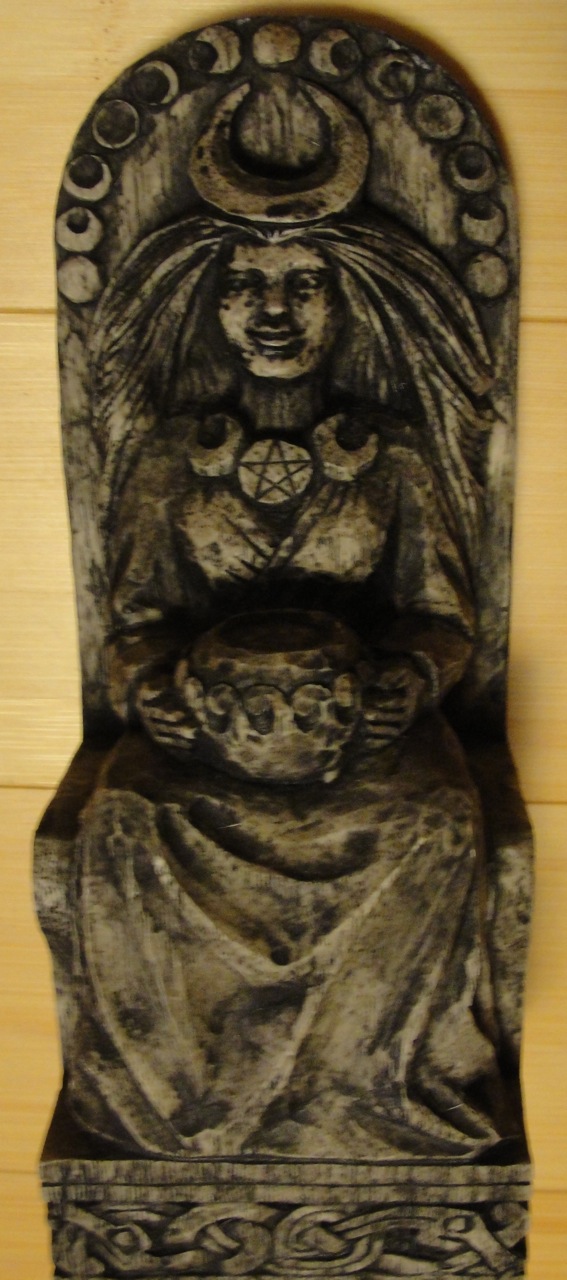
For many years I didn’t know what to do about God. The word had become almost noxious to me, and connected to oppressive forces in my life. Yet I still felt a relationship to some sort of spiritual experience. For a while I didn’t know how to imagine or think about it. Seated GoddessBut I was part of a group of women who were wrestling with all of this together. We began to counter the oppressive forces of religion by creating new images of the divine in a conscious way. We re-imagined God as female, by calling her Goddess. We realized that many cultures have worshipped the divine in female form.

But is it possible to imagine a Goddess and experience her as real? What is real and what is imaginary? Here’s the thing I discovered. The Goddess began to feel real to me when my life started to change. Something is real when it makes a difference to us, when it causes transformation in our lives. Images become real when they open a door. The Goddess became real when the power of women became real—when we were able to embrace our own sacredness, affirm our own intrinsic value and dignity, and live out our own gifts and talents and leadership.

In The Color Purple, Shug also found new ways to imagine God. She said,

My first step from the old white man was trees. Then air. Then birds. Then other people. But one day, when I was sitting quiet and feeling like a motherless child, which I was, it come to me: that feeling of being part of everything, not separate at all. I knew that if I cut a tree, my arm would bleed. And I laughed and I cried and I run all around the house. I knew just what it was.

Sun in Trees DSC05525

Quotes from Alice Walker, The Color Purple, p. 166.
Mary Daly, Beyond God the Father, (Beacon Press, 1973)

Reverence

There is another challenging aspect to embracing a spirituality of experience. It is not only a matter of paying attention to our own experience. It is also a matter of being open to the experience of others. How do we affirm each other’s spiritual experience when that experience may be very different from our own? How do we bring individual spiritual experience into the cauldron of community? If we approach these questions in a merely logical way, we can come up short.

For example, those of a skeptical nature might find it challenging to understand the experience of someone who relates vivid encounters with non-physical beings: gods or angels or spirits. If you do not experience such beings, you might find it inexplicable that others might. It might contradict everything you know about the world. Could there be such a reality, beyond the reach of our ordinary senses? I am not going to ask you to believe in it, but to take into account the possibility that some people may experience it. There are times when experience—our own or that of others—goes beyond our rational understanding.

Some cultures tend to be more at ease about such phenomena. I have a friend who is Puerto Rican. In her culture, one of the ancient traditions brought from Africa is called Santeria. When my friend opens her awareness to experience the larger reality, images from her culture come to life. She sees the spirits of Elegba and Oshun and Oya, with vivid colors and songs that others in her culture also report. These spirit beings interact with her and have been very significant in her life. Who is anyone to say they are not part of reality, when a whole culture affirms and cherishes them?

I am not saying we should not bring our reasoning to bear on our experience. My encounter with people of other cultures has made me more appreciative of the mystical elements of reality, and ironically, also more skeptical. It has taught me how our cultural context shapes our experience, even at what we imagine to be the most intimate and personal levels. If, as a child, I felt held in the loving arms of Jesus, was that reality, or was that an image shaped by what I had been taught to expect? Or could it be both?

When I was twenty six, I learned how my religious tradition had been shaped by the dominance of men in my culture, and I became suspicious of images of God that excluded the female. These male God images had been influenced by the assumptions and values of those in power. I had received no cultural mirror in which to imagine divinity in a feminine way.

So there is a paradox. Our experience of reality is shaped by our cultural context. This can affect our lives in both positive and negative ways. There are times when we need our rational understanding to be able look critically at experience. Experience is the essence of spirituality but it is not infallible. We must measure spiritual experience by the values and thoughtfulness with which we should measure all parts of our lives.

But there are times when our reasoning may be confounded. Let me tell you another part to the story. My Puerto Rican friend fell in love with a white woman who was a cynic about spiritual matters. Her passion was the work of social justice. However, when she entered a relationship with my Puerto Rican friend, her cynicism was challenged in an unexpected way. She began to see Elegba and Oshun and Oya in her inner imagination. She said to me once, “Those Puerto Rican spirits don’t care if I don’t believe in them. They show up whether I want them to, or not.”

There is so much about reality that is mysterious and hard to explain. We rely on our experience, and the experience of others, to give us evidence about the world. If we acknowledge our own experience, our own inner reality, then we must acknowledge the inner reality of others. That leaves us open to dimensions that might be difficult or impossible to measure. So while I would never ask anyone to believe in the unproven, I do invite you to keep an attitude of reverence for all that is unexplained in yourself and in others.

The poet D.H. Lawrence describes it this way:
This is what I believe:
…That my soul is a dark forest.
That my known self will never be more than a little clearing in the forest.
That gods, strange gods, come forth from the forest
into the clearing of my known self, and then go back.
That I must have the courage to let them come and go.
That I will never let mankind put anything over me,
but that I will try always to recognize and submit
to the gods in me and the gods in other men and women.

Clearing

 Quote from D.H. Lawrence, Studies in Classic American Literature:. (Cambridge University Press, 2003) p. 26. Excerpt was first published in English Review, December 1918 in the article “Benjamin Franklin.”

Trust Your Own Journey

Gate The spiritual journey is a path of waking up our awareness. It demands that we trust our experience, become friends with our burning. It does not matter if your hunger is a different hunger than mine: you must trust your own hunger. Sufi mystic Rumi writes that our hunger itself is proof of the existence of bread. Our thirst is proof that there is such a thing as water. If we trust our deepest inner hunger it will lead us on our own spiritual path.

I cannot tell you what your spiritual path must be. I can only offer you some gleanings, some sparks of light for your spiritual journey from my experience of following my own burning, and my experience of being in community with the people of my congregation and other spiritual searchers. Hallway with DoorsSomeone once described our faith community as a hallway with many doors to the holy. One temptation is to get stuck in the hallway, celebrating the freedom to choose whichever door we want, rather than to open any of them. There is a Buddhist parable that says we can’t find water by digging many shallow wells. To begin a spiritual journey we must actually open a door, and walk through to where it leads us.

Albert Einstein’s questioning hungers led him to open a door into scientific experimentation and mathematical reasoning, and he followed that pathway more deeply than most minds are able to fathom. Was that a spiritual journey? I think so. He became a friend to his own burning. His vision has inspired and changed our lives, even if most of us could not explain the theories he developed.

Spirituality is not an escape from the world. Spirituality is about experiencing more deeply our relationship to all that is. Spirituality is awakening to awe and gratitude for all that is. We don’t have to be a Rumi or an Einstein to enter a spiritual doorway. We only need to become friends with our own burning.

Frederick Buechner says,“Listen to your life. See it for the fathomless mystery that it is. In the boredom and pain of it no less than in the excitement and gladness: touch, taste, smell your way to the holy and hidden heart of it because in the last analysis all moments are key moments and life itself is grace.” 

To be spiritual means to pay attention to our own experience of the mysterious reality of which we are a part. I am inviting you to take a risk—to befriend your hunger, to pay attention, to go through the doorway, to see what you might experience about our miraculous world.

To take that next step through the door can be difficult. We might be suspicious of what lies on the other side. We may be drawn to mystery, but uncomfortable with the irrational or unproven. We might discover old wounds triggered by the symbols or language from difficulties in our religious past.  How do we heal?  How do we re-imagine or reclaim our own connection to divinity?

For now, I invite you to notice what is in your heart.  Notice the hungers you feel, the questions, the passions, the fears.  Notice, just notice, any wounds you may carry that surface when you approach a doorway into spirituality. Make a list.  Explore what triggers those wounds, and let yourself remember any painful experiences from your own religious past.  I will continue to explore these questions in future posts.

Mystics & Heretics

An emphasis on spirituality as experience is not really new. It can also be found among those who were called mystics in all the great religious traditions. They were sometimes called heretics because they didn’t worry too much about dogma. We don’t really have the language to adequately describe spiritual experience. When we use words like God or Goddess, we are just grasping at straws, using words and images to try to convey what cannot be defined.

Fire DSC04621The poet Rumi, a Sufi mystic in the tradition of Islam, said that language doesn’t matter, the words we use don’t matter. “The love-religion has no code or doctrine.” Spirituality is not about what we believe, but what we feel. What matters is seeing, touching, knowing, loving. What matters is the burning of our hearts. He says we must become friends with our burning.

[Quotes from The Essential Rumi, trans. by Coleman Barks]