Experience the Present Moment

Snowy Abstract Sun DSC08841In order to enter this experience of the present moment, which is also the experience of eternity, we must move from our left brain awareness to our right brain awareness. Taylor says the way to do that is to quiet the chatter of the left brain, which speaks to us constantly in the story of our life. So that is what meditation teachers have been trying to tell us!

I am usually a very left brain sort of person. I like the way the left brain organizes everything and notices patterns. I like how it tells a story from the memories of my life, and tries to make meaning and find the purpose of things. I like how it can see the patterns of the planets and stars and moon, and create calendars. I like to listen and read and write and talk. One of my spiritual practices has been to journal, and I can see that this is a very left brain spiritual practice, a way to tell a story and make meaning about my life.

But with the insights of Taylor’s perspective, I also feel more comfortable with that other process, that process of stopping the left brain, to experience being. The process of letting go of the past and future to notice the abundance of the present moment. She says,

“The feeling of peace is something that happens in the present moment. It’s not something that we bring with us from the past or project into the future.”

The right brain has the capacity to appreciate the miracle of life right now: that we are here, that our cells work together to see and hear and taste and touch. The right brain has the capacity to experience the connection between ourselves and the larger whole of which we are a part. The right brain is inherently grateful and nonjudgmental, compassionate and curious, awake to beauty and joy. The right brain is aware of the dance of life, not attached to a separated small being, but joined to a flow of energy that is not divisible by time or space. William Blake has put it this way:

To see a world in a grain of sand
and a heaven in a wild flower,
Hold infinity in the palm of your hand,
and eternity in an hour.

Quote from Jill Bolte Taylor, My Stroke of Insight, p. 159.
First lines of the poem by William Blake, “Auguries of Innocence.”

The Work That Reconnects

Sunset Friends

Photo by Margy Dowzer

The Great Turning described by Joanna Macy is in essence a spiritual transformation. She has offered a process for people to work on that transformation together—The Work that Reconnects

It begins with the practice of gratitude. Macy says that gratitude is revolutionary in a world that tells us we are not enough, and we don’t have enough. Gratitude is a remedy for rampant consumerism. Gratitude is how we open our eyes to the beauty of what is now—the beauty of the shining sun and the nourishing rain. The gifts of creativity and relationship. The gifts of friendship and community, the food we eat, and the shelter over our heads. Gratitude can heal our souls, and give us strength to face the challenges of our time.

The second part of this spiritual work is to honor our pain for the world. When we open our eyes to the suffering being caused by the system as it is, we do feel incredible pain; we feel pain when we see how far we are from the future we can imagine. Macy reminds us that our pain comes from our sense of connection, and connection is what will save us. We hope to deepen our awareness of our connection with all people and all beings on this earth. And yet, as we deepen our awareness, we deepen our compassion, and we feel even more that pain of the world. We must choose not to run away from that, but to honor our pain as a signal of our connection.

That leads us directly into the third part of this spiritual work: to see with new eyes, to feel ourselves a part of the larger whole. We awaken to the reality that we are connected to all other human beings, that we belong to this earth, this beautiful living planet, and we have the power to make a difference on the earth.

The fourth part of the spiritual work is to go forth and use our gifts to participate in some way in the Great Turning. Macy identifies three areas of this work.

Tar Sands Protest

Tar Sands Protest
Photo by Margy Dowzer

There are what she calls “holding actions” like protests and lobbying on behalf of the environment, or against foreclosures. Some people need to be sitting in trees and marching in the streets.

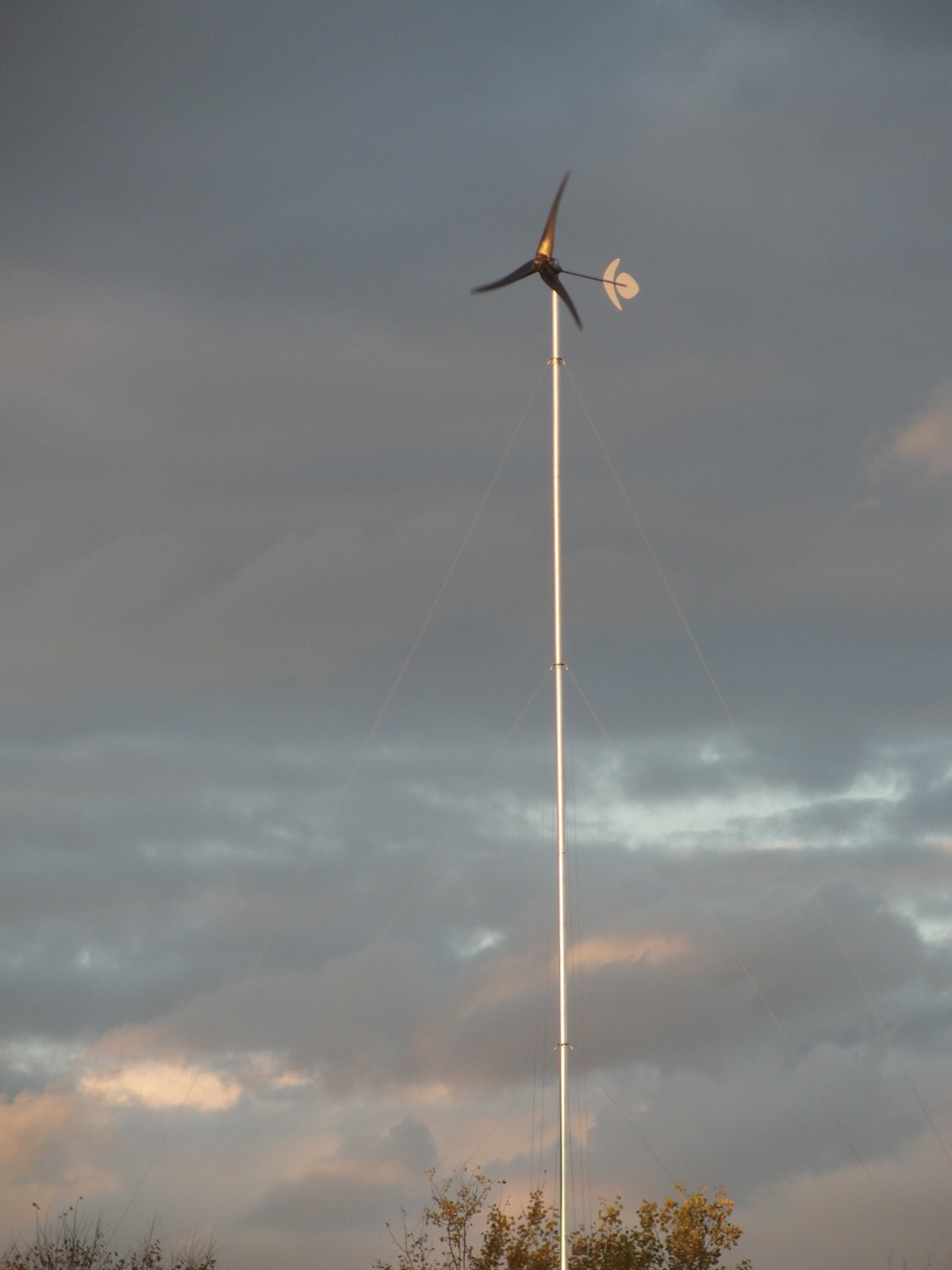
Wind Turbine

Wind Turbine

There are also experiments in what Macy calls, “Gaian structures,” new, or sometimes very old, ways to live that are sustainable and connected.  Some people need to be gardening, and building carbon neutral houses, and installing solar and wind power.

There is also the important work of shifting the consciousness of those around us. Some of us need to be writing books, and creating songs, and teaching young people about how to live as if we are a part of everything else.

Because there is so much to do, we can do that which most calls to us.

Waking Up to Joy

I realize not everyone is attuned to rise at dawn. We each have our own circadian rhythms. Scientists have found that individual rhythms have a genetic basis and are incredibly difficult to change. Some people naturally rise early, they call them the larks, while others are tuned to a later cycle, they call them the owls.

So I am not suggesting that everyone should start rising at dawn. I am still not even sure if I can shape my life in that way. But what I notice is that whenever I take some small step toward attuning myself with the larger earth, I feel blessed by it—I feel more beauty and joy.

And yet, for each small step, I also feel challenged—aware of how broken off I am. Aware of how broken off we are as a people from this earth that is our whole life. I have to believe that awakening to this beauty and brokenness is the essence of the spiritual journey. We cannot have one without the other. My greatest hopes trigger my greatest fears. My greatest fears call forth my greatest hopes. I believe that when we enter that place between our greatest fears and our greatest hopes—when we encounter our own vulnerability, and call out for help, something can rise in us like the dawn… and this is the place where God lives.

I am still on this journey. When the days are shorter, the dawn comes later. But then it is too cold to go sit outside like I sat outside during the summer. So I am not sure how it will unfold. Sometimes I sit by the window and watch the sunrise from the comfy chair in my room, a tiny black cat curled up in my lap. But I remember the message of the cardinal singing at dawn: Come outside! May sadness be dispelled, may joy and beauty be awakened in us.Snowy Sunrise

Dawn Rhythms

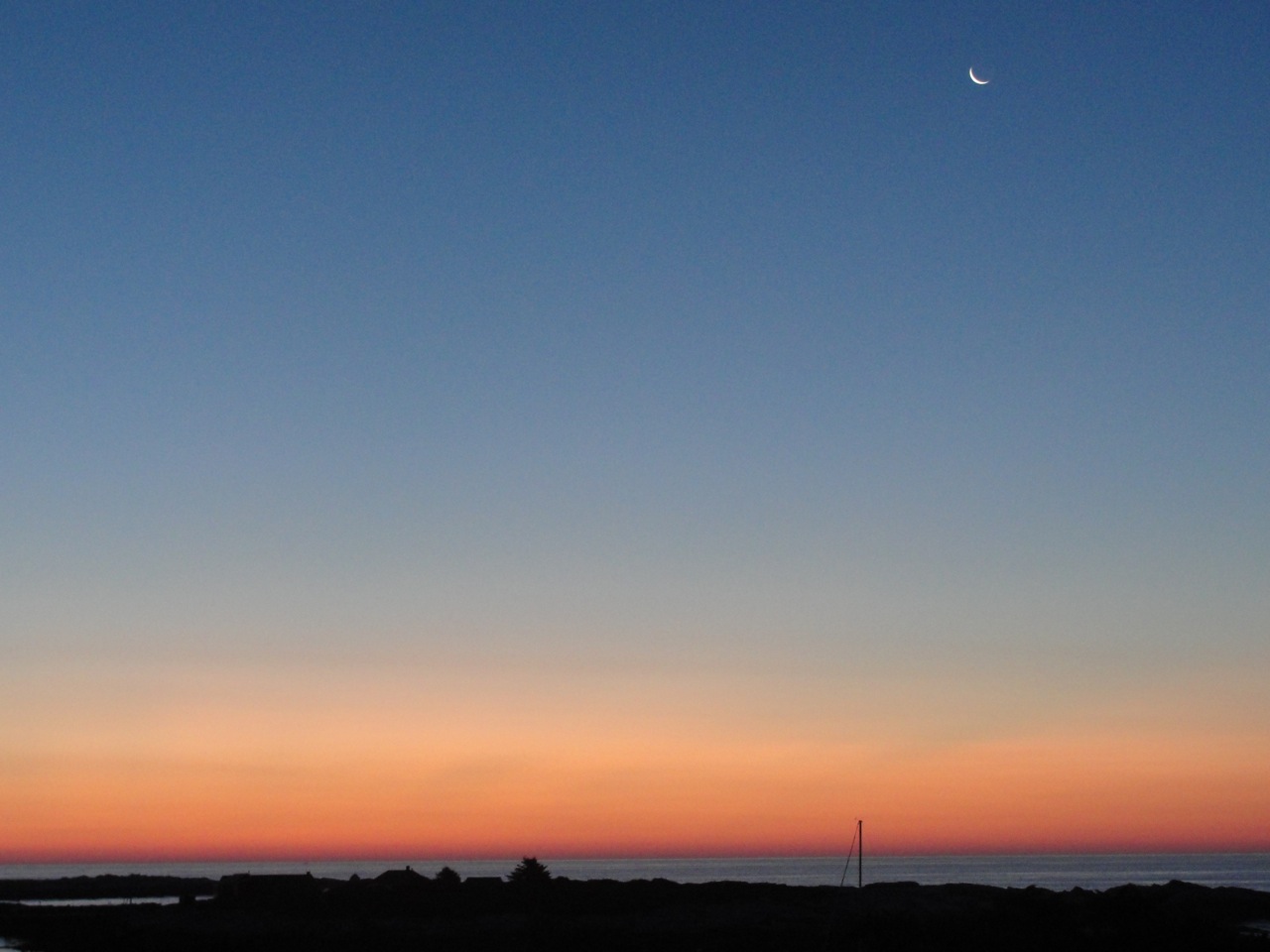
Crescent Moon at DawnOne morning on Star Island, I heard the cardinal at 4 a.m. Closer to first light. The waning crescent moon was hung over a deep pink rainbow of a skyline. I began to wonder why we don’t always get up with the light. It is actually quite bright in the hour between dawn and sunrise.

Before that summer, I had used the words dawn and sunrise interchangeably, but I learned that dawn refers to the first light that comes before sunrise. There is so much of it. Enough to read and write in my journal. We could save a lot of electricity if we got up at first light, and went to bed earlier. Of course, that is the logic behind daylight savings time, where we set the clock ahead so that we wake up an hour earlier during the longer days.

But what would it be like if our world was oriented to the rising and setting of the sun? Then every day we’d rise a little later or earlier than the day before. Because the sunrise changes every day. We’d have long days in the summer, and short days in the winter. The earliest sunrise in Maine comes in mid June, just before 5 a.m. daylight savings time. (That would be 4 a.m. Eastern Standard Time.) The latest sunrise comes about 7:15 at the end of December, except, because of time changes, it actually gets to 7:22 in early November, before we fall back with the changing of the clocks.

So, people might say that it wouldn’t be practical, in our world, to plan our day according to the sun. We plan our lives according to the clock. But what do we lose by that? While I was trying to discover the natural rhythm of dawn, I could feel how disconnected I was from all natural rhythms. Rising at dawn is a way to deepen my relationship with the seasons of the earth, and to the sun, and to the birds. But it makes me wonder, “Why do we try to shape the earth to our demands? Why don’t we try to shape ourselves to the rhythms of the earth?” And what might happen if we changed that pattern?

Cultures and religions the world over have honored the sacredness of dawn, the sacredness of the sun. Our word “sun” comes from the Old English, “sunne,” which was related to the Germanic sun goddess, “Sunna.” It shows up in our everyday language—the day of our worship is called Sunday. Christian monks, and Hindu priests rise at dawn; Muslims during Ramadan, as well as Indigenous peoples across many cultures. There is something in our human life that wants to be attuned to the life of the earth, which looks for beauty and joy in these simple rhythms.

Moving Toward East

I feel awe and wonder when I watch the sun come up in the morning and also when it goes down in the evening. Its beauty and grandeur can be breathtaking. It gives me even greater awe and wonder to realize that it is actually we on the earth who are moving, turning toward or away from our view of the sun. Science has taught us that. The earth spins on its axis once every twenty four hours, and this spinning creates our day and night. I may know all this intellectually, but I must use my imagination to experience it: see if you can, too. You can try this anytime, but it is most vivid at a sunrise or sunset.

Face the east just before sunrise.
Imagine yourself riding on the surface of the round earth sphere,
almost like riding in a car, looking out the front window.
We are speeding forward further and further until suddenly the sun comes into view. Feel yourself moving!

Later, just before sunset, face the west.
Again imagine yourself on the surface of this huge globe.
This time, like a child looking out the rear window of a car,
see that we are speeding away from everything until the sun slips from our sight.
We’re always moving toward the east!

It would make us dizzy to be aware of this motion all the time. But for a moment, we can be dizzy with the wonder of it all. Scientific knowledge can bring us to an awareness of reality beyond what we can see with our own eyes. Spirituality is when that awareness moves from the dry realm of intellect into the visceral experience of awe and wonder. The natural world is the original holy book, the original sacred text: the earliest forms of religion were responses to the mysteries of the earth and sky. As our ability to read this book of the universe grows, our spiritual practices are trying to catch up.

Dawn at Star IslandMargy and I traveled to Star Island, a conference center that is an island off the coast of New Hampshire. It is a rather small island—you can see the water from almost every place on it. It turned out that the windows in our tiny room faced the east. The next morning, through my open window, of course I heard a cardinal singing before sunrise. “Come outside!” it seemed to say, once again.

Right beyond the door of our room was a porch facing east, with rocking chairs on it. I could crawl out of bed wrapped in a blanket, and sit in a rocking chair to watch the sun rise over the ocean. That day, the clouds formed variegated patterns of pink and orange, blazing up through the whole eastern sky. The cardinals jumped from bush to bush close to where I was rocking in my chair.Rocking Chairs

Watching the beauty of the sunrise during the next several days, I was again thinking about how the sun generates its own energy, how all the stars do that. We on earth are more like children, we are utterly dependent on this light-being for all our needs. All of the energy human beings generate and use all over the earth relies on the sun as its ultimate source. The whole sphere of life on earth is a child of the sun. Yet the sun is so personal too. We can feel its touch on our faces—it is as personal as the vitamin D that it creates through our skin.

The poet Hafiz said,

Even
After
All this time
The sun never says to earth,
You owe
Me.”
Look
What happens
With a love like that.
It lights the
Whole
Sky.

 Poem from The Gift: Poems by Hafiz, The Great Sufi Master, translations by Daniel Ladinsky 

Reality is a Dance

Kayaker Reality is a dance between making plans, and responding to small and large disruptions. So to embark on a spiritual journey is to grow our capacity to practice, to plan, to wait outside, and then to embrace all that reality offers.

A spiritual practice is meant to help us develop the skill of embracing what comes to us as an opportunity to wake up. A spiritual practice helps us to be fully present and to pay attention. If we have not been practicing, we can get thrown off by life’s disruptions, become grumpy and anxious, shut down or reactive. In fact, that can happen even when we have been practicing. Kayak Tipped OverBut I know from long experience that the more I practice this embrace of reality, the easier it becomes to shift from resistance to curiosity, from crankiness to compassion.

The spiritual journey is our search for an immediate, personal experience of the larger reality, our connection to the earth, to each other, and to the Mystery that connects and upholds life. Let us go back for a moment to an experiment.

Notice the energy in your heart right now.
If you wish, create an invitation in your heart, open your heart to experience the larger Mystery that connects and upholds all life.

As feelings come up, imagine your breath filling and embracing those feelings. Be present to what emerges in your heart. If you feel emptiness, breathe into the emptiness. If you feel joy, breathe into the joy. If you feel confused, breathe into the confusion.

The beginning and the ending of spiritual practice are in paying attention to the energy of the present moment.

After the wondrous, after the experience of Mystery, we must always come back to the everyday. In pagan rituals, they say we must “ground the energy.” We remember to eat food or have a drink of water. In Buddhism, there is a saying, “after the ecstasy, the laundry.” Sanity is being able to switch our consciousness from the mysterious to the ordinary. Life is not static, it keeps moving. We are not meant to remain in emptiness or in ecstatic feelings. We are meant to be fully involved in all that life is about. Says one Western lama, “What became clear is that spiritual practice is only what you’re doing now. Anything else is a fantasy.”

The most important grounding is how our spiritual experience affects the rest of our living. In the end, we may ask, What is spirituality for? I would answer that our experience of the Mystery that connects and upholds life is meant to bring greater power and resources into growing in community with all that lives. Authentic spiritual practice will energize us for greater kindness, compassion, peace, and humility. May it be so.

In the waterQuote from Jack Kornfield, After the Ecstasy the Laundry, (New York: Bantam, 2000). p. 126

Replacing the Floors

I want to share a secret about the life of a preacher. Preaching itself is a kind of spiritual practice, a paying attention to the present moment. I post my sermon titles and descriptions in our congregation’s newsletter at the beginning of the month, which means that they have been created in my mind at least as early as the end of the previous month. So the topics are hovering around my awareness for a few weeks at least, and they help me to notice things. So as I began to think about the spiritual journey, in preparation for talking about it to my congregation, I was pondering the practices of various religious traditions—things like Zen meditation, or journaling, or daily prayer, and what these might offer to us.

But then, the week before I was to preach, we discovered that our church building had a problem—people were reacting to some sort of mold or mildew in the air, and we needed to fix the problem. The people who volunteer their time on the building committee and the board of trustees responded. They decided to replace the old carpets with tile flooring. Of course this would mean a big disruption. Everything needed to be taken out of the rooms where the floors would be replaced, and put somewhere else. And if you take everything out of the church office, the church administrator can’t do her job. No computer, no copy machine, no email. No Sunday “Order of Service.” It all stops.

I had just gotten this news and I was driving to church on the Monday before the sermon, when suddenly it hit me: All of this disruption was also about our spiritual journey. Growth doesn’t happen just when we plan for it, but in what we do when our plans go awry. We can use everything. In fact, preachers always use everything when we are working on Sunday sermons. We use the books we read and the things that happen to us, and the songs we hear and the stories on the news. We can use everything. And we must.

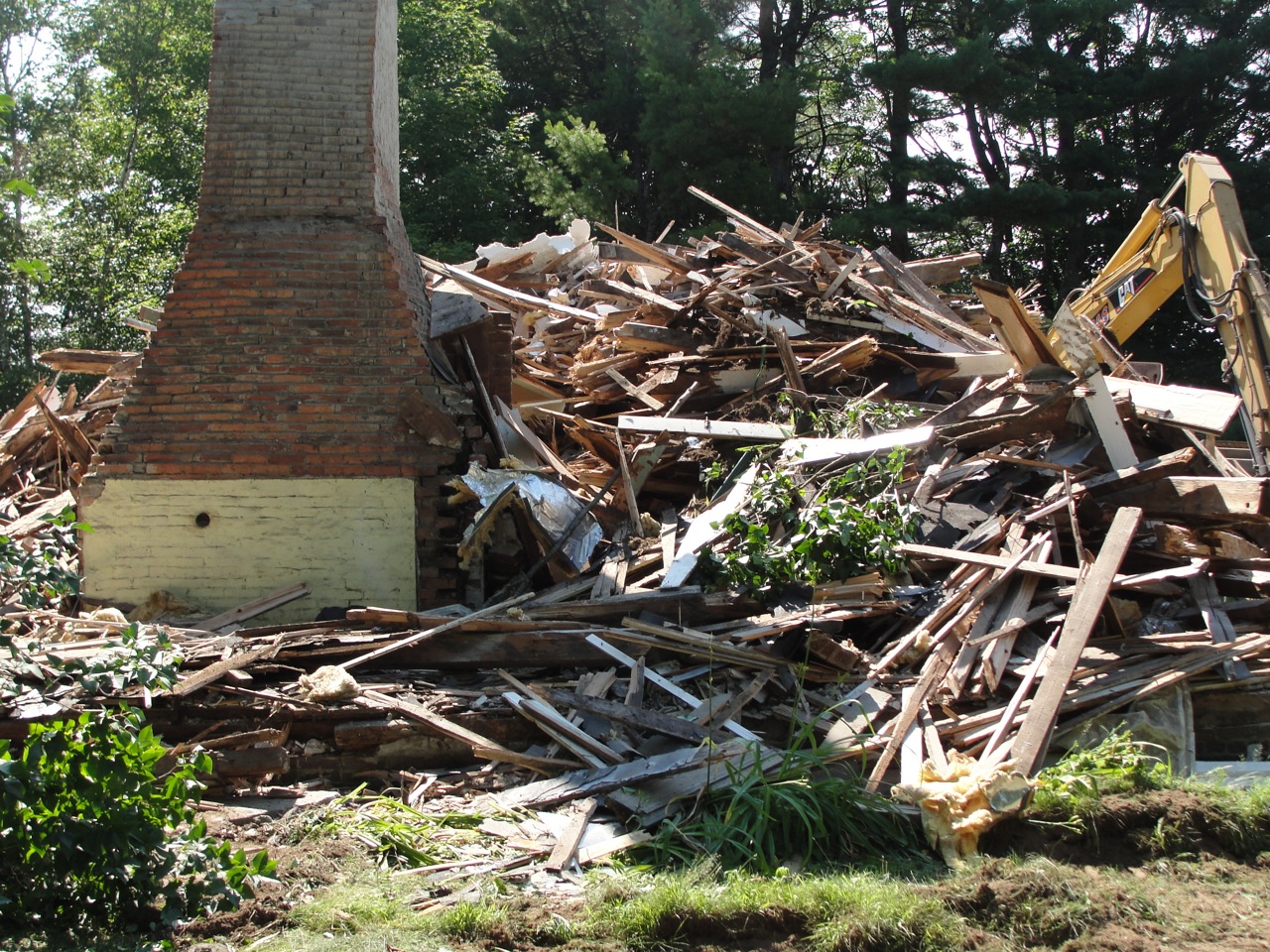
House Destroyed DSC04194Because when we open our hearts to the spiritual journey, we open them to the larger reality of life. We embrace reality, and reality is full of disruptions. So the week that the floors were replaced was the perfect week to preach about the spiritual journey. The floor under our feet had been literally ripped apart, and we faced a new surface to stand on. People were sitting without any familiar order of service to guide them, and thus had an opportunity to embrace the uncertainty of what might happen next. It is called by theologians a liminal time—a time when ordinary events are suspended, and we hover on the threshold of what might come next. A time when we lose the illusion that we are the ones in control of our lives. We will either hang back, or take a leap.

Emptiness

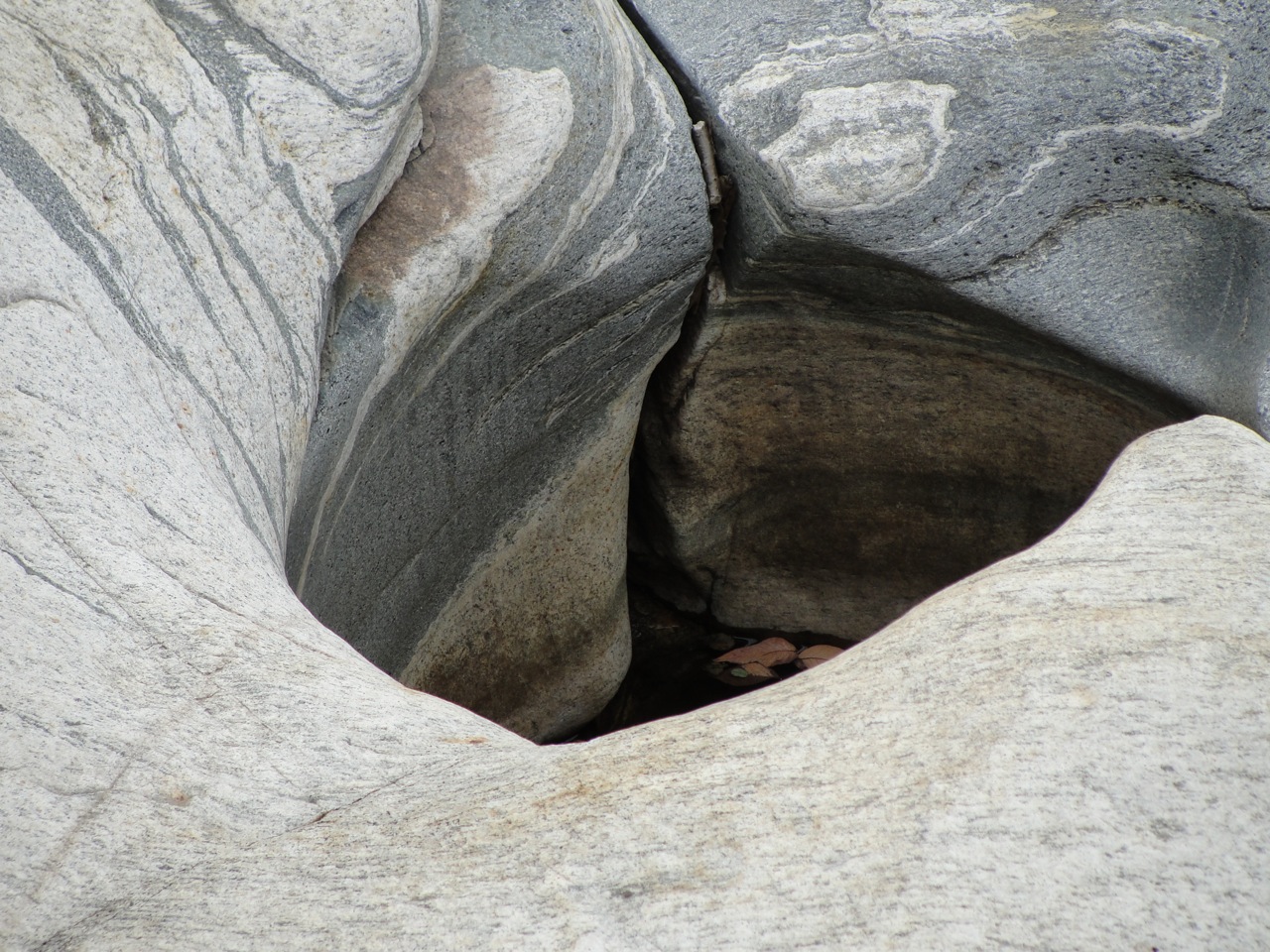
What comes next? If we wait in the darkness, if we succeed in opening our heart to awareness of the present moment, we may discover within us certain empty feelings, a kind of spiritual hunger. That does not mean we have failed in our search. Rather, it means we have found the next step. An experience of yearning may feel like a hole deep in our being. Hole in RocksWe may be tempted to try to fill it quickly with some new type of ritual or escape into some other sensation. It may feel painful and lonely, like an absence of something we need. But this emptiness is itself a kind of window or doorway.

The Buddhist teacher Kinrei Bassis says:

“the deepest form of prayer is really just the willingness to be still and let the longing in your heart go out without defining or understanding where it is going. Meditation is the willingness to let go and learn to trust so that we may enter into this seeming darkness.”

The emptiness itself, if we embrace it fully, can become the doorway into the larger reality. The practice of paying attention to the present moment helps us to cultivate the capacity to remain present to our feelings. We grow more at ease with anger, fear, sadness, and longing. We are able to breathe into these feelings, rather than run away from them.

If we breathe into the longing, breathe into the emptiness, there comes a time when it may open up into an experience of communion, an experience of our connection with the earth, with each other, with the Mystery within all reality. It may feel something like dissolving into Mystery. This experience goes beyond the capacity of words to describe. We may feel deep joy, even ecstasy, an intense awareness of being one with Love. An old hymn described it as “Leaning on the Everlasting Arms.”

Sometimes, that feeling may come unexpectedly, without any spiritual practice at all. The Mystery is funny like that. It surprises us. Sometimes it comes when trouble or grief has opened a chasm in our hearts and the pain of yearning fills our being to the core. It has been in the lowest moments of my life, that I most experienced the presence of the Mystery, holding me in love and connection and carrying me through.

Quote from “The Buddha Calling the Buddha,” by Kinrei Bassis, in Parabola, Summer 2006.

Waiting In the Dark

Milky Way

Image courtesy Wikimedia Commons

I want to share with you a little story. I went outside to watch the meteor shower during an August night. I was just sitting in my driveway, on a reclining lounger, watching and waiting. Every so often, I would see a streak of light flash across the sky. But mostly it was just quiet and dark. I was thinking about the Milky Way, and how far the stars were spread out, and how long it took for their light to reach my eyes. I was thinking about the fact that the light from these stars was reaching my two eyes in an ordinary driveway in Maine. Suddenly the sky seemed so much larger than I remembered, and I felt so much smaller, an infinitesimal speck. And yet I was seeing everything, and my seeing was as large as the sky. I was a part of the mystery. What was inside of me felt as large as the sky.

To experience that feeling, I had to go outside in the night and wait. I had the intention of looking for meteors, but there were only a few of those. However, if I hadn’t been waiting in the dark, I wouldn’t have experienced the mystery of that night. To embark on a spiritual journey is like finding opportunities to wait in the dark, however we might do that—waiting in the dark, looking for what we think we are looking for, but sometimes finding so much more.

The goal of any spiritual journey is to lead us into that depth, that place where the known crosses into the unknown. There is a part of the spiritual journey which must be intentional. We must choose to wait in the dark. But the inner purpose of a spiritual journey is to move beyond the capacity of our own intentions, to discover something larger than what we could imagine—a larger reality, a larger love, a larger mystery.

The method by which we choose to wait in the dark we call a spiritual practice. It does not matter so much how we do it, but that we take the time to do it—that we take the time to be quiet with ourselves, or to pay attention to the world around us, or to stretch the muscles of our mind and heart in the questions that we cannot answer.

For some of us, silent meditation may provide a discipline for that inner attentiveness. For others, the practice of journaling may become a tool for deep reflection.
What did I dream last night? What am I feeling today?
What am I worried about? What am I thankful for?
Another practice is to read poetry and collect the words that inspire us, so that we can memorize them, and ponder them in our hearts.
We might walk in the woods or along the shore of the ocean.

Again, it does not matter so much how we do it, but that we take the time to do it.

Imagination as a Tool

Imagination can play an important role in shifting our attention. If we want to find that which is larger than words, that which we cannot define or explain by words, we need to access the playfulness of the non-verbal mind. Images are one way that we can experience the non-verbal realms. Carl Jung taught us about the power of dream images to express realities which could not be expressed in words. In my dreams, I have experienced the power to fly, to light candles from across the room, to heal with fire in my hands. Our dreams can be a pathway into a different consciousness.

Candle flameSometimes, people shift their attention by calling upon an image of the larger reality. Some people call upon God to hear them and to speak to them. Others invite the goddess to enter the circle. Or we might say, Infinite Light, be here now, and light a candle. These invitations are also called invocations. It might feel silly to us to call out to someone or something that we don’t even know is there. But any time we invite the larger reality into the room, what we are really doing is inviting our hearts to shift their attention. We are re-tuning our hearts to notice the light that is already there.

The images are meant not to be objects to grasp in our minds, but tools for the imagination to awaken the mysteries of connection within us. So, if I say, “Spirit of Life, please open my heart to the wonders of your world,” I create an intention, a form that can hold the energies in a certain rhythm or shape. I open a window in my consciousness, to see what my literal eyes cannot. When we open the door, there is something that wakes up, something beyond what we can expect or explain. If we don’t open the door, we will never know what is out there, or in here.