New Year Beauty

New Year Sunset with Margy

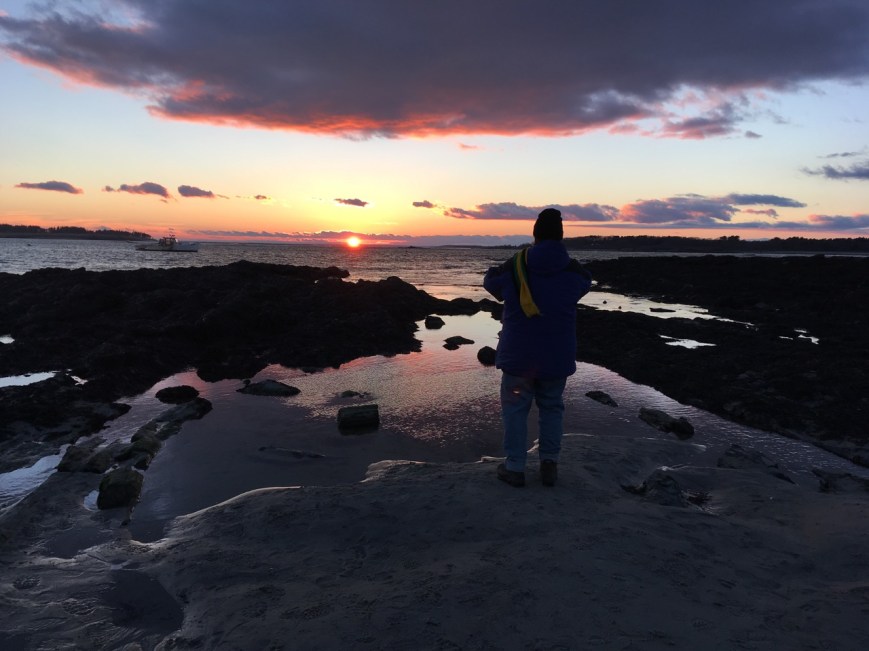
Margy and I watched the New Year sunset at Kettle Cove. It is one of the few beaches we know of on the east coast of Maine, where you can watch the sun set over the water, in winter.  (This is because the beach at that point faces southward, and the sun is setting further to the south than in summer–a perfect alignment.) In 2019, I intend to visit the ocean more often.  It is so close to us, and yet it is so easy to forget to drive 30 minutes to experience this beauty.

Despite all the hard things that are plaguing our beloved world, may we remember to seek out beauty and joy each day.  May we remember color and light and shade and darkness and shine and curve and flow and rhythm.

Turkey Sunrise

Turkey in top of pines

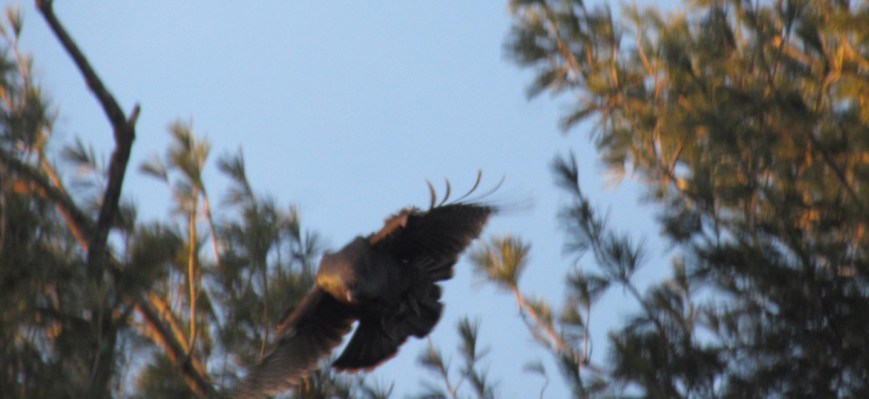
This morning, as the sun was rising, I saw a huge bird shape in the top of the white pines at the very back of our yard. I went outside to see what it was. Looking closer, I saw that it was a turkey, and in fact, there were several turkeys perched high in trees all around us. How my heart is warmed and excited by the fellow beings who visit us here on this land!

Turkey in pines close

Then I noticed that there were half a dozen turkeys on the ground behind me, near our ornamental crabapple trees.  Over the next 10 minutes, one by one, the turkeys in the trees flew gracefully down to the ground. They were mostly too quick for me to capture them in flight, though I caught this one as it approached the ground in a blur.Turkey in flight

Finally, the whole clan of turkeys gathered together and ambled toward the underbrush near the pines. I too started on my walk to the brook and around the neighborhood. In the midst of all that we face in the coming years, I pray that there will always be animal and plant neighbors whose daily lives bring us joy. I pray that we won’t forget to notice and appreciate them.

Turkey clan

For Those Who Are Blue

Some ministry colleagues shared these beautiful poems, and I thought that there might be someone out there who needs them today.

White Candle MJ DSC09662

Sweetness by Stephen Dunn (from New and Selected Poems 1974-1994. Copyright © 1989.)

Just when it has seemed I couldn’t bear
one more friend
waking with a tumor, one more maniac

with a perfect reason, often a sweetness
has come
and changed nothing in the world

except the way I stumbled through it,
for a while lost
in the ignorance of loving

someone or something, the world shrunk
to mouth-size,
hand size, and never seeming small.

I acknowledge there is no sweetness
that doesn’t leave a stain,
no sweetness that’s ever sufficiently sweet . . .

Tonight a friend called to say his lover
was killed in a car
he was driving. His voice was low

and guttural, he repeated what he needed
to repeat, and I repeated
the one or two words we have for such grief

until we were speaking only in tones.
Often a sweetness comes
as if on loan, stays just long enough

to make sense of what it means to be alive
then returns to its dark
source. As for me, I don’t care

where it’s been, or what bitter road
it’s traveled
to come so far, to taste so good.


My Dead Friends by Marie Howe (from What the Living Do, © W.W. Norton & Company, 1998.)

I have begun,
when I’m weary and can’t decide an answer to a bewildering question
to ask my dead friends for their opinion
and the answer is often immediate and clear.

Should I take the job? Move to the city? Should I try to conceive a child in my middle age?
They stand in unison shaking their heads and smiling – whatever leads to joy, they always answer,
to more life and less worry. I look into the vase where Billy’s ashes were – it’s green in there, a green vase,
and I ask Billy if I should return the difficult phone call, and he says, yes.

Billy’s already gone through the frightening door,
Whatever he says I’ll do.


Blessing for the Longest Night by Jan Richardson (from The Cure for Sorrow
© Wanton Gospeller Press, 2016)

All throughout these months
as the shadows
have lengthened,
this blessing has been
gathering itself,
making ready,
preparing for
this night.

It has practiced
walking in the dark,
traveling with
its eyes closed,
feeling its way
by memory
by touch
by the pull of the moon
even as it wanes.

So believe me
when I tell you
this blessing will
reach you
even if you
have not light enough
to read it;
it will find you
even though you cannot
see it coming.

You will know
the moment of its
arriving
by your release
of the breath
you have held
so long;
a loosening
of the clenching
in your hands,
of the clutch
around your heart;
a thinning
of the darkness
that had drawn itself
around you.
Moon in branches DSC02496This blessing
does not mean
to take the night away
but it knows
its hidden roads,
knows the resting spots
along the path,
knows what it means
to travel
in the company
of a friend.

So when
this blessing comes,
take its hand.
Get up.
Set out on the road
you cannot see.

This is the night
when you can trust
that any direction
you go,
you will be walking
toward the dawn.
Winter Kale

winter kaleI just have to say it once more:  kale is amazing! I picked this kale yesterday morning, leaves frozen on the stalk, snow on the ground.  I had already picked most of the kale–just leaving a few tiny leaves that didn’t seem big enough for anything.  But they must have grown a little in the meager sunlight and freezing snowy weather we’ve been having the last two weeks of November.  I don’t know how they do it, but that is why they are so amazing.  The plant just isn’t willing to succumb to the freeze/thaw weather that has killed off most of the other plants.  So when I was walking through the winter orchard, I found several small frozen leaves, broke them off, and cooked them up for breakfast–they taste great!

Kale in snow

I Walk in Passamaquoddy

I have had the privilege of studying Wabanaki Languages this fall, taught by Roger Paul. For me it has been a small way to begin to decolonize my mind–to begin to think differently.  Our final project was to make a short presentation to our class, and I was inspired by the words we had learned to talk about the animals I see and hear on my morning walk. I also drew on the Passamaquoddy/Maliseet (Wolastoqe) Language Portal for further help with verb and noun forms, and I learned some new words along the way.  If any speakers of the language read this, edits are welcome! Roger encouraged us to jump in with using the language, even though we will make mistakes. 

For those who do not know about Wabanaki languages, you might find it interesting that animals are not referred to as “it,” and people are not referred to by “he” or “she.”  There are “animate” and “inanimate” forms, and both people and animals are referred to by animate, non-gendered verb and noun forms.  A lot of information is encoded into one word.  So, for example, “npomuhs” means “I walk.”  “Nutuwak” means “I hear (beings plural and animate.)

Ntoliwis Mayk. Nuceyaw Portland.  (My name is Myke. I am from Portland.)

Spasuwiw npomuhs. Wolokiskot.  (In the morning I walk. It is a beautiful day.)

Nolokuhs lahtoqehsonuk.   (I walk in the direction of the north.)

Nutuwak sipsisok.   (I hear small birds.)

Nomiyak mihkuwiyik oposik.  (I see squirrels in a tree.)

Apc, nolokuhs cipenuk.   (Next, I walk in the direction of the east).

Nomiya kisuhs musqonok.  (I see the sun in the sky.)

Nutuwak kahkakuhsok. Tolewestuhtuwok.  (I hear the crows. They are talking)

Nomiyak oqomolcin kehsuwok nehmiyik awtik.  (I see eight turkeys in the street.)

Apc, nolokuhs sawonehsonuk.  (Next, I walk in the direction of the south.)

Npomuhs sipuwahkuk, naka nomiya motehehsim sipuhsisok.   (I walk along the edge of the brook, and I see a duck in the brook.)

Nutuwa pakahqaha lamatokiw.  (I hear a woodpecker a little ways into the forest.)

Wahte, nomiya qaqsoss.  (In the distance, I see a fox.)

Apc, nolokuhs skiyahsonuk, naka ntapaci nikok.   (Next, I walk in the direction of the west, and I come back to my house).

WoodchuckNomiya munimqehs kihkanok. N’ciciya wot.   (I see a woodchuck in the garden. I know this one.)

Coness, Munimqehs! Musa micihkoc kihkakonol! Wesuwess!   (Stop, Woodchuck! Don’t eat the vegetables! Go back where you came from! )

Munimqehs qasku. Qasku asit kakskusik. Qasku lamatokiw.   (Woodchuck runs. S/he runs behind the cedar. S/he runs a little ways into the forest.)

Toke, ntop qotaputik qocomok.  (Now, I sit in the chair outside.)

Komac Wolokiskot! Woliwon!   (It is a very good day. Thank you)

100 Ways to Support Native People

I want to repost this excellent article, by Simon Moya-Smith, which you can read by following the link below:

100 Ways to Support—Not Appropriate From—Native People

It starts:

November is Native American Heritage Month, when the U.S. is supposed to celebrate Natives and our contributions to the world. In recognition of the season, let’s start with 100 ways you and yours can be allies toward to the Indigenous peoples of this continent—our ancestral land.

I hope it will be helpful to all of us who want to be allies to Indigenous people.

Squirrel Highway

Squirrel PathOne thing I love about the snow is how it reveals the lives of our animal neighbors. Here is a squirrel highway, a path between two mounds.  Now, I had actually helped to create that path the day before, before the snow.  The day before that, Margy got a call from a local arborist that he had some wood chips we could have.  For permaculture gardeners, wood chips are a boon, especially hardwood chips, especially lamial hardwood chips, which are from the small branches and leaves of the tree. They provide nutrients to help create the kind of soil that is best for fruit trees.

It seems ironic, because I don’t want trees to be cut down. But there is a circle of giving and receiving we humans have with trees, and when they are cut down, it feels so respectful to use their remains to feed other young trees and plants.  It had been a difficult year to get any wood chips.  The arborists we knew were mostly cutting diseased trees, which wouldn’t be good to introduce to the garden. So when Margy got the call, she said yes right away.

Wood ChipsSo the wood chips were delivered. The next day I noticed that where the big pile landed had kind of blocked off the pathway on the edge of the food forest.  Last winter, I had strung a small string across the edges of the food forest as a gentle deterrent to deer who might possibly wander through. We had seen deer tracks before, though we didn’t actually see any last winter.  But the idea was to leave one area free for them to traverse, hoping they’d choose that path on the way between the street and the back of the yard.
So what to do?  I went out with a shovel and cleared an area between the wood chip pile and the finished compost pile (covered with a blue tarp), shoveling compost back a little, and wood chips back a little.  That made the path.  I don’t know if any deer will use it, but it was fun to see that the squirrels got the message.

Oak Leaves

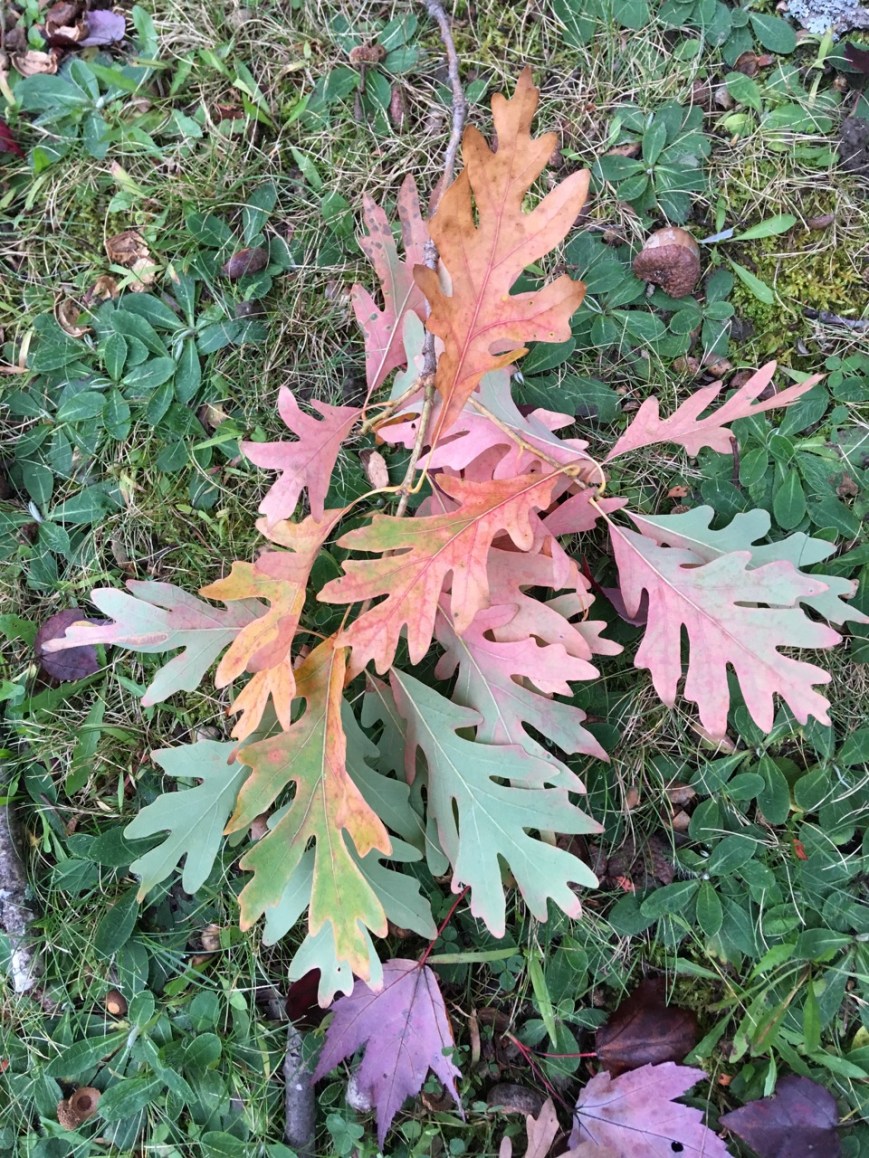
In the spring, I learned that acorns of the white oak were less bitter–and were more widely used for food–than those of the red oak.  At that time, I was walking through thousands of acorns in our neighborhood, and thinking how great it would be to use them for food.  I also walked through thousands of dried-up oak leaves, but never saw any white oaks.  You can tell the difference because the leaves of the red oak are pointy and the leaves of the white oak have rounded lobes.

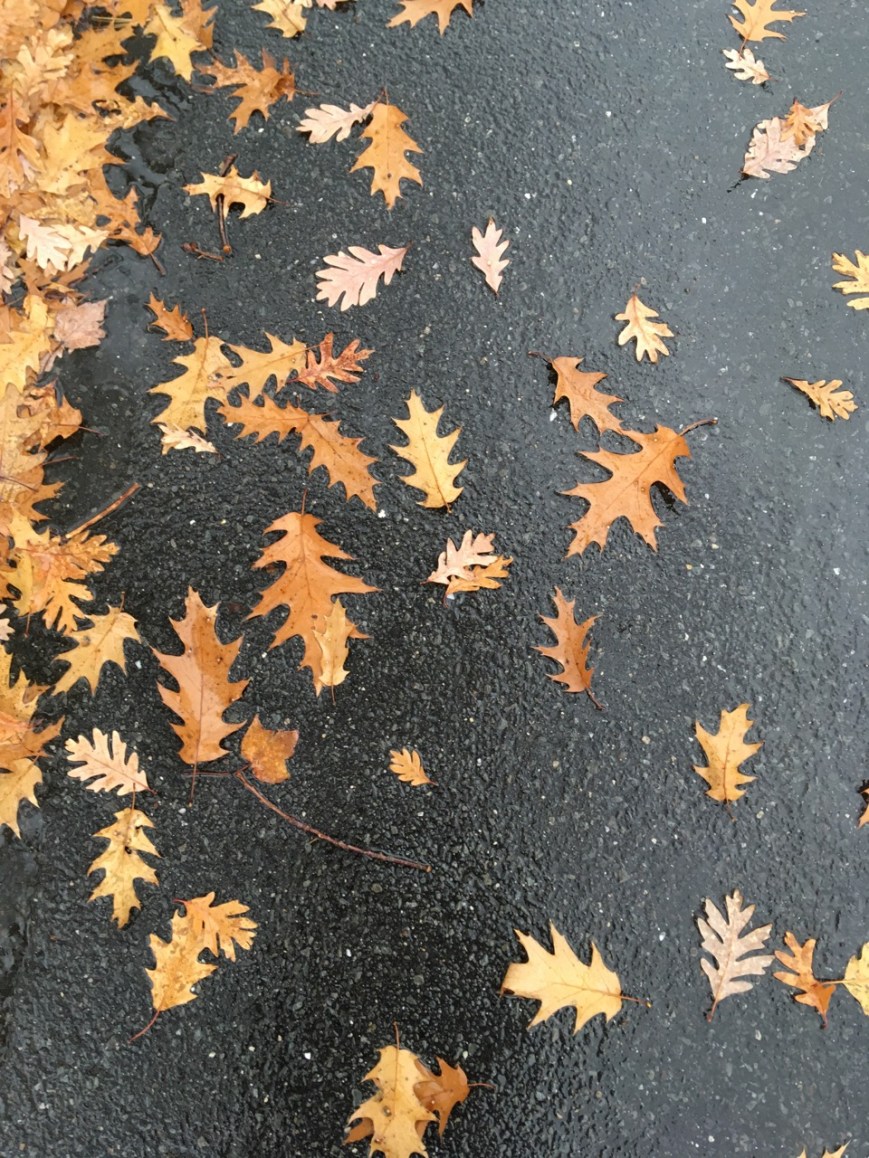
This fall, there were barely any acorns. Oaks do that.  They choose certain years (mast years) to collaboratively put on a full production of acorns, and others years, not so much. This may be a rough winter for the squirrels, who grew their families large on last year’s bounty.  But imagine my surprise when I saw these leaves on the pavement during my morning walk.  You might have to look closely. White Oak and Red Oak Leaves

Amidst the pointy ones are some small round-lobed leaves.  The tree is about two blocks from my house, a smaller oak right next to a big red oak, standing in someone’s front yard. I am going to guess that it might be a white oak. I look forward to the next mast year for acorns, to see if I can distinguish them from each other, and maybe try making acorn flour.

Meanwhile, this was a beautiful autumn for oak trees. Usually, it seems, the oak leaves hang on the tree and go from green to brown without much fanfare.  But two weeks ago, they were a translucent gold to rival the maples. Today, we had our first snow storm, but the snow is spotted with oak leaves everywhere, pulled from their branches by the wind to land on top of the snow.Oak Leaf Gold

This Grandmother Pine Lost

White Pine Cut with markingsIt must have been a big machine that cut down the grandmother pine tree.  I found no disturbance around the stump when I climbed up to it to offer my grief and respect.  The weeds and small brush nearby were there as before, with only fresh wood shavings and pine sap falling over the edges of the stump.  Nothing huge crashed to the ground when they took her. So it must have been a big machine.

I discovered her absence on my walk near Capisic Brook the day before, but didn’t have the strength to approach her while there were lots of workmen in the Rowe school construction zone nearby.  Ironically, they were making a children’s playground, spreading wood chips and such–perhaps that was that her wood they were using?  But why?Workers at the school

I met this tree last winter when I was measuring old white pines around my neighborhood, after I discovered that our white pine was definitely over 100 years old, and perhaps even 160 years, according to her circumference.  At that time, I was also mourning all the cut pines for the construction of the new elementary school.  I found this pine with a yellow tape around her trunk.  She was one hundred and two inches in circumference, just like the white pine in our yard. That is when I knew she was one of the grandmother trees.  I made an inquiry on the school’s Facebook page, but the person who responded didn’t know about the situation of the tree.

And now the white pine is gone.  I went to the place where she had stood, and expressed my sadness, and I did the best I could to honor her.  I counted her rings, making small markings after each 25.  (You can see those marks if you look very closely at the photo above.)  I got to 100, and then the outer rings were too difficult to see clearly–but I guess there were at least 20 more–so 120 years old?  Maybe even 130?  That would mean she was likely a small sapling in the year 1897 when both of my grandmothers were born.  She observed a century of animal and human life from her vantage point above the brook.

People in U.S. society are still thinking of trees merely as resources for our needs and wants.  But we have to begin opening our minds to the idea that the trees have their own lives, their own being-ness.  Scholars are learning that the forest is a living community of trees and other plants and animals and fungi, all interconnected in a network underground, supporting each other and all of life.

Recently, I had a chance to read The Overstory by Richard Powers.  The novel tells the story of several people, all with some significant connection to a tree or trees, who come together to protect old growth forests in the northwest United States.  Powers borrows from actual science and activism in telling his fictionalized version.  I especially loved the character of the woman botanist whose research suggested that trees were communicating and caring for each other. Because of that hypothesis, she lost all her funding and academic connections.  Eventually she found her way into work as a forest ranger, until decades later when other scientists caught up with her insights.  Two other characters spend a year living in one of the oldest redwoods, to try to protect it from the logging company.

Of course, the forest between the Rowe School (formerly Hall School) and Capisic Brook is already badly degraded. It is not old growth or pristine.  It is encroached upon by invasive plants and runoff pollutants. But it is still a living system, a wetland, a wild community in the midst of city streets and buildings.  And so I walk along its path, I cherish it, I pick up litter. I try to bear witness.

Capisic Brook Forest