September Musings

Four huge turkeys in the shade of some green grass, behind leaves of zucchini in the front corner of the photo

The summer garden had some successes and some fails. And it is sometimes hard to tell which is which. This turkey family visited the yard many days, and walked through the garden beds in the back. They mostly left the veggies alone, except they liked to eat the tops off the bean plants. We still got a few beans even so. And they left alone the zucchinis, which did well, the cucumbers which did fair, and the broccoli, also fair. We appreciated their visits–we want to support wildlife after all.

However, we tried to lessen our support for the chipmunks and squirrels that became such little rogues. Despite netting over the blueberries, once they figured out they could squeeze holes into it, they got the rest of the blueberries, though we did get a bunch before that. I am happy to say that the baffle on the bird feeder totally worked. They never got up to the feeder after the baffle was installed. So I am hoping that without all that extra food to stash, the population won’t explode like it did this year. The long game. And the birds keep coming back to the feeder.

In the front yard, we never had monarchs lay eggs on our milkweed plants, despite their visit. Maybe next year? The netting on our kale and carrot bed was a great success. It protected the kale from cabbage moths, and no one tried to get into it. We have a ton of kale harvested and still to harvest.
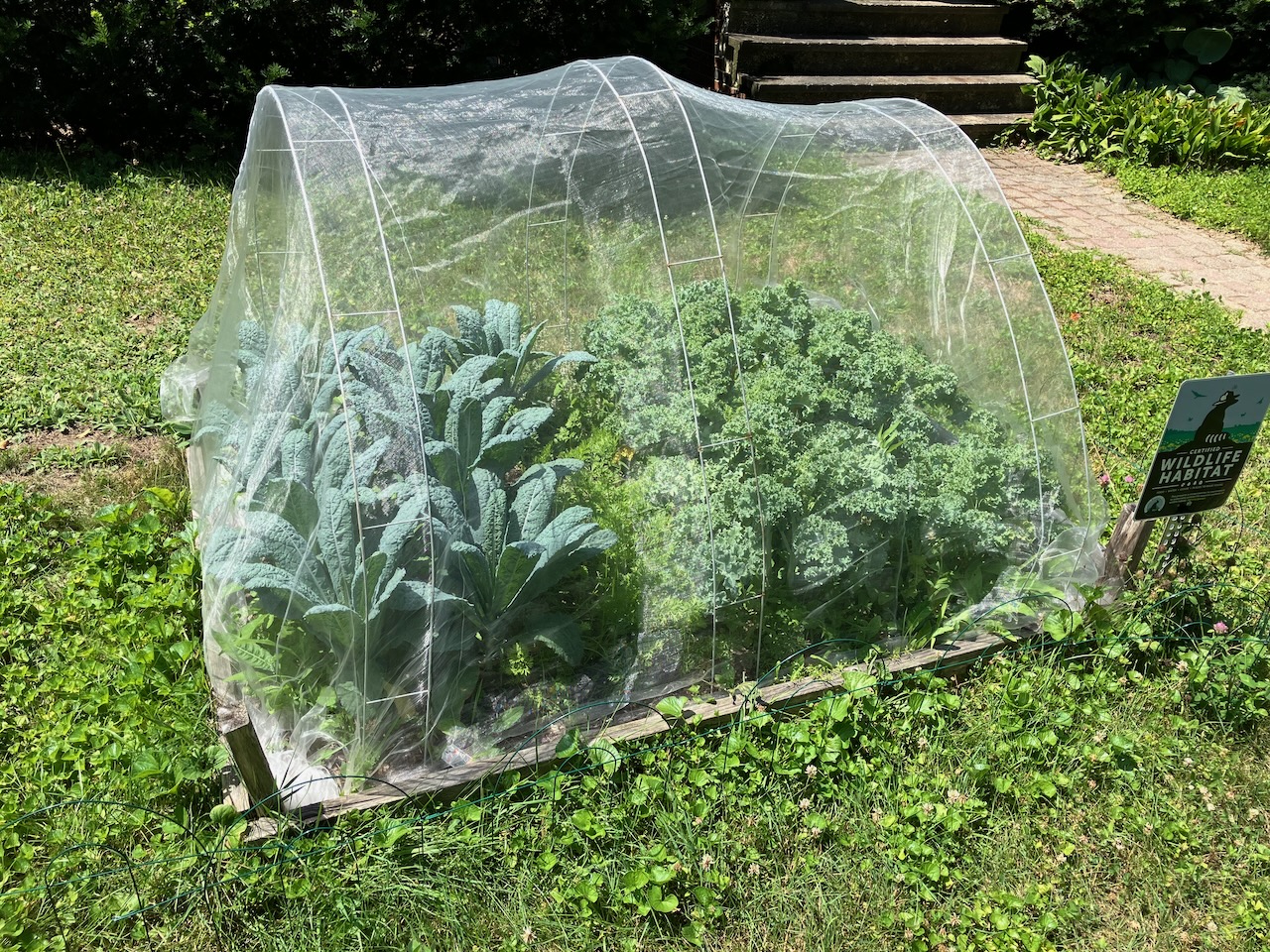
Rectangle garden bed filled with green kale of two kinds, covered over with a translucent net on white metal supports.

The robins never came back to their nest on our back porch after the babies had been attacked. Still so sad about that. We’ve had some lovely visits with human friends out by the pond. The pond water level went down with the drought, but this weekend’s rain helped, especially after adding water from the newly filled rain barrels. Still a few frogs, though I am not sure about the tadpoles. They hide under the lily pads, and it’s a lucky day to see them.

And… and… and… Gaza is still being attacked night and day, and starved by blockades. International resistance is growing but too slowly for the people killed each day. I keep bearing witness, and praying. It’s the same with the rising fascism of our country, and the attacks on immigrants both documented and undocumented, and citizens who are brown or black or speak Spanish. The only thing that gives me hope are the multiple levels of resistance from huge demonstrations to lawsuits to governors who slap back. Here we do the best we can to get by, day by day, accepting our situation as elders and those who are chronically ill. In the face of so much cruelty and hate, we add our little love to the mix, hoping to be part of the larger Love which is our only real hope.
Fighting with Squirrels (and Chipmunks)

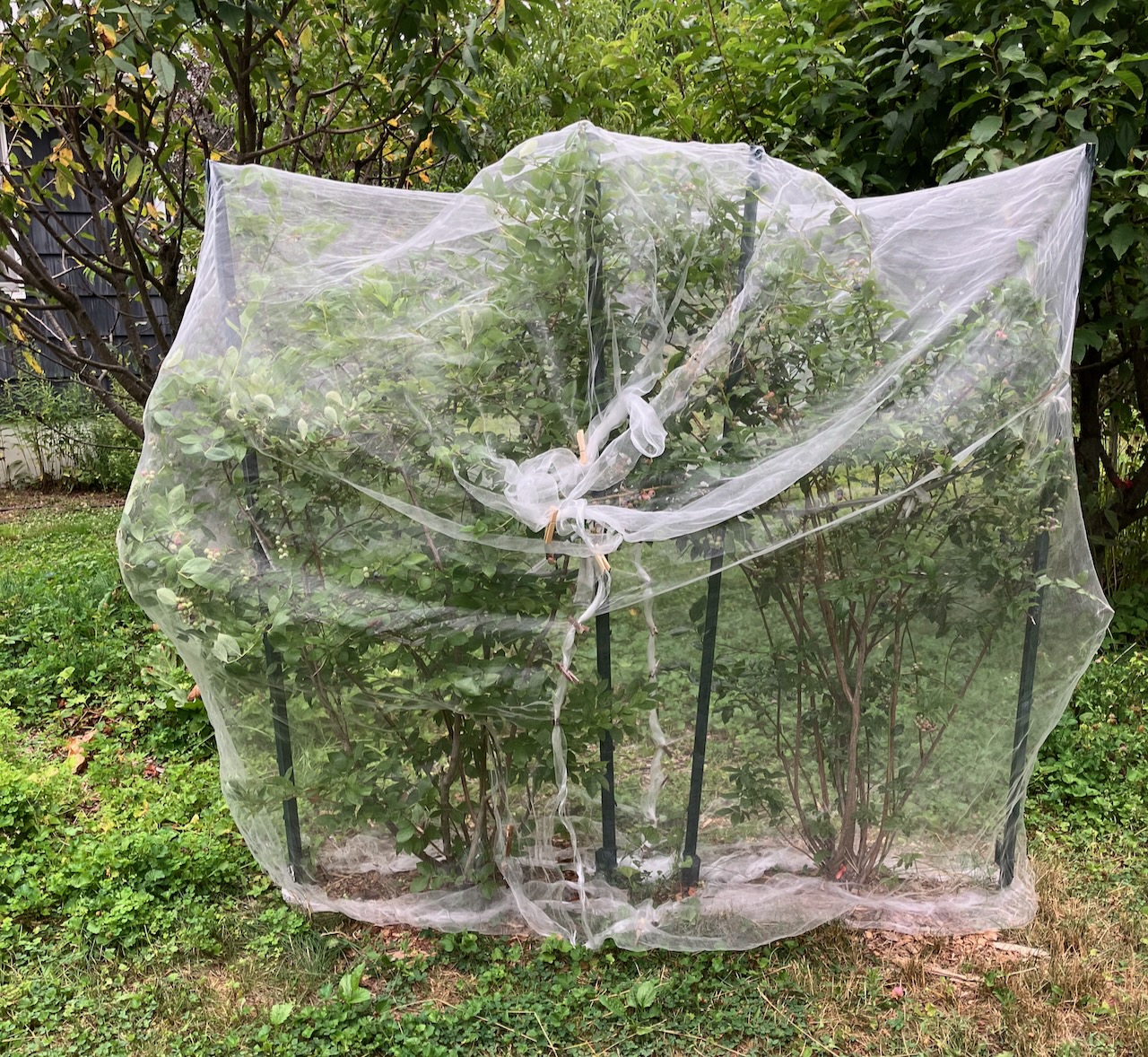
White netting draped over two blueberry bushes, using fence stakes

The intent of our permaculture gardening is to create a mutually beneficial relationship with the earth and all her creatures. But lately, it feels like a little backyard battle. The squirrels have literally eaten all of the green peaches off our peach tree. (Last year there seemed to be enough for all of us.) They have been also eating raspberries, hazelnuts (still green) and mulberries, but I sort of gave up on all of those. I have tried to protect these two blueberry bushes by covering them with netting, garden-stapled down, and using clothes pins to close the side opening. I have actually harvested some blueberries. But the last couple days, they’ve pushed their way through holes they make in the netting. When I see them, I run out yelling and clapping, and they dart around the edges to find their way out and run away.

To be fair, there is another variable this summer. I stopped filling the bird feeder some weeks back because the chipmunks would immediately climb up, fill their cheeks, climb down, and transport the seed to their underground lairs; and then repeat until all the seed was gone. The squirrels also took a fair amount. I wonder if the sunflower seeds were the tribute I had been paying to our little neighbors that ensured that they’d save us a few peaches? But yesterday, perhaps I upped the ante, because I installed a baffle on the feeder, and coated the pole with coconut oil. I really do want to feed the birds, not all the greedy chipmunks and squirrels. So here is the new set-up, (the bush is at least five feet away–I pruned it to make sure):

Green metal bird feeder with clear plastic baffle a few inches down, in front of a green bush background.

Margy and I have a little side bet going as to when they might be able to breach these new security measures. It has been up for twenty-four hours so far. No squirrels, chipmunks so far. But the birds haven’t come back yet either. The next few days will tell. And in case it isn’t easy to see, the original bird-feeder is also “squirrel-proof,” with a weight dependent bar that drops down to close the seed opening. But they figured that out long ago. They are so smart, and acrobatic. In many ways I love them. But I don’t love that they take all the fruit in our garden.

Anyway, I just needed to write about this other side of gardening. I am so impressed by the work farmers do! If we relied only on our own gardening skills, we would go hungry. But perhaps this is one of the lessons I am learning about how to be in a mutually beneficial relationship with the earth, and during climate warming too. We are all under a lot of stress, trying to survive. We don’t have complete systems in place, we don’t have our own ancestral knowledge, we are trying to recover from great imbalance. So we keep showing up, keep going outside, keep being grateful for the gifts of the earth.

And these days, I can’t write about anything food-related without also expressing rage at the intentional starvation of the Palestinians in Gaza by the state of Israel. They destroyed their farms and gardens, and destroyed access to water, and access to help from outside. How many more people will die before the world powers stop this genocide?

Food for Wildlife

Three goldfinches were perched on this volunteer sunflower!

We haven’t been that successful in growing food for ourselves in the garden. (Yes, the experiment with the kale worked well. And we harvested blueberries and raspberries.) But right now the peaches are getting mold on them just as they ripen. Another fungal issue. I’ve started harvesting some that are not yet quite ripe, and just cutting them up to put in the freezer. But in the meantime, the squirrels and a groundhog are happily coming to the tree each morning to eat a peach. The squirrel climbs up the branches to pick her own, but the groundhog takes one that has dropped off.

The squirrels are always fairly bold, but the groundhog is shy and runs away as soon as she sees us on the back porch. So this photo was from a back window.

The more I try to garden, the more I realize what I don’t know. But it makes me happy that critters feel at home with us here. Unfortunately, the groundhog has dug a few holes to get under our garage–we don’t want her to feel that at home, such that she undermines the foundation. So I refill the holes any time I see them, and then pour some human urine on the area, hoping it will discourage her from more digging. Marking our territory, so to speak. We’ll see if that keeps working.

Meanwhile, the birds are relishing the volunteer sunflowers and evening primroses that are blooming and going to seed in lots of places. Also the elderberry bush. They seem to like everything about our yard. That makes me really happy.

February Sunlight

Bright sun shining on snow with small dark tree on left side, shadows marking places where tracks were made.
Bright February sun shining on bright snow.

We are halfway to Spring! So many cultures celebrate this day, or this change of season. For just a few examples: Imbolc or Brigid’s Day for Celtic people, Apuknajit (the winter spirit) for Mi’kmaq people, Candlemas in Catholic liturgy, Groundhog Day in secular America. They hearken to the coming Spring, and offer courage for getting through the rest of the winter. Here at our home in Maine, I can feel the change in the quality and angle of the sunlight. My heart is lifted by its brightness.

We’ve recently had a triple set of snowstorms, so the ground is finally covered in snow after nothing much in December. It too adds to the brightness. I love how it also reveals the creatures who live here with us. I’ve seen deer tracks going through the orchard all the way back across the frozen pond and into the hedgerow. You can see their traces in the photo above. I was also delighted to find these distinct squirrel prints after a rain on top of the snow a week ago. Like little hands.

Squirrel prints on snow, on a gray day.
Squirrel prints

I’ve been continuing my winter project of sorting, organizing and winnowing old papers in the basement. I had started with my years in Boston 1986-1999, then moved backwards in time. I am now finished with the very earliest files-hurray! So then I moved forward from 1999. I’ve begun to sort through papers from my years on Cape Cod, 1999-2005. That has meant that I’ve also started to incorporate the winnowing of digital files on my laptop for the same years. Some of it is plodding work, comparing documents to put duplicates in the trash, renaming documents so they are easier to organize, stuff like that. But some of it includes moments of sweetness, like finding a letter from a young queer person whose life was helped along by a sermon I preached called “Believing in Fairies.” [A version of which found its way into my book, Finding Our Way Home, and was excerpted in the post The Mystery Seed.]

It does my heart good to think of those seeds of blessing planted in the hearts of people I met along the way. Sometimes we hear about it afterwards, and sometimes we may never know. When the interactions were not so blessed–since I had my share of conflict and trouble along the way–it does my heart good to shred the remnants of those interactions, and let go. Lighten the load.

Imbolc is a time for setting intentions, for shaping our hopes for the future. It is kind of like looking through seed catalogues imagining what we will plant when the next season turns. I’m not ready yet for seed catalogues and intentions. But it is good to remember that the sorting and winnowing of my past life will not go on forever. I don’t know what sort of seed I want to plant for the future. That is still a mystery to me. But I am good with a mystery seed.

I saw a funny story on Facebook about a child who thought that bird seed grew birds. They showed their parents the proof–they planted a big pile of bird seed outside, and the following day, there was a whole flock of birds gathered round the spot. Maybe that is what I will plant today–filling the bird feeder with seed so that they will have nourishment for the deep freeze we are expecting in a couple days. I understand that Mi’kmaq people put out food for Apuknajit so that the winter spirit will be remembered and be kind. Maybe that is part of feeding the birds too–to remember our fellow creatures during these cold winter times, so that all of us might make it through to the spring.

Small brown bird perched on a stick on green bird feeder, with snow on top of it.
Bird on feeder today.

Peach Abundance

Peaches are ripening, bright red and yellow, crowded together on the branches.

Those of you who perhaps followed my peach tree saga last year might remember that after hours and hours of tending–including several organic sprays, thinning the small green peaches, putting little mesh bags on the remaining ones–the squirrels ran off with every single green peach, or knocked them off the branches as they tried to get into the bags. We got zero peaches to eat.

Well this year, I didn’t have the heart or energy to do all that tending. I did one holistic spray early in the season. I felt very non-attached to any outcome, since one might assume that squirrels would eat them all again. But that didn’t happen. A few weeks ago, I started picking a few small random peaches, so that others would have more room to grow, and the branches wouldn’t break under their weight–but only a few at a time, not systemically. I put them in paper bags, which is the actual way to help them ripen. (Not on window sills as I had previously thought.) A few weeks ago, the squirrels started eating some peaches too, sitting in the tree, or taking ones with broken spots that I left on the patio table. I found their leavings on the deck railing. It was fun.

Broken peach bits on the deck railing.

But they didn’t take all the peaches. And the peaches started to really ripen. Now they are bright red and yellow, crowded though they are on the branches. Now, we are processing all the bags of ripening peaches in the house, as well as gathering peaches literally dropping from the tree. I have cut them in slices to freeze–first on a tray, and then put into freezer bags. Yesterday I made a gluten free peach cobbler. We have invited friends and neighbors over to share in the abundance. More people are coming by this weekend. This morning, I saw this little bird pecking for its delicious breakfast. There is plenty to share!

Bird eating a peach on the tree.

I feel grateful and humbled by this turn of events. Sometimes gardening feels like a battle between the gardener and the “pests.” I didn’t have the heart to try too hard to fight this battle this season. (And our cucumbers and zucchinis are succumbing to bugs-so it goes.) I was surprised that the peaches thrived so well without my efforts. I was surprised that the squirrels took some, and it seems they felt okay about sharing. Maybe they sensed that we were not enemies this time. Margy and I feel so good to be able to give them away to others. The garden is such a great mystery! I continue to feel humble and grateful by all it teaches us.

Oh, and here is the recipe for gluten-free peach cobbler. I searched the internet, and then adapted this one from several I had seen:

Peach Cobbler: preheat oven to 375 degrees

Slice peaches and place in a lightly buttered 9 x 13 pan. Basically use enough to cover the bottom well, or more if you like. Sprinkle with cinnamon, and a tiny bit of ground cloves.

Whisk together 1 & 3/4 cup almond flour, 1/2 teaspoon salt, and 2 teaspoons baking powder. Blend together 1 large egg, 1 teaspoon vanilla, 1 tablespoon honey, 1/4 cup Greek whole milk yogurt, and 2 tablespoons softened butter. Add that to the flour mixture and blend, and then spoon over the peaches–it won’t cover them completely, but spread it around as you can. Bake 25-30 minutes or until golden and bubbling. Remove and let cool a bit so you don’t burn your tongue. You can serve as is, or with cream, whipped cream, or ice cream.

Peach cobbler in a glass pan, with some pieces removed.

To Be of Use

Chipmunk drinking at the pond

Yesterday morning, I was sitting next to the pond, writing in my journal. After I’d been there, and quiet for a long time, this chipmunk approached the other side of the pond, climbed down the rocks and took long drinks of water. After a couple minutes, it quickly climbed back up the rocks and ran back into the field behind.

If you’ve been following my posts recently, you know that I’ve been dealing with chronic illness causing me to have much less energy this summer. So my relationship with the garden has changed. It has been less purposeful and project oriented, and more, “Let’s see what the yard wants to do this season.” To listen more, to do less, to observe more, to try less–and I’ve learned so much, actually.

It’s true that we had already done a lot to shape the yard–we planted many fruit trees and bushes, let wildflowers grow, planted perennials, pulled invasives, and created the pond last year. Some of the plants that were in the pond didn’t survive the winter, and I did add a few more this spring. But it wasn’t enough to prevent algae from flourishing. So periodically, I get inspired to pull out as much as I can. But I’ve also noticed that bees love to perch on the algae, to get a drink of water presumably. (There is always enough algae left for them.) It gives me gratitude to know that this pond, imperfect though it is, has been of use to these creatures in a drought-burdened summer.

Bees on green algae

Lately, my old nemesis the squirrel has come back to start eating peaches. But since I was doing so much less to nurture the peach tree–less holistic sprays, less thinning of peaches, and so on–and since I had somewhat resigned myself to having no peaches after last year, I haven’t been stressed out about that. And the squirrel or squirrels seem more mellow as well. The peaches are actually very crowded together, and every couple days, I twist off a few tightly squeezed ones, even though they are not ripe yet, to make room for the others to grow bigger. I’ve put a few on window sills in the house to see if they will ripen. I tell myself the squirrel is also thinning the peaches. We are collaborators, rather than enemies. Who knows, maybe there will be enough for all of us?

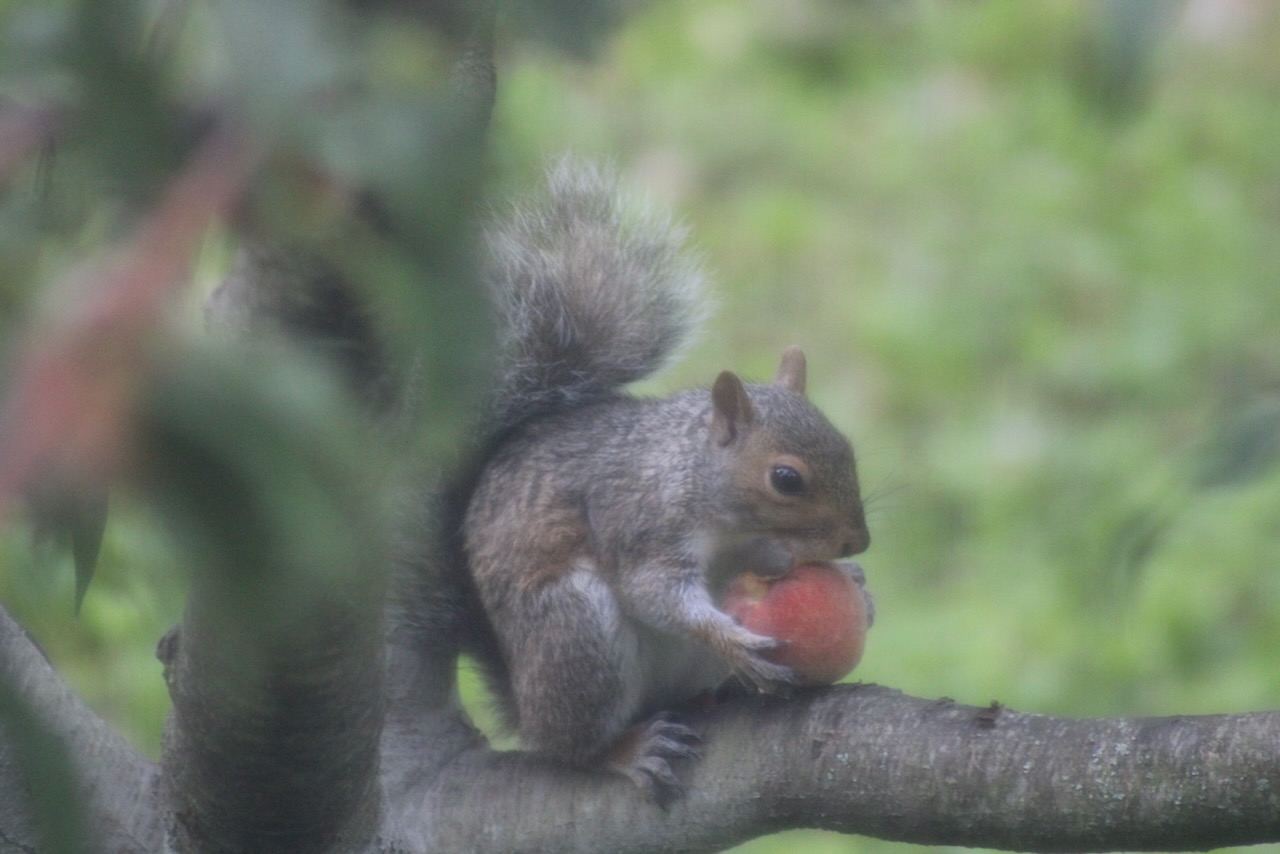
Squirrel sitting on a branch in the peach tree nibbling on a green peach.

In a world with so many horrors that I can do nothing to stop, or even to protest, I am grateful to be of use to these small companions who share our back yard with us.

[And thanks to Marge Piercy‘s poem, To Be of Use, for its evocative and helpful title.]

Can I Forgive the Squirrels?

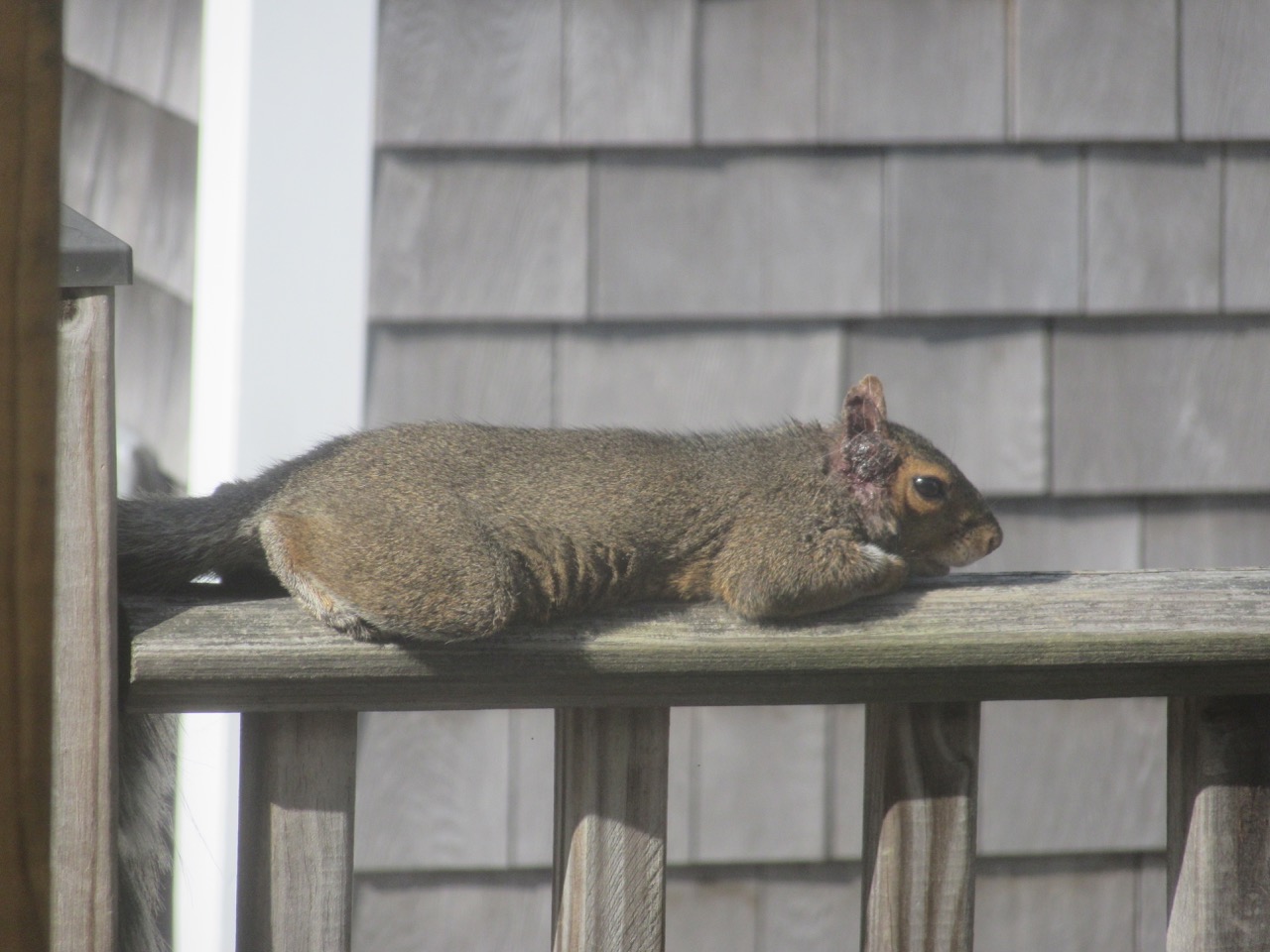
Squirrel relaxed and resting on the railing of our deck

This morning, I watched out my window as a squirrel climbed into the branches of the peach tree, going up and down several branches until she or he stopped at a bagged peach. She nibbled through the small branch it hung from, cutting the branch right off. I could see the leaves and twigs fall to the ground, even though the squirrel was hidden by other branches. Then, she took the unripe peach in her mouth–still in the bag–and carried it down and away from the orchard to some other roosting post in another tree. I didn’t yell or bang on the screen or try to stop her, as I have done on other mornings, because all the peaches have already been destroyed.

Over the last couple weeks, I had to remove over twenty of the bagged peaches after birds or squirrels left bite marks and the fruit had dropped off its stem, to the bottom of the bag. Some of the peaches had only a c-shaped mark that made me wonder about curculio. A couple seemed untouched. But I had seen the squirrels in the trees going after them. Then, a couple days ago I discovered that virtually every peach in a little protective bag had dropped to the bottom of the bag, and all of the peaches that I hadn’t bagged had disappeared completely. The peaches were all still green and hard, nowhere near ripe. I had just read about people using a spray made with peppermint oil and cinnamon sticks to deter squirrels, and was about to try it, when I discovered there were no peaches left to save.

Green peach with a bite missing, dropped to the bottom of a mesh bag, with another nearby.

I’ve been grieving the last few days. I put so much effort into this peach tree all through the spring and summer. Pruning it carefully. Six holistic sprays with beneficial nutrients. Three “Surround” kaolin clay sprays. Picking off leaves with peach-leaf-curl one by one. I was so hopeful when hundreds of little peach-lets started growing! I thinned the peaches so that none was too close to another. I put 80 little protective mesh bags on individual peaches. I even bought toy snakes and an owl to try to scare off the birds and squirrels. None of it stopped them. I had gotten only 3 cherries from the cherry trees, but the peaches seemed to be the saving grace for the little orchard I have been tending so carefully. Last year Margy and I had been able to eat only one ripe peach–and it tasted so good. So this year, I tried all the things to care for and protect them, imagining that taste in my mouth. And now they are gone.

I’ve also felt deeply shaken in my capacity as a permaculture gardener. Here is this little food forest with 2 cherry trees, one peach tree, and two baby apples. And no food. (Well–the raspberries did fine–but I already knew how to tend raspberries. And there were a few blueberries on our young plants. We thought we might get some hazelnuts but the squirrels also grabbed those before they were even close to ripe.) I do come away with a deep respect for organic gardeners and farmers.

But I have been harboring much anger and hate in my soul for these squirrels, and I feel very troubled about that. The original purpose of tending this land–this small place on the earth–was about finding our way home to earth community. Putting into practice the desire for healing the broken relationship between our society and the natural world. But when I try to grow food, so many critters become my enemies. Well, they probably don’t share the enmity–they probably think I run a fabulous restaurant. But meanwhile, I am watching them and hating them.

This morning, after the squirrel ran away with the bagged peach, another squirrel started playing with a stick on the path in the orchard. Literally playing–rolling over and over, turning the stick this way and that, chewing on it, then rolling over again. In a very cute way.

There is a lesson in this, I am sure. So I am trying to grieve, to let go, to open my heart. But I am still not sure I know how to forgive the squirrels. I am trying to listen to the deeper lessons.

A Nest in the Peach Tree

Photo: a nest in the branches of the peach tree, surrounded by leaves mottled with kaolin clay

Life is getting exciting in the orchard. The other day, a friend noticed an empty nest in the branches of the peach tree. It must have just appeared that day–the Summer Solstice–because I had been spraying the tree a couple days before with an herbal foliar spray and would have noticed it. But it seemed like it might be abandoned, and I wondered if perhaps its creators had noticed the toy snake I had hung from the tree the day before to warn off squirrels.

Today, I began to wrap and tie little woven net bags around the peaches–another strategy to keep them protected from burrowing bugs and poking birds and of course, squirrels. This year, I am trying all the things!

Photo: Peach tree, somewhat whitened by kaolin clay, with net bags around some peaches.

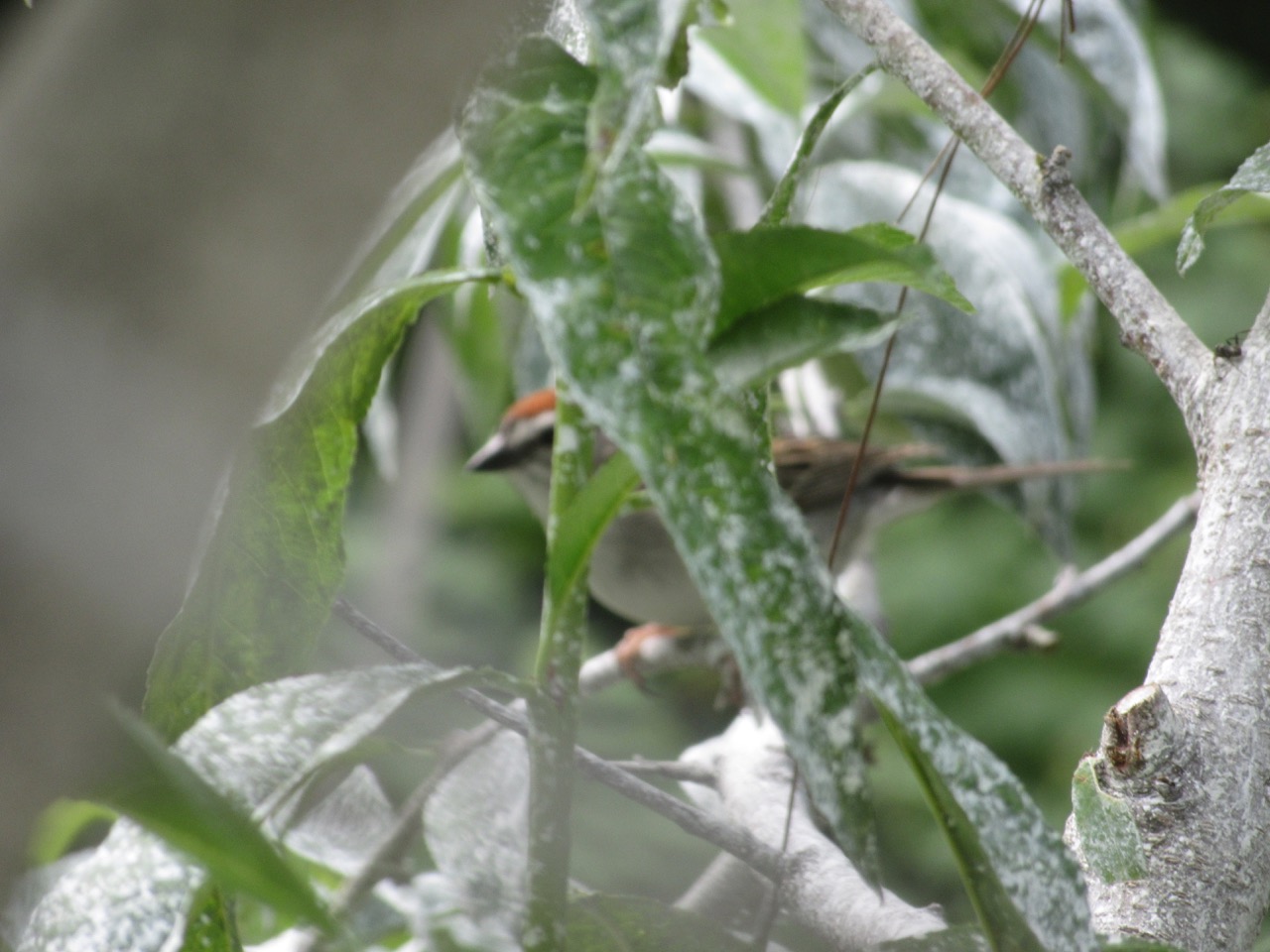
While I was slowly adding a few more bags, this little sparrow was chirping in the next tree over, as if she were trying to get my attention. (Later, I did some research, and she seems to be a native chipping sparrow.)

Photo: chipping sparrow behind leaves

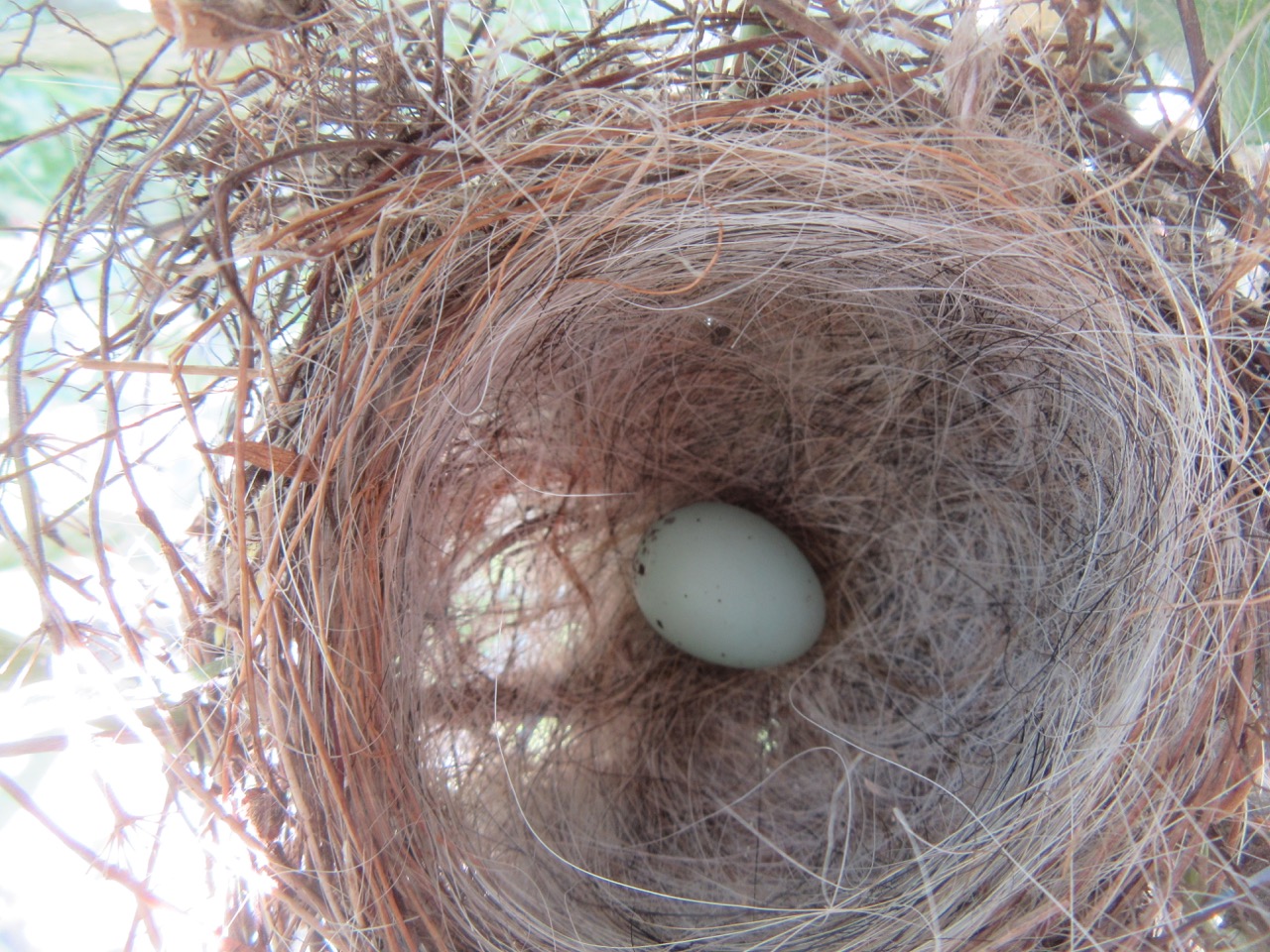
Curious, I carefully put my finger into the nest (which had been empty the day before) and ever so gently touched the smooth shell of an egg. Holding my camera above the nest, I confirmed it.

Photo: one light blue egg with spots inside a nest

Of course, this left me with a dilemma. Do I pay attention to protecting the peaches? Or do I take care not to disturb the chipping sparrow and its nest? Hoping to do a bit of both, I kept putting more net bags around the peaches, but only on the side of the tree away from the nest.

With the bags around the peaches, I won’t need to spray the tree again with kaolin clay, and that seems like a good idea as far as the nest is concerned. These net bags require quite a labor intensive process though. The design of the bags could have been better. I decided to make a small cut in the top of each bag, on the opposite side of where the drawstring tie comes out, so I can pull the tie string out from two sides. That way I can secure it across the branch closest to the peach. (Otherwise, if I just tied it around the stem, I am afraid it would pull the delicate peach right off the branch.) So bit by bit I added perhaps 15 to 20 bags on peaches. I have many more to go.

And then I saw that the sparrow had returned to her nest. Maybe to lay more eggs? Maybe to keep one or more eggs nice and warm until they hatch. I read that it takes two weeks for the eggs to hatch, then 9-12 days for the young to fledge. I think we’ve reached a truce. I hope so.

Photo: head of sparrow is just visible over nest, behind bright green leaves

Humbled

Photo: Future Peaches?

I have been having a few days in the garden that humble me to my core. This process of finding our way home to earth community is so difficult. Trying to care for fruit trees involves learning about so many insect pests and disease processes. Observing the trees carefully every day. Yesterday and today I was thinning the tiny peaches leaving only one every 6 inches, so that the branches can support them to grow. Often I am trying to figure out which organic solution goes with which problem. And yesterday morning, I saw one of our squirrel neighbors climbing the peach tree–a whole other issue. Will we get to eat any peaches, or will the squirrels take a bite out of each one? Or will birds peck holes in them? Or some other insect pest eat them from the inside?

I hate how gardening sets me at odds with the other critters on this land–figuring out which are “beneficial” (to us) and which are “enemies” (to us.) I remember that when I first had a little garden, many years ago now, I was surprised that so much of it was about killing–pulling weeds, drowning slugs in beer, and so forth. And now that I am caring for an orchard, a permaculture food forest, it’s the same thing. A constant battle. So how is that teaching me how to live in a mutually beneficial relationship with this land?

I start to wonder if human beings should ever have shifted from hunting/gathering to agriculture. Hunting and gathering certainly included the taking of animal life, but it seems like it was more in balance, it was received with gratitude, it was a kind of partnership. I am thinking about the different role of the groundhog in the lives of different cultures. The bane of many gardeners’ lives, groundhogs are incredibly inventive and persistent garden eaters. It was amazing to me that here on our land, the groundhog whose den was next door seemed to respect the orchard as our place, while the garden bed behind the garage she claimed for her own. But I have a friend who built a fence deep into the ground around her entire garden, and still the groundhog family dug a tunnel and emerged right in the center of the garden to eat her vegetables.

However, the groundhog played a different role in Wabanaki cultures, in tribes that were traditionally hunting and gathering. I only know a few of the stories about the legendary figure for good, Koluskap (Glooscap), the creator of human beings. But I learned that his grandmother was the groundhog, Munimqehs, and she guided him and taught him the wisdom he needed. What a different perspective! She taught him that people and animals relied on each other, that hunting was necessary for the people to be strong, but that taking more than was needed was destructive to both.

Photo: The groundhog who used to live near our yard.

Likewise, deer might be a blessing for hunters, but destructive to trees and gardens. We see about one deer each year passing through the back of our yard. We used to have a gang of turkeys that roamed the streets of our neighborhood. They are gone now. Eventually, the groundhog disappeared too–I think a neighbor had something to do with that. Now, it seems, along with birds, we only have squirrels and a little star-nosed mole that tunnels under our wood chip paths, and an occasional chipmunk. But the squirrels are very adept at causing trouble to our garden. All winter long, for example, they climbed up our hazelnut bushes, eating the catkins that would pollinate the flowers in spring. After, they would act drunk and run around wildly in circles. Eventually I put some nets over the two smaller shrubs, to try to protect them. Maybe it worked? The smallest shrub now for the first time has some “future hazelnuts” forming on the end of its branches. I don’t know why the larger two do not.

Photo: Future hazelnut?

Sometimes I am amazed at what grows, what we can harvest. I just cut a whole bunch of soft thyme to dry, and I’ve been finding wine cap mushrooms hiding under clover to add to meals. The sea kale was delicious, and now its flowers smell like honey. There are green berries on the blueberry plants. I got the advice to buy some fake rubber snakes and hang them in the trees to scare off the squirrels–as long as I move them every few days. Last night, Margy and I sat in the back of the yard and watched fireflies signaling to each other in the tall grasses and weeds. In this garden, I am bewildered, sometimes discouraged, often exhausted, and always humbled by how little I know, and how difficult it is. What are you trying to teach me, little squirrels?

Photo by Margy Dowzer: Squirrel sitting, eating, on a sunflower last fall

Meanwhile in the Garden

Winecap MushroomsA few fun surprises this week in the garden. Way back in May, I had inoculated the wood chips near the fruit trees with Wine Cap mushroom spores.  Then nothing happened all summer, so I figured maybe it wasn’t moist enough and didn’t take.  But this week suddenly, beautiful big mushrooms started sprouting with a reddish tint to their caps. Being cautious, I checked the package again, and also researched Wine Caps on the internet–I was relieved to discover there are no poisonous look-alikes. First Mushrooms

Since then we’ve had fresh mushrooms in our eggs and in a batch of spaghetti sauce. The mushrooms keep popping up all over the orchard. They should come back again each year now.  What a marvelous thing to get food right from the ground!

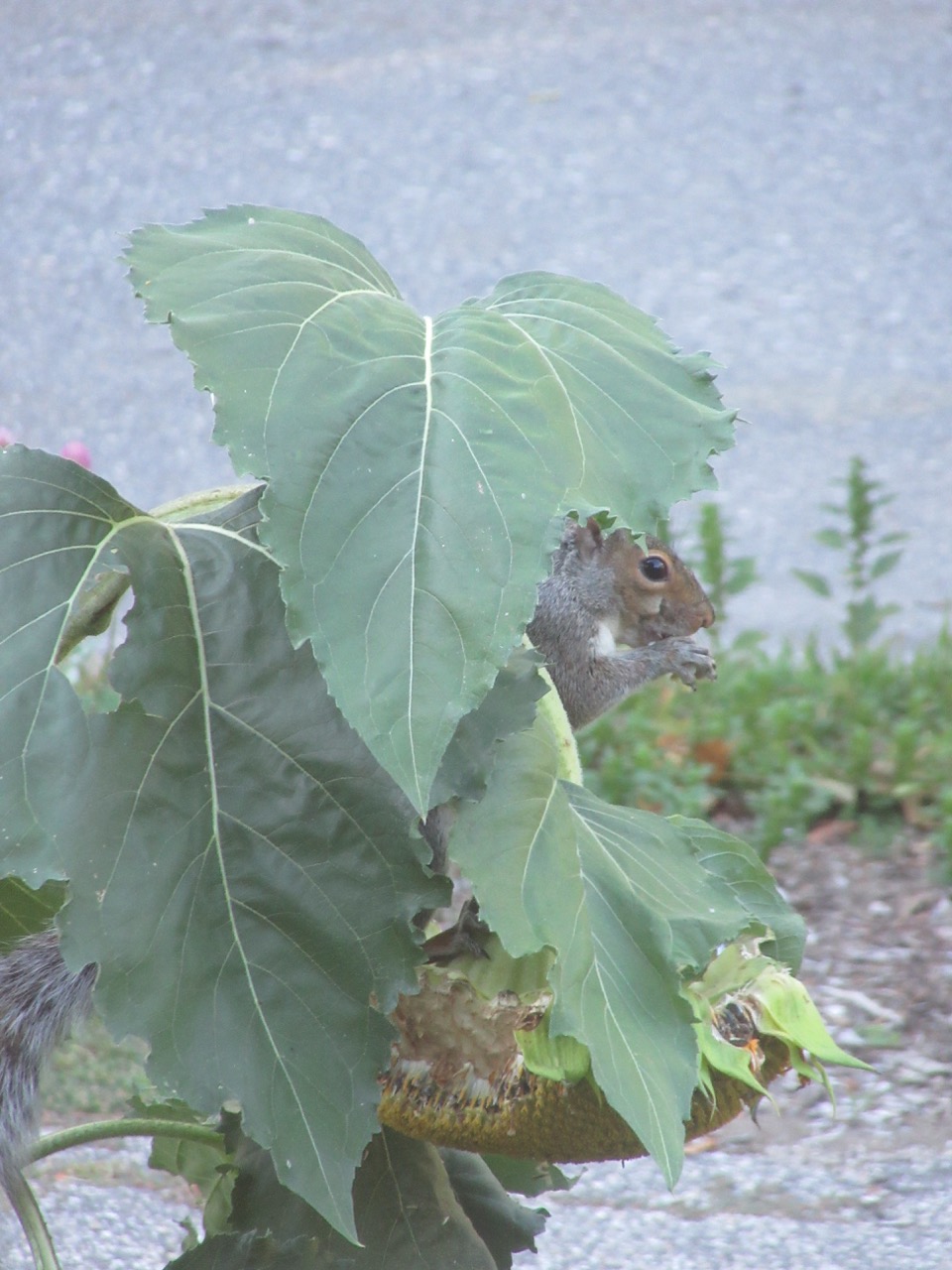
Speaking of food from the ground, the squirrel was excited to discover that one of our volunteer sunflowers had seeds on it. Just like she would do on our bird feeder in the winter, she hung upside down to get to the meaty morsels.Squirrel on Sunflower

Were they really there? Later, I checked for myself. Certainly enough for a little snack. I think this is the same squirrel that decided she should build a nest this week under our solar panels, in a spot behind a cross board that supports our deck roof.  Not good!  (Squirrels can chew the wiring and mess up the solar panel system, we discovered.) Each morning and evening Margy or I would climb on a ladder to pull out small branches and leaves and grass to undo what she had built. We’ve got a plan to cut off some branches on our ornamental crabapple that form a super-highway from the materials to the roof.

But one day, while I was on the ladder pulling out stuff, she came running down the gutter and stopped short when she saw me. I said to her, “You can’t build a nest here! This is our house. Go find a nice tree.”

I don’t know if it was my stern suggestion, or the pile of “stolen” nesting material that was scattered on the deck beneath the ladder, or sheer discouragement from all her work being undone each day, but the last two days she has not replenished her spot. (We’re still going to prune the tree though!) Maybe the sunflower seeds were a little something to sweeten the agreement. We try to find a balance with our plant and animal neighbors in this place. Giving and receiving in gratitude.

Sunflower Seeds