The huge white pine tree next door was too tall to fit into one photo.
It was a sad day on July 6th when our neighbor’s huge pine tree was taken down. It had been the target of woodpeckers for a few years, so that was a sign that it was likely distressed–and in fact the tree company later confirmed the core had rotted. Situated so close to both our houses, our neighbor decided it was too dangerous to keep. But we were all sad to say goodbye too. It was a beautiful old pine.
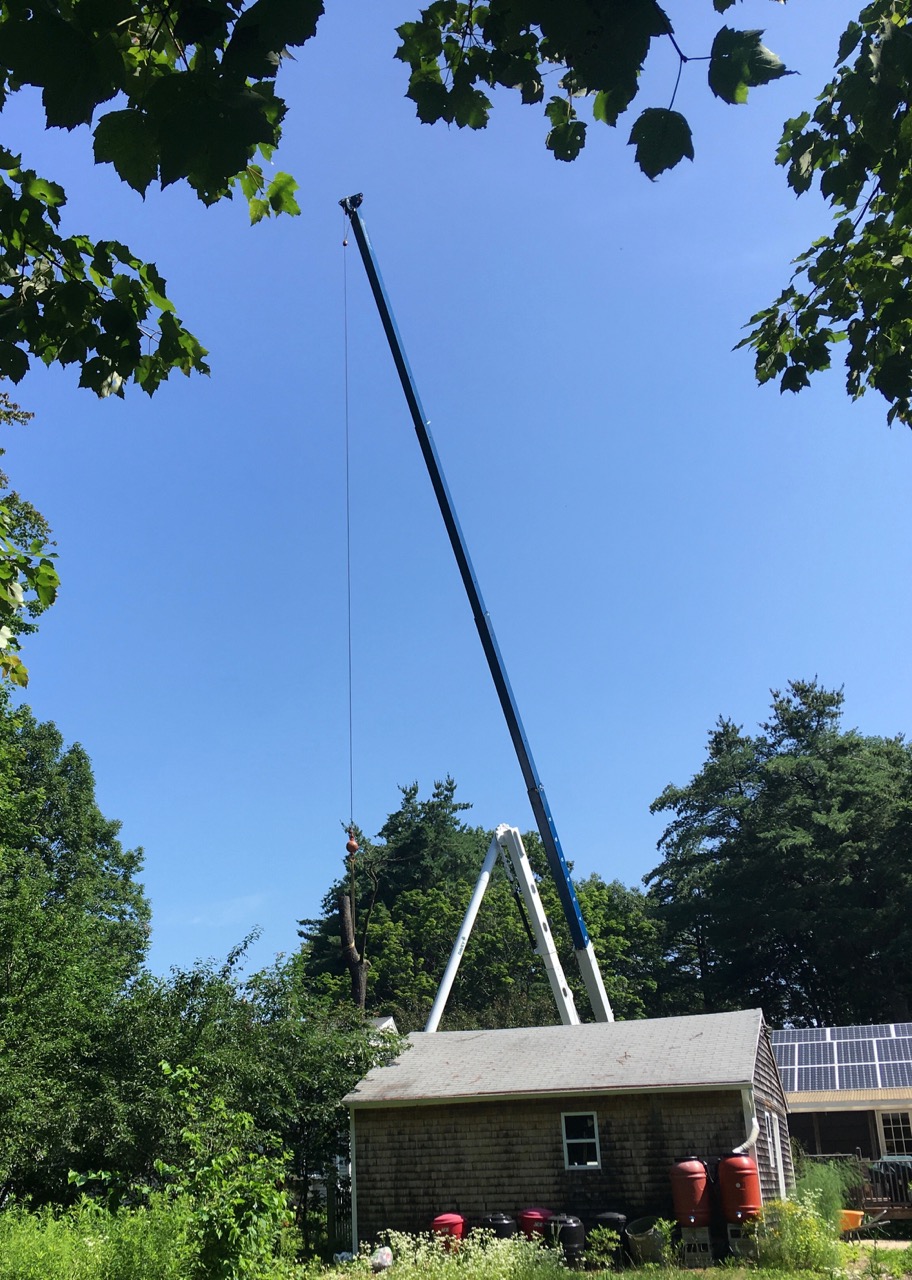
Because of its position, the tree company needed to use our driveway to get access to the tree. I was amazed at the extent of the production. There were three huge trucks–one in the driveway with a crane to lift a worker to chainsaw the tree in huge sections. Another truck was parked and stabilized just off the street in our neighbor’s yard and used an even taller crane with a cable to carry these huge sections of branches and trunk over to the street. A third truck shredded smaller branches. At one point, I went outside to see what the biggest crane was doing, since from inside, it seemed it was lifting the huge logs right over the top of our house.
Crane with cable lifts log up.
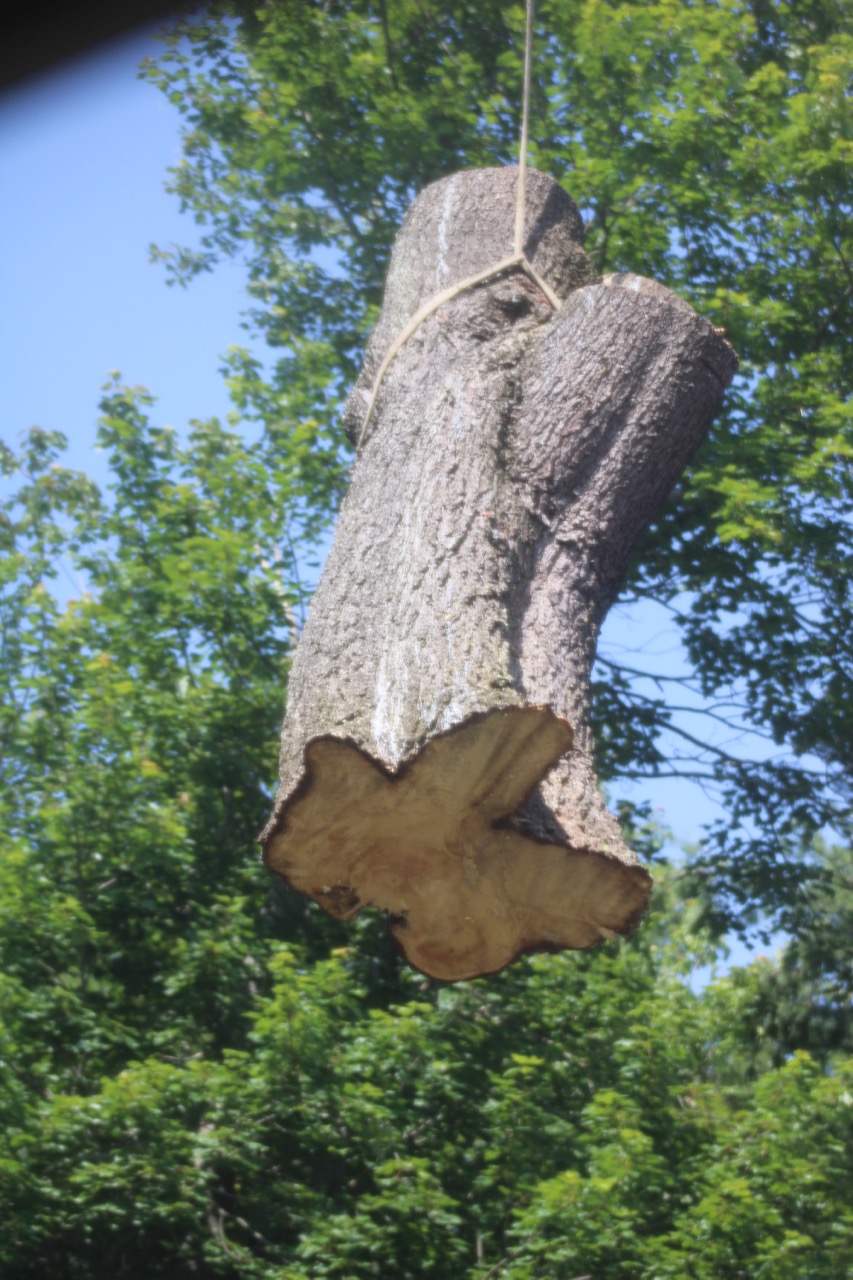
Crane swings over to bring log to the front of our house, to the street.
So it wasn’t actually carrying them right over the top of our house–more like around the edge of our house. Still, these were huge sections of the tree. And then the final section of the trunk was lifted up.
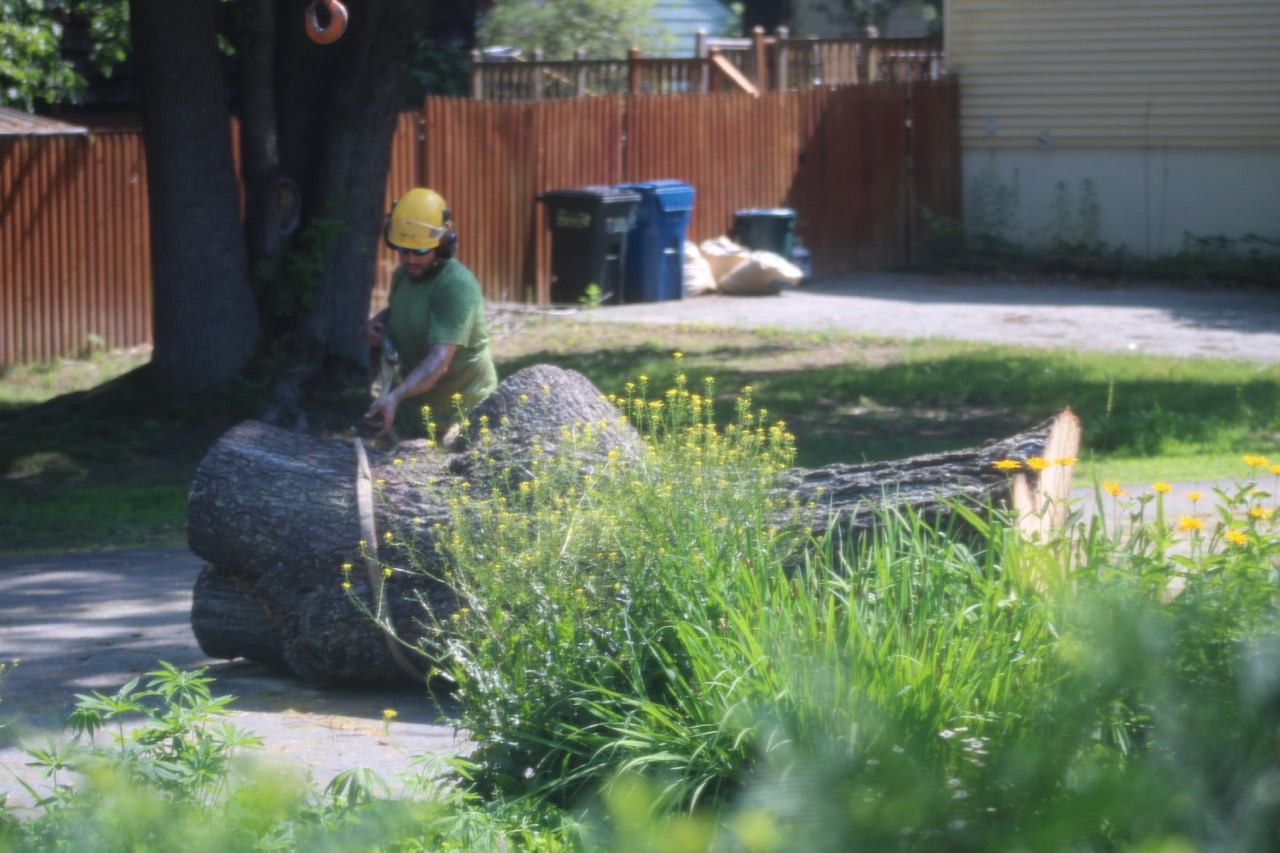
Worker removes the cabling from the trunk.
And then they were done, and the big logs moved to our neighbor’s front lawn to be later removed, and the trucks gone. It all happened in two hours. I’m glad that we are in less danger of a huge tree falling on our house in a big storm. In fact, we’ll also likely see more solar energy production, since the tree cast shade on our solar panels in the late afternoon. But I wanted to mark this passing, make room for the loss, and especially to remember the beauty of the pine.
I have been posting recently about my latest research concerning my Innu third great grandmother, and because of that I want to write today some clarification about identity and relationship. The more I am learning about Indigenous people–through study, through language, through cultural sharing by Indigenous people–the more I understand that I am not Indigenous. This might not even need to be said, except that there is currently a problem of people with ancestors even more distant or nebulous than mine trying to use those ancestors as a way to claim status as Indigenous or Métis, to get benefits from governments, or preference in hiring or hunting rights, for example. Sometimes they actually use this to try to take away benefits from Indigenous communities.
Years ago, when I was still just beginning to learn about all this, I wasn’t sure if I was permitted to claim an Indigenous identity, or a Métis identity. A few times I did, out of my own ignorance. And it is not simple for those of us who are mostly something else, but want to honor our Indigenous ancestors. Even so, I can’t imagine trying to use it to take something away from Indigenous or Métis communities. What I hope for is to be a good relative, a friend, to use my position in this society to act in support of Indigenous communities.
For my latest presentation in our Passamaquoddy language class, I found myself drawn to a word in Passamaquoddy that has been used to describe non-Indigenous people: “Wenuhc.” What does it mean? Some definitions say, “white person.” And that is partly true—it refers to white people. But, its roots come from an old meaning. When, they say, strangers came here to Wabanaki land, the Native people said, “Wenuhc?” It meant, “Who are they?” It also held a question, like, “Where are they from?”
When I ask the question of myself, it comes out: “Wen nil?” “Who am I?” The traditional way to introduce oneself is by naming the place where you come from, and your relatives, the people you come from. But for me, as a wenuhc, that wasn’t so simple. The more I played with the concepts, the more confusing it became—which certainly is a characteristic of many of us living in the mainstream culture of the United States. I want to share some of what I wrote—but mostly just the English translation:
The early strangers said, “We are Englishmen.” I speak English, but my roots are not English—so am I English? Wen nil? Who am I? Three of my grandparents have Germanic roots. But, I can’t speak German. I have German roots, but am I German? Wen nil? Who am I? My grandmother came from Quebec, and she spoke French. I can speak French, a little. I have French roots, but am I French?
Wen nil? Who am I? My grandmother’s great grandmother is named Marie Madeleine. She was Innu. She spoke Innu. Now, I know how to speak Innu a little, only a very few words. I have Innu roots, but am I Innu? Now, I can also speak Passamaquoddy a little, but I am not Passamaquoddy.
Wen nil? Who am I? I don’t know. I am a wenuhc woman, a “who are they?” woman. I am far away from family. Sixteen years ago, I came to Wabanaki land in order to work. Now, I am done working. So, what am I doing? Am I a preacher? Am I a witch? Am I a writer? Am I a gardener? Wen nil? Who am I? Tama nuceyaw? Where am I from? All my grandparents lived in cities. Now, I live in the city, Portland. Am I lost? How do I find myself? Am I a stranger? Am I your friend? Am I foolish? Am I wise? I don’t know. Wen nil? Who am I? I am confused.
What I learn from this Passamaquoddy writing process is that I am not well connected to a place or to my relatives. My being a lesbian, my being a justice activist, my moving around a lot, all contributed to a feeling and reality of being disconnected from place and family. And given the injustice I found all around me in “American” culture, I don’t regret the need I felt to resist it, to break away from it. But in some ways, that is a very “American” way of being. “America” celebrates individual identity and mobility. It defines who we are by what we do.
When I seek to find my way into relationship with the earth, with all beings of the earth, with the ancestors, with spirit, when I begin to value this relatedness, I see more clearly how I have been cut off from places and people that I might have been from. And I see more and more clearly how I am not Indigenous. I am wenuhc. I am “Who are they?”
And that truth is real, it is okay. “Who am I?” is an open question. It is why I make a spiritual journey into earth community. I can learn. As I learn to be thankful for everything, I begin to feel how I am related to everything, despite being wenuhc.
Note: I first learned about the word “wenuhc” from my Passamaquoddy language teacher Roger Paul. More recently, the organization I volunteer with, Wabanaki REACH, posted about this word on its Facebook page, quoting Rebecca Sockbeson (Penobscot), 2019.
Photo: Pileated woodpecker on a pine tree near our house. The woodpecker is a symbol of friendship for Wabanaki people.
Now it feels like Maine again… Lovely snowstorm last night, still coming down and blowing around during my morning walk. But the cardinals were still singing, and this woodpecker was happy for the suet that Margy had put out.




 Finding Our Way Home