Letting Go

9 file boxes of white and brown, marked with Myke Johnson, numbered, with years and places, all lined up in a row

Today, S— came to pick up these nine boxes, to take to the LGBTQ archives at our local university. It feels like a pretty big deal. It involved six winters of going through old boxes that I had carried around for years–some for 50 years. I had to sort them paper by paper, and it became a look back into all the years of my life until now. I shredded and recycled and even composted much more paper than I kept. Perhaps I could have winnowed even more, if I went back through and sorted it all again, but I was ready to be done. (And I think that is one of the roles of an archivist anyway.) S— was so kind, and thanked me for adding to their collection. I felt good about entrusting her with these boxes. (Soon I will also transfer many years of digital files. But those are funny–you can give them and still keep them.)

At our retired ministers’ meeting this week, we reflected on poems, and especially the one by Mary Oliver that ends:

To live in this world

you must be able
to do three things:
to love what is mortal;
to hold it

against your bones knowing
your own life depends on it;
and, when the time comes to let it go,
to let it go.

“In Blackwater Woods” by Mary Oliver, from American Primitive. © Back Bay Books, 1983.

Letting go of these boxes, in a deeper sense, is a way of facing my own mortality. I notice that I am not completely letting go of these boxes, but giving them into someone’s care. I am hoping that I don’t disappear. Letting go of the boxes into an archive is not letting go of the self, really. On the contrary, it is saying: my life has had meaning and significance. And in the context of our times, it is saying, this lesbian life has meaning and significance–this lesbian life of activism, of writing, of spirituality, of ministry, has significance. Didn’t I learn that from Joan Nestle and the Lesbian Herstory Archives in New York? We must keep our own history/herstory. Not let it get lost. Especially now.

Sometimes, it feels like too much–too many pieces of paper, too many words, too many actions–will something essential get lost in the overabundance of words? But that is who I have been–always a pondering soul, a writing soul, a many-worded soul. I also notice that I am revealing so much of myself in this gift to the archives. Like writing, though, it is one step removed. So my shyness barely peaks out as I reflect on it. And I didn’t gift everything. For example, I decided not to send over my journals from 1983 on–(earlier ones are intermingled in the boxes.) I want those journals to go to the archives after I die. But the journals reveal not only my life but the lives of those who are close to me, and it feels much more intimate than the other papers. Very much part of my lesbian life, but for later revelation.

I think how, ultimately, in death, we let go in a much deeper way. I will let go of my small life into the larger Life, the larger Consciousness. I have always hoped, and felt it too, that Someone sees my life, that Someone sees all. I believe that I would be known and held in meaning and significance and love, whether I had written any words at all. All of us are.

The Lost Words

I haven’t had many words this autumn. Now, here we are in mid October. Leaves changing color, lovely cool days and cooler nights.

On the autumn equinox, we had a ritual with a few friends around our fire outside. I had gathered some acorns and we passed around a basket of them and each took out one acorn to express our thanks for some aspect of our lives, and then one for a wish or intention that we wanted for the next darker season. My intention was to bring back more music into my life. For whatever reason, I hadn’t been singing or playing my guitar for ages–I mean, years. So I put on new strings, and tuned the guitar, and then started singing a song here and there.

I found this hauntingly lovely song, Lost Words Blessing, originally shared by a colleague in a worship ritual. The song was inspired by a book The Lost Words created by by Robert Macfarlane and Jackie Morris. “The book began as a response to the removal of everyday nature words – among them “acorn”, “bluebell”, “kingfisher” and “wren” – from a widely used children’s dictionary, because those words were not being used enough by children to merit inclusion. But The Lost Words then grew to become a much broader protest at the loss of the natural world around us, as well as a celebration of the creatures and plants with which we share our lives, in all their wonderful, characterful glory.” [You can find out more about it on their website, and order books and albums there as well.]

One of my favorite things to do with songs is to figure out how I can sing and play them, and so I did with this one. And then, I found myself thinking about Passamaquoddy/Wolastoqey words, and how the language is in a fragile place, with original speakers growing older, and newer speakers trying to find their way into the language after long years thinking in English. How many of those words have been lost, or almost lost?

It has been a powerful gift for me to be learning the language with Roger Paul, via the University of Southern Maine during the last six years. Roger told us that the elders had given permission to share the language with outsiders, so that others might wake up to the world view hidden within. But I am always conscious that the language is filled with triggers of pain for all that was lost and taken by the violence of colonization.

There was something about the language that resonated for me with the song “The Lost Words Blessing.” So I decided to try to translate the song into Passamaquoddy–which I quickly found out isn’t really possible. It isn’t possible in part because the structure of English poetry is based on filling the lines with many words to evoke an experience, while the structure of Passamaquoddy, as well as I can understand it, is to use words that themselves are full of descriptive action. I learned a lot about how different the two languages are, by trying to create a version of the song in Passamaquoddy.

Still, I kept at it, not “translating” but pulling out words and sentences that created a similar experience in me, and also fit the phrasing of the music. While I am only an intermediate learner, I have learned how to research using the pmportal.org, to try to identify patterns and options and vocabulary. I couldn’t do it without that aid, and likely I made mistakes. I still don’t know if or when it might be respectful for me to sing this song. Can I, as a white woman, bring the language into this particular experience? When might it be appropriate to enter deeply into the language such that I can create a song with it? But to learn the language is, in a way, to fall in love with it. I want to honor Roger’s teaching by speaking as well as I can. Whether I ever sing the song for anyone but myself, I have learned so much by trying to create it.

Here is a sample, the first verse, with the original English, the Passamaquoddy, and then a more literal rendering of the Passamaquoddy into English. [Note: edited Dec 2024 with updated draft]

  • Enter the wild with care, my love
  • Kuli-nutahan elomahkiwik
  • In a good way, go out to the wilderness
  • And speak the things you see
  • on ktitomon keq nemihtuwon
  • and say what you see
  • Let new names take and root and thrive and grow
  • Piliwihtomun on kminuwiwihtomon
  • Name it/them newly and name it/them repeatedly
  • And even as you travel far from heather, crag and river  
  • Peci-te pihcehkomon nit sip weceyawiyin
  • Even when you go far from the river where you are from
  • May you like the little fisher, set the stream alight with glitter
  • Ansa pokomkehsis sipuhsis seskahtuweht
  • Like the little fisher make the stream sparkle brightly
  • May you enter now as otter without falter into water
  • Ansa kiwonik cupotomhat, kini-cupotomha
  • Like the otter slides into water, boldly slide into water

Ephemeral

Trout lilies are blooming near the brook.

There is so much beauty in the spring, but it all seems to be moving so fast. I can’t keep up. Mayday has come and gone. Already this season is half over. After two months of physical therapy for my hip and lower back, I am able to walk fifteen minutes and more again. The other day I walked to Capisic brook and onto the path nearby, and saw the trout lilies that usually grow there, a lovely spring ephemeral. American Heritage Dictionary defines ephemeral:

  1. Lasting for a markedly brief time.
  2. Having a short lifespan or a short annual period of aboveground growth. Used especially of plants.

Spring itself and all its beauty feels markedly brief. Is my love of photos a way of trying to hold on to all that is ephemeral? Is my need to write an attempt to halt the relentless flow of time?

I have been drawn outside more and more each day, excited to see daffodils and violets and green shoots coming up everywhere. And, happily, the peach tree is now covered with pink blossoms, and the cherry trees have many blossoms too. Last year, because of the weather, there were none–so these beauties seem fragile and extra special because of that vulnerability.

Peach blossoms on a foggy day.

There are many projects in the yard to attend to. Many branches fell from trees in the storms of winter and early spring. Margy has been cutting them up and hauling them around. Some of these we’re using to make a brush pile in the back corner for wildlife habitat. The other day, I cleared that space of invasive plants. I also set up our eight rain barrels again. We are going to get an new order of firewood, after using up our last old logs in the storms. So we are working on the space for the firewood, and purchased a rack to keep them off the ground.

Yesterday, I added two more pond lilies to the plants in the little pond, and as I was tidying up old dead shoots from other plants, I found strings of toad eggs attached to the old ferns. (So of course I left those.) We haven’t had toad eggs in the pond before. But there are a few frogs beginning to make an appearance–shy ones who have been diving under when they hear me approach.

The robins did not come back to the nest on our back porch that they had used for two years. Maybe that pair are no longer living. I read that their average life span in the wild may be just two years. I also read that they often don’t reuse nest sites–so we were lucky to have them in that spot for two years. Another ephemeral.

Then we discovered a nest in the yew bush near our front door–able to be partly seen from our living room window. So new robins are raising young nearby again. Maybe one of them fledged from the back porch.

Blue robins egg barely visible behind branches.

Is my love of photos a way of trying to hold on to all that is ephemeral? Is my need to write an attempt to halt the relentless flow of time?

I was cuddling with my cat Billie on the couch and suddenly felt a deep sense of our own impermanence. She is 13, I am 70. Senior cat, senior human. How much more time do we have? Someday, I won’t be able to feel her warm little body, with its soft fur and sweet smell, curling up on the pillow near my face. Someday, she will be gone; someday, I will be gone. We too are ephemeral. I want to hold on, but life seems to be about movement, about letting go into the next moment.

Envy

A confession: there is a kind of envy that sometimes creeps up in me when I notice famous people, like authors with many popular books, or those widely praised or described as “influencers” and “visionaries.” (Especially when those books are most similar to my own one book.) I grapple with the fact that in the great scheme of worldly success I often feel like a nobody, and more so in my life today with chronic illness and retirement isolation. Margy reminds me that it is only human to feel such feelings. My critical thinking also notes that in the capitalist system, these hierarchies are meant to elicit self-hate and hunger. Hierarchy and domination are the underpinnings of all oppression.

Taking a brief walk today, I imagine my ancestors curious and baffled at this strange descendent who is a writer, who has strange cravings for fame. They never thought about such things. Then I remembered a poem I wrote many years ago, and went looking for it. I had titled it The Inner Wounds of Class Oppression. It is still a healing incantation for me.

Every day, envy gnaws at your fingers.
Your eyes watch the movers and shakers
climbing into dream cars, Going Places.
You want to be Somebody.  You would ride,
eyes averted from the rear view mirror
where all of the Nobodies recede
like small dark flies to brush away
from smooth shoulders.

Every day, anger fills your gut like a pile of bricks.
Your own hard shoulders ache to reach in
and hurl them forward one by one.
Your ears would strain to hear the glass
shattering and rubber squealing,
as the fine white shine of the dream machine
careens sidelong off the grade
into a deep obituary.

Every day, you clutch at the bark of trees,
knees trembling, moved and shaken.
Your fingertips feel for hidden messages
left there on some other blue morning when somebody
was repeating poems into gnarled crevices,
quiet voice seeping down the edges of roots
into rock under sand:  Remember who you are.
Precious as soil.  Worthy of the sun.
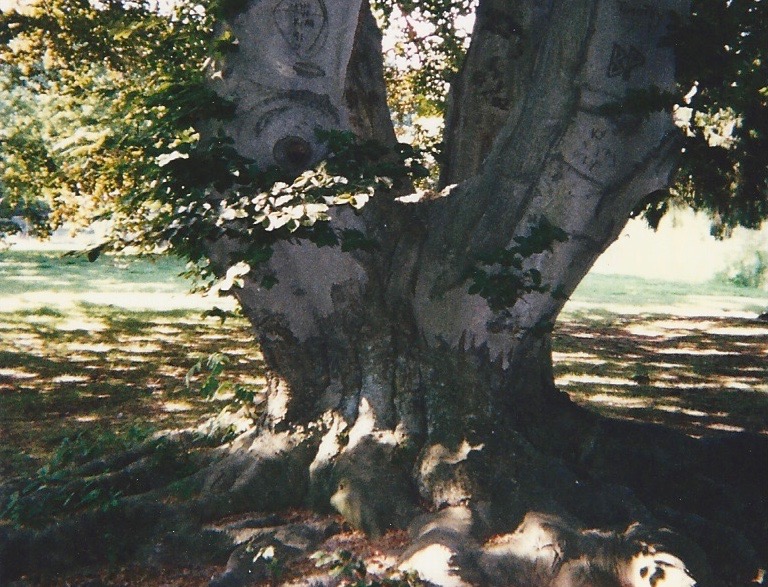
Beech tree with markings and roots
Copper beech tree with markings

Winter Winnowing

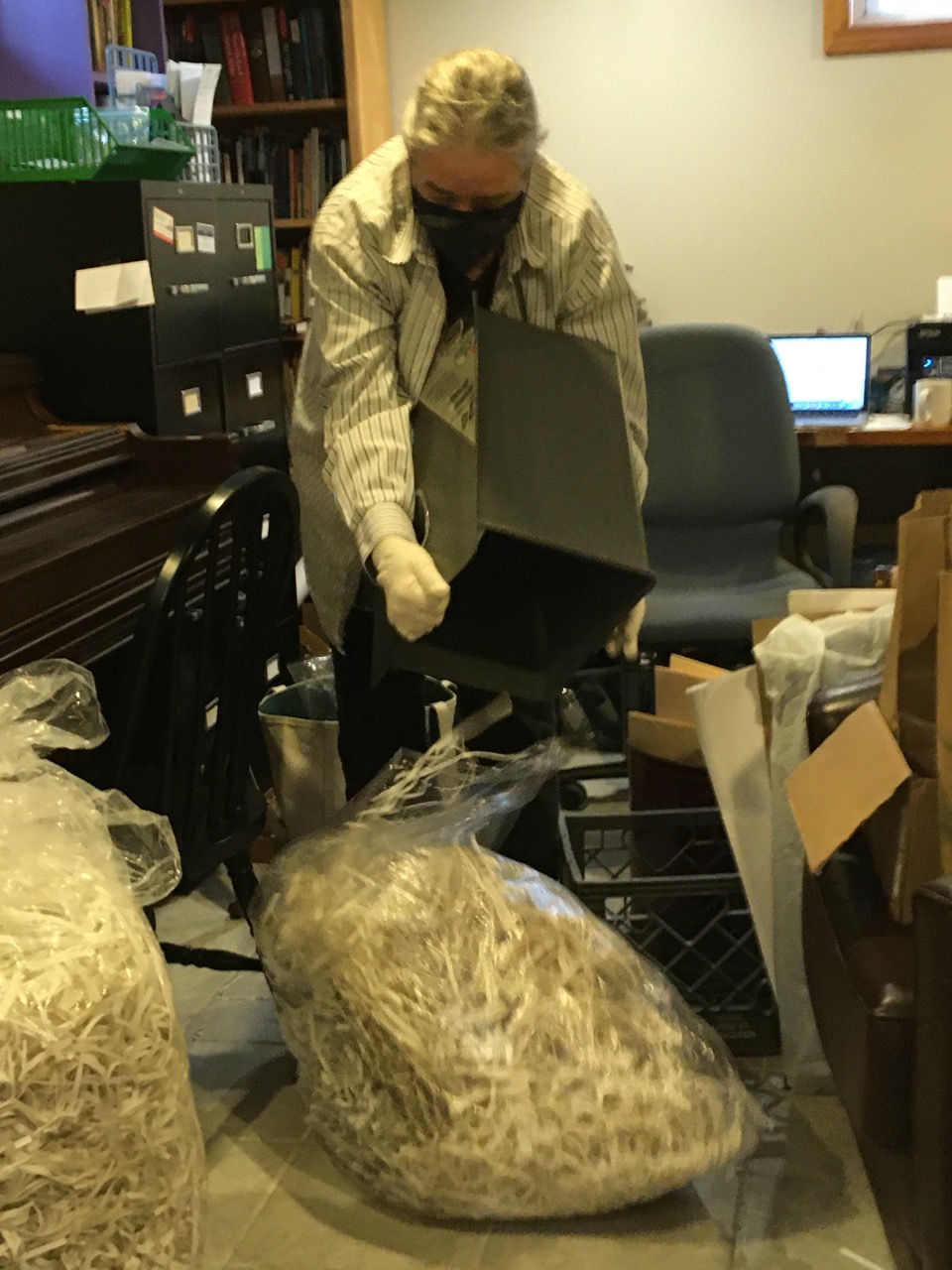
At work in the basement with shredded paper, photo by Margy Dowzer

Every couple days I go down into the basement, to sort through my old boxes. I cover up with an over-shirt and apron, cotton gloves and mask, to protect me somewhat against allergies to dust and old paper. I pull out a box and open it up to reveal treasures and trash, scribbled notes and carefully typed poetry, cherished memories and forgotten moments. I have no idea when I might finish, but it helps to think of this as my Winter Project.

Sometimes I think of it as death cleaning, as in The Gentle Art of Swedish Death Cleaning, by Margareta Magnusson, a method of organizing and decluttering your home before you die to lessen the burden of your loved ones after you’ve passed. But I am not following any methods put forth in this book. What connects is that I am weighing everything against the question “What value might these things have, after I am gone?”

When I became a feminist in 1979, I became aware of how women were hidden from history, how most written history prioritized the deeds of white men in power. Wonderfully, feminist historians, and those of other marginalized communities, have been bringing to light these hidden histories/herstories for several decades. Along the way, I internalized the belief that our own lives are part of history, too. My life is part of history.

As a childless lesbian woman, I won’t have descendants that would value my writings. But that makes it feel even more important to preserve my stories, especially those of lesbian activism, lesbian community, lesbian spirit. And so I have been thinking about what might be valuable for an archive, and in fact, I have already communicated with an LGBTQ archive that expressed interest in my papers. So this becomes an important measure for what to save, and what to shred.

But beyond what value these papers might have after I die, it has also been so valuable for me as a method to reflect on my life as a whole, revealed in what was saved, deliberately or accidentally, during various parts of my life. So far I have been going through boxes from the time I lived in Boston, from 1986 to 1999. I guess I started in the center of my life. There is a lot of shredding-I reduced the first three boxes to just one. I think after I finish with Boston, I will likely go back to the earlier boxes, and only then return to the more recent ones. Perhaps then it will be easier to put it all in perspective.

I don’t know why it has taken so long to begin this project. I don’t know why now seems like the time to do it. But in the middle of winter, in the midst of a pandemic, in this liminal time after retiring, my spirit feels called to this remembering, this winnowing, and so I keep going down into the basement to see what I will find.

Courage

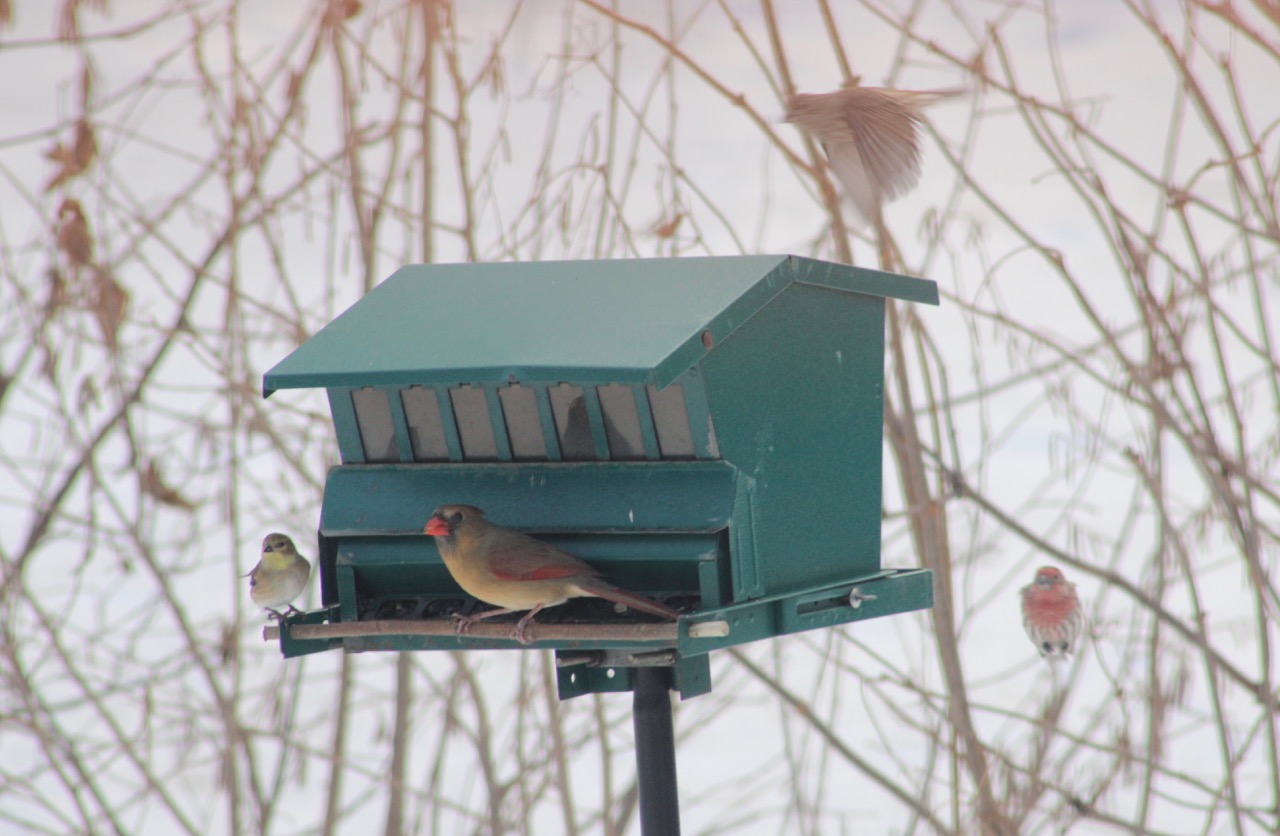
Photo: Female cardinal at feeder, with three smaller birds nearby.

I am finally embarking on a project to go through all of my papers, now in boxes in the basement. These range from files that I brought from my office when I retired 3 1/2 years ago, to boxes that I have carried around since college. This week I have been going through a box of writings–poems, essays, and an almost book, dating from about 1986 to 1996. During those years, I lived in Boston, surrounded by lesbian community, making a living in what today might be called the gig economy, while focusing my time and energy on activism, writing, feminist spirituality, and social change.

It was a scary time, financially, just getting by with no safety net, no health insurance, moving from rented apartments to other rented apartments in an increasingly difficult housing market. It was also, for a while, a joyous and exhilarating time, creating chosen family through collective living with other lesbians, wrestling with issues like classism, racism, and sexism, all the while imagining justice, mutuality, and queer beauty.

Reading the many words I wrote brings me back there, and I am impressed by the creativity which filled those pages and filled my life and the lives of those around me. But there was an undertow that sometimes threatened to drown me–a shift when housing got harder to find, when joyful cooperative situations became uneasy roommate situations, when loneliness began to plague me. Still, poetry and Spirit sustained me even then. I found this poem that seems worth sharing as 2021 comes to an end, and 2022 is about to begin. May you find the courage to follow the road where your heart leads you!

1/13/93

If there can be power in a word
the word “courage”
gets me out of bed
surrounds my heart in hard times.

There are many poverties.
Each moon waning, as I just get by
financially, I find my true despair
lurks in the isolation
which has covered the walls of my days
like some asphyxiating new paint
and I feel I can’t breathe
and I feel I don’t belong here.

I remember when I set out on a path
to transform the world.
We sang then, the joy of our
meeting filling our mouths
like lovemaking, our visions
changing us into new beings.
We laughed at how we didn’t fit
our chains anymore, and big as life
we set about to craft a new home.

There are many poverties.
Loneliness is the unforgivable sin.
I have always felt I could survive
the insanity and cruelty of the world
any poverty or hardship or struggle
if only I had companions to share it.

But here I am.
Loss and need my only mothers.

If there can be power in a word
the word courage
gets me out of bed.
Courage rests her cheek against my heart.
Courage squeezes my hands into her pockets.
Courage plants her feet into the prints
of my solitary steps
as if of course this is where the road
must go and I am still
that traveler.

Death and All the Stuff

Prompted by sheltering at home during the COVID 19 plague, the question came up: maybe it’s time for Margy and I to update our wills and other legal documents which we last visited in 2012. The basic purpose for us in these documents is to protect each other and make sure that we have the power to make decisions for each other, and inherit from each other. As a lesbian couple who are not married, this is what protects our “next of kin” status.

But each of these documents also has a secondary feature.  What if one of us is not available or able, or dies first–what then, who is next? That has always been a more challenging part of the process. In this age of plague, it is not outside the realm of possibility that both of us could succumb.  Who could we ask to take on the role of health care agent, or financial agent, if we were both incapacitated?

We don’t have children, and our family members are far away, and not always supportive of our identities. We have several good friends, but not a “best” friend, and many live far away. Can we ask any of our local friends to take on these roles? Are they close enough, or not too busy, or would they be overwhelmed by such a request? Who would bury us if we both died? Who are our people?

Similar dilemmas confront us with our wills, and who would inherit if we both were to die. I find that I have new concerns now that didn’t show up in the last will. What would happen to our land and garden that we’ve been so carefully tending? How could we ensure that the land would find new caretakers who would love it as we have? And who would have to sort through all the stuff that fills our little house? My natural temperament is to live simply, to possess little, and treasure those few possessions.  But somehow over all these years, I’ve accumulated a lifetime’s worth of stuff. (How did that happen?)

In the past few months, my mother has been preparing to leave her own house, and move into the home of my sister.  She officially moved yesterday.  All of her nine children and multiple grandchildren were invited to consider things we might like to take from her lifetime’s worth of stuff. But, aside from a few mementos, most of it has nowhere to go.  So even more likely, my own stuff will have nowhere to go.  It occurs to me that if I want to share mementos with people, maybe I should just send them as gifts now.

When I first did a will, I noticed that I most cared about my writing–I wanted there to be a way for thoughts and words to survive, for journals, sermons, essays, to live on in some way, to be a legacy.  That is still true, though now that I have actually published a book, I feel less anxious about it.  It feels like something of me will endure, this book child. But I also have five archive boxes full of journals that I have saved, countless sermons, another unpublished book, and even these blog posts. Sometimes I imagine them in an archive somewhere, discovered by some future historian who will be intrigued by my story. Might I be a spiritual ancestor to someone?

What fuels my need to save the writings? What compels me to write in the first place?

I wonder, does anyone see the whole story, does anyone see each of our stories, whether written or unwritten? Are our lives inscribed in a Book of Life somewhere?  When I was a child, we learned that God could see everything we did. It was somewhat scary then.  But now I find the idea a comfort–I want my life to have a witness. I hope my life will be inscribed in a Book of Life.

Hawk Talk

Hawk – Version 2

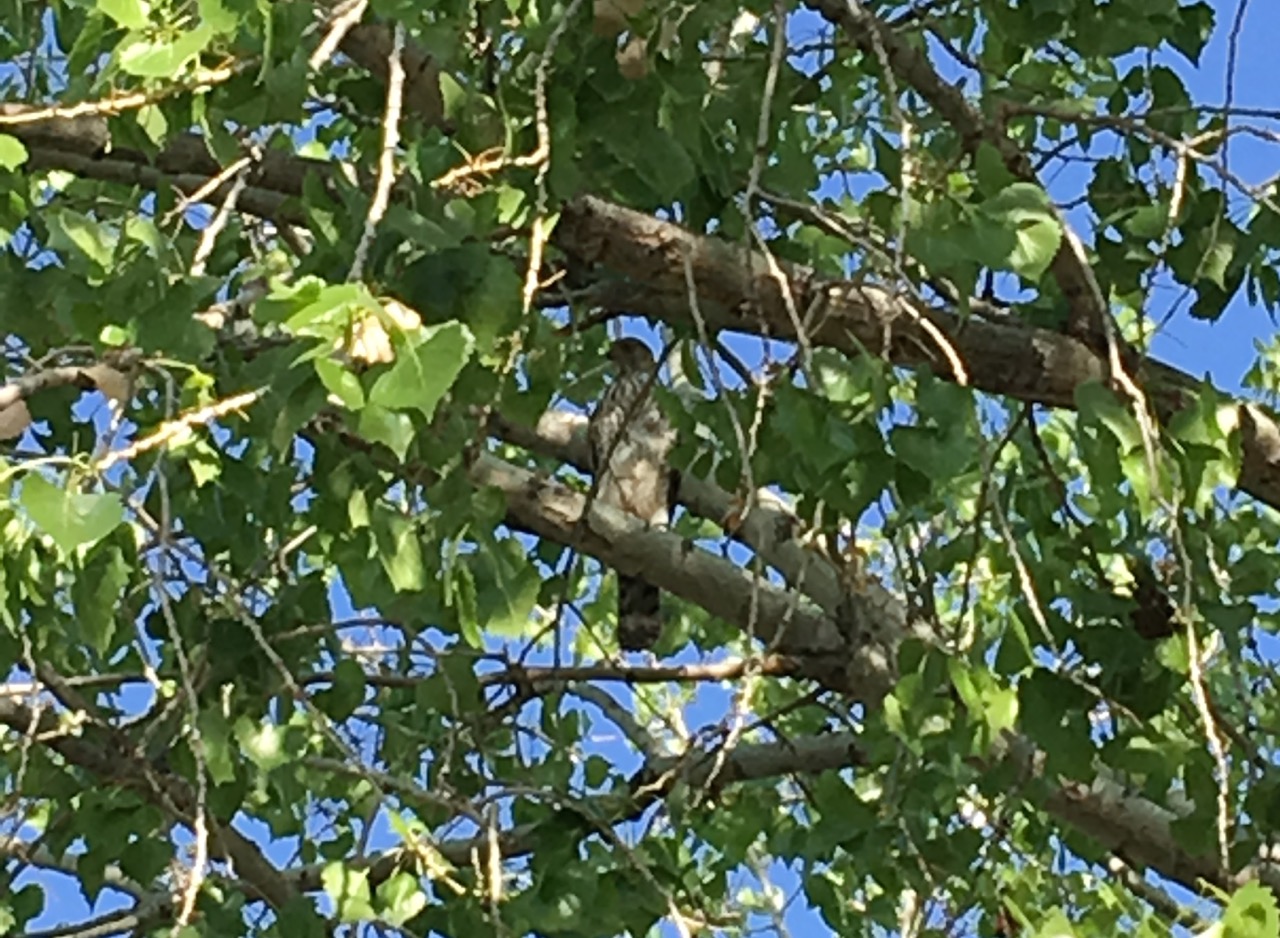
I was sitting outside in a little park writing in my journal, and a young hawk started vocalizing at me–almost like a bark or squawk.  She flew across the little grassy area, and was sitting in the tree when I took her picture.  She came back to the tree above me, and then flew off with another bird.

Meanwhile I was writing in my journal and working on a part of myself that I’ve been troubled by.  I was trying to sort out how to stop being critical, or thinking I know better than someone else.  Rather than try to get rid of a part, a more helpful practice can be to befriend the parts that we don’t like.  So I decided to name that part Athena Advice-giver.  Since the goddess Athena was born from the head of her father.  And I know my critical self was born from the critical side of my father, and from the critical side of his mother.  I asked Athena what she needed.  I wrote a lot.

And then the hawk came back again squawking at me, and flying around the park.  Getting my attention.  She really did seem to be talking to me, rather than occupied with something else.  Maybe she was just annoyed that I was sitting there.  Or maybe she just enjoyed my being there.  I got up from my writing and took pictures of her with my phone, and a video so I could remember her calls.

And writing again, another voice of wisdom came to help Athena evolve, to honor her essence, and bring it to a deeper maturity.  It said:

If you keep thinking you have the best way, you don’t get to learn the wisdom in other ways.  If you stay open to all wisdom, your own will grow–remember that. The wisdom of the hawk, the wisdom of the white pine, the wisdom of your partner, the wisdom of the groundhog, the wisdom of the drum, the wisdom of the desert.  Remember your curiosity.  Curiosity can be the antidote to criticism.  

Let yourself be curious and honor the wisdom of all beings.  They are your teachers.  Each being is wise.  And you are not the only one to deal with these challenges.

When I walked back to the apartment, my friend Virginia Marie told me that hawks represent transformation.  They often appear when we are in ceremonies of transformation.  My writing is a form of ceremony, and this time in New Mexico, a ceremony.  So I give thanks!

Unexpected Magic

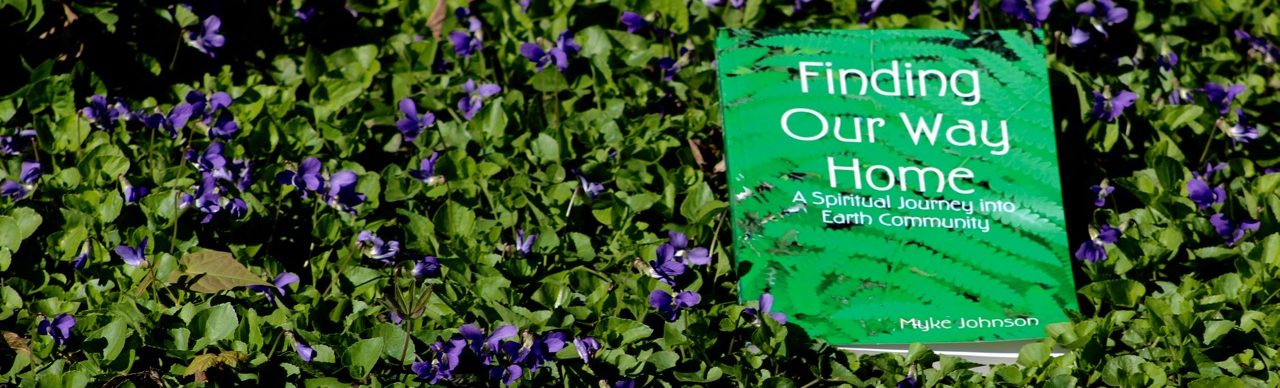
River MagicI am beginning to wonder if the book I have been writing (whether I publish it or not) is creating a kind of unexpected magic to manifest the visions within its pages. Yesterday, for the new moon, I read my journal from the last new moon until this one–a practice I do every new moon day.  This particular month has been a time for spiritual restoration.  But I noticed something rather curious as I read.  Old rituals and practices are finding their way back into my life after a time of absence.  And it seems related to the writing of the book, Finding Our Way Home.
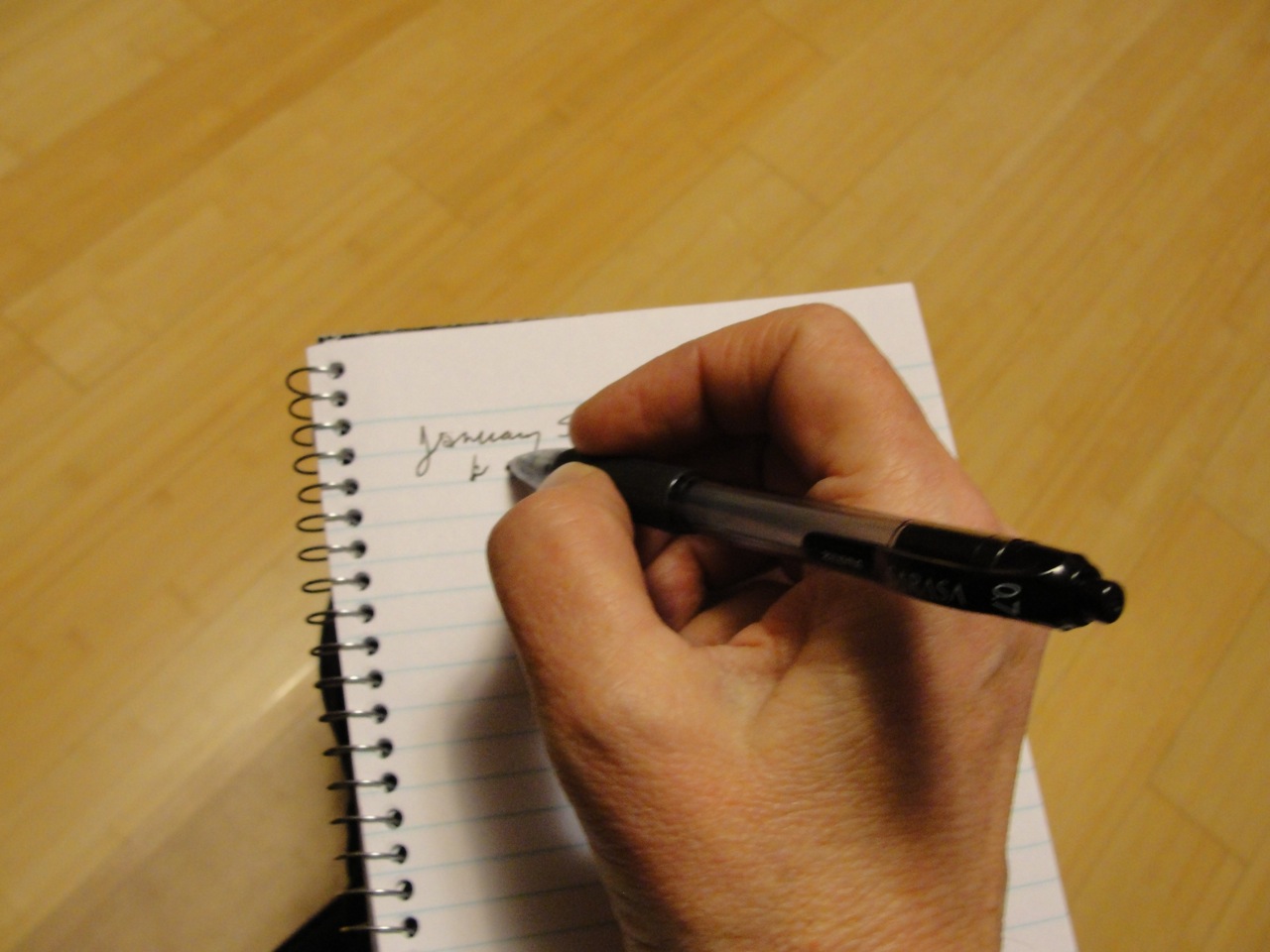
In one chapter, I write about the practice of diving into water every day, which came into my life when I lived on Cape Cod.  But for 11 years, there was no body of water close enough to where we lived for me to do that anymore.  And I didn’t imagine there would be in our new house, but then we learned about access to the Presumpscot River just ten minutes away.  So now it is a possibility again.

In another chapter, I write about dance as a form of prayer–physical, emotional, a way to experience the energy of the divine in my body, and find joy in the midst of struggle.  When I lived in Boston, I was part of a women’s spirituality circle that danced as a part of our rituals.  But I haven’t had an easy or collective way to do that for a while.  Then, this month I found a community group that meets for free-form expressive dance every Sunday morning–not always so great during the church year when I am occupied most Sunday mornings–but for the summer it is accessible to me, and once a month on my Sunday’s off during the year. So now that is a possibility again.

And then I started thinking about how I had written about wanting to use less oil, to have a house that was zero-carbon–I wrote about it before I could imagine any way that we might really find a way to live in greener housing.   But this past year we started an intentional search for greener housing.  Our new home is not all the way to zero-carbon, but with our solar panels and in-town location we are using so much less oil than before.

Journaling DSC01316I also write about the spiritual practice of writing–and the book as a ceremony of reconnection to the earth, to each other, to the spirit within all.  But the magic I have been noticing this month was completely unexpected, beyond my wildest dreams, and uncanny in its particularity.  I wonder if when we write our hopes and visions, when we express our gratitude, when we imagine and tell the stories, there might be an energy that starts to percolate. What has lain dormant wakes up and tries to find a way to express itself.  All I can say is wow, and thank you.
Little Beautiful Changes

DSC02932

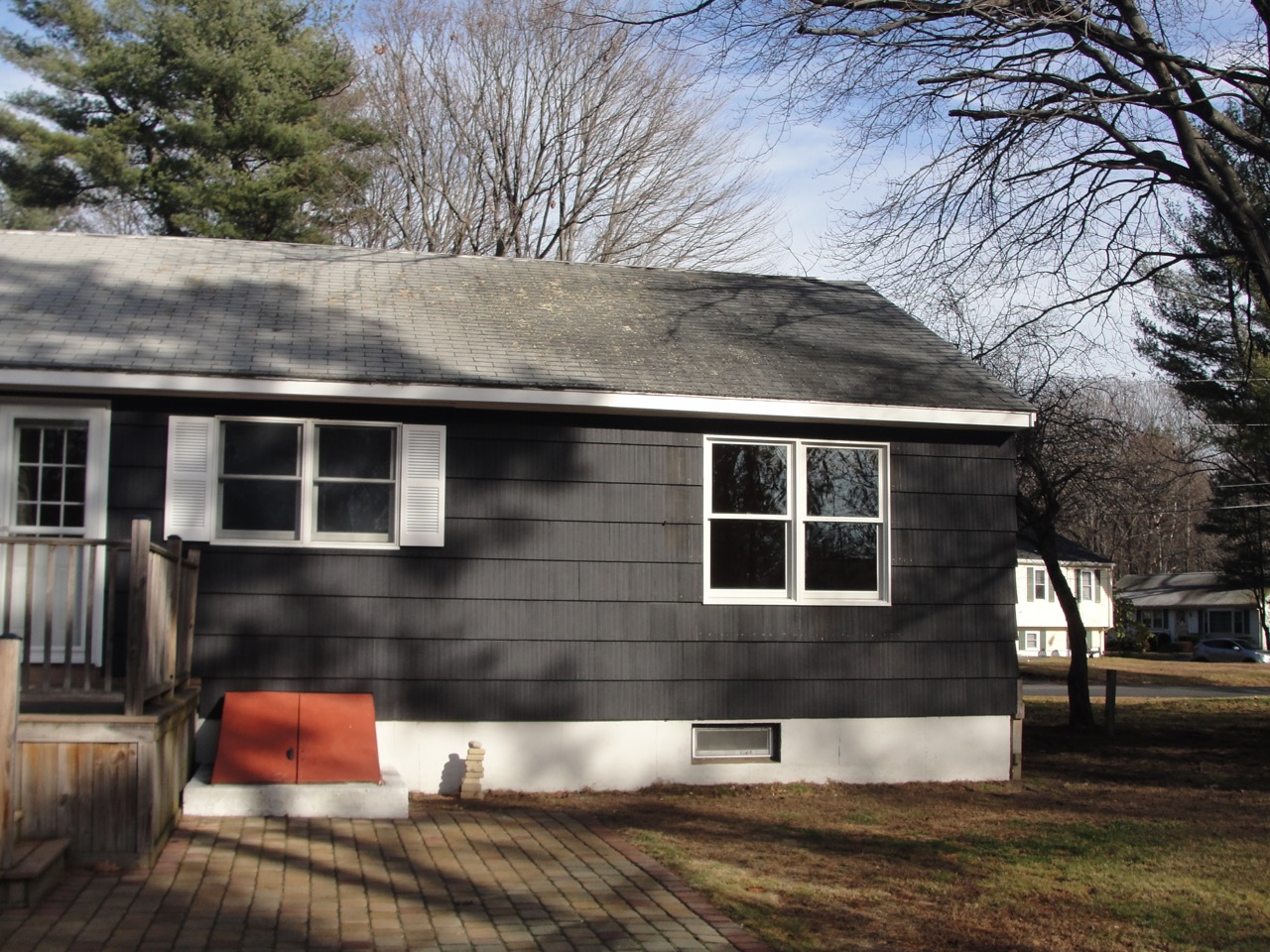
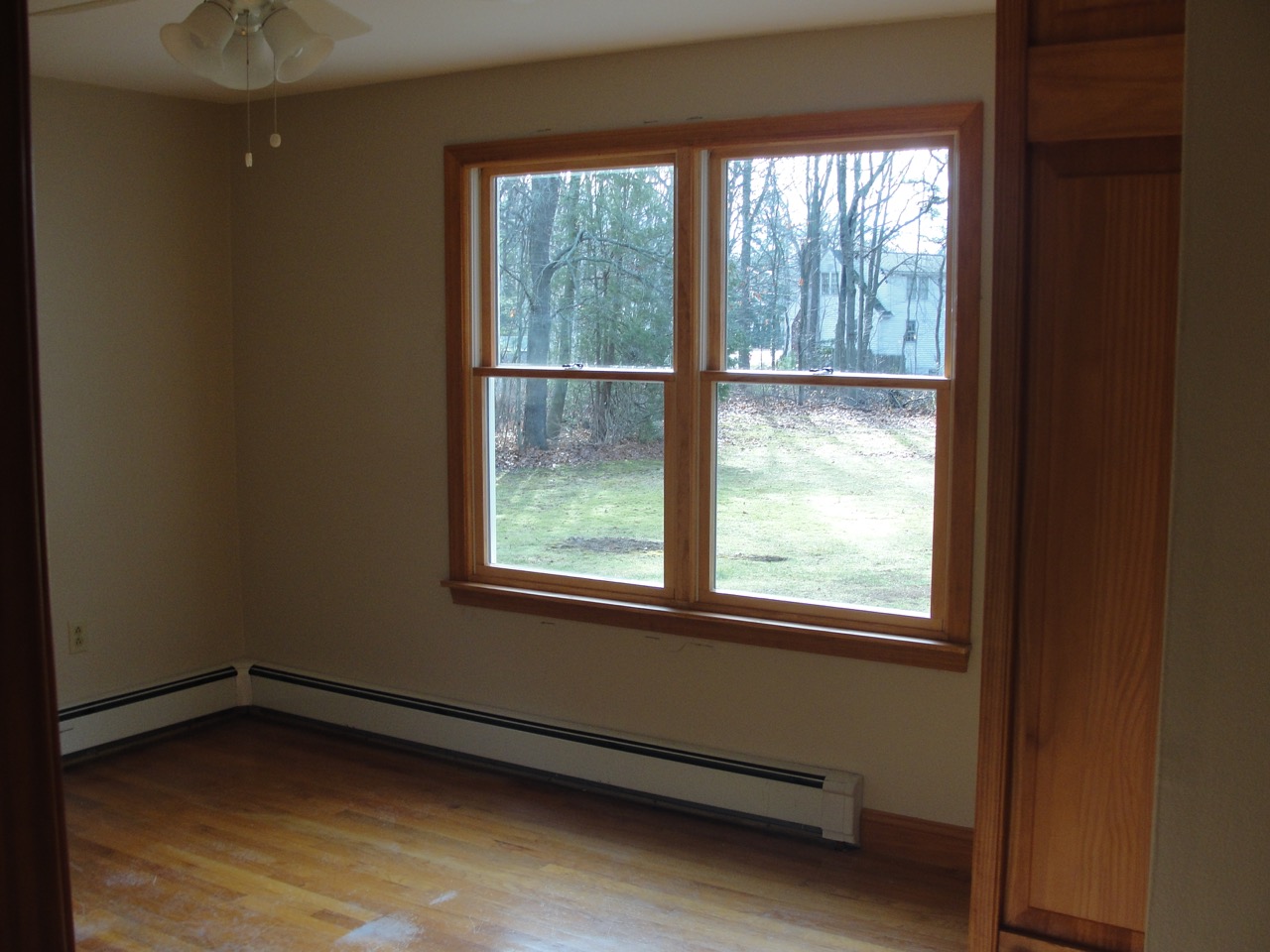
The new windows!

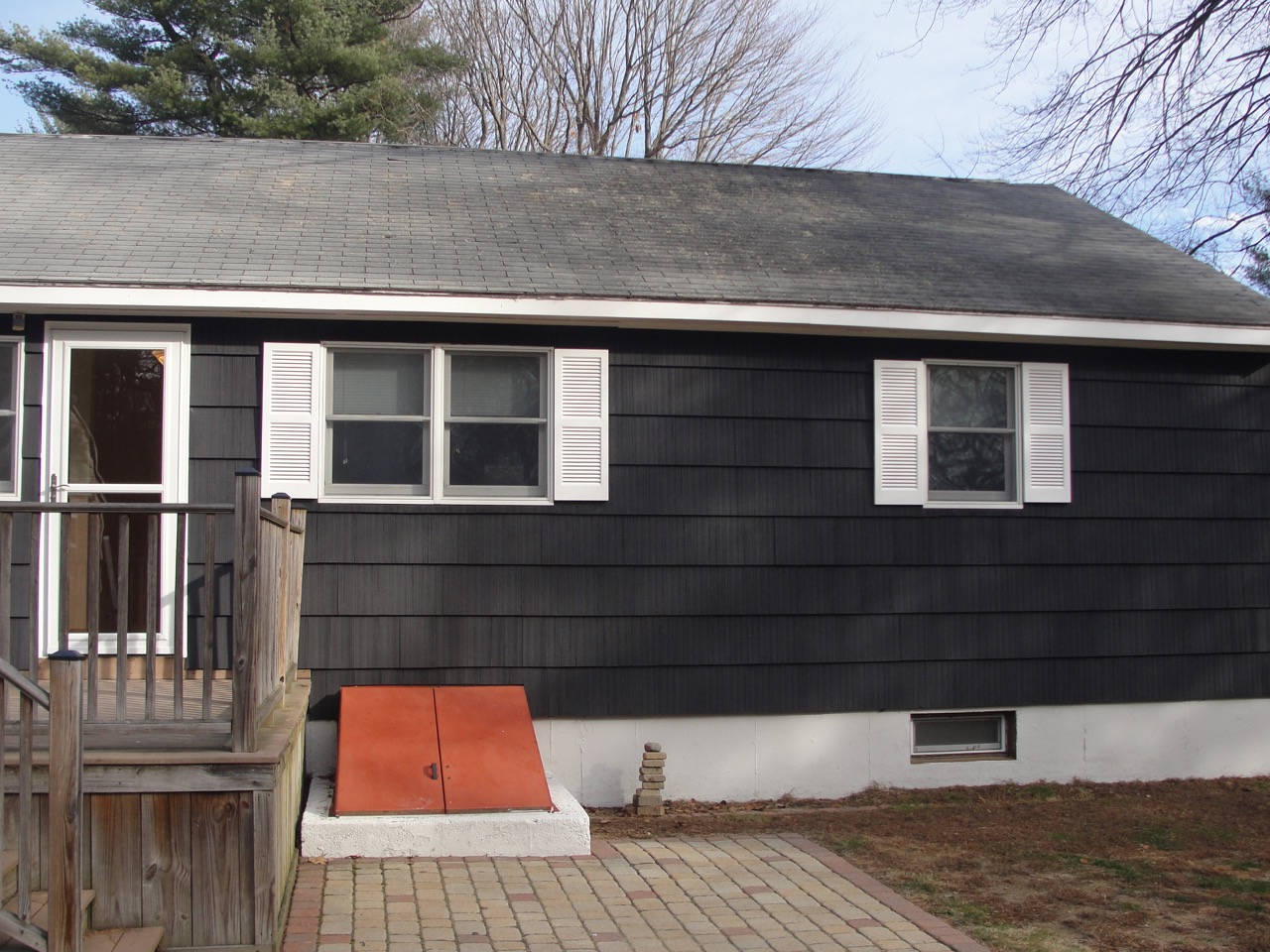
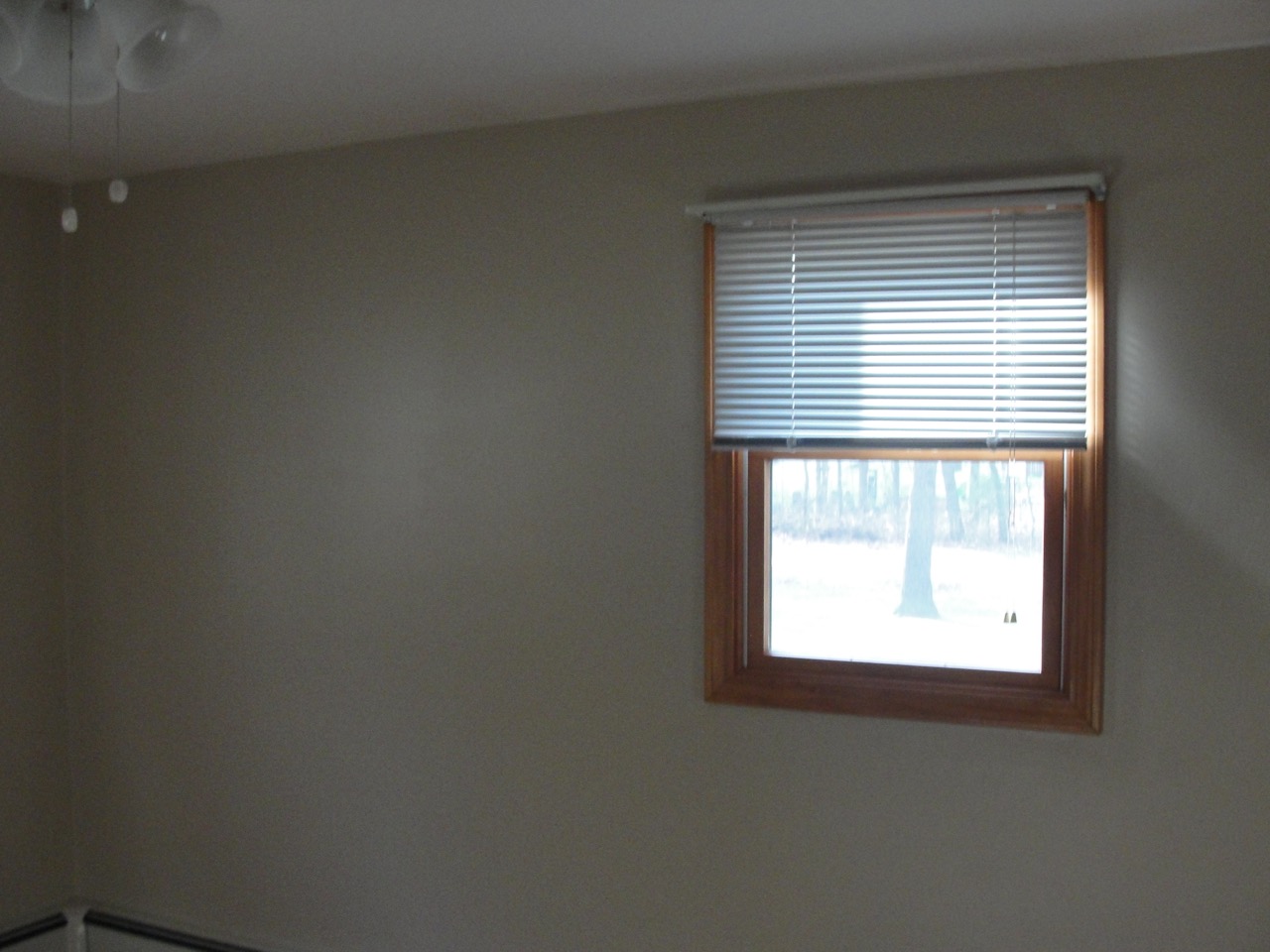
The carpenters are busy at our new house, creating some beautiful changes.  One has been to create a double large window in the back bedroom, where there was only one small window before.

DSC02893

Before

It is a balancing act for green housing, because any hole in the envelope is a hole in the envelope–but these are on the south side of the house, and will let it a lot of light, and connection to the yard.

It made an immediate difference!  This will be my room where I also hope to put a small desk for writing.  My files will be in the basement, but I wanted to write where there was a lot of sunshine. Today I was looking for a sunny spot in our current home, to read a little for my sermon this week, but a sunny spot was hard to find… I am imagining how nice it will be to sit in the sunshine of these new windows.

I am so glad that in our search for greener housing, I learned how important it was to me that there be beauty in my home. Perhaps otherwise it would have felt too extravagant to include these windows in our plans for making the house our own.

Here is how it looks on the outside, before and after.
DSC02898

DSC02949