I have had the privilege of studying Wabanaki Languages this fall, taught by Roger Paul. For me it has been a small way to begin to decolonize my mind–to begin to think differently. Our final project was to make a short presentation to our class, and I was inspired by the words we had learned to talk about the animals I see and hear on my morning walk. I also drew on the Passamaquoddy/Maliseet (Wolastoqe) Language Portal for further help with verb and noun forms, and I learned some new words along the way. If any speakers of the language read this, edits are welcome! Roger encouraged us to jump in with using the language, even though we will make mistakes.
For those who do not know about Wabanaki languages, you might find it interesting that animals are not referred to as “it,” and people are not referred to by “he” or “she.” There are “animate” and “inanimate” forms, and both people and animals are referred to by animate, non-gendered verb and noun forms. A lot of information is encoded into one word. So, for example, “npomuhs” means “I walk.” “Nutuwak” means “I hear (beings plural and animate.)
Ntoliwis Mayk. Nuceyaw Portland. (My name is Myke. I am from Portland.)
Spasuwiw npomuhs. Wolokiskot. (In the morning I walk. It is a beautiful day.)
Nolokuhs lahtoqehsonuk. (I walk in the direction of the north.)
Nutuwak sipsisok. (I hear small birds.)
Nomiyak mihkuwiyik oposik. (I see squirrels in a tree.)
Apc, nolokuhs cipenuk. (Next, I walk in the direction of the east).
Nomiya kisuhs musqonok. (I see the sun in the sky.)
Nutuwak kahkakuhsok. Tolewestuhtuwok. (I hear the crows. They are talking)
Nomiyak oqomolcin kehsuwok nehmiyik awtik. (I see eight turkeys in the street.)
Apc, nolokuhs sawonehsonuk. (Next, I walk in the direction of the south.)
Npomuhs sipuwahkuk, naka nomiya motehehsim sipuhsisok. (I walk along the edge of the brook, and I see a duck in the brook.)
Nutuwa pakahqaha lamatokiw. (I hear a woodpecker a little ways into the forest.)
Wahte, nomiya qaqsoss. (In the distance, I see a fox.)
Apc, nolokuhs skiyahsonuk, naka ntapaci nikok. (Next, I walk in the direction of the west, and I come back to my house).
 Nomiya munimqehs kihkanok. N’ciciya wot. (I see a woodchuck in the garden. I know this one.)
Coness, Munimqehs! Musa micihkoc kihkakonol! Wesuwess! (Stop, Woodchuck! Don’t eat the vegetables! Go back where you came from! )
Munimqehs qasku. Qasku asit kakskusik. Qasku lamatokiw. (Woodchuck runs. S/he runs behind the cedar. S/he runs a little ways into the forest.)
Toke, ntop qotaputik qocomok. (Now, I sit in the chair outside.)
Komac Wolokiskot! Woliwon! (It is a very good day. Thank you)
 One thing I love about the snow is how it reveals the lives of our animal neighbors. Here is a squirrel highway, a path between two mounds. Now, I had actually helped to create that path the day before, before the snow. The day before that, Margy got a call from a local arborist that he had some wood chips we could have. For permaculture gardeners, wood chips are a boon, especially hardwood chips, especially lamial hardwood chips, which are from the small branches and leaves of the tree. They provide nutrients to help create the kind of soil that is best for fruit trees.
 So the wood chips were delivered. The next day I noticed that where the big pile landed had kind of blocked off the pathway on the edge of the food forest. Last winter, I had strung a small string across the edges of the food forest as a gentle deterrent to deer who might possibly wander through. We had seen deer tracks before, though we didn’t actually see any last winter. But the idea was to leave one area free for them to traverse, hoping they’d choose that path on the way between the street and the back of the yard.
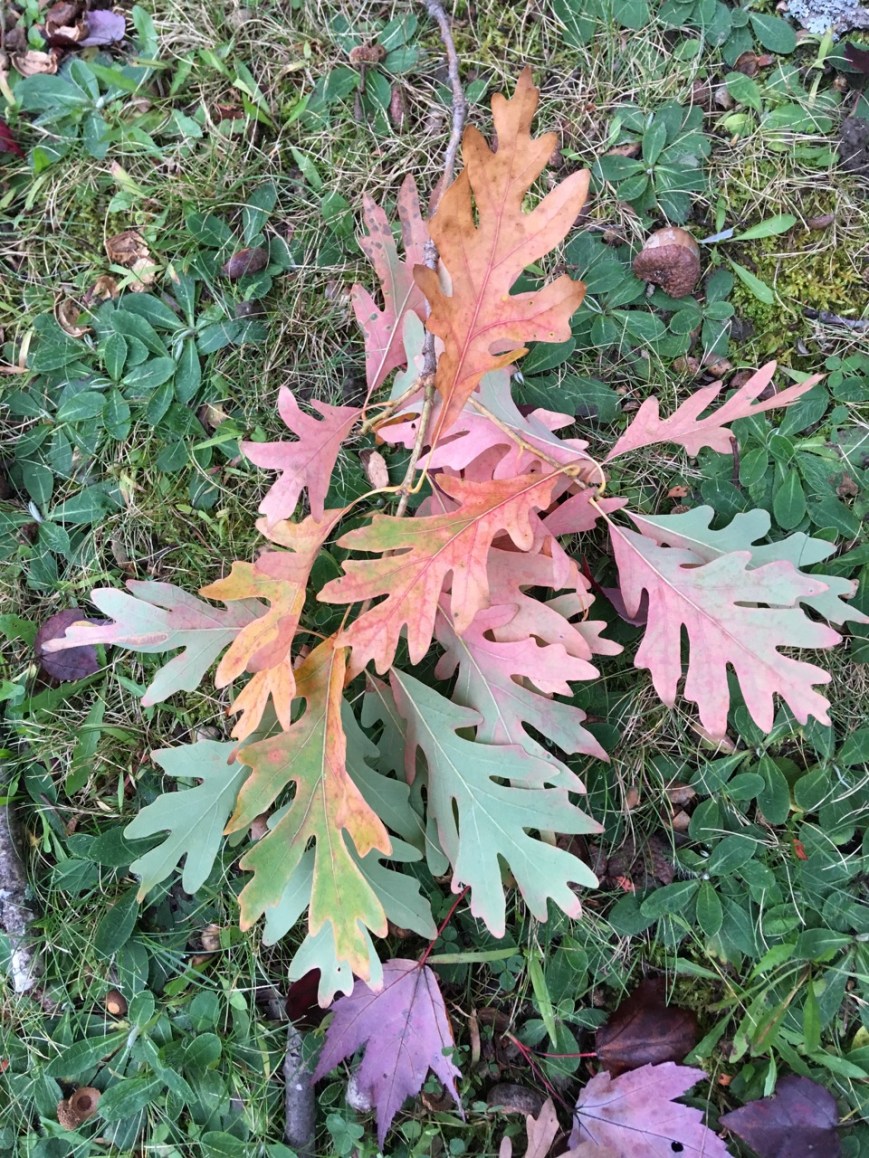 I seem to be writing on trees these days. This morning, I happened to notice this photo I took a month ago, rainbow colored leaves of the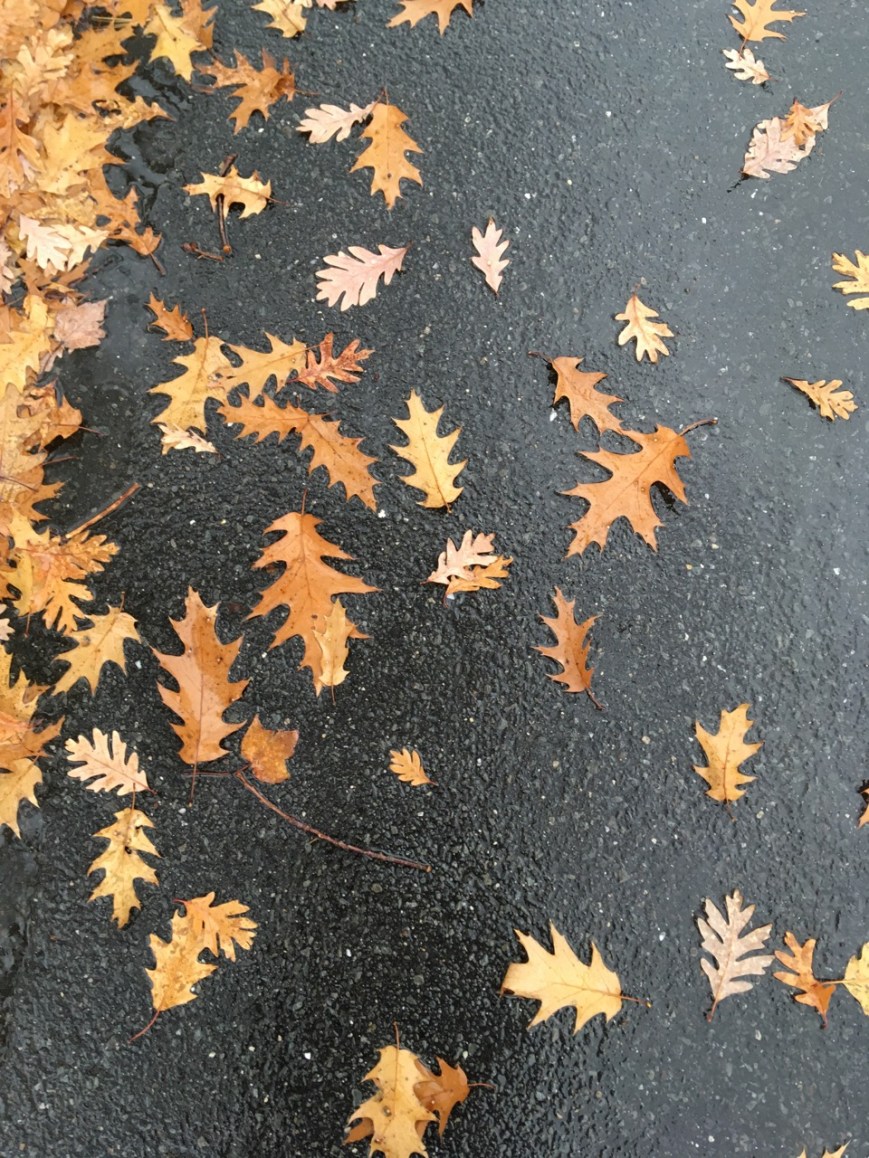

 It must have been a big machine that cut down the grandmother pine tree. I found no disturbance around the stump when I climbed up to it to offer my grief and respect. The weeds and small brush nearby were there as before, with only fresh wood shavings and pine sap falling over the edges of the stump. Nothing huge crashed to the ground when they took her. So it must have been a big machine.

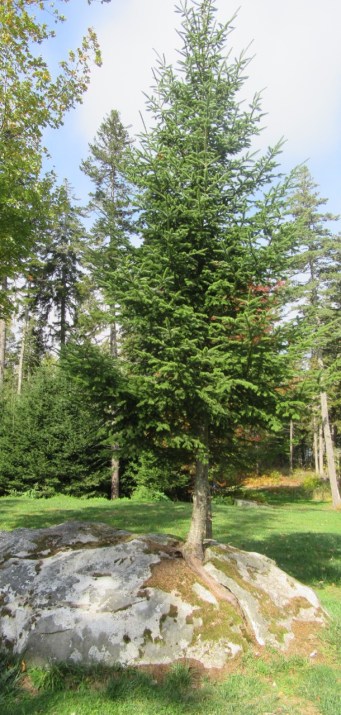 Life holds a strength that will not be extinguished, that will crack open the most oppressive of constraints. When I was in Tenant’s Harbor, a few weeks ago, I saw this spruce tree growing out of a huge boulder. Its roots were literally embedded in a crack in the rock itself. I wondered if a seed had found a tiny patch of soil within a crack, or if in fact, the seed, rooting, had created the crack in the rock. But however it first took hold, the roots were now literally splitting the rock in two.
 I had almost forgotten about the incredible doom of the draft lottery of 1969 and the years following. But recently, I happened upon two fictional accounts of lives being undone by this lottery, and it all came back to me. One came in the television drama This Is Us, in an episode about the back story of Jack’s time in Vietnam. (Spoiler alert!) Jack and his younger brother Nicky are at a bar on December 1, 1969, waiting to see what birthdays will be chosen for the draft call-ups. Nicky is portrayed as a gentle, glasses-wearing kid, not tough, not cut out to fight. Jack is his protector. Nicky’s birthday, October 18th, is chosen as number 5, which means he is sure to be inducted. Their dad tells him only, “Make me proud.” Jack and Nicky consider options, maybe Canada, but Nicky succumbs to the pressure and joins up. We learn that Jack himself had had a deferment because of a rapid heartbeat condition. But when Nicky writes from Vietnam that he has gotten himself into trouble, Jack finds a way to enlist, so he can watch over his brother.
 Finding Our Way Home