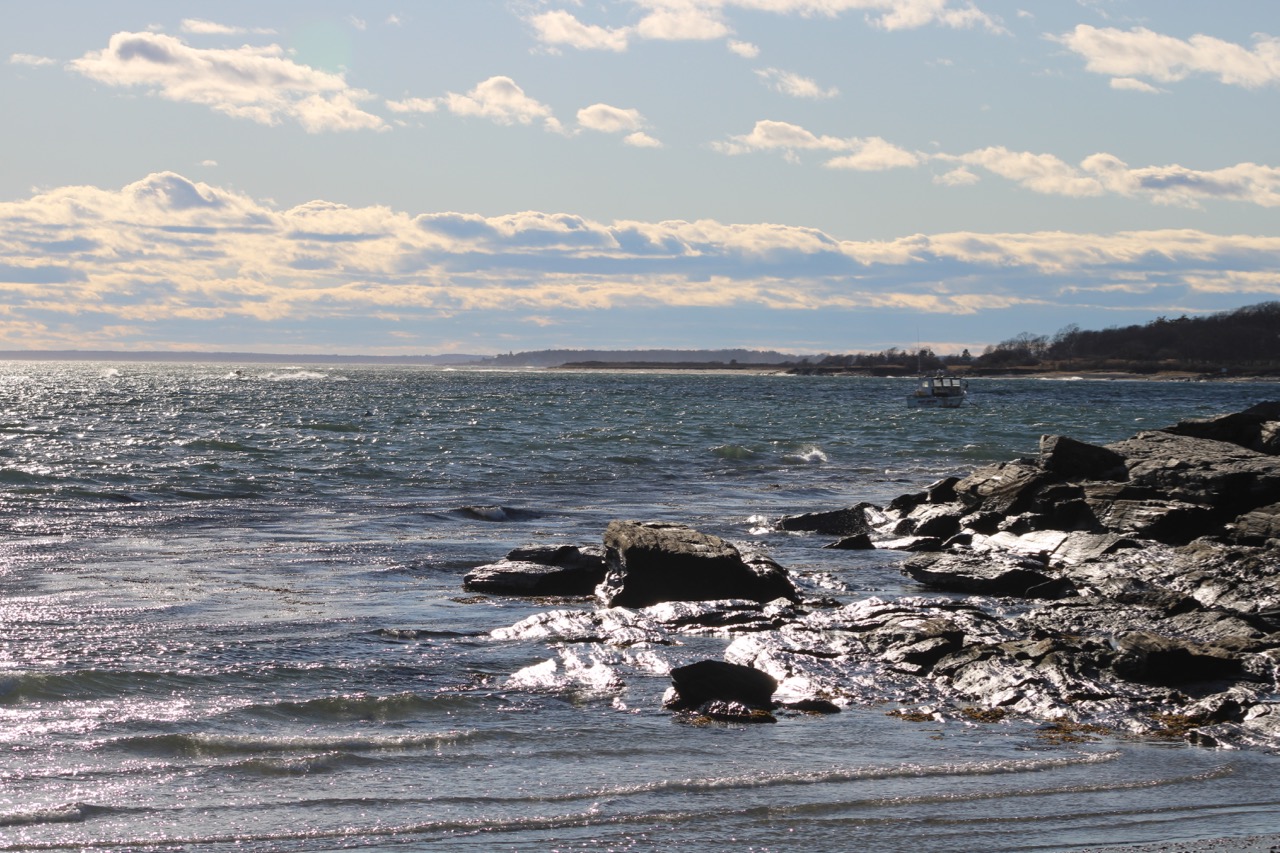
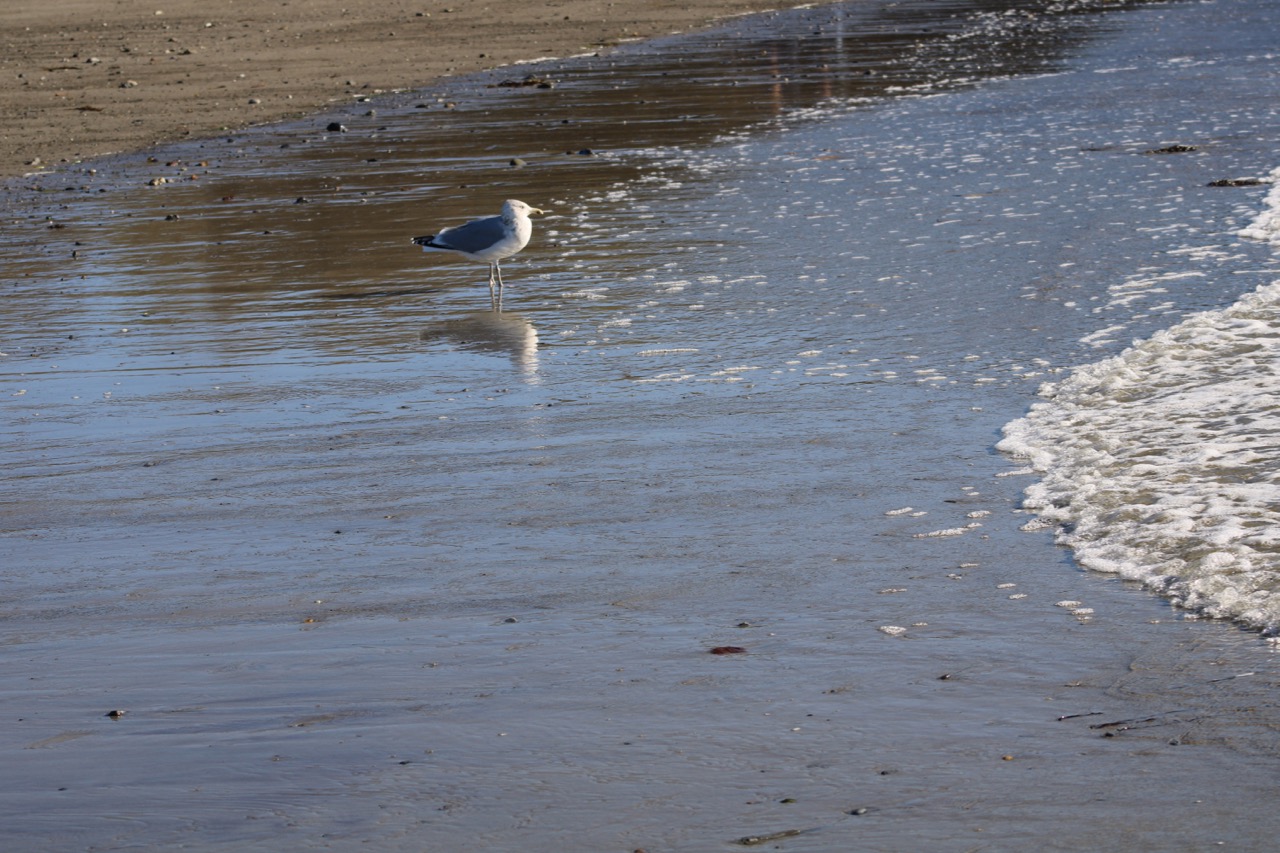
I needed this winter afternoon at the beach. We went to Kettle Cove, where it was windy, sunny, and warm–well, in the forties anyway. So now my heart is calmed and refreshed. There is a quiet that comes from the sound of waves and wind, the feeling of our feet walking on sand. We always say we should go more often, but it takes some push, some energy to get ourselves there. Funny that, because it always feels so good once we arrive.
Even though I am retired, I’ve been doing too many days of projects–still plugging away at the boxes for the archive, among other things. Don’t we need this other rhythm? The one of being in the presence of all that is bigger than we are?
And there was evidence that the wind and the waves had been bigger than the beach recently, maybe when the recent huge storm came through. The wooden walkway was broken apart, and there was erosion in parts of the shore. We are so small, and what we can build is so puny. But all of that is okay–it’s part of what brings the feeling of magic to our walks on the beach.
Broken walkway
So we come home again, and the great quiet is within, the mysterious gratitude for life, in the midst of all its challenges. Can you feel it? How does it come to you?
We are halfway to Spring! So many cultures celebrate this day, or this change of season. For just a few examples: Imbolc or Brigid’s Day for Celtic people, Apuknajit (the winter spirit) for Mi’kmaq people, Candlemas in Catholic liturgy, Groundhog Day in secular America. They hearken to the coming Spring, and offer courage for getting through the rest of the winter. Here at our home in Maine, I can feel the change in the quality and angle of the sunlight. My heart is lifted by its brightness.
We’ve recently had a triple set of snowstorms, so the ground is finally covered in snow after nothing much in December. It too adds to the brightness. I love how it also reveals the creatures who live here with us. I’ve seen deer tracks going through the orchard all the way back across the frozen pond and into the hedgerow. You can see their traces in the photo above. I was also delighted to find these distinct squirrel prints after a rain on top of the snow a week ago. Like little hands.
Squirrel prints
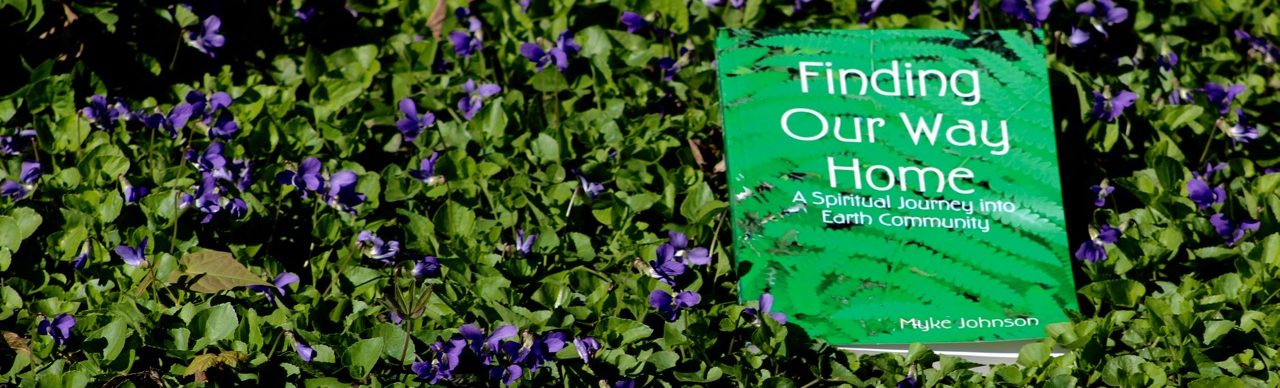
I’ve been continuing my winter project of sorting, organizing and winnowing old papers in the basement. I had started with my years in Boston 1986-1999, then moved backwards in time. I am now finished with the very earliest files-hurray! So then I moved forward from 1999. I’ve begun to sort through papers from my years on Cape Cod, 1999-2005. That has meant that I’ve also started to incorporate the winnowing of digital files on my laptop for the same years. Some of it is plodding work, comparing documents to put duplicates in the trash, renaming documents so they are easier to organize, stuff like that. But some of it includes moments of sweetness, like finding a letter from a young queer person whose life was helped along by a sermon I preached called “Believing in Fairies.” [A version of which found its way into my book, Finding Our Way Home, and was excerpted in the post The Mystery Seed.]
It does my heart good to think of those seeds of blessing planted in the hearts of people I met along the way. Sometimes we hear about it afterwards, and sometimes we may never know. When the interactions were not so blessed–since I had my share of conflict and trouble along the way–it does my heart good to shred the remnants of those interactions, and let go. Lighten the load.
Imbolc is a time for setting intentions, for shaping our hopes for the future. It is kind of like looking through seed catalogues imagining what we will plant when the next season turns. I’m not ready yet for seed catalogues and intentions. But it is good to remember that the sorting and winnowing of my past life will not go on forever. I don’t know what sort of seed I want to plant for the future. That is still a mystery to me. But I am good with a mystery seed.
I saw a funny story on Facebook about a child who thought that bird seed grew birds. They showed their parents the proof–they planted a big pile of bird seed outside, and the following day, there was a whole flock of birds gathered round the spot. Maybe that is what I will plant today–filling the bird feeder with seed so that they will have nourishment for the deep freeze we are expecting in a couple days. I understand that Mi’kmaq people put out food for Apuknajit so that the winter spirit will be remembered and be kind. Maybe that is part of feeding the birds too–to remember our fellow creatures during these cold winter times, so that all of us might make it through to the spring.
My friend Estelle making art from the “13 Hugs Are Healing” shed (2015)
This past week, my beloved friend Estelle died. She had been living with her granddaughter Michele, and thankfully, she was at home with her family during her final days and hours. She had been in declining health for a while, but the shock of her death reverberated through a wide community of people who loved her. She was another person in my life from whom I experienced unconditional love. Estelle was a woman who created community around her, and many people felt her unconditional love. She had a way of seeing the specialness in each person.
I met Estelle in 1985 at the Women’s Encampment for a Future of Peace and Justice–the Women’s Peace Camp for short. The camp was 52 acres directly next to the Seneca Army Depot in upstate New York, where it was rumored that nuclear weapons were stored. Estelle visited the encampment the first week it opened in 1983 and lived there on and off for the next 20 years. She was a founding member of the encampment’s second incarnation, Women’s Peace Land, and was co-founder of the Peace Encampment Herstory Project. I can’t remember it clearly, but Estelle and I probably got to know each other more deeply while sitting by the fire on overnight watch duty. By the end of my first summer staying there, I counted her one of my closest friends.
Estelle was an elder to younger women at the camp–most of us were in our 20s and 30s, and she was in her 40s. But she already had wise crone energy–she was fierce, courageous, protective, and creative in a context where we were willingly on the front lines in the battle against nuclear weapons. There were numerous actions of public civil disobedience and less public direct actions taken on behalf of peace. Because Estelle had a job to go back to, she didn’t risk arrest, but she was a stalwart support for those who did. I want to share one story that was recently shared on the peace camp Facebook page that illustrates her so well.
“So, one night a group of women came back to the house after sneaking into the Army Depot and painting peace slogans on the water tower. They had mud still smeared on their faces and spray paint on their clothes and hands and were telling of their triumph when soldiers came racing after them and tried to charge into the house but Estelle, in her white haired Mother Jones persona, blocked the door and calmly told them, “women are sleeping in here, you men can’t just walk in” and that stopped the men, who were after all mainly young and only here because the world didn’t give them other ways out. By the time an Officer arrived to Put Down This Womanly Nonsense some of the women had wiped off the mud while many others had smeared some on so there was just no way to know who the soldiers had followed home. Much ordering around ensued and women were told to line up and account for themselves and well you know that just did not go as the Officer thought it would. Meanwhile Estelle, who had long since befriended the local sheriff and deputies called that sheriff and those deputies to report that men were trespassing on the farm and threatening the women so then the sheriff and a deputy or two came roaring up and then more ordering around and demands to account for themselves happened and meanwhile the women with spraypaint on their hands got snuck out the kitchen door and into the dozens of tents in the dark field and eventually it was impressed upon the soldiers that they had no rights even one inch off the base and as they drove off Estelle smiled and waved then – Mother Jones, remember – got right back to organizing the next day’s actions.”
post by Elliott BatTzedek
I remember being in a similar action, with similar magic worked by Estelle to confound the army personnel who came after us. Estelle demanded that they produce a search warrant describing who they were looking for, and of course, their descriptions weren’t close to matching the actual women involved. There is so much more I could say about Estelle and about the Peace Camp. Being there from summer 1985, and then winter through summer of 1986, was transformative in my life. Coincidentally, I have been going through old papers and letters from that time this week, so perhaps some other thoughts and memories will bubble up during that process. But for now, I wanted to express how grateful I am that I knew and loved Estelle. There was a shed on the camp with a slogan painted on its side: 13 Hugs Are Healing. I am mindful of the many diverse ways that love that has touched my life through the years and the healing I experienced from that love.
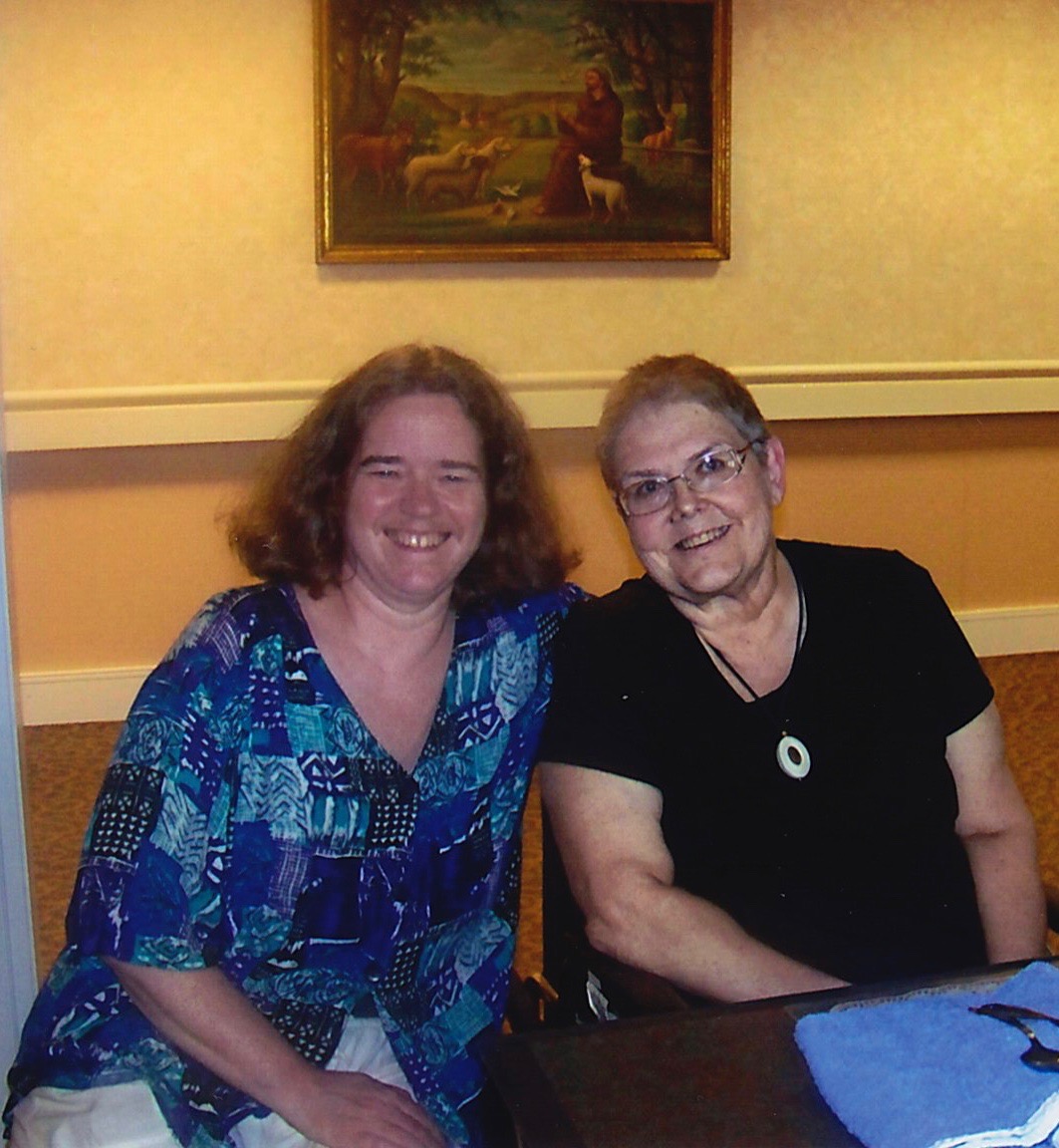
Me and Lori, 1977, when she took her first vows as a Franciscan sister.
What does unconditional love mean? What does it gift to us in our lives? I first experienced unconditional love in my friendship with Lori Slawinski. I have been looking back on my life by going through old papers these last several weeks–my winter project. The other day, I reread dozens of letters from Lori from when we first knew each other. We met when I went to college in the fall of 1971. She was a sophomore at the time, and became the “big sister” I never had at home, my being the oldest child of so many. I haven’t found any photos from that time; this photo from 1977 is the earliest. Very quickly we became best friends, though there was a moment when she hesitated–she said she was afraid of corrupting my innocence. I can’t remember exactly what I said to her, but all I could see in her was her own bright goodness. I think each of us were surprised to be chosen and loved by the other.
Looking back from the perspective of being a lesbian, I wonder about our friendship. We were never sexual with each other, but our letters can only be described as love letters–mostly written on school vacations when we were apart from each other, missing each other, and expressing our affection with such deep passion. I had occasional crushes on boys during this time, but nothing could compare with the love I shared with Lori. Our love for each other was also expressed in the context of our passionate love for God. Lori and I were part of a small circle of friends who were trying to follow Jesus and figure out how to live the gospel in our times. All of it intermingled. From her I felt God as the unconditional lover, and from me she felt that too.
Unconditional love is a transforming energy, a grounding that helped me to believe in myself. Maybe because we weren’t trying to be “in a relationship,” we could grant each other the freedom to explore fully who we were, without expectations? Our maybe it was the spiritual rootedness that provided that freedom. We had a fantasy of continuing forever in our little community, but college is a temporary place. When she graduated, she left to join the Franciscan Sisters of Chicago. I didn’t follow her there, but tried another way, eventually discovering the Catholic Worker movement. Lori was very psychic, and I remember it took a lot to claim my own inner knowing, since she always seemed to know me so well. Separating was a challenge, after being so close. But we were able to let each other go, to try to work out our own destinies.
Our lives diverged significantly when I encountered feminism, and found myself leaving Catholicism, leaving Christianity, embarking on a new spiritual path. I imagine it must have been difficult for her, yet we stayed connected. I went to Chicago Theological Seminary in 1983, came out as a lesbian while there, and she came to my graduation in 1986. (It was years later, in 1999, that I was ordained a Unitarian Universalist minister, but that is another story.) Somehow, the love we had for each other never wavered. We kept in touch via occasional letters and long distance visits. Sadly, Lori died of cancer in July 2012; this second photo was from our final visit in May of that year.
I am so grateful that I was able to experience her unconditional love in my life. I have had other significant loves, and still do, but her love was the root. It enabled me to come alive, to feel joy, to trust the dreams I dreamed and the ideals that guided me. Despite our different paths, that unconditional love remained tangible. Perhaps that is why my image of the divine is rooted in a Larger Love, who loves all of us unconditionally.
Have you experienced such love in your lives? Please share your stories if you might be willing? Each story reminds me of the possibilities that surprise us when we least expect.
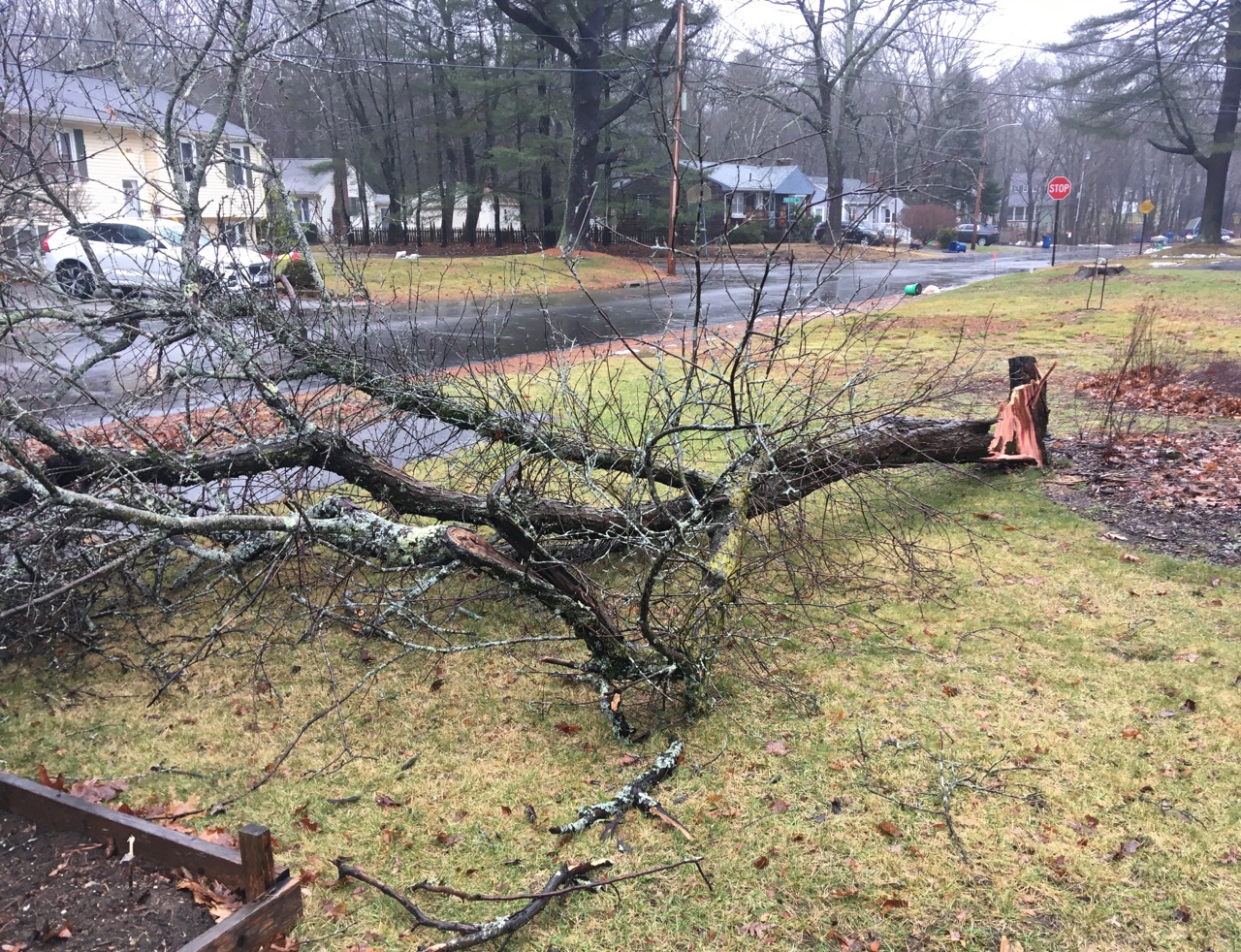
On December 23rd, a severe rain and wind storm passed through Maine, after also creating havoc with storms and snow in other states. In the early afternoon, I was sitting in the living room, and suddenly heard some sort of clattering outside. I had previously gone out in the rain to right overturned trash barrels, and so I went out again to look around. At that moment, Margy was driving into the driveway from an appointment, and she asked me–did you see the crabapple tree? Going round the side of the house, this is what came into view: one of the ornamental crabapple trees in our front yard had suddenly cracked through its trunk and fell over. It didn’t land on anything or damage anything, which was a relief, but the tree was dead.
A couple hours later, our electric power went out, along with many other thousands in Maine–though only a segment of the people on our street. The thing with power outages is–you never know if it is going to be a brief interlude, a few hours, or a few days. You enter this limbo time of unknown duration. We waited until dark, and then lit our wood stove–thank goodness our house had this wood stove when we purchased it. It is a very fine wood stove, and it will heat the entire house when needed. We don’t usually use it except for emergencies. But in fact we had used it just a week ago when our heat pumps were being repaired. We have a few flashlights and candles, so we lit those too. And I could connect to the world via my cell phone, and Facebook.
However, I have to acknowledge that it felt very dark, the sun setting at 4 p.m., and not rising until about 7 a.m. Keeping up with wood in the stove was exhausting. It was hard to just relax with the uncertainty of it all. After a Friday of warm and windy rain, the temperature dropped on Saturday to a frigid 12 degrees. I was worried about our refrigerator food, and the freezer in our basement. I covered the freezer with a few blankets. I put the food from the fridge freezer into rubber tubs, and put them out on the back deck. Then, an unexpected grace–our neighbor Brian came by, and offered to run an extension cord from their house to ours–they had not lost power. So by this gift, we were able to plug in our refrigerator.
Before the storm, we’d purchased a round shrimp plate for a holiday treat–so Friday dinner was shrimp and cheese and crackers and cucumber and carrots. A little picnic. Margy had also boiled some eggs before the storm, and we had some sliced ham, so those were other meals that didn’t need cooking. On Saturday early evening, I got a text that the power should come back at 7 p.m., but then it did not. I felt such disappointment then, and crankiness, and boredom. Later, we tried to work on a puzzle, but without a good light source, it was mostly frustrating.
It is humbling to realize how difficult I found this time without electricity. I felt disconnected, restless, and bereft. I tried reading the book I had started a little while ago, but it was a heavy subject, and I couldn’t manage it in the midst of everything else. I missed the entertainment and mental stimulation of television or streaming channels like Britbox and Prime. I missed connecting to Christmas Eve services through Zoom. I felt at a total loss. I had imagined that as I grew older, I would become more resilient with age. But I see that I am perhaps less resilient after all, that I am vulnerable and dependent in many ways. When I went to bed, I felt defeated.
For whatever reason, I woke at 3 a.m. on Christmas, and couldn’t get back to sleep. I added a log to the fire, and wrote in my journal. I think then that I surrendered to the situation I was in–that here we were, in the dark, and we didn’t know for how long–and yet, we were warm, and we had food, and kind neighbors, and offers of support via Facebook. We were not alone. I thought about the people in Ukraine right now, also facing the loss of electricity in winter, and maybe no heat or water, along with the devastation of war and bombs–so much loss and uncertainty. I found myself praying for those folks who were facing so much greater hardships. I acknowledged my vulnerability and exhaustion.
By the time the sun rose, I felt peaceful sitting near the fire, drinking some tea after I’d managed to heat water on the narrow five-inch ridge on the top of the wood stove. I was still exhausted, still humbled by the difficulty of my managing in these circumstances, but somehow at peace with all of that. It would be a lie to say that I was not relieved when our power came back on at 10 a.m. But I am glad I came to some peace within my spirit before the end of our 44 hours without power.
Almost Winter Solstice here! We got our first snow the other day, just a few inches, but enough to brighten the ground. It is good. It seems the long cold nights are infiltrating my spirit, and I feel weary. As I get older, it is harder to rejoice in the season of winter–ice has tripped me up on prior walks, and bruised my bones. COVID has limited our ability to welcome guests into our home, and it is too frigid for visits in the garden. Last week, our heat pumps suddenly stopped working, and we turned to our back-up boiler, but it seemed a little clanky from disuse, so we fired up our wood stove. That sounds cozy, but I find the wood smoke gives me headaches. (Thankfully, the heat pumps were repaired in two days.)
I feel old and cranky and tired with this season. It is ironic that pagan myths often assign this season to an old woman. I wonder if the winter crone is cranky? I am wrestling with how to find the magic of this cold dark season.
I didn’t really feel like getting a holiday tree. But Margy did, so we got this tree from our local food coop. I don’t feel guilty for it being cut, because it was grown for this purpose on an organic tree farm. Seeing how many seedlings try to grow into a new forest in our yard, I know that there can be an abundance of seedlings that naturally never grow up–so this one got to grow to eight feet and then be celebrated. I find myself surprised by how good it feels to have this little tree with us in the house, like a connection to the natural world during a time when that connection is harder to feel. I feel grateful to Margy for pulling us into its sweet magic.
That is my question. How to find the magic of this cold dark season? Can I quiet my mind, rather than merely entertaining it with stories in books or on screen? (though this has often been a season of stories) Can I open my heart, even if I am far away from most friends and family and other loved ones? (reaching out with letters and cards?) Can I embrace the sorrows and fears of age, of my age, my sorrows and fears, and give them a home in this moment? (hospitality has many forms) Can I embrace the silence? Let myself sink into it, floating down like a snowflake, bury myself in the silence like the plants are buried in snow? Silent night.
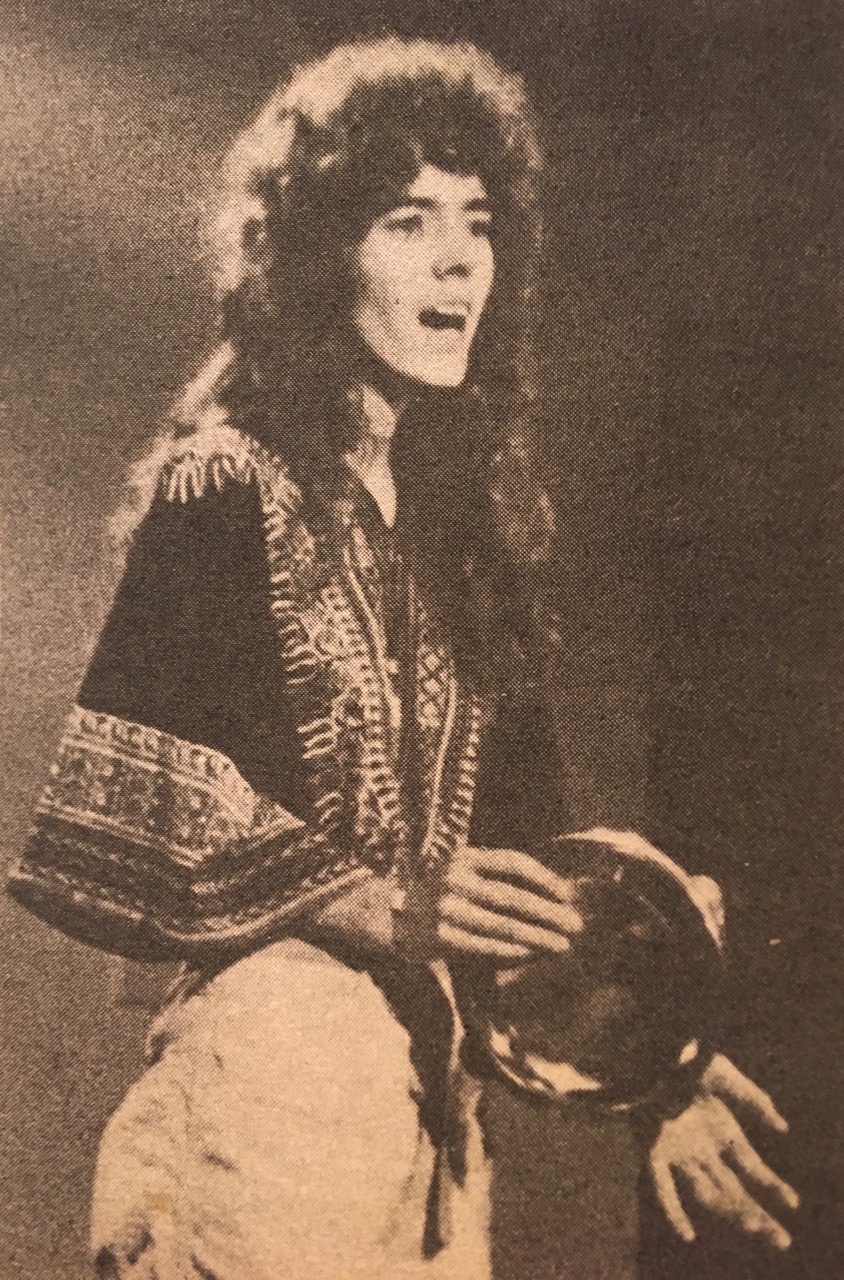
I’ve been going through old boxes from my past, and am currently working on the time I lived in Grand Rapids, Michigan, from 1979 to 1983. It was such a different time–not many photos, for example. But I found this one in a clipping from a women’s periodical, attached to an article I wrote about how women’s history is not just reading about women from the past, but an imperative for us to make history in the present–herstory. I still believe that!
My partner at the time, Gary, and I were trying to make history/herstory through non-violent activism, and through running a Catholic Worker hospitality house. We called it Grimke Community, named after Angelina and Sarah Grimke, white southern women who worked for the abolition of slavery in the early 1800s. We opened our house to a person or family in need of emergency shelter, often in cooperation with the local battered women’s organization. The house was in a kind of land trust, and we lived there rent-free. We could pay the bills if one of us had some sort of half-time job at minimum wage.
I held various jobs during those years, from being a maternity aide for a home-birth midwifery group, to visiting women in the local jail, to cleaning houses, to being a library “page.” I was also doing a lot of music those days, and performing in any local venue I could arrange, from nursing homes to social justice rallies. It is funny to look back at my big naturally-curly hair, my extremely thin torso, and my wide-open mouth. I was learning to use my voice!
In early 1983, when this picture was taken, I was trying to make sense of how to follow my calling. It was something like a call to ministry, but still being Catholic, and being a woman, I felt like I had to invent something totally new. Eventually, I was able to take the next steps by going to Chicago to attend the Chicago Theological Seminary, where I was lucky to receive a full fellowship. Gary and I moved to Chicago to take over also, serendipitously, the leadership of St. Elizabeth Catholic Worker House. Those were years of profound transformations. And after seminary, I did invent something new for myself–a ministry which was a combination of activism, offering feminist therapy for women, and leading feminist ritual and community education. (This was years before I eventually was ordained as a Unitarian Universalist minister.)
Now, looking back at my own herstory, I can feel the continuity between the me of now and the me of back then. But I feel some sadness that the changes for which I struggled, while meeting some success, have also faced incredible backlash and new challenges. Still, I don’t regret any of it.
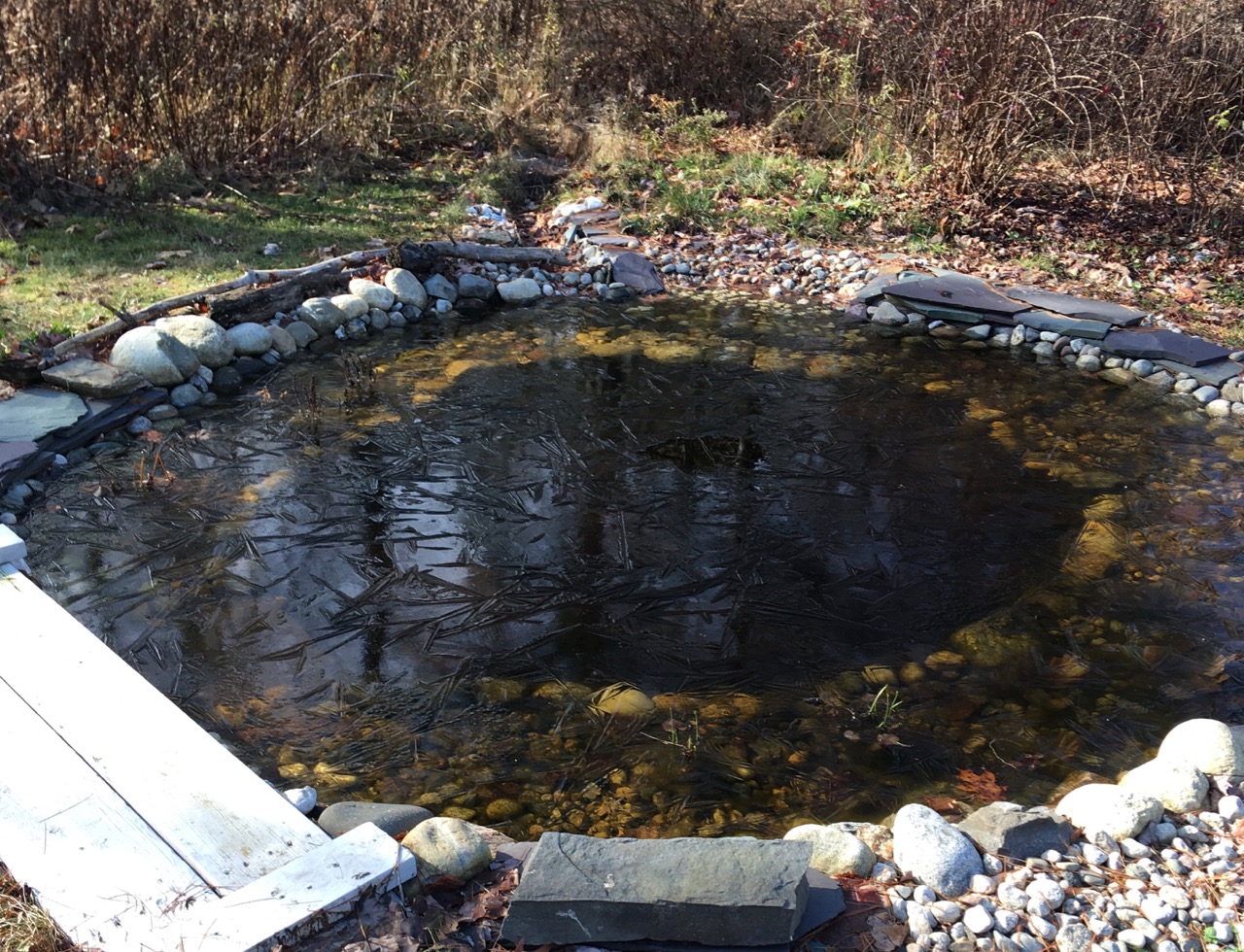
Ice was forming on the surface of the pond yesterday.
Yesterday felt like the true turning of the seasons, from warm autumn 70 degree days to a chilly, almost winter, high of 40 degrees. We had a freeze overnight and the pond surface was wrinkled with ice forming. I went around the yard putting away the last garden hose, the five-gallon buckets, the little tables we use in the back next to chairs. I turned over the wheelbarrows behind the garage. I covered our patio table and chairs with a tarp, and I plugged in the bird bath so it will keep water thawed during frozen weather. I got out the snow shovel and sand mixture to put on the back porch. I left 4 chairs around the fire circle–maybe we’ll get outside around a fire–it could happen!
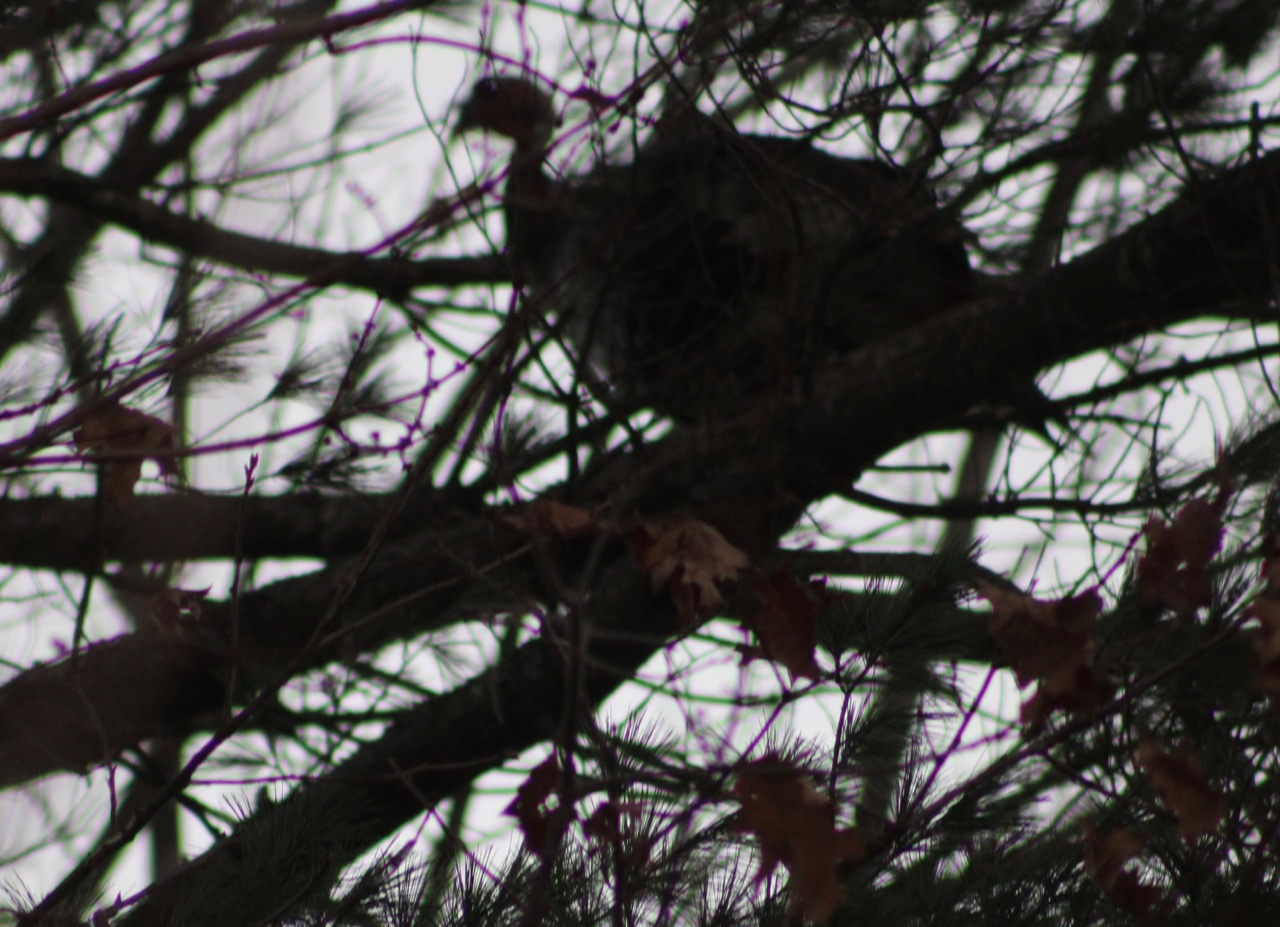
Last Thursday was my last time lying in the hammock for the season. I could see two frogs still hanging out in the pond, the color of mud, not the green of summer. While I was lying there, suddenly I saw a huge bird flying nearby, up to the pine trees at the back near our yard. Looking closer, I recognized the characteristic shape of a turkey! It was dusk and the light was turning all black and white and shades of gray. We’ve had a little trio wandering in the yard during the last few weeks, so I am guessing this was one of them. I had to put the hammock away the next day.
Turkey in a pine tree at dusk
This morning, we had a bit of snow, mixed with rain, so here we are. The gardening work, whether fully complete or not, is done for the season. And I was inspired to get back to my winter project–going through boxes of old papers in the basement. I am proud of myself for diving into it today!
Last winter, I went through 11 boxesfrom my years in Boston, organized, winnowed, and reduced them to four. I had just started on some boxes from the time before I moved there. This winter, I will go through papers from my time at the Women’s Peace Camp, and in Chicago, and in Grand Rapids. I went to Chicago from Grand Rapids in 1983 to attend Chicago Theological Seminary, from which I graduated in 1986. I visited the Peace Camp in the summer of 1983, and then lived there in the summer of 1985, and winter/summer 1986. These places were the scenes of my coming out as a lesbian, and my trying to figure out what ministry might look like for someone like me. At the time I had left the Catholic church, and was part of the emerging feminist spirituality movement. I experienced so much transformation during those years, and I am fascinated to read what I wrote about it. It was a season of profound personal change.
I woke at 3 a.m. and saw the bright full moon through my window. I woke again at 5:30 a.m., but could not see the eclipsed red moon because it was hiding low in the sky behind the many trees and buildings around our house. Still, I dreamt about the lunar eclipse all through the night. First I saw it like a giant pale cookie with a bite taken out. Then I was talking about it with others, and talking about other lunar eclipses. In my dream, I told someone about the memorable total eclipse on the night when the Red Sox were winning the world series for the first time in 86 years. That was October, 2004. We lived on Cape Cod. We were watching the baseball game, and periodically, I’d go out the front door to watch the eclipse. In my dream, I talked about how one of the effects of being old was that I remembered other lunar eclipses, and didn’t have as great a need to see this one.
In a later dream, a group of people were getting ready to create a ritual to honor the moon–children, adults of all ages–and I was getting a drink of water, and then, trying to find a mug to hold more water to bring to the ritual, but everything in the cupboard was plastic or otherwise weird. Random people, both known and unknown to me. When I woke up, my cat Billie was at the window looking outside, but neither of us could see the moon. Still, we were feeling it I think.
Yesterday, Margy and I filled in and dropped off our election ballots at the City Hall dropbox, and then we drove to Kettle Cove to be with the ocean. The weather was warm, sunny. I took my shoes off and waded in the water on the shore, took some photos of rocks and seagulls. We gathered seaweed to bring back to the garden. But mostly, we just sat in chairs on the sand, and listened to the surf, felt the breeze on our skin.
A lunar eclipse feels like a transition, an omen–but for good or ill? The 2004 eclipse was good news for the Red Sox. Undoing the reputed curse of the bambino. But election day is not like a sports game, despite the way the media often frame it. Lives are at stake. When I was quite young, I was a sort of anarchist, and I heard the Emma Goldman quote, “If voting changed anything, they would make it illegal.” I am less dismissive with age. Even if I am voting for the lesser of two evils, I will do so. And I think of the people who died to bring the vote to women and to black Americans. They knew it was that important. But perhaps the quote holds true now, because there are politicians who are trying to make voting illegal–at least for the people they are trying to exclude. Still, I don’t hold with fear-mongering. No matter what, we keep doing whatever we can do, with whatever energy we have, for justice, against oppression, for compassion and respect for all beings. We can’t see the future, we can’t know what wonders might emerge over the horizon. As Rebecca Solnit reminds us, that is a source for hope.
The last few weeks have been full of ordinary tasks around the house and yard. Sometimes we forget to be grateful for these very ordinary things. I think about people whose lives have been disrupted by war, by floods, by fire, by despots. Margy and I are able to do our ordinary tasks and ordinary meals and ordinary rest, undisrupted, and for that I am grateful.
A couple weeks ago, I painted the trunks of the orchard trees, to protect against winter sunburn and insects. This time I used a half and half mix of white milk paint and “Surround”–both powders that are mixed in water. I don’t know if it is really necessary–certainly I see fruit trees around the neighborhood without anything on them. But one morning, I had the energy and decided to try out the mixture. Surround is a kind of porcelain clay organic product that can disrupt certain insects. Last summer, I sprayed the fruit trees with it, and they remained light colored all winter. This summer I didn’t do any sprays like that, but why not try it as a winter paint? So that was one little project.
Peach tree with white paint on trunk.
I’ve been using the skimmer to clear leaves off the pond, and then I also have been cutting off the dead stalks of pond plants. I got into the pond one day, placing my feet very carefully down to the second step in, and lifted the pond lily pot, then dropped it down to the deepest part of the pond. The deepest part is 2 1/2 feet, so I am hoping that the hardy lily might survive the winter this way. And maybe in the spring it will need to be lifted back out, or maybe it will just reach its leaves up to the surface from there. I asked Margy to watch with me, just in case I slipped. But I didn’t! A few frogs are still hanging out, since the weather has been unseasonably warm still.
Since we had an extra weekend of warm weather, I finally painted the upper beam of the roof on our deck. Some of the wood had been left bare when a friend put in the roof, a few years ago, so protecting it has been on the long-term to-do list. Happily, there was some primer in our basement that I could use, leftover from the prior owners. It took three days, and each day after working on it for only a couple hours I was dead exhausted. But it is done today!
Deck beam half painted and half still undone bare wood.
Meanwhile, we’ve been filling in our absentee ballots, and researching the details of 13 referenda questions for our city of Portland, as well as the candidates running for office. I am grateful for democracy, as flawed as it might be practiced, and pray that we’ll still be able to have a democracy going forward. Rising fascism in our country has been alarming and discouraging, as well as the attack on the bodily autonomy of women, and the threats to such importance common goods as Social Security and Medicare. So much of my life’s work has been about expanding the benefits of democracy to those who have been excluded, fighting for equality and justice and liberation for myself as well as others. My work has included criticism of the way that our democracy has been incomplete, flawed, and unjust. But I think of voting as harm reduction–I may criticize candidates and policies, but I will vote for those who will do the least damage. Right now, with the Republican party being taken over by fascists, that means voting for Democrats across the board. So I am extra appreciative these days of the ordinary benefits we can take for granted, and pray that many many people will be moved to vote to keep those benefits.