Plants and their wisdom

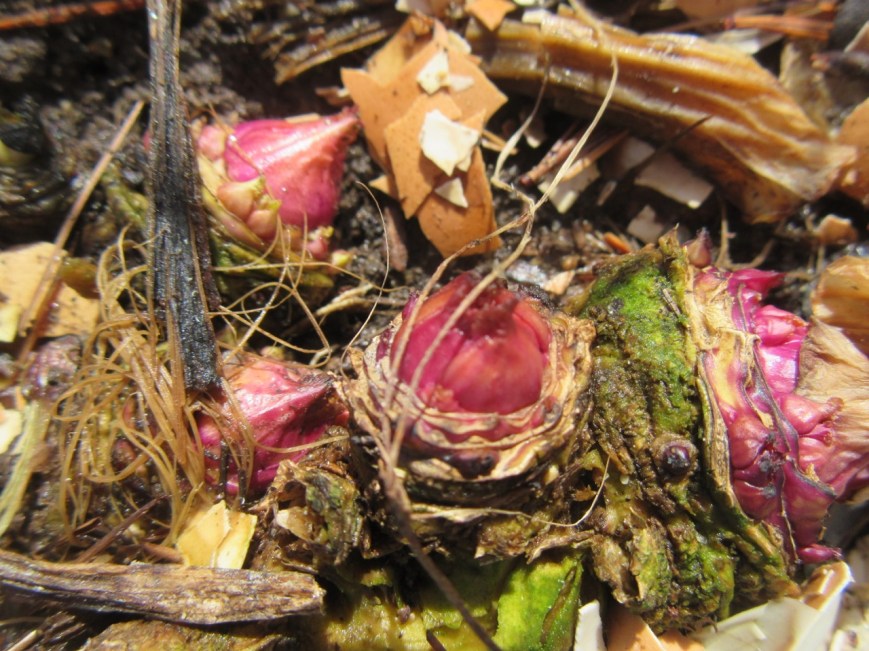
Sea Kale emerging

Sea Kale emerging in my garden, April 3rd.

This morning, I have been reading Farming While Black, by Leah Penniman. It is a marvelous book on so many levels–history lesson, gardening guide, liberation manual–and it feels a privilege to learn so much from a work that is actually focused toward Black farmers and gardeners. I knew so little about the skills of enslaved Africans who brought with them to these lands African plants and knowledge of growing them.  I knew so little about the work of George Washington Carver who was one of the first to study and promote regenerative land practices.  I know so little about multiple plants and their habits and their gifts for us.  Get this book!  

But then, after reveling in reading all morning, I find myself opening to multiple layers of deep grief underneath the joy of reading the book.  Grief for the African peoples who were stolen from their land and enslaved.  Grief for these Turtle Island lands, whose balanced ecosystems and soils were so depleted by the cutting of forests, and the plowing under of the soil, as well as by the war waged on their people.  And grief for myself and my communities–that we have lost our connection to the ecosystems, we have lost our connection to the wisdoms, we have lost our connection to the plants.

I get overwhelmed with the abundant knowledge in the book, and I remember this feeling in other wonderful books I have read, the feeling that I have no hope of learning everything I need to learn, in the limited years left to me on this planet.  I get the feeling that I have no hope of regaining access to the collective wisdom that has been cut off in so many ways.  And I realize that this too is part of colonization.

My East Frisian ancestors were some of those who plowed over the fertile prairies back in the 19th century.  Grief.  But at least they knew how to grow their own food, and provide for their families from their land.  I read online recently that in the last two generations, most Americans have lost the capacity to do that.  More grief.  I don’t know how to do that.  And I can’t envision getting to that ability before I die.  Plus, it is not really something we can learn from books.

In Farming While Black, I was reading about herbs and their healing properties, and there were too many to take in–even though it was a limited list of the herbs they grow and find to use in their community.  I feel lucky if I can learn about two or three herbs in a season.  All of us should have been learning the herbs since the early days of childhood wandering in the woods.  The plants are our elders, our guides, the wise beings who know how to feed us and heal us and care for us.  This separation from the plants is also a part of colonization.

One answer to my dilemma is about community.  No one is meant to have all the knowledge on their own.  It is okay that I can’t learn it all on my own.  But I feel grief too for the fragmentation of communities that has kept us from sharing this learning and wisdom with each other.  And I feel grateful for each person who has shared their knowledge of plants with me.  I feel grateful for organizations like the Resilience Hub, who bring people together to share so much wisdom of soil and plants and ecosystems.

But for this moment, I want to honor the pain of colonization, honor the pain of what has been lost, honor the pain of so many threads of connection that were torn apart and destroyed, never to be rewoven.  It is a long journey to healing.

Wolasuweltom

“When you think in Passamaquoddy, your whole life revolves around being thankful for everything that’s around you,” says Roger Paul, our Wabanaki Languages teacher.  “Everything about what you look at, or what somebody tells you, you think gratitude.” The root verb for giving thanks is wolasuweltom (he or she gives thanks, is grateful). To say “thank you” to someone you say “Woliwon.”  

He went on to comment, “…in other cultures I’ve noticed it’s about, ‘What am I to gain from this?’, …or ‘What’s my goal?'”  He told a story about a woman he met in Washington, DC, who wondered why Indigenous people didn’t come to testify in Congress about why they needed certain funding–they might send lawyers or other non-Native employees to explain–but she had never seen an actual Indigenous person explain why they needed this funding.

Roger said, “It took me a while, but I figured it out. …The reason, I told her, was because we’re not about going to demand what we deserve. We’re about being thankful for what we already have… So… we’re not good at going up to say, ‘Hey, we deserve this–we have an entitlement to this–you owe us this.’ …We’re more at, ‘Oh, this is all we get? But, you know what, I can use this. Thank you.'”  He said, “It’s that attitude, that almost every word in our language surrounds that concept of gratitude.”

All this was during a conversation among a few of us before class last month.  Ironically, earlier that morning I had been thinking about my final presentation, in which we were supposed to introduce ourselves in the language.  I had thought to myself that perhaps I should try to say something about why, as a non-Wabanaki person, I wanted to learn to speak Passamaquoddy.  What was my purpose or goal in doing this?  In English, I have said, I wanted to “decolonize my mind and learn to think in a new way.”  But I couldn’t figure out how to express what I meant in the language, even with the help of the online dictionary.

So when Roger spoke of how the language itself was not so much about expressing goals, as it was about giving thanks, I was struck by the irony of it all.  Here I was, even in my attempts to speak the language, thinking exactly like a white person.  And maybe, the goals and purposes didn’t matter as much as I thought they did.  Maybe I should try to say, instead, what I am thankful for.

Later, I asked Roger if it would be okay to quote him for the blog, and he gave me a generous yes.  I am thankful for all of these conversations, more than I can say.  These days, I am less and less sure of the purpose of anything I am doing.  I am less and less sure of my goals.  But I am reminded, each morning, to give thanks for everything around me.

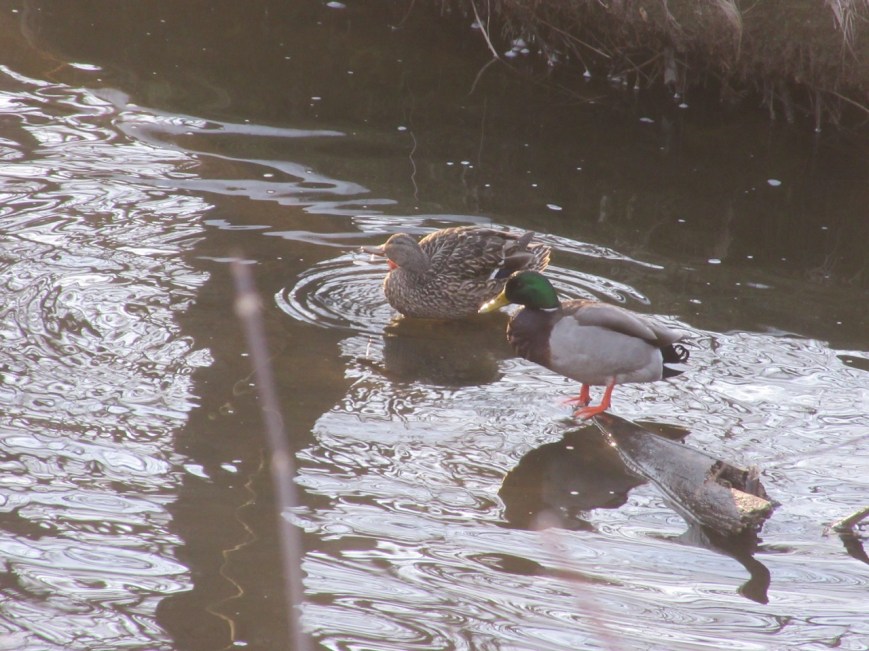
Ducks in Spring

Anishinaabe Land

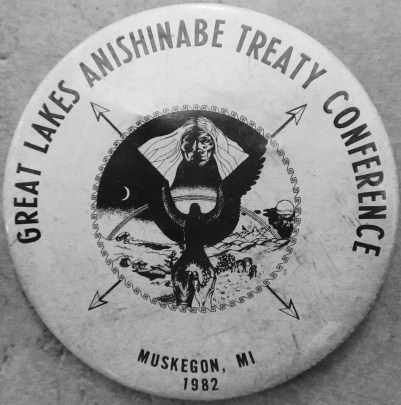
Anishinabe Treaty ConferenceIn an earlier post, I began to explore which Indigenous people belonged to the land where my East Frisian ancestors had settled in the 1850s.  But I had not done that for the land where I was born, in Detroit, Michigan. I wasn’t surprised to read that it was Anishanaabe land, the land of the people of the three fires, Ojibwe (Chippewa), Odawa (Ottawa), and Potawatomi.  Significantly, I didn’t learn about them while I was growing up. Nothing. But as a young adult, that changed as I became an activist. I remember participating in an Anishanaabe gathering in Muskegon, Michigan. I found the button I still have from that gathering, the “Great Lakes Anishinabe Treaty Conference,” in 1982.

The Anishinaabek were really the first Indigenous peoples that I learned about. It has been so long since I lived in Michigan (I left in 1983), that it is hard to remember too many details about what I learned at that time, rather than later.  I remember a children’s book written by Edward Benton-Banai, in which I learned the word for grandmother was Nokomis.  I remember that sovereignty was important, and treaties had historically been tools for taking land away from the people, but they also preserved certain rights to hunting and fishing.  Louise Erdrich is a brilliant Anishinaabe novelist from whom I learned much more of the people’s lives in the context of colonization.

The Anishinaabek lived in the area of the Great Lakes before any Europeans arrived.  I learned from Roger Paul, in my Wabanaki Languages class, that the Anishinaabek were related to the Wabanaki many generations ago, and lived on the east coast.  About a thousand years ago, they were led to move west, and they were guided to stop in the Great Lakes. The Anishinaabe languages are in the same language family as the Wabanaki, (and the Innu as well), called Algonquian by linguists. The word for “my grandmother” in Passamaquoddy is Nuhkomoss.  The Innu would say, Nukum.

The first Europeans who interacted with the Anishinaabek in the Great Lakes region were the French.  When Michigan later became a territory of the new United States, the majority of people living in Michigan were Native people.  You can find out many more details of the history of the people from that time forward on the website of the Ziibiwing Center of the Saginaw Chippewa Indian Tribe of Michigan.  Michigan still has twelve federally recognized tribes today.

I think the first step in the process of making right relationship between Indigenous and non-Indigenous peoples is to learn the history of our peoples’ interactions with each other, to understand the traumatic process of colonization that occurred on these lands. Only if we know the history can we begin to make sense of the present.  With the mixed blessing of the internet, it isn’t so hard to find out these things if we look.  Do you know what Indigenous people lived on the land which you now occupy?

Angela Andrew

angela-andrew

Photo by John Gaudi/CBC

I just learned today that Angela Andrew, an Innu artist in what is now Labrador, best known for her crafting of traditional Innu tea dolls, died February 5th at the age of 72. I posted earlier about the Innu tea doll that my friend Wells gave me, which was created by her. I found this article in the CBC News from Canada.  I am so glad I learned about her and her tea dolls before she died.  The article said she was also instrumental in teaching the Innu-Aimun language to young people, and she had an infectious smile. If you can hear me in the spirit world, Angela, thank you for your beautiful work! her daughters plan to continue making the dolls.

Ancestors and Whiteness

Can learning about our own ancestors help white people in undoing white supremacy and colonization? Or could it possibly be a distraction from the real work? When did our ancestors become “white” instead of German or Ukrainian or French or Irish? How did it happen? If our ancestors owned land, when and how did that happen, especially in relationship to the stealing of land from Indigenous peoples?

We were talking about these questions in my Maine-Wabanaki REACH group last night. It has been helpful to join in a small group with other white folks committed to the process of ending racism and colonization. We ponder the difficult questions together, in the context of the wider work of Maine-Wabanaki REACH which is in conversation and solidarity with Wabanaki people.

It seemed to us that understanding our families’ histories in the context of colonization, can help us to better understand colonization, and to make it visceral and real for us.  It is not just recounting the stories we may have heard in our families, or read about in research, but juxtaposing those stories with the history of colonization, land theft, and slavery, in the particular locations in which they lived.

I have already done a lot of exploring of the matrilineal side of my family.  Last night, after the meeting, I wondered how this might have played out on the other side of my family–my patrilineal ancestry.  My dad’s ancestors came to this country from Germany.  But more specifically, his great-grandfather and great-grandmother arrived in Illinois as children in 1851 and 1854 from East Friesland. East Friesland was actually a somewhat isolated culture on the North Sea with its own community and language, in some ways more closely related to Holland and old English than German.

Thousands of East Frisians came to the midwest during the middle of the 19th century, drawn by the promise of cheap fertile land and a long-standing love of freedom. Most of them worked for a few years, then were able to buy land, and become successful farmers, from what I can gather.  In America, they formed closely knit communities centered around their church, their family and their language.  But over the course of three generations, the young people had assimilated into the surrounding communities, and no longer spoke their parents’ language.

By the time the East Frisians arrived in Illinois, it had already been colonized for several generations.  But the name gives a clue.  On the Illinois State Museum website, I read about the Illinois peoples losing their lands.

In 1803, the Kaskaskia tribe signed a treaty giving up its land claims in the present State of Illinois in exchange for two small reservations on the Kaskaskia and Big Muddy rivers. The Peoria, in turn, ceded their Illinois claims in a separate treaty signed in 1818. Finally, in 1832, two years after President Andrew Jackson signed the Indian Removal Act, the Kaskaskia and Peoria tribes agreed to merge and moved west to a reservation in Kansas.

So I wonder if the German immigrants even knew about the history of the land they were so excited about farming?  More research surely to do about all that.

In the course of this research, I may have coincidentally solved a mystery that had recently emerged in my DNA reports.  According to my DNA analysis, 15.3% of my ancestors came from the British Isles.  But from my genealogy research, I thought that number should be just 3% (my Scottish ancestry).  I didn’t think I had any other British or Irish ancestry.  So what was that other 12%? Was there some family secret I hadn’t heard about?  Well, I learned online that East Frisian DNA is indistinguishable from that of the British Isles.  So rather than a secret in the family tree, I think this 12% might be my great-grandfather Henry Johnson (also known as Heinrich Jansen), who was 100% East Frisian.

And when did they become white?  Well, I’ve got to stop for today, but I’ll come back to it. In the meantime, a 1920 census with Henry Johnson listed–see between the blurred out parts.  And the “W” next to his name.

Henry Johnson 1920 census section

Wabanaki Languages 102

I wanted to study Wabanaki languages with Roger Paul as a way of decolonizing my mind.  Yesterday we began the second semester and already I am experiencing two challenges which seem directly related to this very decolonization process.

Wabanaki languages were spoken for thousands of years, and only more recently have been written, usually with the aid of outside linguists who were sent to each tribe and devised writing systems that differed from each other.  These writing systems are still in flux.  There is an “official” writing system for Passamaquoddy for example, exemplified in the online dictionary, but there are also phonetic systems that spell words more closely based on how they sound.  Roger really doesn’t care how we spell the words.  He grew up speaking the language, but only learned to write it as an adult.  He cares about how we pronounce and speak. So this is a shift from my own ingrained habit of learning more by seeing a word written, than by hearing it spoken. (Though of course, all babies learn to listen and speak before we learn to write. And we do learn to write the words as well.)

The second challenge is that Wabanaki words do not exist as fixed isolated units, but change form in relationship to the context and meaning. In the first semester, we studied lists of words (and a few phrases), beginning to create a basic vocabulary.  But in this semester, we will be studying sentences.  Words in relationship to each other.  And words as sentences–because a sentence might be expressed in one “word.”

As I think about it, I realize how much this may reflect underlying differences between Euro-centric culture and Indigenous culture here on this land.  Euro-centric culture is object oriented–taking things apart, categorizing them, defining them.  Indigenous culture is relational–nothing exists except in relation to everything else. Likewise, English words are more fixed in form, while Wabanaki words are relational.

Last semester, I gradually created a huge set of flash cards with all the words presented, so I could practice and learn them.  I created recorded excerpts of the words and their meanings, so I could listen to them (especially in the car) and get the pronunciations into my head. But now, we are stepping into a different sort of process. The change goes deeper.

Kuskicinuwatu?  (or) Gooskeejinuwadoo? (or) Do you speak a Native language?

Robins in berry tree

Robins hidden within the branches of a winter tree.


About Ads

It’s ironic: since I am using the “free” version of WordPress to publish, they occasionally place ads at the end of my posts.  I want to point out that I have no control over the content of any ads that appear, and sadly, they usually advertise products that are the very opposite of the values that I am writing about.

I apologize for these incongruities!  Isn’t that the position in which we find ourselves so often? We are embedded in systems that infiltrate all aspects of our lives, even as we imagine a better way of living.

IMG_0364

Resilience in Portland

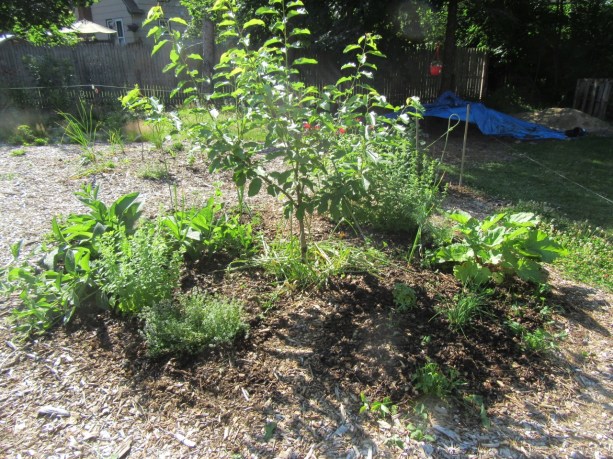
Cherry Tree and companion July

[Photo of our cherry tree with its companion plants.]

I really believe that permaculture offers a way to live in this time of ecological crisis. In Portland, we have a wonderful resource for learning permaculture skills, and offering mutual aid as we learn. The Resilience Hub helps people to regenerate the land, grow healthy food, and build community.  In that way, it also cultivates hope. In June of 2017, the Resilience Hub was the sponsor of our Permablitz when over 20 people came to help us establish our garden.

Over the last ten years, the Resilience Hub has become a thriving community organization. This past summer, its founder, Lisa Fernandes, moved on into new, but related work. Lisa’s departure prompted a series of community conversations about the future of the Hub: its assets and challenges, its goals and visions. Margy and I attended many of those meetings, and I was so committed to continue this important work that I volunteered to be on the new Board of Directors. We now have new part-time staff, Kate Wallace as Executive and Programming Director and Benjamin Roehrl as Operations Director. See more about our plans going forward at the website.

BUT–the Hub is at a critical point and needs all of us who care about permaculture in Maine to show up with financial help and renewed involvement. To that end, we created a Go Fund Me campaign, and we are trying to reach our goal in the next few days.  I’ve shared it via Facebook, but thought I would add my blog “audience” to this appeal as well.  Please check out our page, and donate what you can!  And if you are local to southern Maine, sign up to be on our active members list!

We are celebrating with a potluck and party this Thursday, January 17, from 6-9 p.m. at the Hub at 224 Anderson Street in Portland. See more about the party at https://www.meetup.com/maine-permaculture/events/257165312/

One of my favorite definitions of permaculture is “revolution disguised as gardening.”  Charles Eisenstein says, (in his recent book, Climate: A New Story,) in this time of ecological degradation, perhaps the most important work we can do is to care for and regenerate the places we live in, the places we love. (More on that later!) That’s what the Resilience Hub is all about. Thank you for helping us to keep it thriving!

Indigenous Issues and the Newly-Elected Maine Governor, Janet Mills

I am sharing this essay written by Dawn Neptune Adams, as part of her work as Racial and Social Justice Consultant at the Peace and Justice Center of Eastern Maine.  Please note the action items included!

(It was falsely reported to FB as “abusive” and is now a censored link. I am copying it here as one more way to amplify Indigenous voices on issues that are vitally important to everyone.)

Moving Forward:

Indigenous Issues and the Newly-Elected Governor, Janet Mills

By Dawn Neptune Adams, November, 2018

Congratulations! We all survived the midterm elections. Now, where do we go from here? Newly-elected Governor Janet Mills is known for her work in opposition to Indigenous issues during her time as Attorney General. Three of the most pressing issues are presented in the following essay, along with steps in moving forward:

1. VAWA

Native Womxn are three times more likely to suffer from violent crimes than any other group of womxn. According to statistics, 80% of these crimes are committed by non-Native men. Mills fought to keep Wabanaki Womxn from protections under the Violence Against Women Act of 2013, stating that our communities are not sovereign but are municipalities and therefore not eligible for the additional safeguards put in place by the Federal Government, for every Federally-recognized tribe in the Nation but those in Maine and Alaska.

Moving forward, an updated version of Legislative bill LD 268 “An Act regarding Penobscot Nation’s and Passamaquoddy Tribes’ Authority to exercise Jurisdiction under Federal Tribal Law and Order Act of 2010 and the Federal Violence Against Women Reauthorization Act of 2013” must be introduced and passed. Any attempt on the part of Governor Mills to veto the bill should be met with resistance.

A comment was requested from Penobscot Nation Ambassador Maulian Dana, who answered: “We are committed to working out the kinks in the potential jurisdictional issues that have been barriers in the past. This may mean looking at how the [Maine Indian Land Claims] Settlement Act is being interpreted and used not in the best interest of tribal sovereignty. It is on the radar of the new Governor and we are hopeful we can reach some deeper understanding.”

2. Penobscot Nation vs. Attorney General Janet Mills

Kirk FrancisThe Penobscot River has always been home to the People of the Penobscot Nation. As the Attorney General listed in the lawsuit Penobscot Nation vs. AG Janet Mills, Mills has vociferously defended the State’s opinion that the Water flowing in the Penobscot River surrounding the 200+ islands that make up the Penobscot Nation, was not part of Penobscot Territory. This contradicts Treaties and past interpretations of the Maine Indian Land Claims Settlement Act (MILCSA). The State of Maine and a consortium of 17 Industrial and municipal intervenors, represented by the lobbying firm Pierce Atwood, opposed Penobscot stewardship of the main stem of the River in a manner said by the Federal Government to be in violation of Federal Indian law, and tantamount to an “unlawful territorial taking” of 61 miles of River.

In December of 2015, the U.S. District Court in Portland, Maine, reaffirmed the Tribe’s Treaty-reserved sustenance fishing rights, but decided in favor of the State in redefining the definition of “Tribal Waters.” In the First Circuit Court of Appeals, one of three judges issued a dissenting opinion. Judge Juan Torruella wrote an argument reaffirming the Penobscot territory to include both the land and the water, in which he cited the Treaties of 1796, 1818, and 1833; and legal precedents set in previous agreements which support Tribal stewardship of the River.

Moving forward, the Penobscot Nation has one more level of appeals called an “en banc review” in which the case is heard by a large panel of judges and is usually reserved for complicated or unusual cases. This option is currently being discussed by Tribal leaders. We will need the support of all of our friends and coalitions to keep Industrial interests from framing the narrative in a way that suggests the Penobscot People are trying to exclude anyone from using the River; the Penobscot Nation is simply defending itself against territorial theft and a termination attempt. The River is our Relative and we are determined to protect her health for future generations of ALL the people of Wabanaki Territory.

*Update* January 5, 2019 thanks to Community Water Justice “Jerry Reid was just appointed by Gov Janet Mills to serve as the next Commissioner of the Department of Environmental Protection (DEP). Anti-water protector. Oppressor of Native people.

Mr. Reid fought in court against the Penobscot Nation to their inherent fishing rights and claimed that the Penobscot River was not part of their reservation. He sided with the water-polluting corporations in the Penobscot Nation vs Mills case. He also absurdly claimed in court that the Penobscots only ever fished from the shoreline and not from the water, as though he had never heard of fishing from a canoe or watercraft.

This appointment tells us clearly where Gov. Mills stands with indigenous people. We who stand for the protection of our water and the Wabanaki demand better in state leadership for the people of Maine.

This appointment will first need approval from the Environment and Natural Resources Committee and if approved there, will move forward for approval by the Senate. Please email members of the Committee (below) AND your Senator to ‘ought not approve’ Mr Reid’s appointment:

Ralph Tucker (D) – (Chair) Ralph.Tucker@legislature.maine.gov

Brownie Carson (D) – Brownie.Carson@legislature.maine.gov

Justin Chenette (D) – Justin.Chenette@legislature.maine.gov

Robert Foley – (R) – Robert.Foley@legislature.maine.gov

Mick Devin (D) – Michael.Devin@legislature.maine.gov

Jessica Fay (D) – Jessica.Fay@legislature.maine.gov

Stanley Paige Ziegler Jr (D) – StanleyPaige.Zeigler@legislature.maine.gov

Lori Gramlich (D) – Lori.Gramlich@legislature.maine.gov

Daniel Hobbs (D) – Daniel.Hobbs@legislature.maine.gov

Richard Campbell (R) – Richard.Campbell@legislature.maine.gov

Peter Lyford (R) – Peter.Lyford@legislature.maine.gov

Thomas Skolfield (R) – Thomas.Skolfield@legislature.maine.gov

Chris Johansen (R) – Chris.Johansen@legislature.maine.gov

Search by town to find your State Senator here:

https://legislature.maine.gov/senat…/find-your-state-senator

#WaterIsLife #ProtectOurWater #HonorTheTreaties #ProtectNativeSovereignty #RespectEachOther #Maine #BeBetter

3. Maine vs. the EPA

Clean water and fish on the dinner table should be a right for all of the people in Wabanaki Territory, now called Maine. In 2014, the State of Maine’s DEP tried unsuccessfully to set water standards so low as to allow only 1.4 ounces of fish from Tribal Waters per day. This equals a portion the size of almost one-half of a deck of playing cards; not even close to the definition of sustenance. The EPA refused these standards, fulfilling the Federal Government’s trust responsibility to uphold Treaty-reserved sustenance fishing rights, and in 2016, insisted on water standards in Tribal Waters that would allow for safe consumption of 10 ounces of fish per day. This resulted in the lawsuit Maine vs. the EPA, in which AG Mills stood with Industrial interests and Gov. LePage in opposition to clean water for all of us. Later, Mills petitioned Trump’s former EPA administrator, Scott Pruitt, to withdraw the standards set by his predecessor. The EPA is now poised to rollback these Water quality standards.

At the current time, Scientists from the Penobscot Nation Dept. of Natural Resources recommend NO freshwater fish consumption for Womxn who are pregnant, nursing, or planning to become pregnant; nor for any child under the age of eight. For anyone else, recommended consumption of fish from the Penobscot River is 10 ounces per month.

Moving forward, resistance to this regression in water quality standards is of the utmost importance. Because Penobscot people eat more fish than surrounding populations, the cancer rate is five times higher in our communities than in the communities of our neighbors. Our cultural connection to the River includes eating fish, just as our Ancestors have done since time began here in this beautiful place we now call Maine. Clean water is in the best interest of ALL the people of Maine, and we must make sure that Industrial interests and Trump’s EPA no longer have an ally in the Blaine House nor in the Attorney General’s office, as they did while LePage was Governor.

In all of the issues outlined above, the recurring theme is the question of sovereignty and misinterpretation of the Maine Indian Land Claims Settlement Act. The Act was signed with the understanding that any ambiguities should favor of the Tribe and that the MILCSA never abrogated our Treaty rights. I look forward to standing with you in the protection of our Relatives.