Prophecy, Part 1

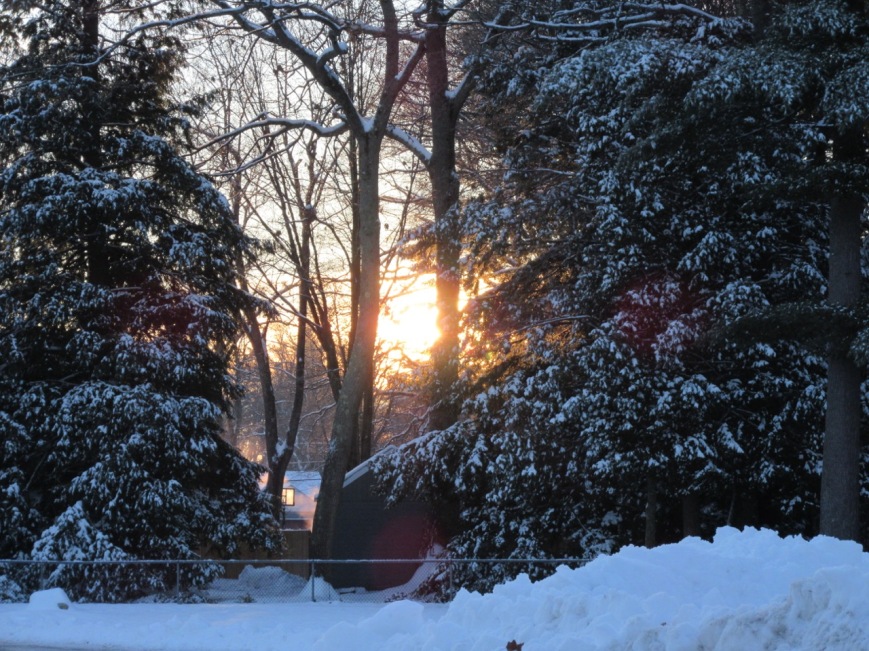
Sun through evergreens


What does it mean to be a community of prophecy? Rebecca Parker says: “Our times ask us to exercise our capacity for prophetic witness. By prophetic witness I mean our capacity to see what is happening, to say what is happening and to act in accordance with what we know.”

These are capacities that each of us has, to varying degrees. We can’t always see clearly what is going on—but by sharing what we can see with others, by listening to what others see, we can form a better picture of what is going on, a truer understanding of what is happening.

The Quaker educator Parker Palmer recently described patriotism as a “lover’s quarrel with our country.” He reminds us to quarrel lovingly and passionately about truth, about “what is and isn’t true.” Many of the president’s enablers are saying truth itself doesn’t matter anymore. If you repeat a big lie enough times, people will begin to believe it. Or as one person said, “There’s no such thing … anymore of facts.”

Palmer wrote on January 18th:

We who hold the quaint belief that it’s often possible to tell whether what comes out of a mouth is true or false need to assert the facts every chance we get. Last week, for example, the man who says that only he can save our economy claimed that there are “96 million…wanting a job [who] can’t get [one].” False. There are “roughly 96 million people not in the labor force, but that includes retirees, students and others who don’t want jobs. Only 5.5 million of them want work.” The unemployment rate, which neared ten percent every month of 2010, was five percent or less every month of 2016.

He goes on to say:

Facts are so tedious, aren’t they? And they won’t change the minds of true believers. But we need to preserve them for the same reason Medieval monasteries preserved books: the torches have come to town. Let’s try to remember that science and the Enlightenment gave us ways to test the truth-claims of potentates and prelates, laying the foundations for our little experiment in democracy. Until someone blows up the lab, we must proclaim the facts, then tuck them into a fireproof vault until we need them again.

I am thinking about the scientists who began downloading climate change research data from government websites, to preserve the research against the possibility that a new administration would take it all down. Fighting for and preserving truths in a time of propaganda.

To be a community of prophecy we must see what is happening, say what is happening and act in accordance with what we know.

Note:  Rebecca Parker quote from, “Rising to the Challenge of Our Times,” in Walter P. Herz, Redeeming Time: Endowing Your Church with the Power of Covenant, p. 66-67.

Too Small to Make a Difference?

Snow on branches

[Snowflakes on branches]

Continuing from my prior post, as we confront the great challenges of our time, there is another hurdle that we may face—sometimes we feel as if the problems of our nation are so big, that what we have to offer is too small to make a difference. One approach to this problem is offered by Israeli writer, Amos Oz. He says,

Everyone of us has to choose confronting a big fire. Everyone of us has a teaspoon. Fill it with water and throw it in the fire. The teaspoon is very small and the fire is very large, but there are many of us and every one of us has a teaspoon. I do what I can as a teacher, as a writer, as a neighbor, as a citizen, to pour some water on the flames of hatred and incitement and fanaticism and bigotry and prejudice. I have words and I use words. My words are my teaspoon. This is what I can do. What can you do?”

When each of us does our small part, something can change about the larger problems.

Writer Charles Eisenstein goes even further. He addresses the underlying logic that permeates our society and our movements, that we need “big solutions to big problems.” This logic says, “whatever you do on a local level, you’d better make sure… it can go viral, because otherwise its impact will be trivial.” He says that “contained within this logic is an implicit hierarchy that values the contributions of some people more than others. It values the activities of people who have a big reach, a big platform, a loud voice, or the money or institutional power to affect thousands or millions of people.” And he finds this suspect in the movement for transformation because it is the same valuation as the dominant society’s allocation of status and power.

He explores the theories of change that underly such logic—that “change happens only when a force is exerted on a mass.” But the problem with this logic is that “the ruling elites” of the world always have “more force-based power—more money, more guns, …a bigger voice—than any activist organization ever could.” Yet, throughout history, there have been changes that happened in unexpected ways, from unexpected places. He says, “Reality often turns out to be the opposite of what the arithmetic of measurable impact would suggest. The most potent actions are often the ones done without forethought of publicity… Every act we take ripples out to affect the whole world…”

He goes on to reflect,

“My indoctrination into the logic of bigness has exerted an insidious effect on my own life, causing me always to question whether I am doing enough. When I focus on the small, intimate realms of life, taking the hours to tend to a relationship, to beautify a space, perhaps, or to enter the timeless child’s world with my youngest son, I am subject to an unease along the lines of, ‘There is something more important I’m supposed to be doing.’ The logic of bigness devalues the very heart of life.”

I thought about this logic of bigness quite a bit when I was trying to publish my book. I sent book proposals to several publishers, but got only rejections. One publisher was kind enough to give a reason. They said, your writing is good, but we don’t know how to market this kind of book because you are not well-known, and there is no big hook to pull people in. I didn’t have a big enough voice. But when I decided to self-publish the book, it grew from a sense that even a small voice must speak its truth, even a small bird has a song to sing. And so I named my publishing imprint Small Bird Press.

If we are all interconnected, then our gifts and our limits are intertwined for the life of the whole—what each of us has to offer is unique and irreplaceable. In the world of which we dream, hierarchy has given way to the circle of community. In the world in which we struggle, some of us will have the power to lobby, to protest, to rage against the destruction that can be caused by greed run amok. Others will have the power to grow gardens, to teach children to be kind, to dance and sing so that our spirits are replenished. All of it is important in this time.  We must live the life that wants to be lived in us, we must follow the lead of our hearts.

Questions to Ask Ourselves

img_0448I have been asking myself and others, what does the change in our country mean for our personal activities and commitments?  Every day I receive dozens of emails asking me to sign this petition or donate to that organization working on behalf of immigrants, or women’s reproductive health care, or the environment, and on and on. Invitations to March on Washington, or Boston, or Augusta. Invitations to lobby my senator or call my congressperson. I can feel overwhelmed by trying to make decisions on what to choose, what to ignore, what to do with the same amount of time in each day, in each week as I have always had.

How are we meant to respond to the current challenges in our world, to the pain and suffering we see? On the one hand, we can say simply—follow our values, care for the vulnerable, fight for justice. But Quaker educator Parker Palmer, in his book, Let Your Life Speak, asks us to take a step back, to look more deeply at what we are being called to do. Palmer says, “Our deepest calling is to grow into our own authentic selfhood, whether or not it conforms to some image of who we ought to be… True vocation joins self and service, as Frederick Beuchner asserts when he defines vocation as ‘the place where your deep gladness meets the world’s deep need.’”

So one question we might be asking ourselves is, What is our own deep gladness? What sparks in us a sense of joy, because it taps into the very essence of our gift, our personality, our being? Another way to think of this might be, What are we good at doing? The influential African-American theologian, Howard Thurman, puts it, “Don’t ask what the world needs. Ask what makes you come alive, and go do it. Because what the world needs is people who have come alive.”

But is it really okay to pay attention to our own hearts, to our own deep gladness, to what makes us come alive? Shouldn’t we be mobilizing, organizing and lobbying every day to support our values in a society where they are under attack? I think what Palmer and Beuchner and Thurman are reminding us is that we can’t give what we don’t have. Not that we can’t learn new skills and rise to challenging occasions—but we can’t sustain a commitment if it goes counter to our nature.

For example, some people might be very at home with organizing a protest rally—making phone calls, posting on social media, renting sound equipment, contacting the right speakers, giving a stirring speech, and so forth. Some one else might be very good at going door to door, talking to neighbors and strangers of all political persuasions, making a connection and bridging the divide. Someone else might be good at strategizing behind the scenes, mapping out goals and objectives, and a course of action to take to get there. Someone else might be very good at bringing coffee and cookies to the meeting, and making sure that each new person is welcomed and brought into the conversation, and leaves feeling a sense of connection and involvement. Even in organizing and mobilizing, we each bring our particular gifts to the table.

And by that same token, we each have limits. Parker Palmer points out that he learned as much about understanding his calling from his limits as from his talents and gifts. He said, “Lacking insight into my own limits and potentials, I had allowed ego and ethics to lead me into a situation that my soul could not abide.”

He isn’t referring to the external limits that society places on people because of our gender, or the color of our skin, or the country of our origin. Rather, he means the limits that arise from our personalities, from our natural way of being in the world, from who we are at our core. We are encouraged to be tender with our natural way of being in the world, and not ask our souls to bear what they cannot abide.

For example, if someone is a complete introvert, they would not best serve their soul by forcing themselves to go to a march or a meeting. Rather, they might be happier to write letters to the editor or to their congressperson. Another person might not be able to go door to door, talking to neighbors, but they are really good at tutoring asylum seekers one-on-one to help them learn to speak English more quickly and feel at home in this country. Our limits and our strengths are mirrors to each other. We need to ask ourselves about our gifts and our limits.

I want to mention something about external limits. Parker Palmer admits that he holds a lot of privilege as an educated white male. Even to ask ourselves about “our soul’s calling” assumes that we have the privilege to ponder the question. Many people work overtime in jobs that do nothing to provide gladness, and barely enough to support a home and food. Another important question to ask ourselves is about our areas of privilege or areas of marginalization. What we can offer the community is dependent upon our social location—and that goes both ways. As a woman, I would not be welcome to share a gift for leading worship in the Catholic community. This is an area of marginalization for me. On the other hand, as someone currently with a steady income, it would be inappropriate for me to try to teach people in poverty how to save their money. It would be intrusive and disrespectful.

We must understand our position in a social fabric, the powers we hold and the challenges we face just by who our people are, where we live, the color of our skin. I am reminded of the advice given to budding writers—write what you know.

So we must ask, What are our gifts, what gives us joy, what are our limits, what is our location? Palmer says, “Is the life I am living, the same as the life that wants to live in me?” It is from this place of understanding our own essence that we can best respond to the great needs of our world.
Book Launch Party

book-2-send

[Photo by Rick Kimball]

On January 14, I had my first book reading and a wonderful book launch party for Finding Our Way Home: A Spiritual Journey into Earth Community.  It was organized by several members of Allen Avenue UU Church, and held at the church, but open to the public.  Thank you Mark, Cathy, Connie, Sally, Sonia, Tirrell, and Sharon, and everyone who brought food, and everyone who came.

Book Launch Party MD

[Photo by Margy Dowzer]

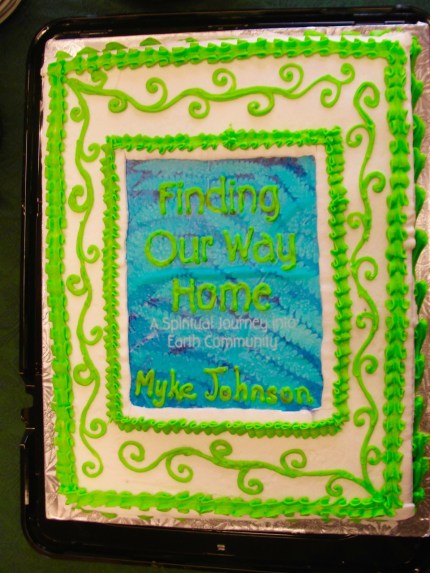
I did a reading from the book, and sold and signed many copies. There was music by Dale Churchill and lovely refreshments, including a cake reproducing the cover of the book.  It was the perfect launch, since so many ideas and stories in the book were born in the context of my relationship with this community of people.  Thank you everyone!

Book Cake MD

[Photo by Margy Dowzer]

Business Is Funny

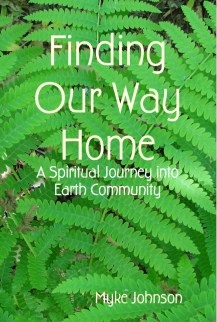
title-pageMy book, Finding Our Way Home: A Spiritual Journey into Earth Community is now available for $17.99 through Amazon.com, BarnesandNoble.com, and via special order at your local bookstore through Ingram, as well as directly from lulu.com.  You can follow the links, or search using my name.  It may ask you, Did you mean “Mike Johnson”?  Say, no, “Myke Johnson.”

A funny thing.  If I go to its listing  at Amazon.com, it also says there are “2 used and 11 new copies” available from other sellers. But obviously, there are no used copies in existence yet–this is a print-on-demand book that was just released.  But there are all kinds of discount booksellers who list it at prices varying from $14.52 to $24.44 plus shipping.

From the business side of things, it is still better for me (financially) when folks order it directly from lulu.com or get a copy from me in person.  This is because other sellers take over half the list price, so I receive about a third of what I would receive if someone ordered it directly from lulu.com.  On the other hand, if someone orders it from their local bookstore, it helps to support local booksellers, which is fabulous. And I myself use Amazon.com for its convenience and speed, and its free shipping when I accumulate a few titles. Plus, you can look “inside” the book on their website.  So all in all, it feels good to have it listed out there in multiple venues, so folks can get a copy in the easiest way.

It has been illuminating to learn more about the business side of book publishing.  I don’t expect to make a lot of money from this adventure in publishing, but I do want to get the message out to wherever it might be welcome.  It is up to me to do the promotion and marketing for the book.  But it won’t really work without some help from my friends. Thanks very much to those who have already purchased a copy!

And thanks very much to some wonderful members of my congregation who are hosting a book launch party this weekend.  If you are near Portland, Maine it is from 12-2 at the Allen Avenue UU Church on Saturday, January 14th.  There will be copies of the book to buy, a reading of selections from the book, music, refreshments and I will sign your copy. Everyone is invited.

Other ways you can help:  If you read the book and appreciate its message, tell your friends about it or give it as a gift.  Share it on Facebook.  You can also help promote it by writing a review under its listing at lulu.comAmazon.com, or BarnesandNoble.com and then sharing it via Facebook or Twitter.  Thank you in advance!

My Dad and the Land

Johnsons 1936.jpg

[1936, his brother, sister, & my dad in back.]

My dad was born in 1930 in Gillette Wyoming, where his parents were homesteading.  Some stories I remember from his childhood there.  My grandmother made cinnamon rolls. They had a fire that burned down their house.  His mother grabbed the laundry, and all the family got out safely, but they lost their other possessions.  One time, maybe 3 years old, my dad went into town, with his dad perhaps, and when he came home he proudly announced “I buyed me this!” He had spent a coin to purchase some candy or some small toy.

The family left their homestead in 1938, when my dad was eight years old, and they ended up in Detroit Michigan.  For the rest of his life, in many ways, he was trying to get back to Wyoming.  He went there at 16 to work on the ranch of a family friend.  Back in Detroit, he met my mom at a riding stable, and we lived in Michigan when I was young.  We moved to Texas when I was 7, but after six months returned to Michigan.  When I was 12 we moved to Sheridan, Wyoming, and my dad worked on a ranch in Montana. There were six children then. I was the oldest, and my sister Mary was the baby.  We went to the Catholic grade school in Sheridan.  We stayed there for one school year.

We could walk to school–I think it may have been about 8 blocks.  One time the weather reported it was 17 below zero.  My mom called another mother to ask whether she should send us to school.  Just bundle them up! she said.  I was in seventh grade that year, and was amazed that the popular kids were also those who got good grades.  I was in a drama club and a science club.  But it took a while to make friends.  By the end of that year, I had gotten close to a girl in my class whose name was Patricia Ann Rhodes.  The drama club put on Thornton Wilder’s Our Town.  I shared the role of Mrs. Gibbs with another student.

My dad stayed up in Montana during the week.  Actually, I don’t remember the exact schedule of him coming home.  He did go back and forth.  That year we spent Christmas week at a one-room cabin in Montana, which was a lot of fun.  Shortly after that, he stopped working at the ranch, and went back to Michigan to work again in drafting.  I didn’t know the full story until years later.  I had always thought he left the ranch because you couldn’t support of family with six children on a cowboy salary.  But really what happened was that he hurt his back in a fall from a horse.  Someone unexpectedly tossed him a bag of feed, and the horse startled and jumped away.  That was how he fell.  It was very physical work, and he was in too much pain to continue.

He told me later how devastating that fall had been for him.  He went back to his old job–but felt a deep sense of failure.  The year before, this company had held a going away party for him, and gave him a gift, a rifle I think, with many good wishes on this new adventure he was looking forward to.  So coming back was to admit the defeat of his dream.  Back in Michigan, he found a house for us to live in, and the family moved back to Michigan after the school year ended.  I cried when we had to go back.

I am thinking about how much he loved the open range, and longed for the land in Wyoming.  He found God in that land.  He said once that “people called it a ‘God-forsaken land’ yet even in that naming they were reminded of God.”  His longing for this faraway land was a part of my growing up years, one root of my own sense of disconnection and longing for the land.

I have been thinking a lot about my dad these last few weeks because he had a fall at home in West Virginia a few weeks ago and hurt his back.  He is now in a nursing home, theoretically to get some rehab and pain management, but he is feeling very discouraged, and not really participating in therapy.  He had a stroke in September of 2014, and recovered well at first, but it has been a hard two years. I am thinking about how much I love him, even though my own journey took me so far away from his world. Cowboy, mystic, dreamer… I send you blessings on this difficult chapter.  And gratitude to my sister Julie who has been caring for him and my mom close up these last eleven years.

The Chamomile & Me

From the Introduction to my new book, Finding Our Way Home:  A Spiritual Journey into Earth Community:

When I was a young adult I became intrigued with the use of natural herbs for healing. I read how particular flowers and leaves and roots were able to address different ailments of the body. I purchased herbal products in the local food coop, and steeped them in teas when I didn’t feel well. I learned, for example, that chamomile tea was calming during a time of stress. Then one day, with a group of peace activists protesting outside a nuclear weapons facility, someone pointed out to me a chamomile plant growing wild by the side of the road.

wild-chamomile

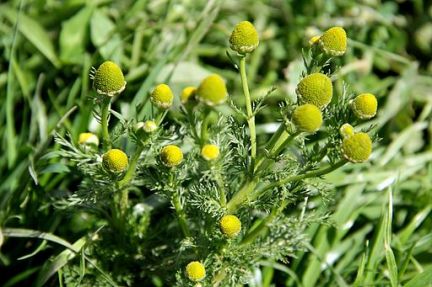
[Photo by Lazaregagnidze via Wikimedia Commons]

It was tiny, easy to overlook, with tight yellow-green berry-like flowers. Its feathery leaves branched out over a stony patch of ground.

I suddenly felt the connection. Chamomile wasn’t merely something I bought at the store. It was a plant that grew by the side of a road. Something in those chamomile flowers could ease my stress. We were related to each other in a deep, essential way—physically, chemically. And not only chamomile. I understood in that moment I was not separate from any of the plants or animals or people on the earth. We were all one, all interconnected. Something in me woke up.

But if we were one, why did we lose our awareness of our connection? What broke us apart? And more importantly, what could bring us back together? Standing outside that nuclear weapons facility, the contrast could not feel more devastating. If we truly felt our interconnection, how could we even imagine such destruction? Somehow, we had become lost, we had become divided—from the plants, from the earth, from other human beings, from the Mystery binding all of us together. How could we find our way back to each other?

…Without experiencing our connection, we cannot begin to address the dangers facing us in our time.

I invite you to join me on this journey into earth community. I offer stories from my own path, and stories from others who have helped me to find the way. Along this winding road, I had many teachers. Human teachers, to be sure, but also a red bird, a copper beech tree, a piece of bread, a common mushroom, my cats. I have not reached the destination, but I have come to understand a sense of the direction we must travel. We must cultivate deeper relationships with our fellow inhabitants of this planet, both human and non-human. We must understand that the Divine Spirit is here with us as well, not separate, but present in each being, and present in the larger reality of which we are a part.


Small Bird Press

Version 2

Photo by Margy Dowzer

Small Bird Press is the name for my self-publishing adventure. I  considered several other names, but when Small Bird Press came into my mind while I was on a walk, I realized it expressed so much about the purpose of publishing my book.

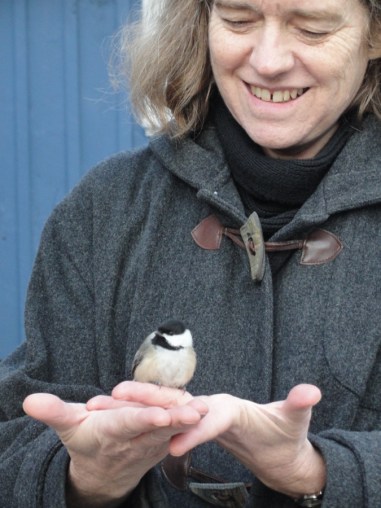
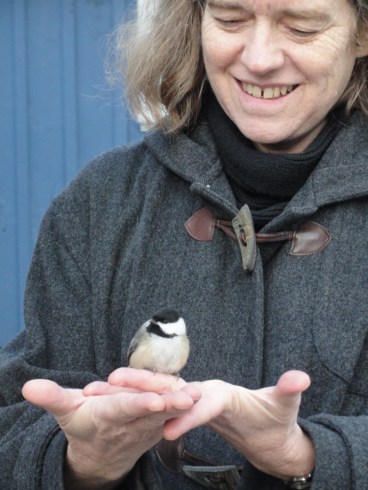
First of all, small birds were among my most important teachers for the spiritual journey I describe in Finding Our Way Home. The small chickadee I held in my hands after he was stunned by flying into our window. The cardinals who kept calling me outside at dawn. Small Bird Press is a way to honor those teachers.

Secondly, I had submitted my book to several publishers, but was rejected.  Most of the time, they didn’t really say why, but one publisher was kind enough to say that though my writing was good, they couldn’t take on the book because I wasn’t well-known enough and didn’t have a catchy hook, so it would be difficult to market my book. I understand this is often the way of publishing right now. So I too am a “small bird.”

But I believe that even a small bird–a person who is unknown, or only locally-known– even a small bird can change the world. When we have a vision of how the world might be, when we seek to articulate that vision and live that vision, it can ripple out in untraceable ways to shift reality. I want to be that kind of small bird, to bring about changes for whoever might listen, to shift reality toward earth community, toward human beings living in mutually beneficial relationship with all other beings of earth.

So I am delighted to be publishing as Small Bird Press. And if the message is going to ripple out, it will be because those in my small circles who share my vision are willing to share the book with others in their own circles. Find out more about the book here: Finding Our Way Home: A Spiritual Journey into Earth Community.

And thank you, Margy Dowzer, for capturing my moment with a chickadee in your photo.

The Book

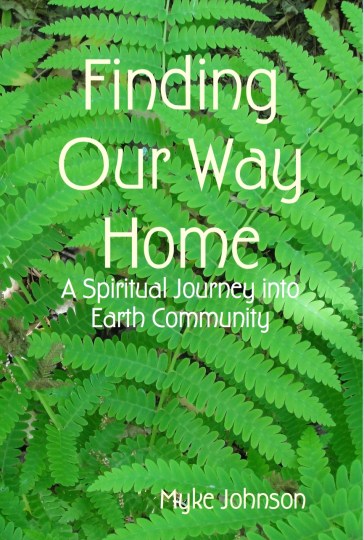
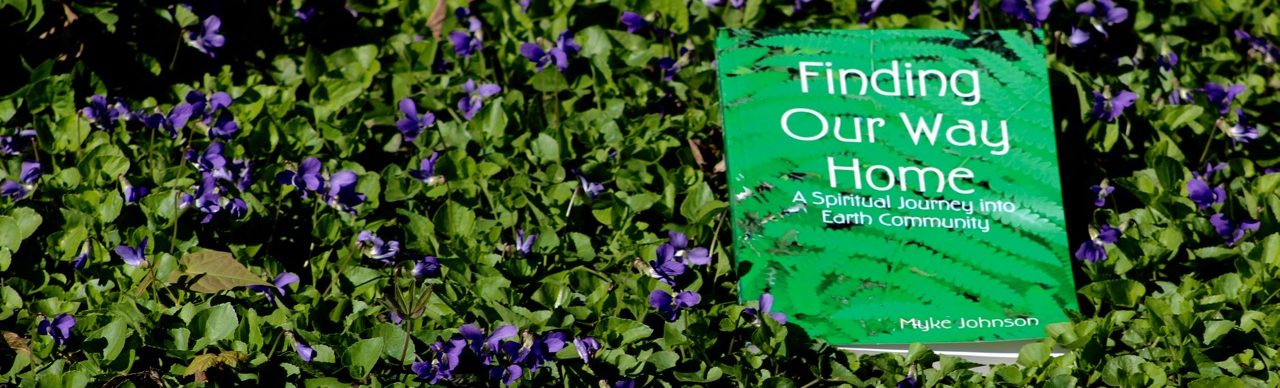
Now available!  The book, Finding Our Way Home: A Spiritual Journey into Earth Communityis being published by my own imprint, Small Bird Press, and available through lulu.com via this link.title-page 

What others are saying:

“Myke Johnson’s beautiful stories from her own journey illuminate the way to reconnecting with ourselves, each other and the entire Earth community. The practices that punctuate the end of each chapter help embody and guide the path of reconnection. A book to savor, it is also a compelling reminder of the legacy of stolen land and genocide, and of the urgency to face the past as a necessary step toward healing and finding our way home.”  Anne Symens-Bucher, Executive Assistant to Joanna Macy and facilitator of the Work That Reconnects

“Myke Johnson’s writings are inspiring, transformative and grounded in the mystic contemplative way of life.  Reading her reflections and meditations gives you a deep sense of connection not only to Mother Earth but to her own personal journey. This is a companion book for all that are seeking a simple but conscious choice of living in peace and harmony on our planet with all of creation.”  Rev. Virginia Marie Rincon, Episcopal priest and Curandera

From the back cover:

In this time of ecological crisis, all that is holy calls us into a more intimate partnership with the diverse and beautiful beings of this earth. In Finding Our Way Home, Myke Johnson reflects on her personal journey into such a partnership and offers a guide for others to begin this path. 

Learning from the Indigenous philosophy that everything is related, she found in her plant and animal neighbors generous teachers for a way back to connection: a chamomile flower, a small bird, a copper beech tree, a garden slug, a forest fern. Their lessons are interwoven with insights from environmental science, fractal geometry, childhood Catholic mysticism, the prophet Elijah, fairy tales, and permaculture design. Each chapter includes practices for further reflection and experience.

This eco-spiritual journey also wrestles with the long history of our society’s destruction of the natural world. Johnson investigates its roots in the original theft of the land from Indigenous peoples and in other violent oppressions between human beings. Exploring the spiritual dimensions of our brokenness, she offers tools to create healing. Here is a map into a new relationship with earth, with each other, and with the Spirit within and between all. Lyrically expressed, Finding Our Way Home is a ceremony to remember our essential unity with all of life. 

You can now order the book for $17.99 (plus shipping) via environmentally-friendly Print-on-Demand at this link:  Finding Our Way Home 

Version 2

Photo by Margy Dowzer

Myke Johnson is a Unitarian Universalist minister and earth activist, serving a congregation in Portland, Maine, while practicing and teaching ecological spirituality. She holds a Master of Divinity from Chicago Theological Seminary and a Doctor of Ministry from Episcopal Divinity School.

More recommendations:

“I work with Unitarian Universalist congregational, environmental leaders across the United States. I am keenly aware not only of my need, but what so many seem to experience as a lack, a daily rift between functioning well on Earth, and Living with All Earth in ways that sustain our core. The messages and ceremonies of Finding Our Way Home are as essential, I think, as sleeping. But like sleeping, we try to do without as much as our hearts, bodies and souls need to meet demands in these times. This book is welcome medicine for the beautiful, difficult work and love of our lives.”  Rev. Karen Brammer, UUA Green Sanctuary Program

“As a student of Naiyantaqt, I have, over the long journey of my life, come to appreciate the rhythm of the Great Mystery; the wondrous Consciousness, the empowered understanding and meaning of Manitou, that exists everywhere and in all living and immobile matter. Such connections are profound, relevant, and mark the passage to the future awaiting the enlightened. I am aligned to such kinships and Myke Johnson is a long-time kinship, a seeker of the Divine, a companion in the awe of the Great Mysterious. She boldly embraces the Divine and her quest to connect with the All-Encompassing Mystery. Her book is the re-telling, the sharing of her wondrous spirit, life, and the path to her awareness. Her book will empower true seekers on this Path of Life, a path she confirms by our friendship and mutual journey together.”  gkisedtanamoogk, Maine Wabanaki-State Child Welfare Truth & Reconciliation Commissioner and author of Anoqcou: Ceremony Is Life Itself

“During times of chaos, whether private or public, the human psyche/spirit seeks inner and outer grounding as its home base. Using her own life as a prism of refracted insights, Myke Johnson has created a tool-kit for the rest of us to use in our personal and/or political struggle to survive, and perhaps even thrive. As she shows as well as tells us how to concentrate and tap into our deepest energy and then send it out into the universe in order to affect change, she does exactly that with this book, her own special gift to the world.”  Gail Collins-Ranadive, author of Nature’s Calling, The Grace of Place

“In Finding Our Way Home, Myke Johnson names the many disconnections that modern people constantly experience as the core spiritual issue of our time.  And then through wisely chosen stories from her own experience, she shows us how we might reconnect the inner pieces of ourselves, our relationships in genuine community, and our relationships with the earth into a more integrated whole. She helps us remember our deep belonging with all that is. And that as we engage this process, we are finding our way home.”  Rev. Deborah Cayer, lead minister, Eno River Unitarian Universalist Fellowship, Durham, North Carolina

ARMY CORPS DECISION: WHAT DOES IT MEAN?

Reposting from Andy Pearson on Facebook.

On Sunday afternoon, the U.S. Army Corps of Engineers denied the easement for the Dakota Access Pipeline to cross under the Missouri River at Lake Oahe, just north of the encampments at Standing Rock. This is amazing, virtually unprecedented, and a movement victory — and the water protectors who have led the fight are right to claim it as such. It’s also likely temporary and by no means the end of this fight. Here’s some context and paths forward as best I understand right now.

WHAT HAPPENED: The Corps denied the easement and ordered an Environmental Impact Statement, which is a formal study which will compare various route alternatives. Denying the easement was a stepping stone to getting to an EIS here for the Corps, and doesn’t mean that the pipeline won’t be built in its current alignment near Standing Rock eventually. The Corps is essentially hitting the pause button and initiating further study.

HOW DOES AN EIS GO? There are usually three phases to conducting an EIS: Scoping, Draft, and Final. The public can generally comment during each phase. The purpose of scoping is to identify what should be studied in the EIS — the scope. Then the Corps and their EIS contractor prepare and release a draft, which the public is invited to comment on. They then rework the draft in light of public input and release a final version, which the public can generally also comment on. The process usually takes several months, and can last for years depending on the project’s complexity. A generic timeline would be about nine months, but we don’t have any actual guidance yet on the timeline for this particular EIS.

WILL THIS ACTUALLY STOP CONSTRUCTION? Debatable. It would be illegal for Energy Transfer Partners to drill under the Missouri, but that’s not to say they won’t do it and opt to pay whatever legal penalties they incur. That would be a fairly shocking move on their part but they’ve hinted they may be open to doing it. It’s easy to imagine that an incoming Trump administration would do their best to make the penalties as minimal as possible.

WHY IS IT IMPORTANT FOR ETP TO DRILL RIGHT NOW? Contracts with oil shippers. These contracts, called take-or-pay contracts, obligate shippers to pay money to the pipeline company over a long, committed period of time regardless of whether they have oil to actually send or not. It’s a great deal for DAPL but not so good for the oil shippers, especially now that the Bakken oil boom isn’t so hot. These contracts expire if the pipeline isn’t substantially complete by January 1, and there’s somewhat of a chance that some shippers will choose to drop out at that point due to changing economics in the industry if the pipeline isn’t complete. Sunday’s decision by the Corps means that the pipeline won’t be complete by January 1 unless ETP breaks the law and drills anyway.

WHAT ABOUT TRUMP? Oh, you had to ask. He’s a problem here. Once he’s president, he’ll be able to stack the deck at the Army Corps so that the EIS is weak or biased in favor of DAPL, and he might be able to stop the EIS process altogether and reinstate the permit, though I don’t know the legal specifics here yet. It’s very doubtful that we’ll see a full and robust EIS with him taking office. The upshot of Sunday’s decision as I see it, assuming that ETP chooses to follow the law, is that it delays approval of the line until after Trump takes office, giving time for the contracts to expire and letting the worst of winter slide by without the need for full forces at the encampments.

WHAT CAN WE DO IN THE MEANTIME? We can continue the work we’ve been doing, because it’s all still relevant and helpful, and will become quite urgent again in at most a few months. We can go after the banks harder than ever to cut off funding to DAPL. We can continue to spread information, lobby elected officials, lobby the Corps, hold events, train for direct action. We can engage in the EIS process once it begins. This isn’t the end of the fight by a long shot, but it’s a brief respite between battles and a sign of how far we’ve come thanks to the indigenous leadership and water protectors at Standing Rock. Let’s celebrate and reflect and keep fighting. #NoDAPL