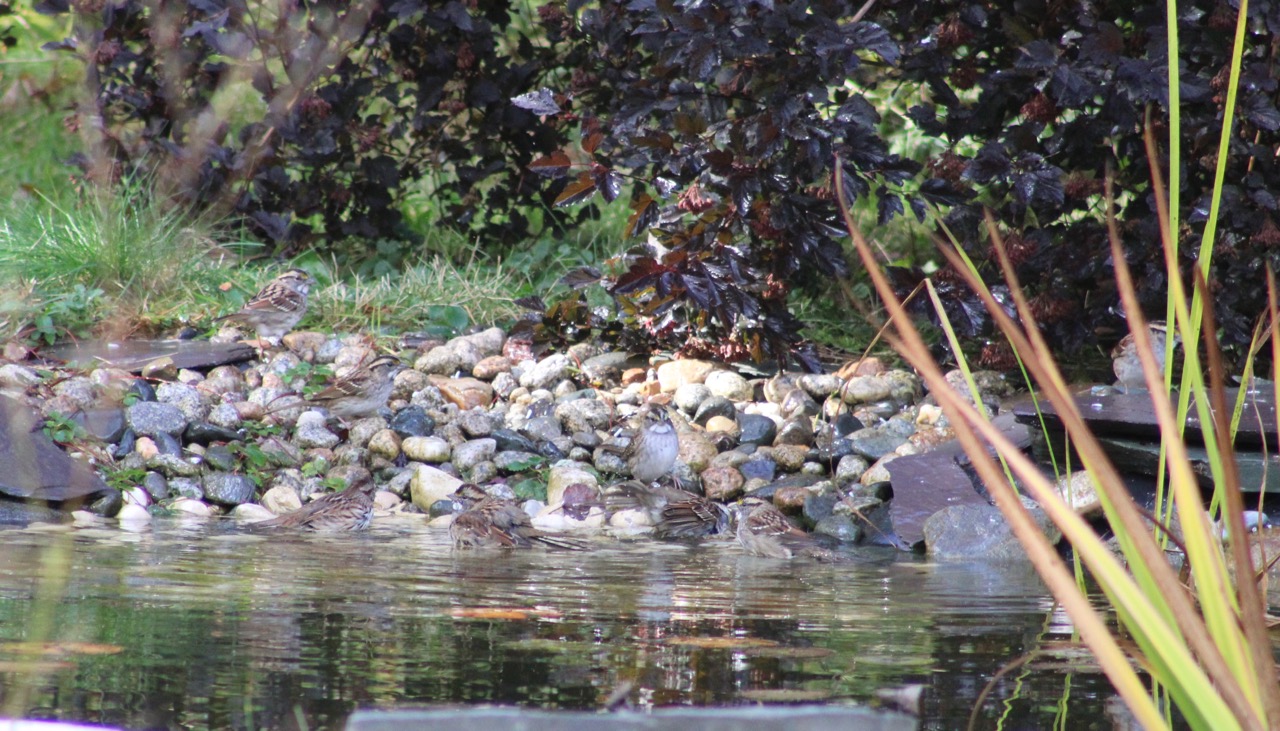
If you look closely you can see 8 white-throated sparrows visiting the pond.
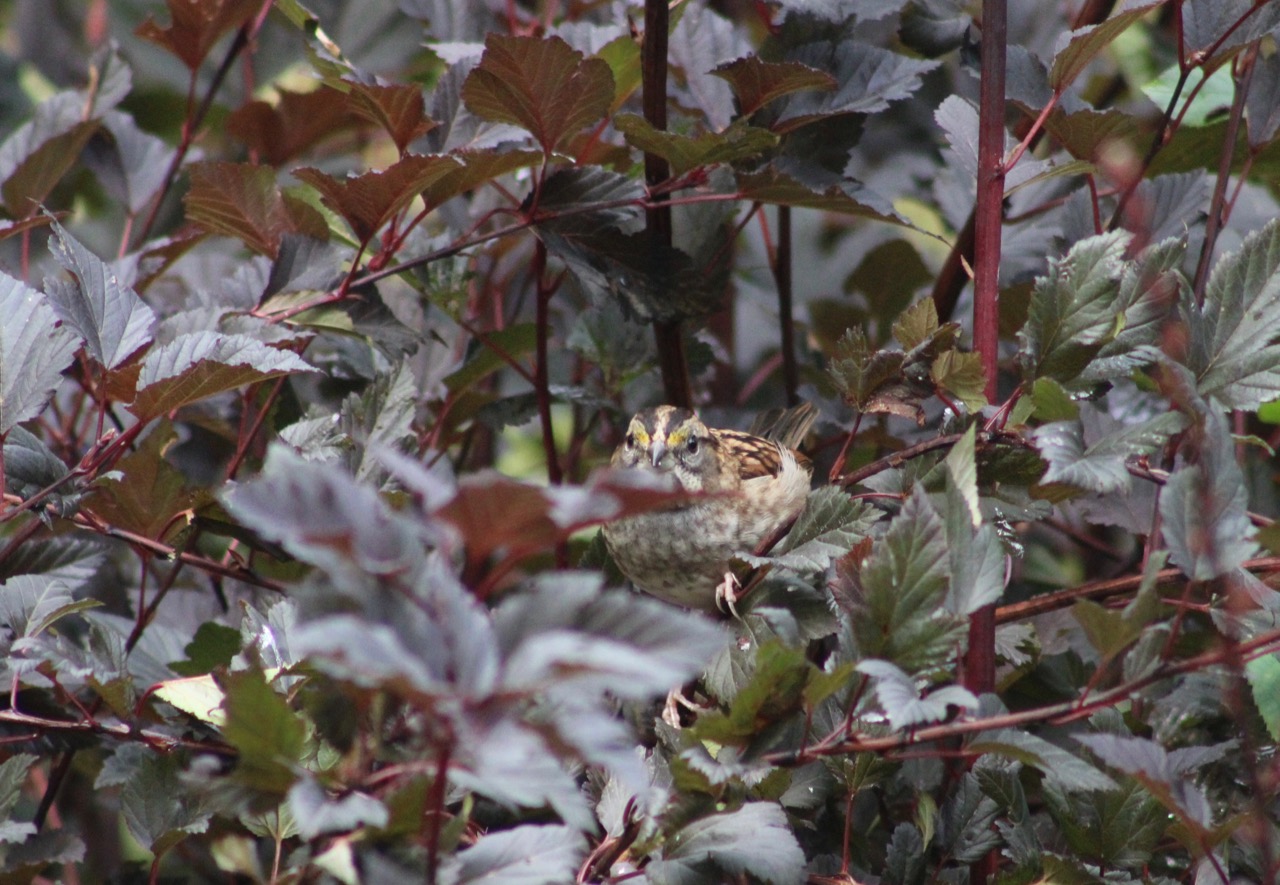
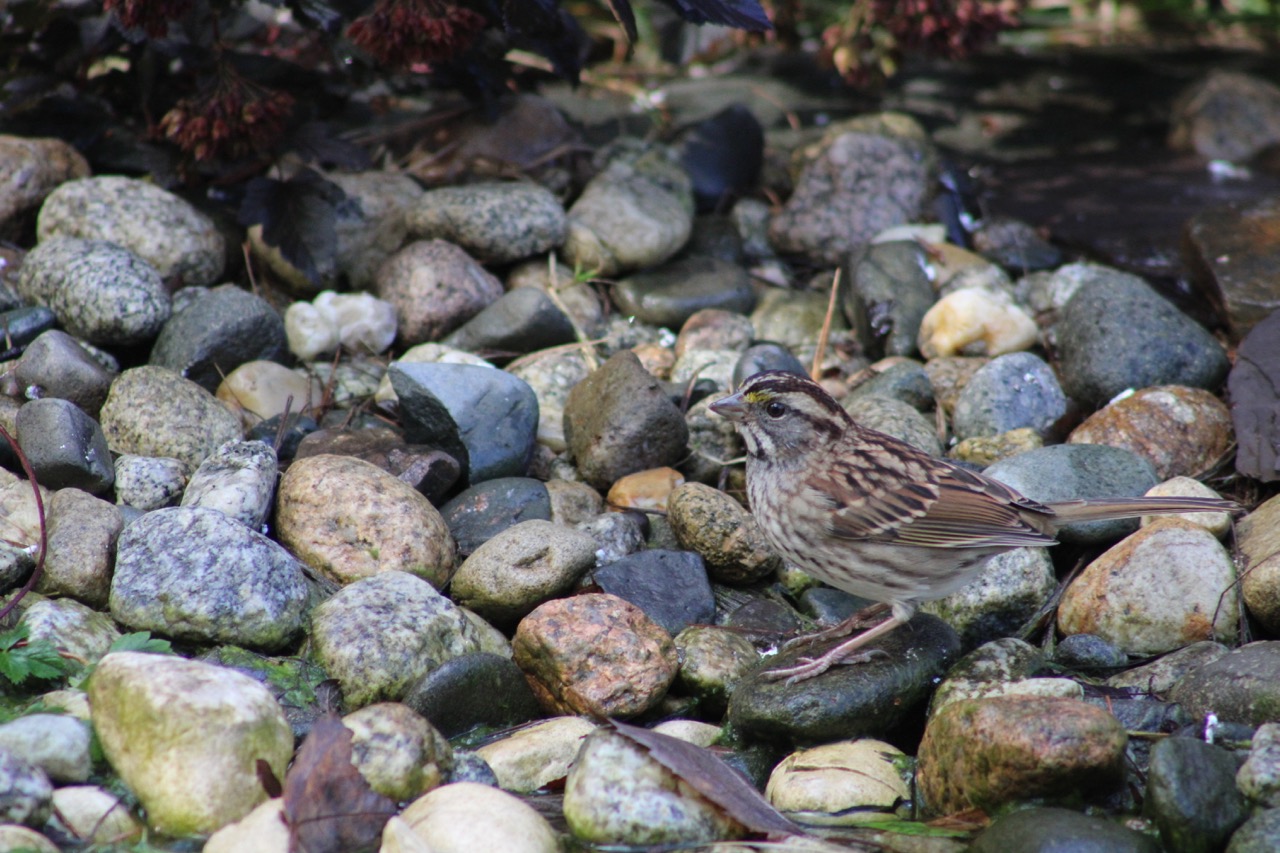
This week we’ve had a flock of dozens of white-throated sparrows in our back yard and the field and trees next to it. I love their little striped heads and loud chirping. They are drawn by the water of the pond, and I’ve seen them drinking and bathing there. It is such a blessing to feel the yard full of birds. If I am sitting right next to the pond, they are a bit timid, but yesterday I took the photo above from a little further away so as not to spook them. A few days before, one sparrow kept peering out from the nine-bark branches, but wouldn’t come any closer.
Then a couple days ago, when I sat quietly for a long while, a few began to venture near to drink even with my presence on the other side of the pond.
Every living being needs water. A human being can only survive for about 3 days without water. I am thinking about water in relation to the people in Gaza under siege, where Israel has cut off water and the electricity needed to pump and purify the water for drinking. The killing of innocents is always wrong, I believe that what Hamas did was wrong. But I also believe that the government of Israel is wrong to attack the civilians of Gaza, or cut off their access to water, food, and fuel. I am not unaware of the long history that is the context for these attacks. I have been following Jewish Voice for Peace for information and guidance in the midst of this deeply sad time. As someone who is neither Jewish nor Palestinian I can’t begin to grasp the depth and complexity of it all, but I trust the deep values of the Jewish Voice for Peace.
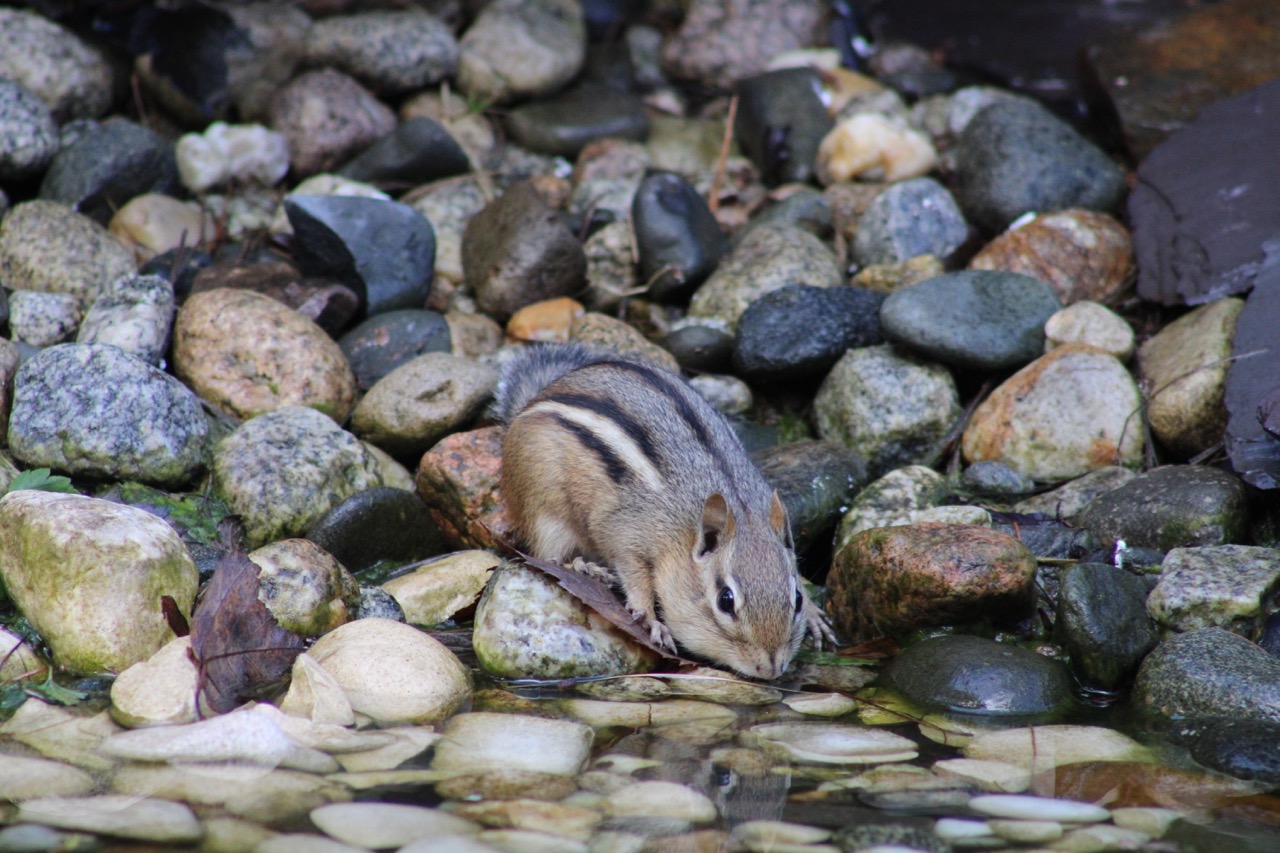
In the midst of this larger sadness, about which I can do nothing really, except to bear witness, I find peace with wild things gathering at the water. Everyone needs water. We are all relatives in this, whether large or small, near or far.
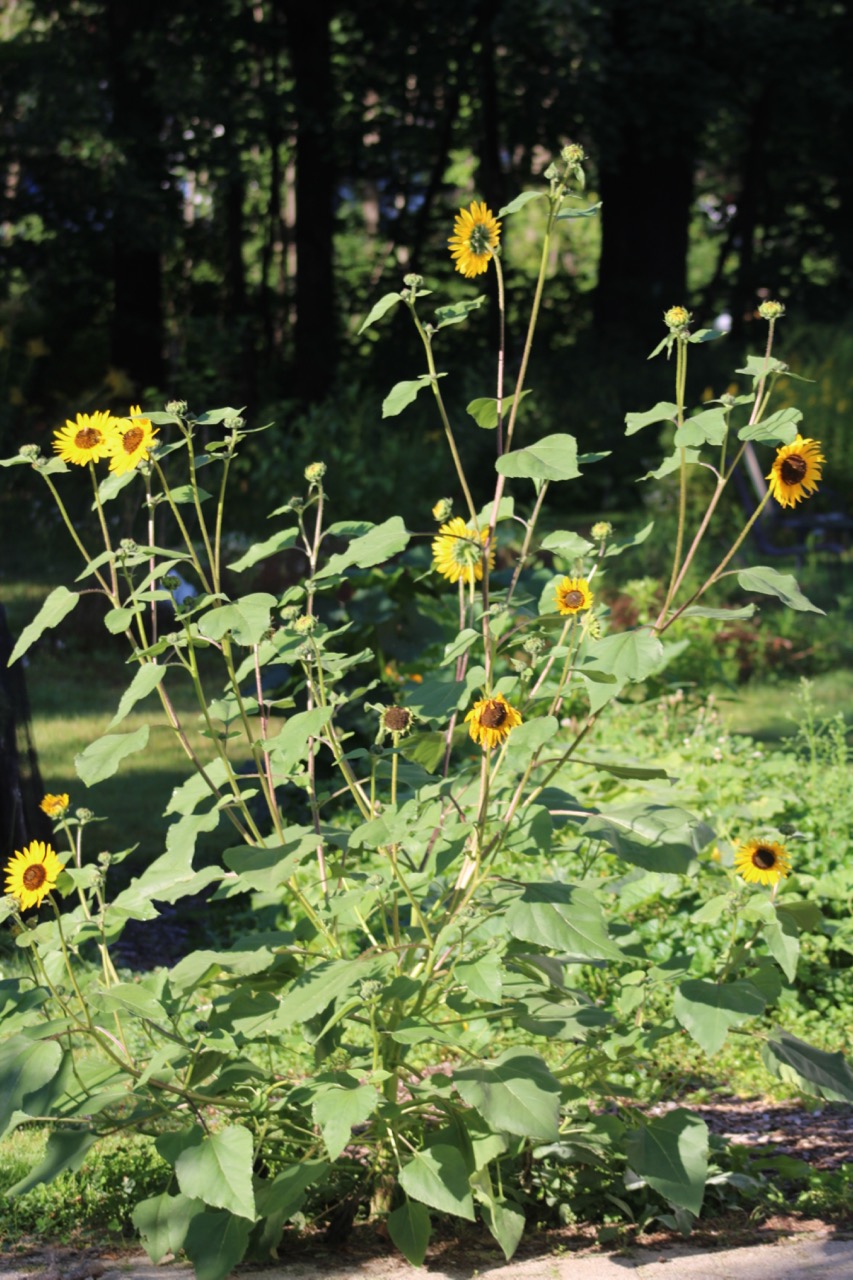
This year one volunteer sunflower plant came up next to the patio, starting small. Now it has expanded into this multi-branched extravagantly flowering giant! Doing a little research, it seems to be a native wild sunflower, because of its branching habit and the size of its flowers, and its continuing blooms. It is still one plant though, a community of flowers that is connected at the root, and much loved by all sorts of bees, other insects, and birds. It is easy to see how they belong to this place and to each other.
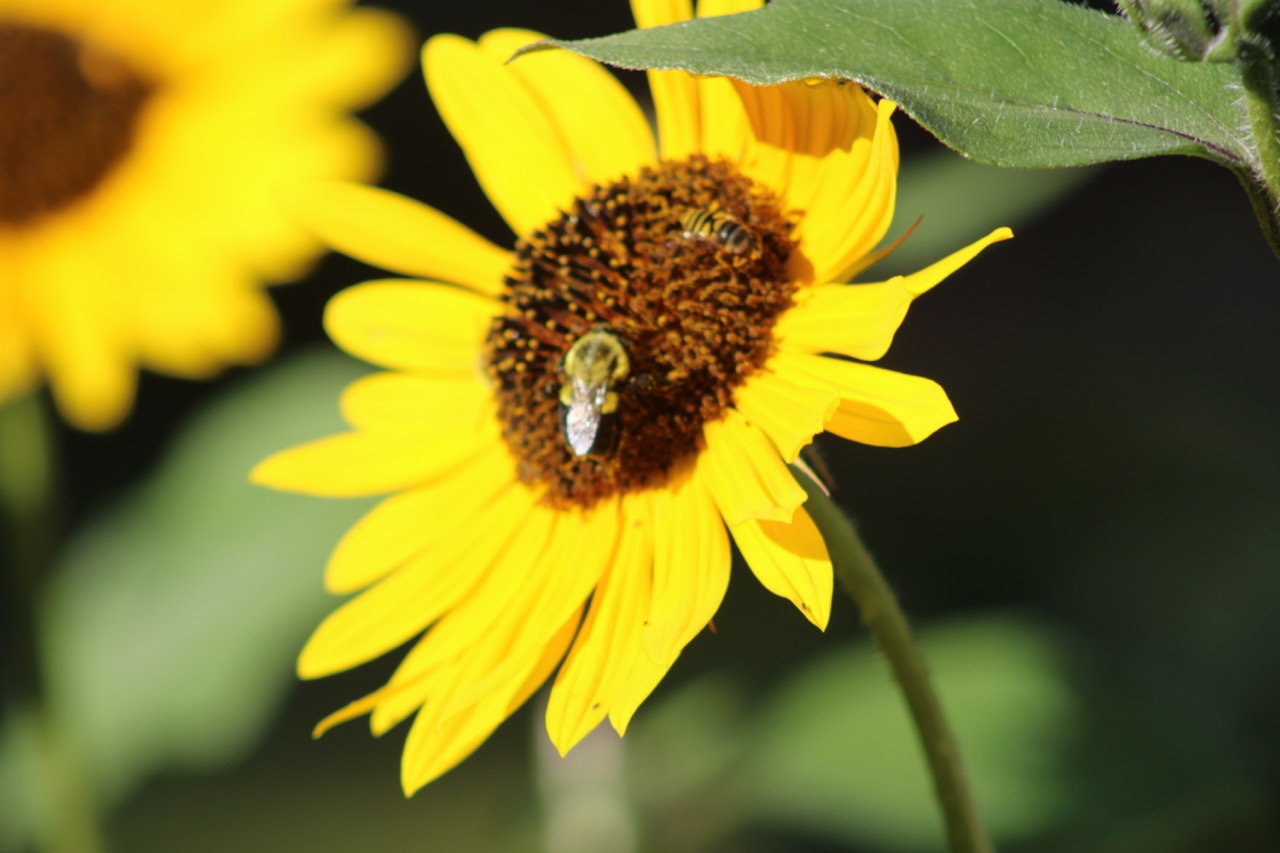
Bumblebee and honey bee on center of the sunflower.
What does belonging mean? It is easy for me to get caught in a “not-belonging” wound, the scar of a childhood moving from place to place, always starting on the outside, trying to find my way in, feeling invisible and unconnected. It is not that I haven’t had some times of belonging–there was the group of friends at college, the group of activists at the Catholic Worker or the women’s peace camp, the lesbian community in Boston. Changing perspective sometimes took me away from earlier forms of belonging, sometimes into new communities–sometimes not. In some ways I belong to my family of origin, but my lesbian identity and feminist politics created a deep barrier.
On this personal journey, becoming a UU minister created an avenue for me to nurture community, to bring other people into a sense of belonging. And in that ministry, I had a form of belonging, too, right at the center of community, but also always a bit set apart in my role. And it also meant moving once again. Even though I have retired, I am still a bit set apart because of the role of a minister. Reflecting on it, I’ve also experienced a form of belonging in my connections with ministry colleagues. But the wound continues to shape the ways I navigate the current chapter of my life. I continue to wonder, “Where do I belong?”
As I explore various facets of belonging, the feeling remains elusive. Do I belong to this place like the sunflower and the bees? I am not indigenous to this land, it is Wabanaki land. When I reach back to my own ancestors, language is a barrier between us–I don’t speak the German of my father’s ancestors. I don’t speak French (even if I understand a little), the language of my Quebec ancestors, and even of my distant Innu relatives in these times. I don’t belong to Nitassinan (which would be my matrilineal homeland) or Quebec or Austria or Germany. I don’t belong to an ethnic community. What does belonging mean in white America, especially for those of us who reject the racism of its founding?
All these thoughts are coming round in a scattered fashion. When the feelings come up in me of “not-belonging,” it helps me to remember these childhood wounds, these societal wounds. I can acknowledge and honor those feelings but then make a choice to open my heart to new possibilities of interconnection. I am becoming interconnected to this land, as I tend the trees, appreciate the wildflowers, make habitat for birds and frogs, eat the blueberries that grow. There is a reciprocity that is developing between us. I must choose to open my heart to new people as well–not dwelling in the old fear that there will be no room for me, but being curious about the ways that we might be interconnected already, or the ways that we might find to connect right now.
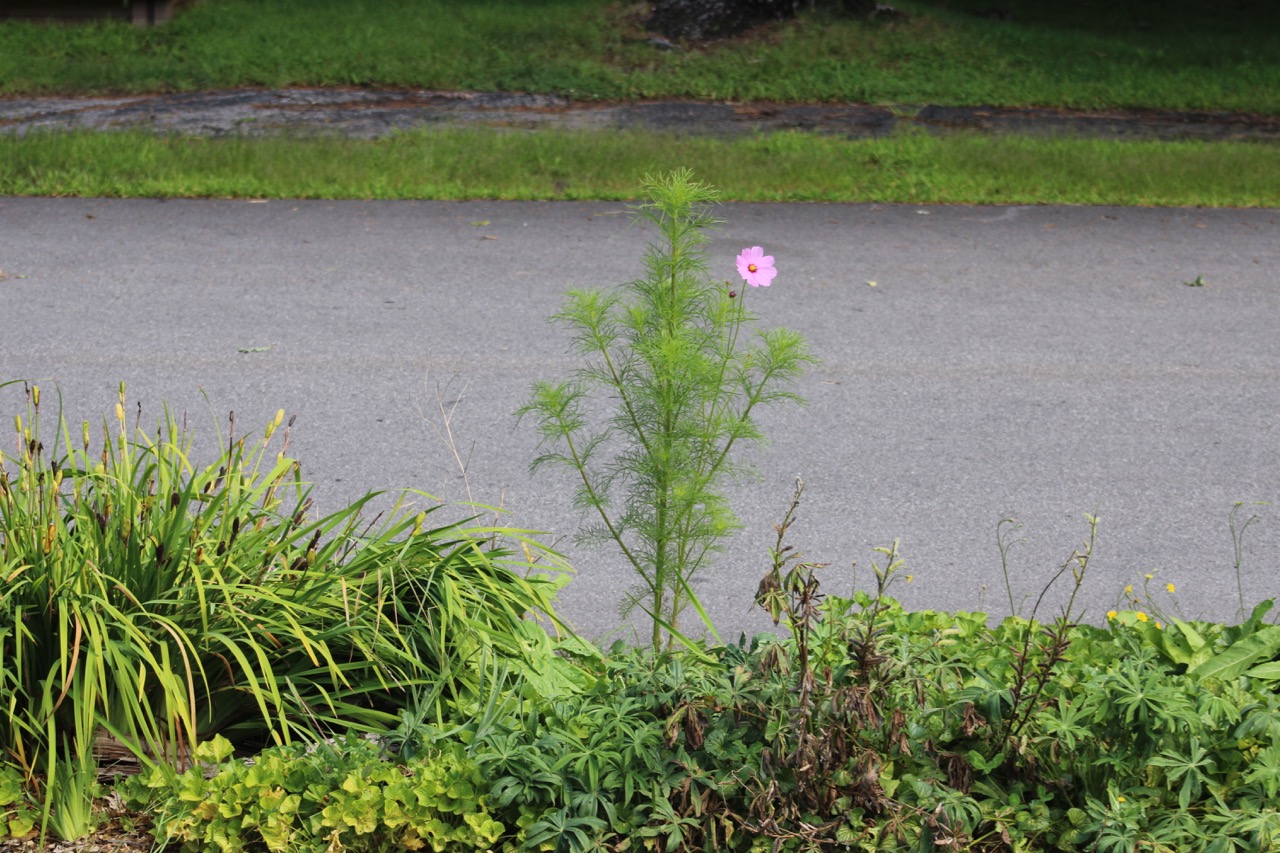
Today I see one more lesson about belonging in a tall pink cosmos flower that we didn’t choose or plant, but somehow it rooted itself next to the road we live on. It is now blooming on its own after the rest of the plants have faded. It is not in the “color scheme” of the roadside garden bed. I guess its motto is a variation of the old adage: “Bloom where you are planted.” Bloom wherever your seed happens to land.
Margy & Myke cuddling on our new loveseat recliner 2023.
July 4th is the 30th anniversary of Margy and I being together as lovers! We have many different anniversaries actually–for example, it was six years before we moved into a household together, when we moved from Boston to Cape Cod in 1999. Perhaps that was our first truly big commitment, buying a house together in a new place. We never did the legal marriage thing, even as we fought for it to become available to same-sex couples, partly because Margy has been disabled since we’ve known each other, and she would have lost her health care coverage, and partly because legal marriage just didn’t matter to us personally, radical dykes that we were.
Mar 11 2004 rally at the state house in Massachusetts, constitutional convention about equal marriage
We were something of a case of opposites attract, and we often found ourselves surprised to be together. Our values and commitments were solidly aligned, but our personalities and relationship styles were different. Still, we adapted to each other’s needs, we cared for each other, and we are still learning how to do that. I love Margy for her passion, for her humor, for her curiosity, for her tenderness. Also for being such a sweet butch. Music, dancing, activism, the ocean–they were all parts of our love story. These days, I love that she goes out beyond the yard to get rid of invasive plants; that when she mows, she mows around native plants like goldenrod and ferns so they can flourish.
I love that she encourages my pond building and orchard planting. I love that we both love critters like birds and frogs. That each of us cherishes solitude as well as togetherness. As we come into our elderhood, many things keep changing. We face new challenges, but our love is like the ground, a living foundation in which to keep planting and tending the seasons of our daily life. I am so grateful that we found each other, and that we have journeyed together for these thirty years!
Our new screened in pop-up tent is set up, ready for summer visits.
There is a phrase I’ve seen online that applies to Margy and I–we are “still COVIDing.” It means that we know the COVID virus is still circulating, still dangerous especially to elders and those with other health issues, and we are still taking all precautions. This despite the end of the declared public emergency and the end of mask mandates. So we always wear N95 masks if we have to go inside stores or offices, we don’t eat inside restaurants, and we don’t go inside where crowds are gathered. We try to keep a six foot distance even outside.
Sadly, we feel more isolated now that so many people have chosen to live with or ignore any risk. (It felt so different to be in it all together, even alone in our homes.) I am sure that many people are very carefully weighing the risks and benefits to make their choices, but I am guessing that many others are just following along with the culture’s decision that the emergency is over. We are often the only people masked in a store or even a doctor’s office.
I read an excellent article in The Conversation.com which explores how ageism plays a role in this issue.
“COVID is not over, but we are acting like it is. Many COVID research programs are winding down. Can you imagine winding down research into any other condition on the top five mortality list? The reason for not doing more to prevent COVID-19 appears to be ageism, plain and simple. There is no logical explanation for accepting an unnatural degree of hospitalization and premature deaths in elders except that we value the lives of younger people more.”
It is baffling to me, even with this analysis. Because even programs for elders are dropping precautions. I try to understand why people make the choices they make, but it also fills me with sadness. It seems there is a great divide between us.
In the midst of all this, we decided to treat ourselves to a screen tent, a pop-up gazebo. (I have had screen tents before, but they had all worn out a while ago.) We have been looking forward to the possibility of more visits with friends during the summer, when we can sit outside in our yard. But the weather has been so rainy all of June, and the forecast predicts more of the same. With this gazebo, we can visit during more kinds of weather, and still be safe together. It is an investment in our happiness. How are you keeping safe and happy during these hard times?
The E-book of Finding Our Way Home is now available! You can get an EPUB version at lulu.com for $9.97. (The link should take you directly to the book, or you can search by author and title.) In 3-5 weeks there will also be versions on Amazon, Barnes & Noble, Kobo, and other ebook stores. EPUB is readable on Apple Books as well as Nook, Kobo and other readers.
In 2016, when I first published Finding Our Way Home: A Spiritual Journey into Earth Community, I was happy to use an ecologically oriented print-on-demand source for a paperback format. That is still available for $17.99 plus shipping. I have been told it is the kind of book that does well with slow reading, a chapter at a time, with spiritual practices offered at the end of each chapter. Personally, I enjoyed doing the layout and choosing the typeface, and creating all the formatting. I assumed I would also do an e-book at some point, but with chronic illness and not very much energy, it took longer than I expected.
For some mysterious reason, during the last few weeks, I was inspired to get back to it. The first step was reading “how-to guides” at lulu.com. I had to create a new document and undo all the formatting I had previous used, substituting standard formats. I checked all the internet links that showed up in the notes, to make sure they were still functioning. I also updated the author page, but did not change anything else in the content.
My hope is that this new format will make the book more accessible to more readers, both financially and visibly. I especially want to thank my friend Diane K. for her cheerleading and enthusiastic support. Just a little note to mention that when you purchase directly from the publisher more of your payment goes to me as the author. But another way you can help, if the message appeals to you, would be to leave a review wherever you purchased the book. In the end, most of all, in my small way I want to keep fostering a spiritual journey of waking up to interconnection—to the earth, to each other, and to the Mystery within and between all.
Two people have reached out to me in the last few weeks to ask about the origins of the name of our little Capisic brook. They accurately assumed that it was a Wabanaki name, as are many waterways in what is now Maine, and wondered about its original meaning. I have wondered that too, though when I asked Wabanaki friends, no one was quite sure. So recently I began some research about it.
Capisic Brook has several branches winding through our neighborhood, with three headwaters: the north branch starts east of Forest Avenue near the intersection with Allen Avenue, the main stem in a wooded area within Evergreen Cemetery, and the west branch just east of I-95 near the intersection with Warren Avenue. Sadly, it receives run-off from development and roadways, and its water quality is significantly impaired. After these feeder branches join together it crosses under Brighton Avenue, flowing into Capisic Pond, which was originally created in the 1600s by a dam for a grist mill. Eventually Capisic Brook feeds into the Fore River. [I want to note here that the Fore River was called Casco by the Wabanaki people who lived here.]
All of this land is Wabanaki land. I wrote about its history in a previous post, noting that it was the chief Skitterygusset who first made an agreement for a settler to live near Capisic Brook and its uplands. While the settlers thought of these agreements as deeds of sale, a Wabanaki interpretation was something more like a treaty: an agreement to co-exist, and to render offerings each year for the use of the land and water. Unfortunately, the settlers kept taking more and more of the land and waterways. That is the painful legacy of colonization. Any story must include this legacy.
For those of us who live here now, if we are paying attention, the presence of the brook is everywhere in the neighborhood, showing up in the patterns of the roads, and the deep ravines with trees and brush. It most likely contributes to the wildlife that still frequents our yards. When I go for a walk, I seem to find myself heading to places where I can see the brook, in one segment or another. Despite the pollution and development, the brook has its own powerful presence in this place, that cannot be denied.
So what about the name? I have been privileged to study a Wabanaki language, Passamaquoddy/Wolostoqey, for the last five years with Roger Paul. One thing I learned is that the languages are polysynthetic–words are formed from the combination of smaller syllables, with root segments, prefixes, and suffixes, that combine to form new meanings. The word “Capisic,” as such, is not in the online Passamaquoddy/Wolastoqey dictionary. So I began to look at its parts. First of all, early spellings by settlers were not consistent or necessarily accurate to the actual Wabanaki words. It is likely that it has changed over the years. But I listened to how it sounded, and converted it as well as I could to the spelling system which has been used for the last 40 years–and is used in the online dictionary: ‘Kahpisik.
Now, it is more likely that the dialect here was Abenaki, and their recent spelling system is different, but I was working with what I knew best, and all of the Wabanaki languages are intelligible to each other, so that seemed not unreasonable. Here is what I was able to find: first of all, the final two letters “ik” are most likely a “locative” signifying that the word is a location. So then I looked at Kahpis. Sometimes, an “is” signifies something small, though that is less certain in this case. “Pis” can also mean “in” or “into.” I found the syllable “Kahp” in the prefix “kahpota” meaning to climb down or disembark, and also the verb “kahpotassu,” used in the context of transportation, meaning she or he gets off, gets out, disembarks, steps down. I couldn’t find other uses for “kahp.”
Many Wabanaki location words are the descriptions of what might take place there. Because of the physical characteristics of the brook, I am wondering if Kahpisik might refer to “the [small] place where we disembark [from our canoes].” The brook was unlikely to be a navigable stream, so people traveling on the Casco (Fore) River, coming to this brook, would have to disembark. So maybe that is what the name refers to.
I want to acknowledge that I am not an expert in the language, and merely hope to be a respectful and curious student. I checked in with Roger and he thought it was possible that this meaning might be on the right track. If others can tell me a more accurate meaning, or source for a meaning, I will update this post.
But in the meantime, it is helpful to think about this place in relation to its own history, to the people who lived here, live here still, and love this land and water. I imagine it used to be great drinking water, filtered as it was through gently sloping forest. Animals and birds still drink from it today, polluted though it is. I am grateful to be able to walk to the brook, to see the water and the plants, and sometimes birds and animals who visit. I am glad to see awakening environmental consciousness that seeks to purify its waters again, or at least mitigate its pollution. We belong to our watershed, and when we can imagine ourselves located in such a way, we are more likely to care for our home.
Pond has open water today, first time this spring!
Back in 1981, I wrote a poem that meant so much to me at the time–an expression of the spiritual path I was attempting to follow as a social change activist. It is interesting to me to read it today–do I still agree with it or not? Since that time, I have been involved in several organizations working for change. I would love to change the system, and I grew to think much more collectively. But after many years, and seeing the backlash against so many changes we tried to create, there is some grounding in remembering that we are creating a new way, no matter how the larger system reacts. I am curious what other activists or spirit kin might think about it all. (I do still love the word kin-dom.) (And one can make a small pond by digging a hole and pouring in water–it will never be the ocean, but it gives me joy none the less.)
We are not reformers
We are resisters
We are not reformers with a cause
We are resisters with a way
A reformer is one who tries to change the system
A resister is one who tries to change herself
A resister does not try to answer the question
    of what the system should be
A resister does not try to organize a new system
A resister resists the system
A reformer is like someone trying to make an ocean
    She digs a big hole and pours in water
A resister is like a river
A river doesn’t know what the ocean looks like
But it knows the way to the ocean


Now here is a mystery
The organizers of groups try to organize people
    into organization which resist the system
But only individual persons can become resisters
Only individual persons can change themselves
But when a person becomes a resister
    she finds a kinship with other resisters
She becomes part of the kin-dom
The kin-dom is always in the midst of the system
The kin-dom is always in resistance to the system
The kin-dom is not an organization to be joined
It is the kinship with other resisters one finds
    when a person becomes a resister
Only individual persons can change themselves
Only individual persons can become resisters


When resisters protest this or that evil
    we are not trying to change the system
A resister protests to strengthen the change
    in her own life
A resister protests to let other people know
    that there is another way
A resister protests to invite other people
    to become resisters
If everyone became a resister
	the system would collapse
But a resister is not waiting or working
    for that goal
The kin-dom is not waiting or working
    for that goal
The kin-dom is at hand.
March 11 2004 Margy and Myke at a rally at the state house in Massachusetts, in support of equal marriage
This week in my basement archives I revisited my life in Massachusetts in 2003 and 2004, during the time when its Supreme Judicial Court declared that to deny civil marriage to same sex couples was unconstitutional. In the six months following their declaration, state legislators were arguing over trying to stop it from happening, or support it to happen, and we were at the state house too, lobbying, and rallying. I had forgotten many of the details of those months, but I had not forgotten the strange mix of joy and fear as we anticipated this unimaginable possibility. It is hard to believe that was only 19 years ago. Now marriage is accessible to same sex couples across the land, but it is still under threat. I found my remarks from a forum we held on Cape Cod that spring, and they still seem relevant today.
This was Civil Rights, Civil Marriage: A Forum on Equal Marriage Rights for Lesbian and Gay Couples, Cape Cod Community College, May 3rd, 2004, where I was part of a panel presentation. At that time I was a minister at First Parish Brewster, Unitarian Universalist. Linda Davies and Gloria Bailey were members of our church, and one of the plaintiff couples in the lawsuit. They also had just spoken at the event.
“I want to start by saying how much I am looking forward to signing the marriage license of Linda and Gloria on May 17th. When I sign that license, I won’t be acting merely on my own behalf, but representing the whole community of First Parish Brewster. I believe I speak for all of us when I say how grateful we are to Linda and Gloria for taking a risk with their lives to end discrimination against gay and lesbian couples, and what a joy it has been to join them at the front lines of this historic civil rights effort. I know that your courage and your transparent love for each other have touched people’s hearts and opened their minds.
“Our struggle is far from over. Many of our opponents use the teachings of Christianity to claim that gay and lesbian couples should be excluded from marriage. I think Jesus would be horrified to see how his message has been twisted.
“Someone once said that even the devil can quote the Bible. Every religious community that draws inspiration from the Bible has the challenge of interpreting a collection of documents that were written and gathered over 1800 years ago in languages and cultures not our own. Some people will tell you that they take the Bible literally word for word. I will tell you, following Karl Barth, that I take the Bible far too seriously to take it literally. As even my Catholic professors used to say, the Bible is ‘the word of God written in the words of men.’ It is full of contradictions and its heroes are entangled mixtures of good and evil. The Bible tells the stories of a community’s experience of the Holy in their midst. If we are to be true to its message, we must also pay attention to the working of the Holy within our midst.
“You know, Jesus actually said very little about marriage, and nothing about homosexuality. He wasn’t so concerned with family arrangements. He was concerned about love. He was concerned about how we care for each other, and especially, about how we care for those who are—what he called—’the least’ among us. He called on his followers to welcome the stranger, to take in the outcast; to bear witness to the kingdom of God within each person. He said, when we live in love, God is in our midst.
“I am a minister and I am a lesbian. So this moment in history is meaningful to me in two ways. I want to say that I respect how difficult this issue is for those who are religious. It was difficult for me when I was a young Catholic woman. It was easy to imagine that everyone could just follow the rules if they tried. It wasn’t until I became friends with a gay man in college that this ‘issue’ took on a human face—the face of a brother who was in deep pain because of the contradictions between the teachings of his religious tradition, and the inner truth of his own body and soul.
“When we risk honoring the truth in our own soul, we are entering dangerous ground. What if we are deluding ourselves? Some would say we are. But on the other hand, what if the truth in our souls is the voice of the Holy in our midst?
“The God of the prophets was always leading them beyond the comfort of the familiar in the direction of greater love. I believe that we are living in a prophetic moment. Something holy and miraculous is going on here. It has always been the Holy who has lifted up the downtrodden. It has always been the Holy who has filled the hearts of people with compassion. It has been the Holy who made strong the faint of heart, and transformed the lowly.
“Equal marriage is a civil rights issue, a legal issue, an issue of respect for diversity. But for my part, I want to take off my shoes, for I believe we are standing on holy ground.”
Gloria Bailey, left, and Linda Davies of Orleans rejoice moments after being pronounced married by First Parish Brewster Unitarian Universalist minister Rev. Dr. Mykel Johnson, left, on Nauset Beach during a 1:00 ceremony on Nauset Beach Monday. The couple, who have been together three decades, were married in front of a group of about 40-50 friends and press. Monday is the first day of legalized same-sex marriage in Massachusetts and the US. A dinner party is planned at a friends house to celebrate the event. (Dewitt photo 5/17/04)
My friend Estelle making art from the “13 Hugs Are Healing” shed (2015)
This past week, my beloved friend Estelle died. She had been living with her granddaughter Michele, and thankfully, she was at home with her family during her final days and hours. She had been in declining health for a while, but the shock of her death reverberated through a wide community of people who loved her. She was another person in my life from whom I experienced unconditional love. Estelle was a woman who created community around her, and many people felt her unconditional love. She had a way of seeing the specialness in each person.
I met Estelle in 1985 at the Women’s Encampment for a Future of Peace and Justice–the Women’s Peace Camp for short. The camp was 52 acres directly next to the Seneca Army Depot in upstate New York, where it was rumored that nuclear weapons were stored. Estelle visited the encampment the first week it opened in 1983 and lived there on and off for the next 20 years. She was a founding member of the encampment’s second incarnation, Women’s Peace Land, and was co-founder of the Peace Encampment Herstory Project. I can’t remember it clearly, but Estelle and I probably got to know each other more deeply while sitting by the fire on overnight watch duty. By the end of my first summer staying there, I counted her one of my closest friends.
Estelle was an elder to younger women at the camp–most of us were in our 20s and 30s, and she was in her 40s. But she already had wise crone energy–she was fierce, courageous, protective, and creative in a context where we were willingly on the front lines in the battle against nuclear weapons. There were numerous actions of public civil disobedience and less public direct actions taken on behalf of peace. Because Estelle had a job to go back to, she didn’t risk arrest, but she was a stalwart support for those who did. I want to share one story that was recently shared on the peace camp Facebook page that illustrates her so well.
“So, one night a group of women came back to the house after sneaking into the Army Depot and painting peace slogans on the water tower. They had mud still smeared on their faces and spray paint on their clothes and hands and were telling of their triumph when soldiers came racing after them and tried to charge into the house but Estelle, in her white haired Mother Jones persona, blocked the door and calmly told them, “women are sleeping in here, you men can’t just walk in” and that stopped the men, who were after all mainly young and only here because the world didn’t give them other ways out. By the time an Officer arrived to Put Down This Womanly Nonsense some of the women had wiped off the mud while many others had smeared some on so there was just no way to know who the soldiers had followed home. Much ordering around ensued and women were told to line up and account for themselves and well you know that just did not go as the Officer thought it would. Meanwhile Estelle, who had long since befriended the local sheriff and deputies called that sheriff and those deputies to report that men were trespassing on the farm and threatening the women so then the sheriff and a deputy or two came roaring up and then more ordering around and demands to account for themselves happened and meanwhile the women with spraypaint on their hands got snuck out the kitchen door and into the dozens of tents in the dark field and eventually it was impressed upon the soldiers that they had no rights even one inch off the base and as they drove off Estelle smiled and waved then – Mother Jones, remember – got right back to organizing the next day’s actions.”
post by Elliott BatTzedek
I remember being in a similar action, with similar magic worked by Estelle to confound the army personnel who came after us. Estelle demanded that they produce a search warrant describing who they were looking for, and of course, their descriptions weren’t close to matching the actual women involved. There is so much more I could say about Estelle and about the Peace Camp. Being there from summer 1985, and then winter through summer of 1986, was transformative in my life. Coincidentally, I have been going through old papers and letters from that time this week, so perhaps some other thoughts and memories will bubble up during that process. But for now, I wanted to express how grateful I am that I knew and loved Estelle. There was a shed on the camp with a slogan painted on its side: 13 Hugs Are Healing. I am mindful of the many diverse ways that love that has touched my life through the years and the healing I experienced from that love.
Me and Lori, 1977, when she took her first vows as a Franciscan sister.
What does unconditional love mean? What does it gift to us in our lives? I first experienced unconditional love in my friendship with Lori Slawinski. I have been looking back on my life by going through old papers these last several weeks–my winter project. The other day, I reread dozens of letters from Lori from when we first knew each other. We met when I went to college in the fall of 1971. She was a sophomore at the time, and became the “big sister” I never had at home, my being the oldest child of so many. I haven’t found any photos from that time; this photo from 1977 is the earliest. Very quickly we became best friends, though there was a moment when she hesitated–she said she was afraid of corrupting my innocence. I can’t remember exactly what I said to her, but all I could see in her was her own bright goodness. I think each of us were surprised to be chosen and loved by the other.
Looking back from the perspective of being a lesbian, I wonder about our friendship. We were never sexual with each other, but our letters can only be described as love letters–mostly written on school vacations when we were apart from each other, missing each other, and expressing our affection with such deep passion. I had occasional crushes on boys during this time, but nothing could compare with the love I shared with Lori. Our love for each other was also expressed in the context of our passionate love for God. Lori and I were part of a small circle of friends who were trying to follow Jesus and figure out how to live the gospel in our times. All of it intermingled. From her I felt God as the unconditional lover, and from me she felt that too.
Unconditional love is a transforming energy, a grounding that helped me to believe in myself. Maybe because we weren’t trying to be “in a relationship,” we could grant each other the freedom to explore fully who we were, without expectations? Our maybe it was the spiritual rootedness that provided that freedom. We had a fantasy of continuing forever in our little community, but college is a temporary place. When she graduated, she left to join the Franciscan Sisters of Chicago. I didn’t follow her there, but tried another way, eventually discovering the Catholic Worker movement. Lori was very psychic, and I remember it took a lot to claim my own inner knowing, since she always seemed to know me so well. Separating was a challenge, after being so close. But we were able to let each other go, to try to work out our own destinies.
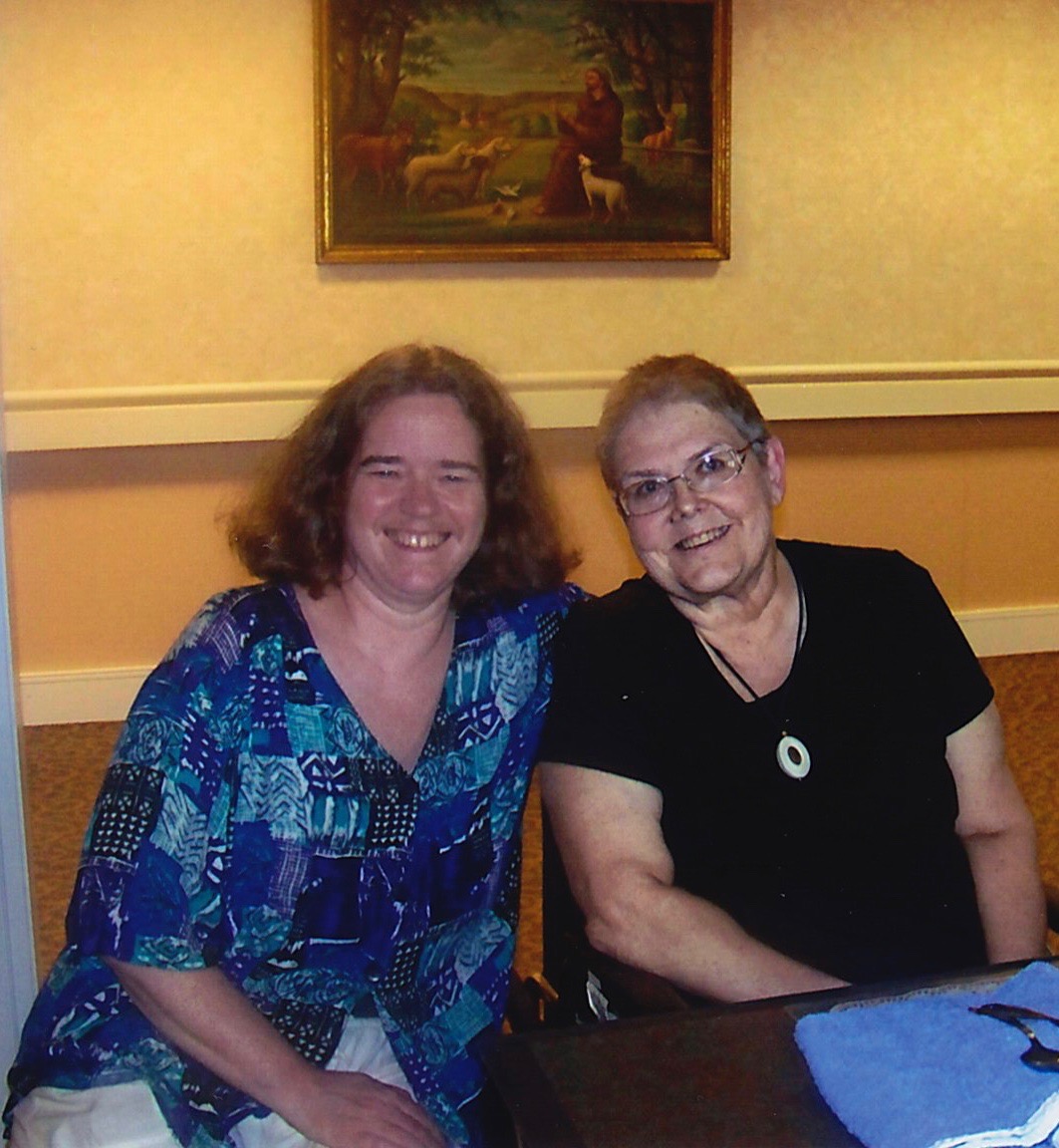
Our lives diverged significantly when I encountered feminism, and found myself leaving Catholicism, leaving Christianity, embarking on a new spiritual path. I imagine it must have been difficult for her, yet we stayed connected. I went to Chicago Theological Seminary in 1983, came out as a lesbian while there, and she came to my graduation in 1986. (It was years later, in 1999, that I was ordained a Unitarian Universalist minister, but that is another story.) Somehow, the love we had for each other never wavered. We kept in touch via occasional letters and long distance visits. Sadly, Lori died of cancer in July 2012; this second photo was from our final visit in May of that year.
I am so grateful that I was able to experience her unconditional love in my life. I have had other significant loves, and still do, but her love was the root. It enabled me to come alive, to feel joy, to trust the dreams I dreamed and the ideals that guided me. Despite our different paths, that unconditional love remained tangible. Perhaps that is why my image of the divine is rooted in a Larger Love, who loves all of us unconditionally.
Have you experienced such love in your lives? Please share your stories if you might be willing? Each story reminds me of the possibilities that surprise us when we least expect.





 Finding Our Way Home