All the Water Is One Water #3

In honor of World Water Day, part 3 of my chapter “All the Water Is One Water”from Finding Our Way Home.

At the Earth Activist Training we learned about Permaculture, a science of designing systems that can meet human needs while regenerating the land around us. Its ethical mandates are to care for the earth, to care for the people, and to share the surplus. I especially loved the cheerful atmosphere of hope and creativity that was engendered. Much of the environmental situation is foreboding and terrifying. But at the training I discovered a merry band of folks who sang while they gardened and went around the world demonstrating alternatives that make a real difference.

Permaculture observes natural patterns to create highly productive environments. For example, it uses the model of the forest to create food forests—gardens of fruit and nut trees, vines, bushes, and ground cover that can function together to feed a family while nurturing the land in a sustainable way. Agribusiness narrowly regards one crop as the only valuable entity, and sees all other life forms as weeds or pests. But if we look more closely at the natural world, we discover diversity is the norm and there are beneficial relationships throughout the plant and animal realms. In one example recounted by bio-chemist Linda Jean Shepherd,

Researchers at the University of California at Santa Cruz studied the traditional Mexican farming practice of pruning back, rather than pulling, a weed that commonly sprouts between rows of corn. They found that the roots of the weed Bidens pilosa secrete compounds lethal to fungi and nematodes that destroy corn. Instead of competing with the corn, the weed controls the pests without significantly stealing soil nutrients from the corn. The practice protects the soil and provides more wholesome food.[i]

The more we learn about nature, the more we see that everywhere diverse plants and animals are interconnected with each other, offering mutual benefit and function; modern agribusiness has ignored this to our detriment. To live sustainably, we must learn from nature, we must open our eyes to the lessons it can teach us about how all beings are related to one another.

Permaculture design also offers sustaining and restorative approaches to our use of water. In a natural landscape, water is absorbed and held in place by plants and trees, and advances very slowly through the ecosystem. When the surface of the earth is covered with concrete for buildings and roads, the water rushes quickly over the surface, picking up pollutants it brings to rivers and lakes. When forests are cut down, or grasslands uprooted for agriculture, the drylands can devolve into desert. Permaculture designers have created tools to slow the water down, and capture it for use. These designs can purify water moving through a system, or reverse the process of desertification.

Swale

[Swale creating at the Earth Activist Training]

We learned about and built one such tool, called a swale. This is a small ditch created in alignment with the contour of the sloping soil, so rain washing over the soil will be captured, and can be used in plantings near the edge of the swale. The plantings then serve to keep the moisture in the landscape. A swale can also be used to direct water from one area to another. The goal is to slow the flow of water for as long as possible, and thus restore the fertility of the soil, rather than letting the water wash away into creeks that flow rapidly out to rivers and to the sea.

Adopting another practice, Margy and I purchased two rain barrels to collect the rain-water that ran off our garage roof, for use in watering the blueberry bushes and vegetables and flowers we had planted in our front yard. We learned about how high off the ground the barrels needed to be, in order for gravity to pull the water all the way to the plants. We learned that water in a rain barrel heats up in the hot summer sun. We learned how quickly a rainstorm can fill two fifty-gallon barrels.

It is important to take these small steps toward changing our relationship to water use, even in our comparatively water abundant climate in Maine. Even here we need to learn about conserving water and treating it with respect. We face challenges from multinational corporations who bottle our Maine water for sale around the world. The bottled water industry isn’t concerned about the water needs of local communities or ecosystems. They negotiate contracts to extract the water for almost nothing, and put it into plastics that end up in the waste system causing further pollution.

Permaculture design follows the principle that in nature there is no waste. What one system doesn’t need, another system uses. Our human society wastes an incredible amount of water, even though we know it is scarce. We use it for washing and showering and then let it drain into the septic system or sewer. Why not build gray water systems that take the water from washing and showering and pipe it out for use in the garden?

[i] Quote from an article by Linda Jean Shepherd, “My Life with Weed,” The Sweet Breathing of Plants: Women Writing on the Green World, edited by Linda Hogan & Brenda Peterson (New York: North Point Press, 2001), 200.

All the Water Is One Water, #2

In honor of World Water Day, part two of my chapter All the Water Is One Water.

My little bottle of the waters of the world also reminds me that we need not only ritual, but also practical action to take care of water. When I was ten, my family went on vacation to the mountains of Wyoming. I remember coming upon a stream that had a little sign saying Potable Water. My sisters and I were very excited we could drink right out of the stream. The water tasted funny to us, with its enhanced mineral content, but it was cool and refreshing nonetheless. Now, looking back on that event, I am saddened by our amazement at drinking water directly from the earth. For millennia, all people drank from rivers and streams, and animals still do. But in the memories of most of us, this no longer is a part of our expectations about water. We take for granted that pollution has made most water undrinkable unless it is purified.

Capisic Brook EquinoxIt may seem as if there is an endless supply of water on the earth. But of all the water on the earth, only one percent is fresh water. More and more water is being polluted, or being diverted to industrial or agricultural use. We have now reached the stage where there is a global crisis looming as drinkable water becomes increasingly scarce.

Oren Lyons, Faithkeeper of the Turtle Clan of the Onandaga Nation, has said,

“Keeping the water pure is one of the first laws of life. If you destroy the water, you destroy life. That’s what I mean about common sense. Anybody can see that. All life on Mother Earth depends on the pure water, yet we spill every kind of dirt and filth and poison into it.”

Analysts are predicting water will be the number-one political issue in the coming years. Just as wars are being fought over oil, so increasingly there are conflicts over access to water. The business solution is to privatize the water: sell it to corporations and let them sell it to the people. The theory is that if water is a scarce resource, then the market should determine its price, and price will regulate its use. But citizens’ groups are fighting back to say water cannot be commodified, because it is an absolute necessity for life. We cannot take water out of its relationship to all living beings, and leave it in the hands of a system which is designed to think only in terms of profit.

In Cochabamba, Bolivia, citizens passed a resolution in 2000 to declare:

  1. Water belongs to the earth and all species and is sacred to life, therefore, the world’s water must be conserved, reclaimed and protected for all future generations and its natural patterns respected.

  2. Water is a fundamental human right and a public trust to be guarded by all levels of government, therefore, it should not be commodified, privatized or traded for commercial purposes. These rights must be enshrined at all levels of government. In particular, an international treaty must ensure these principles are noncontrovertable.

In 2010, due to grassroots organizing and lobbying efforts by an international coalition led by Bolivia, the United Nations General Assembly voted overwhelmingly to affirm “the right to safe and clean drinking water and sanitation as a human right that is essential for the full enjoyment of life and all human rights.” That doesn’t end the battle over commodification, but it becomes one more tool in the struggle to care for the water and ensure its protection.


All the Water Is One Water

In honor of World Water Day, I offer this excerpt from a chapter in my book, Finding Our Way Home: A Spiritual Journey into Earth Community.  I will share further excerpts during the next few days.  This chapter is entitled, “All the Water Is One Water.”

Water BottleOne summer several years ago, I attended a two-week Earth Activist Training, which combined a Permaculture Design Course with practice in magical and political work on behalf of the earth. We began with a water ritual. We brought water from the places we lived or the places we may have traveled to pour into one container. At the end, each person took some of the water, and we brought it home with us. One of the teachers for the training was feminist witch and eco-activist Starhawk, whose writings had been important for me earlier in my spiritual journey. She had begun collecting water in this way many years ago. She brought water back from her travels around the world, and asked her friends to bring back water when they went to far off places. They brought water from the sacred Ganges River in India, and from the great Nile River in Egypt; they even brought melted ice from Antarctica. After a while, they had water from every continent.

When you pour it into one container, all of the water mixes together, and every drop has some of the molecules of water from every place. So if you take a small bottle of water out, you have the waters from many places in one bottle. Each time you have a water ritual, you add some water from the bottle you saved from the previous ritual. In that way, each ritual, each small bottle, contain the waters from all over the world.

Why would we want to have a small bottle of waters from everywhere in the world? For me, first of all, it is one more way to make tangible the sacredness of water. All life comes from water, and needs water to survive. Water moves through the whole ecosystem, nurturing and transforming life as it moves. It rises from the ocean in evaporation, forming clouds in the sky, and, blown by the winds, it returns to the land in the form of rain or snow. This precipitation falls into the soil, and gathers in streams and aquifers. In the midst of this journey, it also travels through the bodies of every living thing.

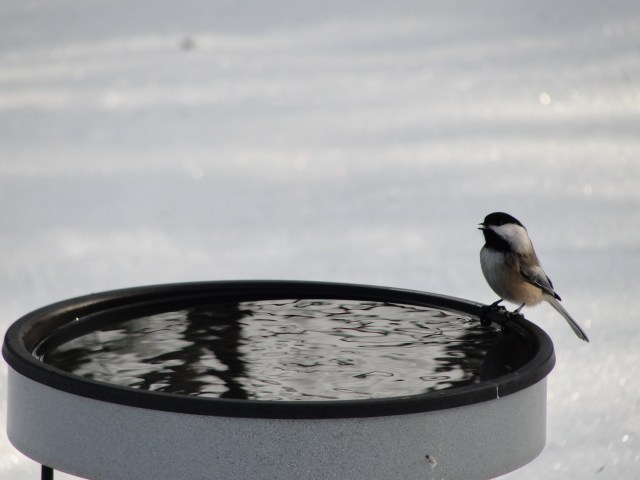
Margy and I have a bird bath outside our back door. Many kinds of birds come to drink the water we keep filled there, but we’ve also seen squirrels, chipmunks, and bees stop to drink. Every being needs water: insects, birds, mammals, fish, humans. Water also rises up into the stems of plants and the trunks of trees. But none of the water is isolated from the rest—even our own bodies are part of the watershed. We drink in the water, it moves through our blood, and permeates all of our cells, and then we sweat it out or pee it out. Sometimes we weep with wet salty tears. The water goes back to the air or the earth and continues in streams and rivers on its way to the ocean. The cycle keeps going round and round.

All the water on earth is really one water, continuously flowing through the biosphere. Even if we get water from our kitchen tap, that water has been around the world on its journey. All water is connected, and connects all of life.

Not Just for Native People

Today about 160-200 people gathered in Augusta Maine, in solidarity with the Native Nations Rise with Standing Rock march in Washington.  Organizer Sherri Mitchell commented how important it was that non-Native peoples were showing up–both because for too many years Native people have been struggling without support from the white community, but also because these issues really affect all of us.  Issues like water to drink, on which depends everything else about our lives, or the problem of toxins in the land, like uranium mining and oil pipelines, which so often have first been situated on land where Indigenous people were living, but then spread everywhere.

People Gathering in Augusta.jpg

[People beginning to gather at the Augusta rally]

I think about how my activism on these issues is often perceived by (white) others as something I am doing “for” Indigenous peoples, or a “special interest.” Perhaps I am misperceiving it, but I get the impression that some see it as too “narrow.”  But Sherri gave voice to what feels true to me–that Indigenous issues are tied in to so many other issues that we are facing in this time, issues that will determine the future of our planet.

I tried to articulate this in my book, Finding Our Way Home.  So many of the issues we are facing are the result of disconnection from the land, from other people, from the spirit within and between all beings.  So many of the issues we face are a result of the original colonization and theft of this land from Indigenous nations.  There is such a pervasive overlay of denial around the true origins of our nation, that it is easy for me to feel tongue-tied just trying to speak or write about it.

After leaving the rally in Augusta, I went to see the movie “I Am Not Your Negro” (directed by Raoul Peck).  What a wake-up call from James Baldwin to white America–again, confronting the pervasive overlay of denial about racism in America.  Can’t we see that racism makes white people monsters!  Our country will rise or fall depending on healing the wounds of colonization and racism, and we can’t heal what we aren’t willing to acknowledge.  Or as James Baldwin said it so eloquently, “Not everything that is faced can be changed; but nothing can be changed until it is faced.”

I grew up in a bubble of “innocence.”  I remember when white people applauded the innocence of children who knew nothing about racism.  But “innocence” is not what we need to heal–we need to wake up, we need full vision, we need to face it.

Some of my colleagues in ministry speak of their congregations growing weary of our preaching about racism, such a downer.   I don’t know if my congregation has grown weary of my words about racism, or my work supporting Indigenous rights.  But here is what I want to say.  It doesn’t feel like a “downer” once it is acknowledged.  Yes, it can bring up tears and rage and regret.  But there is also a sense of relief that comes from experiencing what is really true.  There is a sense of solidarity.  Because it gets to the heart of what is wrong in white America, it gets to the root of what is wrong in all of America.

As I said, I don’t feel very articulate today, but I feel inspired by the rally, inspired by the movie, encouraged in the fog of the everyday illusions that comprise so much of our country, to #staywoke.


Pray with Water Protectors Today

The Water Protectors at Standing Rock have called for a day of prayer today.  The Governor of North Dakota and the Army Corps of Engineers have given an eviction notice to the Oceti Sakowin camp that takes effect 2 p.m. today (Mountain Time).  They have said that everyone remaining in the camps will be arrested. You can call the Army Corps at 202-761-8700 and demand an extension. But also–Pray!  The people in the camps have been cleaning up the camps from the aftermath of the blizzards in December and in preparation for spring flooding.  In a video released Monday, women said

“After the deadline for February 22 at 2pm, we are all at risk of facing arrest, police brutality, federal charges and prison time.”  “In the history of colonization, they’ve always given us two options. Give up our land or go to jail, give up our rights or go to jail. And now, give up our water, or go to jail. We are not criminals.”

From Arvol Looking Horse, last night:

Right away I woke remembering our history of abuses we have suffered from the continued need from Mother Earth’s Resources. My heart is heavy today, for what we are all facing together with tomorrow’s deadline in the removal of the Standing Rock’s Camps…
Because of the seriousness of this situation, I humbly would like to once again call upon all the Religious/Spiritual Leaders, URI and the People who traveled to Standing Rock’s sacred fire on December 4th. (Sari At Uri) Pray with us at your own sacred places for Mother Earth, her Mni wic’oni (water of life) and the protection of our People who are still at the Standing Rock Camps.

We also need to remember healing for those who are making these dangerous decisions that have only ended up abusing all life.

I too will stand in the sacred place with our Sacred Bundle to offer prayers – if anyone would like to join me by bringing offerings to the Bundle, they are welcome – @ 2:00pm mountain time on Wednesday February 22, 2017.

Please pray with us where ever you are upon Mother Earth.

Mother Earth is a Source of Life – Not a Resource.

Onipikte (that we shall live) ,

Nac’a Arvol Looking Horse C’anupa Awiyanka (Keeper of the Sacred White Buffalo Calf Pipe)

When I walk in my own neighborhood at dawn, I pray, and I come to this sacred place, the small brook that feeds into Capisic Brook.  On the walk, I hear and see the cardinals singing.  They are praying.  Back in my yard, I pray there, because this too is a sacred place. The crows are shouting to each other.  They are praying.  Let us all join in this sacred work, from wherever we are.  Water is life.  The Earth is our mother.  We are all one.

Capisic Brook feeder

[Capisic Brook]

What now?

chickadee-bird-bath-mj-dsc00898

Are you getting thrown off-balance by the shocking pronouncements every day from the Trump administration?  I have been wrestling with my heart, needing quiet, needing spaciousness to hear, underneath the din, the voices of the Spirits.  I think I am coming to some clarity.

It is easy to want to pass along the latest Facebook post with one more horror that is being perpetrated on innocent people or the earth.  So much outrage fills my heart when I hear about what is being done.  But it is their plan to stun us with horror, so that we are debilitated and unable to act.  So I plan to stop passing along horrifying posts. I will try to pass along posts of resistance and beauty and solidarity and compassion. I will also continue to post what news I hear from the resistance at Standing Rock, since that is often kept from the media.

Every week I am invited (via Facebook) to several rallies or vigils or demonstrations.  I am happy to see people in the streets–it is important.  But for me, I need so much solitude to keep on track, so much quiet to hear what is going on.  Unlike some people, I don’t find it empowering to be anonymous in a passionate crowd.  I can’t go to the rallies and marches every week.  Maybe I can do this once a month.  Rather, I need to make connections at a personal level.  So when something is coming down that might be hurting people, I will try to reach out to those with whom I have some possible link, to offer more personal support.

Similarly, we’ve been encouraged to inundate our elected representatives to try to stop what is happening.  I know this needs to happen, but it is generally not my own area of strength or passion.  (I have also come to understand that petitions aren’t usually effective, so unless it seems particularly well-suited, I am not going to spend energy on those.)  Phone calls are supposed to be the most effective way of getting counted.  So, I have found a website that sends an email once a week, with simple options for making phone calls on the current issues.  5 Calls uses your location to find your local representatives, and provides phone numbers and scripts so that calling is quick and easy.  I can do that once a week for 5 minutes, and maybe it might work for others too.

I don’t want the Trump administration to hijack my own calling, my own work.  I don’t want to be overwhelmed with guilt or “shoulds” or some internalized expectation of what an activist must look like.  The Spirits say to me, “Be a human being! You don’t have to have all the answers. You don’t have to be the “savior” of the world. Risk your heart. Use your preaching voice to speak the truth. Keep doing your core work.  It is still necessary to wake up to our connection to the earth, our connection to spirit, our connection to each other.  Stay centered in that work.”

Do you have core work that you need to do?  Please know that it is okay to Listen.


Prophecy, #4

Another important aspect of communal prophecy is that those of us whose voices are often heard, who have the privilege that creates a larger platform, need to stop speaking sometimes; we need to step back and take time to listen to the voices that have been marginalized. We need to listen to those who are targeted, not merely to come to their aid, but to learn from them, and to take leadership from them. Indigenous people and other people of color have access to truths that mainstream American society may not be able to discern, or may choose not to notice.

For example, those who are new immigrants have valuable truths to share. I think about how so many newcomers to Maine survived in the midst of oppression and persecution in their home countries. They developed personal and communal tools that might be important for all of us in the coming months. Plus, they can observe truths about American culture that those of us who have lived in it all our lives can’t see.

Reza Jalali, a human rights activist and educator, and immigrant to Maine from Iran, gave me some hopeful insights when we were talking about the change in power in Washington. He said, “America has so many non-governmental organizations, like schools and hospitals and churches, and other voluntary associations. These are a potentially powerful source of checks and balances against the damage that the current administration may try to do. Other countries which fell to authoritarian regimes did not have this resource for resistance.”

I had never really thought about our associations and organizations as a resource like that. I had assumed that every country had such things. But someone who has been an outsider can see more clearly what we often take for granted.  Those who have been outsiders within our own country can best name what needs to be known.

I am reminded of a song by Holly Near, called Listen to the Voices. One verse goes like this: “Listen to the voices of the First Nations/Calling out the messages Of the earth and sky/Telling us what we need to know/In order to survive”

Native people have been on the front lines for many decades, even centuries, in the battle against corporate takeover of land and resources. When the people at Standing Rock tell us that water is life, and we need to protect the water, that is prophecy of the highest order. When they build a movement based on prayer and non-violence, we should be taking notes.

Indigenous activist Winona LaDuke has said,

My advice is: learn history. Take responsibility for history. Recognize that sometimes things take a long time to change. If you look at your history in this country, you find that for most rights, people had to struggle.

One of our people in the Native community said the difference between white people and Indians is that Indian people know they are oppressed but don’t feel powerless. White people don’t feel oppressed, but feel powerless. Deconstruct that disempowerment. Part of the mythology that they’ve been teaching you is that you have no power. Power is not brute force and money; power is in your spirit. Power is in your soul. It is what your ancestors, your old people gave you. Power is in the earth; it is in your relationship to the earth.

To be a community of prophecy, to see what is happening, we must listen to the voices that are speaking the truths we cannot see ourselves. We must listen to history, we must listen to the earth, we must listen to people of color, and we must listen to the voice from within, the power in our spirits.

Sun on frozen pond

Prophecy, # 2

To be a community of prophecy we must see what is happening, say what is happening and act in accordance with what we know.

Right now, there are so many layers to see, and sometimes what is on the surface may be important to us, but is actually being used as a smokescreen for something else that has been hidden. We’ve got to really search for the meaning underneath events, for the important truths hidden behind the drama.

For example, a week before the inauguration of Donald Trump, Representative John Lewis stated that he would not attend it, because he felt that the interference wielded by Russia cast doubt on the legitimacy of the election. Trump immediately attacked Lewis in a tweet, said he was all talk and no action. The media rushed to defend Lewis, bringing out interviews about how he is a true American hero in the cause of Civil Rights. It might seem that they were trying to speak real truths in the face of falsehoods.

But later I read an article in Daily Kos, an online news journal, that gave me new insight about this. The writer, Dartagnan, pointed out that Trump is an expert on creating flashy outrageous distractions via his tweets, and most of the media follow along—so no one was paying much attention to why the Russians may have been trying to influence the election. Dartagnan uncovers the deeper story that much of the media ignored. He writes:

In an interview with the Wall Street Journal on [January 13], Trump confirmed that he’s “open” to lifting sanctions imposed by the US against Russia… The media are lazily treating Trump’s statement as if [the most recent sanctions] are the only sanctions “at issue.” But they’re not.  The far more significant sanctions are the ones [the US] imposed [in 2014] for the Russian invasion of Crimea.  In particular, imposition of those sanctions put up a roadblock to a $500 Billion dollar oil deal between ExxonMobil and Russia for jointly developing oil and gas properties in the Arctic.

.The Russian “state-owned” Rosneft corporation, [is] run by Igor Sechin, ….Putin’s “de facto deputy.”  Sechin was specifically sanctioned by the Treasury Department in 2014 as a response to the destabilization of Ukraine and the deal was blocked by those sanctions. Putin knew going in to the 2016 election that if he could install [someone] like Trump those sanctions would very likely be lifted in a heartbeat, with billions of profits going directly to Putin and his cabal of oligarchs, all with enormous financial interests in the project. …The deal was in fact authored by [Rex] Tillerson, which gives us a clear rationale why he is the perfect person, from Putin’s point of view, to be our Secretary of State.”

Our capacity to exercise prophetic witness is dependent upon our ability to see through the smokescreens put up by the new administration, and dig deeper for the power deals that are being conducted, and for whose benefit. It means turning to news sources whose reporters are willing to dig deep to uncover the issues beneath the surface.

Understanding the implications of the Exxon-Russia deal makes me wonder if most of Trump’s more outrageous statements are merely meant to stir up his base, and inflame his opponents. Perhaps he doesn’t really care what happens to women, or people of color, or GLBTQ people, or Muslims, or even immigrants—not that he can’t generate a lot of damage. Damage has already been done.

But it also may all be a distraction to syphon off the energies of resistance, while he quietly goes about consolidating the power of the super rich and multinational corporations. It may really be about generating outlandish profits through a complete corporate takeover of the land and resources of this country. That could be fatal to the environment and the capacity for all of us to have a future on this planet.

I am not saying that we should ignore what is happening to people who are vulnerable to this new climate of hate. We must continue to speak and act in solidarity with all who are targeted. But to be a community of prophecy we must open our eyes on many levels, and reveal what is meant to be kept hidden.

Sun through Trees

Business Is Funny

title-pageMy book, Finding Our Way Home: A Spiritual Journey into Earth Community is now available for $17.99 through Amazon.com, BarnesandNoble.com, and via special order at your local bookstore through Ingram, as well as directly from lulu.com.  You can follow the links, or search using my name.  It may ask you, Did you mean “Mike Johnson”?  Say, no, “Myke Johnson.”

A funny thing.  If I go to its listing  at Amazon.com, it also says there are “2 used and 11 new copies” available from other sellers. But obviously, there are no used copies in existence yet–this is a print-on-demand book that was just released.  But there are all kinds of discount booksellers who list it at prices varying from $14.52 to $24.44 plus shipping.

From the business side of things, it is still better for me (financially) when folks order it directly from lulu.com or get a copy from me in person.  This is because other sellers take over half the list price, so I receive about a third of what I would receive if someone ordered it directly from lulu.com.  On the other hand, if someone orders it from their local bookstore, it helps to support local booksellers, which is fabulous. And I myself use Amazon.com for its convenience and speed, and its free shipping when I accumulate a few titles. Plus, you can look “inside” the book on their website.  So all in all, it feels good to have it listed out there in multiple venues, so folks can get a copy in the easiest way.

It has been illuminating to learn more about the business side of book publishing.  I don’t expect to make a lot of money from this adventure in publishing, but I do want to get the message out to wherever it might be welcome.  It is up to me to do the promotion and marketing for the book.  But it won’t really work without some help from my friends. Thanks very much to those who have already purchased a copy!

And thanks very much to some wonderful members of my congregation who are hosting a book launch party this weekend.  If you are near Portland, Maine it is from 12-2 at the Allen Avenue UU Church on Saturday, January 14th.  There will be copies of the book to buy, a reading of selections from the book, music, refreshments and I will sign your copy. Everyone is invited.

Other ways you can help:  If you read the book and appreciate its message, tell your friends about it or give it as a gift.  Share it on Facebook.  You can also help promote it by writing a review under its listing at lulu.comAmazon.com, or BarnesandNoble.com and then sharing it via Facebook or Twitter.  Thank you in advance!

My Dad and the Land

Johnsons 1936.jpg

[1936, his brother, sister, & my dad in back.]

My dad was born in 1930 in Gillette Wyoming, where his parents were homesteading.  Some stories I remember from his childhood there.  My grandmother made cinnamon rolls. They had a fire that burned down their house.  His mother grabbed the laundry, and all the family got out safely, but they lost their other possessions.  One time, maybe 3 years old, my dad went into town, with his dad perhaps, and when he came home he proudly announced “I buyed me this!” He had spent a coin to purchase some candy or some small toy.

The family left their homestead in 1938, when my dad was eight years old, and they ended up in Detroit Michigan.  For the rest of his life, in many ways, he was trying to get back to Wyoming.  He went there at 16 to work on the ranch of a family friend.  Back in Detroit, he met my mom at a riding stable, and we lived in Michigan when I was young.  We moved to Texas when I was 7, but after six months returned to Michigan.  When I was 12 we moved to Sheridan, Wyoming, and my dad worked on a ranch in Montana. There were six children then. I was the oldest, and my sister Mary was the baby.  We went to the Catholic grade school in Sheridan.  We stayed there for one school year.

We could walk to school–I think it may have been about 8 blocks.  One time the weather reported it was 17 below zero.  My mom called another mother to ask whether she should send us to school.  Just bundle them up! she said.  I was in seventh grade that year, and was amazed that the popular kids were also those who got good grades.  I was in a drama club and a science club.  But it took a while to make friends.  By the end of that year, I had gotten close to a girl in my class whose name was Patricia Ann Rhodes.  The drama club put on Thornton Wilder’s Our Town.  I shared the role of Mrs. Gibbs with another student.

My dad stayed up in Montana during the week.  Actually, I don’t remember the exact schedule of him coming home.  He did go back and forth.  That year we spent Christmas week at a one-room cabin in Montana, which was a lot of fun.  Shortly after that, he stopped working at the ranch, and went back to Michigan to work again in drafting.  I didn’t know the full story until years later.  I had always thought he left the ranch because you couldn’t support of family with six children on a cowboy salary.  But really what happened was that he hurt his back in a fall from a horse.  Someone unexpectedly tossed him a bag of feed, and the horse startled and jumped away.  That was how he fell.  It was very physical work, and he was in too much pain to continue.

He told me later how devastating that fall had been for him.  He went back to his old job–but felt a deep sense of failure.  The year before, this company had held a going away party for him, and gave him a gift, a rifle I think, with many good wishes on this new adventure he was looking forward to.  So coming back was to admit the defeat of his dream.  Back in Michigan, he found a house for us to live in, and the family moved back to Michigan after the school year ended.  I cried when we had to go back.

I am thinking about how much he loved the open range, and longed for the land in Wyoming.  He found God in that land.  He said once that “people called it a ‘God-forsaken land’ yet even in that naming they were reminded of God.”  His longing for this faraway land was a part of my growing up years, one root of my own sense of disconnection and longing for the land.

I have been thinking a lot about my dad these last few weeks because he had a fall at home in West Virginia a few weeks ago and hurt his back.  He is now in a nursing home, theoretically to get some rehab and pain management, but he is feeling very discouraged, and not really participating in therapy.  He had a stroke in September of 2014, and recovered well at first, but it has been a hard two years. I am thinking about how much I love him, even though my own journey took me so far away from his world. Cowboy, mystic, dreamer… I send you blessings on this difficult chapter.  And gratitude to my sister Julie who has been caring for him and my mom close up these last eleven years.