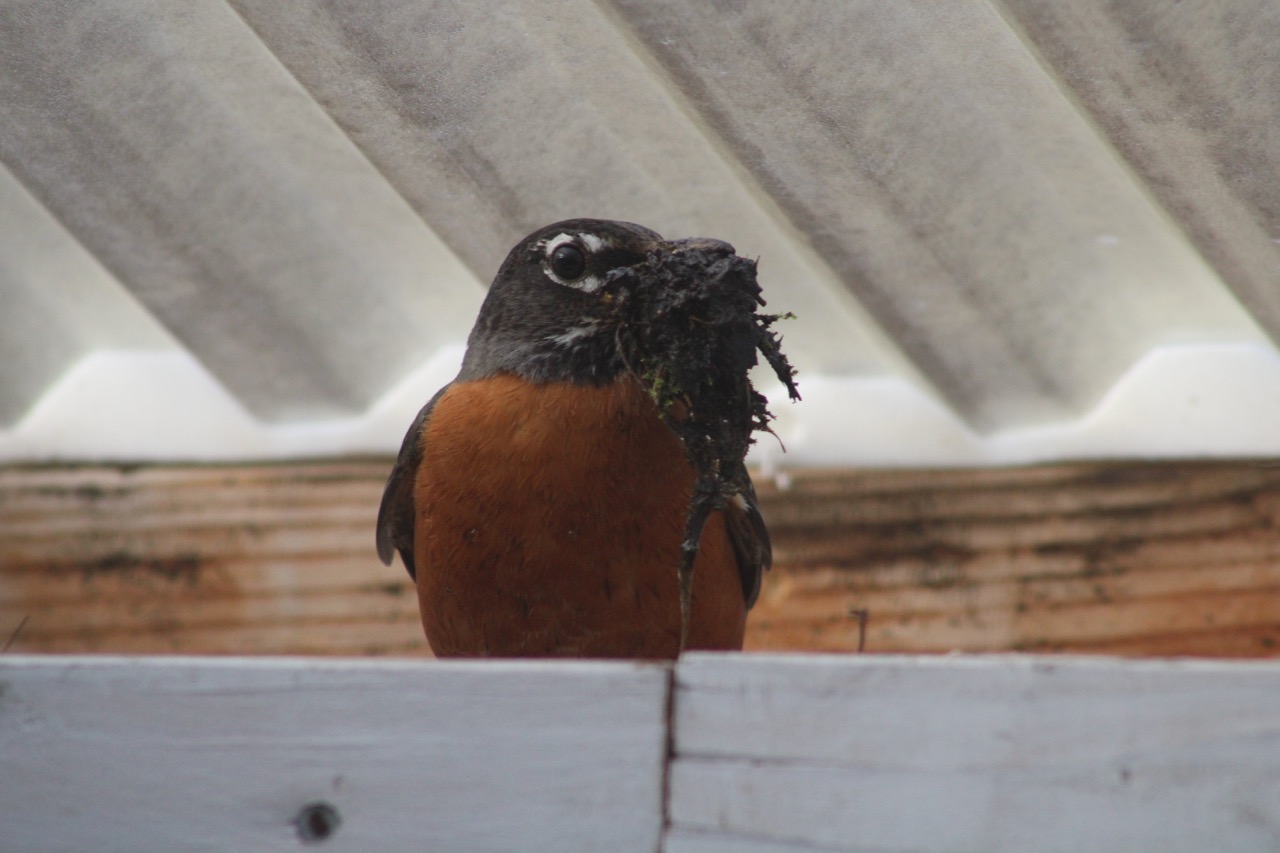
Photo: Robin with moss in beak, sitting on beam under our deck roof.
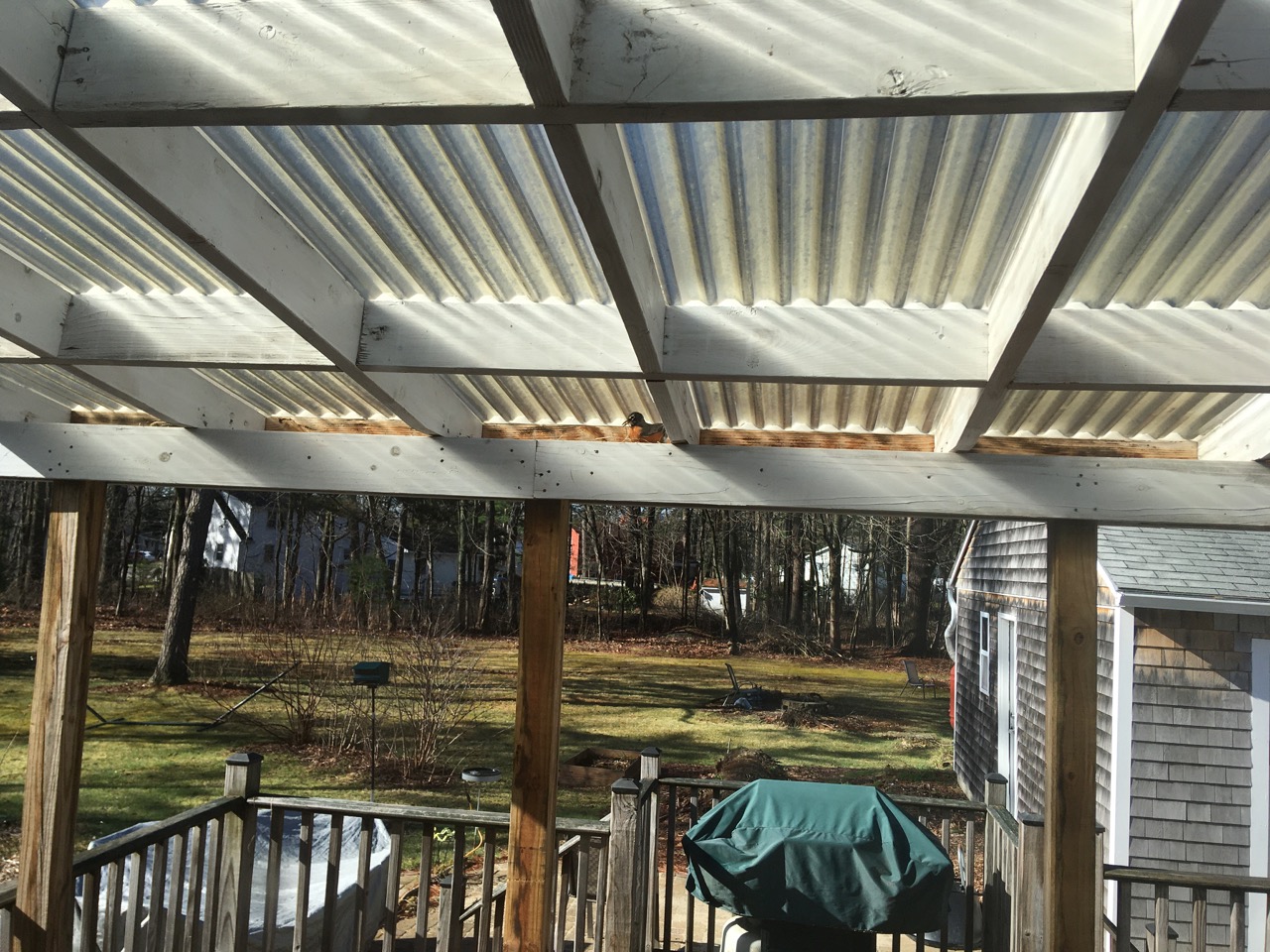
A robin is building a nest in the beam under our deck roof. I thought she would stop yesterday, after I went out and in a few times–it is our entryway. But she is back today. It seems to be a great place for a nest. The way the beams are fastened, the center board creates a lowered groove between two higher boards, so a nest could rest in that groove and be quite secure. It is protected from rain. She can enter and exit from either side of the beam. I do wonder how warm it might get under the clear plastic roofing, nice for now, but later it could get hot.
One weird thing is that she seems to be working on more than one nest, bringing dried grass and moss to three different sections along the beam. She started in the segment on the left, and this morning I’ve seen her in three different sections adding dried material. Still, her focus is on the section on the left.
Larger view, robin adding nest materials in different sections.
I feel so grateful for the animal neighbors. I love to watch the robin fly back and forth, carrying so much material in her beak. I hope we can be neighbors during the time she raises a little brood. But however it turns out, it is a delight today.
I have started to take short walks in the neighborhood–just 10-15 minutes each morning. It feels good to be moving again and hopefully building my strength. I especially get energy from the birds singing so exuberantly. There are cardinals all over the neighborhood.
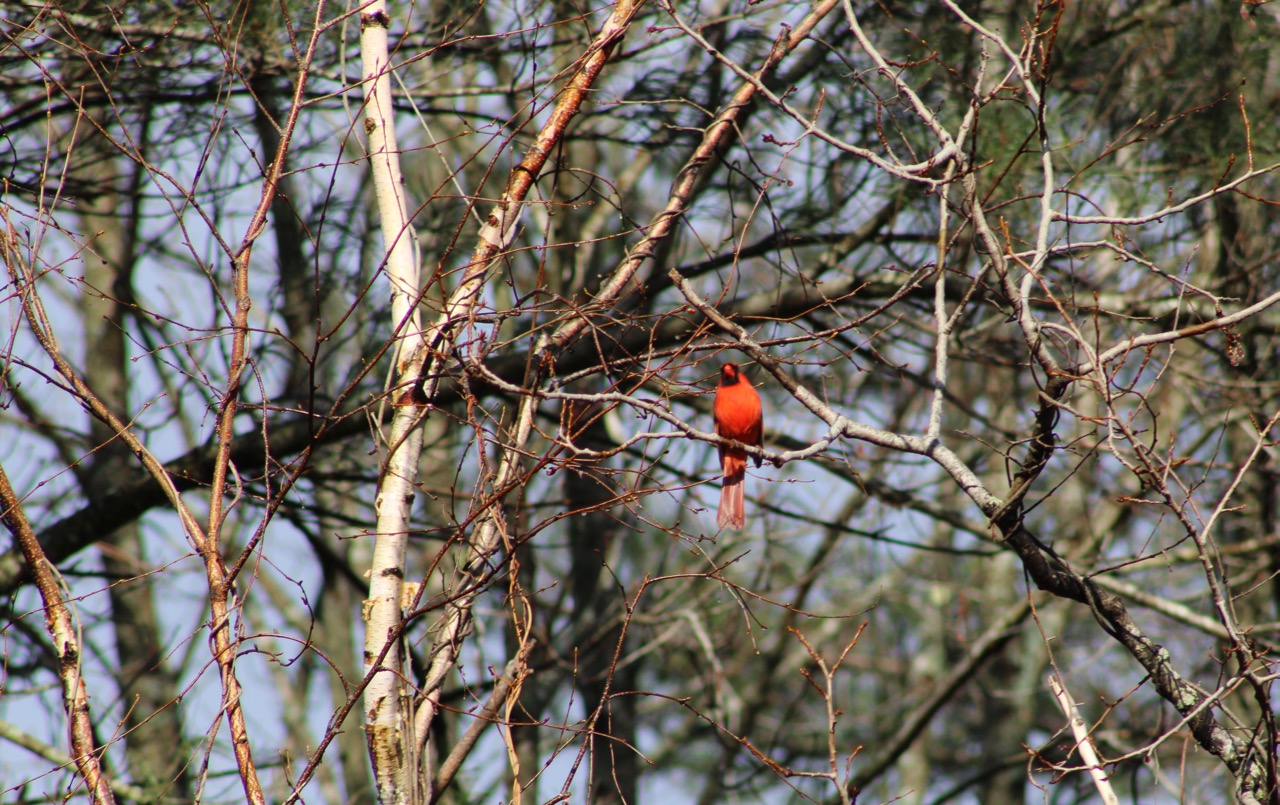
This morning, from our backyard I saw several cardinals chasing each other through some tangled branches. They especially like the plot of undeveloped land next to the back of our yard, that we call the “fairy field.” Sadly, it is filled with invasive bittersweet and multi-flora rose that Margy is trying to curb, but it does make for lots of brush up to higher branches, and the cardinals seem happy there. Perhaps they are young males trying to establish their own territory.
Or perhaps they, too, are merely feeling the exuberance of warmer air and brighter days, and can’t keep from singing.
More beauty: some of the pond plants are starting to green up. Especially the blue flag iris. No frogs yet, but I go back and check each day just to see when they might arrive. Only a few of the stones were dislodged during the ice of winter. When it rained the last couple days, there was flooding all along the back yard area beyond the pond, and an overflowing “drain.” But it didn’t seem to be a problem. I hope all of the plants from last year will come back. I am also hoping to add some Marsh Marigold when it comes in to our local nursery. This will be our first spring with the pond, and so it is all an adventure, a slow, curious, waiting kind of adventure.
Blue flag iris beginning to grow at the edge of the pond.
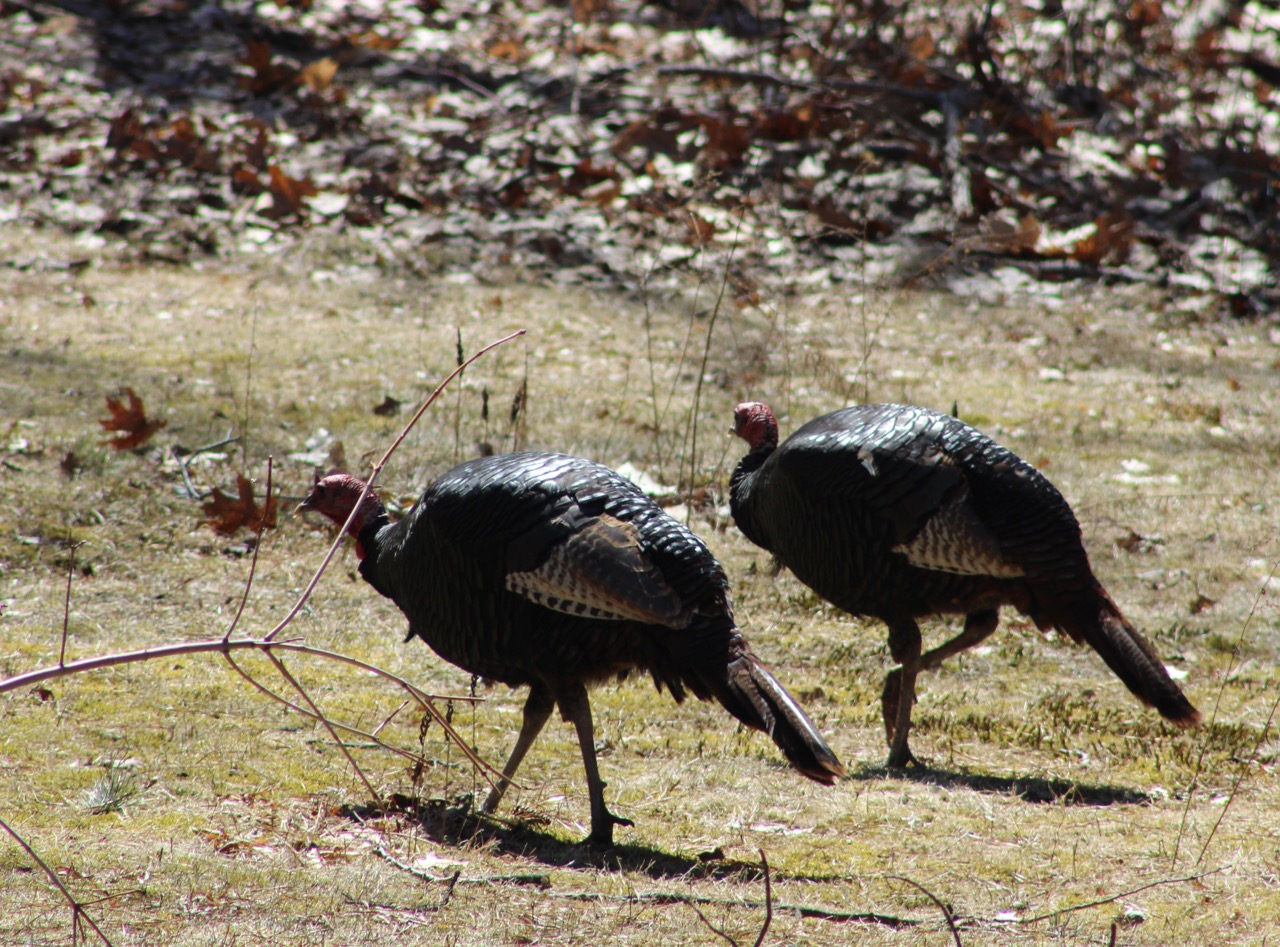
I am writing this outside on the back porch, listening to cardinal songs from the trees at the edges of our yard both right and left. It’s cooler today than yesterday, partly cloudy, but spring feels like it’s waking everything up, including me. I was delighted yesterday to look out the back windows and see a whole family of turkeys wander through the back of our yard. Seven of them! We haven’t seen any turkeys here for a few years. Wild visitors make me smile. I came outside and started tending the now thawed pond: I skimmed off leaves and trimmed off dead stems and leaves from the pond plants. The blue flag irises have new green shoots emerging, and the fern is also starting to show green shoots.
My energy was depleted after finishing only a part of the work, but then was rejuvenated by drinking licorice root tea with ice and a cut lemon at lunch. It truly is a miraculous plant for me. I didn’t drink it during the winter–maybe I should have. I have been growing a licorice plant for about five years now, so if all goes well, it should be ready soon to let me harvest some of the roots. The small bush dies back in winter, but regrows in spring, and sends out runner roots to create new plants nearby. So, rejuvenated by the licorice, I came back outside and set up our hammock (after rearranging some things in the garage so I could reach it–every project is really a few projects, it seems.)
This season, the hammock is most important to me of all the tools in the yard. I have been feeling so overwhelmed by the garden this past year–the problems were starting to outway the pleasures. I mean, the squirrels took all the green peaches, the oregano was out of control spreading all over, and the hugel mound is full of weeds and small critters, I think, and won’t really work except for zucchini and cucumbers, because the water just runs off the sides. I am tired of the feeling of working so hard to get food, and like I am fighting in a battle. I have been searching for a way to be at peace here, as we were when we started. Our hope was to find relationship with this land, and to be a healing presence for the land. To learn from the land.
So I brought myself to the hammock, to rest, to listen, to see the tree tops, and to be open. I was noticing the green moss beneath the hammock, and everwhere in the back half of our yard, and wondered, “Why does it like to grow here? Is it a good thing?” (I am always asking that when random plants pop up–because we have so many invasives like bittersweet, you never know, friend or foe? And I know so little.) I did some research on my phone. “Methods to get rid of moss in your lawn.” On the other hand: “Methods to grow a lawn made entirely of moss.” People have lots of opinions about moss. But our yard likes it. It likes to grow in compacted soil, shady, moist, it doesn’t need nutrients from the soil. It is at home in acidic places, like a pine forest. We have our lovely pine trees here, that is probably our basic ecology. It seemed to me that lying in the hammock, I was able to let go of doing, and enter into the mindset of learning from this place. It was good. Here I am humbled and grateful.
So even though it was cooler today, I found myself outside again, tending to the pond, pulling out dead tree leaves, cutting old plant leaves to make room for new. Going slow. Noticing two robins in the orchard right now. The wild pansies that were blooming in December are blooming again, and dandelion greens are showing. Chives are emerging under the fruit trees. I am trying to remember to balance the tending with the being tended.
Hammock under the pitch pine tree, moss on the ground.
I recently read Sarah Ramey’s memoir, The Lady’s Handbook for Her Mysterious Illness. Published just last year, it is described this way:
“In her harrowing, darkly funny, and unforgettable memoir, Sarah Ramey recounts the decade-long saga of how a seemingly minor illness in her senior year of college turned into a prolonged and elusive condition that destroyed her health but that doctors couldn’t diagnose or treat. Worse, as they failed to cure her, they hinted that her devastating symptoms were psychological. …Ramey’s pursuit of a diagnosis and cure for her own mysterious illness becomes a page-turning medical mystery that reveals a new understanding of today’s chronic illnesses as ecological in nature, driven by modern changes to the basic foundations of health, from the quality of our sleep, diet, and social connections to the state of our microbiomes.”
Book Jacket Cover
I haven’t experienced the horrifying stories she recounts with medical personnel, but I know others who have. I think it helped that I was usually drawn to alternative practitioners, though Sarah had her own horror stories with alternative practitioners. She finally found help with practitioners of Functional Medicine, and my own primary care nurse practitioner is aligned with that field. For that I am grateful.
I identified with the mysterious nature of auto-immune chronic conditions–when I reflected on it, I realized that they have been a part of my life for many years–most recently, Hashimoto’s thyroid disease, SIBO, adrenal fatigue, and borderline diabetes, but earlier in my life there was endometriosis, polycystic ovary syndrome, and gradually developing multiple chemical sensitivities, and multiple food sensitivities. For most of my life, I managed to work and keep my balance, but it became more and more difficult. Finally, when I turned 65, and could access Social Security and Medicare, I retired from my work as a full-time minister.
I wondered at the time if being released from the stress of full-time work might bring me relief from the illnesses, but that was not to be the case. Instead, I was better able to manage living with the illnesses. But it is a delicate balance. If I eat well (for me that means no refined sugar, no gluten, low carb, lots of vegetables, and meat, while avoiding the list of specific foods that give me problems), if I rest when I am weary (which is spending some variable part of every day lying on the couch), if I take certain natural supplements (for example, I take Berberine, which has been shown to be as effective as Metformin for helping blood sugar balance), and if I don’t overdo it anywhere, well then, I have some energy to do things I love, to write, to garden a bit, to learn new things, even the miracle of building our little pond last year.
Sometimes, I can forget that I have these illnesses. Some days I wake in the morning rested and glad to greet a new day. I might have several hours to work on projects. I tend to get more weary and achy as the day goes by. And during these two years so far of COVID, I have been glad for the many opportunities that the world on Zoom provided. But then, something happens that upsets the balance, and I am sunk into a lower level of functioning, just barely able to cook my meals and take care of the basics. Most recently, I think that my body might have reacted badly to my second Shingrix vaccine. The last four weeks have been mostly couch weeks: reading books and watching British mysteries on Roku. I hope that I am emerging from that now. It is not easy to know what upsets the balance–all I can do is respond to it.
Because I am always asking questions about meaning, I appreciated the connection that Sarah Ramey made between our chronically ill bodies, and the larger ecology of the earth. I think about that too. I wonder if my own body is mirroring the afflictions of the earth I love, is somehow sensitive to the larger web–global warming, the prevalence of forever poisons, the loss of communal connections, the ecological balance which human beings have undermined. If that is the case, can I love my body as I love the earth? Can I grant her that self-care that has been neglected for too long?
One aspect that Sarah Ramey sees as critical is our need for human connection. I was reflecting on how for much of my life I made connection through activism, through shared work. I still feel the impulse to act for justice, in small ways, but there are less opportunities now for the connection that used to be a part of it. I have also felt more isolated since retiring, and, of course, since COVID. Maybe I need to learn something new–to nurture connection that is not at all about work or social justice, but about something more elementary. Can I be cherished, not for what I do, but for my being? Can I cherish others in this way? Can I also cherish myself in just this way? Perhaps it will require a kind of spring melting of some other kind of hidden ice. May it be so.
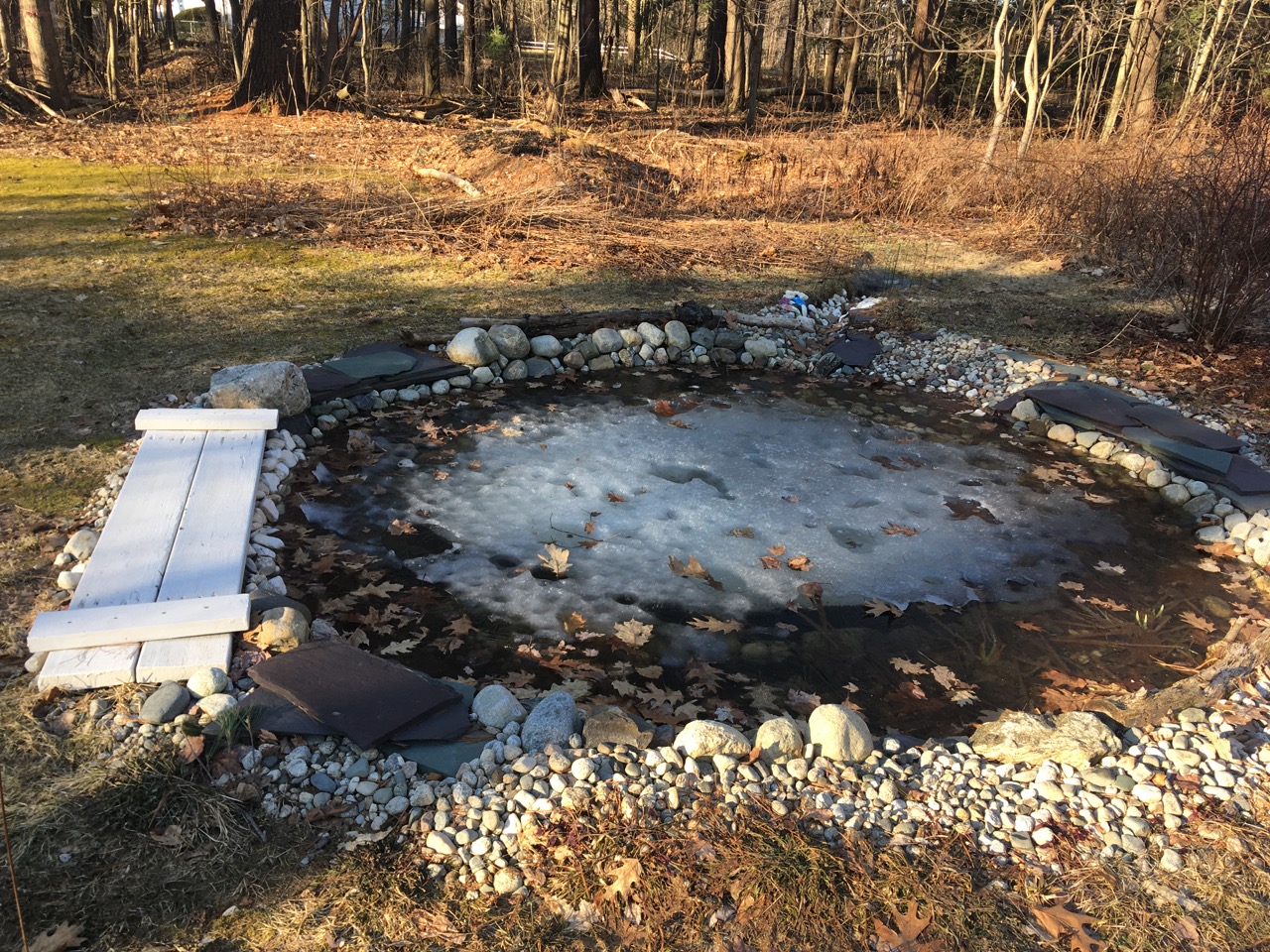
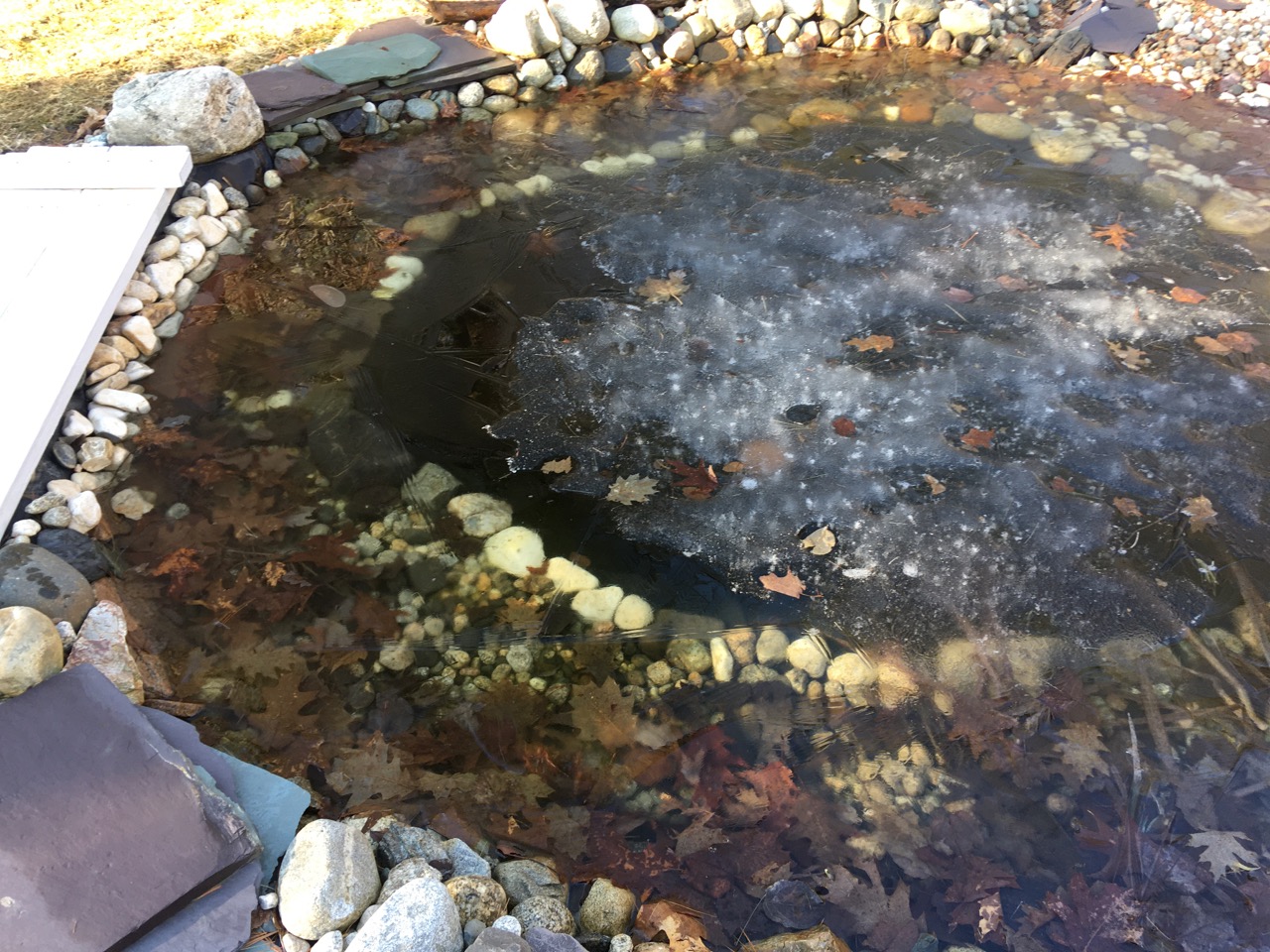
Hard to see, but there is a thin clear layer of ice on the surface of the pond this morning, but more of the winter ice is melting each day. March 26, 2022
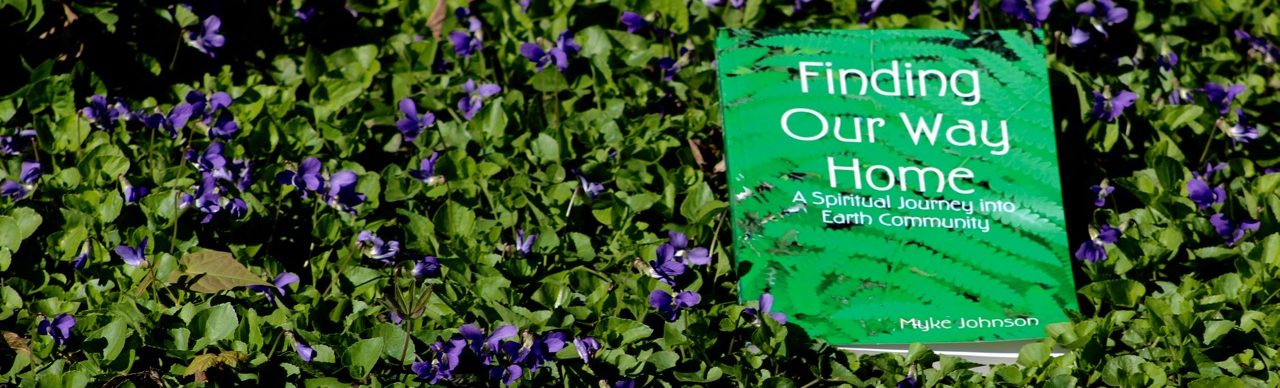
On March 14th, at 1 p.m. Queer Spirit will broadcast an interview with me, done by Revs. Marvin Ellison and Tamara Torres McGovern. Queer Spirit is a regular feature of OUT Cast, a forum for LGBTQ+ issues broadcast on community radio every Monday. WMPG 90.9 FM from 1:00 – 1:30 p.m. (Livestream: WMPG.org) One of the questions they asked: “What do you think has been your generation’s unique struggle with sexuality and spiritualty – and what would you say is your generation’s contribution to these matters?” I thought about what I had written in my book, Finding Our Way Home, in a chapter called “The Mystery Seed.” I want to share an excerpt with you today.
Bean seeds
Do you remember the fairy tale of Jack and the Beanstalk? When he and his mother are in desperate straits, Jack trades their cow for some magical bean seeds. The bean seeds grow overnight into a vine that reaches up to the sky. He climbs the vine and encounters an evil giant, who eats human beings, but Jack is able to escape with a magical hen that lays golden eggs, and a golden harp that plays by itself. He learns from a fairy that the giant’s castle is actually his very own—he is really a prince whose father was killed by the giant. In the end, he kills the giant, and recovers his hidden inheritance.
So what does this have to do with us? The bean seeds enable Jack to connect with who he truly is, and with a larger reality beyond the small cabin he shares with his mother. Within each one of us is something like those magical bean seeds. We are so much more than we can imagine. We might say inside each of us is a Mystery seed, a seed of what we might become. This Mystery seed is our potential to connect with the larger Mystery of which we are a part; it is the Divine within us that connects to the Divine beyond us, it is the fractal pattern of life and love and creativity. This seed is not only in some of us, not only in fairy tales or kings or saints, but in every one of us.
What evidence do I have for this seed of divinity within each human being? How have I personally experienced this might be so? Ironically, it has been illuminated when I faced situations where people were treated as if they had no dignity or value at all. But something within and between people transpired to bring forth a light that could not be extinguished.
When I went to college, one of my best friends slowly revealed to a few of us that he was homosexual. This was a great torment for him and for all of us who loved him, because we were very devoted Catholics. According to Catholic teaching, homosexuality was against the laws of nature. Tom would try hard to live celibately, and then crash, and go out and “get debauched.” He was depressed and often despaired of his life. I felt a painful contradiction in all of this—I knew he was a deeply spiritual person, so why should he suffer in this way? But I didn’t have an answer at that time.
Before I met Tom, in the reality of my youth, it was as if gay people did not exist. When I was growing up, during the 1950s and 60s, I never even heard the word lesbian, and gay only meant happy. I never saw gay people on TV, read about them in a book or newspaper, or learned about them in school. As a girl in a Catholic family there were two possibilities for my life path: I could become a wife and mother, or I could become a nun. I never even imagined the possibility of lesbian.
Tom’s dilemma introduced to me a whole category of people who were considered unworthy of sacredness. Gay people were not supposed to exist. And if they did exist, they were identified as unnatural, disordered, a mistake, a problem. African American lesbian poet Audre Lorde writes, “We were never meant to survive.”[i]
At that time it never even occurred to me I might have something in common with that group of people. I didn’t come out as a lesbian until years later, at the age of thirty-one, after a five-year process of struggle and transformation… Gays and lesbians have often been excluded or disparaged even by those who are closest to us. After I came out, one of my sisters refused to let me stay in her home because she didn’t want her children to know about gay people. I received a letter from another sister. She wrote, “I pray for you night after night… Homosexuality is wrong! And as your sister I don’t want to lose you to the devil.” Her words were those many of us have heard from parents or siblings, or from the institutions of our society.
How much guilt, despair, and shame have gay people carried in our hearts because we were not welcome in the reality defined by our culture and religion? Because we could not see the sacredness within? How many gay people have killed themselves in the pain of that reality? How many gay people have been killed, through the violence and hate of a society that has refused to include us in their definition of reality?
But so much has changed. Now it is hard to imagine I didn’t know about the existence of lesbians or gay men. Now gay people are in prime-time television. There are supportive high school groups for Gay, Lesbian, Bisexual, Transgender, Questioning, and Straight youth. My friend Tom eventually was able to embrace his sexuality, and share his life with a long-time partner. In 2004, Massachusetts became the first state in the U.S. to allow same sex couples to be legally married, and in the years since, marriage has been won throughout the whole country.
Even language became transformed. Words like lesbian, or queer—once painful putdowns—were reclaimed as words of honor. I remember we young activists marching and shouting, “We’re here, we’re queer, get used to it.”
So much has changed. For me, it seems like a miracle—in fact, two miracles. First, I still can be amazed I exist as a lesbian at all. How did I cross over into a whole new reality? It is as fantastical as Jack climbing a bean stalk into a castle in the sky. Second, it is remarkable that we who are queer can celebrate being queer. How did we go from being outcasts, to celebrating and believing in ourselves? How did we go from being outcasts, to demanding that reality make a place for us? To celebrate ourselves as queer we often have had to risk every other valuable thing in our lives. We’ve risked family, friends, jobs, safety. Yet this thing which was considered a problem became the “pearl of great price,”[ii] as the gospel says. This heavy burden became the hen that laid golden eggs. And it has been incredible to see!
What happens within people that they can claim the power to celebrate themselves? …What happens inside people when they refuse the rejection of society, and claim the right to name themselves valuable. When people who have been told all their lives “You are no good,” find within themselves a different voice that says, “You are sacred.” To me, this is powerful evidence of the divinity within us. And this is the premise of the work of those of us who call ourselves Liberation Theologians: the Divine is revealed in the struggle of oppressed people for liberation.[iii] It is the Mystery seed within us growing like a vine into the sky.
…That is what happened for me, too. Within a community of women, I experienced a new reality coming into being. With women who were celebrating lesbian existence, I encountered the Divine in a new way. Sometimes we called it the Goddess. Sometimes we had no name to describe it. But we felt a sacred and holy power when we seized the courage to embrace the body of another woman. Everything shifted. It no longer mattered whether we were welcome at the table of the society that excluded us. We were in a new reality and could no longer be denied.
Me and Rev. Marvin Ellison, back in 2009, as co-leaders of the Religious Coalition for the Freedom to Marry, getting ready for the public hearing.
[i] Audre Lorde, “A Litany for Survival,” The Black Unicorn: Poems (New York: W. W. Norton, 1978), 31.
[iii] Liberation Theology was first articulated in 1971 by the Catholic Peruvian priest Gustavo Gutierrez, in his book, A Theology of Liberation: History, Politics, Salvation (1971 in Spanish, English edition Maryknoll, NY: Orbis Books, 1973).
What a beautiful dawn the other day, all the branches coated with light snowy adornment! I’ve been feeling grateful these days. In particular, I’ve been thinking about how lucky I have been to study the Passamaquoddy language with Roger Paul during the last 3 1/2 years. I recently saw an article published a few years ago, by Taté Walker, “3 Questions to Ask Yourself Before Learning an Indigenous Language as a Non-Native.” It got me reflecting about the questions, some of which I had already considered when I began. #1 Why am I learning this language? #2 How will I center tribal perspectives as I learn this language? #3 How will I handle criticism from Indigenous people? Today, I also have a fourth question which I will explore.
I looked back to my earlier posts to remember my thoughts about why I was learning this language. I had asked permission from the teacher, and also from my Wabanaki friend who was going to take the class, and both had been very welcoming. Roger has talked about how his elders had decided it was time to share the language with others beyond the community. On a very practical level, it was hoped that by increasing the number of registrations, the class was more likely to be offered at USM, so more available to Wabanaki students who wanted to learn.
On a deeper level, I wrote that it was a way to begin to decolonize my mind, “I want to think differently”–Nkoti piluwitahas. I also had the thought that, ideally, any of us who came to live in Wabanaki territory should learn the original language of this land, as respectful visitors. Also, years ago, an Indigenous woman had said, “If you really want to understand our spirituality, you must learn our language.” It stayed in my mind though I can’t remember now who it was who said it. (This was during the time I was working on the issue of cultural appropriation by white people of Indigenous spiritualities.)
Today, thinking about it again, I know I had the privilege of retiring from work right at the time the class began, and there was a program for seniors to enroll in university classes for free. Everything came together so easily. My heart led me into it and the door opened. I think perhaps, too, though I didn’t realize it at the time, it was a way to connect to my own Innu ancestors.
During the process of taking these classes, I have learned so much about the perspectives and history of Wabanaki people. I have learned how few people are now fluent in the language, because of forced assimilation, and because of the terror of the boarding schools and day schools, where children were punished for speaking their language. I have learned that for me to learn the language is a privilege that many Wabanaki people do not have, if only because they are busy trying to survive in the English-speaking world. I understand that if I were to speak the language in most contexts, it might be a painful trigger for Native people who carry so much trauma about the loss of their language. So mostly, I haven’t tried to speak it except in our class contexts. And though I am beginning to understand more than I could have imagined, I am humbled too by how difficult it is for me to speak any of it, except for carefully constructed dialogues. I am truly still a beginner.
But the question closest to my heart these days is this: Since I have been granted this gift of learning the Passamaquoddy language, how can I give back? From this course, I’ve learned gratitude and the importance of reciprocity: so what is my responsibility now, as the recipient of such a gift of knowledge? Bearing in mind that I’m not training to be a professional teacher, and I have so little energy anyway because of chronic illness. I have done some activities in solidarity to Wabanaki concerns–but these are not related to language. I don’t have an answer right now. But I am holding this question closely. How can I give back? What is my responsibility in light of the gift of this knowledge? It may be that by holding the question, an answer will be revealed.
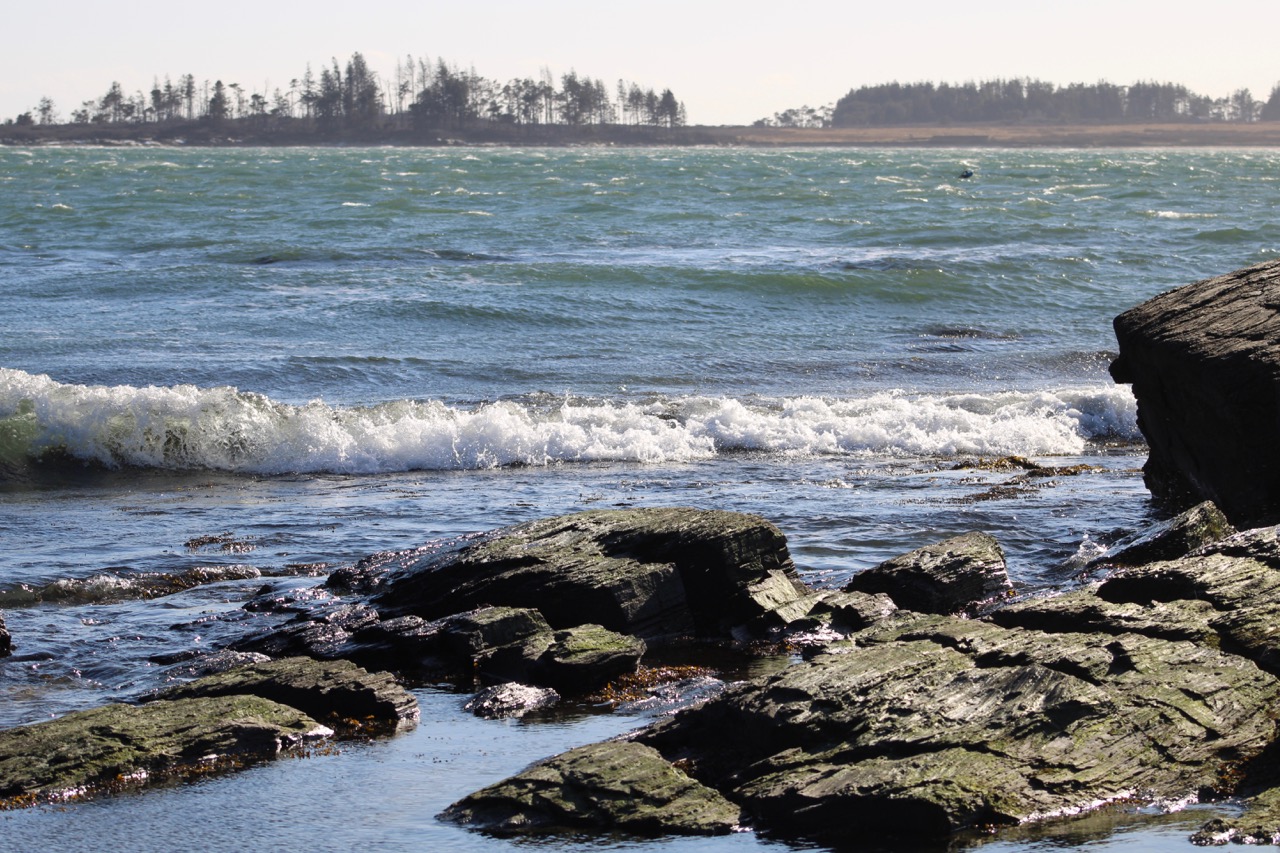
Photo: Kettle Cove: blue-green sea, white breaking waves, rocks near me, island trees at the back
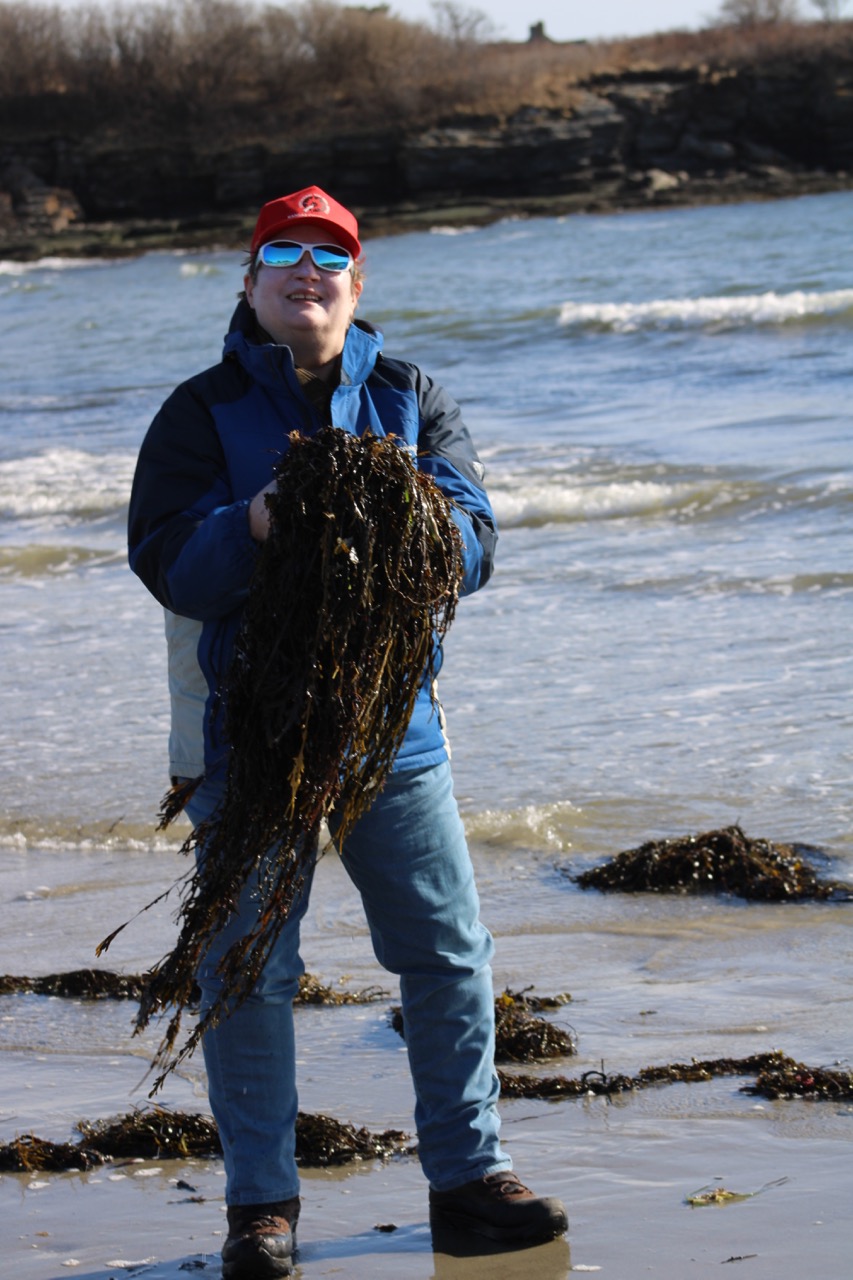
February in Maine, and it is 60 degree weather today. It isn’t really supposed to be like this. We went to Kettle Cove, where dozens of people were out at the beach. A few even went into the water in their swim suits–but not us. Margy was inspired to collect some seaweed for the garden. I decided to sit on a lovely rock, and take photos of the waves and rocks.
Margy holding seaweed at the beach.
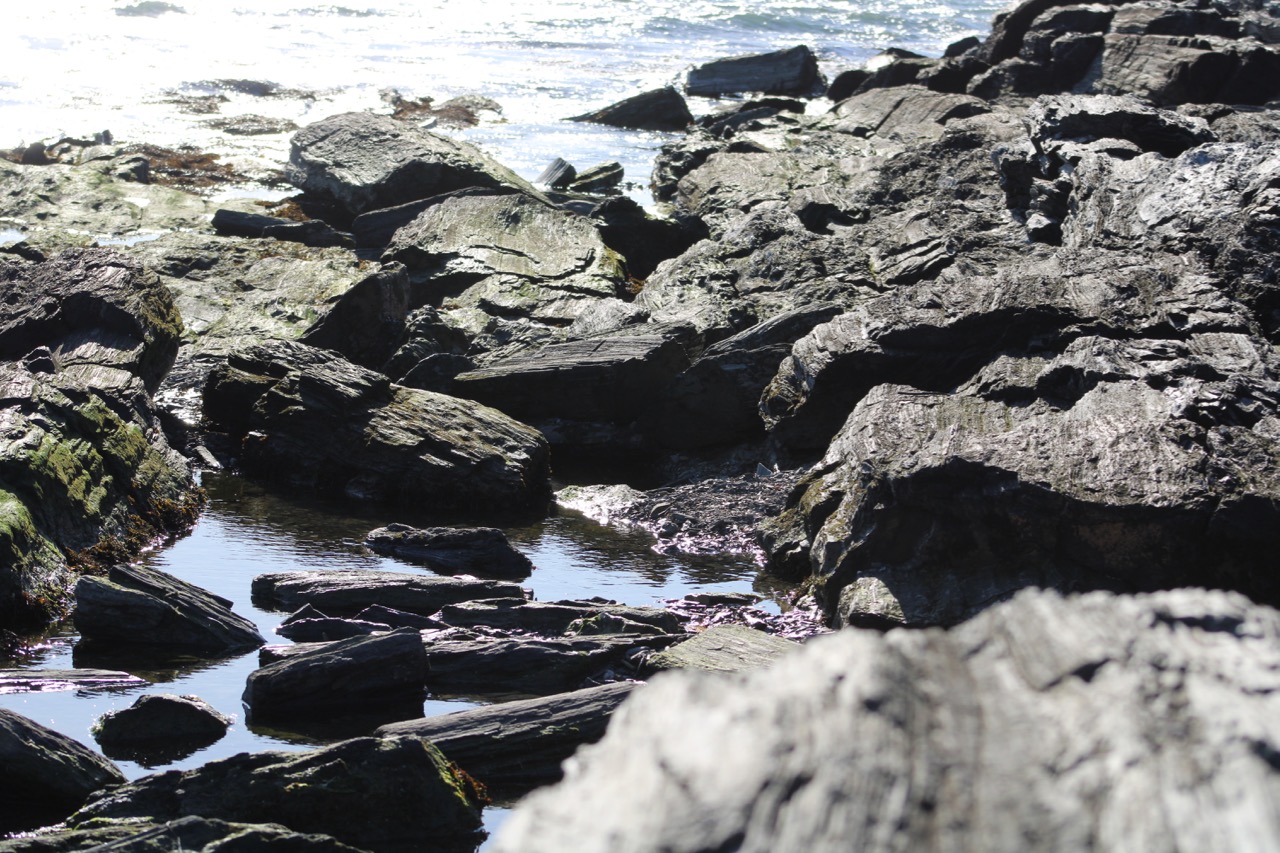
Rocks to sit on, with tide pool.
It was so restorative–wind, sun, rocks, water–all the elements. And the sound of the waves calming the spirit like a deeper kind of silence.
I was thinking about climate change and how the weather has become so chaotic. Tomorrow we’re back in the freezing zone, between the teens and twenties, and Friday a snowstorm is on the way. But the message I felt from the sea was not about worry. It was to love the earth just as she is in this moment, to love the weather as it comes–not to always think on how it is supposed to be different, but to embrace the changes as they emerge, to embrace every amazing aspect of this beautiful planet.
I don’t fully understand this message, the activist that I am. So often I grieve for what is happening to the earth because of the greed and destruction of some human beings, all of us trapped in this pattern. And I still grieve. But the other side of that grief is this love.
The message was that we must never cease to love the earth in all of her mysterious flowerings, her beauty everywhere, even when we cannot perceive it. So what a joy when we can feel that beauty all around us. It was that kind of day, that kind of visit to the ocean.
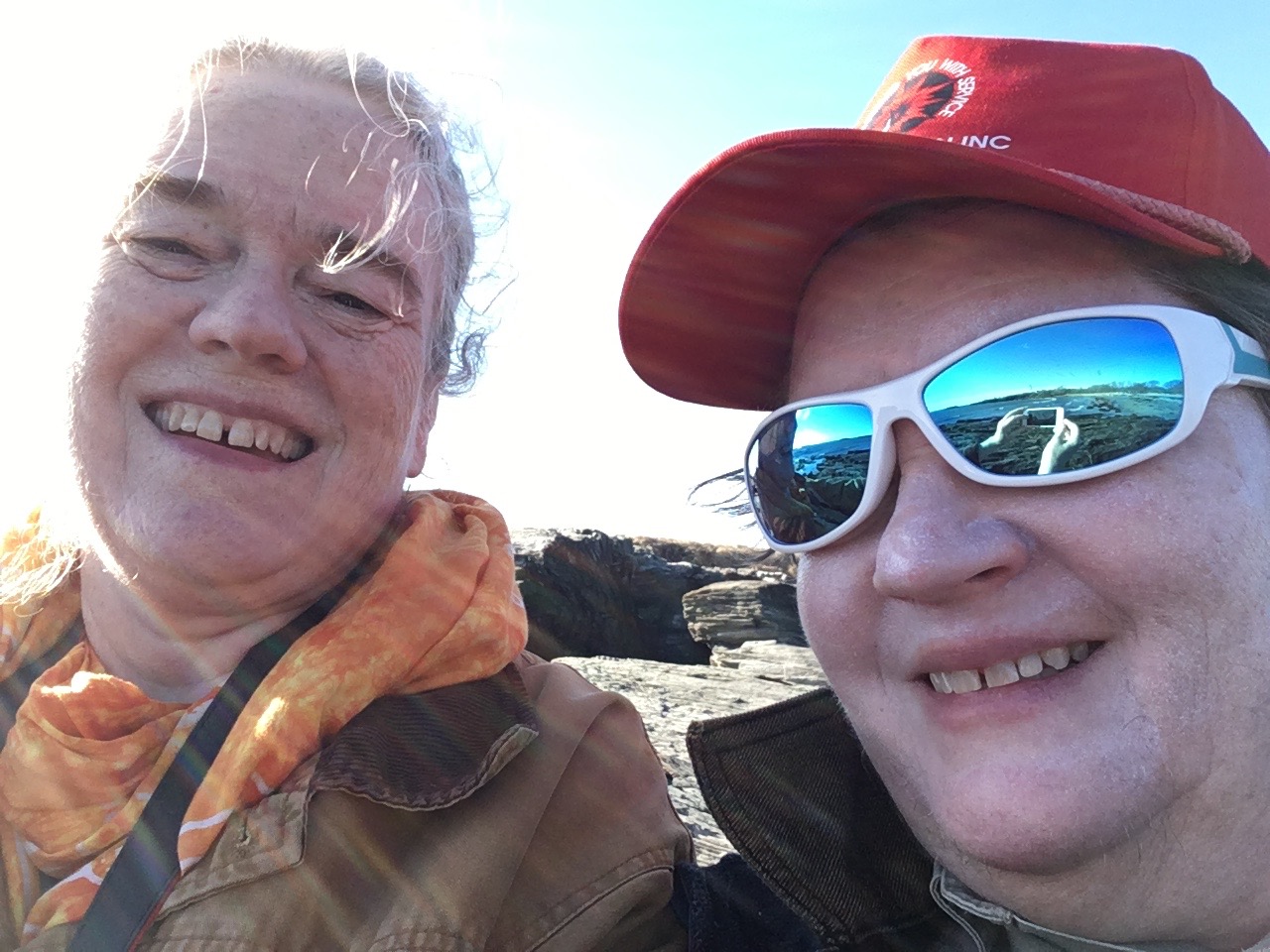
Myke & Margy smiling, with rocks behind us, and the ocean reflected in Margy’s sunglasses.
Tonight I feel grateful to participate in the virtual opening ceremony for the Healing Turtle Island gathering. Songs, prayers in Indigenous languages, stories of grief, woundedness, devastating loss, and yet, gratitude. How do we bring healing, bring back balance in our relationships, with each other, with the earth, with spirit? This weekend will be filled with many speakers… (anyone can join on Facebook, or on Zoom, just follow the link). I don’t have a lot of words right now but one of the strange blessings of the pandemic is that because this gathering is virtual, I am able to participate. I was present for the very first gathering here in Wabanaki land, the eastern door. There will be 21 gatherings all together.
This photo is of two deer whom we sighted in our backyard on Tuesday–there were four all together. They were a gift in the midst of a painful week. I found myself just sitting on the back porch watching as they took their time amidst the trees and brush. Sitting still and watching. I feel the presence of such a compassionate Spirit through these visitors from the natural world.
Going through my boxes of old files in the basement, I am now working on files related to activism in solidarity with Indigenous people in Boston back in the 1990s. I found some correspondence with one particular activist, for example, and I am remembering the long process of getting to know each other, building trust, and finding ways to be helpful in that struggle. But when my ministry calling required that I move to another place (Cape Cod, at first, and then Maine), it meant that all of that relationship-building was lost, in a way, and I had to start all over again in a new place to build trust, to make connections, to find ways to be of use.
When white people are moved to act in solidarity with Indigenous people, it requires a lot of work to create relationships of trust. There is such a long history of colonization, of oppression, of theft, of genocide, between us–and a long history of “helpful” people doing damage. And yet, the more I became aware of that broken history, the more I have felt moved to participate in such solidarity. Not without mistakes. But I have continued in these other places seeking to build relationships of trust with other Indigenous people, doing the long work of decolonization.
I am not one who usually has spirit-filled dreams at night. Usually, in my dreams I am at a conference or gathering somewhere, along with a whole crowd of people, only some of whom I am acquainted with. I am trying to find my way around, or find food, or find my way back to where I was before–such mundane anxieties. Sometimes I meet old friends there. Often, I feel lost and overwhelmed by all the people I don’t know in places I don’t know.
I started feeling like that as I was going through these and other files from Boston. So many people with whom I have done work, shared conversations, struggled for justice, had significant experiences, lived in a household together, loved, hurt or been hurt by, and yet, I had forgotten so much of it. If I were not looking through these files, I wouldn’t remember much of what is in them. It all slips away with the effort and energy of building a life in a new place. Only a few relationships carried into long distance realities.
Sometimes I fantasize about not having moved everywhere, living somewhere and staying there my whole life. But I realize it is only a fantasy. This came clear to me a while back when I watched the movie Kuessipan, about two girls who grow up as best friends in an Innu community. In the description, “their friendship is shaken when Mikuan …starts dreaming of leaving the reserve that’s now too small for her dreams.” In reflecting on that movie, I realized, I would have been the one who left. In fact, I did leave a small town to go off to college, and I kept traveling to “bigger dreams.” I guess that journey is also in my blood. My grandmother left Canada to come with a foreigner to America when she was 17. Perhaps she too was seeking a bigger life, bigger dreams.
And now, here I am, sitting alone in the basement, going through memories, looking back on the many people I met over so many years. Sometimes I feel so tired. Sometimes I feel lonely in the midst of the crowded gatherings in my dreams. Sometimes it is a relief just sitting alone with the boxes, trying to make sense of the puzzle pieces of my life. It is a humbling journey. May Spirit help me to remain curious and grateful.
I wasn’t able to capture most of them with my camera, but I want to speak of bird visitors nonetheless. This morning little winter goldfinches, with their olive feathers, were flocking to our bird feeder, and to the water, and to the dead heads of bee balm never cut down, and likely full of lovely little seed breakfasts. The seeds, and the water kept liquid by electric warming, are our offerings to the creatures with whom we share this land.
I think of February 1-2nd–Imbolc, Brigid’s Day, Candlemas, Groundhog Day–as the day the birds start singing again. The light returning. Still, even though something is stirring anew, this year there were many birds and other creatures who frequented our little offerings of seed and water during the dark of winter as well. There were a couple days mid-January when flocks of robins appeared. I only managed to photograph this one getting a drink of water, but there were likely a dozen. They love our neighbor’s crabapple tree. The birds also love to perch in our fruit trees branches nearby.
Photo: dark day, robin drinking water
The cardinals have stayed throughout the winter, and I often see the female cardinal at the feeder. The other day she and other smaller birds were jockeying for position—if three were on the roost, the seed door would close—so they chased each other off long enough to get a snack. Of course, the squirrels always have to take their turns–they’ve mastered the acrobatic positions needed to keep the door open. So smart.
Storms seem to increase the number of creatures who seek out our offerings. During our last blizzard, as dusk enveloped our yard, Margy called me to the back door, where we saw two deer walking so quietly near the bushes. The next morning, I saw their tracks leading to the seeds and water. I have heard it said that one of the rituals of Brigid’s day is to give food offerings to the spirits of the land. I hope our seeds and water might be a blessing to all the creatures who visit or call this place their home.







 Finding Our Way Home