Moon, Sun

Full Moon in the west

I wake early this morning and see the shadows of the two cats, sitting upright together on a small table, gazing out through the semi-sheer curtain to the bright full moon.  The moon is called nipawset kisuhs in Passamaquoddy, the one who walks in the night. The sun is espotewset kisuhs, the one who walks in the day.  The moon and the sun are both considered animate, living beings.  That is how it has always seemed to me as well.

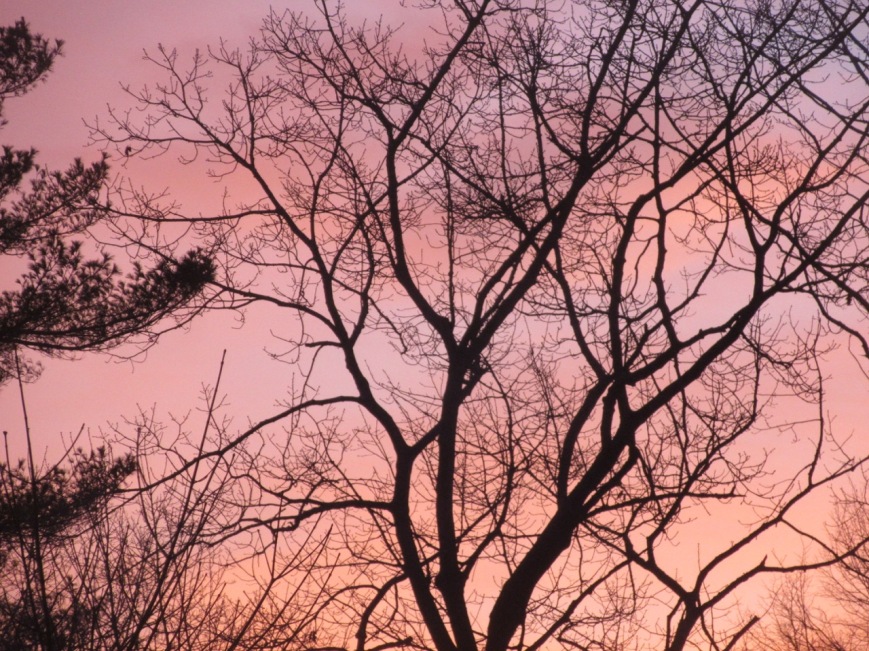
And so I am lying quietly awake, lifted by this beautiful light, this moment of magic, as the moon begins her descent into the west, into the branches of trees. We earth beings, cat and human, love the moon.

These days have felt fraught with fears for me, new coronavirus fears adding to the larger fears of ecological destruction, the resurgence of white nationalism and fascism, the horrors being wrought by our government on innocent children and parents who seek refuge from even larger fears of their own. So many fears. Now that I am retired, now that I am not so occupied with constant pressure from work, the fears have more room to rise up from their subconscious depths to trouble me directly.

Yet, the moon.  The moon eases the fears with her beauty.

Something about the moon calls into my memory a poem I wrote many years ago, back when I lived in Boston. That poem was about the sun, and also about fear. I think I want to share it here this morning, though it feels vulnerable to do so. These sacred moments. But perhaps it will be a blessing for someone else who is living into fear. The moon and the sun shine for us all.

The Sun spoke to her sometimes,
early, mostly at dawn,
though dawn usually meant
first glimpse she got each
morning, maybe standing
on the front porch to get the paper,
maybe looking through the window
between branches and buildings.
The Sun spoke to her then.

Is that a prayer?
Seems like she didn’t call out
or ask for anything–maybe
just a heart full of certain
needs–but the Sun seemed so eager.
The Sun seemed eager to name the day.

It was through the window
between the tree branches one time,
and three story buildings,
the Sun gave her a name too.
She never talked about the name,
seemed like it would sound silly
repeated like ordinary words
into conversation.

When the Sun spoke her name,
that was different,
so clear and simple
like words of power are:
First Afraid.
As soon as she heard those words
she didn’t feel afraid any more,
even though she could see so clear
how true it was,
how fear was always first in line
when things came up,
her heart clutching at the moments,
not wanting to let go or let come.
First Afraid.

And there was the sky turning
from pink to yellow
and night was turning right into day.
She sees the moments passing,
and all quiet-like inside,
knows that even her fear
can’t stop that turning,
and her hands relax a little,
her eyes watch, curious.

She remembers a child learning words
and colors and numbers,
the names of things.
All the world fitting
into the hands and mouth,
touched and eaten and spoken
–her mouth so full of power
she can’t help laughing–
words multiplying like popcorn,
words sweet like candy,
she wants to say everything.

But then her mother’s voice
tightens like a lid on a jar
–be careful, be careful–
as if naming were sharp like a knife
or heavy to drop and crush,
words so hot they might burn.
As if she just might eat up
the whole world and leave nothing left
at all, And so she stops to measure,
stops and measures.
First Afraid.

The Sun doesn’t slow down or speed up,
moves surely, gently, warmly.
Caresses with indifferent generosity
across the words
of morning or noontime.
The Sun speaks her.
Puts words back in her mouth
and on her fingers.
Sky turning from pink to yellow
and night turning into day
through the window
between the tree branches
and three story buildings.
The Sun puts words back in her mouth
and on her fingers.

Sun in winter

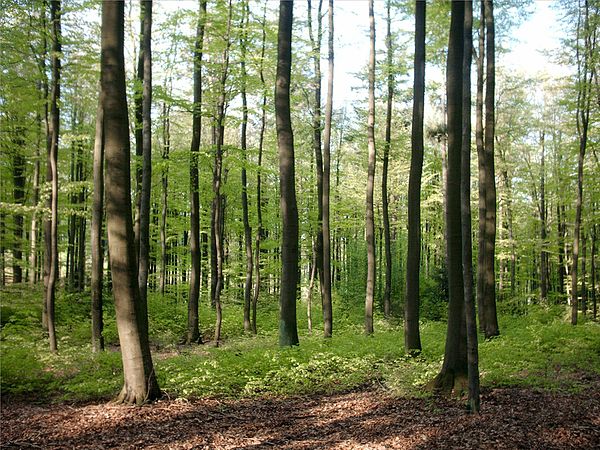
Ancient Beech Forests in Germany

Buchenwald_Frühling

Beech Forest Buchenwald Frühling by Nasenbär (Diskussion) / CC BY-SA 3.0 DE (https://creativecommons.org/licenses/by-sa/3.0/de/deed.en)

I just learned this week that the ancient forests of Germany were beech forests. They were the first trees to grow in the land about 11700 years ago as the ice sheets retreated after the last ice age. If there had been no human beings or human agriculture, the beech forests would have covered the whole of Europe. But human development reduced the forests to a fraction of their former acreage. In 2011 five beech forests in Germany were made UNESCO World Heritage Sites to conserve them. 

I learned this after watching a movie called ‘Call Of The Forest – The Forgotten Wisdom Of Trees,’ a documentary featuring scientist and author Diana Beresford-Kroeger. Along with other people around the world, she interviews Dr. Silke Lanniger and Meinrad Joos, who are involved in German forest preservation. One of them said that Germany is committed to keeping 30% of its land forested. It is a beautiful movie, and I was heartened to learn about the German commitment to its forests.

Mostly, however, I was intrigued because of my own connection to a copper beech tree in Boston, which I have previously written about. The copper beech tree was a primary spiritual anchor for me during the time I lived near to its location in the Forest Hills Cemetery.  I was also intrigued because of my more recent reaching out to my ancient Germanic ancestors.  I realized that they were living in these primordial beech forests, likely during many generations of my relatives. Sometimes the beech trees were considered fairy trees, or a link to all that is magical.

And isn’t it ironic, or magical, that, knowing none of this, I found the beech tree in Boston, or perhaps the beech tree found me?  There are so many synchronicities here. When I wrote about the beech tree, I also wrote about the magic of the runes–that ancient alphabet of the Northern Europeans which has been another link to my Germanic ancestors. Now, when I imagine my ancient Germanic ancestors, I see them in this beautiful forest.

Going back to the film, its message was wider and more universal than merely a link to my own ancestors. In her visits to forests around the world, Beresford-Kroeger speaks so eloquently of the gifts that trees bring to human beings, and also how important they are to the balance of all life on our planet. How important they are to the climate.  Perhaps they might be the most important being for maintaining our life on this earth. My spirituality is a tree spirituality!

Poem for Disappearing

Robin hidden behind berries
It has now been eighteen months since I retired from church leadership, and when I began that new chapter of my life I was not sure what to expect. I was surprised by experiencing an insistent pull toward quietude. I was surprised by how comfortable it felt to be “disappearing,” from a very public role as a minister.
This morning, I stumbled upon this poem by Naomi Shihab Nye.  Perhaps it jumped out at me because I had the privilege yesterday of attending a beautiful ordination ceremony for someone who is entering the start of their ministry.  Perhaps because, at that ceremony, I had a chance to see briefly many people who were in my former church community.  I still feel such tenderness and love for them.
But I don’t have regrets about the decision to retire. As Nye says so well, “It’s not that you don’t love them anymore. You’re trying to remember something too important to forget.” Sometimes I am baffled by this time and by how to decide what to do in it.  This poem speaks to that bafflement.

The Art of Disappearing

When they say Don’t I know you?
say no.

When they invite you to the party
remember what parties are like
before answering.
Someone telling you in a loud voice
they once wrote a poem.
Greasy sausage balls on a paper plate.
Then reply.

If they say We should get together
say why?

It’s not that you don’t love them anymore.
You’re trying to remember something
too important to forget.
Trees. The monastery bell at twilight.
Tell them you have a new project.
It will never be finished.

When someone recognizes you in a grocery store
nod briefly and become a cabbage.
When someone you haven’t seen in ten years
appears at the door,
don’t start singing him all your new songs.
You will never catch up.

Walk around feeling like a leaf.
Know you could tumble any second.
Then decide what to do with your time.

From Words Under the Words: Selected Poems by Naomi Shihab Nye, published by Far Corner Books, 1995.

Water from Brigid’s Well

I was thinking of this visit to Brigid’s wells as we celebrated her feast last night, and blessed ourselves with water collected 4 1/2 years ago.

Myke Johnson's avatarFinding Our Way Home

On our way from the west to the east of Ireland, we stopped in Kildare, the town which was home to St. Brigid, one of the patron saints of Ireland and, according to the stories, an abbess who founded a monastery in 5th and 6th century.  Many stories link her to the older goddess Brigid, goddess of smithcraft, poetry, and healing.  We had read that there were two Brigid’s wells in Kildare–one now designated for the saint, and a pagan well still associated with the goddess.  Apparently, the pagan well wasn’t advertised, but we had read that it could be found near the parking lot of the Japanese Gardens/Irish National Stud.  So we set out to find it.

St. Brigid's Well, Kildare St. Brigid’s Well, Kildare

On the way, close by, we saw a sign for St. Brigid’s well and found that one.  People come to the Brigid’s wells for the healing properties of their waters…

View original post 453 more words

The Ongoing Struggle

I learned another new word in Passamaquoddy:  Mocahantuwok, which means wicked devils. I am not sure if the word is used in a friendly teasing way, or in a serious condemning way. But in a serious way, I have been thinking about using it for certain people in Washington DC who are bent on undermining the processes and hopes of democracy in this country.  You can guess who I mean.

It is not the worst time in our country’s history.  That might have to be the initial conquest of these lands, and the direct genocide of millions of Indigenous people.  (That oppression still continues of course, but perhaps in more indirect ways.)  Another contender for the worst time would be the 250 years of enslavement of captured African peoples. (That oppression also continues, also in more indirect ways.)  I don’t believe there was a golden age of American democracy, that we are now on the verge of losing.

But I do believe there was a dream of America that had something to do with democracy, cooperation, and reciprocity. I think about the poem of Black American, Langston Hughes, written in 1938.

Let America be the dream the dreamers dreamed–
Let it be that great strong land of love
Where never kings connive nor tyrants scheme
That any man be crushed by one above.
(It never was America to me.)

O, let my land be a land where Liberty
Is crowned with no false patriotic wreath,
But opportunity is real, and life is free,
Equality is in the air we breathe.
(There’s never been equality for me,
Nor freedom in this “homeland of the free.”)

…Let America Be America again.
Let it be the dream it used to be.

Let America be the dream the dreamers dreamed! This dream was not only dreamed in America either. In learning more about my ancestors in Europe, I was struck by the ongoing struggles between the forces of domination, empire, and greed and the forces of reciprocity, cooperation, and shared power.  For example, my East Frisian ancestors valued their freedom and resisted domination, resisted being forced into feudalism. Friesland actually means Free Land.

But those relational values were even more striking among my early Innu ancestors on this continent. I remember reading parts of the record that the Jesuits wrote about the Innu during early conquest times. How horrified the Jesuits were that the Innu people would only follow the lead of their leaders if they agreed with them. (Democracy!) How horrified they were that a man might agree to a contract, but if he went home and his wife disagreed, he thought he should be able to get out of that contract. (Power was meant to be shared!)

Those are the same values we are now struggling over, in Washington, and all over this country, once again and still. Will we create a society in which all people are included, in which power is reciprocal and we cooperate for the good of all? Or will some mocahantuwok create a society in which they dominate over others, accumulate as much as they can, and destroy the rest of the people and the world?

It is no easy struggle.  I don’t know how we achieve our goal.  But I know I choose to live by the values of reciprocity, cooperation, and democracy in every way possible, and I choose to align myself with others who share those values. Perhaps each time we do that, in all areas of our lives, we contribute some spark of energy that makes the dream more possible.

Sunrise

Winter dawn

Orphan Mystery

Margareta Graue

Margaretha Graue Henneke Englemann, 1890s

One of the first stories I heard about an ancestor was that of my great-great grandmother, Margareta, on my dad’s side of the family. My grandfather Heie Johnson wrote about her in a little notebook, and I have a copy of that story in his handwriting. He said:

Margareta Graue Henneke Engelman was born in Westphalia Germany, no dates. Parents died when grandma was 12 (she told of having to carry water for cows with a yoke until neighbors & friends interceded.) Seems she was given over to someone as bond servant. When she grew up, the brother of her husband, grandfather Henneke, came to US went to Calif. found gold. Sent for his bride & grandma Graue Henneke & her husband. Grandma’s husband died leaving her several small children. (Don’t know what happened to brother Henneke & wife). Later grandma married Menke Engelman. He was killed by a runaway team of horses & plow when our mom was very young. Grandma Henneke Engelman is buried somewhere in Kansas. Mom and I went to see Grandpa’s (Engelman) grave one time but I can’t remember the name of cemetery. I do remember that the tombstone needed attention. Wonder if it is still there. I often wondered what Grandpa looked like. That seems to be about all I can remember. Doesn’t sound like much does it? However I do feel thankful that they all came over when they did.

I feel thankful that my grandfather preserved this story! I’ve always thought of her as someone who overcame much adversity.  Since then, I’ve learned a lot more about her life, but her parents and the exact place of her birth have remained a mystery, even after 30 years research by my cousin Jim.

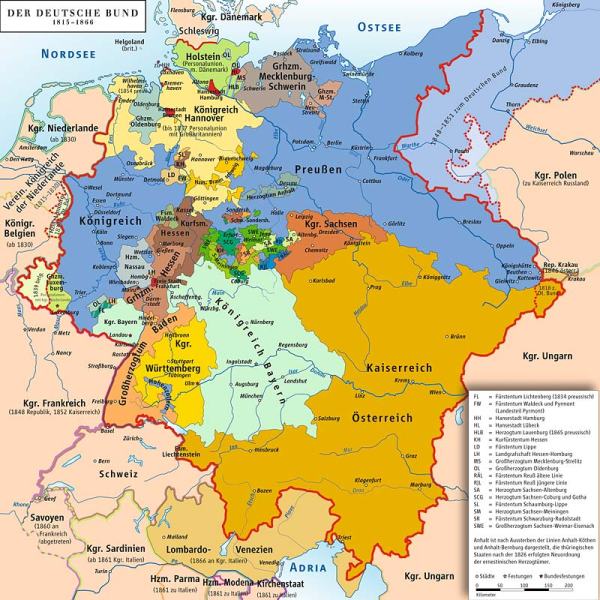
However, I am beginning to wonder if she too might be from East Friesland, like all the others of my grandfather’s ancestors. Here is why: according to a census in 1880, she described her birthplace, and the birthplace of her parents, as “Hanover.” The Kingdom of Hanover lasted from 1814 to 1866, at which time it became a province of Prussia. Margareta was born about 1827-9, and emigrated about 1861, so even though this area is now part of Germany, she would have known it as Hanover.  And, Hanover included East Friesland during that time, where notes seem to indicate that she was married to her first husband, Johann Heinrich Henneke, about 1852, [though I haven’t seen a source for this] and perhaps birthed her first children.

I excerpted this brief history of Hanover from another genealogy site:

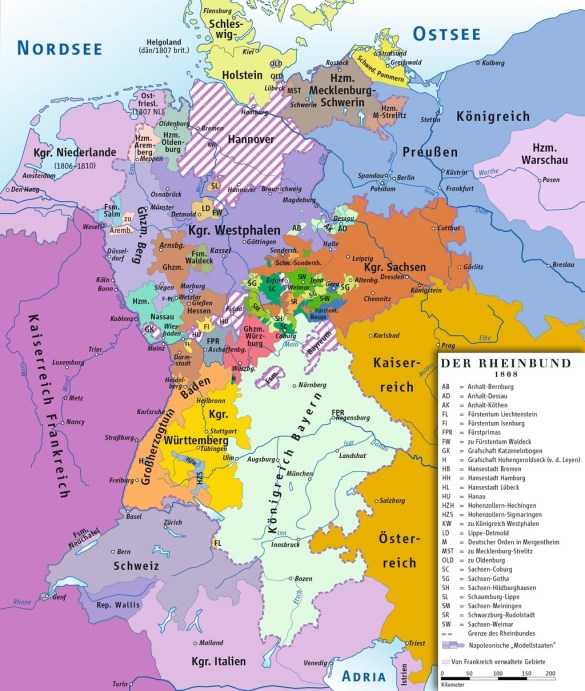
Until 1708, Hanover had been a minor principality within the Holy Roman Empire. In 1708, its lands were combined with most of the Duchy of Brunswick-Lüneburg and became an electorate (essentially, a voting member state) of the Holy Roman Empire. Its rulers belonged to the dynastic lineage of the House of Hanover. …The status quo persisted until 1803 when Hanover was conquered by both Napoleon and the Kingdom of Prussia. In 1806, …16 states from the Holy Roman Empire, including Hanover, were joined together to form the rather weak Confederation of the Rhine. In 1807, the Treaty of Tilsit declared that Hanover would be joined with part of Prussia to create the Kingdom of Westphalia, ruled by Napoleon’s brother Jérôme Bonaparte. Westphalia joined the Confederation of the Rhine soon after… When Napoleon was finally defeated in 1813, it spelled the end for both the Confederation of the Rhine and the Kingdom of Westphalia. Rulership over Hanover reverted back to the House of Hanover.

The Congress of Vienna of 1815 …created the German Confederation, a loosely-knit group of 39 Germanic nation-states of which Hanover was a member. …The March Revolution in 1848 caused Hanover to temporarily leave the German Confederation, but after they failed, it rejoined in 1850. Hanover remained within the German Confederation until the Austro-Prussian War (or “Seven Weeks War”) in 1866.

Map_GermanConfederation

1815-1866 Kingdom of Hanover/Konigreich Hannover, in yellow, near the top.

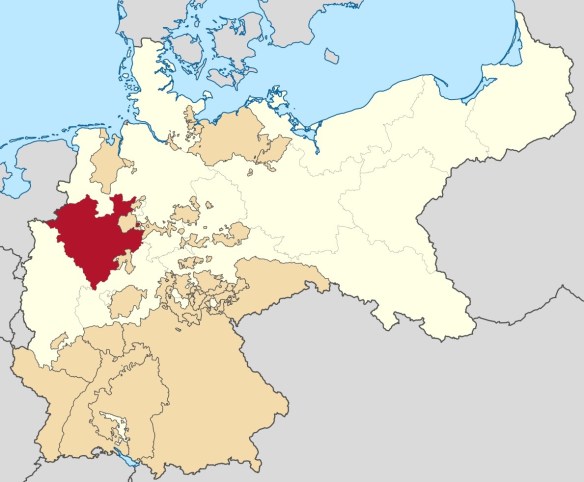
But my grandfather said she was born in Westphalia, so I looked more closely at the Kingdom of Westphalia, which included Hannover (striped and purple on map) but didn’t include East Friesland, which came under the rule of Holland during those years. So another possibility is that she was born in an area of Hanover that was also included in the Kingdom of Westphalia during that time.

Westphalia

1808 confederation of the Rhine

Finally, down below, there is a map of the Province of Westphalia, after the kingdom was dissolved and it was part of Prussia. It is adjacent to Hannover, and just south of East Friesland. So it wouldn’t be impossible for her to be from there, later traveling north into Hannover, or East Friesland.  A further argument for this place is that both parents of her husband Johann Heinrich Henneke were born there. So perhaps they met up in Westphalia, and then moved to Hanover. However, another argument for East Friesland is that when her first husband died, in Illinois, she later married Meenke Engelmann, who was from East Friesland. People tended to cluster with others from their own regions and who spoke their own dialects.

I have been so interested in this question, since one of the reasons I am exploring my ancestors is to find out their connections to the lands that they lived in before they came to America. I also want to tell more about the family she created, but that will be another post. For now, her original home sadly remains a mystery, but I am so thankful to have her photo and part of her story.

East Frisian Ancient Grandmother

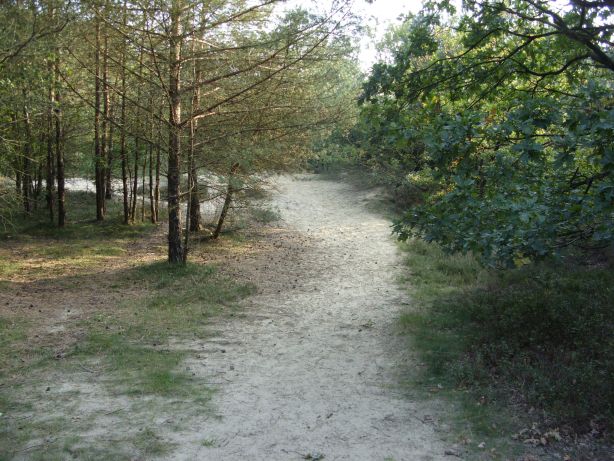
Holle_Sand_-_07

Holle Sand in East Frisia: a nature preserve on the duneland forest, near where my ancestors lived.

Are there any European ancestors who might help us to find a mutually beneficial relationship with the earth in our time? Today I was remembering that this was my original motivation for reaching back to these ancestors. Oh, it has also been helpful to gain a better understanding of how my ancestors fit into the larger story of the colonization of this continent in which I live.

But on a spiritual level, why would I reach for a true connection, if not to ask for help in the struggles we are facing in our time? Much of Australia is burning right now, fascism is running rampant over our country, hurting the plants and animals, and the people of our land, leaders plot for power and violence, and so much is being destroyed.

And I remembered what sparked my heart last spring about my patrilineal East Frisian ancestors. It was a line in a letter, a mocking recounting of a piece of old wives’ advice: “Remain in the land and nourish it.”   I wanted to reach out to those “old wives” to see if they might help me, help us.  During our Ancestor Wounds and Healing workshop in October, I introduced the group to the East Frisian tea ceremony, as part of our ritual of gratitude for the gifts of the ancestors.  We were short on time, and I considered leaving out the tea ceremony, but felt an unmistakable tug from spirit–“No! You must do the tea.”  And so I did.

Two days later I led our group on a trance journey with the intention for each of us to find an ancient ancestor–maybe from centuries ago–for each of us to meet someone who was at one with their land, in harmony with their land and people. So we traveled through time and out of time to make a connection. In that journey, I met my East Frisian ancient many-greats-grandmother, the same one who called for the tea.

When she arrives, I burst into tears and suddenly feel how wounded I am, we are. She is whole, she can traverse deep time and be called upon in any time. I burst into tears and she is loving me, with healing hands, and she knows how all of us have been broken. I felt the holding power of her love to contain the pain of centuries.  She is a healing presence, a witness to it all. She touches my heart, she says, “I can teach you how to laugh, even though the later Germans in your family lost how to feel.” She has a joy deeper than I know. She wants to continue our connection. She says, “Drink the tea ceremony to call me.”  

I was profoundly moved. I didn’t have a name for her that day, but later, a name came to me.  The German/Frisian affectionate name for grandma is Oma or Ooma. But a great-grandmother would be, in German, Ur-grossmutter and I am moved to call this ancient great-grandmother Ur-ma, or Oor-ma. The word also reminds me of the rune Uruz, which represents the aurochs, an ancient wild cattle species, now extinct, that was the symbol of wild strength, persistence, healing, and courage.

At the end of December, Margy and I shared in a rune reading. I used the runes to reach out to Ur-ma, and the first rune I pulled was Uruz.  Sweet.  Then came Nauthiz–which means Need, or difficulty, or struggle. How we are.  Finally I pulled Gebo, which means Gift, and the power of reciprocity which is love.

And so when I reach out to Ur-ma, I drink the tea and I pray: “You have wholeness, we are so broken. Bring your healing energies to our time. We have lost the connection to all beings and the land. We have forgotten our kinship. Help us heal. Help us to love the land, to love the spirit.” And I keep remembering those words, which somehow came down the centuries even so: “Remain in the land and nourish it.”


At Home

Picture by Arla Patch, James Francis

With these last few quiet days at home, Margy and I were finally (after almost four years) able to take down from the attic all of our wall pictures, and decide how we wanted to decorate the walls of our living room and kitchen. It was especially wonderful to place over our fireplace hearth this print, Stewardship of the Earth, by James E. Francis and Arla Patch. We had purchased it several years ago in a fundraiser for Maine Wabanaki REACH.  Here is more information about it from an article in the Friends Journal.

This work of art is a collaboration between James E. Francis, Penobscot artist and director of cultural and historic preservation for the Penobscot Nation, and Arla Patch, artist, teacher, and [at that time] member of the communications subcommittee of the Wabanaki Truth and Reconciliation Commission.

It was made for a western Maine community celebration of the native woman Molly Ockett (c. 1740–1816, Abenaki nation, Pequawket band). The theme of 2013’s MollyOckett Days Festival was “Stewardship of the Earth.” James created the central image of the tree that becomes the earth. Arla created the context based on the European American tradition of quilts. James provided the symbols, which represent the four remaining tribes in the Wabanaki Confederacy: the Penobscot, the Passamaquoddy, the Maliseet, and the Micmac.

A theme of the four directions, which comes from both Native American spirituality and ancient Celtic tradition, is depicted as the night sky for the north; the sun rising over “second island” next to the Passamaquoddy land of Sipayik; the midday sky for the south; and the sun setting over the White Mountains for the west. “Agiocochook” (home of the Great Spirit), also known as Mt. Washington, is included in the western sky.

Blueberries are included for the role they have played in sustaining Maine native peoples historically and to this day. Maple leaves are in the upper corners to honor the development of maple syrup by the Wabanaki.

When we put this picture on the wall, along with a few others around the room, I found myself feeling rooted and joyful, at home in a deeper way than before. It was as if some mysterious magic had created a circle around us, and we were aligning into harmony and beauty.

May that beauty bring us hope and strength as we enter a new decade, a decade that will be pivotal in our collective stewardship of the Earth. May we human beings find a way to live in harmony with all of our relatives on this planet that is our home.

Mothers and Grandmothers

In the early days of my feminist awakening, I began to trace the ancestry of my mother line, to learn who my grandmothers might be, and what land we originally came from. I learned this: my matrilineal great-great-great-grandmother was an Innu woman, identified in the records as Marie Madeleine, Montagnaise. She married a Scottish trapper who worked for the Hudson Bay Company in Quebec. His name was Peter Macleod, and he called her Marie de Terres Rompues, after the place where they came to live on the Saguenay River. Her name might be translated, Marie of Broken Lands, which resonates with what came later.

When I have been able to travel to Quebec, to the place the Innu call Nitasinnan [our land], I have felt the presence of the ghosts of my ancestors in the land. The very first time I drove into Chicoutimi on the Saguenay River, I came upon a book on the shelves of the Welcome Center in the rest area—it was about my ancestor Peter Macleod and his family. There have been other encounters over the years, a feeling of my ancestors reaching out to me as I reach out to them.

Learning about their stories has been an important part of my journey. I discovered many dislocations and relocations that occurred for my grandmothers, ways they were separated daughter from mother, separated from the land and the people from which they came. Marie de Terres Rompues bore several children with Peter MacLeod. Her daughter, Angele, was only twelve when her mother died, and Peter married another wife; Angele’s stepmother was a white woman. I wonder if Angele kept a connection to her Innu relatives? She was married at the age of twenty to a French Quebecois farmer, Joseph Tremblay, and they lived in the area of Peribonka near Lac St. Jean. I only know one story about them, from a census report. One year, all their grain burned in May, and they replanted with fresh grain but all of it was frozen and “not fit to be threshed.”

Her daughter Claudia was only eighteen when Angele died. At twenty-two, Claudia married Ferdinand, and during an economic downturn in their region, they moved over four hundred miles away to the town of Hull in the suburbs of Ottawa. Later, they traveled over seventeen hundred miles to the Black Hills of South Dakota, where Ferdinand worked in the mica mines for five years, during the boom years when Westinghouse Electric was producing over $100,000 per year in mica. Then the mines closed.

Their daughter, my grandmother Yvonne, was born in Hull in 1897; she was nine when they moved to the Black Hills, and fourteen when they returned to Quebec. She became a chamber maid in a hotel in the Canadian capital city of Ottawa, where she met Johann, an Austrian immigrant working as a waiter. At seventeen, she followed him five hundred miles to the United States, marrying at the border in Detroit Michigan.

My mother tells me Yvonne and her sisters worried that someone might think they looked Indian. Did she fear prejudice learned in Quebec, or in South Dakota? In Detroit, she became fully assimilated into the white and English-speaking world. Most of the stories were lost, but she did tell my mother they were part-Indian, and my mom grew up feeling proud of that heritage. There were occasional visits to family in Canada. When my mother was a four years old, the news came of Claudia’s death at the age of seventy-three.

Claudia Tremblay

My great-grandmother, Claudia Tremblay, age/date unknown

My mother was not quite twenty-one when her mother, Yvonne, died. I was a baby then. I have a picture [below] of my grandmother holding me in her arms. When I ponder this story of my mothers and grandmothers, I am struck by how most of these women lost their mothers before, or just as they were entering, adulthood. None of them had a chance to be with their grandmothers. They each turned to the life and the culture of their husbands. And I am struck by the many miles each generation traveled away from the place in which they might have felt a sense of belonging to the land. My mother, too, followed her husband on his travels across the United States. I grew up during those travels and none of those places ever truly felt like home. I didn’t know any other way.

Grandmother Yvonne with Myke

My grandmother Yvonne holding me as a baby.

It has been a long and important process for me to reclaim these stories and reweave a connection to my grandmothers.

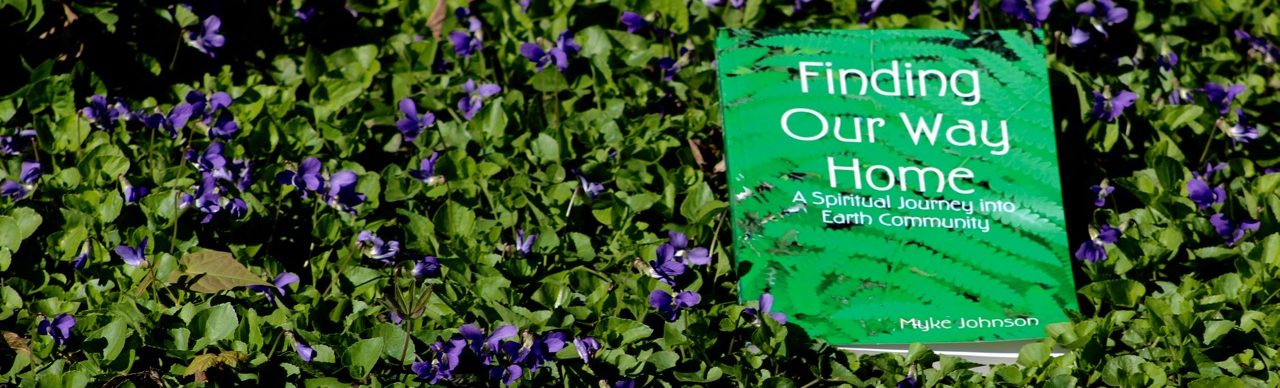
[This story first appeared in my book, Finding Our Way Home: A Spiritual Journey into Earth Community.]

Little Land Spirits

Sunrise after Solstice

Sunrise, the morning after Winter Solstice.

In Scandinavia, there is a Solstice Eve tradition to leave a bowl of porridge outside for the Nisse, the little land spirit person who helps out with the work on the farm and serves as a guardian to the family and the animals. According to what I learned, it was very important to put a pat of butter on top.  The Nisse can be troublesome if not properly respected.

There are little guardian spirit people traditions in many other places, too.  Scots and English call them Brownies, there is the German Kobold, and I have learned about Wabanaki little people called Wonakomehsisok who were said to be spirit helpers who lived among rocks. The Wolastoqiyik spoke of Kiwolatomuhsisok, who were said to help people secretly at night, and have a breath that smells like mold.

All that said, on Solstice Eve, I put out a bowl of porridge in the back yard, with a big pat of butter on top, (which by the way is how I like my own porridge) as an offering for any little land spirits on our land that might appreciate it.  Perhaps it might be one more way to deepen our relationship with this land, to make friends with the spirits who protect and cherish the land.

Sadly, the next morning, it was still there, and frozen–but I moved it from the middle of the yard to the way back, where more wild creatures tend to go by. (We’ve put other food offerings out there in a similar way, and they disappear.) When I returned from my walk, I was happy to see a crow back there at the bowl, pecking at it with their beak.  They are also guardians of this land.

Crow eating butter – Version 2

Later, I discovered that the crow flew off with the pat of butter but left the porridge.  So I guess that our land spirits might not like porridge–which is after all a very European food tradition.  We’ll have to keep experimenting with other foods, to see what they prefer.  Still, I was happy to give a gift to the crow.