Ancestors: Clearing the Forests

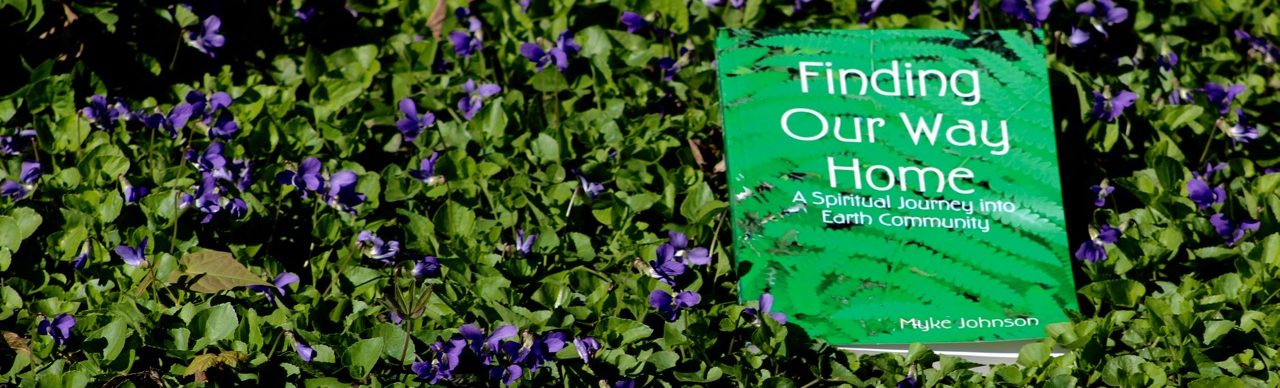
I just finished reading Barkskins by Annie Proulx. It is a 300-year-plus epic novel, beginning with the stories of two French settlers who arrive in Quebec in 1693, who become involved in cutting down the trees of the forest. One runs away to make a fortune starting with the beaver pelt trade, and the other ends up marrying a Mi’kmaw woman.  We then encounter the lives of the descendants of these two men, through a relentless series of clear-cutting the forests of this continent and beyond, partly from the perspective of lumber company entrepreneurs trying to get wealthy, and Mi’kmaw logging laborers risking their lives and health working for the lumber companies, when they can no longer live in their traditional ways because the forests are being destroyed.

Any attempt to summarize does an injustice to the complex multi-generational stories Proulx weaves from the characters she creates, and the overarching sense of doom one feels, looking at it from our current perspective. I was glad to see that she consulted with Roger Lewis, a Mi’kmaw scholar, ethnologist and curator of the Nova Scotia Museum of Natural History. I would be curious what my Mi’kmaw friends think of the stories she wove of their histories.

While I was reading the early chapters, I also was researching my Scottish ancestor, (great-great-great grandfather) Peter MacLeod (sometimes spelled McLeod), who came to Quebec in the late 18th century. He too was involved in the beaver pelt trade, and then in the logging industry, and married a Montagnais (Innu) woman, (or possibly two.)

Peter MacLeod

Peter MacLeod, senior

I found this excerpt about his activities, loosely translated from the French by Google:

The Simard-McLeod tandem is behind the construction of the first sawmill on the Riviere Noire, whose work began in 1834. Thomas Simard, assisted by Charles Dufour, Peter McLeod Sr., who was responsible for the construction of the building, worked with the merchant Hubert Simon to build the Port-au-Saumon, Port-au-Persil and Riviere Noire mills.

“[…] Many of these characters employed by the lessees of the king’s posts will later participate in the early days of the Saguenay colonization. The best known are the brothers Thomas and Michel Simard, Peter McLeod father and son, Cyriac Buckell, Alexandre Murdock, Simon Ross and the Verreau family. Associates in several Charlevoix companies, Thomas Simard and Peter McLeod Jr. represent the pivotal era of the opening of the Saguenay to colonization, at the time of the transfer of an economy based on the fur trade to that of logging. “

Peter MacLeod Jr., my great-great-great uncle, was half-Scottish, and half-Montagnais/Innu. He was the founder of the city of Chicoutimi, and he is more well known than his father.  But the Dictionary of Canadian Biography under his entry, says this about his father:

Engineer, surveyor, and officer in the British army, he entered the service of the North West Company, and on its merger with the Hudson’s Bay Company in 1821 he became the confidential agent of William Lampson, the lessee of the king’s posts. He occupied this position until 1831, when the HBC secured the leasing rights.

It was during his time as Lampson’s agent that McLeod Sr became interested in lumbering in the Charlevoix region. Acting virtually as a timber contractor, he built sawmills for rental in La Malbaie, served as a timber supplier, and obtained felling rights. From 1827 to 1836 he became one of the principal sources of timber for William Price, who was then established at La Malbaie. In September 1836 he entrusted his eldest son with the responsibility for his facilities and commitments. But Peter’s assumption of control evidently did not produce very satisfactory results. From 1837 to 1842 the McLeods’ debts to Price continued to grow, and by the end of the latter year had reached £2,200. It is in the context of indebtedness, and also of Price’s desire to be the first timber contractor established as far up the Saguenay as Chicoutimi, that the partnership between Price and the McLeods must be seen.

Price could not himself acquire the felling rights and the letters patent on mill sites or on land in the region because of the prerogatives over this territory granted to the HBC until 2 Oct. 1842, and its antagonism towards him. He therefore proposed to use McLeod Jr to push farther inland along the Saguenay. With the help of the Société des Vingt et Un, McLeod had established himself between Tadoussac and Grande-Baie by 1837. Since, as a Montagnais on his mother’s side, he had natural rights to circulate freely among the king’s posts and to settle there, Price would be able, through him, to thwart the HBC and achieve his goal of exploiting the region’s rich pine stands. This prospect prompted the agreement between Price and the McLeods.

It is probably true that most of the settlers were engaging in the logging industry, if they were not clearing land for farming.  But learning this information while reading the novel Barkskins made it really come alive for me, in such a sad way.  These men who were trying to make their fortunes, these men who were caught between two worlds, these forests that were thought to be never-ending, but weren’t.

So much was lost, so much was invisible to the settlers, who saw trees as merely a way to sell lumber and make money, and saw the rivers as a way to power the sawmills and transport the lumber. My ancestors in Quebec were a part of all of that. It feels heavy. But I am grateful for the novel Barkskins that revealed so much what it must have been like for those who lived it.


First Quote from:  UNIVERSITÉ DU QUÉBEC, MÉMOIRE PRÉSENTÉ À L’UNIVERSITÉ DU QUÉBEC À CHICOUTIMI COMME EXIGENCE PARTIELLE DE LA MAÎTRISE EN ÉTUDES ET INTERVENTIONS RÉGIONALES PAR ÉRIC TREMBLAY , L’OUVERTURE DU SAGUENAY À LA COLONISATION (1821-1842), JUILLET 2015

Garden Updates

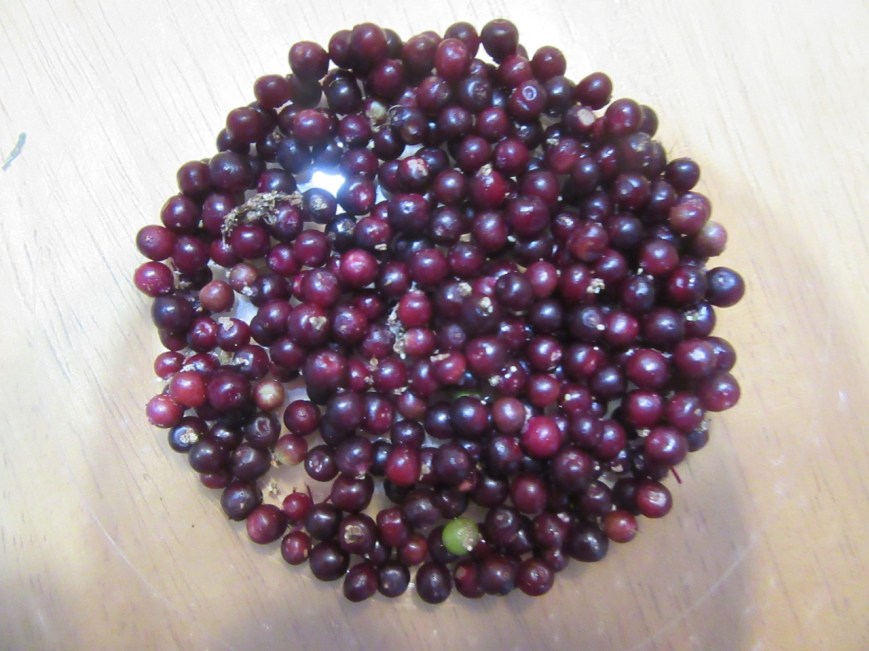
Elderberries ripeThis week there were a few exciting new developments in the garden. We harvested our very first elderberries—maybe a whole half cup of them! Earlier in the summer, I was worried about whether something was wrong with the elder flowers, and perhaps there was, but eventually they created a spotty bunch of green berries. I must admit, I hadn’t gone by the bush for several days, but when I went out the other day, they were purple. I ate one that was quite sweet, but Margy tasted a sour one, not as ripe. Elderberry harvest 2019Not enough to make elderberry syrup, or really much of anything, but enough to be enthused about future possibilities. Margy and I will have to celebrate with a berry eating ritual.
Another new development: I saw a few catkins on our hazelnut bushes! I hadn’t known to expect them, but when I  looked it up, I learned that these are the male part of the plant’s reproductive system. They will stay on the plant through the fall and winter, and then in very early spring they start lengthening and unfurling.  When the female flowers open at the tips of branches, they pollenate. Hazelnut catkinsThere are only a few catkins right now, but they are a harbinger of future crops of hazelnuts. In my last batch of pesto, I used hazelnuts from the Food Coop to add to basil, parsley, chives and garlic from the garden, plus olive oil and lemon of course. So we can’t quite do it only from our garden, but maybe more and more.
I also processed oregano and thyme that had been drying in the basement herb dryer for longer than they needed to be, and did another batch of frozen chives, and frozen kale for the winter. Our harvest is limited more by my own energy than by the earth energy.

If anyone local would like oregano or thyme or chives, please let me know—they are flourishing in the garden still, and I’d be happy to share—also lemon balm, comfrey, and dill. They have all been very enthusiastic.

Miracle of Ocean

Crescent Beach September

Yesterday late afternoon, with the weather up to 80 degrees, I went to Crescent Beach. Would it be the last day warm enough for me to go in the water? Maybe, maybe not. But without expectations, I set up my chair on the sand, and walked down to the edge of the water to feel the cold splashing on my feet. Its temperature was mildly cold not frigid, much warmer than early summer. There were a few more waves than usual. Only a small group of children were in the water, jumping into the waves as they broke on the shore.

I have become a bit timid about waves, as I have gotten older. The tide was low, and there were lots of round stones to walk over, so I came back to my chair and put on some swim shoes, so I’d have better balance. Then I walked back out and stepped right in. I moved quickly through the breaking waves and past them to about my waist level. The rhythms of the water rose up to my shoulders, and then back down, lifted me up and down, too, but gently. I dove into one wave to cover my head, but then I just stood facing the sea, watching the waves come in, letting them carry me up and down.

Here’s the amazing thing: after being in the water, the waves, for a long time, and then staying longer still, I began to be washed in a sense of joy and happiness. It felt miraculous because this whole past week, I had been feeling exhausted and achy–a classic flare up of the auto-immune conditions I struggle with. But somehow the water washed all of that away, and I was filled with a physical sense of well-being and playfulness.

When I go into the water, I usually pray to the Mother Ocean, I give her my worries and struggles. She is one kind of divine presence, larger than I can ever be, and the source of all life. But it wasn’t my small prayer that shifted me–it was the very energy and power of her presence all around me, it was the waves dancing with me, it was my body responding to the waves. It was unexpected.

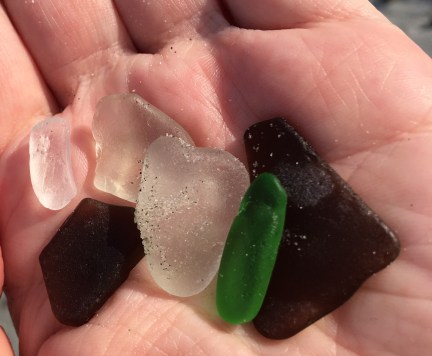
Filled with this lovely happiness, when I came out of the water, I walked along the shore looking at stones and shells, and I found several pieces of sea glass. I love that the ocean can transform these broken bits of human invention into tokens of beauty. Since I have been thinking lately about the ancestors, it came to me that sea glass is a kind of gift from people who came before. I’ve read that it can take 20-40 years in the waves, sometimes longer, for glass to be tumbled to create this patina. So someone a long or short time ago made the glass, touched it, discarded it.  I am holding this connection, broken yet made whole again, and so I prayed for friends and family who needed healing.Seaglass

After my walk, I sat in my chair and ate some yogurt mixed with cocoa, honey, cacao nibs, and blueberries. I started reading the novel Barkskins by Annie Proulx, which begins with French settlers in Quebec taking down the forest. (Another way to try to understand colonization.)  Isn’t it a picture of happiness, to read in a chair on the beach, sun on my shoulders?

monarch catepillarOn my walk back to the car, one more fun surprise. This colorful monarch caterpillar on a milkweed plant just past the beach roses.
I wish I could share with you the happiness of being in the ocean, of walking on the shore finding sea glass, of reading on the beach on a September evening, of finding a monarch on a milkweed.

But the happiness was triggered by actually being in the ocean with its waves dancing me up and down. So if you are feeling timid about walking into the waves, whether literal or metaphorical, please know that on the other side little miracles might happen. Joy might find you.


Conflicting Survival Strategies in early Quebec

(More reflections on colonization in Quebec, jumping off from the book Helene’s World.)  Author Susan McNelley writes:

Summer days for the French settlers were long and filled with hard work. This was not the case for the indigenous people. Life was much less demanding in the summer. Fish, fowl, and small game were readily available in the river and nearby forest. The indigenous peoples along the St. Lawrence didn’t worry about storing food to last the winter. To the consternation of their French neighbors, the natives spent much of their time sleeping and socializing with their friends. There were games, story-telling, feasting and opportunities for young people to meet and court.  Summer was a time of replenishment and fortification for the rigors of winter.

A common factor for both Montagnais/Innu people and French settlers in early Quebec was surviving the long hard winter.  But they had quite different strategies for doing that. The French worked very hard in the summer to clear fields, and plant and harvest crops. Bread was their primary food. They were agricultural people, and in the early years were also reliant on ships arriving in summer with new supplies, to replenish their stores of wine and oil and spices and grains. They preserved food and stored it for surviving the long winter. Winter included much less activity, so in some ways it was an easier time, but they were on their own, and their strategy for survival was to carefully ration what food they had among the people in their families.

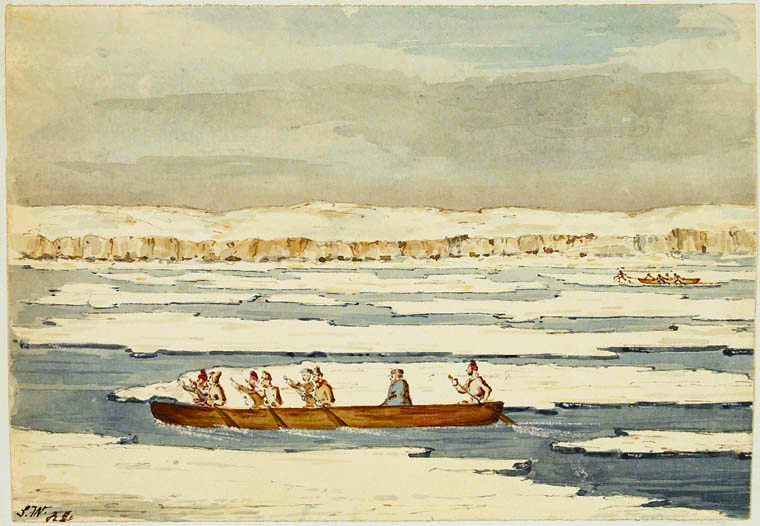
For the Montagnais, on the other hand, summer was the easy time–they camped by the river, fished & hunted, gathered fruits and nuts, feasted and celebrated with each other, and generally felt a sense of abundance in all sorts of food. As the fall came, they caught and dried eel, and then they left the summer encampment and began to hunt small game in the nearby woods. In winter, they traveled in small family groups into the interior, where they relied on heavy snow cover to slow down the big game: moose, caribou, deer, and bear. When they were successful in the hunt, they shared their feast with nearby families.

hiver_transports_11

Susan McNelley describes a winter incident recounted by Champlain when some of the Montagnais/Innu came to the early French settlement, because they were starving, and asked for food.

Although the French did try to be generous, they rationed the distribution of provisions to the aborigines out of necessity. Otherwise, the food would not have lasted a month.

The French believed that the Innu were irresponsible because they didn’t store food, and because when they acquired food in the hunt, they ate all of it, or shared with their neighbors.  But if you are traveling to follow big game, it wouldn’t be practical to carry large quantities of preserved food.  It would be practical to share the abundance that came sporadically depending on who had a good hunt.  Reading between the lines of this incident, I could imagine the Innu noticing that the French had food while they had none, and expecting, according to their own values, that of course the French would be willing to share with them. Their strategy for survival was sharing what became available, as it became available. The French strategy was about storing up and rationing.

And isn’t that just like capitalism, really, and how our modern mainstream society works.  “Save what you don’t need now, to use later. Try to accumulate as much as possible. That is the definition of wealth.”  (But perhaps rampant consumerism and planned obsolescence have superseded that model too.  Some things to think about.)

I feel the pressure of this time of year to preserve what we can from our garden, small as it is–making pesto from basil and chives and parsley, freezing kale, drying herbs–in our own way getting ready for the long Maine winters. We certainly wouldn’t know how to survive on our own, without being able to go to the Food Coop or grocery store. So perhaps both the French settlers and the Innu had better survival skills than we have now.Kale


French and Innu in Early Quebec

Samuel de Champlain map of Quebec

1612 Map of New France by Samuel de Champlain

Some thoughts on early French and Innu ancestors, on reading Helene’s World: Helene Desportes of Seventeenth-Century Quebec, by Susan McNelley.

I was surprised to learn that the primary Indigenous nation at the Quebec settlement in 1620 (later, Quebec City) were the Montagnais (Innu.) I had thought they had been mostly living further downriver and inland. But the Quebec settlement was one of the summer dwelling places in their vast territory along the St. Lawrence, where they fished, gathered herbs and berries, and traded with their neighbors for corn and tobacco.

In the early days of the settlement, the Innu, along with the Huron (Wendat) from further west, and other Algonquin tribes, were the main trading partners of the French.  Beaver pelts were the primary export from the colony.  Interestingly, the French especially valued the used pelts–those having been worn for a few years–after the longer hairs had worn off, because the French used the shorter hairs to felt for popular hats back in Europe. So what a great opportunity!  The Innu could trade the pelts they were about to discard, for copper kettles, metal tools, firearms, blankets, and food.

In the early days of the settlement, hundreds of canoes would arrive each summer, bringing furs for the annual trade. The French settlers had become part of earlier trading patterns. (The French made the choice to ally with the Huron and Montagnais against the Iroquois, and those earlier rivalries were exacerbated by competition to control the beaver trade. The Iroquois had allied with the English and the Dutch.)

But beginning in the 1630s, as in so many other places on this continent, diseases from the Europeans proved decimating for the Native peoples who had no natural immunity to them. Measles, smallpox, plague. The Huron/Wendat lost 50% of their people, and losses were said to be similar among the Montagnais/Innu. That, combined with increasing hostilities with the Iroquois, caused the remaining Innu eventually to go further downstream or inland.

French colonization took a different shape from English colonization.  There was more interaction with–and valuing of–Indigenous peoples as trading partners and allies. But an underlying driving force of this colonization was the desire of French Catholics to convert the Indigenous people to Christianity, to “save their souls,” which for them was inextricably linked with their also adopting French customs and lifestyles.  The Jesuit priests and Ursuline nuns settled in Quebec with a special call to this mission.

Native people were seen as “savages” who must be “civilized.” The French colonizers would send a few people to live among the tribes to learn their languages and customs. They invited Native people to send their children to be educated, and a few did send their children to the Ursuline school. There were many positive connections between the two groups. The Indigenous people were interested in the French, they shared a love of pageantry and celebration, they valued the trade, but ultimately and unsurprisingly, most were unlikely to give up their own ways for the ways of the French during these years.

More later on their different cultural strategies to survive the hard winters…

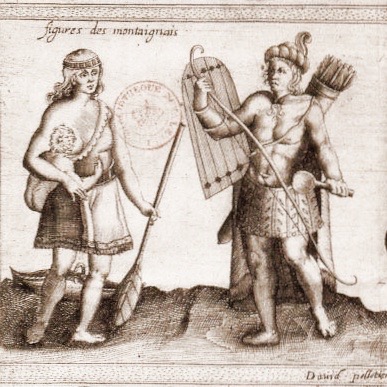
Montagnais as seen by Champlain detail

Detail from the map–Champlain’s drawing of Montagnais/Innu people.


Ancestors & Colonization: Quebec

When I was exploring my German immigrant ancestors in the context of decolonization, I was struck by the feeling that they arrived after the major struggles of colonization in their part of the country.  For my dad’s family who arrived in the mid-1800s, it was a generation earlier that treaties were pressed upon the Indigenous peoples of those lands, who were forced to move further west or to Oklahoma.  In another branch of my family, my mom’s father was from Austria, and immigrated even later, via Canada, to Detroit in late 1915.

I wonder if these Germanic immigrants even thought about it, or if so, maybe it was like, “We just got here, we don’t have anything to do with those struggles you all had before.” Though, of course, the German farmers benefitted from those earlier actions, because now land was available for low prices. But it can leave a feeling of distant non-involvement, a sense that colonization wasn’t very much about my family.  My mom’s mother was also an immigrant to the United States, but her background is more complex, because she came from Quebec.

When I was younger, the very first ancestors I was curious about were those of my grandmother, born Yvonne Tremblay.  That intensified when I became a feminist, and wanted to learn about my motherline.  Plus, as I have written about elsewhere, she was “part Indian,” and I was curious about that. It turned out that Quebec province kept very good records, and I was able to learn a lot, even before the age of the internet.  But I wasn’t asking questions then about colonization or decolonization.  So this week, I decided to reopen that window of exploration, to see what I could find.

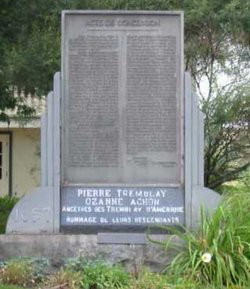
While the information available about my Scottish and Innu ancestors stops with Peter Macleod and Marie Madeleine Montagnaise, (my great-great-great-grandparents), the information about my French ancestors in Quebec goes back to some of the original colonizers.  Yesterday, I learned that one ancestor, Jean Guyon, my 11th great-grandfather, arrived in 1634. But not to get egotistical about it, they say three out of four Quebecois descend from him. And in fact, I am descended from him via four separate lines of ancestry. I am including this monument to the first Tremblays in Quebec, Pierre Tremblay and Ozanne Achon, who arrived in 1657.

Pierre Trembly Ozanne Achon

Today, in my family tree, I accidentally came upon the name Helene Desportes, my 9th great-grandmother. Her birth was listed as 1620 in Quebec, and it turns out she is said to be the first white child born in Canada, though she might have been born on the ship just before arrival. One of my methods is to do an internet search for any of these early names, and I learned there is a recent biography about her, Helene’s World: Helene Desportes of Seventeenth-Century Quebec, by Susan McNelley.

Suddenly, there is a whole new world to explore–okay that was the wrong phrase to use–in my decolonization understanding.


The Flowing

Orchard August 2019

The other morning I woke from a dream, in which I was thinking about Wabanaki languages. Wabanaki languages are a flowing. Everything is moving. Verbs are central. Verbs change shape to fit who is acting, who is moving, how many, and who or what their object might be. For example, Wiku is a verb for identifying where someone dwells. (The k is pronounced like g.) As in, Wiku Portland, meaning, “He/or/she lives in Portland.” But to say, “I live in Portland,” would be Nwik Portland.  “Where do you live?”  Tama kwik?

Even many nouns are flowing, changing, shapeshifting. Like the word for home. The noun, Wik, means a home. But “my home” is nik. “At our home” is nikonuk. “At your home” is kikonuk. The words flow depending on who lives there, or if you are going there. And the words for “mother” are related to the words for home. Wikuwossol, nikuwoss, kikuwoss. “His/or/her mother, my mother, your mother.” Flowing. Shapeshifting. Full of relationship.

English, on the other hand, is filled with many more nouns than verbs. Since contact with the colonizers, Wabanaki languages have had to add more nouns to the lexicon, to translate from English or French. Some of these nouns were created from verbs by adding an ending that, by itself, means “bait.” For example, koselomol, means “I love you.”  But to turn the verb “love” into a noun, you must say kseltomuwakon. Wakon means “bait.” So perhaps to make these nouns we must capture the verb, trap it with our bait, to stop its movement for a moment.

We colonizers live in solid houses with lots of things/nouns in them. The Indigenous peoples of northern places used to live in easily movable homes, with fewer things, to follow the hunt in winter, to fish the shores in summer. Everything was a movement, a dance, a shape-shifting. (Of course, many southern Indigenous peoples were/are farmers, stayed in one place. I don’t have any exposure to how their languages work.) But I notice the tendency in me to look for solid things, to struggle with the endless flow.  To try to put things in their places, get organized.  Make vocabulary flash cards to capture the words into my brain. (Even though the Wabanaki Languages class I am taking is on summer break, I have been listening to the recordings from the class, and continuing to study.)

Still, the garden in this place, at our home, nikonuk, also tries to teach me about flow, if I can be open to it. Every week is filled with different patterns and growing and shapeshifting. This week, no more snap peas or raspberries. But the basil has come back again after I harvested most of its leaves a while ago. The young fruit trees are wild and leafy. The bee balm is dying, and prone to powdery mildew. My nephew and his girlfriend helped me put wood chips on the paths during their visit a couple weeks ago. It rained during the night last night. Every day is different. There is no way to get the garden in shape, in form, once and for all. It demands relationship, interaction, flowing, it demands the verb “gardening.”

In Passamaquoddy, kihke means “He/she gardens or plants,” and kihkan is a garden. It is also another form of the verb.


Gifts

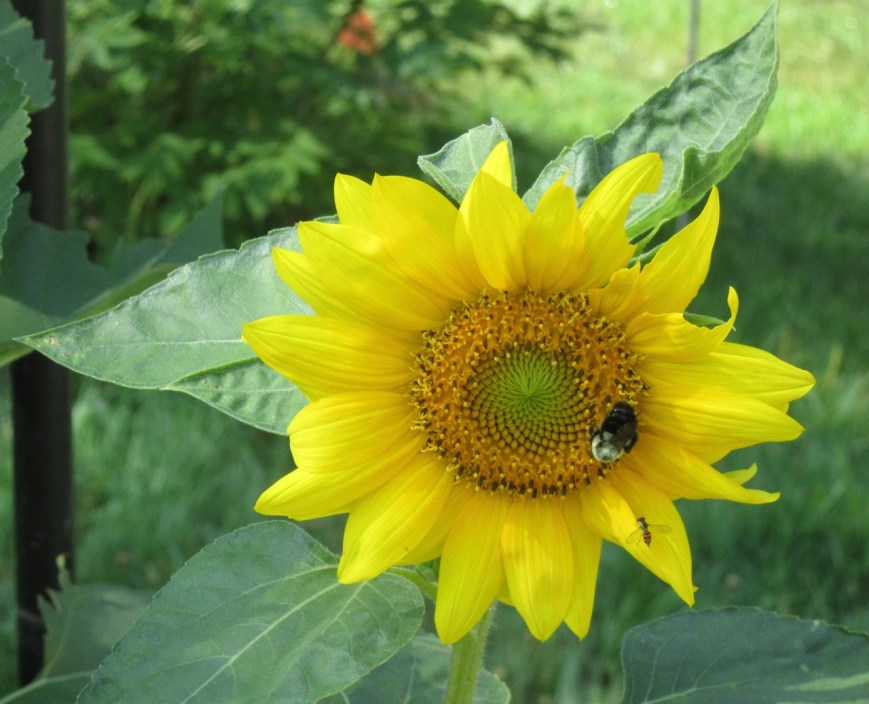
During the spring, Margy was talking about wanting to plant sunflowers this year. But as it happened, she was busy with too many other garden projects to actually do it.  So imagine our delight when the garden planted its own sunflowers! They came up under the bird feeder, now sitting empty for the summer, but where sunflower seeds were the food we offered to the birds (and squirrels) all winter.

Gift sunflowers

Lately, the garden plants have felt mostly like children who need our care and attention. With the dry hot weather, they’ve needed a lot of watering. Yesterday, I did another foliar spray for the fruit trees, to help them ward off Japanese beetles, which I also have been picking off every day and dropping in soapy water. And there have also been lovely raspberries to harvest each day, and snap peas (almost gone now) and kale and basil to gather and preserve.

So this gift of flowers emerging without any effort on our part–perhaps the land is reminding us that she loves us as we love her?

It has been one year since my retirement began. One of its themes has been to find connection with this small portion of the Mother Earth, this land we are so lucky to call our home. As non-Indigenous people, we are trying to heal a long wounded history of our people’s disconnection from land.  Our ancestors left their home places generations ago.  If our society had an understanding of earth connection, it could not destroy earth life as it destroys, with such thoughtlessness–pollution, clearcutting of forests, poisoning of soil with pesticides, trash dumping, mining, fracking… the long list of ecological destructions that are endangering us all.

So in our small corner of the world, we are trying to reweave those threads of interconnection, reawaken the truth–long dormant in our bodies–that we are not separate from the earth–we are the earth.  As we tend the land, as we care for the plants, as we pay attention each day, we hope that a shifting occurs–that we move from domination patterns to partnership patterns in our relationship to Earth. We know how small we are–yet hope that if we can shift our own patterns, it might in some way ripple out to the larger patterns. Because we are interconnected. Because that is the magic.

The gift sunflowers remind me that the land herself is eager to be in partnership with her human children. She loves us and wants wholeness for all.

sunflower with bees

Every sunflower has its bees.


Deer Neighbors

Deer near our yard

The phone rang this morning about 8 a.m., and it was our neighbor Mary, calling my attention to a deer in the wild brush behind her yard. I came outside and walked behind our garage, to the edge of our yard, near where Margy had cleared bittersweet from all over the crabapple trees in the wild area. Mary had said it was a small deer, so I was surprised to see what seemed to me a rather large animal with antlers. He didn’t startle, but calmly looked at me, as I took photos from several yards away.  After a few minutes,  he slowly turned and disappeared into the bushes.

So beautiful! I had once seen a deer the first year we moved here, and that winter we also noticed some tracks in the snow, but we hadn’t seen any in our yard since then.  (However, Margy mentioned she has seen some deep in the undeveloped wild areas.) Of course, it has stirred up mixed feelings to see or not see them. We love our wildlife neighbors, but have also been concerned about our fruit trees.  The year we planted our first trees, I put up a fine fishing line thread between metal poles, at the back and side of the orchard, because I read that deer don’t like barriers that they can’t see clearly. So it was meant to be a gentle deterrent, and I haven’t taken it down, though this summer the line had sagged to about a foot above the ground.

And perhaps, this clears up a mystery that developed several days ago.  Earlier last week, I noticed that the ends of some branches on one of our cherry trees seemed to have been bitten off–just four branches in one area of one tree with their tips clean gone.  You might notice it in the center of the photo below. I also noticed the top bitten off of a raspberry shoot that had sprouted near our wood chip pile. I’ve been trying to figure out what might have done it, and I think maybe we have our culprit. Thankfully, he didn’t eat any more of anything. I’ve re-stretched the fishing line “fence” to see if that helps.

Cherry branches bitten off

We never know what adventures we’ll find in our backyard.  The other evening, during dusk, Margy saw a beautiful skunk wandering across the back of the yard.  I’ve seen a few holes in the garden where it came digging for grubs in the night.  Mostly, these days, we have scores of small birds who love to perch on branches and even tall flower stalks in the orchard, and peck for bugs in the mulch.

And can I say, finally, that I love that we have a dear neighbor who calls us to report a deer sighting!

Plants are amazing

Comfrey

Comfrey Plant in our Orchard

Last night, I watched (again) the documentary, What Plants Talk About. Did you know that plants change their chemistry based on the environmental stressors they experience? So, for example, if a certain caterpillar is munching on their leaves, they can release chemicals into the air, scents, that attract the insect predator of that caterpillar.  Or they might offer nectars that shift the scent of the bug itself, and that scent attracts predators. They also share nutrients with their child plants and other tree species in a forest.

This got me thinking about our human use of plants for healing. We benefit from their chemical wizardry and can use their medicines for our own challenges. Over thousands of years of human “prehistory” and “history,” we learned the benefits of so many various plants in our environment. A body of knowledge has accumulated for the medicinal use of herbs.

Plant medicines can also be used to help other plants. Michael Phillips, in the book Holistic Orchard, recommends making fermented teas of comfrey, horsetail, stinging nettles, and/or garlic scapes to use as a foliar spray to help orchard trees during the summer.  Comfrey provides large amounts of calcium. Horsetail has natural silica which helps the plant cuticle defense against certain summer fungi.  Nettles are a tonic of overall nutrition with trace minerals, vitamins, nitrogen, calcium, and potassium. They also have silica, with levels skyrocketing when seeds formation is just beginning, so that is a great time to use it. Garlic helps to carry other nutrients.

It just so happens that I was in the orchard last week, thinking I needed to trim back the comfrey because it was getting too big.  Then I noticed that the nettles in Sylvia’s herb garden were flowering, maybe starting to form seeds. (We’d rather that they didn’t spread nettles everywhere.) And lo and behold, the garlic plants had formed scapes. So maybe it was time to make some herbal tea. (We don’t have any horsetail, sadly.)

Comfrey Nettles Garlic brewTo make the fermented tea, you use a five-gallon bucket.  Cut plant leaves into the bucket and loosely pack them in.  Then, pour a kettle of boiling water over the leaves to get things started, and add unchlorinated water to fill it to the top. I used water from our rain barrels. Then “let sit for seven to ten days somewhere outside, loosely covered to prevent significant evaporation. This fermentation period makes the constituents that much more bioavailable for foliar absorption.” It gets pretty smelly with sulfur compounds–that’s how it is supposed to smell. You strain it when you use it. Once brewed, you dilute it, using about a cup of the tea per gallon of spray.

So I made the tea on July 6. It is likely ready to use about now, though I went ahead and added two cups to the spray formula I did on July 9th.  Having such a small orchard, I might not be able to use all of the tea in a timely way, so I figured that partially brewed tea would add something beneficial in any case. I will add whatever I don’t use to the compost pile.

A few other thoughts were brewing in my mind after watching What Plants Talk About. If you think about how plants change their chemicals to fit their environmental stressors, you have to conclude that the medicines in the plants might be changing day by day, hour by hour. So when you harvest that plant, and in what condition you harvest it, might make all the difference in the world about whether that plant has the medicine you need. And perhaps that is the source of the “old wives’ tales” about when and how to pick various medicinal herbs. When the moon is full, or first thing in the morning? (By the way, I think that old wives’ tales are often the source of much hidden wisdom.)

If I were a young person just starting out as a scientist herbalist, I would want to ponder how we might experiment and cooperate with plants to create particular medicines that we need. We’d have to start by understanding and measuring the differences in their chemical composition under various conditions. Try to better understand why the old herbalists knew the best times for picking. That might take a while. But then, once we better understood these marvelous beings, maybe we could learn to communicate back and forth with them, and then, perhaps we could invite them to create new medicines for the diseases we face in these times. What a line of research that would be!

Stinging Nettles

Stinging Nettles