Angela Andrew

angela-andrew

Photo by John Gaudi/CBC

I just learned today that Angela Andrew, an Innu artist in what is now Labrador, best known for her crafting of traditional Innu tea dolls, died February 5th at the age of 72. I posted earlier about the Innu tea doll that my friend Wells gave me, which was created by her. I found this article in the CBC News from Canada.  I am so glad I learned about her and her tea dolls before she died.  The article said she was also instrumental in teaching the Innu-Aimun language to young people, and she had an infectious smile. If you can hear me in the spirit world, Angela, thank you for your beautiful work! her daughters plan to continue making the dolls.

Ancestors and Whiteness

Can learning about our own ancestors help white people in undoing white supremacy and colonization? Or could it possibly be a distraction from the real work? When did our ancestors become “white” instead of German or Ukrainian or French or Irish? How did it happen? If our ancestors owned land, when and how did that happen, especially in relationship to the stealing of land from Indigenous peoples?

We were talking about these questions in my Maine-Wabanaki REACH group last night. It has been helpful to join in a small group with other white folks committed to the process of ending racism and colonization. We ponder the difficult questions together, in the context of the wider work of Maine-Wabanaki REACH which is in conversation and solidarity with Wabanaki people.

It seemed to us that understanding our families’ histories in the context of colonization, can help us to better understand colonization, and to make it visceral and real for us.  It is not just recounting the stories we may have heard in our families, or read about in research, but juxtaposing those stories with the history of colonization, land theft, and slavery, in the particular locations in which they lived.

I have already done a lot of exploring of the matrilineal side of my family.  Last night, after the meeting, I wondered how this might have played out on the other side of my family–my patrilineal ancestry.  My dad’s ancestors came to this country from Germany.  But more specifically, his great-grandfather and great-grandmother arrived in Illinois as children in 1851 and 1854 from East Friesland. East Friesland was actually a somewhat isolated culture on the North Sea with its own community and language, in some ways more closely related to Holland and old English than German.

Thousands of East Frisians came to the midwest during the middle of the 19th century, drawn by the promise of cheap fertile land and a long-standing love of freedom. Most of them worked for a few years, then were able to buy land, and become successful farmers, from what I can gather.  In America, they formed closely knit communities centered around their church, their family and their language.  But over the course of three generations, the young people had assimilated into the surrounding communities, and no longer spoke their parents’ language.

By the time the East Frisians arrived in Illinois, it had already been colonized for several generations.  But the name gives a clue.  On the Illinois State Museum website, I read about the Illinois peoples losing their lands.

In 1803, the Kaskaskia tribe signed a treaty giving up its land claims in the present State of Illinois in exchange for two small reservations on the Kaskaskia and Big Muddy rivers. The Peoria, in turn, ceded their Illinois claims in a separate treaty signed in 1818. Finally, in 1832, two years after President Andrew Jackson signed the Indian Removal Act, the Kaskaskia and Peoria tribes agreed to merge and moved west to a reservation in Kansas.

So I wonder if the German immigrants even knew about the history of the land they were so excited about farming?  More research surely to do about all that.

In the course of this research, I may have coincidentally solved a mystery that had recently emerged in my DNA reports.  According to my DNA analysis, 15.3% of my ancestors came from the British Isles.  But from my genealogy research, I thought that number should be just 3% (my Scottish ancestry).  I didn’t think I had any other British or Irish ancestry.  So what was that other 12%? Was there some family secret I hadn’t heard about?  Well, I learned online that East Frisian DNA is indistinguishable from that of the British Isles.  So rather than a secret in the family tree, I think this 12% might be my great-grandfather Henry Johnson (also known as Heinrich Jansen), who was 100% East Frisian.

And when did they become white?  Well, I’ve got to stop for today, but I’ll come back to it. In the meantime, a 1920 census with Henry Johnson listed–see between the blurred out parts.  And the “W” next to his name.

Henry Johnson 1920 census section

Quickening

At winter solstice, the sun begins to rise earlier each morning, but only by about one minute every couple days.  As we approach the spring equinox, the changes begin to quicken, each day the sun rises earlier by one or two minutes a day. It doesn’t sound like much of a difference, but I feel this sense of speeding up. This morning, I woke at 6, and found myself jumping out of bed, wanting to get outside as quickly as possible, so as not to miss the dawn.

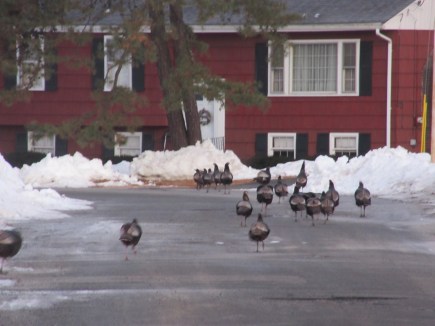
Gang of turkeysI was not disappointed. First of all, there was the waning moon shining bright in the western sky.  Then there was the gang of turkeys marching down the end of my street.  Twenty strong, they roam the place like they own it, and they do, as much as we do. Around the corner, a neighbor walks her little dog: Sparkles is still a puppy and just can’t contain herself when I approach.  She is trying to learn not to jump.  But she jumps. So we say our good mornings with enthusiasm.

Cardinal with tuftsOn my own again, around another corner, I hear a cardinal singing. He is already looking for a mate, or marking out his territory. I can see him in the tree, his characteristic shape visible with its tufted head, even though he is too far away to see the brightness of his red feathers.

The streets are a mix of clear pavement and icy patches, so I make my way carefully, no rushing.  But I feel buoyant in the  early morning light.  Finally, I approach the brook, and look over to the east, where I catch my first glimpse of the sun rising through the thicket of trees.

I am a morning person, but I usually don’t like to get up before 6 a.m. Just before sunrise is my favorite time of the day, but if it gets too early, I have a hard time making it out of bed.  In this regard, I will be saved by Daylight Savings Time on March 10. The sunrise would have been at 6:03 that day, but we jump our clocks ahead, so it slides back to 7:03. Then we have all the days until April 15 before it approaches 6 a.m. again. Nonetheless, everything is starting to wake up now. Buds are starting to appear on the fruit trees. Birds are singing. They know.

Sunrise in trees

[True happiness is not in buying things, but in being thankful for all that we already have. You can ignore any ads that appear at the end of these posts.]

Moments of Joy

Capisic Brook invisible cardinals

I saw a group of cardinals on my walk today! I haven’t seen them all winter, but as I stood still, watching the beauty of Capisic Brook, first one and then another and then more appeared in the distance.  You can’t really see them in the photo, but after the brook bends to the right, and then to the left–they were there in the bushes near the water. Then, as I was walking home, I heard a cardinal sing in the trees nearer my house. Joy!

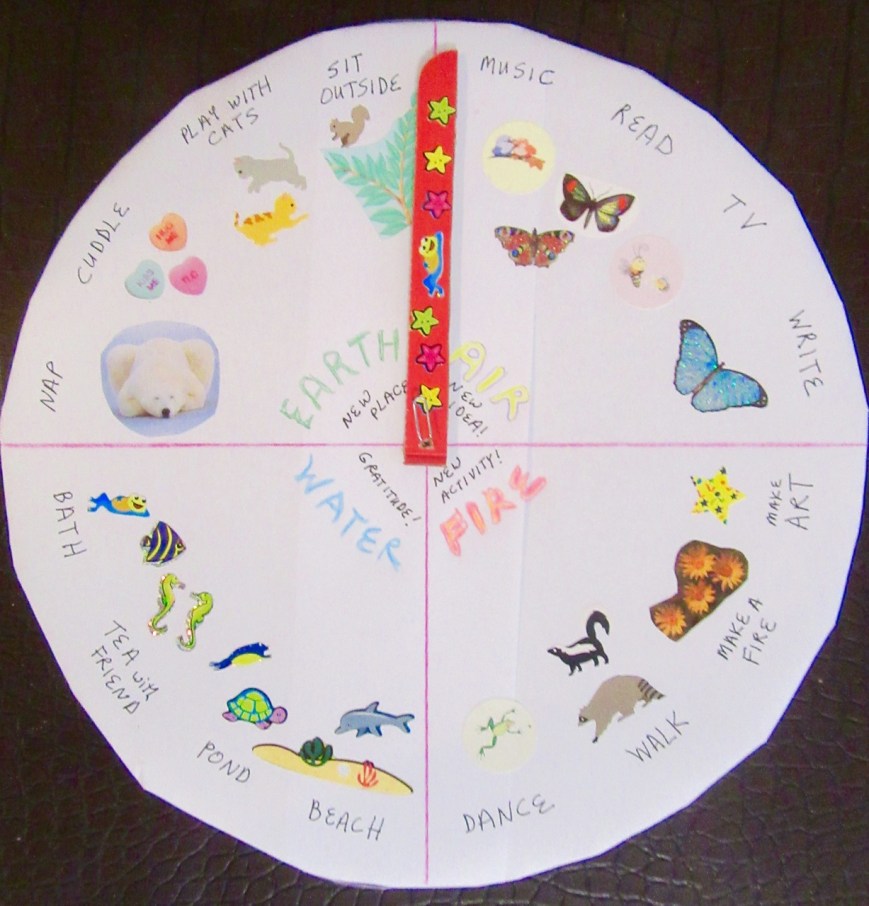
I was thinking more about the fun wheel I created the other day. I put “Walk” as something to do under the element of fire, but really, my morning walks include all the elements. Fire is for the movement of my body, and sometimes, the bright sun rising.  But I almost always walk to the brook–which is water.  And I am connecting to the trees and the land and sometimes little animals–which is earth. Hearing the songs of birds, breathing in the invigorating air, well that is air.

Sometimes the walk feels like a chore–getting out there in the cold–it’s exercise, you know, good for me, I should do it, etc.  And my usual definition of fun is something I don’t have to do–no “shoulds.” But often, even usually, once I get out there, a walk is a doorway into moments of delight, moments like seeing the cardinals today, or finding turkeys in the street, or sometimes near the brook, catching a glimpse of a fox or a raccoon. Moments of surprise and moments of joy.

What might you do today to open a doorway into possibility, into moments of joy?

Wheel of Fun

Fun Wheel

Today, Margy and I made art together.  She was coloring Celtic goddesses, and I made this fun wheel.  It is on the model of a chore wheel–you know, where you spin the dial and know who is doing dishes, or laundry, or sweeping the floor.  Only this is for activities that bring joy.  Since that is not always my forte.  So this way, I can spin the dial, and have a suggestion for a fun thing to do.

I constructed a wheel out of cardboard and paper, and then I brainstormed a list of ideas for activities.  I decided to categorize them by the four elements–Earth, Air, Fire and Water.  Because I am a witch and that is how my mind works.  Plus it occurred to me that to care for ourselves, it might be good to have nourishment in all four elements.  Then I decorated with stickers.

We were listening to music while we made art! Plus I took a break to drink a cup of tea and play with Sassy… so that is air, fire, water and earth in one afternoon.  In the center is traditionally the element of spirit, and I thought to add new places, new ideas, new activities, and gratitude to fill out the center of the circle. Today, doing art is our new activity.

What I noticed:  in my original list of activities, the fewest were for water–I had to ponder that and add a couple more.  In my everyday life, most of the activities for earth and air already happen every day, fewer for fire and water.  What do you do for fun and self-care?

[Note–because I use free WordPress for blogging they sometimes add ads at the bottom of my posts. I have no control over these ads and invite you to ignore them.]


Being Interrupted

One morning, I couldn’t find two handout pages from my Wabanaki Languages class. The day before, those two pages had been on the kitchen table, ready for me to work on them over breakfast. But at breakfast, not there. I looked everywhere. I am usually very organized, so when something gets lost, I go a little bonkers.  I looked in the basement, I looked in the junk drawer, I looked on my writing desk, I looked in the basement again. Nothing. We’d had our house cleaned the day before, so I emailed our housecleaner to see if perhaps she had put them somewhere.  I secretly wondered if Margy had moved them. (Sorry Margy!)

Finally, after more than an hour of this, I gave up.  There was no where else to look.  I stopped.  I sat in my room in the chair next to the window and wrote in my journal.  Writing in my journal is a form of praying for me.  Praying is a form of surrender.  I wrote, “How do I handle this? I give up. I can’t do my day as I planned it–the next Wabanaki lesson over breakfast and then, etc. I give in. Is there a better response than going bonkers? Is this some sort of cosmic interruption? What should I be paying attention to?”  Then I sat silently and breathed. I accepted the interruption. I got more quiet and breathed some more.

Then I quietly remembered that I had moved some health notes from the table the day before. And that is where I found my lesson pages, intermingled among them.

But I continued to sit, and I reflected on how much energy I used up being anxious and frantic about losing the papers. It was only when I gave in, and prayed, that the answer emerged, from quiet.  So I decided to fully embrace this cosmic interruption of my plans for the day. I let go of the projects I had thought about doing, and went into Margy’s room and we cuddled.  We decided to go see the ice disk in the Presumpscot River in Westbrook–that temporary, famous, huge, slowly spinning circle of ice that was mysteriously floating on the surface of the river.

We walked along the river and took photos.  We mingled with dozens of other people who were out to see this curiosity of nature. We felt full of joy.  I learned that this is what can come from embracing cosmic interruptions.  Joy. Maybe there is a cosmic interruption waiting to happen for you today?

Ice disk in Westbrook

Wabanaki Languages 102

I wanted to study Wabanaki languages with Roger Paul as a way of decolonizing my mind.  Yesterday we began the second semester and already I am experiencing two challenges which seem directly related to this very decolonization process.

Wabanaki languages were spoken for thousands of years, and only more recently have been written, usually with the aid of outside linguists who were sent to each tribe and devised writing systems that differed from each other.  These writing systems are still in flux.  There is an “official” writing system for Passamaquoddy for example, exemplified in the online dictionary, but there are also phonetic systems that spell words more closely based on how they sound.  Roger really doesn’t care how we spell the words.  He grew up speaking the language, but only learned to write it as an adult.  He cares about how we pronounce and speak. So this is a shift from my own ingrained habit of learning more by seeing a word written, than by hearing it spoken. (Though of course, all babies learn to listen and speak before we learn to write. And we do learn to write the words as well.)

The second challenge is that Wabanaki words do not exist as fixed isolated units, but change form in relationship to the context and meaning. In the first semester, we studied lists of words (and a few phrases), beginning to create a basic vocabulary.  But in this semester, we will be studying sentences.  Words in relationship to each other.  And words as sentences–because a sentence might be expressed in one “word.”

As I think about it, I realize how much this may reflect underlying differences between Euro-centric culture and Indigenous culture here on this land.  Euro-centric culture is object oriented–taking things apart, categorizing them, defining them.  Indigenous culture is relational–nothing exists except in relation to everything else. Likewise, English words are more fixed in form, while Wabanaki words are relational.

Last semester, I gradually created a huge set of flash cards with all the words presented, so I could practice and learn them.  I created recorded excerpts of the words and their meanings, so I could listen to them (especially in the car) and get the pronunciations into my head. But now, we are stepping into a different sort of process. The change goes deeper.

Kuskicinuwatu?  (or) Gooskeejinuwadoo? (or) Do you speak a Native language?

Robins in berry tree

Robins hidden within the branches of a winter tree.


Disappearing Moon

Lunar Eclipse half way – Version 2After a stormy snow all day long, the sky cleared long enough for me to watch the beauty and mystery of the lunar eclipse, in the crisp cold wind blowing through our back yard. I am not usually awake this late, but something called me out when I saw the sky had cleared.  I kept warm by shoveling the walkway, and I prayed for our troubled world. Actually, it felt like the moon itself warmed my body and soul.

What does eclipse mean?  It spoke to me of disappearing, the power of the hidden, the gift of letting go of any need to shine.  It spoke to me of the beauty of what is hidden.  As the moon became fully eclipsed, the foggy clouds also drifted in, and it was gone from sight. Hidden being, bless our aching world, heal our wounded hearts.Lunar Eclipse almost full – Version 2

About Ads

It’s ironic: since I am using the “free” version of WordPress to publish, they occasionally place ads at the end of my posts.  I want to point out that I have no control over the content of any ads that appear, and sadly, they usually advertise products that are the very opposite of the values that I am writing about.

I apologize for these incongruities!  Isn’t that the position in which we find ourselves so often? We are embedded in systems that infiltrate all aspects of our lives, even as we imagine a better way of living.

IMG_0364

Resilience in Portland

Cherry Tree and companion July

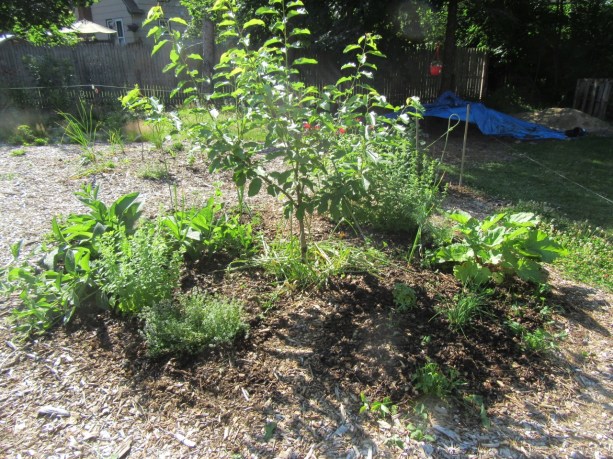
[Photo of our cherry tree with its companion plants.]

I really believe that permaculture offers a way to live in this time of ecological crisis. In Portland, we have a wonderful resource for learning permaculture skills, and offering mutual aid as we learn. The Resilience Hub helps people to regenerate the land, grow healthy food, and build community.  In that way, it also cultivates hope. In June of 2017, the Resilience Hub was the sponsor of our Permablitz when over 20 people came to help us establish our garden.

Over the last ten years, the Resilience Hub has become a thriving community organization. This past summer, its founder, Lisa Fernandes, moved on into new, but related work. Lisa’s departure prompted a series of community conversations about the future of the Hub: its assets and challenges, its goals and visions. Margy and I attended many of those meetings, and I was so committed to continue this important work that I volunteered to be on the new Board of Directors. We now have new part-time staff, Kate Wallace as Executive and Programming Director and Benjamin Roehrl as Operations Director. See more about our plans going forward at the website.

BUT–the Hub is at a critical point and needs all of us who care about permaculture in Maine to show up with financial help and renewed involvement. To that end, we created a Go Fund Me campaign, and we are trying to reach our goal in the next few days.  I’ve shared it via Facebook, but thought I would add my blog “audience” to this appeal as well.  Please check out our page, and donate what you can!  And if you are local to southern Maine, sign up to be on our active members list!

We are celebrating with a potluck and party this Thursday, January 17, from 6-9 p.m. at the Hub at 224 Anderson Street in Portland. See more about the party at https://www.meetup.com/maine-permaculture/events/257165312/

One of my favorite definitions of permaculture is “revolution disguised as gardening.”  Charles Eisenstein says, (in his recent book, Climate: A New Story,) in this time of ecological degradation, perhaps the most important work we can do is to care for and regenerate the places we live in, the places we love. (More on that later!) That’s what the Resilience Hub is all about. Thank you for helping us to keep it thriving!