The other day I read an article in the Guardian, The Great Climate Silence by Clive Hamilton. I found it easy to agree–no one is really talking about or dealing with the coming catastrophe of climate change. Having had these issues on my mind for a while, I moved on to other things that day. But sometimes it is the little things that break through to our hearts.
This morning, I was planning to walk over to Evergreen Cemetery for the Warbler Walk sponsored by Maine Audubon, but though I searched everywhere, I couldn’t find my pair of binoculars. So I left the house feeling that sense of frustration I am sure we all feel when we can’t find something. As I walked, I opted to forego the warblers, and go by Capisic Brook near the Hall School. I wrote previously about the cutting of trees that is going on for construction of the new school.
 The big loud machines are still there, but today I was startled to see that they have also cut trees between the school and the brook, a whole section that I thought should be safe. The wide swath of trees that made for a little wilderness in the city, is being narrowed so that the sanctuary is no longer as much a sanctuary.
I am not in on any of the planning or decision-making, so I feel very helpless and sad and angry about all of this, wishing there were someone I could yell at, like, Really, you have to cut those trees too? Isn’t it bad enough that you destroyed the trail on the other side of the school? Meanwhile the big machines kept digging up the earth near the pathway, now widened to a road, that goes over the brook. As I walked back over that pathway, I heard the plaintive chirps of a woodpecker that I have often seen in this little ecosystem.
On my way home, I thought about the article about climate silence. But this time, my frustration and grief and anger were open, and I felt for the earth as a whole what I had been feeling for my little brook and its trees and birds and newly blooming trout lilies. Why are we doing this? Isn’t it bad enough that we’ve already caused extinctions, and destroyed so many ecosystems? Why do we just keep on destroying more and more? We’ve got to get out of our denial, face our grief, and break our silence.
And for some reason I also thought about the proposal to borrow money to re-build four of the other elementary schools in Portland. Most progressives I know are in favor of that proposal, but when I think about climate change, I have misgivings. It is not about particular trees or construction damage, or not wanting the best schools for our kids. But just as Clive Hamilton suggests, no one takes into account the coming catastrophes as they go about making plans for the future. The new Hall School is slated to be a “green building.” So yes, that is good. But there are other issues, too.
The one that came to my heart today is debt. I think about cities in Michigan that are under “emergency management” because they went bankrupt from debts they could not repay. Those managers, with no democratic accountability, can close school districts, sell off common resources like parks and museums, and change public water systems, such that the children in Flint were poisoned by lead. If we take into account the coming climate catastrophes, wouldn’t it be wise to get our cities and ourselves out of debt? So that we can preserve local control when things get worse? Do we really want the banks to be in charge when everything gets more chaotic and difficult?
Everything shifts when we include climate change and the earth ecosystem in our conversations about the future. What questions might you start asking, that you haven’t been asking up until now?
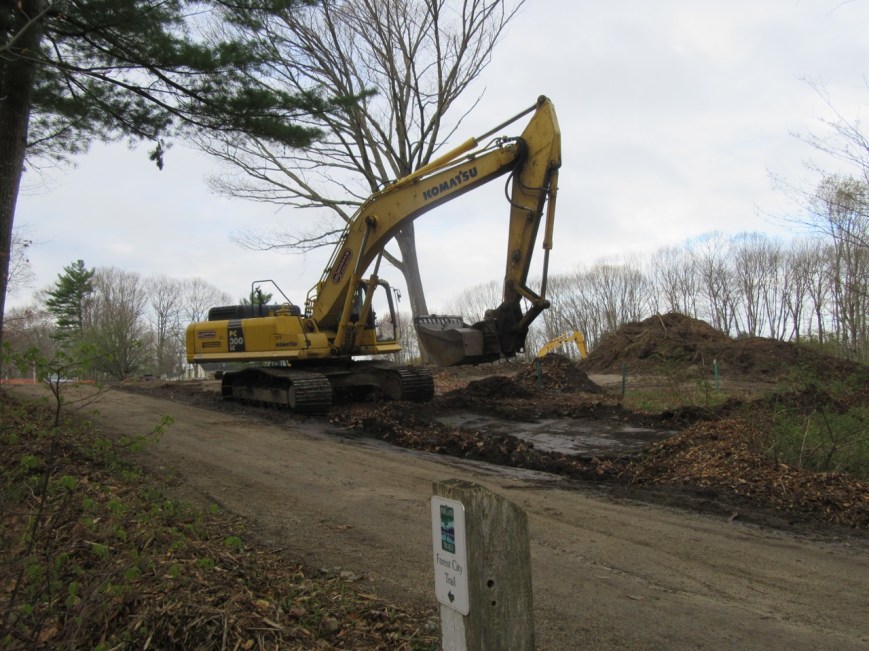
[Forest City Trail sign, with big machine digging up the earth]
 This is a section of our evolving Permaculture Design for our yard. (It didn’t really work to try to put the whole design into one photo, so this is of the half of the yard nearest the house.) I had started this design by measuring everything in our yard and putting them on grid paper–the grids equate to 3 feet square. Then we had lots more input with our
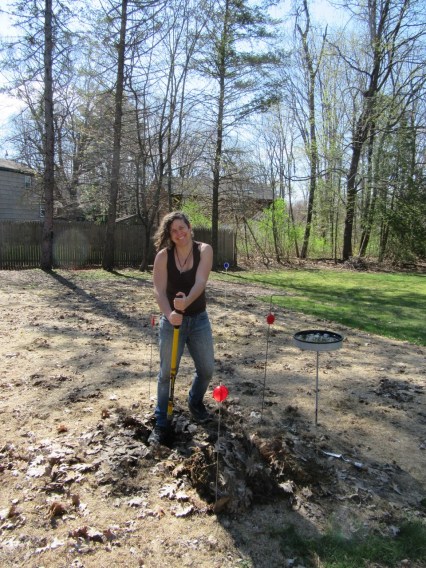
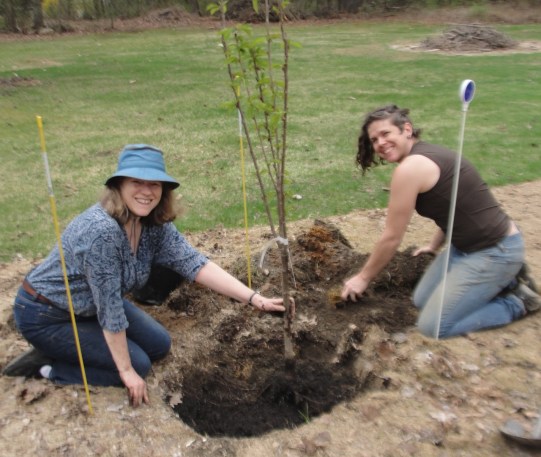

 Some of the plants and their functions: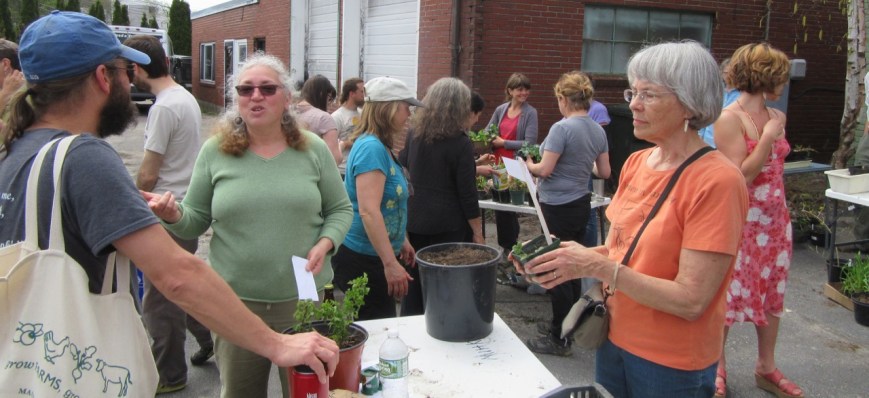


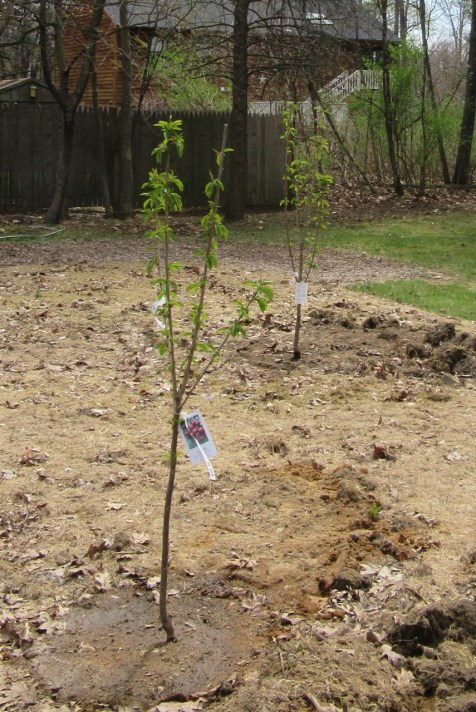
 On Friday the 21st, Margy, our friend Mihku, and I went to Broadway Gardens and picked out two sweet cherry trees. Mihku is a master gardener and her help was invaluable–in fact, the sales person suggested she should have a job sitting with their trees and telling people about them.
 On March 11 and 25th, Margy and I hosted two sessions of an “Intro to Permaculture Design” course, through the
 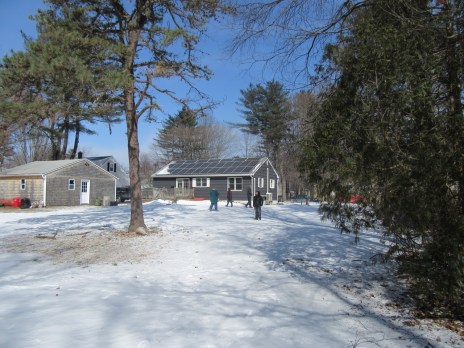 One of the first aspects of Permaculture Design is observation, and so Margy and I have spent the first year of our residence here mostly in observation–trying to learn everything we can about the land, before we begin gardening. Having another group of eyes was marvelous!
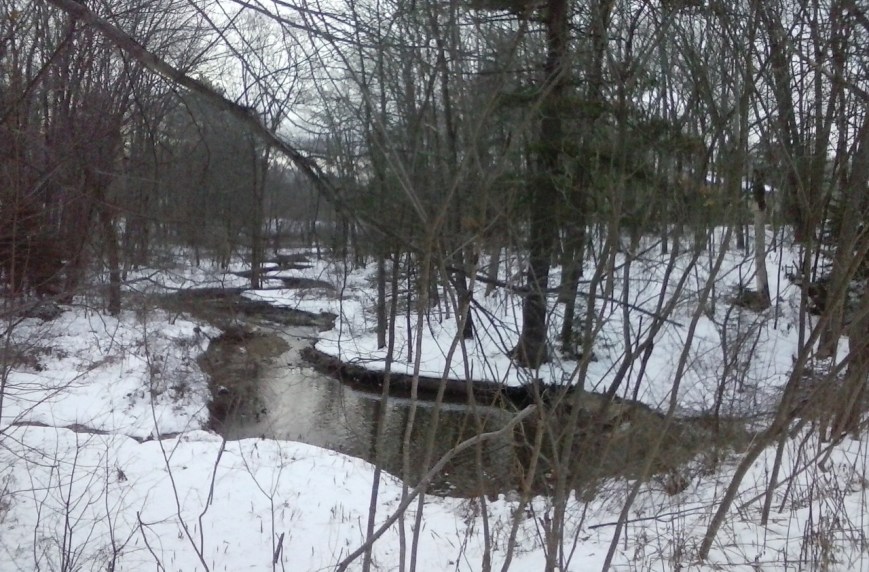 The path forward will not be a straight line. I find hope in that. A river or stream meanders on its way to the sea. [Thank you Starhawk for teaching me about this!] Because of the friction of the river bed, the water on the bottom of the river moves more slowly than the water on the top. So it creates a spiraling current that wears down one bank and deposits sediment on the other, and then vice versa, as it moves around and around in sweeping curves. Just so, our journey into a new relationship with all life on earth will meander—I imagine in this case, there is more movement at the bottom of our culture, while the top is going much slower. But since we are all connected, movement in any segment has a ripple effect on the whole.

