The Search for Greener Housing, Part Three

House Search #1 DSC09847Following our dream of finding greener and accessible housing, we have now looked at six houses. The first was in a great location (halfway between the houses of two friends!) and had an amazingly private back yard, despite being right in town, though it was hard to get to the yard from the house. It had an almost south facing roof, but narrow hallways, and we couldn’t imagine how we could make it accessible without major reconstruction. Plus, there was a tenant in the basement who had lived there over 25 years, and the house wouldn’t have worked for us without the basement space. Bad karma?

The second house had such great character–it was a house we would love to live in. There were blueberries and raspberries in the yard, which we were told we could pick, and so we did. House Search 2 DSC09736There were gardens and a hoop house for extending the growing season. Lots of windows, sunny, and though it was a bit out of town, it was close to a lake, which was a nice bonus. There was not quite as much work to make it accessible, (though still some) but it was a very old house, and there was water along the edges of the basement–along with a mildew smell. And because of the unique shape of the house, it might be hard to insulate and put up solar. Regretfully, we decided it was too much to take on.

The third house had a great open living/dining/kitchen area, a lovely back deck, and also a great yard–though the very back of it fronted onto an in-use railroad track. It looked like we could put solar on the garage. But the bedrooms were dark and felt small, and there were two very tiny bathrooms that would have to be remodeled into one. We talked about whether we could put in more windows. Also there were a lot of steps to the front door.

The fourth house was on a busy street, too small, and not really worth looking at.

The fifth house was fully accessible! It had a lovely open kitchen/living area, a great deck, and nice bedrooms and bathroom. BUT–it was larger than our current house, and so that didn’t fit our goal of downsizing and having fewer expenses. They said it had been insulated, but it had used quite a bit more gallons of oil over the season than where we are now. However, it was great to see what someone else had done for accessibility and beauty.

The sixth house inspired a long conversation with our green-building savvy real estate agent. (That was one of our practical steps–to find an environmentally experienced agent!) The house was in great shape, with a lovely living room with a fireplace, a big mud room, two nice sized bedrooms on the first floor and extra finished space in the basement. It had a one car garage that probably could have been expanded to two ($), we’d need to remodel the bathroom for access, widen a doorway–and once again, it was an odd-shaped roof, so solar might be more expensive. Plus it had these great old cast iron radiators along the baseboards, but if we went electric they would all have to come out with much ado. And even with a lot of work, we probably couldn’t get to zero-carbon in this house, would have to keep using oil.

Our agent suggested that with all of these houses we’d seen so far, we were trying to squeeze ourselves into a house that wasn’t really quite right for what we wanted. Each one would require a lot of renovations in addition to solar and air-source heat pumps and insulation. It is an emotional up and down–excitement over houses that seem worth seeing, and in some ways are so close to what we want, or have such nice qualities, but then the disappoint that they don’t quite work. AND tomorrow could mean another house comes on the market that could be just right.
The Search for Greener Housing, Part Two

After deciding it is the right time to start searching for a more ecologically friendly house, my partner and I sit down together and make a list of what we hope for in a home.

  • One-level living that can be made wheelchair accessible (because my partner can’t do a lot of steps, and we have friends who use wheelchairs, and universal design makes sense for a house we want to get older in.)
  • South facing roof that is solar energy suitable
  • Able to be retrofitted with more insulation and air-source heat pumps
  • Location closer to Portland and public transportation, near some sort of village center
  • Quiet street
  • An area safe for lesbians and people of color
  • Privacy in the back yard
  • About a quarter-acre lot, smaller than where we are now, but still room for permaculture gardening. Some parts shady with trees, some parts sunny, and flat enough for easy access. We want to get rid of lawn to mow, and have other kinds of plantings instead.
  • And, perhaps counter to our village center idea, a location close to woods and critters?
  • About 1200 square feet of house (this number to be adapted as we actually look at houses and see what the spaces feel like.)
  • Two bedrooms plus some office space and guest space
  • Living area that can hold ten people or so for gathering together
  • Some extra space, like a basement
  • Wood floors or equivalent–no carpet, no mold, no smokers. (We have allergies. If there is carpet, plan to replace with wood floors.)
  • Big windows, lots of light
  • Two-car garage (because of Maine winters, and for now we need two cars)
  • Laundry on first floor
  • Mudroom area
  • Fireplace or wood stove, more for the feeling of a hearth than for heat
  • Deck
  • No vinyl siding (That stuff is really bad for the environment! Watch the documentary Blue Vinyl!)
  • Electric appliances

Okay, that’s our list, that’s our desire. And of course, we want a sound, well-built house that will last. The other part of the equation is that we want the price to be enough less than our current house so we can afford to do the retrofits and add solar energy without taking on more debt. Our goal is to own it debt-free before we come to retirement, and to have the ongoing taxes and utilities and maintenance costs affordable to us on a low retirement income.

There is a strange magic to finding a new home. There are practical steps we need to take, but then, it all depends on what is out there. And what will emerge in the next day or week or month. I have moved dozens of times in my life, and it always brings up a lot of anxiety for me. Will we find a home that works for us? Will we recognize it when we see it? What is essential on our list, and where can we compromise? It took us four months to find our current home when we moved here to Maine. Will it take that long for this process? If we find a house we like, will we be able to bid for it successfully? My partner has her own list of fears.

In this magic of finding a new home, we are placing our desires up against our fears. That is why it feels important to me to name our very specific desires for a new home, and also to acknowledge and honor our fears. I know that magic works that way. But there is another deeper movement going on as well. It comes to mind again as I look at houses-for-sale online. In the listings, they don’t mention the orientation of the house, so I try to figure it out by looking closely at the maps. It is discouraging how few houses have a south-facing roof.

Then I remember that we are trying to do something new with this move–we are trying to re-orient our home environment into harmony with all life on earth. The current built environment is oriented around cheap oil and other fossil fuels. It can’t last. We are trying to take our own small steps closer to a whole new way of living that is about beauty and sustainability and a future for the generations yet to be born. There is a great Earth energy that is beneath our feet guiding our way down this path.

It says to me, “Remember to embrace the process. Enjoy the whole journey, right now! You don’t have to wait until everything is ‘settled.’ Keep taking small steps until you are ready to leap. Until the time comes when it is clear. You do not have to rush. Keep holding hands with the ones you love.”

Photo by Margy Dowzer

Photo by Margy Dowzer

The Search for Greener Housing, Part One

For a long time, I have been saying to whomever might listen that my fantasy is to live in a zero-carbon home, a home that is so energy efficient that it doesn’t put carbon into the atmosphere through burning fossil fuels, or use energy that is based on fossil fuels.  There is more to it than that, but ultimately, I am hoping for a way to live more in harmony with the whole of the living earth, to live as if our human future holds life-sustaining possibilities.

So, my partner and I have started on a new adventure toward this greener living.  We have decided to downsize from our current home, and look for a smaller home that could be retrofitted to approach zero-carbon efficiency.  It is an adventure full of anxieties and tensions, so I decided to create a blog journal as we go.  I want to remind myself of the core values involved in this transition, and the grace and magic available to us when we take steps toward our deepest earth connection. It is also a way to honor the challenges we face as we seek to create change.

Our house with trees

Our house with trees

There are so many things we love about our current home–it is a well-built ranch-style house on one acre of land full of grand mature trees–large maples in the front yard, and tall oaks, pines, hemlocks, spruce, and birches in the back yard. We have such privacy and beauty around us when we go outside, and this place has been a teacher for my journey into deeper connection with the earth. There are birds and chipmunks and other critters who wander through. The house is full of light.

So why leave? For one reason, there are limits to what can be done with this house toward greater sustainability.  It doesn’t have the right alignment for solar power, for example. Secondly, it is out in the country/suburbs, and totally dependent on automobile transportation for every human need. So even if the house could be made more efficient, the location is oil-dependent. Thirdly, and perhaps most basically, it is more house and land than we really need, and expensive for us to maintain and take care of.  We couldn’t afford to do much more than we have already done toward greener living in this house. And as we look toward the possibility of future retirement, we realize we couldn’t afford to stay here at all on a retirement income.

One essential part of this process of change is the grief that emerges when we contemplate letting go of a home we have loved, and these trees that are older than we are. When we open our hearts to the land, we open our hearts to the particularity of a place.  This unique place.  I have taken hundreds of walks down this road, taken photos of these trees in all seasons, walked to the conservation land and the water district land just half a mile away.  I’ve cross-country skied back behind the yards and houses through little paths in woods out to hidden fields.  I know where the lady slippers bloom in the spring. We’ve planted flowers and bushes and young trees here, along with blueberries and raspberries.

Can a part of the magic of this change create protection for this land we have nurtured? Only if some new resident falls in love as we fell in love when we arrived here. Maybe someone with more resources could even take this place further on its own path to sustainability.  In the meantime, we keep our hands in the soil and our hearts open. We gather this season’s raspberries and keep going outside. Perhaps our love for this land is a part of the magic of this journey.

Next time, I will share our particular dreams for the new home we are seeking…

Changing Lanes Without Signaling

"Ta-Nehisi Coates" by Eduardo Montes-Bradley. Licensed under CC BY-SA 4.0 via Wikimedia Commons

“Ta-Nehisi Coates” by Eduardo Montes-Bradley. Licensed under CC BY-SA 4.0 via Wikimedia Commons

Ta-Nehisi Coates’ new book, Between the World and Me, is a powerfully devastating window into the experience of living in a black body in America, a body that is constantly vulnerable to assault, to capture, to torture, to destruction, to death.

I am a white woman who has long been involved in the white anti-racist struggle–I say this, not with any attempt at boasting, but merely to point out the map that my reality has followed over the last more than thirty years of my life. But even so, Coates’ words painted a picture of soul-shattering fear that struck me to the core.

I grew up with a general feeling of safety. I belonged to a working class family in Michigan, living in suburban Detroit for the most part, raised to believe that “all people are the children of God,” but also living in all-white communities where racial violence was something that appeared only on our television screen. A liberal white world aspiring to be “colorblind,” in the “Dream” that Coates describes as the place where white America lives as if asleep, unaware that it is built on the violence against black bodies.

I was asleep like that, but in my young adulthood I began to wake up to the horrific realities that America was built upon–the theft of the land and destruction of Indigenous people, the slavery and destruction of Black people. The first window into those realities came through my own awakening to the violence that was perpetrated on female bodies. That violence was hidden under the mantle of (white) safety. I did not actually experience sexual violence in my own body, only the constant threat and fear of it. Don’t go out at night, don’t talk to strangers, don’t dress to draw attention to your body, and so on. But here was the irony–a woman could “feel” safe if she stayed “asleep.” It was only upon waking that the fear undergirding my life became visible.

Once I woke up to that illusion, other illusions began to break through as well, and racism became visible and anti-racism became important to me. But so much remained hidden. Layer upon layer, I kept being surprised again and again at the horror of it, the extent of it, the insidious forms it takes, the interlocking systems that perpetuate it. I got it that we are all implicated, that no one can escape the systems in which whiteness benefits those who are understood to be white, and devastates those understood to be not white.

Ta-Nehisi Coates broke open for me a new and deeper layer of the reality of racism–his words, along with the revelations of the #blacklivesmatter movement, which have kept before the public eye the many recent killings of black people by police. Last week, I watched videos of the police officer’s traffic stop of Sandra Bland. Pulled over for failing to signal a lane change, three days later, she was dead in her jail cell. Something about her story–her innocent journey to start a new job, her bright spirit–brought it all home. No black person is safe anywhere.

This week, as I passed the flashing lights of a police vehicle behind a pulled-over car, I felt an unfamiliar shudder in my gut. A tiny glimpse into the terror. When I read Coates describing the terror he felt when he was stopped in his car by police, these images and videos came to mind, and I understood his fear for his life, his shaky relief when he was let go. A few months later, his friend was killed by the same police force.

The thing is, Coates continues to live with this original and constant fear in his body, just as my body still holds that original feeling of safety, even though I realize its illusory nature. I have to choose to stay awake, to remember. I can take a break, not think about it for a while.

It is not easy to stay awake. Mab Segrest talks of choosing white anti-racism as becoming a “Race Traitor.” There is a loneliness in it, a separation from the mainstream American dream, a separation from family and friends. Most often, I feel more resonance with my friends who are people of color, but I will never really belong to that world either. So staying awake is often lonely and sad. I usually don’t have a clue how to create change, or make things any better. But I believe that if we stay asleep we will never find transformation. We have to wake up to reality, bear its pain, before any change can happen. So thank you Ta-Nehisi Coates for being willing to be so open about the reality in which you live, in which we all live.

How to Face the Mess We’re In Without Going Crazy

Redwood Sky DSC06718I was away for eleven days at an intensive retreat in northern California on The Work That Reconnects with Joanna Macy. I have loved Joanna’s work for over thirty years, from when she was leading workshops on Despair and Empowerment in a Nuclear Age.  If you haven’t yet encountered her work, a great book to begin is Active Hope:  How to Face the Mess We’re in without Going Crazy, co-authored with Chris Johnstone.

Here is the description of the book from the publisher’s page:

The challenges we face can be difficult even to think about. Climate change, the depletion of oil, economic upheaval, and mass extinction together create a planetary emergency of overwhelming proportions. Active Hope shows us how to strengthen our capacity to face this crisis so that we can respond with unexpected resilience and creative power. Drawing on decades of teaching an empowerment approach known as the Work That Reconnects, the authors guide us through a transformational process informed by mythic journeys, modern psychology, spirituality, and holistic science. This process equips us with tools to face the mess we’re in and play our role in the collective transition, or Great Turning, to a life-sustaining society.

A true gift I have experienced in Joanna’s work is a way to experience my own grief for the world, not as a debilitating or paralyzing weight, but as a doorway into experiencing my deep interconnection with all beings.  We begin in gratitude, and the spiral of the work takes us through grief and interconnection, and we go forth with new strength for changing our lives and our world. I came away from the intensive feeling more alive and whole, and with new ideas for bringing people together around this work. Reading a book or a blog can be a solitary experience, but gathering with others to discuss a book, or doing practices together that make the ideas come alive, can be profoundly healing.  I am dreaming of how I might bring this work to Maine.

Birds We Met in Ireland

Before we left home to visit Ireland, I had learned that there were no cardinals there.  The fact of different birds brought home to me that we were really going to a foreign land.  So one of the delights of our visit was to meet new birds–common birds in that place–but curious and unique to us.  Some birds aren’t easy to photograph–we never did catch a picture of the magpies, which we usually saw along the road while driving.  But here are a few that were more happy to be captured for our memories. I took the first three of these photos at Ashley Park near Nenagh.  The later ones were in the Japanese Garden restaurant where Margy and I handed the camera back and forth, and we lost track of which ones were which.

Pied Wagtail

Pied Wagtail

A waterhen calling for her chicks.

A waterhen calling for her chicks.

This is a Robin--a totally different species than our American Robin, though I can see why the Europeans gave the name to ours.

This is a Robin–a totally different species than our American Robin, though I can see why the Europeans gave the name to ours.

The robins were very friendly!

The robins were very friendly!

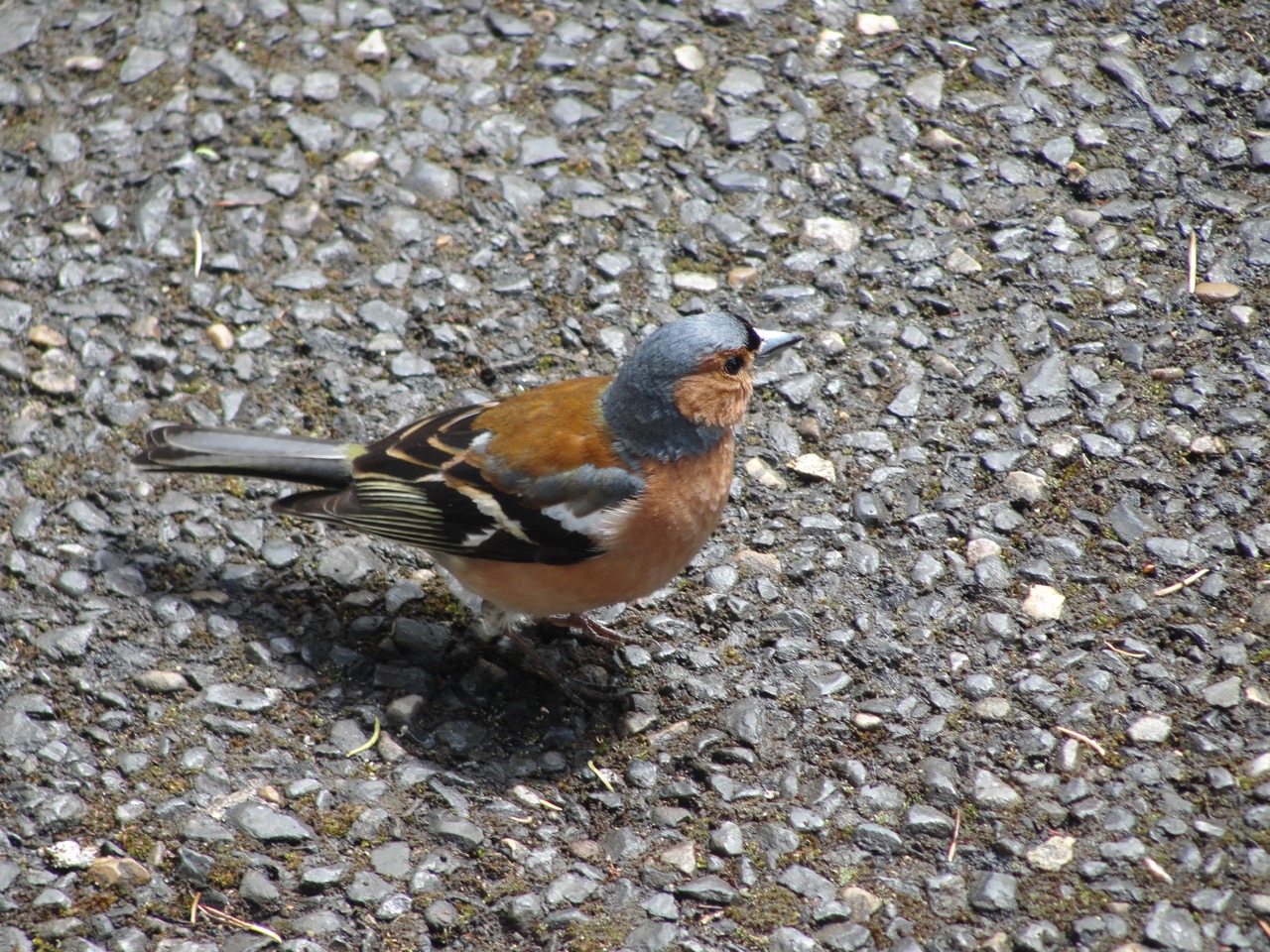
So was this beautiful little bird, the Chaffinch.

So was this beautiful little bird, the Chaffinch.

This fierce looking guy is a Jackdaw.

This fierce looking guy is a Jackdaw.

New Story – New Questions

I have been reading a fascinating book, Charles Eisenstein’s The More Beautiful World Our Hearts Know Is Possible. I am only part way through, so I don’t yet know what my final experience of the book will be, but I am loving the questions he is exploring. He asks about all the underlying assumptions and unexamined perspectives we hold in a world defined by separation. We believe we are separate selves, with humans separate from nature, earth from heaven, people from each other. What might it look like to redefine our world and our beliefs according to a profound interconnection? I have been exploring that same transition in my life and in my writing, and welcome the way his questions take me deeper into a new way of being.

For example, how much are we motivated by the feeling that unless we make something happen, nothing will happen? How is this undergirded by a belief that we are tiny separate beings in a dead, uncaring universe? What if the universe is utterly alive and we are one aspect of its aliveness? Might there be an unfolding process in this living universe that we can rely on, and attune to, and participate in? Then we can pause, we can wait until we are moved in our deepest (inter) being to act. We can lose the idea of “urgency” and “force” and “guilt.”  Eisenstein suggests we might  transform our whole approach to activism.

I keep reading.

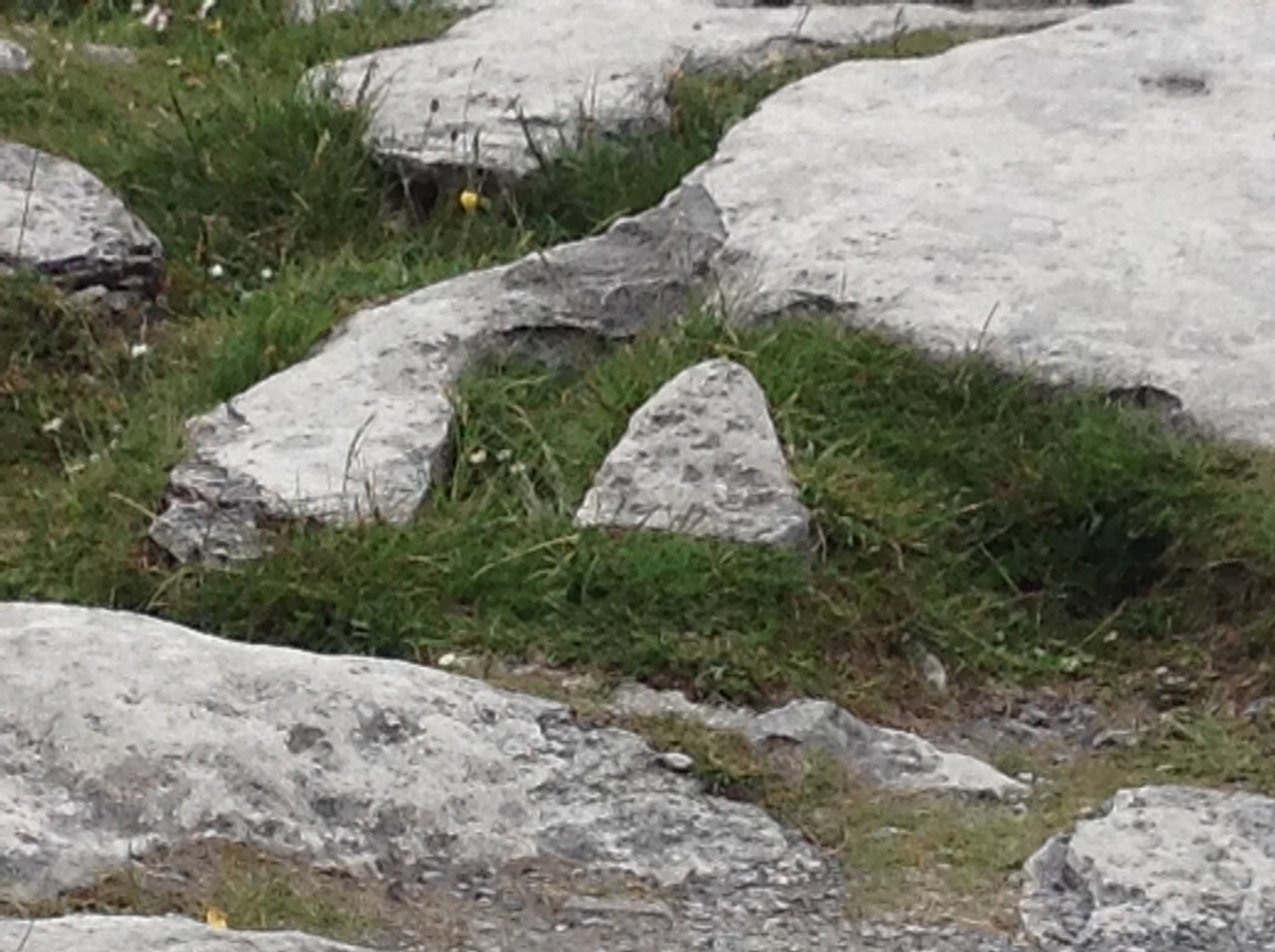
The stones of the Burren.

The stones of the Burren.

The Ancients

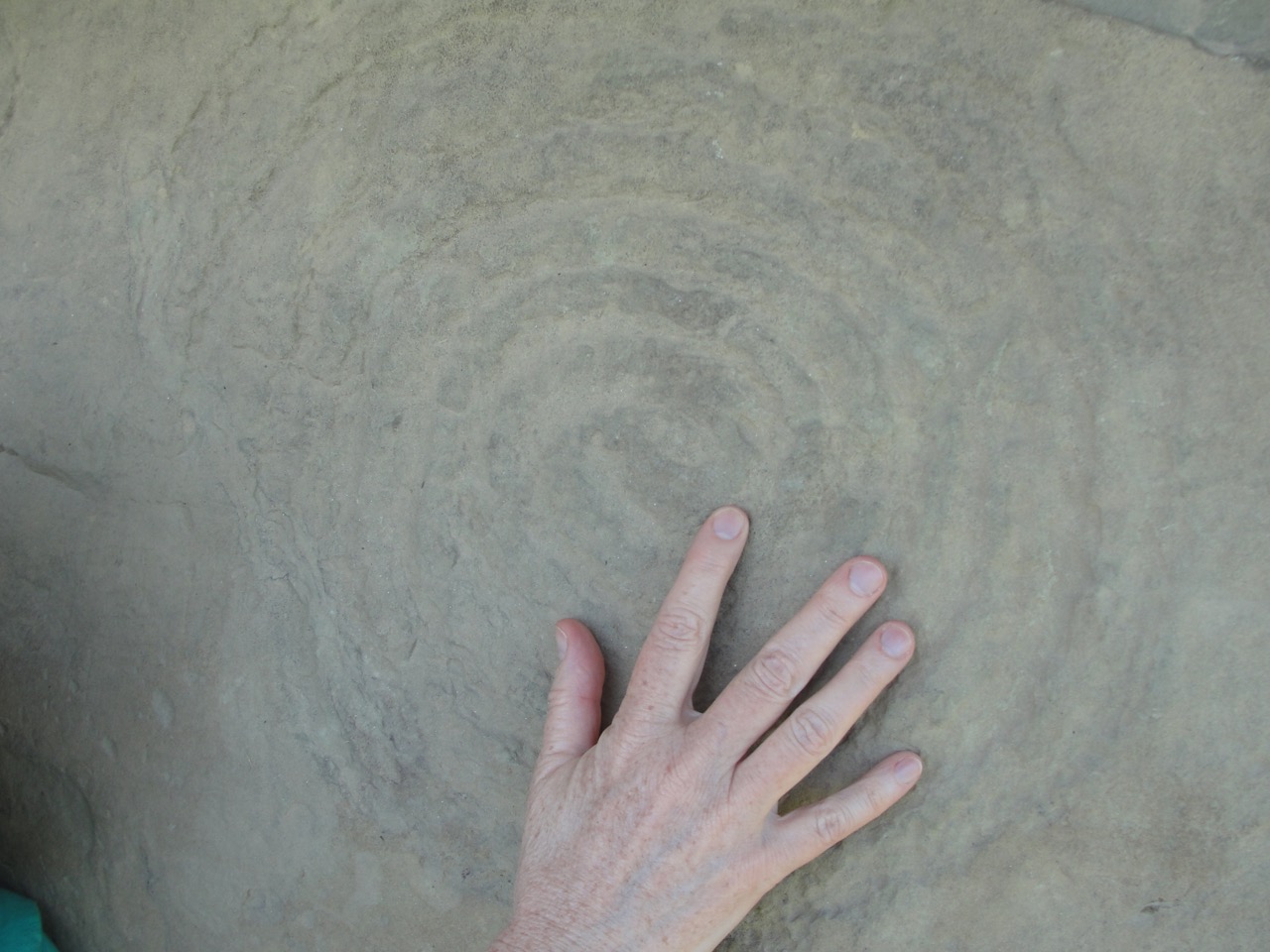
Knowth spiral MD DSC09032

Photo by Margy Dowzer

Thursday, Margy and I went to the ancient sites of Knowth and Newgrange.  Built by neolithic stone age peoples about 5200 years ago, they were burial mounds and ritual centers, aligned with the sun at certain points of the year.  We had heard about Newgrange, where the light from the sun at dawn enters the burial chamber on the Winter Solstice.  But we were even more impressed by Knowth, where tourists are not able to go into the burial chambers–too dangerous–but can walk up to the top of the mound.  There are huge boulders that surround and support the mound, called curb stones, and most of them are covered in geometric images–spirals, triangles, undulating serpent like forms.  We could photograph and touch this art created before the pyramids were built in Egypt.  It is a UNESCO world heritage site because of this high concentration of neolithic art. What an astonishing feeling to trace a spiral that was carved so many generations ago by the ancients!  Our guide said that similar stone carved art with the same kinds of geometric patterns can be found all around the world–America and Australia, for example.  Until fifty years ago or so, all these stones at Knowth were buried under soil–the mounds looked like an extension of the hills.  Then, archaeologists began to excavate and discovered the careful construction and design of the burial passages and chambers, were able to carbon date the remains, and restored the mounds to their neolithic era appearance.  All of the stones are original, and the guides reminded us of the sacred and beloved nature of the site. After this visit I got to thinking about ancient mounds in the United States.  I barely knew anything about them, except that they were built by early indigenous peoples of this land, and that many have been destroyed or are even now being threatened with destruction.  Most recently, I heard about a new football stadium being planned in St. Louis that would destroy the remains, now underground, of a burial site and city.  Since no federal money is involved, there are no laws demanding that they even do archeological investigation. I wonder why our country doesn’t take care of these precious artifacts from the ancients on this land?  In a time when there is international outcry over destruction of ancient sites in Syria, where is the outcry over destruction of ancient sites in America?  I suppose it is directly related to our society’s general insistence on forgetting that these lands once belonged to another people.  As to the mounds that do still exist, I have read that there was much early resistance to thinking that Native peoples would have the expertise to build such structures.  Racism then, must surely underly this disregard, and perhaps the overarching allegiance to the gods of money and profit.  And the brokenness of our times, the forgetting that the land is full of sacredness in her essence and in her history.

Fairy Trees

Hawthorn flowering MJ DSC07671Since we have been in Ireland, I have learned more about fairy trees than I knew before.  On the first day we were here, I was taking photos on the grounds of the B & B, Ashley Park House, and took this one of some beautiful blooms I couldn’t identify.  So many of the plants and birds I was seeing were unfamiliar to me.  I wondered if it might be a hawthorn, because of the small thorns on the branches.  But it had been a long time since I had been around a hawthorn.  Years ago, when I was at the Seneca Women’s Peace Camp, my friend Estelle and I pitched our tents in a little opening of the hedgerow, under a hawthorn tree.  And that was a magical place and time, though I didn’t know about fairy trees then.

When we came over to Ashford in County Wicklow the owner of our B & B had some of these blossoms on our dining table.  I asked her what they were, and she said they were hawthorn.  She herself is not Irish, though she has lived in Ireland for many years.  The next day she told us that her Irish friend had sternly scolded her that it was bad luck to bring these flowers into the house.  We later met that very friend, and she repeated her consternation.  She told us that the hawthorn trees are where the “wee folk” live, and they are not to be disturbed. According to Irish lore, “If you cut one down, you will die.”  You will often see a whole cleared farm field, with a solitary tree remaining–a hawthorn.

I do apologize to the wee folk on behalf of our host–I was glad that her misstep offered me an opportunity to confirm my hunch about the blossoms and gain more understanding about these beautiful trees. Because of so-called “superstitions” like this about the realm of fairy, many ancient sites have been preserved without disturbance for generations.  Fairy mounds and fairy forts and burial sites.  We visited a fairy fort at Ashley Park, a neolithic ring fort made of stones and earth, and covered now with beech trees, and yes, some hawthorn too.  I left a gift of a coin before taking anything from that place.  A strange thing happened.  I was deciding where to leave the coin, and was finally drawn to the largest beech tree, somewhat near the entrance to the fort.  I tossed the little coin into a deep crevice near the root of the tree.

Toad or Frog MJ DSC08139Then, looking in more closely, I realized there was a tiny toad or frog at the very back of the crevice.  I never saw any other toads in that area.  How did it happen that one lived right where I was pulled to leave the offering?  When Margy and I came back the next day together, it was still there, and I took this picture, somewhat blurry as it happened.

In each of these ancient holy places, I have honored the elements and the directions and the ancestors in the best way I can, and these small magics reassure me that we are welcome here.

Water from Brigid’s Well

On our way from the west to the east of Ireland, we stopped in Kildare, the town which was home to St. Brigid, one of the patron saints of Ireland and, according to the stories, an abbess who founded a monastery in 5th and 6th century.  Many stories link her to the older goddess Brigid, goddess of smithcraft, poetry, and healing.  We had read that there were two Brigid’s wells in Kildare–one now designated for the saint, and a pagan well still associated with the goddess.  Apparently, the pagan well wasn’t advertised, but we had read that it could be found near the parking lot of the Japanese Gardens/Irish National Stud.  So we set out to find it.

St. Brigid's Well, Kildare

St. Brigid’s Well, Kildare

On the way, close by, we saw a sign for St. Brigid’s well and found that one.  People come to the Brigid’s wells for the healing properties of their waters, and so we touched the water and asked its blessing.  The well is shallow, about a foot deep, and is spring fed. We left a coin in the water along with our wishes. It is said that this well, too, may have ancient connections to the goddess Brigid, incorporated into Celtic Christianity as St. Brigid.  There are other Brigid’s Wells all over Ireland.

Then we went on to the Japanese Garden, and searched around the parking lot, but didn’t see anything.  We went inside, and had a lovely lunch at the restaurant there.  Afterward, we asked a man at the ticket counter about the second Brigid’s well, and he told us to go around to the other side of the parking lot, behind a little wooden gate.  So off we went, and we found it.  Totally unmarked on the outside, but set into a lovely little paved area, with a half circle of stone wall opposite that could be used as seats.  Nearby, people had left ribbons on the branches (we saw those at the other well too).  It was intriguing to Margy and I that these ancient sacred sites are so hidden in plain sight.

Brigid's Well, Kildare

Brigid’s Well, Kildare

I felt so delighted and awed to be in this place where healing waters have been flowing since ancient times.  Margy and I drank a little water, and took pictures, and absorbed the magic all around us.  Then, an unexpected encounter–I was down on the stones next to the well, with the camera, and Margy was on the stone pavement above, holding my backpack, and she leaned over a little, and suddenly my metal water bottle that was in the open pocket of the backpack fell right into the waters of the well.

Into the Well!  Photo by Margy Dowzer

Into the Well!
Photo by Margy Dowzer

Those of you who know me know that this water bottle I carry has its own sacred role in always reminding me of the holiness of all water.  When I saw it there on the bottom of the well, I remembered that I wanted to take some of Brigid’s healing waters to bring home with me.  Was Brigid herself reminding me, and making a personal connection to us in this way?  I have celebrated her holiday in February for many many years.  So, I leaned in to scoop it out of the well, and then emptied its water into the nearby plants, and filled it with water from the well.

After that, Margy and I sang some more songs, sent healing wishes to all our friends back at home, and left our own ribbon on the branches hanging over the well.  If I may, I also send healing energy to you who are reading this.