Miracles

One of the first things to be discarded by the early Unitarians, as reason was adopted as their guide, was their belief in miracles. They celebrated the wonder of the natural world, but decided that healing and prophecy and other supernatural events found in the Bible were imaginative stories from a more superstitious age. And it all makes sense: those events were not a part of their own lived experience.

However, there are many mysterious aspects of our human experience. More recently, even scientists have grown curious about healing, extra sensory perception, and other phenomena that seem to defy logical understanding. As the orderliness of Newtonian physics gave way to the strange chaotic properties of matter and energy encountered in Quantum physics, people began to wonder if spiritual mysteries had been cast aside too soon.

It has been difficult to use the scientific method to sort out the very subjective realm of spiritual experience. If some people can experience God, does that mean all people should be able to do so? Are there spiritual methods and practices that should consistently produce a spiritual experience? Buddhist and other forms of meditation have had an appeal for skeptical thinkers because meditation is a practice offered in the manner of an experiment. It is a method, not necessarily linked to particular beliefs, and anyone can try it out. But this is not to say that results are easy to measure.

I believe when we move beyond religious dogma that tells us we must believe certain miraculous things have happened in the past, we can move toward a thoughtful openness and curiosity about the inexplicable experiences of our own lives and the lives of those around us. Let me tell you a story from my life. It is actually a rather simple story, nothing big or dramatic. But it taught me something about miracles.

In the spring of 1986, I was living at the Seneca Women’s Peace Camp in upstate New York. At that time of year, there were only a few of us there, staying in an old farmhouse on land near the Seneca Army Depot. We were there to protest nuclear weapons, but this story is not about a prayer for world peace. At that time, my lover was living in western Massachusetts, and I missed her. I didn’t have a car, or much money. My prayer was a wish that I might find a way to go visit her.

The camp was a crossroads of sorts, and it wasn’t uncommon for us to have visitors. Peace activists from all over would stop in for a day or a week. Not so many during the winter or spring, but still a few. In my prayer, I was conscious of my wish to see my love, and I remember imagining someone coming like a knight on a white horse to carry me to Massachusetts. Quite a small prayer.

The very next day someone drove into the driveway. The visitor was driving to Massachusetts in a white pickup truck. It would have been enough to get a ride, which I did. But the white pickup truck was an added ironic touch that still sends goose bumps up my arms. So whimsical and tender a response. 

Photo by Margy Dowzer

Photo by Margy Dowzer

Recognizing Spirit–Keep Your Eyes Open or You Will Miss It

Misty Branch DSC05513Winifred Gallagher, in her memoir, Working on God, chronicled her own spiritual search in the context of what she called “millennial spirituality among the neo-agnostics.” Neo-agnostics are well-educated skeptics who are mistrustful of traditional religious dogma. Unlike believers, neo-agnostics don’t have ready answers to the big questions about the meaning of life. But unlike secular atheists, they sense something important beyond the tools of intellect and learning.

As part of her search, Gallagher studied Zen Buddhist meditation. She was curious about the Zen experience of kensho, which is translated as “see nature.” Kensho is a sudden, ecstatic transformation of a person’s perception of reality. She describes one practitioner’s experience of kensho:

One morning toward the end of a retreat, he despaired of his practice and wished to ‘turn back to the “normal” world.’ For some reason, he recalled the roshi saying ‘Keep your eyes open or you will miss it!’ Suddenly, he says… ‘the teacup in front of me seemed to “fly apart” and all the constituent matter in the cup, and in my body, and in the universe, were the same from all past to all future for endless time. I saw that what seems to be me or a cup is only due to where my self was sitting. This experience totally freed my self from the coming and going and caused the greatest gratitude to well up in my heart.

The word Buddha means the awakened one, and Buddhism offers itself as a method for waking up to the deep unity of reality all around us. Gallagher discovered, however, that Zen practitioners actually put little attention on these peak spiritual experiences. Part of their realization seems to be that ultimately ecstatic experiences do not matter, except perhaps as a help to waking up. The center of devotion for Zen is in the humble and simple practice of sitting and breathing meditation.

There is a similar lesson in the story of Elijah told in the Hebrew Bible. Elijah had displayed the power of his God Yahweh with great signs and wonders in a showdown with the prophets of the God Baal. But the queen, who was loyal to Baal and unconvinced by miracles, wanted to kill him, and he had to flee for his life. He walked for forty days and forty nights until he reached Horeb, the mountain of God.

The story goes on to say that he was told to wait out on the mountain and Yahweh would be passing by. Then there came a mighty wind, so strong it tore the mountains and shattered the rocks, but Yahweh was not in the wind. After the wind came an earthquake. But Yahweh was not in the earthquake. After the earthquake came a fire. But Yahweh was not in the fire. And after the fire there came the sound of a still small voice, like a gentle breeze. And when Elijah heard this, he covered his face with his cloak, for he knew that Yahweh was near.

Rabbi Burton Visottzky says, “A miracle is not God, but that which calls your attention to God, as pyrotechnics do. You have to stop, look—pay attention—before you hear God’s voice. Otherwise, you miss the miracle.”

The Limits of Mystical Experience

Rainbow in Branches DSC03269I come from a peculiar perspective on the topic of spirituality, because I grew up with a father who is a mystic. He later described to me his own pivotal experience of God. He told me he was lifted to a state of bliss that continued for two weeks. During that time, he could feel no pain, and he said if he went walking in the rain, he literally did not get wet. When he read the Christian scriptures, he was struck by the message that Jesus, who had been in glory with God, left that glory to become a human being. He felt then, that he too should let go of this heavenly state, and come back into the ordinary human world of suffering and joy, so he could be of service. And so he did.

When I was growing up, this God lived in our house like another member of the family. Learning to pray was like learning to talk—there was an expectation that someone was there listening. The other side of this story was that my father was far from perfect—he could be dogmatic about his experiences and beliefs, and critical of his children. He got angry and sad and frustrated and disappointed. Don’t get me wrong, he was and is a good and loving man. But once I grew up enough to form my own opinions, I realized that spiritual experiences were no guarantee of emotional compassion, or accuracy in the search for knowledge. Just because my father could have a spiritual experience, did not mean he was always right.

The biggest challenge for me in this regard came when my journey took a very different turn than my father’s. Our family had become involved in the Catholic Pentecostal movement, which in many ways was a very empowering and spiritually nurturing community for a teenage spiritual seeker. But during my last years of college, the Pentecostals were shaping themselves into a more institutional structure, and I found myself repelled by their hierarchical and sexist understandings of community. Where the Spirit seemed to be leading them was very different from where I felt the Spirit was leading me.

My great helper through that time was a woman professor of the Bible, who taught me about scholarly interpretation of sacred texts and the dangers of fundamentalism. I have talked about that in another post.  But I learned, then, that we cannot abandon mind and intellect, as we search for spiritual experience. We’d like to think that people who have spiritual experience will be always compassionate and wise. But it doesn’t necessarily work that way.

Our experience of the larger reality, the great Mystery, is mediated by our human limitations and our human failings. We must keep our eyes open. Spiritual community can be used to hurt and to oppress, as well as to help and uplift. Spiritual conviction can be used for destruction as well as for compassion. Jesus once said that you can know a tree by its fruit, and the apostle Paul wrote, “The fruits of the spirit are love, joy, peace, patience, kindness, goodness, faithfulness, gentleness and self-control.” We too must pay attention to the fruits that are borne by spiritual experience.

Eventually, my own spiritual and intellectual journey led me out of Christianity, and I became a part of the feminist revival of the Goddess. On the one hand, it could be said I was rejecting everything my father stood for. But on the other hand, the essence of the gospel message—the message of liberation for the downtrodden—had opened a door for this next stage of my journey. And it was a similar journey to his—a journey of being called beyond the familiar, into a new experience of reality; a journey of trusting this inner calling and conviction more than outer definitions.

Even though my father and I are worlds apart in the details of our spiritual expression, we can still sometimes find a deep connection because of the inner core of our spiritual journeying. My relationship to my father teaches me about the complications of searching after spirituality as experience. We must trust our own experience, we must honor the experience of others, but we must weigh everything according to our deep values.

Can intellect and ecstasy co-exist?

The Unitarian side of my church’s heritage partly developed in response to what it saw as an excessive focus on “feeling after God” in the Great Awakening of the early eighteenth century. During the Great Awakening, revival preachers were traveling across the countryside stirring people into a frenzy of religious devotion. Salvation was marked by conversion experiences of great emotional intensity. The underside of this fervor was a pessimistic theology that claimed that all human beings were inherently evil and destined to eternal damnation. Salvation was seen as a literal rescue from this horrific fate. An emotional conversion experience marked you as one of the saved.

By contrast, the preachers who were my forebears mistrusted this approach of salvation by catharsis. They advocated a religion based on reason and character, and believed we might participate in the process of spiritual growth. God, they said, would not despise our use of the intellect which he had given us. Reason and character have remained hallmarks of our faith.

Unitarianism became known as a religion comfortable with words, mistrustful of emotion. Yet from the beginning there were Unitarians who worried about the coldness of such a reasonable approach. Ralph Waldo Emerson, called “the father of American spirituality,” complained about it:

“Where now sounds the persuasion, that by its very melody imparadises my heart, and so affirms its own origins in heaven?… The test of a true faith, certainly, should be its power to charm and command the soul…”

Is it possible to find a faith which charms both the mind and the soul? Can intellect and ecstasy co-exist?

Sunset Crescent MJ DSC09452

Emerson quoted from “The Divinity School Address” in Three Prophets of Religious Liberalism

Feeling After God Is a Dangerous Business

Would you climb a mountain if you knew for sure that you could have a spiritual experience at the top? Would you go down into a river? About fifty years ago, theologian Harvey Cox predicted that religion would decline in the face of modern progress, and many educated people agreed. They were skeptical about all matters religious or spiritual. But his prophecy did not turn out to be accurate.

Many people began looking for spiritual experience again, evidenced by such widely diverse phenomena as the New Age movement, the popularity of the Pentecostal movement, and the growing number of people who call themselves “spiritual but not religious.” What they have in common is the desire for an experiential connection to the larger reality, to the mysterious, to the divine. But for many this is still unfamiliar terrain. What is Spirit anyway? What is the Mystery that connects and upholds all life? By what signs would we recognize it if we experienced it?

September 15, 1946 (National Archives and Records Administration). Photo by Russell Lee.

September 15, 1946 (National Archives and Records Administration) Photo by Russell Lee.

One group of people who thought they had the answer were the snake handling churches of the Appalachian south. Perhaps they offer a cautionary tale. Dennis Covington wrote about them in his book Salvation on Sand Mountain. He entered into the world of the “Church of Jesus Christ with Signs Following.” Its name and its practices were drawn from an obscure verse at the end of the gospel of Mark: “And these signs shall follow those who believe: in my name they will cast out demons; they will speak in new tongues; they will pick up serpents, and if they drink any deadly thing, it will not hurt them.”

Interpreting these words literally, their church services regularly invite believers into prayers for healing, the handling of rattlesnakes, and the drinking of strychnine poison. While on the surface, it doesn’t sound like this would play well as an advertisement for divine encounters, the author was amazed to find himself drawn more and more into the power of their experience. What began as a journalistic investigation became a much more personal exploration.

Eventually, he too joined in, and took up serpents. He described it like this:

I didn’t stop to think about it. I just gave in. I stepped forward and took the snake with both hands. I turned to face the congregation and lifted the rattlesnake up toward the light. And it was exactly as the handlers had told me. I felt no fear. The snake seemed to be an extension of myself. And suddenly there seemed to be nothing in the room but me and the snake. Everything else had disappeared… all gone, all faded to white. The air was silent and still and filled with that strong, even light. And I realized that I, too, was fading into the white. I was losing myself by degrees… The snake would be the last to go, and all I could see was the way its scales shimmered one last time in the light… I knew then why the handlers took up serpents.

 What makes an experience a spiritual experience? By what signs would we recognize it? Is an experience of ecstasy an experience of God? Covington would later compare the ecstasy of snake handling to the adrenaline induced high of being on a battlefield, surrounded by the risk of death. But eventually, he mistrusted this emotional surge. It wasn’t the physical danger that drove him away. Rather, it was the dogmatism of the spirit-filled preachers, who condemned him when he didn’t accept their whole system of beliefs. Near the end he remarked, “Feeling after God is dangerous business.”

Meandering Toward Wholeness

If I can remember to be thankful about water, then I have the capacity to take action on its behalf as well. There are many people mobilizing on behalf of clean water. Thankfulness can be the beginning of restoring our relationship with water. And then the water itself will guide us into the next steps on the journey.

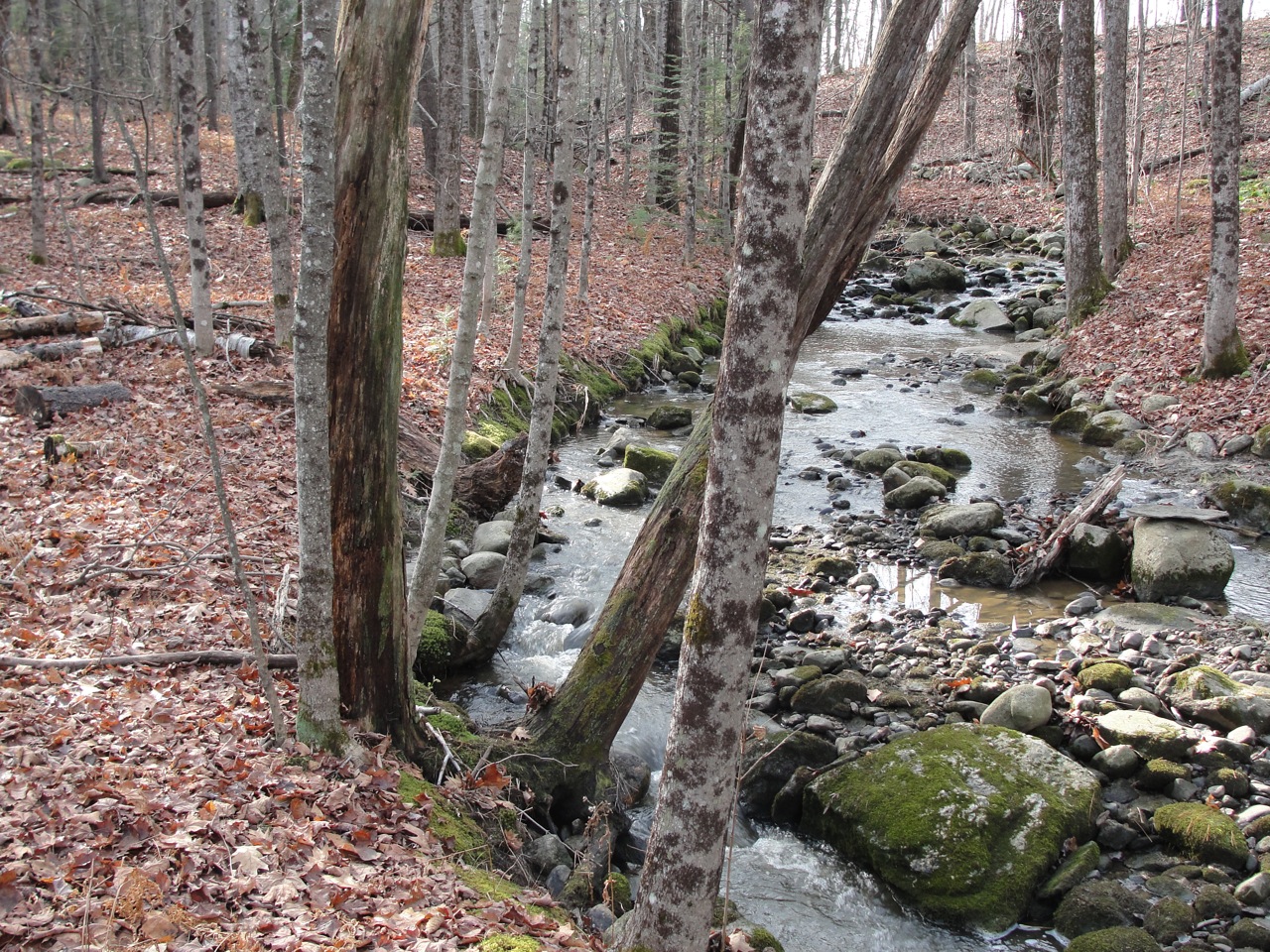
Stream DSC02225The path forward is never a straight line. I find hope in that. A river or stream meanders on its way to the sea. Starhawk explains that because of the friction of the river bed, the water on the bottom of the river moves more slowly than the water on the top. So it creates a spiraling current that wears down one bank and deposits sediment on the other, and then vice versa, as it move around and around in sweeping curves.1 Just so, our journey into a new relationship with all life on earth will meander—I imagine in this case, there is more movement at the bottom of our culture, while the top is going much slower. But since we are all connected, movement in any segment has a ripple effect on the whole.

For me, hope also comes with the choice to keeping taking steps, even small steps, in the direction of living in balance with the rest of our interdependent web. To keep meandering in the direction of wholeness. To keep learning from our elder siblings on this planet—learning from the plants, and animals, the soil and the seasons.


Photo by Margy Dowzer

Photo by Margy Dowzer

One summer, Margy and I purchased two rain barrels, as one step toward more conscious participation in the great cycle of water. We are collecting the rain-water that runs off our garage roof, for use in watering the blueberry bushes I planted in our front yard. We are learning about how high off the ground the barrels need to be, in order for gravity to pull the water all the way to the plants. We are learning that water in a rain barrel heats up rather quickly in the hot summer sun. We are learning how quickly a rainstorm can fill two fifty gallon barrels.

It is a very small step, especially here in our comparatively water abundant climate in Maine. No matter. Some people are taking bigger steps, and that gives me hope too. For example, some people are designing gray water systems that take the water from washing and showering and use it for the garden. Others are restoring rivers and lakes that once were declared dead.

All the earth is one earth. All the water is one water. We all belong to this great cycle of life. Each creative step forward will ripple out into a spiral momentum toward greater balance. I feel hopeful that so many human beings are embracing these deep truths and changing the way we imagine our futures.

We Are a Part of the Watershed

Photo by Margy Dowzer

Photo by Margy Dowzer

Analysts are predicting that water will be the number one political issue in the coming years. Just as wars are being fought over oil, so increasingly there are conflicts over access to water. The business solution is to introduce the “privatization” of water: the theory is that if water is a scarce resource, then the market should determine its price, and price will regulate its use. But citizen’s groups are fighting back to say that water cannot be commodified, because it is an absolute necessity for life. Rather, water must be recognized as a fundamental right and provided equitably to all.

The danger in the privatization of water is that it takes water out of its relationship to all living beings, and into the hands of a system which is set up to think only in terms of profit. Water is not something separate from us, something we have made, that we might think of it in terms of selling and buying. Water is in us and we are in water. We must think of ourselves as part of the watershed.

The water we drink passes through us, and is returned to the earth. When we open our hearts to the wonder of this cycle, we can begin to heal from the out-of-balance patterns we all have learned in our society. Weeping is a part of it too. The water of tears moves our grief, heals and cleanses, as water does, moves us on the journey. The cycles of water teach us that we are all related.

Each of us has a choice. Will we approach water as a commodity to be used, or as a blessing to be honored? If we acknowledge water as a blessing, we recognize its essential importance. Water is the mother of all life. There is no life without water. Whether we view it scientifically or spiritually, water is the womb from which all living beings have been born. We are made of water and we need the constant flowing through of water to remain alive in this world. When I made the conscious choice to regard water as a blessing, I decided to stop using plastic bottled water as much as I was able. I like to carry water with me, so now I carry tap water in a special reusable metal bottle. Anytime I drink water, I am reminded to offer thanks for the blessing.

All religious traditions have recognized the sacredness of water in some way. The old earth religions always revered a god or goddess of the waters—usually certain spirits were associated with salt water and others with fresh water. I learned about some of these water spirits from Mandaza, a healer from Zimbabwe who visited my previous congregation. According to Mandaza, the water spirits offer us healing and peacemaking. There are rituals for people to go into the water when they desire to be restored to wholeness or to find guidance for their spiritual journey.

According to my friend, gkisedtanamoogk, water is considered a Manito, a mysterious life force that has its own life. Water is also medicine, the most important medicine in Creation. The Wampanoag people know fresh water as Nipinapizek, and regard her as a grandmother. He wrote to me, “i think that we humans only exist because there is a significant number of people who remember to Give Thanks to all Those Ones who are the Keepers of Life, one of Those being, NIPINAPIZEK. May we continue to Give Thanks…..”

When I was growing up as a Catholic, we used to bless ourselves by touching our fingers in holy water. I associated it with purifying ourselves because we were in some way unclean. But now, the blessing of water feels more like remembering our heritage. We come from water. Since all water is holy, we are holy too. We are washed by water, we are restored by water, we are nourished by water. 

Water Is a Teacher

Water is a teacher. Water teaches us about the unity of all creation. All life comes from water, and needs water to survive. Water moves through the whole ecosystem, nurturing and transforming life as it moves. It rises from the ocean in evaporation, forming clouds in the sky, and, blown by the winds, it returns to the land in the form of rain. The rain falls into the soil, and gathers in streams and aquifers. In the midst of this journey, it also travels through the bodies of every living thing.

Margy and I have a bird bath outside our back door. Many kinds of birds come to drink the water we keep filled there, but we’ve also seen squirrels, chipmunks and bees. Every being needs water: insects, birds, mammals, fish, humans. Water rises up into the stems of plants and the trunks of tall trees.Chickadee at Bird Bath MJ DSC00964

Our bodies are 70% water—so it would be accurate to say that we ourselves are one form of water. But none of the water stays isolated from the rest—we drink it in, it moves through our blood, we sweat it out or pee it out. Sometimes we weep with wet salty tears. The water goes back to the earth and continues in streams and rivers on its way to the ocean.

When I was ten, my family went on vacation in the mountains of Wyoming. I remember coming upon a stream that had a little sign saying the water was drinkable. My sisters and I were very excited that we could drink right out of the stream. The water tasted funny to us, with its enhanced mineral content, but it was cool and refreshing none the less. Now, looking back on that event, I am saddened by our amazement at drinking water directly from the earth. For millennia, all people drank from rivers and streams, and animals still do. But in the memories of most of us, this no longer is a part of our expectations about water. We take for granted that pollution has made most water undrinkable unless it is purified.

It may seem as if there is an endless supply of water on the earth. But of all the water on the earth, only one percent is fresh water. More and more water is being polluted, or being diverted to industrial or agricultural use. We have now reached the stage where there is a global crisis looming as drinkable water becomes increasingly scarce.

Oren Lyons, Faithkeeper of the Turtle Clan of the Onandaga Nation, has said:

One of the Natural laws is that you’ve got to keep things pure. Especially the water. Keeping the water pure is one of the first laws of life. If you destroy the water, you destroy life. That’s what I mean about common sense. Anybody can see that. All life on Mother Earth depends on pure water, yet we spill every kind of dirt and filth and poison into it.

Human Beings Are Part of Nature

Many of the ecological problems we face are rooted in a foundational assumption of western culture that human beings are separate from nature. We see ourselves as distinct and superior to nature, and imagine that the earth is like a resource bank to exploit for our own use.

Starhawk, in The Earth Path, notes that some environmentalists go the opposite extreme. Because of the devastation that human actions have caused, they see human beings as a “blight on the planet,” and suppose that the earth would be better off without us. But, as she points out, “it’s hard to get people enthused about a movement that …envisions their extinction as a good.”

What we need to understand—emotionally, intellectually, physically, spiritually—is that we are not separate from nature at all. We are part of nature. She passes on a story from Allan Savory, about land management in Zambia and Zimbabwe in the 1950’s.

People had lived in those areas since time immemorial in clusters of huts away from the main rivers because of the mosquitoes and wet season flooding. Near their huts they kept gardens that they protected from elephants and other raiders by beating drums throughout much of the night… [T]he people hunted and trapped animals throughout the year as well.

The herds remained strong and the river banks lush …until the government removed the people in order to make national parks.” The parks set up rules to protect all the animals and vegetation from any sort of disturbance. Within a few decades, the vegetation had disappeared from miles of riverbanks. What they discovered was that the fear of human beings kept certain grazing animals on the move, and that prevented over-feeding that damaged soils and vegetation. With the removal of one species—the human farmers and hunters—the ecosystem had lost its balance.

Photo by Margy Dowzer

Photo by Margy Dowzer

This story illustrates the truth that human beings belong to this earth—we are a part of the ecosystem, for good or ill. We can be a part of the balance as well as a cause of the imbalance.

Some Indigenous stories of North America say that we are like a younger sibling on this earth. The other beings and species are more acclimated to their purpose and their relationship to the whole. And so, when we are feeling overwhelmed by these messes we have created, we might turn to our older relatives on the earth to find wisdom for our journey.

Ecological Connection and the Wall of Grief

Jon Young, founder of the Wilderness Awareness School, teaches young people the skills of wildlife tracking and plant identification, fostering an ecological connection to nature. Many skills and techniques are easy to learn, and there is a deepening sense of wonder and gratitude that grows along with their skills. But when the youth reach a certain stage in their learning, they hit what he calls the “wall of grief,” an experience of being overwhelmed with sorrow at the loss and degradation of the natural world around us. That grief is the most difficult challenge the young people face in all of the school’s programs.

Live-video-of-BP-oil-spil-004I felt such a wall of grief, during the spring and summer of 2010 watching millions of gallons of oil pouring into the Gulf of Mexico from the broken BP oil well. It seemed as if the earth itself was bleeding from this gaping human-made wound deep below the waters of the sea.

I believe that our spiritual growth depends on deepening our connection to the interdependent web of all existence, of which we are a part. The natural world is vital to our spiritual journey. We might say that the earth is our Bible, our Quran, our sacred revelation, and our paradise. We echo this principle in the mission statement of my own congregation, when we say, simply, that we walk with care on this earth.

But there are times when that careful walk awakens deep sorrow and anguish. We know so much more than human beings have known before. We know what is happening all over the globe. We see the melting of ancient glaciers, as the climate heats up from greenhouse gases. We know there is a vast soup of plastic refuse possibly twice the size of the continental United States floating in the Pacific Ocean. We know that the topsoil in which our food grows is being depleted, and the rain forests which renew the world’s oxygen are being cut down. We know that increasing numbers of species are threatened with extinction. We know that there are nuclear stockpiles that could destroy most life on earth many times over.

We know so much more than human beings have known before, but we don’t know the solutions to these problems that threaten our future. And that is a wall of grief that can stop us in our tracks as we seek to walk with care on this earth. How do we live with the painful questions that do not yet have answers?  

I learned the story of the Wall of Grief in Starhawk, The Earth Path