
Exchanging God for an Idol?

Stone TowerIn the story of Exodus, we read that Moses led the Hebrew people out of their slavery in Egypt, with the help of great miracles performed by their God. As they traveled through the desert, they survived with the help of more miracles. They made an agreement with God—he would continue to protect and lead them and they would serve him forever. Then Moses went up the mountain to talk to God, to receive the law.

But after forty days and nights, the people grew restless, and asked Moses’ brother Aaron to build them another God to worship, saying “we don’t know what has happened to this Moses.” Aaron asked for all their gold earrings, melted them down, and formed them into the shape of a golden calf. Then the people brought sacrifices and burnt offerings, and began to create a great celebration for this calf God.

Well, the story goes on to tell us that God was angry, and Moses was angry, and many lives were lost, before the people repented and reconciled. But that is not what is most interesting to me about this story. What I find most curious is that even though this group of people had been up close and personal with God, even though God freed them, and did miracles to feed them—they still forgot all about that after only forty days. They wanted something solid that they could worship—and so they exchanged their God for an idol.

It is an old story, but it still rings true today. Human beings have a perennial problem. We are very quick to turn any idea or experience of God into an idol—something solidified, defined, predictable, and under control.

Think about the image of God that many of us absorbed as children from our American culture. This God is an old white man with a beard and a long white robe who sits on a golden throne in heaven. Remember him? He is supposed to control things on earth and grant favors to the good people who pray to him, while punishing the people who do bad things. There are plenty of preachers who will tell you that if you are good and give your life to Jesus and your money to them, that God will make you prosperous and successful and healthy.

And if you don’t follow their prescriptions, well, you’d better beware. A certain televangelist I won’t name blamed a number of disasters on pagans, feminists, and gays and lesbians. After the devastating 2010 earthquake in Haiti, he claimed that the Haitian people had been cursed by God, because they had made a deal with the devil during their 19th century liberation struggle.

I don’t believe in that God. Maybe that televangelist doesn’t want to see it, but I have noticed that goodness can go hand in hand with poverty, illness and misfortune, and those who are wealthy can more than occasionally be selfish, greedy, and downright mean. I don’t believe in a God who blesses the prosperous people and curses the misfortunate people. I think that particular God is a kind of idol, a golden calf, created by people to prop up their own prejudice or insecurity, and apparently, to put other people down.

Reality is a Dance

Kayaker Reality is a dance between making plans, and responding to small and large disruptions. So to embark on a spiritual journey is to grow our capacity to practice, to plan, to wait outside, and then to embrace all that reality offers.

A spiritual practice is meant to help us develop the skill of embracing what comes to us as an opportunity to wake up. A spiritual practice helps us to be fully present and to pay attention. If we have not been practicing, we can get thrown off by life’s disruptions, become grumpy and anxious, shut down or reactive. In fact, that can happen even when we have been practicing. Kayak Tipped OverBut I know from long experience that the more I practice this embrace of reality, the easier it becomes to shift from resistance to curiosity, from crankiness to compassion.

The spiritual journey is our search for an immediate, personal experience of the larger reality, our connection to the earth, to each other, and to the Mystery that connects and upholds life. Let us go back for a moment to an experiment.

Notice the energy in your heart right now.
If you wish, create an invitation in your heart, open your heart to experience the larger Mystery that connects and upholds all life.

As feelings come up, imagine your breath filling and embracing those feelings. Be present to what emerges in your heart. If you feel emptiness, breathe into the emptiness. If you feel joy, breathe into the joy. If you feel confused, breathe into the confusion.

The beginning and the ending of spiritual practice are in paying attention to the energy of the present moment.

After the wondrous, after the experience of Mystery, we must always come back to the everyday. In pagan rituals, they say we must “ground the energy.” We remember to eat food or have a drink of water. In Buddhism, there is a saying, “after the ecstasy, the laundry.” Sanity is being able to switch our consciousness from the mysterious to the ordinary. Life is not static, it keeps moving. We are not meant to remain in emptiness or in ecstatic feelings. We are meant to be fully involved in all that life is about. Says one Western lama, “What became clear is that spiritual practice is only what you’re doing now. Anything else is a fantasy.”

The most important grounding is how our spiritual experience affects the rest of our living. In the end, we may ask, What is spirituality for? I would answer that our experience of the Mystery that connects and upholds life is meant to bring greater power and resources into growing in community with all that lives. Authentic spiritual practice will energize us for greater kindness, compassion, peace, and humility. May it be so.

In the waterQuote from Jack Kornfield, After the Ecstasy the Laundry, (New York: Bantam, 2000). p. 126

Replacing the Floors

I want to share a secret about the life of a preacher. Preaching itself is a kind of spiritual practice, a paying attention to the present moment. I post my sermon titles and descriptions in our congregation’s newsletter at the beginning of the month, which means that they have been created in my mind at least as early as the end of the previous month. So the topics are hovering around my awareness for a few weeks at least, and they help me to notice things. So as I began to think about the spiritual journey, in preparation for talking about it to my congregation, I was pondering the practices of various religious traditions—things like Zen meditation, or journaling, or daily prayer, and what these might offer to us.

But then, the week before I was to preach, we discovered that our church building had a problem—people were reacting to some sort of mold or mildew in the air, and we needed to fix the problem. The people who volunteer their time on the building committee and the board of trustees responded. They decided to replace the old carpets with tile flooring. Of course this would mean a big disruption. Everything needed to be taken out of the rooms where the floors would be replaced, and put somewhere else. And if you take everything out of the church office, the church administrator can’t do her job. No computer, no copy machine, no email. No Sunday “Order of Service.” It all stops.

I had just gotten this news and I was driving to church on the Monday before the sermon, when suddenly it hit me: All of this disruption was also about our spiritual journey. Growth doesn’t happen just when we plan for it, but in what we do when our plans go awry. We can use everything. In fact, preachers always use everything when we are working on Sunday sermons. We use the books we read and the things that happen to us, and the songs we hear and the stories on the news. We can use everything. And we must.

House Destroyed DSC04194Because when we open our hearts to the spiritual journey, we open them to the larger reality of life. We embrace reality, and reality is full of disruptions. So the week that the floors were replaced was the perfect week to preach about the spiritual journey. The floor under our feet had been literally ripped apart, and we faced a new surface to stand on. People were sitting without any familiar order of service to guide them, and thus had an opportunity to embrace the uncertainty of what might happen next. It is called by theologians a liminal time—a time when ordinary events are suspended, and we hover on the threshold of what might come next. A time when we lose the illusion that we are the ones in control of our lives. We will either hang back, or take a leap.

Emptiness

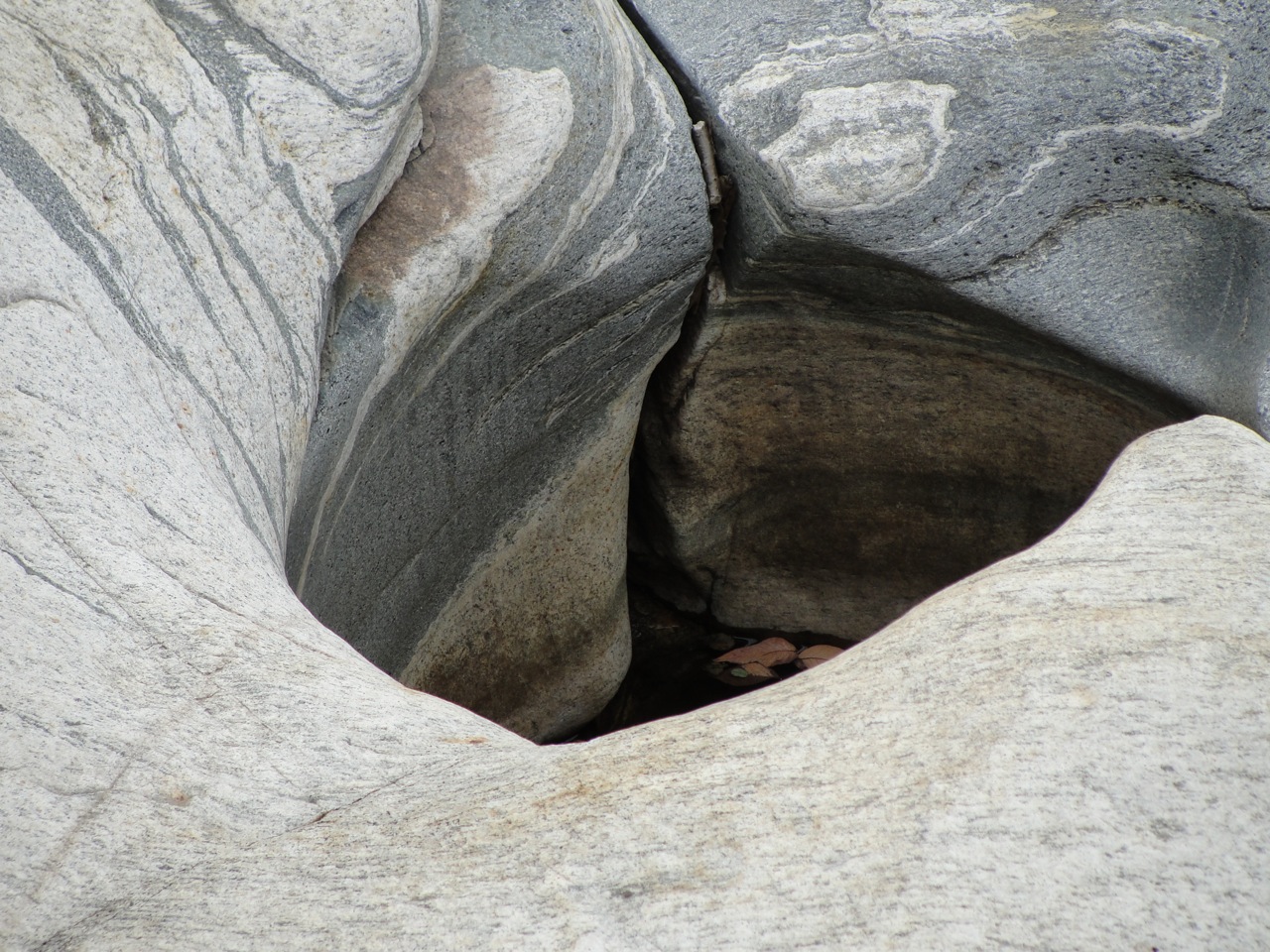
What comes next? If we wait in the darkness, if we succeed in opening our heart to awareness of the present moment, we may discover within us certain empty feelings, a kind of spiritual hunger. That does not mean we have failed in our search. Rather, it means we have found the next step. An experience of yearning may feel like a hole deep in our being. Hole in RocksWe may be tempted to try to fill it quickly with some new type of ritual or escape into some other sensation. It may feel painful and lonely, like an absence of something we need. But this emptiness is itself a kind of window or doorway.

The Buddhist teacher Kinrei Bassis says:

“the deepest form of prayer is really just the willingness to be still and let the longing in your heart go out without defining or understanding where it is going. Meditation is the willingness to let go and learn to trust so that we may enter into this seeming darkness.”

The emptiness itself, if we embrace it fully, can become the doorway into the larger reality. The practice of paying attention to the present moment helps us to cultivate the capacity to remain present to our feelings. We grow more at ease with anger, fear, sadness, and longing. We are able to breathe into these feelings, rather than run away from them.

If we breathe into the longing, breathe into the emptiness, there comes a time when it may open up into an experience of communion, an experience of our connection with the earth, with each other, with the Mystery within all reality. It may feel something like dissolving into Mystery. This experience goes beyond the capacity of words to describe. We may feel deep joy, even ecstasy, an intense awareness of being one with Love. An old hymn described it as “Leaning on the Everlasting Arms.”

Sometimes, that feeling may come unexpectedly, without any spiritual practice at all. The Mystery is funny like that. It surprises us. Sometimes it comes when trouble or grief has opened a chasm in our hearts and the pain of yearning fills our being to the core. It has been in the lowest moments of my life, that I most experienced the presence of the Mystery, holding me in love and connection and carrying me through.

Quote from “The Buddha Calling the Buddha,” by Kinrei Bassis, in Parabola, Summer 2006.

Waiting In the Dark

Milky Way

Image courtesy Wikimedia Commons

I want to share with you a little story. I went outside to watch the meteor shower during an August night. I was just sitting in my driveway, on a reclining lounger, watching and waiting. Every so often, I would see a streak of light flash across the sky. But mostly it was just quiet and dark. I was thinking about the Milky Way, and how far the stars were spread out, and how long it took for their light to reach my eyes. I was thinking about the fact that the light from these stars was reaching my two eyes in an ordinary driveway in Maine. Suddenly the sky seemed so much larger than I remembered, and I felt so much smaller, an infinitesimal speck. And yet I was seeing everything, and my seeing was as large as the sky. I was a part of the mystery. What was inside of me felt as large as the sky.

To experience that feeling, I had to go outside in the night and wait. I had the intention of looking for meteors, but there were only a few of those. However, if I hadn’t been waiting in the dark, I wouldn’t have experienced the mystery of that night. To embark on a spiritual journey is like finding opportunities to wait in the dark, however we might do that—waiting in the dark, looking for what we think we are looking for, but sometimes finding so much more.

The goal of any spiritual journey is to lead us into that depth, that place where the known crosses into the unknown. There is a part of the spiritual journey which must be intentional. We must choose to wait in the dark. But the inner purpose of a spiritual journey is to move beyond the capacity of our own intentions, to discover something larger than what we could imagine—a larger reality, a larger love, a larger mystery.

The method by which we choose to wait in the dark we call a spiritual practice. It does not matter so much how we do it, but that we take the time to do it—that we take the time to be quiet with ourselves, or to pay attention to the world around us, or to stretch the muscles of our mind and heart in the questions that we cannot answer.

For some of us, silent meditation may provide a discipline for that inner attentiveness. For others, the practice of journaling may become a tool for deep reflection.
What did I dream last night? What am I feeling today?
What am I worried about? What am I thankful for?
Another practice is to read poetry and collect the words that inspire us, so that we can memorize them, and ponder them in our hearts.
We might walk in the woods or along the shore of the ocean.

Again, it does not matter so much how we do it, but that we take the time to do it.

No One Way

If some of this talk about spirituality doesn’t make sense for you, remember that we bring our diverse personalities to our experience of spirituality. We will not all resonate with every approach to spirituality. My colleague, Rev. Peter Richardson, outlined four possible approaches to spirituality corresponding to traits from the Myers Briggs personality inventory.  His framework is just one example of how our spiritual experience might be diverse. We all have natural inclinations to tune into different frequencies.

He suggests that those of a more intellectual bent may be primarily drawn to the search for great truths. Einstein is one such mystic of the scientific realms. He felt awe and wonder at the mysteries of life revealed through science. A first step for an intellectual might be to appreciate the intricacy and beauty of the natural world, to pay attention to those moments of wonder.

Those of a more practical bent may be drawn to the works of goodness. They might find inspiration in the path that Gandhi shaped, to live out the connectedness of life by organizing for justice on behalf of the oppressed. A first step might be to volunteer for a soup kitchen, to pay attention to the larger reality in the gift of soup that connects us to someone who is hungry.

Those of an emotional bent are more likely to be drawn by love and devotion to divine or spiritual beings. The Sufi poet Rumi wrote thousands of love poems to the divine Friend, whom he felt most closely through his relationship with his human friend Shams. These are the folk who might especially benefit by reading the poems of the mystics, by music and incense and sacred ritual.

Finally, there are those of an intuitive bent, who may be drawn to the unfolding and transformation of the self into the larger self. The writings of Ralph Waldo Emerson might be a guide for those in this visionary orientation. These folk may be drawn to a diversity of practices and rituals, and may find their spiritual experience changing greatly over time.

There is no one way to practice spirituality. We begin by being aware of the present moment, by inviting our hearts to pay attention. We can notice those activities that help us to feel a sense of connection and wonder and gratitude, that help our hearts to feel most alive. We can invite the larger reality into our lives, by choosing to bring more of these activities into our daily lives.

Path

Photo by Margy Dowzer

Peter Richardson, Four Spiritualities, (1996.) Find it here.

Imagination as a Tool

Imagination can play an important role in shifting our attention. If we want to find that which is larger than words, that which we cannot define or explain by words, we need to access the playfulness of the non-verbal mind. Images are one way that we can experience the non-verbal realms. Carl Jung taught us about the power of dream images to express realities which could not be expressed in words. In my dreams, I have experienced the power to fly, to light candles from across the room, to heal with fire in my hands. Our dreams can be a pathway into a different consciousness.

Candle flameSometimes, people shift their attention by calling upon an image of the larger reality. Some people call upon God to hear them and to speak to them. Others invite the goddess to enter the circle. Or we might say, Infinite Light, be here now, and light a candle. These invitations are also called invocations. It might feel silly to us to call out to someone or something that we don’t even know is there. But any time we invite the larger reality into the room, what we are really doing is inviting our hearts to shift their attention. We are re-tuning our hearts to notice the light that is already there.

The images are meant not to be objects to grasp in our minds, but tools for the imagination to awaken the mysteries of connection within us. So, if I say, “Spirit of Life, please open my heart to the wonders of your world,” I create an intention, a form that can hold the energies in a certain rhythm or shape. I open a window in my consciousness, to see what my literal eyes cannot. When we open the door, there is something that wakes up, something beyond what we can expect or explain. If we don’t open the door, we will never know what is out there, or in here.

Spiritual Practice

Windy Sails

Photo by Margy Dowzer

As we grow older, we begin to understand non-object realities such as the wind, or electricity, or heat. We experience the wind through clues such as blowing leaves, or the feeling of its force on our faces in the cold, or the tug on a kite at it rises into the sky. There are many forces of connection that are so ever present that we might never notice them without flashes of insight. One of these is gravity. 

We are used to being held to the ground, we are used to thinking in terms of up and down. Let yourselves notice the force of gravity on your body right now.

Do you feel the heaviness of your body?
Imagine floating up out of your chair into the air above you.

Try to do it.
(Do you need more time?)

Now can you feel the pull of the earth keeping you attached?
What would it be like if we all just floated off the earth into the vast reaches of empty space?

If we wish to begin a spiritual journey, we need a way to shift our attention, to tune in to the larger reality of which we are a part, to the mysterious forces that connect and uphold life. A method for shifting our attention is called a spiritual practice.

We usually don’t notice radio waves which surround us all the time. But if we turn on a radio, and tune into a particular frequency, we will hear the sounds of music. The radio waves are always there—it is us who need to tune in to hear them. Spiritual practices are the radio tuners that help us to tune into the music of the universe. We are trying to move beyond our ordinary experience of everyday life, into a different channel of consciousness. The very beginning of spiritual practice is to shift our attention to the energy of the present moment. 

Beginning a Spiritual Journey

A spiritual journey is our path of waking up our awareness to the larger reality of which we are a part. It is simpler than we think. It is so simple, that if we don’t pay attention, we can miss it entirely. I invite you to experiment with me:

Start by noticing the energy level wherever you are at this moment, both around you and within you. Are you alert? Restless? Calm or anxious? Tense or relaxed?

Now, sit up as erect as you can without straining. Notice how the energy level changes.

Now I invite you to breathe deeply, breathe all the way down into your belly. As you breathe in and out, let go of whatever might be on your mind, and let yourself relax and recharge. Just pay attention to your breathing in and out, as you sit quietly for a minute in the silence.

Now pay attention to the energy around you and within you. Do you notice any changes?

The very beginnings of a spiritual journey are in the practice of paying attention to the energy of the present moment. When we are first born, we see and hear everything around us without definition or understanding. Gradually, we come to assign meaning to shapes and colors and sounds. We say mama, or daddy, or ball, or doggie. We separate the world into smaller objects that we can name and grasp. Perhaps we learn about God as a kind of separate object that we might name and grasp.

But once we assign such names, once we divide the world into objects, we sometimes forget to see what is actually before us. When I was in high school, I took several drawing classes. Our first lesson was to stop drawing objects, and to start sketching out shadows and light. In order to draw, we have to see at a different level from the level of objects. To pay attention, spiritually, is like that. We are shifting our consciousness from small separate objects to larger connecting energies.

Shadow & Light

Photo by Margy Dowzer

I learned the awareness meditation from Starhawk, in her book, The Spiral Dance: A Rebirth of the Ancient Religion of the Great Goddess.

Face to Face

Clouds DSC04297When I was a devoted Catholic child, I learned about the saints who had visions of angels or the Blessed Mother Mary or even Jesus himself. There were the children in Fatima, and Bernadette of Lourdes, and Margaret Mary Alacoque, and Joan of Arc. I wanted to have a vision, too. I prayed for Jesus or Mary to come and show themselves to me and speak to me directly. I imagined spirituality should include a holy person coming down from the sky and standing in front of me. It never quite happened that way. Why not, I wondered? Why tell us these stories if we could not have those experiences?

Ralph Waldo Emerson, the most famous of the 19th century intellectuals who became known as the transcendentalists, wrote something similar in 1849:

The foregoing generation beheld God and nature face to face; we, through their eyes. Why should not we also enjoy an original relation to the universe? Why should not we have a poetry and philosophy of insight and not of tradition, and a religion by revelation to us, and not the history of theirs?”

A spiritual journey is our search for our own “original relation to the universe.” A spiritual journey is our search for our own face to face, personal experience of “God and nature,” whatever those might turn out to be. A spiritual journey brings us to our own experience of the larger reality of which we are a part, our awareness of connection to the earth, to each other, and to the Mystery within and between all life.

When I was growing up, it seemed that only a few special people might have such a personal experience of that Mystery. But now I believe that I was confused about what I was looking for. Let me use an analogy here. I was looking for something like a trip to a great auditorium to see “The Mystery” in concert; but the Mystery really emerges more like the sound of a tune in one’s own imagination.

Quote from the Introduction to Nature; Addresses and Lectures (1849).