The Larger Whole

Reflected SkySpirituality is our experience of connection to the larger whole of which we are a part. I believe that each being is sacred, and we are all one family, one circle. My deepest experiences convince me this is true, even though we may forget, even despite the ways we may be estranged. Linda Hogan writes that the purpose of ceremony is to remember that all things are connected. She says:

“The participants in a ceremony say the words ‘All my relations’ before and after we pray; those words create a relationship with other people, with animals, with the land. To have health it is necessary to keep all these relations in mind.”

As we begin to build bridges across the broken places within our hearts, across the broken places between peoples, across the broken places between people and the earth, we are doing the work of mending the world. We are awakening, we are remembering, the reality in which we actually live, the unity of all. The Buddhists call it inter-being. In South Africa it is called ubuntu: we are all born to belonging, and we know ourselves in just and mutual relationship to one another. We move beyond the small self of the ego, into the larger Self some call God, or what I have called Mystery. Thomas Merton writes,

“We are already one. But we imagine that we are not. And what we have to recover is our original unity. What we have to be is what we are.”

The purpose of spirituality is to remember that all things are connected and to heal the brokenness between us.

An old Rabbi once asked his pupils how they could tell when the night had ended and day had begun.
Could it be,” asked one of the students, “when you can see an animal in the distance and tell whether it is a sheep or a dog?”
No,” answered the Rabbi.
Another asked, “Is it when you can look at a tree in the distance and tell whether it’s a fig tree or a peach tree?”
No,” answered the Rabbi.
Then what is it?” the pupils demanded.
It is when you can look on the face of any man or woman and see that it is your sister or brother. Because if you cannot see this, it is still night.”
                                                                             (Hasidic Tale)

Quotes from Linda Hogan, Dwellings: A Spiritual History of the Living World, (New York: Norton, 1995)
Thomas Merton: Essential Writings, edited by Christine Bochen. (Maryknoll NY: Orbis Books, 2000)
Hasidic Tale, Quoted in Spiritual Literacy, edited by Frederic and Mary Ann Brussat, p. 502. 
Broken Histories

Mab Segrest, in her book, Born to Belonging, examined the effect that the institution of slavery has had on the self-understanding of people in America, particularly the white people of her own family. She believes that a kind of spiritual anesthesia developed—a cutting off of compassion and connection—in order for a person to own slaves.

She ponders what it did to a man’s soul to sell his own children. Though it was not openly discussed, it was true that many of the children born into slavery had been fathered by the owner of the plantation. White people had to cut off their emotions, deny their relationships, and numb their spirits, to maintain this horrible institution for four centuries.

Segrest believes that the emphasis on individualism in America is an expression of our spiritual distress. We are all born into families, each with their own histories of disconnection or oppression that can cause a numbing of the soul. It feels less painful to imagine ourselves as separate, than to acknowledge the abusive and traumatic relationships that have closed our hearts. But when we close our hearts, we also lose our capacity for deep joy. We are not fully alive without each other.

Shortly after I first came to Maine, I visited Indian Island, home of the Penobscot Nation, in a trip sponsored by the Four Directions Development Corporation. During a beautiful traditional lunch that was prepared for us, we heard about some of the long history of brokenness between white people and indigenous people in Maine, as researched by Donna Loring, who at that time was the Penobscot representative in our State House of Representatives. Near the end she spoke of her belief that America needs to remember its roots. She wasn’t speaking of its ideals of freedom and democracy. Rather she meant that we cannot find the way to peace until we revisit our brokenness.

It is uncomfortable and painful to embrace our brokenness. But if we hope to find wholeness, we must be willing to hear the stories that we tried to forget. To return to wholeness is not to paint over the past with easy brush strokes, but to make awkward and painful attempts to cross over into the experience of the other. It takes a long time, and a lot of courage. In my experience, it is often easier to feel at one with nature than to feel at one with our fellow human beings. But I have also experienced, after the awkwardness, moments of grace and connection. Moments when we talk and share from our hearts, and feel a sense of wholeness restored.

Broken Rock DSC00135

Photo by Margy Dowzer

Broken Shards of Light

The Jewish practice called Tikkun Olam has been translated as the mending of the world. This practice draws from the Kabbalistic ideas of Isaac Luria, a sixteenth century Jewish mystic.

He believed that when God created the world, God formed vessels to hold the Divine Light. As the light began to fill the vessels, they were unable to contain divinity and shattered. Sparks of Divine light were trapped in the shards of these vessels; they scattered throughout the cosmos and formed our world. The task of humanity is to reunite the scattered sparks of Light, to repair the broken world, and thus participate in finishing God’s work.

Light in HemlockBy acknowledging our brokenness we take the first step toward returning to wholeness. I observed this so often during my practice as a psychotherapist. As painful things happen in our lives, we learn to block off the memories and feelings that cause our pain. We become divided from ourselves, and divided from others. Perhaps we may shut down the angry feelings we feel, or despise the needy child that is deep within us. The first step in healing is to acknowledge those parts of ourselves that we have broken off.

According to the healing process of psychodrama, one might begin by imagining the broken off parts of the self as separate entities. A woman came in for therapy, anxious and lonely, and we chose an empty chair to represent her loneliness. I invited her to talk to the loneliness. At first she is dismissive. “I don’t need anything from you,” she says to the empty chair. “Just stop bothering me.” But then I asked her to move over and sit in the chair of the loneliness, to imagine herself as the loneliness talking back to her. In that other chair, tears start to fall, and something like a light dawns in her eyes. She has brought the loneliness back together with her own center.

People often come to therapy thinking they are going to get rid of the pain inside themselves. But they find healing only when they have learned to embrace the brokenness with love. It is that embracing of the pain which finally eases their pain, the return to wholeness.

Webs of Connection

Think about language. Humanity is a social species. Not only our bodies, but our minds are interwoven. Human beings speak to each other. I am able to create sounds with my voice, and a certain meaning awakens in your mind. When I say the color blue, you can hear the word blue, and see it within your imagination. When I say the word love, you can call to mind a whole wealth of feelings and memories.

Web

Photo by Margy Dowzer

We belong to each other. We are part of a larger whole. And yet, we forget. Wars rage on in the Middle East, millions die from disease in Africa for which treatments are already known, poverty sits alongside wealth, industry pollutes the air and water. This is why we need to understand brokenness as well as wholeness. Chickasaw writer Linda Hogan tells a beautiful story of a broken clay woman. She writes:

I remember the first time I saw the clay woman …in a museum gift shop. …Her black hair flowed behind her, and on her clay feet were little black shoes… Her stomach attached to earth, just above North America. Her name was written on a tag, “The Bruja Who Watches Over the Earth.” Bruja is the Spanish word for a woman healer, soothsayer, or sometimes a witch.

I loved the flying soothsayer who protected the lands beneath her. She was connected to them by her very body, the very same clay. …I bought the clay woman and asked the clerk to mail her back to me, then I returned home, anticipating the day The Woman Who Watches Over the World would appear.

When she arrived, she wasn’t whole. Her legs were broken off, the gray interior clay exposed beneath the paint. I glued them back on. Then she began to fall apart in other ways. Her nose broke. Soon one of her hands fell off. The woman who watches over the world was broken. Despite my efforts she remained that way, fragmented and unhealed. At first I was disappointed, but then I thought, Yes, the woman who watches over us is as broken as the land, as hurt as the flesh people. She is a true representation of the world she flies above. Something between us and the world has broken. That is what the soothsayer says.

Linda Hogan’s bruja is an image of a creator who is connected to us in our actual reality, broken as we are broken, not merely a perfection to which we might strive. Broken Web DSC01269The brokenness is within us, the brokenness is between us, and also between people and the earth. But—this is important—we feel broken because we are meant to be connected.

Quote from Linda Hogan,The Woman Who Watches Over the World: A Native Memoir (New York: Norton, 2001) pp. 17-18.

DNA, Breathing & Trees

There are many signs all around us that can help us to awaken from the illusion of our separateness, help us to awaken into an awareness of the larger whole to which we belong. Science has always been a form of revelation for me. For example, I am amazed when I think about DNA. All forms of life are propagated by this microscopic code. The human DNA includes elements in common with the DNA for yeast. Even microbes discovered deep within caves—bacteria that feed on poisonous chemicals and never enter the light of the sun—these strange bacteria also have a DNA code that has been measured by scientists. All life, as we know it, is written in the same language.

Our biological unity is present in the continuous interconnecting of all life on earth. It was bacteria that first began to create oxygen, billions of years ago, originally as a volatile waste product. Now, all of us are breathing oxygen every minute of every day.

Take a moment to notice yourself breathing right now.
As you breathe in, small molecules of oxygen are entering your lungs
and then passing through the membranes of its cells into your bloodstream;
from there those molecules flow to every cell in your body.

Imagine those oxygen molecules flowing down
into your belly, your legs, your toes.
Imagine the oxygen flowing up
into your arms, your face, your brain.

Without oxygen we cannot survive for even ten minutes. When we breathe, we bring into our bodies molecules that have been inhaled and exhaled by other beings. This air is common air. These molecules may have sailed here from the winds of Africa, or through the tempest of hurricanes in Japan. Lions may have roared these molecules; whales may have spewed them forth in a fountain above the sea.Misty Trees

Look at the trees outside your windows.
We breathe each moment with the trees.
As we breathe out, we release carbon dioxide into the air,
which the trees need for life.
As the trees breathe, they take in carbon dioxide
and exhale the oxygen that we need.
Breathing teaches us that we are one.

The Mullein Plant

Mullein Plant

Photo by Forest & Kim Starr, Creative Commons License

As a young adult I became intrigued with herbal healing. I read books that identified particular herbs that could heal different ailments of the body. I learned, for example, that mullein tea was helpful for a sore throat. Then one day, someone showed me a mullein plant growing wild by the side of the road. I suddenly felt the connection: human beings and plants belong together! That mullein plant can actually heal my human sore throat. We are related to each other in some deep essential way.

Spirituality is about experiencing our connection to the earth, to each other, and to all that exists. According to Thich Nhat Hanh, the Vietnamese Buddhist teacher, “We are here to awaken from the illusion of our separateness.” Seeing that mullein plant beside the road brought me a moment of awakening. For that moment, I knew deep in my being, that I was not separate from any of the plants or animals or people on the earth. I realized that, in reality, we all are one.

But time passed, and the illusion of separateness took over again. We are all one, and yet we are also divided from one another. Mother Teresa said, “If we have no peace, it is because we have forgotten that we belong to each other.” Certainly, for most of us, we go through our days forgetting this essential truth. How often do we feel isolated from, or even in competition with, the people around us? In fact, every day we are encouraged to see ourselves as separate and individual, we are encouraged to watch out for “number one.”

A whole series of television commercials come to my mind: a grandmother telling her grandchild to “Get your own bag of chips,” or a man guarding his chicken fingers from his co-workers, or a family getting individual pizzas so everyone can have their own topping… it just goes on and on. There are messages all around us that promote the illusion of separation.

In much more devastating ways, the political idea of a common good is being taken apart in favor of privatization. Programs like Social Security and Medicare are under fire, under the guise of some kind of freedom of choice, with the argument that people can do better on their own, that individuals can maximize their retirement options through private investing.

I am pretty sure that is not true, but what goes unspoken is the shift in the very terms of the debate—we are no longer arguing how to best care for all the members of our society. Rather, we are being asked to buy into a fragmented and individualized world, a place where the important goal is to get the most for myself. Thich Nhat Hanh, Mother Teresa, and other teachers, call us to a different outlook. They call us to remember that we are part of a larger unity. They call us to return to our true wholeness.

Part of the Whole

GiverofStarsA Human Being is a part of the whole called by us universe, a part limited in time and space. He experiences himself, his thoughts and feelings as something separated from the rest, a kind of optical delusion of consciousness. This delusion is a kind of prison for us, restricting us to our personal desires and to affection for a few persons nearest us. Our task must be to free ourselves from this prison by widening our circle of compassion to embrace all living creatures and the whole of nature and its beauty.

                                                                                           Albert Einstein

From a 1950 letter, published in Howard Eves Mathematical Circles Adieu, (Boston: Prindle, Weber and Schmidt, 1977).

Sand Castles

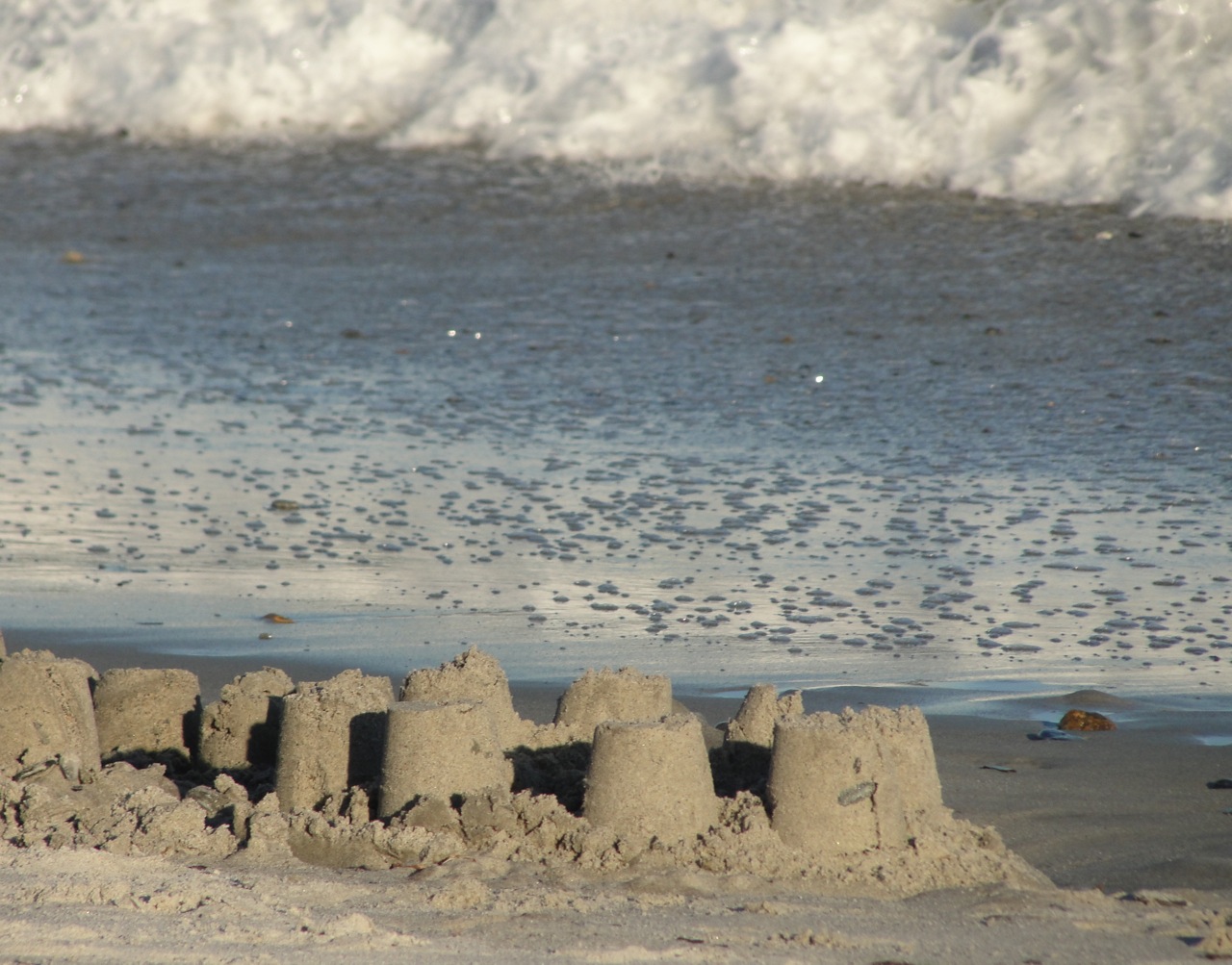
Sand Castle

Photo by Margy Dowzer

Harold Kushner tells a story:

I was sitting on a beach one summer day, watching two children, a boy and a girl, playing in the sand. They were hard at work building an elaborate sand castle by the water’s edge, with gates and towers and moats and internal passages. Just when they had nearly finished their project, a big wave came along and knocked it down, reducing it to a heap of wet sand. I expected the children to burst into tears, devastated by what had happened to all their hard work. But they surprised me. Instead, they ran up the shore away from the water, laughing and holding hands, and sat down to build another castle.

All the things in our lives, all the complicated structures we spend so much time and energy creating, are built on sand. Only our relationships to other people endure. Sooner or later, the wave will come along and knock down what we have worked so hard to build up. When that happens, only the person who has somebody’s hand to hold will be able to laugh.

From When All You’ve Ever Wanted Isn’t Enough, (New York: Fireside, 1986) p. 165-166.

Community as a Spiritual Practice

Here is how it works when we choose community. There will be people in any community who inspire us. And there will be people in any community who rub us the wrong way. Those irritating people are the ones who are the biggest blessings for us. There is a story about a rabbi who was the leader of a spiritual community. There was one member who always gave the rabbi a hard time. The other members of the community hated it.

After many years, this person died. And many people were secretly relieved that they wouldn’t have to put up with him any more. But the rabbi wept at the funeral. When they asked, he said, “That man was the only friend I had. Here I am surrounded by people who revere me. He was the only one who challenged me. I fear that with him gone, I shall stop growing.”

To choose community does not mean to accept abuse, or to let people walk all over us. It does not mean always agreeing with someone, or refraining from speaking our own truths. Community includes challenging each other, arguing with each other, and sometimes saying no. But we don’t write each other off, we don’t speak disparagingly of one another, we don’t give up on each other. We treat each other as if we were treasures to each other. Because that is what we are.

To choose community means to be glad that each other person is here, to assume that they belong here, and to revere them as a part of our family. To choose community means to hold ever ready an attitude of curiosity and respect. To choose community means to look for the insights that the other might offer to expand our own limited viewpoint. To choose community means to assume that even when someone is acting badly, they are doing the best they can do at the moment. When we can practice getting past the irritations that arise in us, we have a chance to discover the magic.

Choosing community is a form of spiritual practice because it opens us to that which is divine within our neighbor. What has been hidden is revealed by the light of love. We come to realize that we are not alone. We are surrounded by family. The divine light is shining in the threads between us, and deep within each person. Dostoyevsky said: “If you love everything you will perceive the Divine Mystery in all things.”

Sunset

Photo by Margy Dowzer

Quotes from Anthony De Mello, in The Heart of the Enlightened: A Book of Story Meditations, (New York: Image/Doubleday, 1991, 1989) p. 79. and Fyodor Dostoyevsky, The Brothers Karamazov, translated by Constance Garnett, (New York: MacMillan, 1922), p. 339.

Choosing Community

So often when we hear that we should love one another, it sounds like hard work, like a task, like a moral imperative that would be good to follow, but not very pleasant. And I admit there is something difficult about loving one another. But somewhere in the middle of it, comes a surprise. There really is divinity within each person—and when we see it, it is beautiful, joyful, mysterious, and wonderful. It is like the diamond that Dorothy Day was so quick to give to the homeless woman. 

And not only that, when we risk opening our hearts to others, sometimes we experience the divinity that happens in the connections between us. We experience something of that ancient belonging for which we have been yearning. Ubuntu. We experience the oneness of all beings, our part in the family of all things. We realize that we are all gathered in a circle already, we are all part of one dreaming.

Those moments give me energy for the work of creating circles of love and faithfulness. Because we really do have to work at community. We have to make a choice for community. In our society, the bonds are frayed, and the mainstream is drifting toward isolation and competition. There are people who have no one with whom to share their real feelings. So dreaming in circles is about choosing connection, choosing love, joining hands with one other, and then another, finding the people with whom we can cast our lot, those who are similarly looking to manifest ubuntu in our lives.

When we choose community, when we practice loving a particular group of people, we are letting the reality of the universe enter our hearts—we are learning how to experience the reality that we truly are all part of one another. Of course we don’t usually get it right. Otherwise we wouldn’t need to practice. We are not here to try to fix everything in order to create some sort of perfect circle—we are the circle right now, trying to wake up together. Every person is sacred, and we are all one circle. Stone Circle