One Other Species

Cats CuddleAnother way to enter this sphere of earth connection is through making a relationship with one other species. Maybe for you it is with your cat or your dog. We can play with our companion animals, cuddle and pet each other, curl up for a nap, and feel love for each other. Sometimes when I am meditating in the morning, one of our cats climbs up into my lap and sits with me there, purring. Isn’t it amazing that we can make a bond across species and communicate in so many silent and vocal ways?

I heard an amazing story about a connection between a man and some elephants. Lawrence Anthony worked with rogue elephant herds in a reserve in South Africa. He had taken on these elephants because they were causing trouble in other reserves, and were about to be shot. He spent time living with the elephants, feeding them, talking to them, until finally they relaxed in their new home. He became known as the Elephant Whisperer, and other troubled animals were sent his way. It is a wonderful story.

But here is the amazing thing. When Mr. Anthony died in March of 2012, a few days later two of the elephant herds were seen walking slowly, as if in a procession, toward his house. They walked for twelve hours from a distant part of the reserve, and when they came to his house, they stayed around for two days, as if to say goodbye to the man who had saved their lives. How could they have known that he had died?
Rabbi Leila Gal Berner said,

If there ever were a time, when we can truly sense the wondrous ‘interconnectedness of all beings,’ it is when we reflect on the elephants of Thula Thula. A man’s heart’s stops, and hundreds of elephants’ hearts are grieving. This man’s oh-so-abundantly loving heart offered healing to these elephants, and now, they came to pay loving homage to their friend.

Mother Earth

Blue Marble EarthFor how many years have people been calling the earth our mother? The image dates to the days before history, in cultures all around the world. And no wonder. Our mother is the one who feeds us. Before we are born, in our mother’s womb, we are literally fed and shaped from out of her body. After we are born, we are fed milk from her body. The earth is our mother because we are created and fed from her body. We are a part of her, and all of our life is out from her.

We live in a time when this ancient understanding is coming to the fore again. During the industrial age, people treated the earth as a resource to be exploited. Whatever could be mined or cut down or damned up or harvested was taken for human use. So much was taken and destroyed that now for the first time in history, we can see the fearful limits of the earth’s abundance. In order to find wholeness, we must restore a relationship of respect and honor between people and the rest of nature. We are beginning to understand that we are not separate from the earth.

Buddhist teacher Thich Naht Hanh speaks about this. He says,

You carry Mother Earth within you. She is not outside of you. Mother Earth is not just your environment… Fear, separation, hate and anger come from the wrong view that you and the earth are two separate entities…. That is a dualistic way of seeing… So …breathe in and be aware of your body and look deeply into it and realise you are the Earth and your consciousness is also the consciousness of the earth…

It is one thing to mentally acknowledge that we are part of the earth, that we and the earth are one. But it is more challenging to experience it in our bones. We have been taught by our culture to think of ourselves as separate from all that. We live in houses that divide the inside from the outside. We think of some things as human and other things as natural. It is a mental leap to imagine ourselves as a part of the larger life of the earth. But if we desire to understand our connection, to awaken our instinct for feeling the unity of it all, connecting to one tree, one rock, or one place, can bring it down to our human level. 

Here is a practice for paying attention to a very small place:

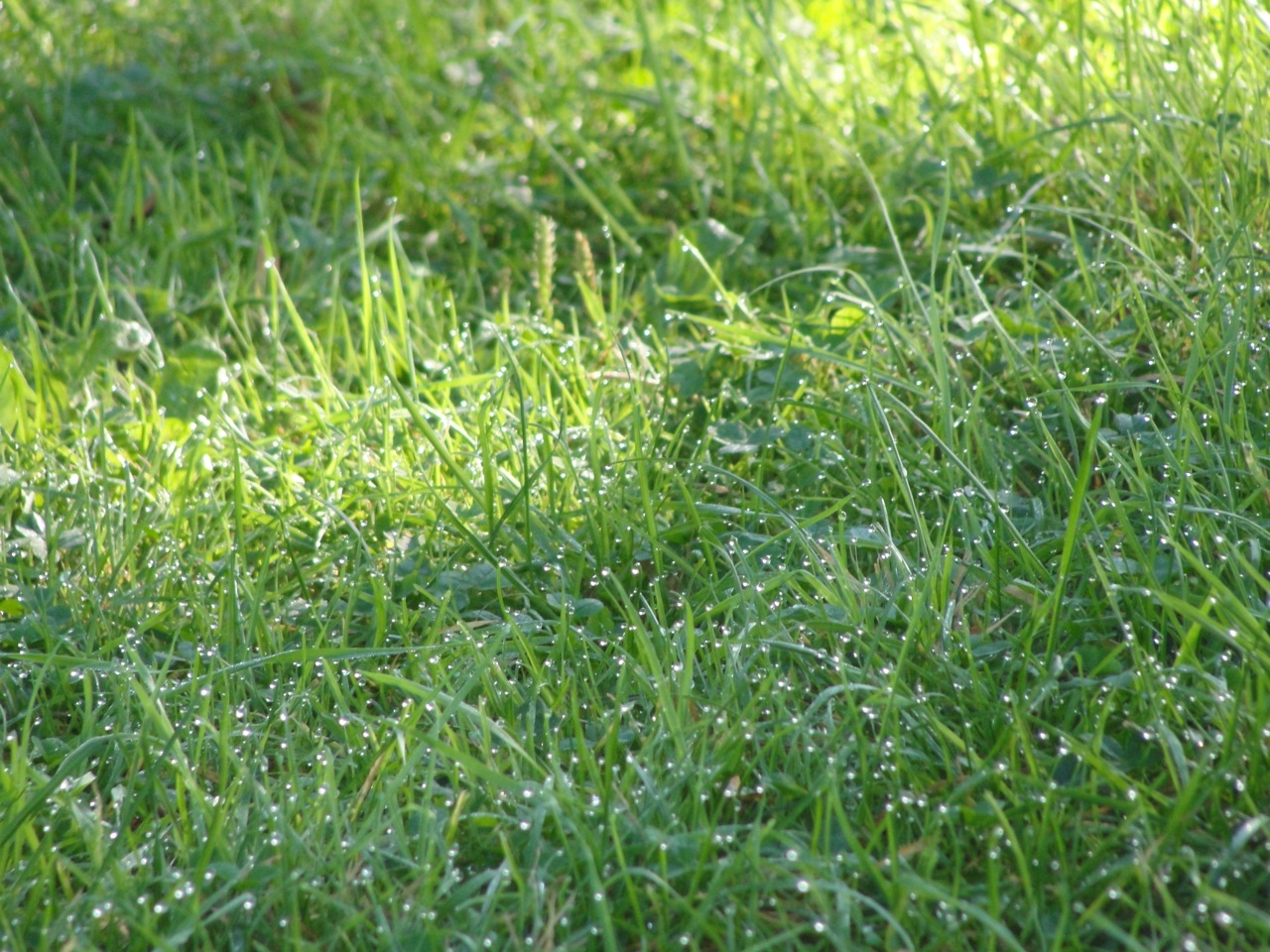
GrassMark out one square foot of earth, perhaps with some sort of string on a few sticks hammered into the ground. Then sit near your square foot, and observe all the life forms you find there. Look for the different kinds of plants—maybe clover and grass and wild strawberries and moss. Look for the insect life—some of it moving in and out, like bumble bees and flies; other staying close, maybe an earthworm or a group of ants. Perhaps you might take pictures of the ones you don’t know, and look for them on the internet, or with a biology teacher or friend.

Then, realize that there are also microscopic life forms in that square foot of soil. Thousands of them. If you are up for it, get a microscope and check out our hidden neighbors in the soil.

Biologists say,
When we are standing on the ground, we are really standing on the roof top of another world. Living in the soil are plant roots, viruses, bacteria, fungi, algae, protozoa, mites, nematodes, worms, ants, maggots and other insects and insect larvae (grubs), and larger animals. Indeed, the volume of living organisms below ground is often far greater than that above ground.

 It is because of all these living beings that plants can grow and be fruitful.  If we want to wake up our awareness of connection to the whole, it can help to wake up our awareness of connection to the small.

Thich Naht Hanh goes on to say,

If we are able to touch deeply the historical dimension – through a leaf, a flower, a pebble, a beam of light, a mountain, a river, a bird, or our own body – we touch at the same time the ultimate dimension. The ultimate dimension cannot be described as personal or impersonal, material or spiritual, object or subject of cognition – we say only that it is always shining, and shining on itself.

Thich Naht Hanh quotes from an article by Jo Confino, “Beyond environment: falling back in love with Mother Earth,” Feb 20 2012, The Guardian
Biology quote from Dr. Jill Clapperton and Dr. Megan Ryan, “Uncovering the Real Dirt on No Till

Call It Forth

Ultimately, it isn’t really about the words at all. Rev. Davidson Loehr tells a story about a worship class in graduate school, when he was a part of a group of Unitarian and Christian students who had the assignment to create a worship service together. They spent quite a bit of time arguing about words, about how to address the focus of their worship. The Unitarians objected when the Christians wanted to pray to Jesus or to God. The Christians backed off when the Unitarians suggested maybe God and Goddess. The conversation went around and around.

Finally, their professor intervened. Loehr writes:

He glared at us: “And the only thing you have been able to agree on is that you would like the Spirit to be a part of your worship service?”
Yes, we all stammered: “But we don’t know what to call it.”
Still the stern father, he shot us a punishing glance and said three words: “Call it forth!” “Call it forth!” No matter what you choose to call it, he explained, call it forth. Because unless you can call forth the quality of spirit that is rightfully called holy, you don’t have a chance of staging a worship service anyway.

 It is not enough to ask, do you believe in God or not? It is not enough to ask, what do you believe about God? Rather we must ask, what God do you want to call forth into the world? What you call it isn’t so important. Use the word Mystery, or energy or power if you wish. What energy do you want to call forth into the world? What power do you want to call forth into the world?

Fireworks

Despite the transformations I experienced as I wrestled with the images of God and Goddess, I realized that there was a thread running through it that stayed the same: an experience of the power of love. At some point in my life, I realized I wanted to call forth the power of that love into the world.

The words and images we use to describe what we believe and experience are less important than living our faith to the fullest, testing it in practice, calling it forth into our community, for the benefit of all. When we live our faith to the fullest, then the real God will stand up in our midst.

And so I will ask you to consider: what kind of power will you call forth into the world? What do you hold in your heart and your hands? 

Quote from “Call it Forth: Religion for Atheists” by Davidson Loehr (in Religious Humanism, Volume XXXIV, #1 & 2, Winter/Spring 2000)
Photo by Margy Dowzer

Humility and Confidence

What do we do with people’s different understandings about God and the religious battles that go along with it? I believe we must begin by affirming that difference is real. People—in the same town and all over the world—think differently about the idea of God and have different experiences of God. That is real, and we can choose to fear it, or we can choose to welcome it, explore it, and even celebrate it.

But what does that do to our ideas about truth and reality? We might ask, for example, “Can God both exist and not exist at the same time?” That isn’t logical. But the truth is: both kinds of human experience exist! There are humans who experience or affirm God and there are humans who do not experience or affirm God. There are humans who experience or affirm certain images and ideas of God, and reject other images and ideas of God. We must take into account that all of our understanding about God comes through our human experience.

When my images and ideas about God began to change, something opened up before me. I embarked on a journey that demanded a deeper humility and a deeper confidence. I needed humility to recognize the incompleteness of my spiritual experience and the validity of truth beyond my understanding. I also needed to have confidence to claim my own experience as valid, whether or not others agreed with me.

I believe that each person’s experience is valid, at least in part, and the fullest truth is that which is weighed in community with the experience of others. This is one reason why I later chose to find a home within a Unitarian Universalist spiritual community that welcomes diverse beliefs. There is a Hebrew proverb: “Hospitality to strangers is greater than reverence for the name of God.” To live within a diverse spiritual community, we must cling more strongly to an open heart, than to specifics images and beliefs about God.

Heart StoneWhat this means for me is that the real God might be everywhere—hidden within each person, in each plant or animal, in each sunrise or stormy day, in the ordinary and the spectacular alike. Or God might be no where at all. It means that revelation is continuous and always unfolding. It means that words and images like God or Spirit or Mystery are metaphors trying to describe what is indescribable. The Sufi poet Rumi said,

“Just remember: it’s like saying of the king, he is not a weaver… words are on that level of God-knowing.”

My colleague the Rev. Forrest Church has said:

“The power which I cannot explain or know or name I call God. God is not God’s name. God is my name for the mystery that looms within and arches beyond the limits of my being. Life force, spirit of life, ground of being, these too are names for the unnamable which I am now content to call my God.”

Quote from The Soul of Rumi: A New Collection of Ecstatic Poems, translated by Coleman Barks, p. 77.

Re-imagining God?

If we seek some larger truth, we need to be open to our human experience. This approach sets me apart from people of some faiths, who have an idea of God that is mediated through external religious authority. Some religions believe that certain leaders or scriptures have the truth about God and reality, and the role of other persons is to follow and obey their authority. In these religions, a person may be instructed to discount their own experience as faulty or sinful, in favor of the wisdom of the leader. But that is not what I believe.

Perhaps I have been hurt too deeply by the misused authority of religious leaders. The very idea of God has felt corrupted by the betrayals of religious institutions. Alice Walker explores this question in her novel, The Color Purple. Two black women, Celie and Shug, talk about the God that they find in the white man’s Bible. Shug says, “Ain’t no way to read the bible and not think God white… When I found out I thought God was white, and a man, I lost interest.”

There was a time in my life, too, when the God of the churches didn’t work for me. At first, when I was a child, God was like a perfect father. I learned about this God from my Catholic family. My idea of God helped me as a child: I felt held in the care of a strong and loving presence. Later, when my family and I became a part of a Pentecostal movement among Catholics, this community also believed that God was a loving father. They emphasized that the Spirit would communicate with us directly and would guide us on our path. It opened a beautiful door to a spirituality of direct experience.

But by and by, a problem occurred for me. This Spirit seemed to be guiding people in really different directions. One man heard the Spirit say that men should be stronger leaders, and women should be only in supportive roles. But the Spirit in my heart was saying that men and women were equal. So why were my gifts and energy not valued? I didn’t feel equal enough in that group to express my truth, so I left instead. I felt like my heart was broken.

Later, the work of feminist philosopher Mary Daly helped me better understand how culture influences our most personal images and experiences. A white male-dominated culture will create white male-dominant images of God. We draw a picture of God shaped by our cultural expectations. And those images in turn reinforce the cultural values by which we live. The father God was white and male and reinforced a system of domination by white men. So where did that leave me and other women and those who were oppressed by racism?

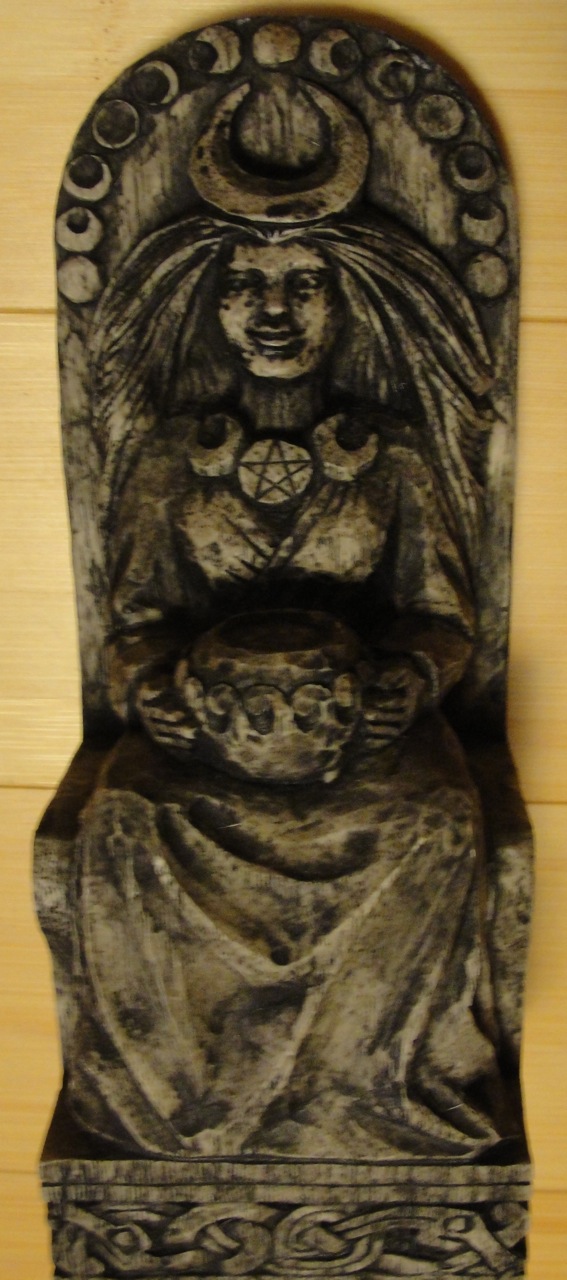
For many years I didn’t know what to do about God. The word had become almost noxious to me, and connected to oppressive forces in my life. Yet I still felt a relationship to some sort of spiritual experience. For a while I didn’t know how to imagine or think about it. Seated GoddessBut I was part of a group of women who were wrestling with all of this together. We began to counter the oppressive forces of religion by creating new images of the divine in a conscious way. We re-imagined God as female, by calling her Goddess. We realized that many cultures have worshipped the divine in female form.

But is it possible to imagine a Goddess and experience her as real? What is real and what is imaginary? Here’s the thing I discovered. The Goddess began to feel real to me when my life started to change. Something is real when it makes a difference to us, when it causes transformation in our lives. Images become real when they open a door. The Goddess became real when the power of women became real—when we were able to embrace our own sacredness, affirm our own intrinsic value and dignity, and live out our own gifts and talents and leadership.

In The Color Purple, Shug also found new ways to imagine God. She said,

My first step from the old white man was trees. Then air. Then birds. Then other people. But one day, when I was sitting quiet and feeling like a motherless child, which I was, it come to me: that feeling of being part of everything, not separate at all. I knew that if I cut a tree, my arm would bleed. And I laughed and I cried and I run all around the house. I knew just what it was.

Sun in Trees DSC05525

Quotes from Alice Walker, The Color Purple, p. 166.
Mary Daly, Beyond God the Father, (Beacon Press, 1973)

Reverence

There is another challenging aspect to embracing a spirituality of experience. It is not only a matter of paying attention to our own experience. It is also a matter of being open to the experience of others. How do we affirm each other’s spiritual experience when that experience may be very different from our own? How do we bring individual spiritual experience into the cauldron of community? If we approach these questions in a merely logical way, we can come up short.

For example, those of a skeptical nature might find it challenging to understand the experience of someone who relates vivid encounters with non-physical beings: gods or angels or spirits. If you do not experience such beings, you might find it inexplicable that others might. It might contradict everything you know about the world. Could there be such a reality, beyond the reach of our ordinary senses? I am not going to ask you to believe in it, but to take into account the possibility that some people may experience it. There are times when experience—our own or that of others—goes beyond our rational understanding.

Some cultures tend to be more at ease about such phenomena. I have a friend who is Puerto Rican. In her culture, one of the ancient traditions brought from Africa is called Santeria. When my friend opens her awareness to experience the larger reality, images from her culture come to life. She sees the spirits of Elegba and Oshun and Oya, with vivid colors and songs that others in her culture also report. These spirit beings interact with her and have been very significant in her life. Who is anyone to say they are not part of reality, when a whole culture affirms and cherishes them?

I am not saying we should not bring our reasoning to bear on our experience. My encounter with people of other cultures has made me more appreciative of the mystical elements of reality, and ironically, also more skeptical. It has taught me how our cultural context shapes our experience, even at what we imagine to be the most intimate and personal levels. If, as a child, I felt held in the loving arms of Jesus, was that reality, or was that an image shaped by what I had been taught to expect? Or could it be both?

When I was twenty six, I learned how my religious tradition had been shaped by the dominance of men in my culture, and I became suspicious of images of God that excluded the female. These male God images had been influenced by the assumptions and values of those in power. I had received no cultural mirror in which to imagine divinity in a feminine way.

So there is a paradox. Our experience of reality is shaped by our cultural context. This can affect our lives in both positive and negative ways. There are times when we need our rational understanding to be able look critically at experience. Experience is the essence of spirituality but it is not infallible. We must measure spiritual experience by the values and thoughtfulness with which we should measure all parts of our lives.

But there are times when our reasoning may be confounded. Let me tell you another part to the story. My Puerto Rican friend fell in love with a white woman who was a cynic about spiritual matters. Her passion was the work of social justice. However, when she entered a relationship with my Puerto Rican friend, her cynicism was challenged in an unexpected way. She began to see Elegba and Oshun and Oya in her inner imagination. She said to me once, “Those Puerto Rican spirits don’t care if I don’t believe in them. They show up whether I want them to, or not.”

There is so much about reality that is mysterious and hard to explain. We rely on our experience, and the experience of others, to give us evidence about the world. If we acknowledge our own experience, our own inner reality, then we must acknowledge the inner reality of others. That leaves us open to dimensions that might be difficult or impossible to measure. So while I would never ask anyone to believe in the unproven, I do invite you to keep an attitude of reverence for all that is unexplained in yourself and in others.

The poet D.H. Lawrence describes it this way:
This is what I believe:
…That my soul is a dark forest.
That my known self will never be more than a little clearing in the forest.
That gods, strange gods, come forth from the forest
into the clearing of my known self, and then go back.
That I must have the courage to let them come and go.
That I will never let mankind put anything over me,
but that I will try always to recognize and submit
to the gods in me and the gods in other men and women.

Clearing

 Quote from D.H. Lawrence, Studies in Classic American Literature:. (Cambridge University Press, 2003) p. 26. Excerpt was first published in English Review, December 1918 in the article “Benjamin Franklin.”

Trust Your Own Journey

Gate The spiritual journey is a path of waking up our awareness. It demands that we trust our experience, become friends with our burning. It does not matter if your hunger is a different hunger than mine: you must trust your own hunger. Sufi mystic Rumi writes that our hunger itself is proof of the existence of bread. Our thirst is proof that there is such a thing as water. If we trust our deepest inner hunger it will lead us on our own spiritual path.

I cannot tell you what your spiritual path must be. I can only offer you some gleanings, some sparks of light for your spiritual journey from my experience of following my own burning, and my experience of being in community with the people of my congregation and other spiritual searchers. Hallway with DoorsSomeone once described our faith community as a hallway with many doors to the holy. One temptation is to get stuck in the hallway, celebrating the freedom to choose whichever door we want, rather than to open any of them. There is a Buddhist parable that says we can’t find water by digging many shallow wells. To begin a spiritual journey we must actually open a door, and walk through to where it leads us.

Albert Einstein’s questioning hungers led him to open a door into scientific experimentation and mathematical reasoning, and he followed that pathway more deeply than most minds are able to fathom. Was that a spiritual journey? I think so. He became a friend to his own burning. His vision has inspired and changed our lives, even if most of us could not explain the theories he developed.

Spirituality is not an escape from the world. Spirituality is about experiencing more deeply our relationship to all that is. Spirituality is awakening to awe and gratitude for all that is. We don’t have to be a Rumi or an Einstein to enter a spiritual doorway. We only need to become friends with our own burning.

Frederick Buechner says,“Listen to your life. See it for the fathomless mystery that it is. In the boredom and pain of it no less than in the excitement and gladness: touch, taste, smell your way to the holy and hidden heart of it because in the last analysis all moments are key moments and life itself is grace.” 

To be spiritual means to pay attention to our own experience of the mysterious reality of which we are a part. I am inviting you to take a risk—to befriend your hunger, to pay attention, to go through the doorway, to see what you might experience about our miraculous world.

To take that next step through the door can be difficult. We might be suspicious of what lies on the other side. We may be drawn to mystery, but uncomfortable with the irrational or unproven. We might discover old wounds triggered by the symbols or language from difficulties in our religious past.  How do we heal?  How do we re-imagine or reclaim our own connection to divinity?

For now, I invite you to notice what is in your heart.  Notice the hungers you feel, the questions, the passions, the fears.  Notice, just notice, any wounds you may carry that surface when you approach a doorway into spirituality. Make a list.  Explore what triggers those wounds, and let yourself remember any painful experiences from your own religious past.  I will continue to explore these questions in future posts.

Risky Talk

I have some of my own baggage attached to spirituality. From my earliest memories, I knew that it was risky to talk about spirituality. It was sure to mark you as strange or crazy, or get you into trouble. I don’t even know how or where I learned this—maybe at school among my classmates? There was something embarrassing, or dangerous, or profoundly broken with the idea of speaking about this realm.

But in my immediate family, it was just the opposite. Spirituality was an ever-present force. My father didn’t just believe in God, he was in love with God. He had called out to God, and experienced an answer. It filled his life like a contagious fire. A spark of that fire ignited in my heart, too.

FlameI was hungry for this burning love. But I was also afraid of what other people would think of me. How often do we deny our own deep experience to gain social acceptance? It seemed to me that most people outside my family said they believed in God, but they didn’t really expect anything to come of it. So I learned to keep certain things hidden—especially the solitary and mysterious experiences of longing or feeling loved.

Because I was a child growing up Catholic, I fit my experience into the stories I learned, the beliefs that were given to me. It was safer to talk in the language of belief, rather than to reveal my feelings. Later, those beliefs were challenged by my experience, and my journey brought me into a very different place. My beliefs got turned upside down, in order for me to be true to my experience. But that fire of burning love kept re-igniting.

Today, when I venture inside my own heart, I still experience deep longings, these hungers that feel almost like pain, or sometimes like restlessness. It is difficult to feel this and I am tempted to read a book, or find something else that might fill up that empty place. But instead of escaping or fixing it, I invite myself to try to be present with it. I breathe into the longing and let myself experience the hunger. Is this what it means to become friends with my burning? I accept the feelings of my heart just as they are. I connect with the experience of my deeper self.

Perhaps that is all that happens. But sometimes, something else happens too. My heart opens up, the emptiness becomes a doorway, and I fall into a larger awareness. I feel the earth, the sky, the wind. I feel joined to everything. I find answers to questions and guidance when I face a crossroads. I feel held in the arms of tenderness. I feel that I have come home. Sometimes, as Rumi says,

Something opens our wings
Something makes boredom and hurt disappear
Someone fills the cup in front of us
We taste only sacredness.

This has been my experience of spiritual awakening. Hunger itself becomes a doorway into sacredness, into feeling connection beyond my aloneness. Does it matter, on any particular day, whether I feel longing or feel love? Whether I feel questions or feel answers? The Buddhist mystics would say no. What matters is that I am becoming conscious. Vietnamese Buddhist teacher, Thich Nhat Hanh, says,

“If we want to enter Heaven on Earth, we need only one conscious step and one conscious breath.”

Take some time to notice what is brewing in your heart. Do you feel a sense of emptiness? A sense of connection? Do you feel questions? Don’t try to change anything, just become aware of what you are carrying in your heart in this moment.

Quotes from: The Essential Rumi, trans. Coleman Barks p. 280.
Thich Nhat Hanh, Touching Peace: Practicing the Art of Mindful Living, p. 8.

Mystics & Heretics

An emphasis on spirituality as experience is not really new. It can also be found among those who were called mystics in all the great religious traditions. They were sometimes called heretics because they didn’t worry too much about dogma. We don’t really have the language to adequately describe spiritual experience. When we use words like God or Goddess, we are just grasping at straws, using words and images to try to convey what cannot be defined.

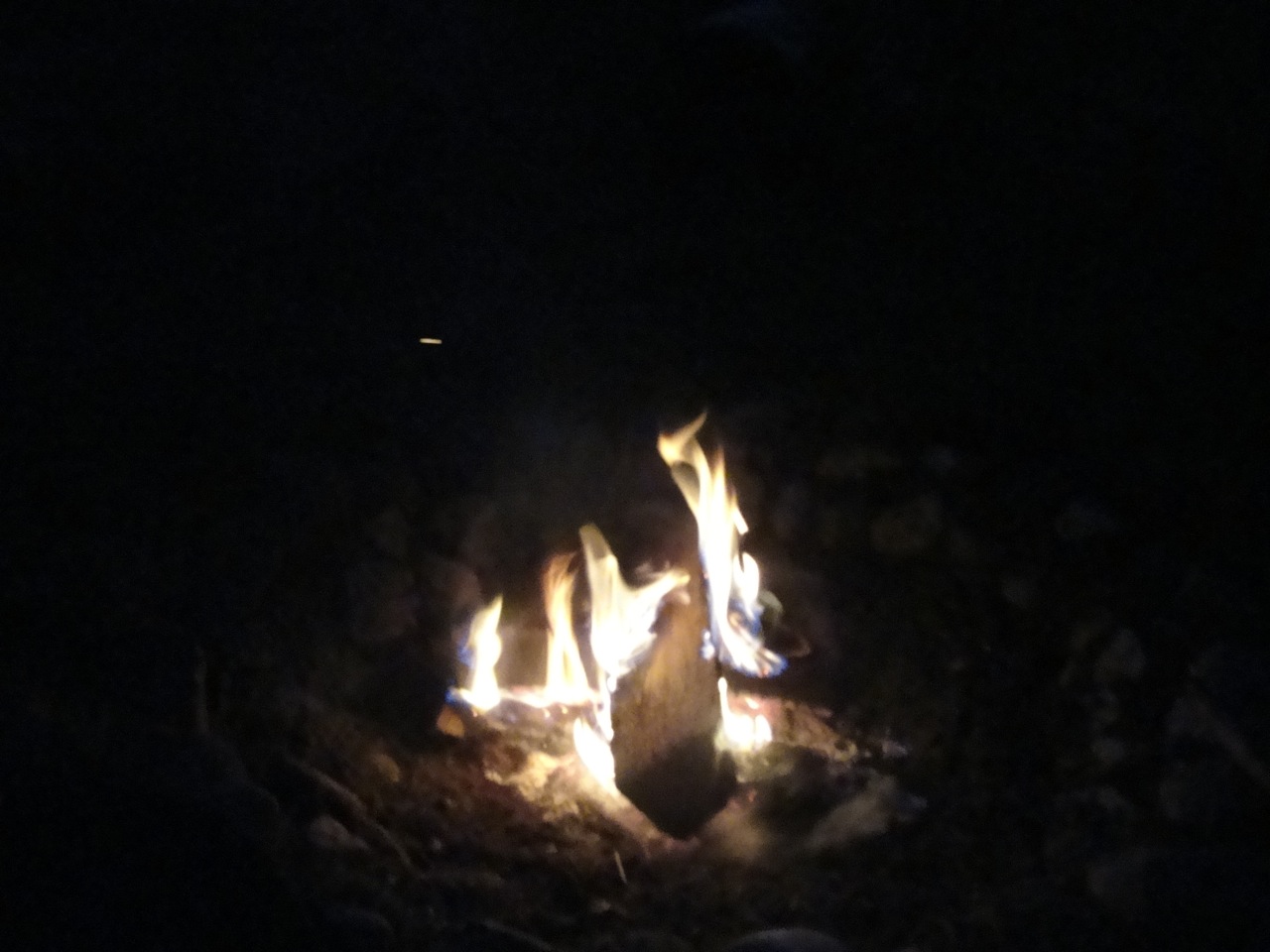
Fire DSC04621The poet Rumi, a Sufi mystic in the tradition of Islam, said that language doesn’t matter, the words we use don’t matter. “The love-religion has no code or doctrine.” Spirituality is not about what we believe, but what we feel. What matters is seeing, touching, knowing, loving. What matters is the burning of our hearts. He says we must become friends with our burning.

[Quotes from The Essential Rumi, trans. by Coleman Barks]

Bread

“We are here to awaken from the illusion of our separateness.”  Zen Buddhist teacher, Thich Nhat Hanh invites people to do an exercise, to begin to grasp with our minds the symphony of the larger whole. 

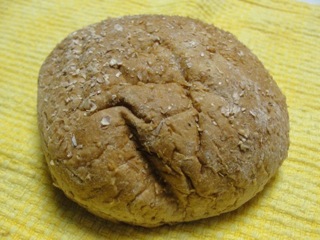
BreadTake an object—any object. He talked about a table, but I would like to reflect on a piece of bread. Find a piece of bread and hold it in your hand. Then, let yourself imagine what has conspired in order for this bread to be here in your hand. First of all, think of the wheat. In order for it to grow, it needed topsoil, with its fungal and bacterial components, its minerals and small worms. It needed the decomposition of the plants of many years, decades, and even centuries to create this fertile soil.

Think about the sun that shines on the earth, and the rain that falls, and the earth itself turning round in its orbit of seasons, and the moon that shapes the tides and the weather, all utterly necessary. Think about the wind, which helps the plants to self-pollinate, and the ancient peoples in the Middle East who began to cultivate the grain during the seventh pre-Christian millennium, and those who developed it and carried it to many continents through the intervening centuries. The wheat that is used in bread co-evolved with human beings, and does not thrive in the wild.

If your bread is made from organic wheat, it doesn’t use petroleum for fertilizer, but it took petroleum in the form of gasoline to harvest it and ship it to the bread makers. Non-organic wheat uses even more petroleum. Petroleum is created from the remains of ancient plants, so this bread is also dependent on them. Think about the metal in the trucks that drove the wheat and in the machines that mixed the bread, and the mines it came from and the factories where the machines were made.

Think about the yeast, and the process by which human peoples discovered and developed the properties of yeast to raise the dough of bread. The honey, and the bees that work tirelessly to make it, and the flowers and their nectar. Think about the water that enabled these ingredients to be blended together. Think about the fuel to heat the ovens.

Think about the farmer, and the miner, and the bread-maker and the factory worker; think about the food they needed to eat, and the clothing they needed to wear in order to do their part of the work that brought this bread to your hand. The trucker, the grocery stocker, the clerk. The houses they live in, their schools and their doctors and their dentists.

Think about their parents, and their grandparents and their great grandparents, and what kept them alive, to bring forth their children, that these people who work might be here today. If you are holding organic whole wheat bread, think about the growing environmental consciousness, that created a market for organic whole wheat bread, after many farmers, bakers and corporations had abandoned the old methods for the soft white appeal of Wonderbread.

I could keep talking all day if I followed all the threads of connection just linked to this one piece of bread. Paraphrasing what Thich Nhat Hahn would say:

If you grasp the bread’s reality then you see that in the bread itself are present all those things which we normally think of as the non-bread world. If you took away any of those non-bread elements and returned them to their sources…[the honey to the bees, the metal to the mines, or the farmers to their parents], the bread would no longer exist. A person who looks at the bread and can see the universe, is a person who can see the way.

 As long as we think of God as “up there” somewhere, like a father or a king or some other kind of person, we imagine that we are separate from God, we imagine that we can think or not think about, believe or not believe in, pray or not pray to that God. But in a spirituality of connection, the gaze shifts to understand that there are no truly separate things, that there is no separate self or separate God—that our “own life and the life of the universe are one.”
Quotes from Thich Nhat Hanh, The Miracle of Mindfulness, Translated by Mobi Ho, (Boston: Beacon Press, 1975) p. 47-48.