Letting Go

9 file boxes of white and brown, marked with Myke Johnson, numbered, with years and places, all lined up in a row

Today, S— came to pick up these nine boxes, to take to the LGBTQ archives at our local university. It feels like a pretty big deal. It involved six winters of going through old boxes that I had carried around for years–some for 50 years. I had to sort them paper by paper, and it became a look back into all the years of my life until now. I shredded and recycled and even composted much more paper than I kept. Perhaps I could have winnowed even more, if I went back through and sorted it all again, but I was ready to be done. (And I think that is one of the roles of an archivist anyway.) S— was so kind, and thanked me for adding to their collection. I felt good about entrusting her with these boxes. (Soon I will also transfer many years of digital files. But those are funny–you can give them and still keep them.)

At our retired ministers’ meeting this week, we reflected on poems, and especially the one by Mary Oliver that ends:

To live in this world

you must be able
to do three things:
to love what is mortal;
to hold it

against your bones knowing
your own life depends on it;
and, when the time comes to let it go,
to let it go.

“In Blackwater Woods” by Mary Oliver, from American Primitive. © Back Bay Books, 1983.

Letting go of these boxes, in a deeper sense, is a way of facing my own mortality. I notice that I am not completely letting go of these boxes, but giving them into someone’s care. I am hoping that I don’t disappear. Letting go of the boxes into an archive is not letting go of the self, really. On the contrary, it is saying: my life has had meaning and significance. And in the context of our times, it is saying, this lesbian life has meaning and significance–this lesbian life of activism, of writing, of spirituality, of ministry, has significance. Didn’t I learn that from Joan Nestle and the Lesbian Herstory Archives in New York? We must keep our own history/herstory. Not let it get lost. Especially now.

Sometimes, it feels like too much–too many pieces of paper, too many words, too many actions–will something essential get lost in the overabundance of words? But that is who I have been–always a pondering soul, a writing soul, a many-worded soul. I also notice that I am revealing so much of myself in this gift to the archives. Like writing, though, it is one step removed. So my shyness barely peaks out as I reflect on it. And I didn’t gift everything. For example, I decided not to send over my journals from 1983 on–(earlier ones are intermingled in the boxes.) I want those journals to go to the archives after I die. But the journals reveal not only my life but the lives of those who are close to me, and it feels much more intimate than the other papers. Very much part of my lesbian life, but for later revelation.

I think how, ultimately, in death, we let go in a much deeper way. I will let go of my small life into the larger Life, the larger Consciousness. I have always hoped, and felt it too, that Someone sees my life, that Someone sees all. I believe that I would be known and held in meaning and significance and love, whether I had written any words at all. All of us are.

First Snow, Gaza, Small Birds

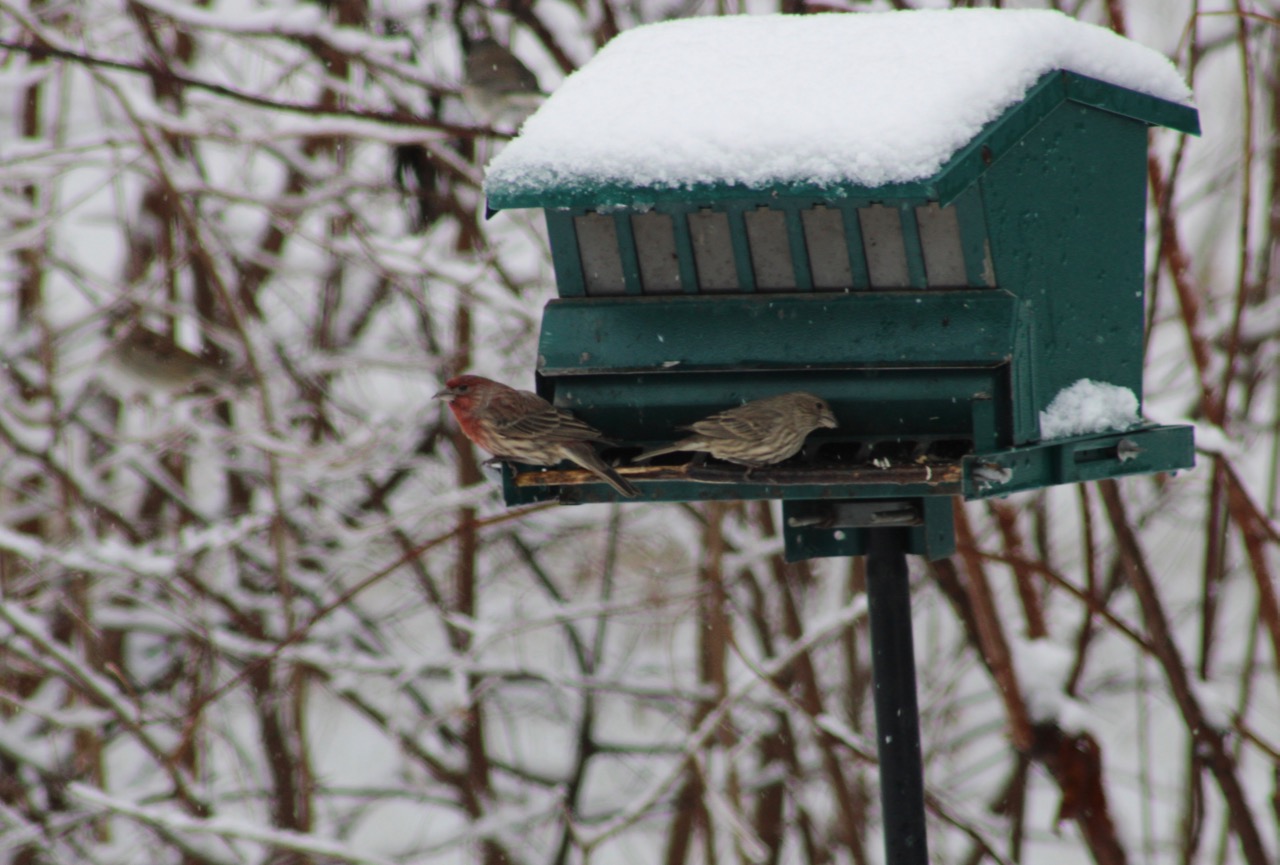
Green bird feeder in front of snow covered branches of hazelnut hedge.
Bird feeder near hazelnut hedge.

We have our first snow-covered morning here in our yard in Portland Maine. In places further from the shore they got several inches, but we had mostly rain until early morning. Now it feels like winter is really here. My internal clock has felt the shift, as the days grow shorter and darker. A few days ago, I started working again on sorting through my old documents–my winter project of the last few winters. This year, most of the documents are digital, though there is at least one box of paper files to go through in the basement. In prior winters, I looked back on all the years before we moved to Maine in 2005. This winter, I am looking through my time as minister of Allen Avenue Unitarian Universalist Church here in Portland, before I retired in 2018.

I started by reading all of the “annual reports” I wrote for the church to summarize the work of that year. It was a simple way to quickly turn the pages of thirteen years of ministry. I was astounded at the sheer number of times I marched in protests, or spoke at vigils in solidarity with issues of justice or worked on legislative change in support of human rights, usually along with other members of my congregation or other ministry colleagues. My life now is so much quieter and less intense, but also less connected. It was good to have that public voice, and to use my voice in service to all that I believe. I feel so far removed from that life and that work.

I suppose in some ways a blog is a kind of public voice, but much quieter and less visible. My life these days is much quieter and less visible. That is chronic illness, compounded by our continued COVID precautions in our household. I can’t put my body out on the line for love and justice. It takes most of my body’s energy just to manage our household tasks. It is like I am looking out a window at all that is happening in our world.

I was surprised to notice that I hadn’t blogged for a few weeks. Lately, all I can think about is Gaza and the way the people there are suffering and dying. In my files I found a sermon I preached in 2014 about Palestine and Israel. In many ways, the issues are all the same. In other ways, everything has gotten worse, much worse. So many deaths, so much destruction. I can’t even imagine the words I could say about it, and then I don’t have words for anything else. My heart is on the ground. My heart is on the ground.

And then, out the window I see a large flock of small birds visiting the hazelnut hedge and the bird feeder. They find their way to our yard each day, traveling together as a group. They usually arrive mid-day, but today they are early. Tufted titmice, chickadees, goldfinches in their winter garb, sparrows, juncos, finches, even a bluebird. (Maybe they come more than once a day, but you have to be looking out a window to see them so I am not sure.) Often a few chickadees even stop at our back porch pecking for stray seeds. It is not so easy to take a photo of a flock of small birds. They scatter themselves across the orchard. They come through and then they are gone again. Traveling all together on their mysterious rounds.

And my heart is lifted just a little, with their flight and their community.

Finches at feeder.
Junco on a branch.

Season Changes

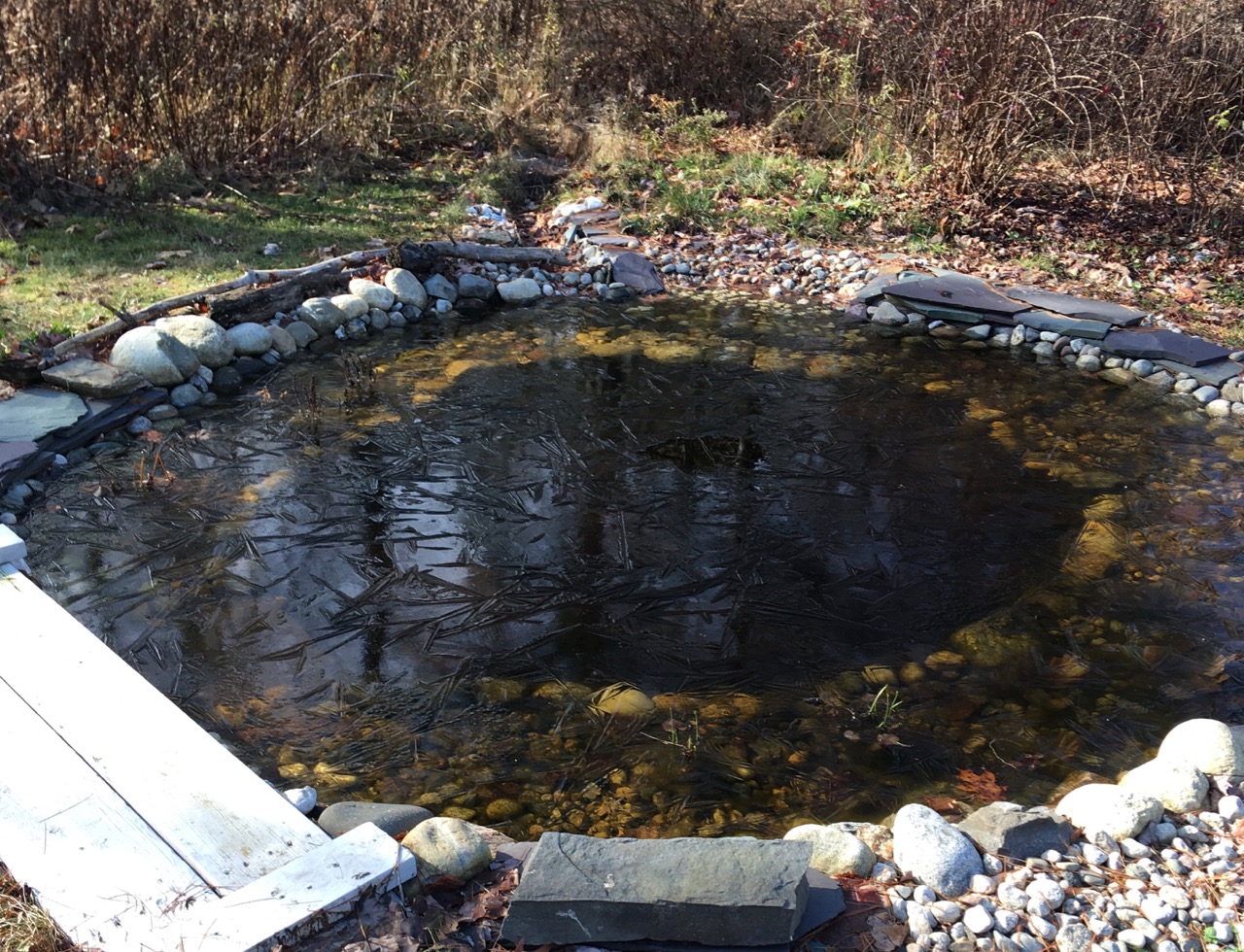
Ice forming on the surface of the pond yesterday, like wrinkles over the water. You can see stones around the water in a ring.
Ice was forming on the surface of the pond yesterday.

Yesterday felt like the true turning of the seasons, from warm autumn 70 degree days to a chilly, almost winter, high of 40 degrees. We had a freeze overnight and the pond surface was wrinkled with ice forming. I went around the yard putting away the last garden hose, the five-gallon buckets, the little tables we use in the back next to chairs. I turned over the wheelbarrows behind the garage. I covered our patio table and chairs with a tarp, and I plugged in the bird bath so it will keep water thawed during frozen weather. I got out the snow shovel and sand mixture to put on the back porch. I left 4 chairs around the fire circle–maybe we’ll get outside around a fire–it could happen!

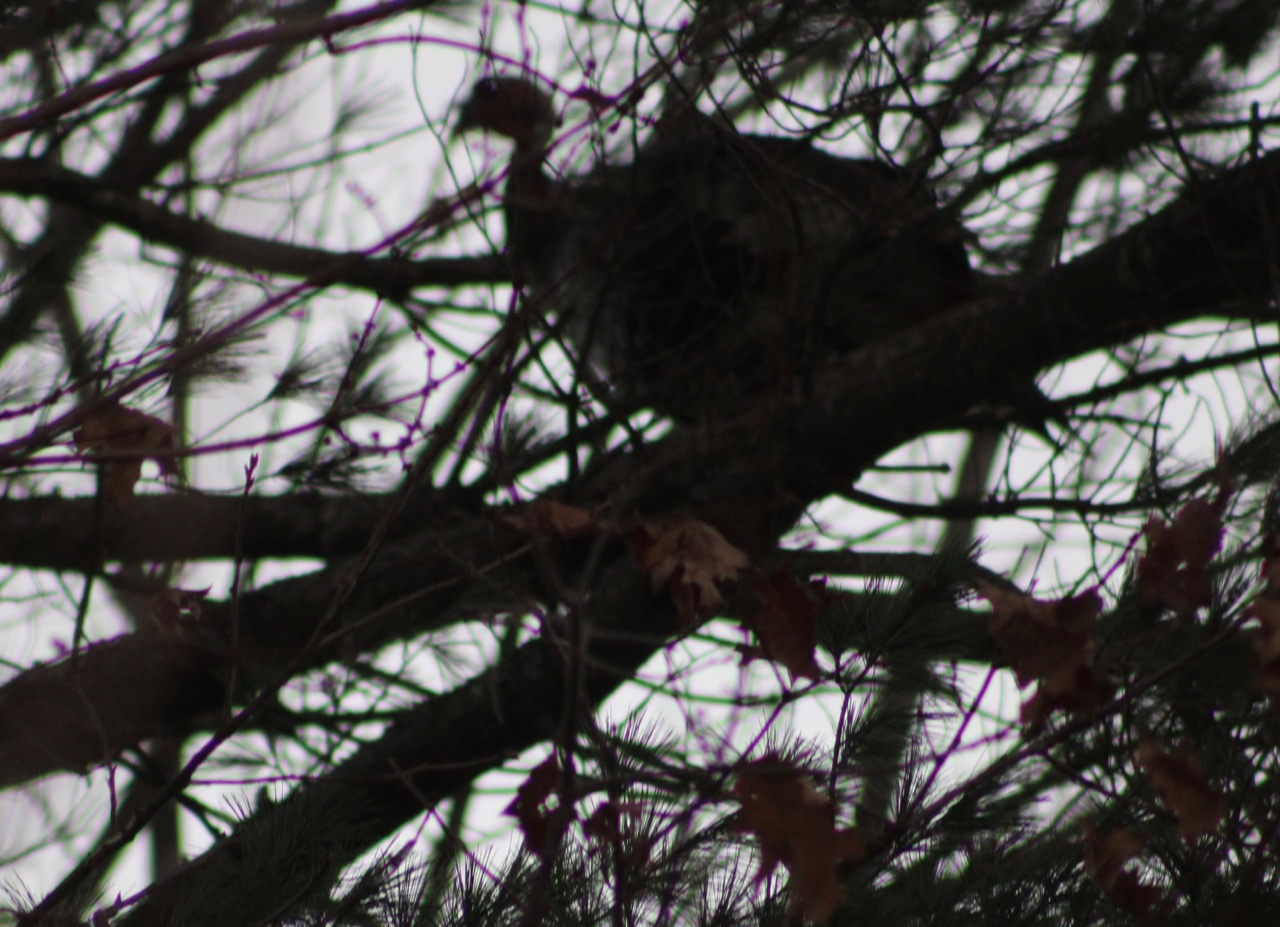
Last Thursday was my last time lying in the hammock for the season. I could see two frogs still hanging out in the pond, the color of mud, not the green of summer. While I was lying there, suddenly I saw a huge bird flying nearby, up to the pine trees at the back near our yard. Looking closer, I recognized the characteristic shape of a turkey! It was dusk and the light was turning all black and white and shades of gray. We’ve had a little trio wandering in the yard during the last few weeks, so I am guessing this was one of them. I had to put the hammock away the next day.

Turkey in a pine tree at dusk, mostly black and white silhouette.
Turkey in a pine tree at dusk

This morning, we had a bit of snow, mixed with rain, so here we are. The gardening work, whether fully complete or not, is done for the season. And I was inspired to get back to my winter project–going through boxes of old papers in the basement. I am proud of myself for diving into it today!

Last winter, I went through 11 boxes from my years in Boston, organized, winnowed, and reduced them to four. I had just started on some boxes from the time before I moved there. This winter, I will go through papers from my time at the Women’s Peace Camp, and in Chicago, and in Grand Rapids. I went to Chicago from Grand Rapids in 1983 to attend Chicago Theological Seminary, from which I graduated in 1986. I visited the Peace Camp in the summer of 1983, and then lived there in the summer of 1985, and winter/summer 1986. These places were the scenes of my coming out as a lesbian, and my trying to figure out what ministry might look like for someone like me. At the time I had left the Catholic church, and was part of the emerging feminist spirituality movement. I experienced so much transformation during those years, and I am fascinated to read what I wrote about it. It was a season of profound personal change.

Winter Winnowing

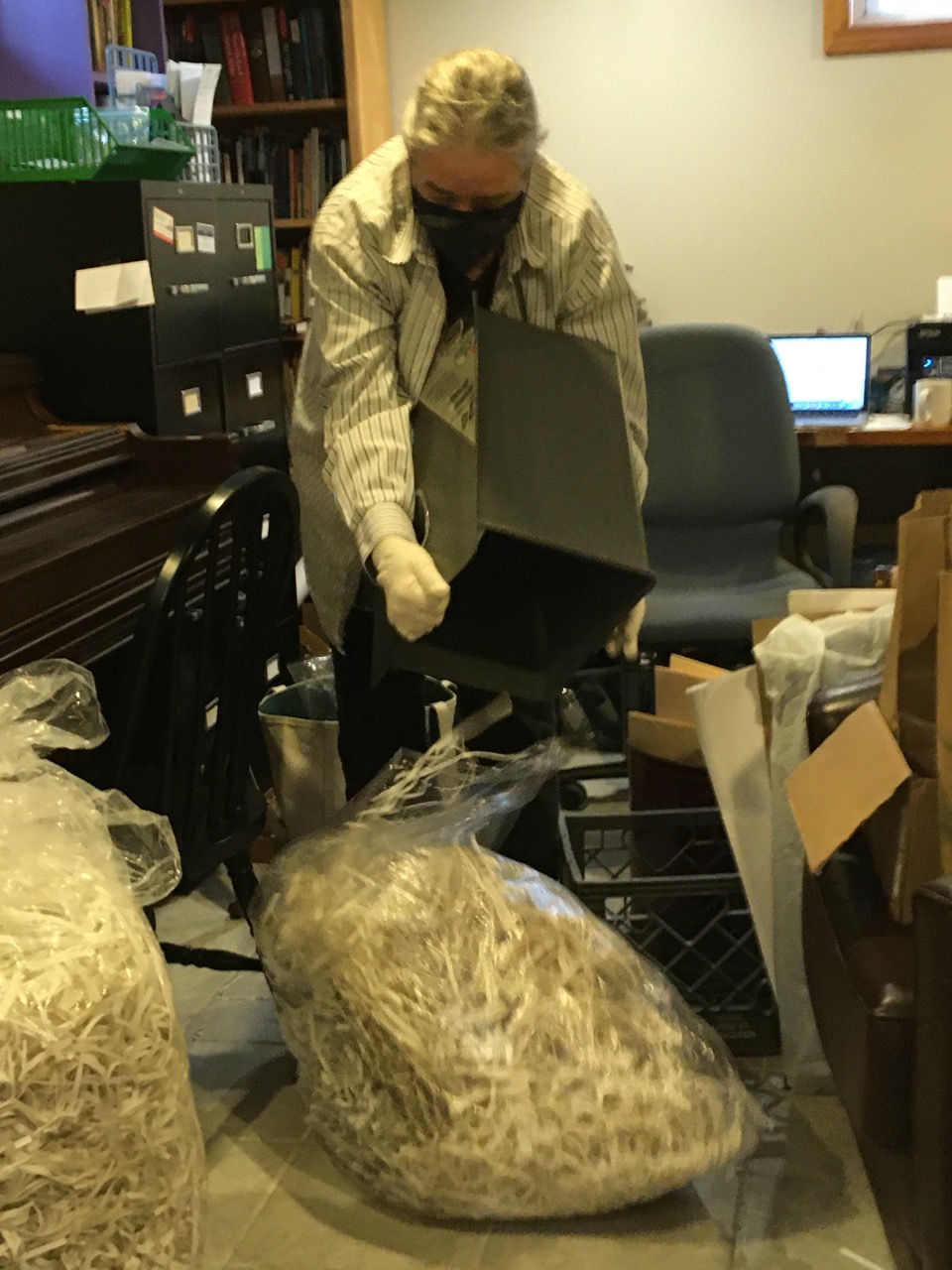
At work in the basement with shredded paper, photo by Margy Dowzer

Every couple days I go down into the basement, to sort through my old boxes. I cover up with an over-shirt and apron, cotton gloves and mask, to protect me somewhat against allergies to dust and old paper. I pull out a box and open it up to reveal treasures and trash, scribbled notes and carefully typed poetry, cherished memories and forgotten moments. I have no idea when I might finish, but it helps to think of this as my Winter Project.

Sometimes I think of it as death cleaning, as in The Gentle Art of Swedish Death Cleaning, by Margareta Magnusson, a method of organizing and decluttering your home before you die to lessen the burden of your loved ones after you’ve passed. But I am not following any methods put forth in this book. What connects is that I am weighing everything against the question “What value might these things have, after I am gone?”

When I became a feminist in 1979, I became aware of how women were hidden from history, how most written history prioritized the deeds of white men in power. Wonderfully, feminist historians, and those of other marginalized communities, have been bringing to light these hidden histories/herstories for several decades. Along the way, I internalized the belief that our own lives are part of history, too. My life is part of history.

As a childless lesbian woman, I won’t have descendants that would value my writings. But that makes it feel even more important to preserve my stories, especially those of lesbian activism, lesbian community, lesbian spirit. And so I have been thinking about what might be valuable for an archive, and in fact, I have already communicated with an LGBTQ archive that expressed interest in my papers. So this becomes an important measure for what to save, and what to shred.

But beyond what value these papers might have after I die, it has also been so valuable for me as a method to reflect on my life as a whole, revealed in what was saved, deliberately or accidentally, during various parts of my life. So far I have been going through boxes from the time I lived in Boston, from 1986 to 1999. I guess I started in the center of my life. There is a lot of shredding-I reduced the first three boxes to just one. I think after I finish with Boston, I will likely go back to the earlier boxes, and only then return to the more recent ones. Perhaps then it will be easier to put it all in perspective.

I don’t know why it has taken so long to begin this project. I don’t know why now seems like the time to do it. But in the middle of winter, in the midst of a pandemic, in this liminal time after retiring, my spirit feels called to this remembering, this winnowing, and so I keep going down into the basement to see what I will find.

Guests & Storage

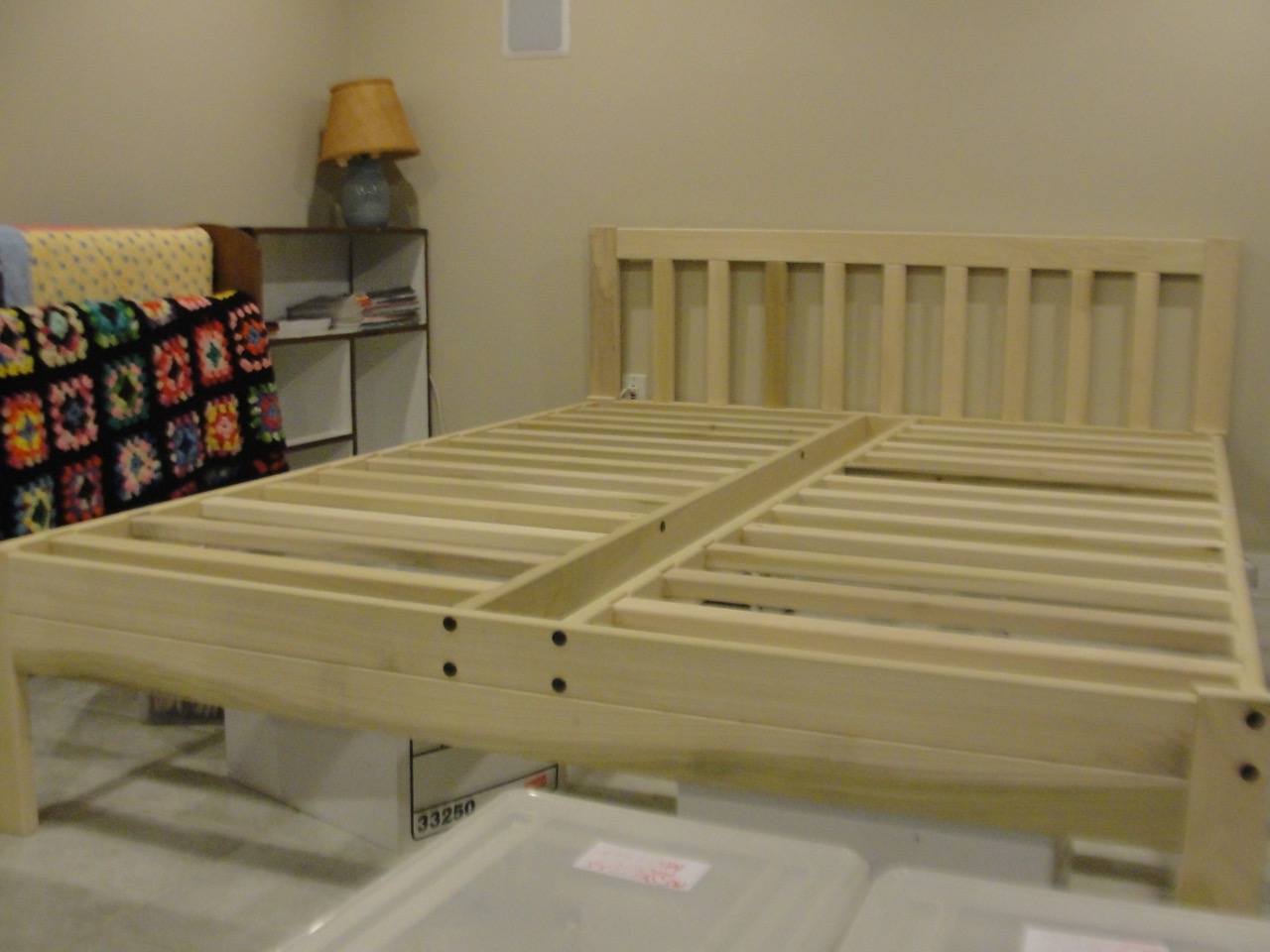
Bed for guests & storage

One of the principles of permaculture design is stacking functions–whereby one item serves more than one function at the same time and in the same space.  I just finished putting together this bed which occupies a corner of our finished basement, and it provides room for guests, as well as room for storage underneath.  (Now we just need a mattress.)

Since we downsized, we’ve needed to be creative about how to manage multiple functions in a smaller space.  We really want to be able to offer comfortable hospitality to guests, but we also have been struggling with storage options.  So the two major requirements for this bed were that it be comfortable, and also that there be room for boxes underneath.  I have a lot of boxes–the archives of my life you might say.  Some early writing, some political work, some letters and photos… When I considered the possibility of getting rid of them, I realized that I wanted to keep this history–if only to go through it again in my old age.

Now, I am happy to see it before my eyes.  My plan is to organize the boxes, and make a diagram of where they are, so that if I need to get access to them, I know right where to look. Otherwise, they will be hidden under a bed skirt, and the room will be neat and welcoming and uncluttered.