When Trees Fall

The good part, for which I am grateful, is that our neighbor came to our door to talk to us. He asked whether we would mind if they took down trees in the area between our two properties. He wasn’t sure of its status, but I told him it was a “paper road” that likely would never be built. I told him we would NOT want those trees taken down, that they provide privacy between the two yards. The neighbors want to garden in the way back of their yard, but don’t get enough sun. I suggested that the boundary trees are to their north, so wouldn’t affect their sun. He said it was just as a way for the machinery to get into the back, but they could do it a different way and not take down those trees. He wanted to respect our wishes. So that is the good part. And I like that they want to garden.
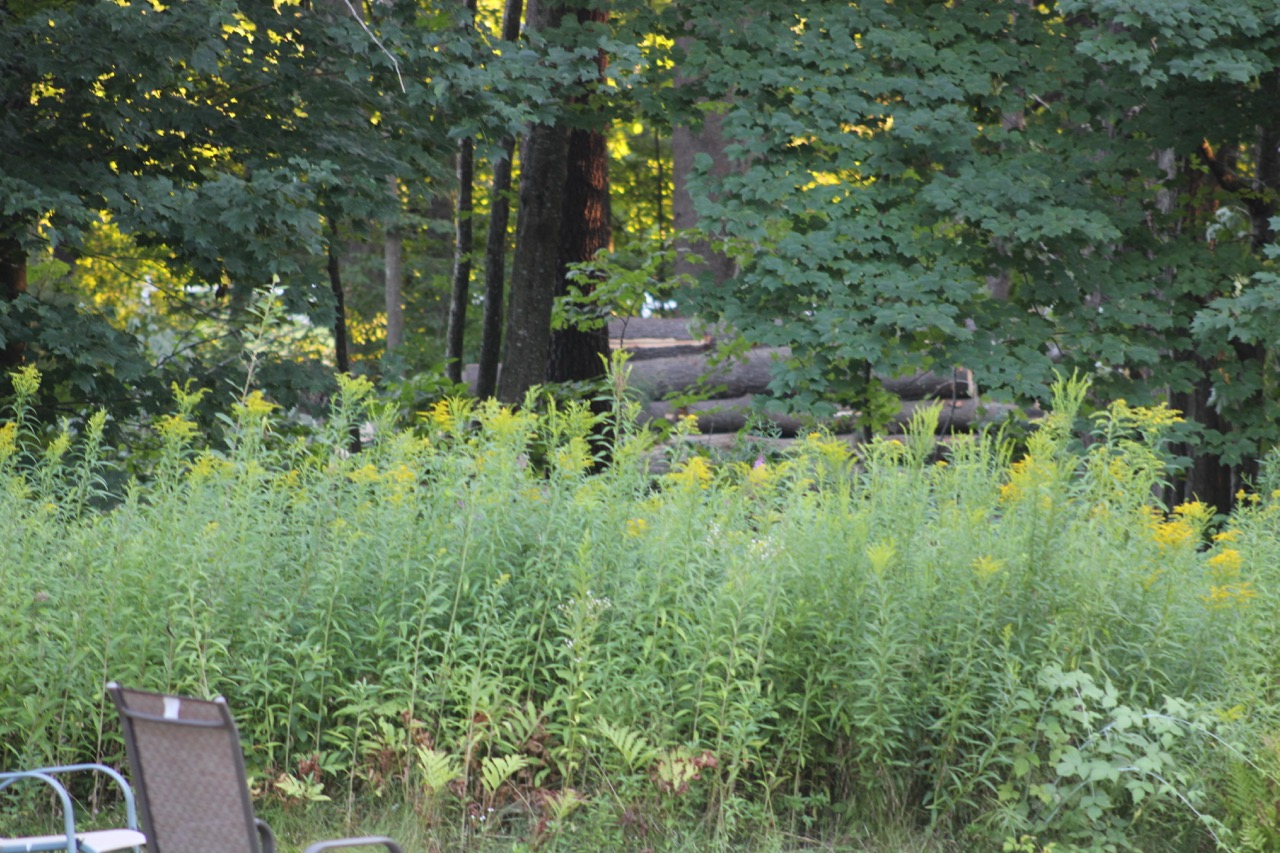
Felled pines behind our big pine, behind our back yard, with goldenrod in front.

But the rest is so bad. Loud machines have been working all day yesterday and today, felling tall pines, and chipping up branches. Sometimes we feel the ground shake in our house when the trees fall. Our thin strip of protected trees does not hide what they are doing, light comes through and all the visuals of machines, and trees being cut down. The cherished privacy of our back yard is no longer what it was. But most of all, I think about all that habitat lost and wonder how many birds’ nests have been destroyed. Many many birds yesterday were making alarm calls. Early this morning, a pungent skunk-spray smell came through my windows. I imagine that the skunk has been dislodged in some way, and perhaps came across our yard and encountered one of the little cats that hunt here. I think about how we love the wildlife that come through our yard, and how the trees and underbrush, on the so-called “undeveloped” land, have been a mini-wildlife corridor for deer, turkeys, skunks, groundhogs, sometimes even foxes.
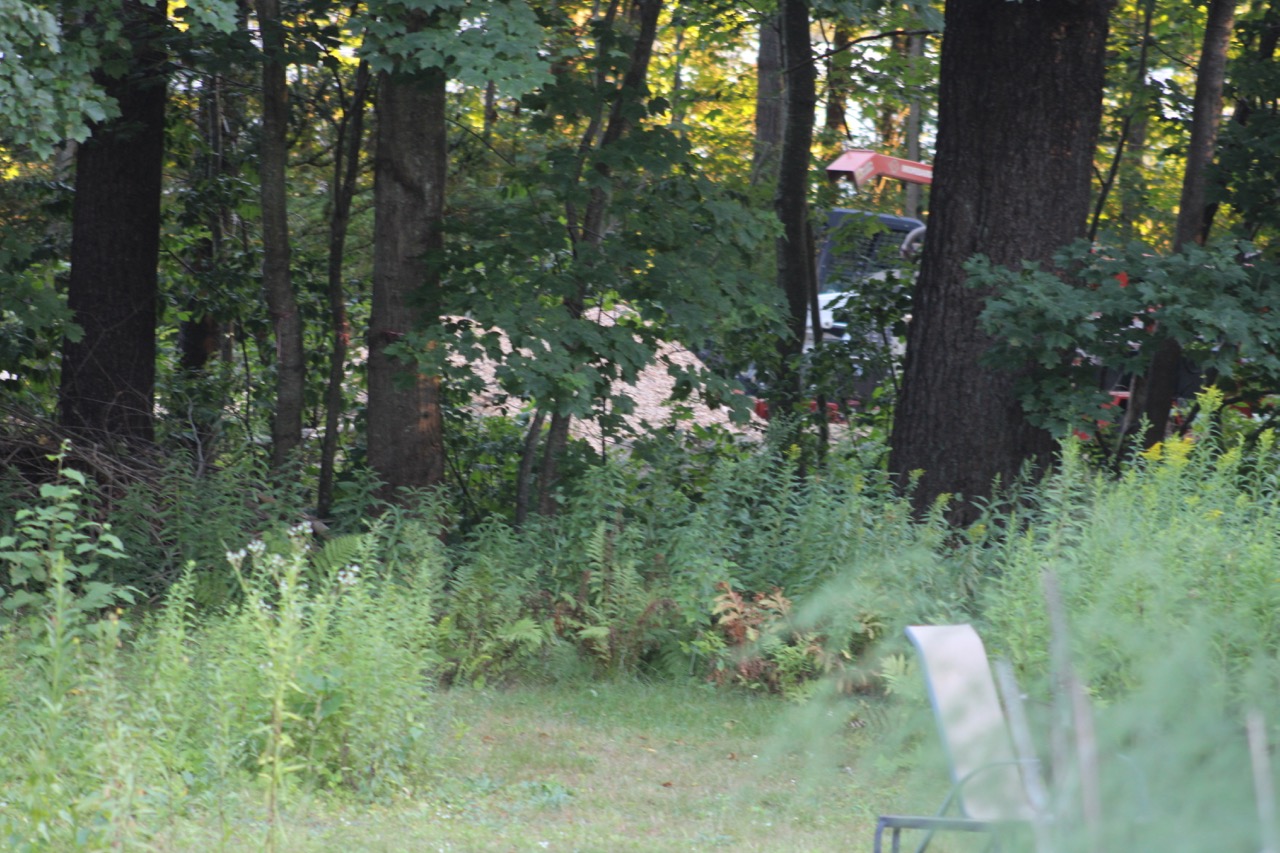
Through the trees, we can see the big machines, the pile of wood chips.

I try not to make the neighbor an enemy in my mind–after all, he wants to create a garden, so there is love for the earth there too. We live in the city, in a neighborhood near little brooks in sunken areas that continue to provide wildlife a refuge. But just in the six years we have lived here, acres of trees have been cut down in our neighborhood. Each tree down means more carbon in the atmosphere, more warming, more drought. I think about the long history of cutting the great forests of North America for settlers’ farms and gardens and cities.

And this is how the wider world feels to me right now as well. Slowly falling down around us, more and more “developed,” less and less room for wildlife and trees. I don’t even know how to feel this sadness. It is too deep, too fundamental. Even as Margy and I try to love this small piece of land, to learn from it how to live in mutuality with the earth, all around us the path of destruction seems to hold sway. I think about the great pine in our back yard on the paper road, the one that is over 100 years old, and how she must feel to sense the destruction of her family of trees nearby. I think the trees know. They know that we are destroying our only home, our only planet. And so we grieve together.

The Gifts of Birds and Berries

Blueberries and raspberries from our garden

Right now the garden is happy with berries: the raspberries are loaded with fruit, and this is the first year for a blueberry harvest. We planted these blueberry bushes in 2017. This year, I put up some fence posts and draped the berry bushes with gauzy fabric after the berries started to form. (Tried it first without the posts, but the weight bent the bushes over when it rained.) This is to keep the birds from eating all the berries. But we have three younger plants in the back that I left open. And the raspberries do fine on their own. So every other day, I go out and pick a bowlful of ripe berries.

Blueberry bushes wrapped with tulle fabric

The fabric barrier is a bit ironic really. I don’t mean to discourage the birds at all. But expert gardener’s advice says that they will eat all the blueberries before we can. I think of myself as a very novice gardener. Our garden only provides us with a very modest harvest. Last year the squirrels took all the peaches, and cabbage moths are now eating a lot of the kale. I have given up on the idea of creating a food forest that will provide all our needs. This year, I haven’t had the energy to give any of it much attention at all.

But somehow, in the midst of it all, the garden keeps giving back to us in unexpected ways. The orchard has become a bird heaven. We now regularly see cardinals, a robin couple (who, after two failed attempts, are again playing with the nest on our porch), gold finches, house finches, sparrows, chickadees, catbirds, starling visitors, not to mention the turkey mom and her two babies that keep coming through, and so many more. The small birds love perching in the fruit trees–and I love seeing them there. They ate the few cherries, which I didn’t try to protect. I think they are also eating a lot of bugs. They even love perching on top of the stakes in the zucchini bed. We provide sunflower seeds in the bird feeder, and they planted sunflowers all around it with the droppings. So we are gifted with all this beauty.

Sunflowers in bloom around a green bird feeder with a small sparrow on it.

This has been a summer of much gifted beauty. Another example is the wild evening primrose. I pulled all of the primrose plants that had sprouted up in the orchard, because I knew they would be too tall and block the paths. But I purposely left the ones on the other side of our back porch, this one in front of irises that bloomed earlier. And now they sparkle a bit like a Christmas tree in July.

Tall evening primrose in bloom

Each year I do learn a bit more about how to garden. This year, it seems that what I am learning most of all is how much the earth gifts to us and to all her creatures, how generous and abundant she is, when we merely open to her and open to other creatures, and stop trying so hard to make something specific happen. I am feeling the interconnected family of beings, and especially the joy of birds who now find a home in our yard. It’s amazing! Finally, I just want to also express gratitude for a monarch butterfly who came to visit a few days ago.

Monarch perched on volunteer elecampane flowers

More Ordinary Magic

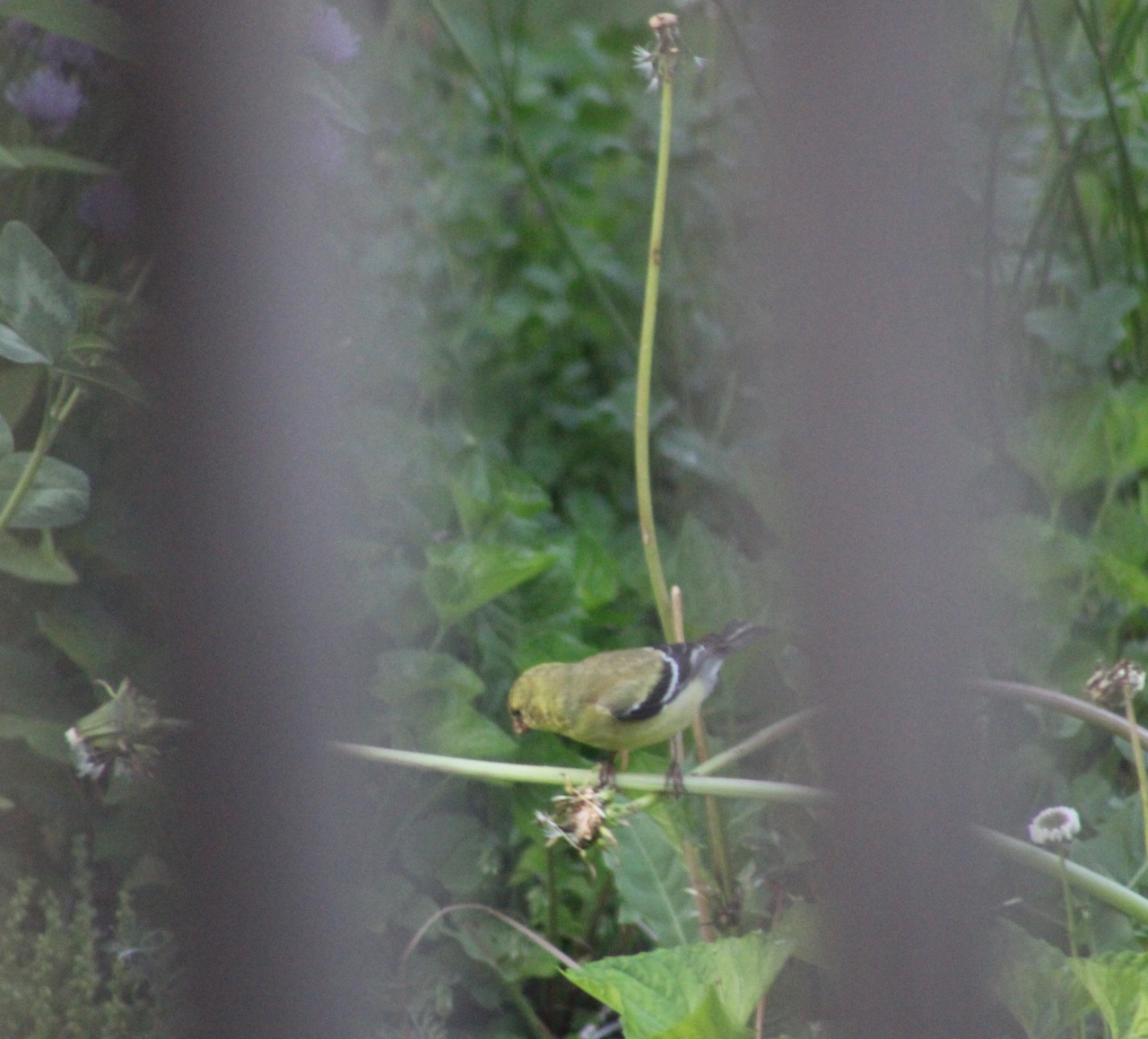
Goldfinch on dandelion stem, through deck rails

Remember when I described the beauty of seeing a goldfinch climb over a dandelion stem to get the seeds? But I didn’t get a picture then? A little magic happened again, and this time I was able to get this photo from our deck. The more wild and plant-filled our yard has been, the more birds of all kinds we see. They bring so much delight. (Sadly, we’ve also seen more ticks than before as well.)

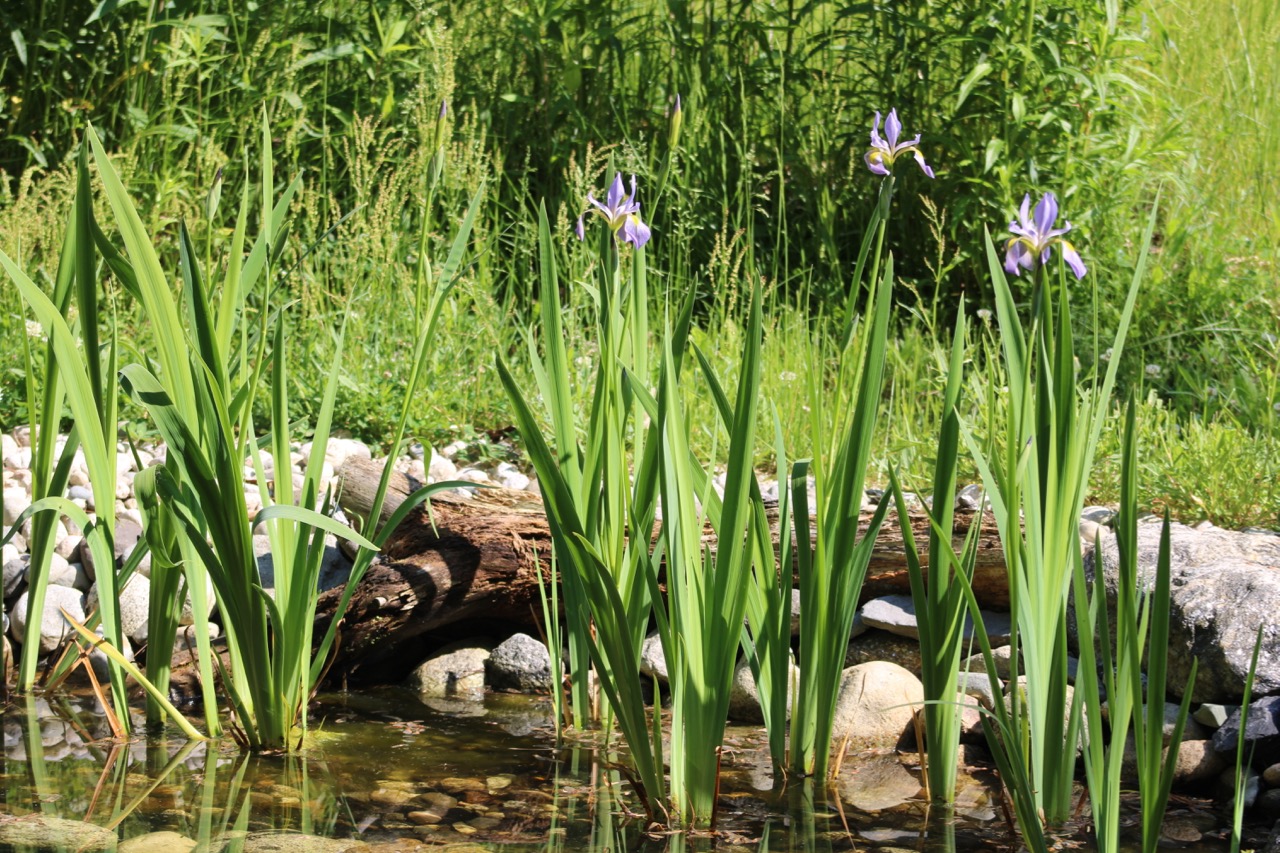
In other news, the blue flag iris in the pond are blooming for the first time! We also have a lot of algae–likely because there are not enough plants, since several didn’t come back. But I am not too worried. I skimmed some out and I hope I can keep doing that until the plants expand, or I can add some more.

Blue flag iris blooming

I also finally was able to plant–in three different short spurts of time and energy–some kale and broccoli seedlings, and seeds of cucumber and zucchini. Lots of rain today, so they all got watered. I am humbled by this process of observing, doing small things that I am able to do, and hoping for the best. One thing is sure. Plants will grow!

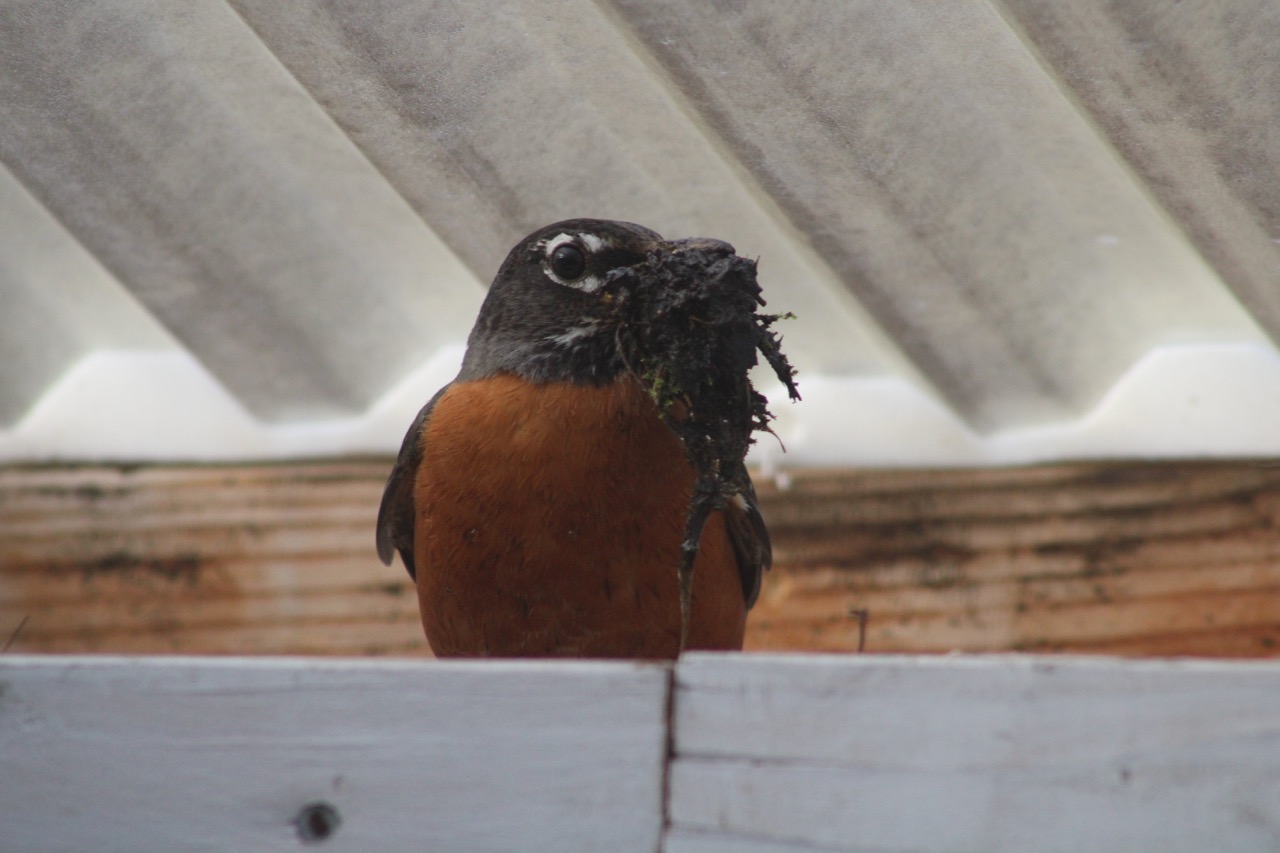
Robin Building a Nest

Photo: Robin with moss in beak, sitting on beam under our deck roof.

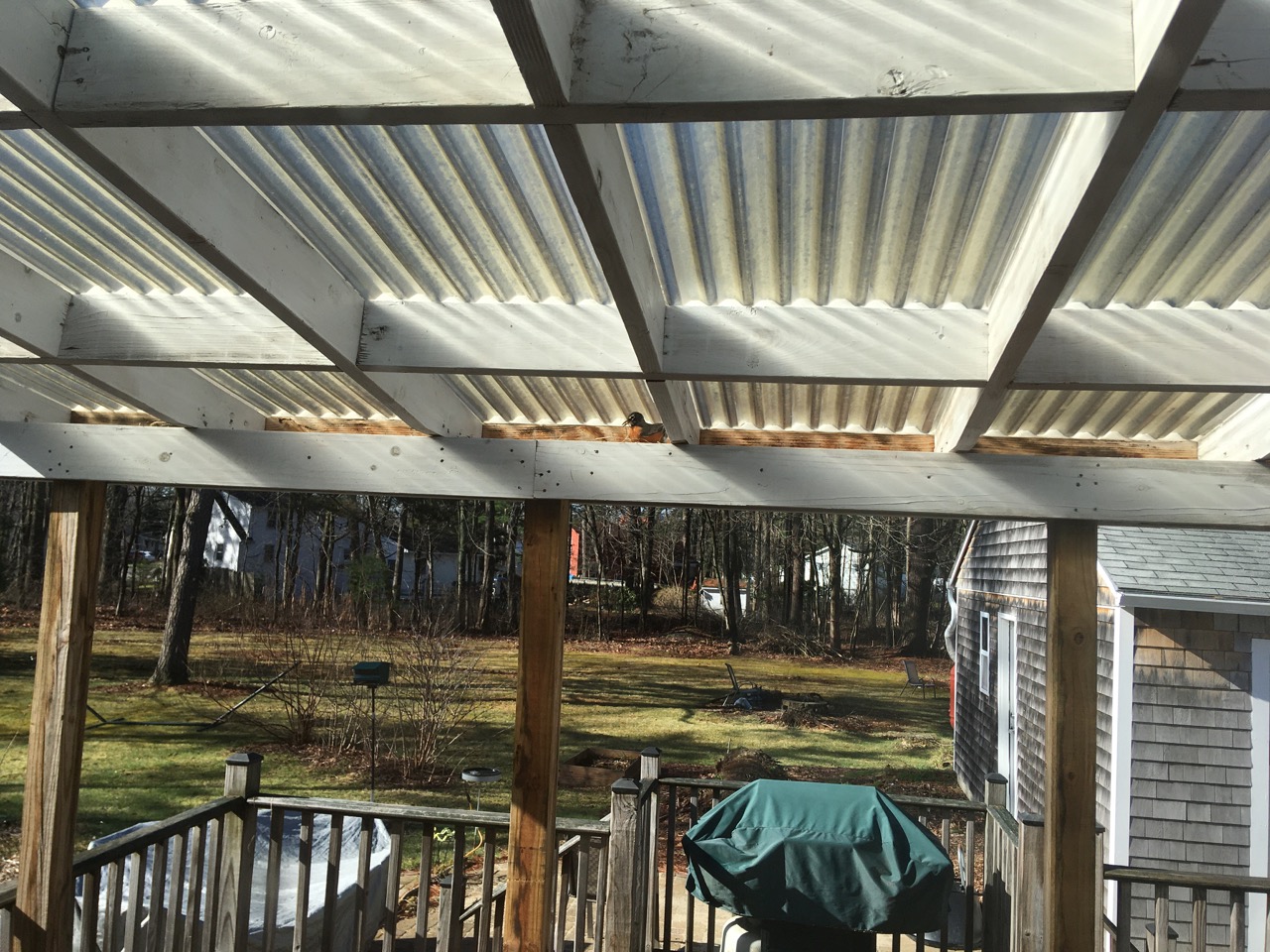
A robin is building a nest in the beam under our deck roof. I thought she would stop yesterday, after I went out and in a few times–it is our entryway. But she is back today. It seems to be a great place for a nest. The way the beams are fastened, the center board creates a lowered groove between two higher boards, so a nest could rest in that groove and be quite secure. It is protected from rain. She can enter and exit from either side of the beam. I do wonder how warm it might get under the clear plastic roofing, nice for now, but later it could get hot.

One weird thing is that she seems to be working on more than one nest, bringing dried grass and moss to three different sections along the beam. She started in the segment on the left, and this morning I’ve seen her in three different sections adding dried material. Still, her focus is on the section on the left.

Larger view, robin adding nest materials in different sections.

I feel so grateful for the animal neighbors. I love to watch the robin fly back and forth, carrying so much material in her beak. I hope we can be neighbors during the time she raises a little brood. But however it turns out, it is a delight today.

Offerings

I wasn’t able to capture most of them with my camera, but I want to speak of bird visitors nonetheless. This morning little winter goldfinches, with their olive feathers, were flocking to our bird feeder, and to the water, and to the dead heads of bee balm never cut down, and likely full of lovely little seed breakfasts. The seeds, and the water kept liquid by electric warming, are our offerings to the creatures with whom we share this land.

I think of February 1-2nd–Imbolc, Brigid’s Day, Candlemas, Groundhog Day–as the day the birds start singing again. The light returning. Still, even though something is stirring anew, this year there were many birds and other creatures who frequented our little offerings of seed and water during the dark of winter as well. There were a couple days mid-January when flocks of robins appeared. I only managed to photograph this one getting a drink of water, but there were likely a dozen. They love our neighbor’s crabapple tree. The birds also love to perch in our fruit trees branches nearby.

Photo: dark day, robin drinking water

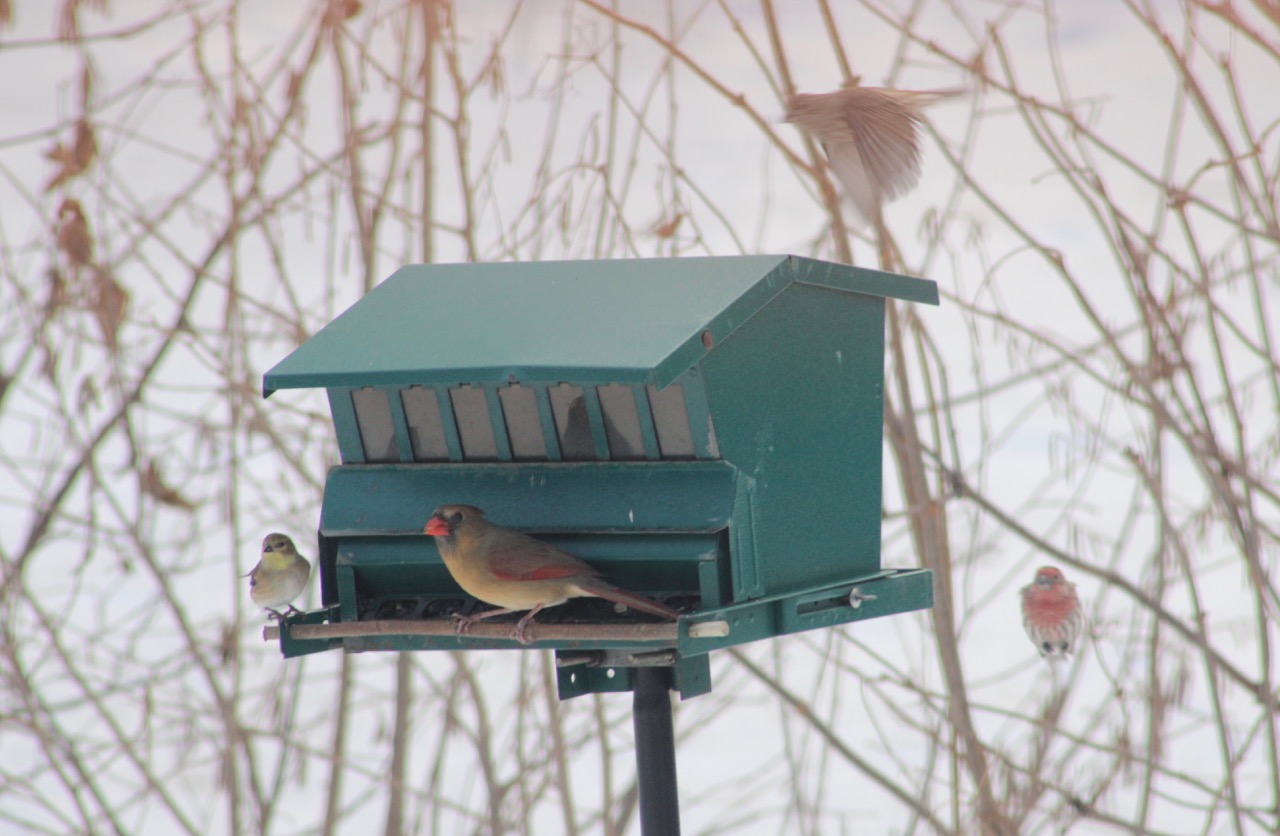
The cardinals have stayed throughout the winter, and I often see the female cardinal at the feeder. The other day she and other smaller birds were jockeying for position—if three were on the roost, the seed door would close—so they chased each other off long enough to get a snack. Of course, the squirrels always have to take their turns–they’ve mastered the acrobatic positions needed to keep the door open. So smart.

Storms seem to increase the number of creatures who seek out our offerings. During our last blizzard, as dusk enveloped our yard, Margy called me to the back door, where we saw two deer walking so quietly near the bushes. The next morning, I saw their tracks leading to the seeds and water. I have heard it said that one of the rituals of Brigid’s day is to give food offerings to the spirits of the land. I hope our seeds and water might be a blessing to all the creatures who visit or call this place their home.

Courage

Photo: Female cardinal at feeder, with three smaller birds nearby.

I am finally embarking on a project to go through all of my papers, now in boxes in the basement. These range from files that I brought from my office when I retired 3 1/2 years ago, to boxes that I have carried around since college. This week I have been going through a box of writings–poems, essays, and an almost book, dating from about 1986 to 1996. During those years, I lived in Boston, surrounded by lesbian community, making a living in what today might be called the gig economy, while focusing my time and energy on activism, writing, feminist spirituality, and social change.

It was a scary time, financially, just getting by with no safety net, no health insurance, moving from rented apartments to other rented apartments in an increasingly difficult housing market. It was also, for a while, a joyous and exhilarating time, creating chosen family through collective living with other lesbians, wrestling with issues like classism, racism, and sexism, all the while imagining justice, mutuality, and queer beauty.

Reading the many words I wrote brings me back there, and I am impressed by the creativity which filled those pages and filled my life and the lives of those around me. But there was an undertow that sometimes threatened to drown me–a shift when housing got harder to find, when joyful cooperative situations became uneasy roommate situations, when loneliness began to plague me. Still, poetry and Spirit sustained me even then. I found this poem that seems worth sharing as 2021 comes to an end, and 2022 is about to begin. May you find the courage to follow the road where your heart leads you!

1/13/93

If there can be power in a word
the word “courage”
gets me out of bed
surrounds my heart in hard times.

There are many poverties.
Each moon waning, as I just get by
financially, I find my true despair
lurks in the isolation
which has covered the walls of my days
like some asphyxiating new paint
and I feel I can’t breathe
and I feel I don’t belong here.

I remember when I set out on a path
to transform the world.
We sang then, the joy of our
meeting filling our mouths
like lovemaking, our visions
changing us into new beings.
We laughed at how we didn’t fit
our chains anymore, and big as life
we set about to craft a new home.

There are many poverties.
Loneliness is the unforgivable sin.
I have always felt I could survive
the insanity and cruelty of the world
any poverty or hardship or struggle
if only I had companions to share it.

But here I am.
Loss and need my only mothers.

If there can be power in a word
the word courage
gets me out of bed.
Courage rests her cheek against my heart.
Courage squeezes my hands into her pockets.
Courage plants her feet into the prints
of my solitary steps
as if of course this is where the road
must go and I am still
that traveler.

Climate Catastrophe in Disguise

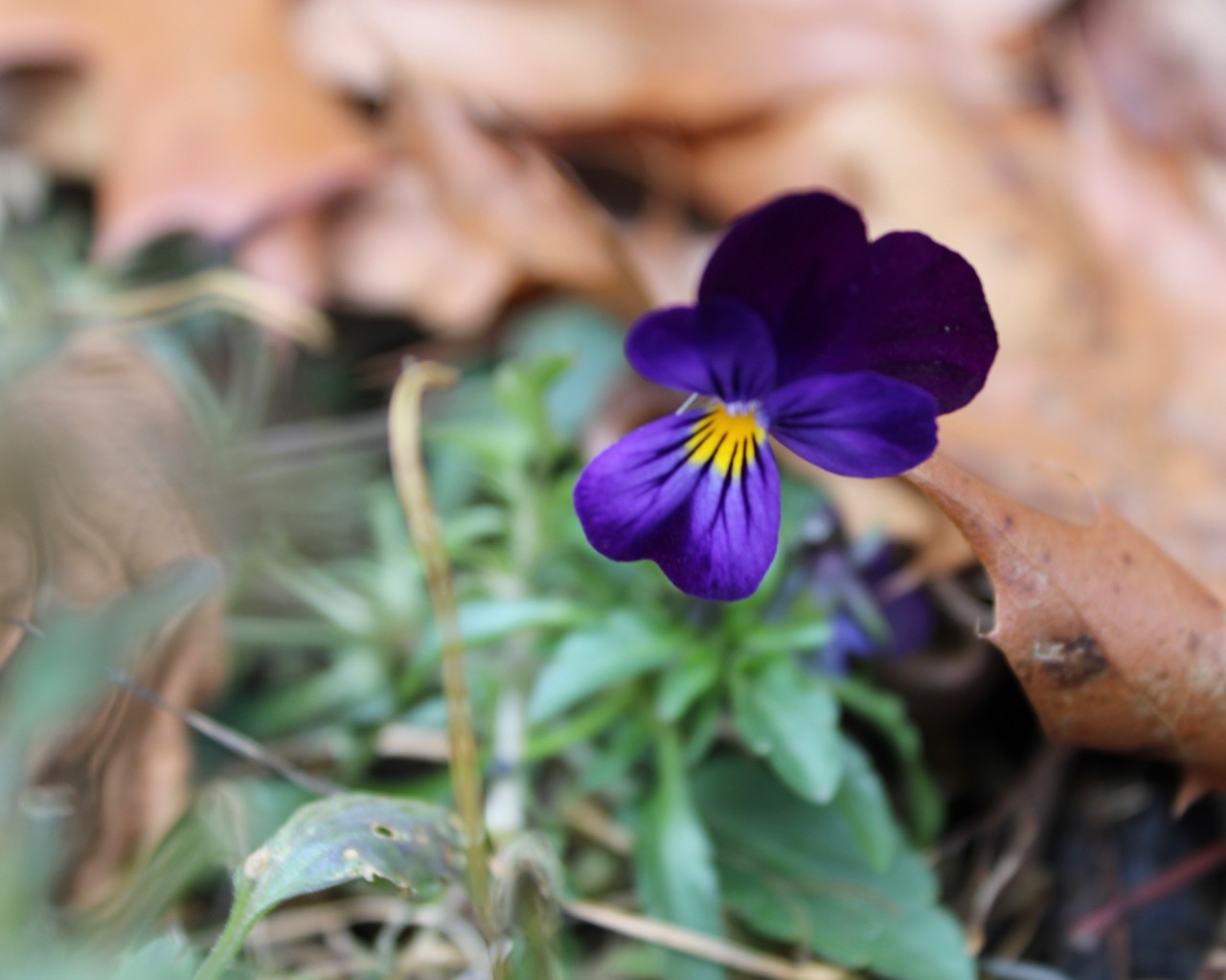
Wild pansy purple and yellow, blooming in December

A climate catastrophe sometimes shows up as the fragile beauty of a wild pansy blooming in mid-December in Maine. I took a photo this morning, before the snow arrived this afternoon, our likely first plowable snow of the season. Very late for us. The unseasonably warm days feel bright and pleasant, nothing dangerous. But I am thinking of the deadly storms that blasted through the midwest last week, tornadoes killing dozens of people in an unprecedented long trail of destruction. I am thinking of giant raging wildfires in the west, and monster hurricanes in the Atlantic. Sometimes the change feels like nothing much at all, unless I stretch my eyes to take in the bigger picture.

We arrived at our current house and yard six years ago after a 4 month search to find greener housing. We were able to downsize, to add insulation, to cover the south facing roof with solar panels, to install energy efficient heat pumps, to create a garden. Our actions fit the best choices we could make at that time, to align with our love for the earth and all her creatures. In that, they were like a prayer, like a magical spell to further the possibilities of earth community based in mutual respect. On a spiritual level, I have to hope that our small choices can ripple out for good.

But these individual actions don’t make a dent in the greater physical scheme of things. The giant polluters of greenhouse gases continue to ignore the limits of earth to push for expanding profits. We, as a planet, have already exceeded the hopeful atmospheric carbon dioxide goals of environmental organizations like 350.org. Now we’re at 415 parts per million. We’re on the way to unmitigated disasters that we can no longer walk our way back from. Scientists can make some predictions, but no one really knows how the increase in global temperature will play out in the next years and decades.

From where I sit, I can feel overwhelmed and helpless. I don’t have the energy to be out in the streets anymore, an activist like in my younger days. I don’t have the money to donate to activist organizations like I used to when I was working. Many activists I respect talk about the coming collapse of economies and civilizations, even within the next decade. I don’t imagine that I have the physical capacity to survive such a collapse, given my age and health. So what is there to do?

What helps is to recognize my limitations, to take in the very smallness of my being. What helps is to see young activists in the street, sharing their anger and love with loud voices. What helps is to remember that Indigenous people the world over have already experienced the collapse of their economies and civilizations. Pay attention to their advice. What helps is to recognize the smallness of my being, and yet remember how I am interwoven with the ancestors and all the interrelated beings of earth. What helps is to keep on loving the trees and birds and frogs and even the squirrels of this small place we are lucky to share with them. What helps is to offer bird seed as a prayer in the morning. What helps is to imagine the unimaginable largeness of the Earth, our mother, and her mysterious powers that we cannot measure or predict.

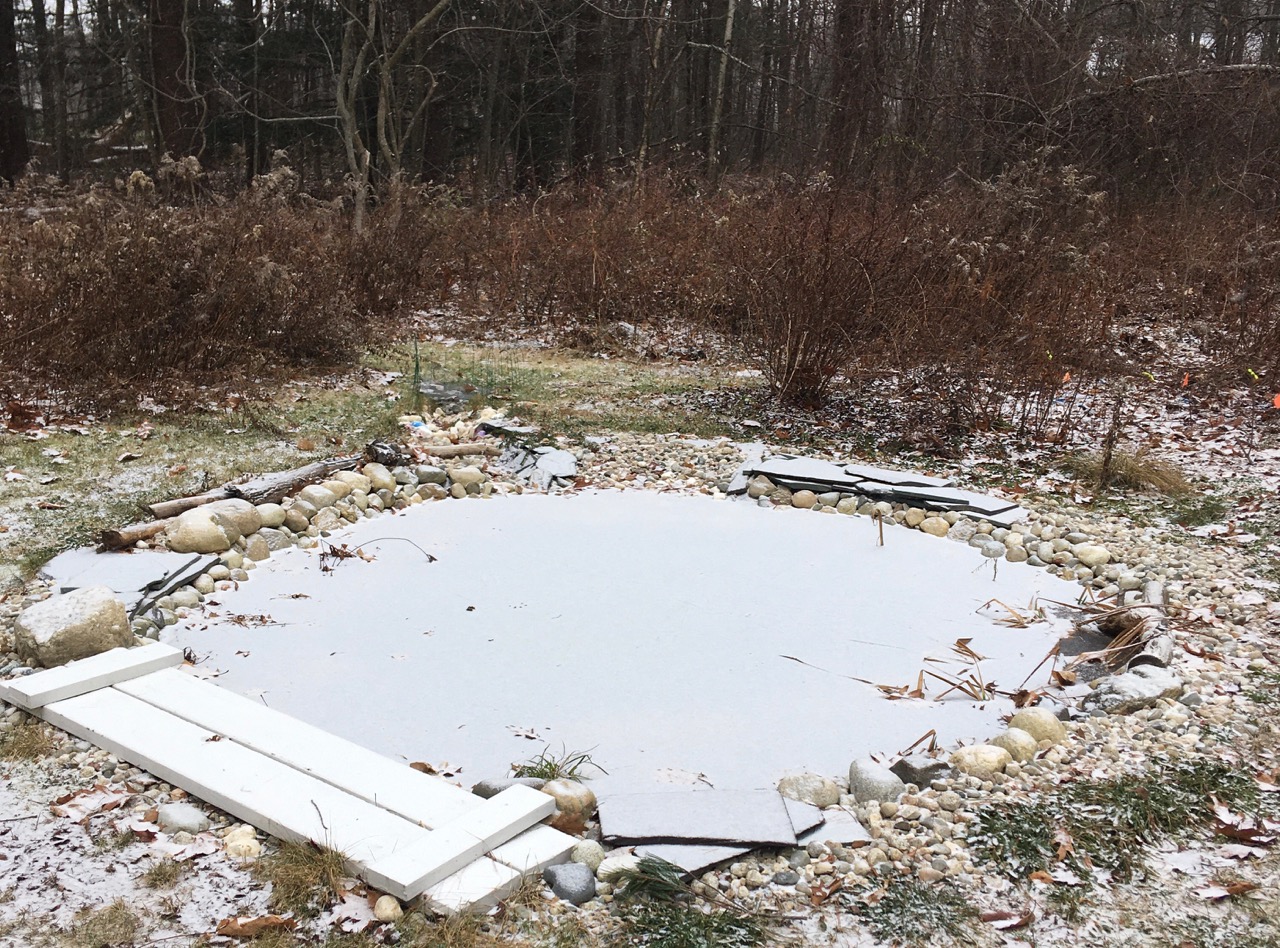
Our pond, frozen, with light snow cover.

A Nest in the Peach Tree

Photo: a nest in the branches of the peach tree, surrounded by leaves mottled with kaolin clay

Life is getting exciting in the orchard. The other day, a friend noticed an empty nest in the branches of the peach tree. It must have just appeared that day–the Summer Solstice–because I had been spraying the tree a couple days before with an herbal foliar spray and would have noticed it. But it seemed like it might be abandoned, and I wondered if perhaps its creators had noticed the toy snake I had hung from the tree the day before to warn off squirrels.

Today, I began to wrap and tie little woven net bags around the peaches–another strategy to keep them protected from burrowing bugs and poking birds and of course, squirrels. This year, I am trying all the things!

Photo: Peach tree, somewhat whitened by kaolin clay, with net bags around some peaches.

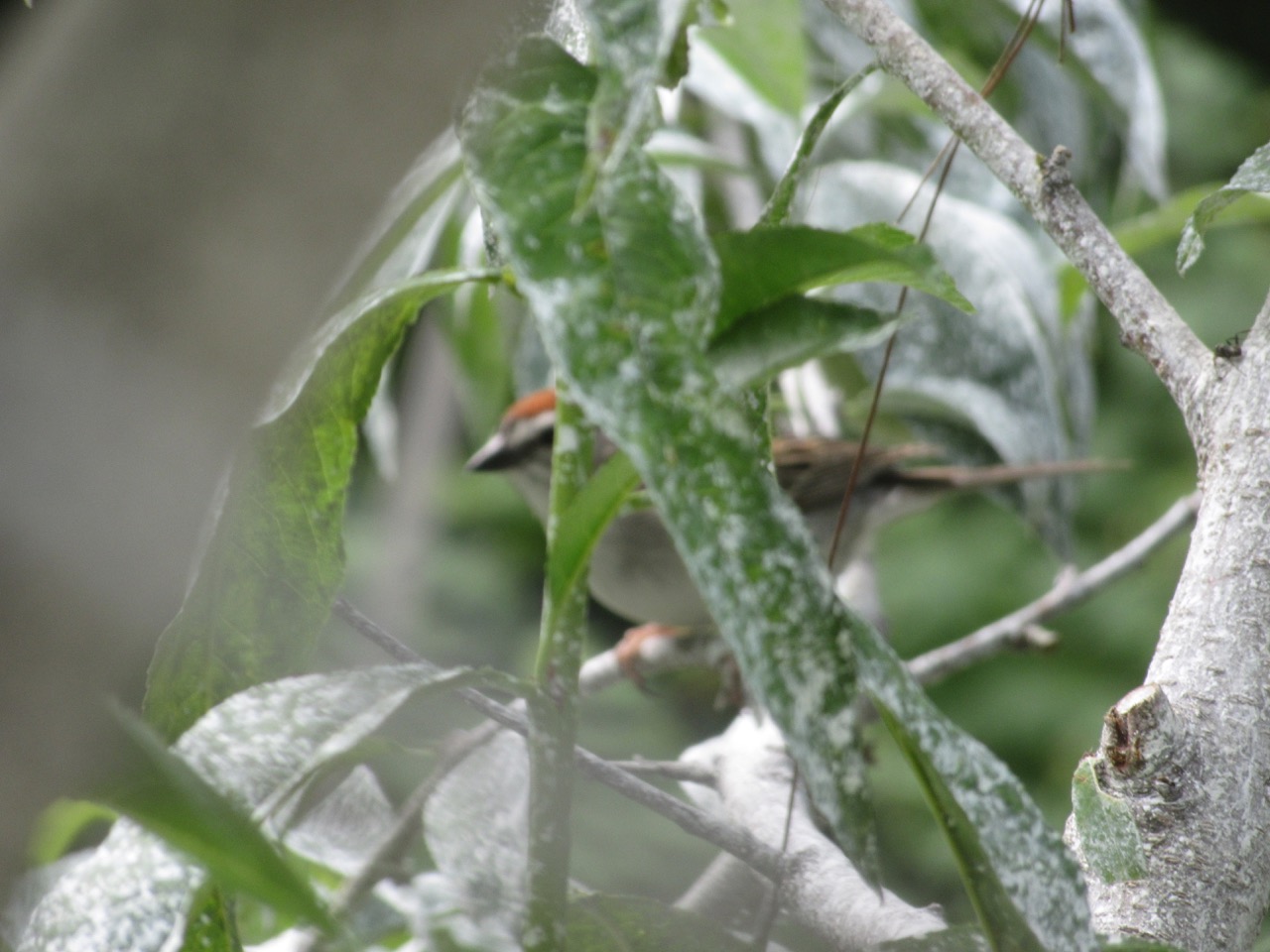
While I was slowly adding a few more bags, this little sparrow was chirping in the next tree over, as if she were trying to get my attention. (Later, I did some research, and she seems to be a native chipping sparrow.)

Photo: chipping sparrow behind leaves

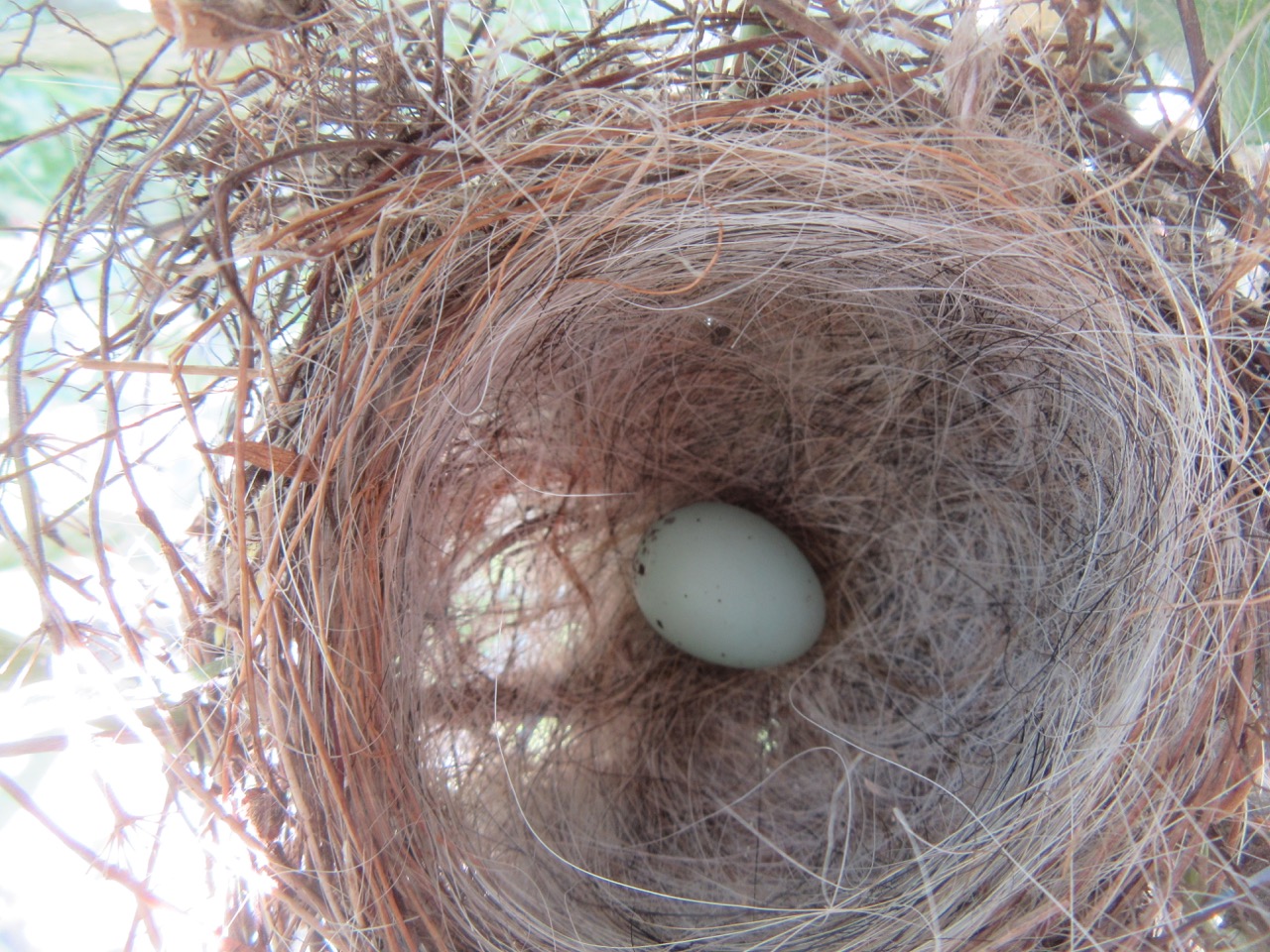
Curious, I carefully put my finger into the nest (which had been empty the day before) and ever so gently touched the smooth shell of an egg. Holding my camera above the nest, I confirmed it.

Photo: one light blue egg with spots inside a nest

Of course, this left me with a dilemma. Do I pay attention to protecting the peaches? Or do I take care not to disturb the chipping sparrow and its nest? Hoping to do a bit of both, I kept putting more net bags around the peaches, but only on the side of the tree away from the nest.

With the bags around the peaches, I won’t need to spray the tree again with kaolin clay, and that seems like a good idea as far as the nest is concerned. These net bags require quite a labor intensive process though. The design of the bags could have been better. I decided to make a small cut in the top of each bag, on the opposite side of where the drawstring tie comes out, so I can pull the tie string out from two sides. That way I can secure it across the branch closest to the peach. (Otherwise, if I just tied it around the stem, I am afraid it would pull the delicate peach right off the branch.) So bit by bit I added perhaps 15 to 20 bags on peaches. I have many more to go.

And then I saw that the sparrow had returned to her nest. Maybe to lay more eggs? Maybe to keep one or more eggs nice and warm until they hatch. I read that it takes two weeks for the eggs to hatch, then 9-12 days for the young to fledge. I think we’ve reached a truce. I hope so.

Photo: head of sparrow is just visible over nest, behind bright green leaves

Crows at the Pond

Photo: one crow perched, another below to his right, dipping her head in the water, tail up

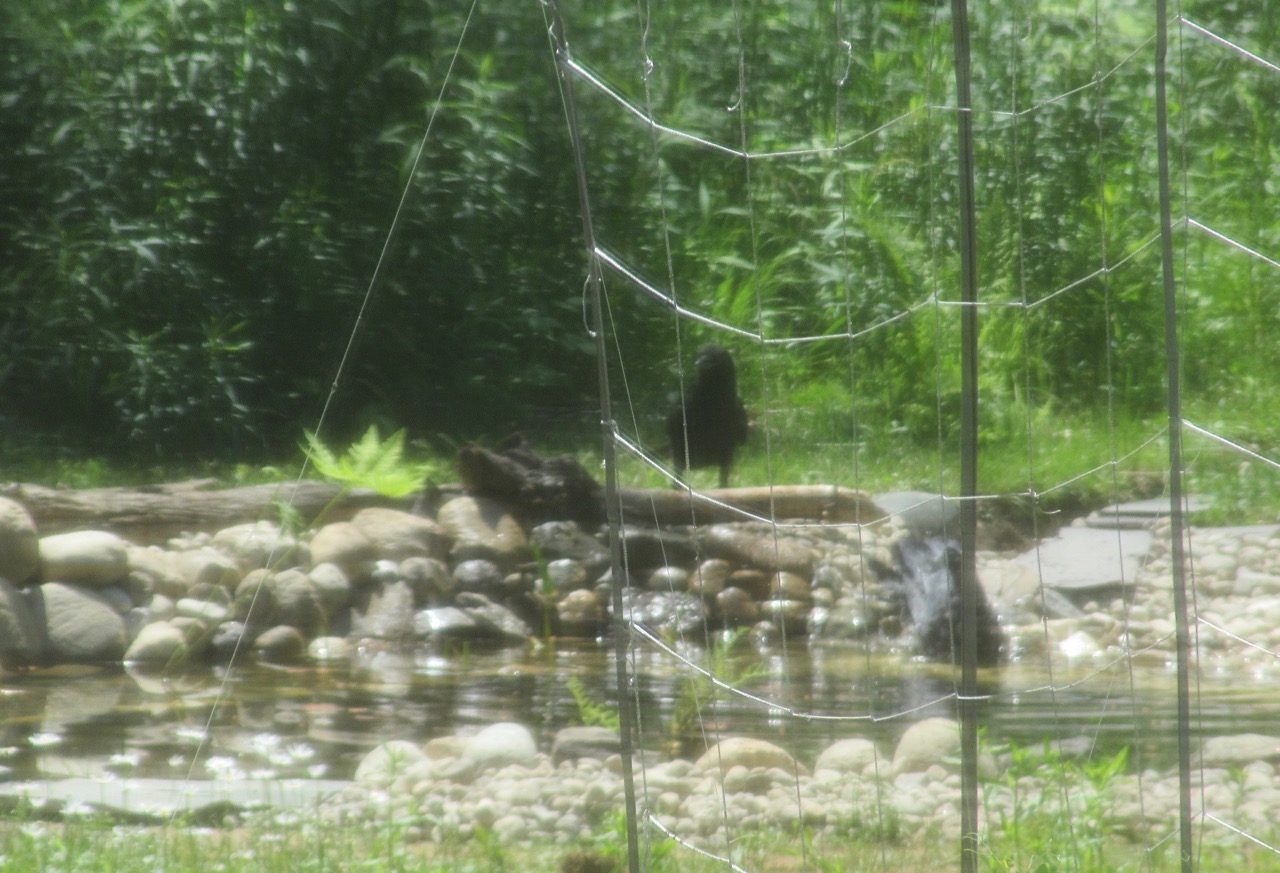
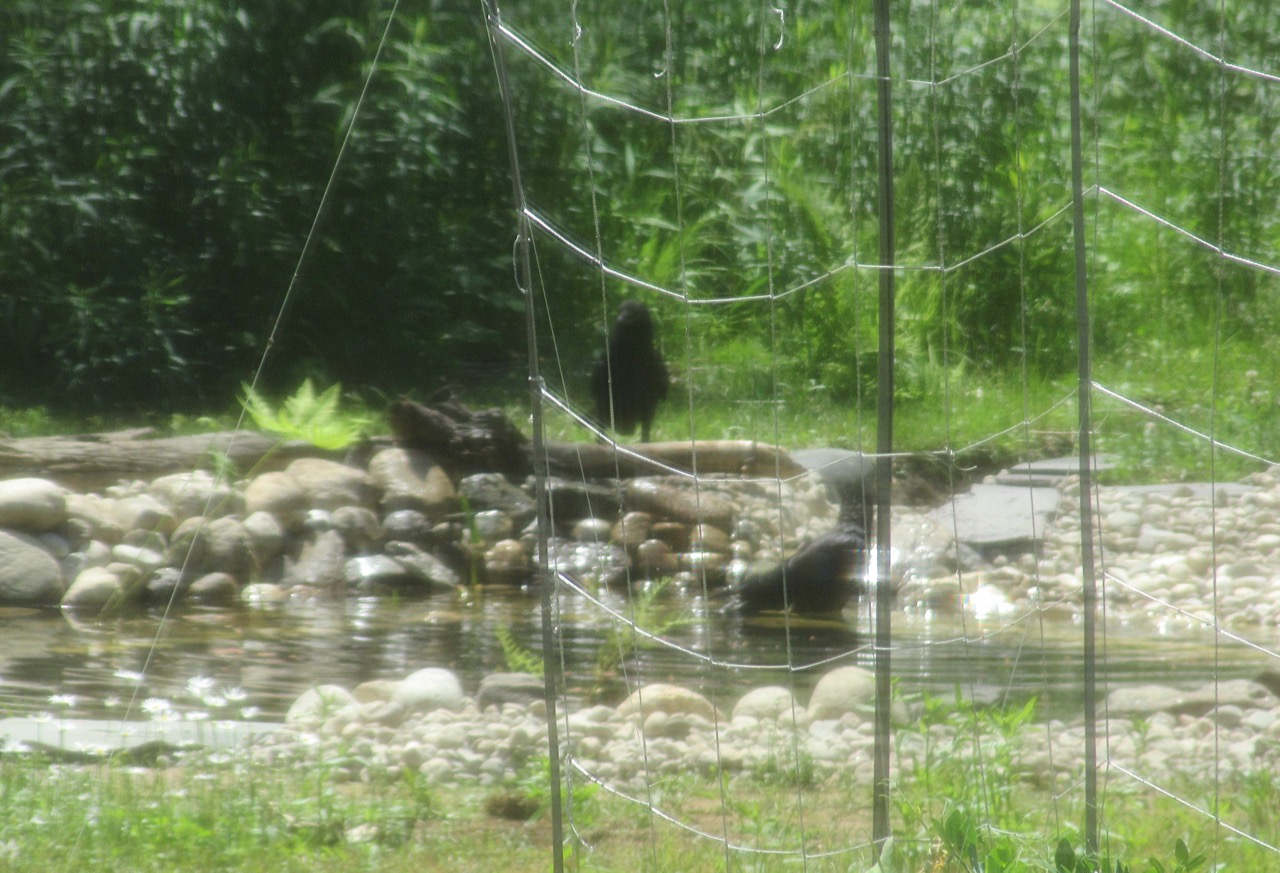
Yesterday, I was excited to see a few crows visiting the pond! I was looking out my window from the house, and there is a string-and-bamboo trellis (for our snap peas) about halfway between the house and the pond that partly blocks the view. But if you look carefully, you can see one crow taking a bath, while the other is perched on a log on the edge behind it.

Photo: Crow in the water lifts up its head

I have been slowly gathering more stones from country roads, and adding them to cover the pond liner all around the edge, along with placing some aging branches there, from around our land. Seeing the crows perched on the branches, I am so glad I included them. This process of covering the liner edge is about two thirds complete now, and the plants in the water are also beginning to grow some new leaves and shoots.

Photo: crows on the branch, one with a stone in his beak, one wet from her bath

I didn’t notice until I saw these photos, but one crow has picked up a little stone in his beak! He reminds me of me as I go around looking for stones the right size for the edge. I wonder if he brought it with him to place somewhere himself. (By the way, I don’t know whether these crows are male or female, but they are not “its” so I prefer to give them personal pronouns. I wish English was like the Wabanaki languages in that the personal pronouns are not gender specific.) After placing a new batch of stones in the morning, I felt really exhausted and rested for the afternoon. But in the evening, I came out and just sat down next to the pond, enjoying the reflections in the water.

Duck, Duck, Goose!

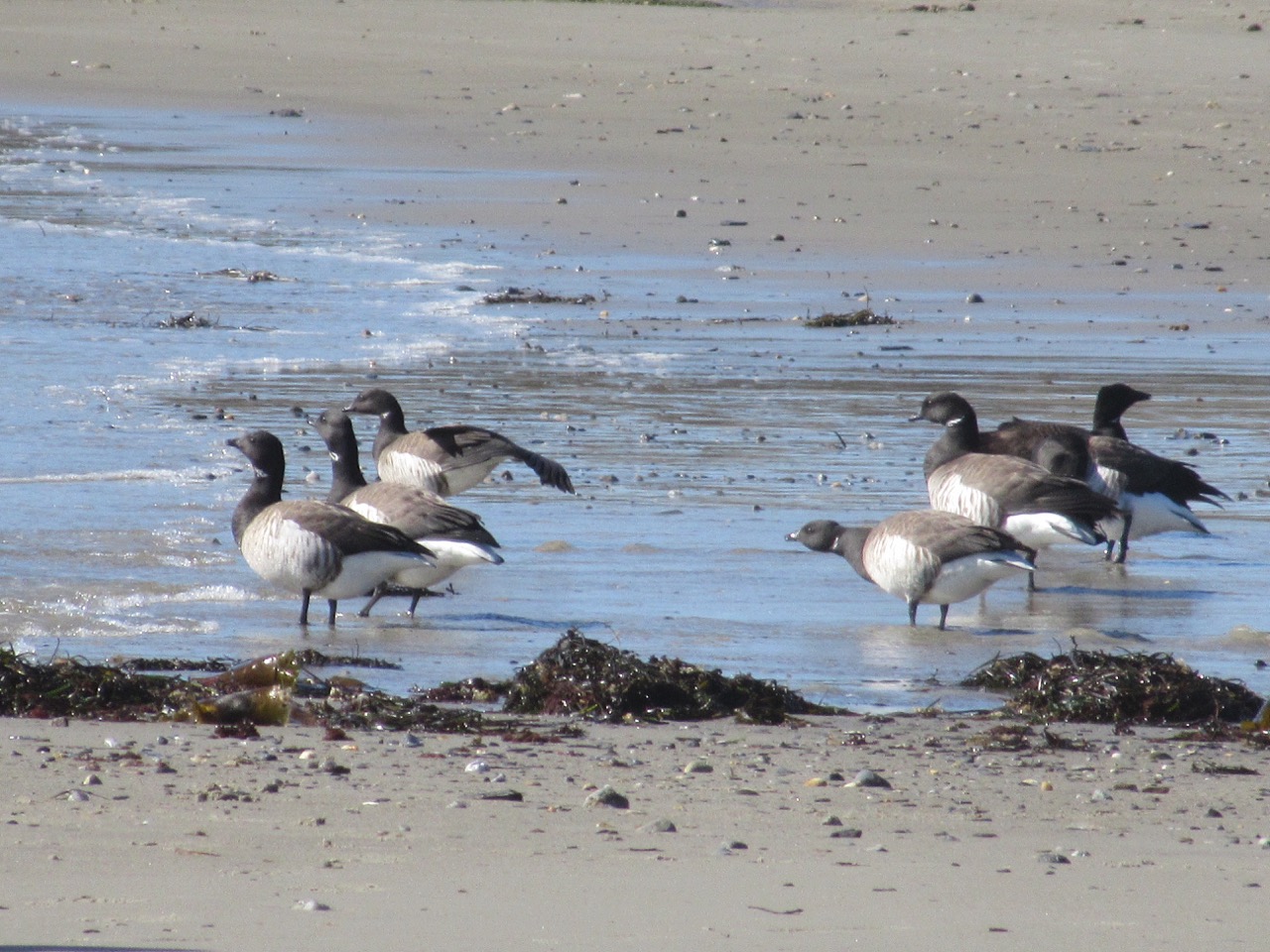
We had a spring teaser day today, with temps in the upper 50s so Margy and I went to Kettle Cove to take in the sun, the breeze, and the sea. We got a special treat when we saw these lovely birds in the water and on the shore. At first I thought they were ducks, because they were that size, but they were also somehow similar to Canada Geese but not quite. When I got home I searched the internet until I found them. They are Brant Geese. The Maine coast is part of their migration route. Here are some of the ones we saw. Margy Dowzer and I shared the camera, so I am not positive which photos are hers and which are mine.

Brant goose swimming in the low tide shallows.
Seven brant geese at Kettle Cove
If you look closely here, the goose in the foreground has plastic netting on its lifted foot–it was limping and we wondered why so we moved closer to see what it was. It was using its beak to try to get the netting off. We had no way to help it, and then they all flew off. So sad. I hope it was able to get free.
Sunshine sparkles on the water as the goose swims calmly.