Heartbreak among the robins

Something got at our baby robins… of the four in the nest, we just found three on the deck floor, two were dead, and one still alive–I gently put that one back in the nest, but not sure if it is really okay or how it might survive, we hope the parents will come back for it. They were calling loudly, but not around now. We don’t know what happened. One had disappeared entirely. So heartbreaking… We wondered if it might have been a chipmunk.

This is not the way I hoped to mark the Solstice. How fragile all of life is right now.

Letting Go

9 file boxes of white and brown, marked with Myke Johnson, numbered, with years and places, all lined up in a row

Today, S— came to pick up these nine boxes, to take to the LGBTQ archives at our local university. It feels like a pretty big deal. It involved six winters of going through old boxes that I had carried around for years–some for 50 years. I had to sort them paper by paper, and it became a look back into all the years of my life until now. I shredded and recycled and even composted much more paper than I kept. Perhaps I could have winnowed even more, if I went back through and sorted it all again, but I was ready to be done. (And I think that is one of the roles of an archivist anyway.) S— was so kind, and thanked me for adding to their collection. I felt good about entrusting her with these boxes. (Soon I will also transfer many years of digital files. But those are funny–you can give them and still keep them.)

At our retired ministers’ meeting this week, we reflected on poems, and especially the one by Mary Oliver that ends:

To live in this world

you must be able
to do three things:
to love what is mortal;
to hold it

against your bones knowing
your own life depends on it;
and, when the time comes to let it go,
to let it go.

“In Blackwater Woods” by Mary Oliver, from American Primitive. © Back Bay Books, 1983.

Letting go of these boxes, in a deeper sense, is a way of facing my own mortality. I notice that I am not completely letting go of these boxes, but giving them into someone’s care. I am hoping that I don’t disappear. Letting go of the boxes into an archive is not letting go of the self, really. On the contrary, it is saying: my life has had meaning and significance. And in the context of our times, it is saying, this lesbian life has meaning and significance–this lesbian life of activism, of writing, of spirituality, of ministry, has significance. Didn’t I learn that from Joan Nestle and the Lesbian Herstory Archives in New York? We must keep our own history/herstory. Not let it get lost. Especially now.

Sometimes, it feels like too much–too many pieces of paper, too many words, too many actions–will something essential get lost in the overabundance of words? But that is who I have been–always a pondering soul, a writing soul, a many-worded soul. I also notice that I am revealing so much of myself in this gift to the archives. Like writing, though, it is one step removed. So my shyness barely peaks out as I reflect on it. And I didn’t gift everything. For example, I decided not to send over my journals from 1983 on–(earlier ones are intermingled in the boxes.) I want those journals to go to the archives after I die. But the journals reveal not only my life but the lives of those who are close to me, and it feels much more intimate than the other papers. Very much part of my lesbian life, but for later revelation.

I think how, ultimately, in death, we let go in a much deeper way. I will let go of my small life into the larger Life, the larger Consciousness. I have always hoped, and felt it too, that Someone sees my life, that Someone sees all. I believe that I would be known and held in meaning and significance and love, whether I had written any words at all. All of us are.

Halloween Frost

Frost on flower

Today is Halloween, that wild holiday of ghosts and ancestors and gifts of sweets. Some say the veil between the worlds is thin during these days. Celtic Samhain, Mexican Dia de Muertos. The day midway between autumn equinox and winter solstice. This morning I woke to our first frost of the season. It is later than usual for Maine, but also earlier this week than I had expected. Still, it drew me out to walk in the dawn’s first light.

I harvested the last of the (now frozen) raspberries. We often don’t get any in the fall because they don’t get enough sun to ripen before the frosts. So we’ve been grateful for several little bonus treats over the last few weeks. I also cut some (frozen) chives, and quickly chopped them up small and put back into a frozen state for use during the winter.

On October 16th, I had dug up the licorice plant, to harvest the roots–they make my favorite herbal remedy–such an energy boost iced as tea with lemon in the summer garden work. I cut off several large roots near the main plant, and all the long extension roots to new plants. After that, I replanted the original plant, and mulched with wood chips all around. Then, and I haven’t yet finished, I wash them with a scrub brush, and cut into small pieces to dry in the herb dryer. It takes quite a bit of my energy, so I can only do small batches at a time. Here is the latest:

licorice root as dug
licorice root washed and cut

So the end of the harvesting is in sight. No more zucchini. Still more kale–that keeps going after the frost. Still some carrots in the front yard beds. Leaves are still falling. Margy did some final mowing and some not-final raking. Much of our back lawn is moss mixed with wild strawberry, clover, grass, and weeds. We love the moss. On more mechanical themes, our garage door was fixed today! (It has been broken since the end of September.) We’ve also had a broken clothes dryer. Appointment scheduled for Friday. I guess these are part of our preparations for winter.

But today, mostly I think about the ancestors, those I loved who have died, and those I never knew who are the roots in my family tree. I had a new thought about my mom’s father, whom we called “Papa.” He was born “Johann” in Austria in 1884, but was “John” in the United States. He left his country with a few friends, who all worked as waiters to pay their way traveling across France, England, Canada, and finally Detroit, Michigan. None of his family of origin were on this side of the Atlantic. He remained friends with those men to the end of his life. He died when I was a young teen, so I don’t have too many memories except of a very quiet, very short man. Even though he lived with our family for a while. But when I look at my own life, I too left the place of my family, and bonded with friends who have been like another family in my life. So maybe we have that in common.

Really, there is so much we don’t know about the lives of our ancestors. All we can do is wonder. During this past year, since last Halloween, my friend Estelle joined the company of the ancestors. She was a true spirit sister. So I honor her today along with those others in my life whom I loved, and who loved me. In that, I have much for which to be thankful.

Goodbye Old Pine

Huge white pine tree trunk with three or four sections higher up, next to garage door on the left, white picket fence in front and other garage on the right.
The huge white pine tree next door was too tall to fit into one photo.

It was a sad day on July 6th when our neighbor’s huge pine tree was taken down. It had been the target of woodpeckers for a few years, so that was a sign that it was likely distressed–and in fact the tree company later confirmed the core had rotted. Situated so close to both our houses, our neighbor decided it was too dangerous to keep. But we were all sad to say goodbye too. It was a beautiful old pine.

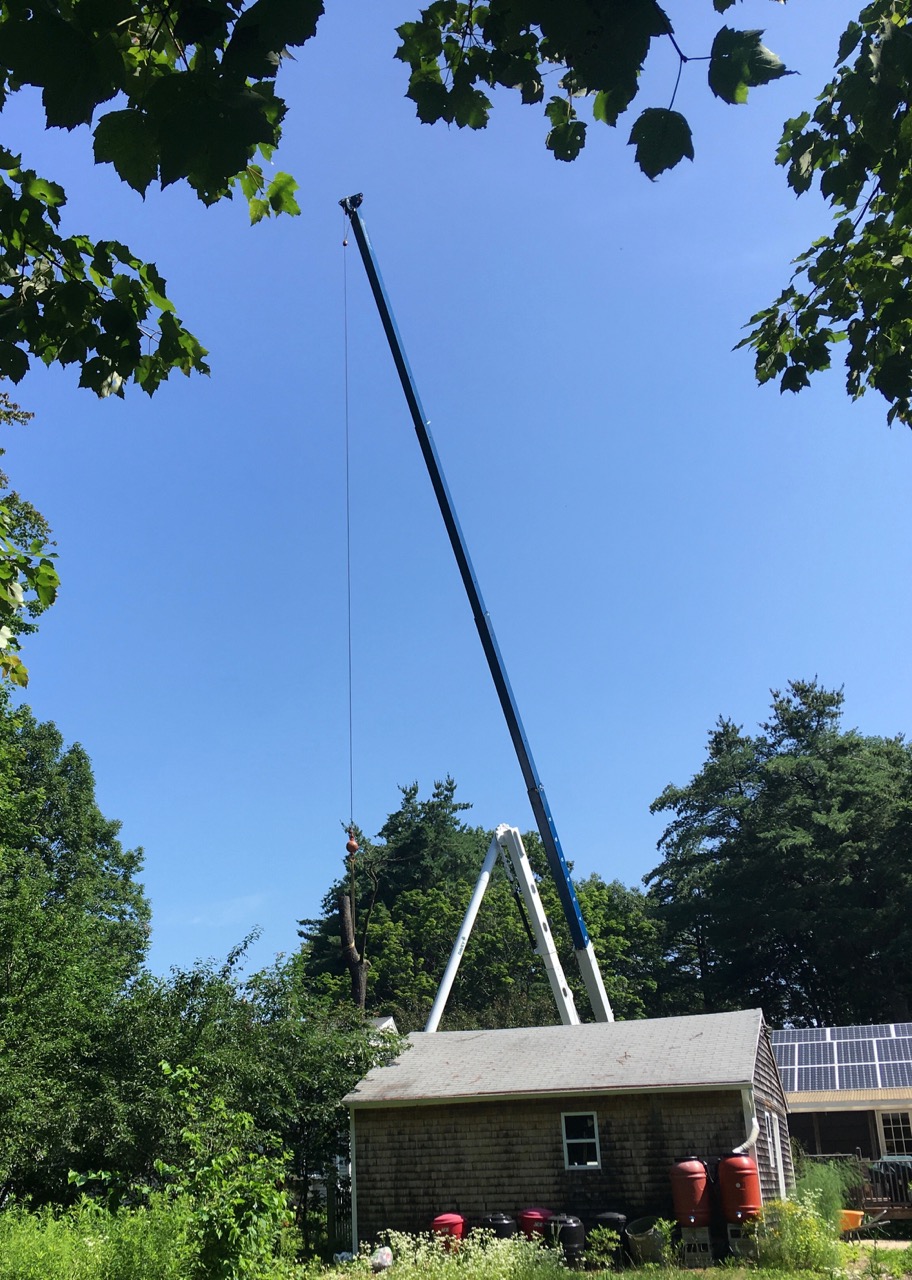
Because of its position, the tree company needed to use our driveway to get access to the tree. I was amazed at the extent of the production. There were three huge trucks–one in the driveway with a crane to lift a worker to chainsaw the tree in huge sections. Another truck was parked and stabilized just off the street in our neighbor’s yard and used an even taller crane with a cable to carry these huge sections of branches and trunk over to the street. A third truck shredded smaller branches. At one point, I went outside to see what the biggest crane was doing, since from inside, it seemed it was lifting the huge logs right over the top of our house.

Blue sky, with tall crane and cable holding log, next to garage, trees in back.
Crane with cable lifts log up.
Blue sky, crane angled to the right over house with solar panels on roof, still carrying big log.
Crane swings over to bring log to the front of our house, to the street.

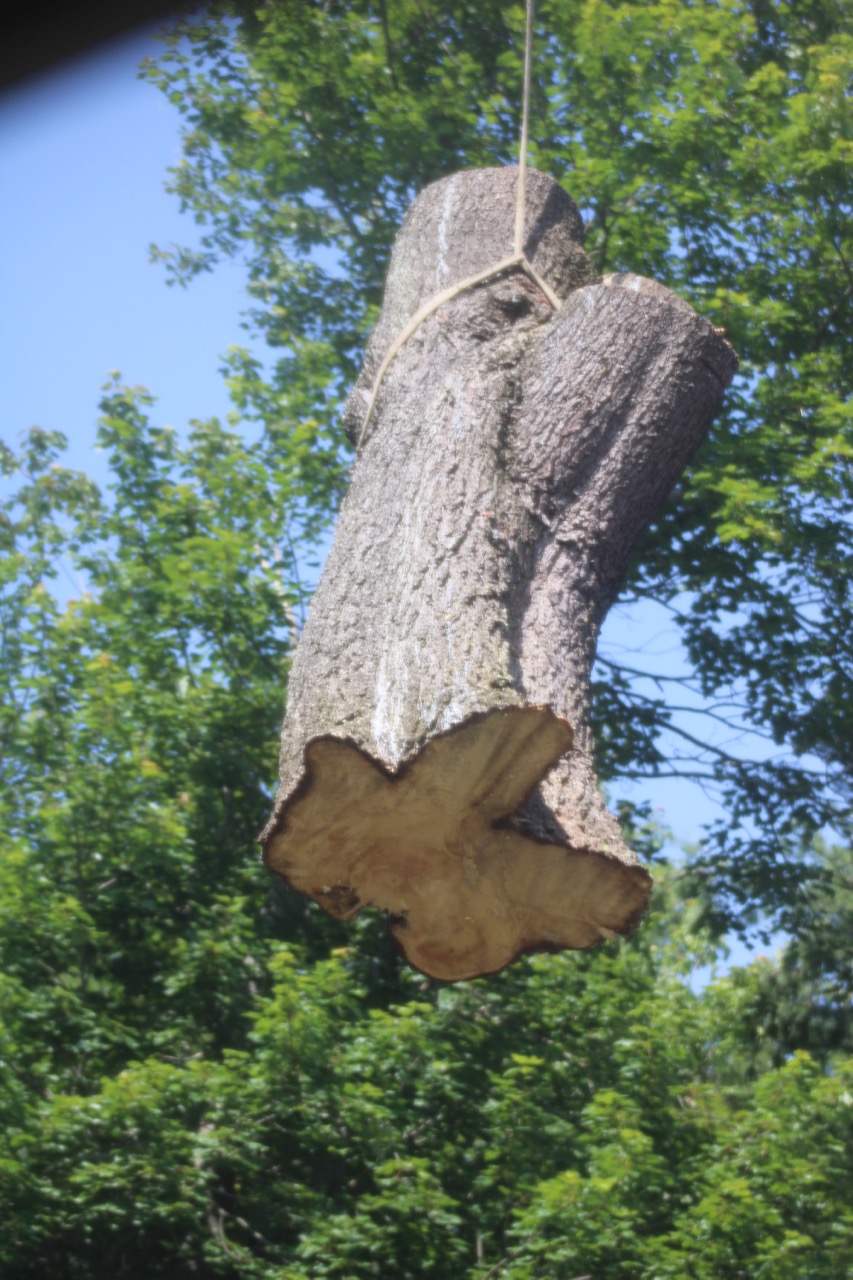
So it wasn’t actually carrying them right over the top of our house–more like around the edge of our house. Still, these were huge sections of the tree. And then the final section of the trunk was lifted up.

Huge trunk of pine hanging from cable
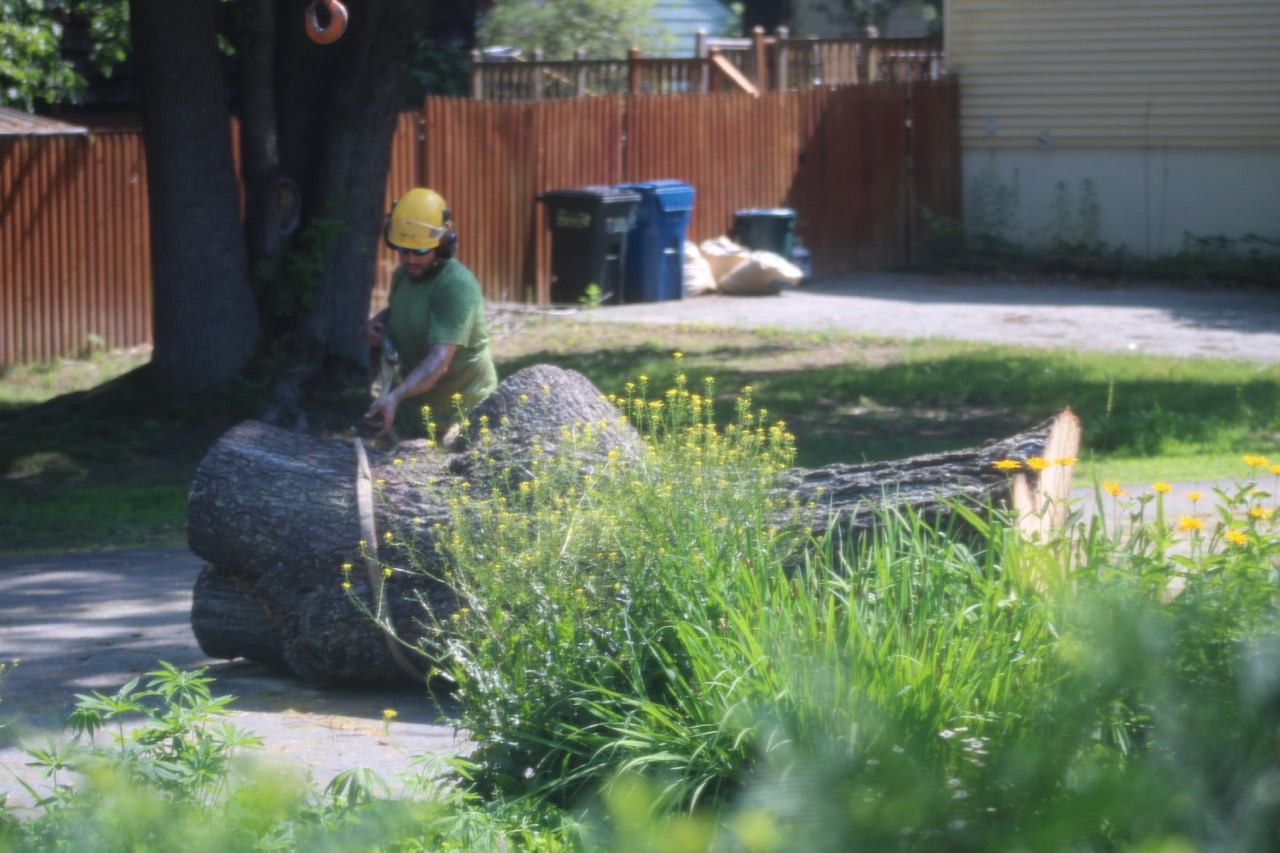
Huge trunk on its side in the street, with worker in yellow hard hat removing cabling. the width of the trunk comes up almost to his waist.
Worker removes the cabling from the trunk.

And then they were done, and the big logs moved to our neighbor’s front lawn to be later removed, and the trucks gone. It all happened in two hours. I’m glad that we are in less danger of a huge tree falling on our house in a big storm. In fact, we’ll also likely see more solar energy production, since the tree cast shade on our solar panels in the late afternoon. But I wanted to mark this passing, make room for the loss, and especially to remember the beauty of the pine.

More Love

Estelle doing needlework, on a piece with "13 Hugs Are Healing" on a blue shed.
My friend Estelle making art from the “13 Hugs Are Healing” shed (2015)

This past week, my beloved friend Estelle died. She had been living with her granddaughter Michele, and thankfully, she was at home with her family during her final days and hours. She had been in declining health for a while, but the shock of her death reverberated through a wide community of people who loved her. She was another person in my life from whom I experienced unconditional love. Estelle was a woman who created community around her, and many people felt her unconditional love. She had a way of seeing the specialness in each person.

I met Estelle in 1985 at the Women’s Encampment for a Future of Peace and Justice–the Women’s Peace Camp for short. The camp was 52 acres directly next to the Seneca Army Depot in upstate New York, where it was rumored that nuclear weapons were stored. Estelle visited the encampment the first week it opened in 1983 and lived there on and off for the next 20 years. She was a founding member of the encampment’s second incarnation, Women’s Peace Land, and was co-founder of the Peace Encampment Herstory Project. I can’t remember it clearly, but Estelle and I probably got to know each other more deeply while sitting by the fire on overnight watch duty. By the end of my first summer staying there, I counted her one of my closest friends.

Estelle was an elder to younger women at the camp–most of us were in our 20s and 30s, and she was in her 40s. But she already had wise crone energy–she was fierce, courageous, protective, and creative in a context where we were willingly on the front lines in the battle against nuclear weapons. There were numerous actions of public civil disobedience and less public direct actions taken on behalf of peace. Because Estelle had a job to go back to, she didn’t risk arrest, but she was a stalwart support for those who did. I want to share one story that was recently shared on the peace camp Facebook page that illustrates her so well.

“So, one night a group of women came back to the house after sneaking into the Army Depot and painting peace slogans on the water tower. They had mud still smeared on their faces and spray paint on their clothes and hands and were telling of their triumph when soldiers came racing after them and tried to charge into the house but Estelle, in her white haired Mother Jones persona, blocked the door and calmly told them, “women are sleeping in here, you men can’t just walk in” and that stopped the men, who were after all mainly young and only here because the world didn’t give them other ways out. By the time an Officer arrived to Put Down This Womanly Nonsense some of the women had wiped off the mud while many others had smeared some on so there was just no way to know who the soldiers had followed home. Much ordering around ensued and women were told to line up and account for themselves and well you know that just did not go as the Officer thought it would. Meanwhile Estelle, who had long since befriended the local sheriff and deputies called that sheriff and those deputies to report that men were trespassing on the farm and threatening the women so then the sheriff and a deputy or two came roaring up and then more ordering around and demands to account for themselves happened and meanwhile the women with spraypaint on their hands got snuck out the kitchen door and into the dozens of tents in the dark field and eventually it was impressed upon the soldiers that they had no rights even one inch off the base and as they drove off Estelle smiled and waved then – Mother Jones, remember – got right back to organizing the next day’s actions.”

post by Elliott BatTzedek

I remember being in a similar action, with similar magic worked by Estelle to confound the army personnel who came after us. Estelle demanded that they produce a search warrant describing who they were looking for, and of course, their descriptions weren’t close to matching the actual women involved. There is so much more I could say about Estelle and about the Peace Camp. Being there from summer 1985, and then winter through summer of 1986, was transformative in my life. Coincidentally, I have been going through old papers and letters from that time this week, so perhaps some other thoughts and memories will bubble up during that process. But for now, I wanted to express how grateful I am that I knew and loved Estelle. There was a shed on the camp with a slogan painted on its side: 13 Hugs Are Healing. I am mindful of the many diverse ways that love that has touched my life through the years and the healing I experienced from that love.

Tragedy in the Garden

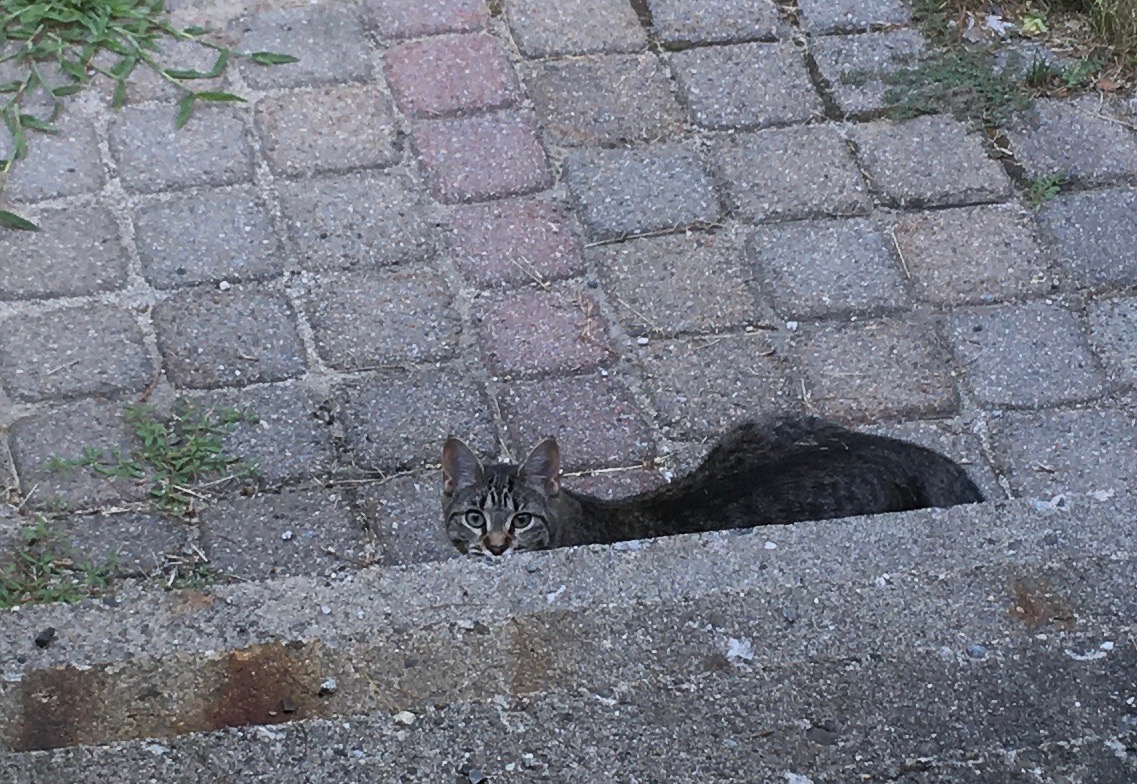
This little tabby cat hiding near our steps is not ours… it must belong to someone in our neighborhood.

The tabby has been hanging out in our orchard the last few days, in stalking position under the cherry tree. I had just been writing recently about how our orchard is a bird haven. The cat decided to make it a hunting ground. Every time I saw it there I chased it away. Yesterday, I was resting in my room and heard a commotion outside, and suddenly saw that it had attacked and grabbed one of the baby turkeys that has been visiting our yard every day with its mother. The mother turkey was screaming and charging at the cat. I tore out of my room and out the back door but the cat had disappeared with the baby.

More yelling at the cat, then Margy joined me outside, and finally the cat ran out from under our deck down the driveway. The mother turkey was pacing back and forth and calling. We started looking for the baby, and Margy finally saw it under the deck, still alive, but looking injured. I recently had read a post on Facebook about what to do about injured birds, and so I called Avian Haven to ask their advice. Wendy suggested that I get it into a box, and then call back. They have a volunteer in the Portland area who could take it.

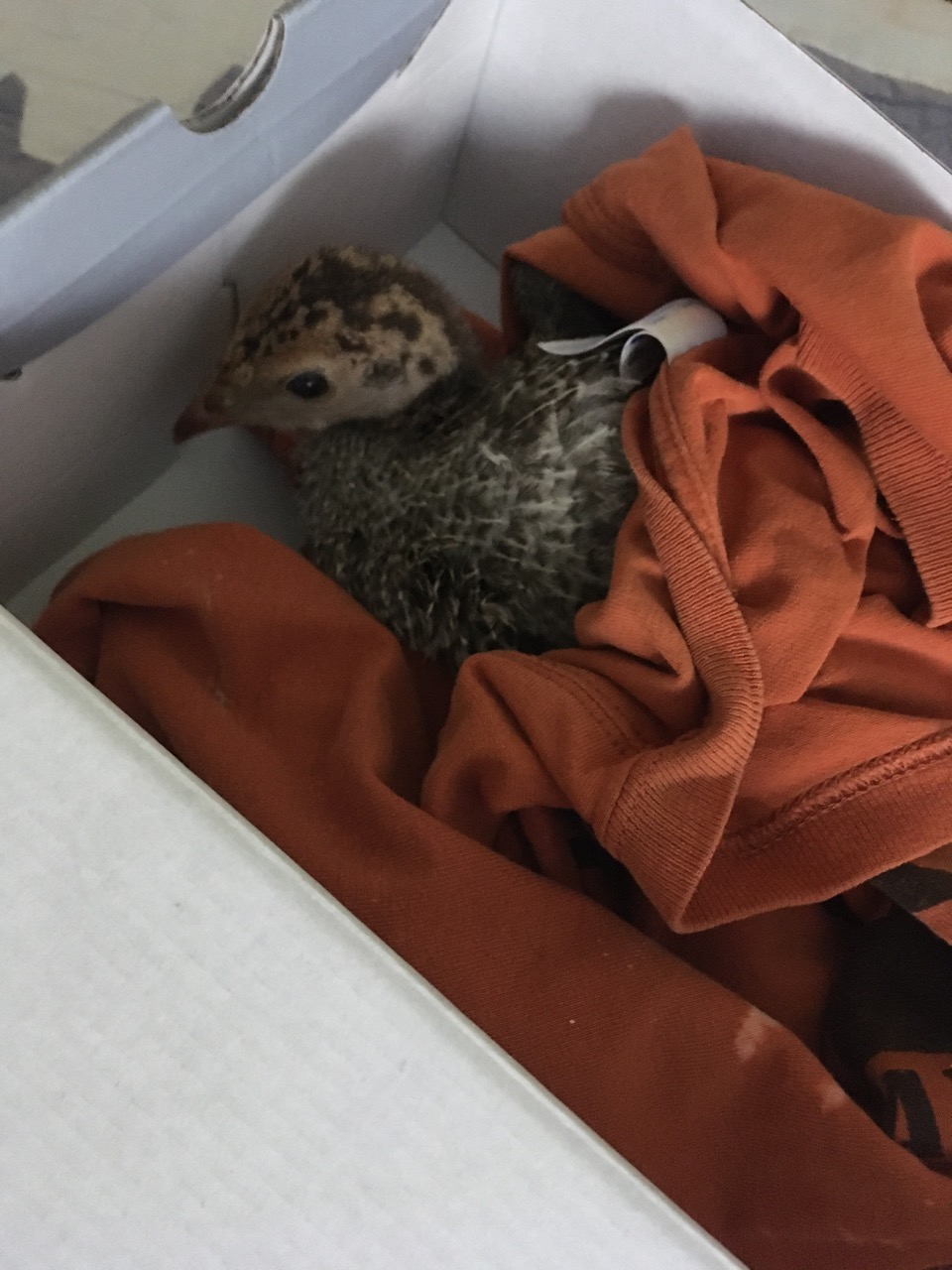
So I crawled under the deck, using a pad to help my knees, with a very shallow cardboard tray, and creeped over on my belly to where the bird was laying. It was about a foot long, and something was wrong with its wing. I was able to cradle it in my hands and lift it onto the cardboard, all the while talking gently to it. In the house, we put it into a large shoebox, and wrapped it in an old t-shirt of Margy’s. We got a call from the volunteer, Karen, and she drove over to our place to pick it up.

Wounded turkey baby in a box wrapped in a t-shirt

Last night she texted that she had found a wound under its right wing, and did some first aid. But this morning she let us know that the baby had just died. She was hopeful earlier because it had stood up, but then a little later it was gone. She thanked us for rescuing the bird, and said that because of us it had a safe, peaceful end of life.

I just feel so sad. I feel angry at the little cat. We love our two kitties, but they are indoor-only kitties. However, sadly there are several cats in our neighborhood who wander wherever they like, and often into our yard. I shouldn’t really blame the little tabby–it was only following its instincts. And maybe there was a time when cats being hunters was helpful to humans for their rodent problems. But what are we to do? As we try to create a little wildlife haven in the city, as we listen to and love this ecosystem, we try to find a balance. Squirrels, ground hogs, chipmunks can be annoying to our gardens, but cats are known to be the major threat to song birds. Can we change our cultural practices to protect the birds?

Winter Winnowing

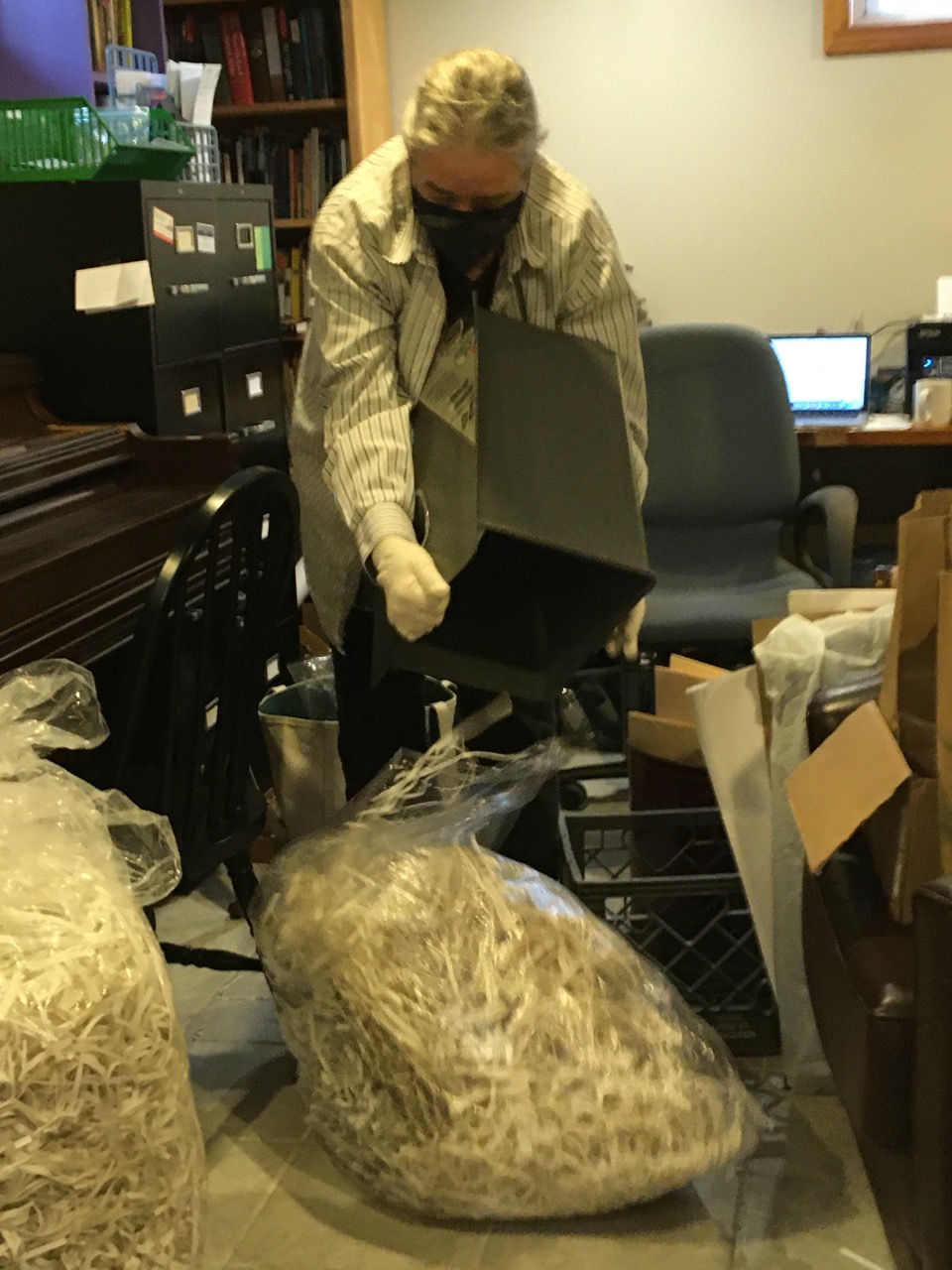
At work in the basement with shredded paper, photo by Margy Dowzer

Every couple days I go down into the basement, to sort through my old boxes. I cover up with an over-shirt and apron, cotton gloves and mask, to protect me somewhat against allergies to dust and old paper. I pull out a box and open it up to reveal treasures and trash, scribbled notes and carefully typed poetry, cherished memories and forgotten moments. I have no idea when I might finish, but it helps to think of this as my Winter Project.

Sometimes I think of it as death cleaning, as in The Gentle Art of Swedish Death Cleaning, by Margareta Magnusson, a method of organizing and decluttering your home before you die to lessen the burden of your loved ones after you’ve passed. But I am not following any methods put forth in this book. What connects is that I am weighing everything against the question “What value might these things have, after I am gone?”

When I became a feminist in 1979, I became aware of how women were hidden from history, how most written history prioritized the deeds of white men in power. Wonderfully, feminist historians, and those of other marginalized communities, have been bringing to light these hidden histories/herstories for several decades. Along the way, I internalized the belief that our own lives are part of history, too. My life is part of history.

As a childless lesbian woman, I won’t have descendants that would value my writings. But that makes it feel even more important to preserve my stories, especially those of lesbian activism, lesbian community, lesbian spirit. And so I have been thinking about what might be valuable for an archive, and in fact, I have already communicated with an LGBTQ archive that expressed interest in my papers. So this becomes an important measure for what to save, and what to shred.

But beyond what value these papers might have after I die, it has also been so valuable for me as a method to reflect on my life as a whole, revealed in what was saved, deliberately or accidentally, during various parts of my life. So far I have been going through boxes from the time I lived in Boston, from 1986 to 1999. I guess I started in the center of my life. There is a lot of shredding-I reduced the first three boxes to just one. I think after I finish with Boston, I will likely go back to the earlier boxes, and only then return to the more recent ones. Perhaps then it will be easier to put it all in perspective.

I don’t know why it has taken so long to begin this project. I don’t know why now seems like the time to do it. But in the middle of winter, in the midst of a pandemic, in this liminal time after retiring, my spirit feels called to this remembering, this winnowing, and so I keep going down into the basement to see what I will find.

Death and All the Stuff

Prompted by sheltering at home during the COVID 19 plague, the question came up: maybe it’s time for Margy and I to update our wills and other legal documents which we last visited in 2012. The basic purpose for us in these documents is to protect each other and make sure that we have the power to make decisions for each other, and inherit from each other. As a lesbian couple who are not married, this is what protects our “next of kin” status.

But each of these documents also has a secondary feature.  What if one of us is not available or able, or dies first–what then, who is next? That has always been a more challenging part of the process. In this age of plague, it is not outside the realm of possibility that both of us could succumb.  Who could we ask to take on the role of health care agent, or financial agent, if we were both incapacitated?

We don’t have children, and our family members are far away, and not always supportive of our identities. We have several good friends, but not a “best” friend, and many live far away. Can we ask any of our local friends to take on these roles? Are they close enough, or not too busy, or would they be overwhelmed by such a request? Who would bury us if we both died? Who are our people?

Similar dilemmas confront us with our wills, and who would inherit if we both were to die. I find that I have new concerns now that didn’t show up in the last will. What would happen to our land and garden that we’ve been so carefully tending? How could we ensure that the land would find new caretakers who would love it as we have? And who would have to sort through all the stuff that fills our little house? My natural temperament is to live simply, to possess little, and treasure those few possessions.  But somehow over all these years, I’ve accumulated a lifetime’s worth of stuff. (How did that happen?)

In the past few months, my mother has been preparing to leave her own house, and move into the home of my sister.  She officially moved yesterday.  All of her nine children and multiple grandchildren were invited to consider things we might like to take from her lifetime’s worth of stuff. But, aside from a few mementos, most of it has nowhere to go.  So even more likely, my own stuff will have nowhere to go.  It occurs to me that if I want to share mementos with people, maybe I should just send them as gifts now.

When I first did a will, I noticed that I most cared about my writing–I wanted there to be a way for thoughts and words to survive, for journals, sermons, essays, to live on in some way, to be a legacy.  That is still true, though now that I have actually published a book, I feel less anxious about it.  It feels like something of me will endure, this book child. But I also have five archive boxes full of journals that I have saved, countless sermons, another unpublished book, and even these blog posts. Sometimes I imagine them in an archive somewhere, discovered by some future historian who will be intrigued by my story. Might I be a spiritual ancestor to someone?

What fuels my need to save the writings? What compels me to write in the first place?

I wonder, does anyone see the whole story, does anyone see each of our stories, whether written or unwritten? Are our lives inscribed in a Book of Life somewhere?  When I was a child, we learned that God could see everything we did. It was somewhat scary then.  But now I find the idea a comfort–I want my life to have a witness. I hope my life will be inscribed in a Book of Life.

Life and Death in the 1800s

(Content warning-tragic deaths)
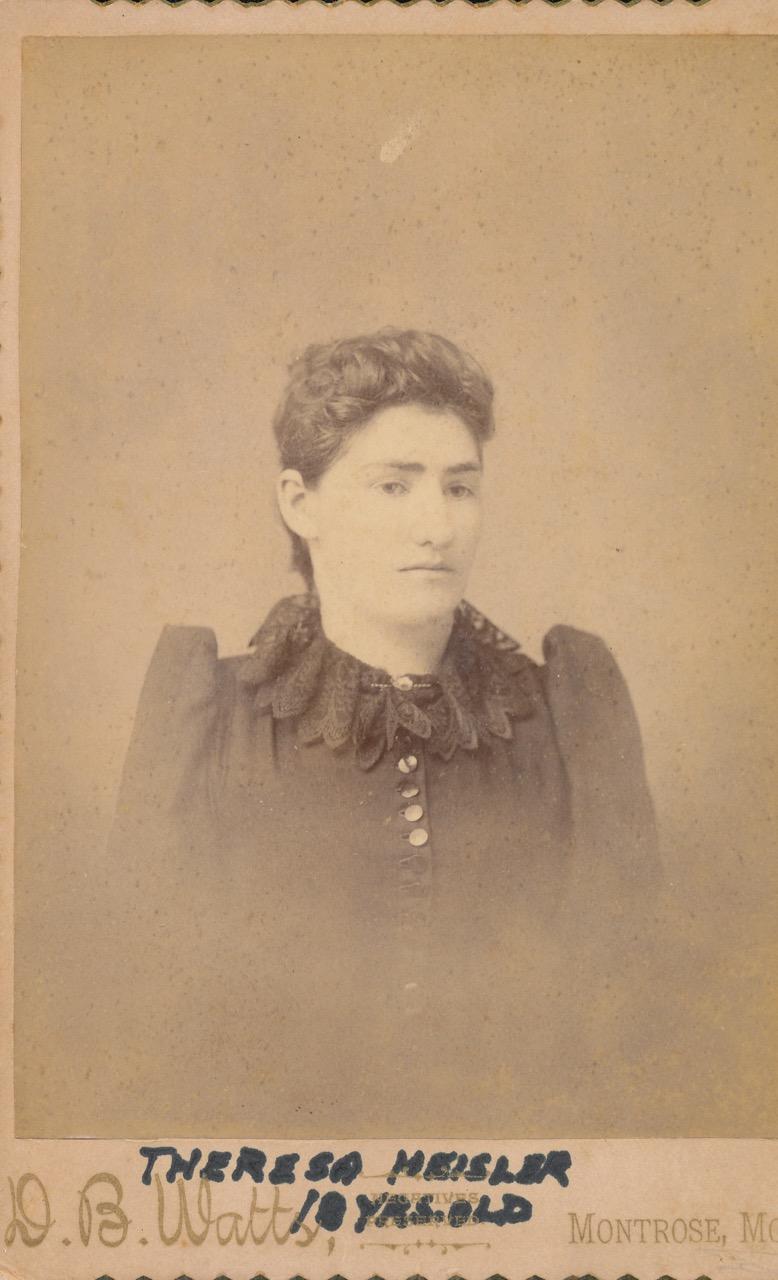
Theresa Gerling Heisler

Theresa (Gerling) Heisler 1886, the year of her marriage.

Continuing with my study of ancestors, I want to talk about the family of my great grandmother, my dad’s mother’s mother, Maria Theresia (called Theresa) Gerling. Earlier, I spoke of her marriage to Thomas Heisler in 1886 in St. Thomas, Missouri. Her parents were Heinrich (Henry) Gerling and Sibella Agnes Hahn. They were both born in what is now part of Germany, but came to Missouri before they met and married. They were devout Catholics.

Heinrich Gerling was born 18 April 1824, in Osterath, in the Lower Rhine region (in German, Niederrhine).  Osterath is now part of the town of Meerbusch, west across the Rhine River from the city of Dusseldorf.  His parents were Gerhard Gerling and his first wife Anna Christina Wilms (or Wilmes), who were married Oct 23, 1821 in Osterath. They had three children: Wilhelm (1822), Heinrich (1824), and Maria Catharina (1830).

When Heinrich was five, his 7 year old brother died.  When he was nine, his mother died, and some months later, on 22 Oct 1833, his father married Maria Christina Kronen (b. 1800-1805?). Heinrich’s sister also died the next year, but three more children were born to Gerhard and Christina: Joseph Herman (1834), Ludovicus (1836), and Michael (1839).  I am moved by how many children died at such a young age, in the stories of these families of the 1800s. This was also true for the Heisler family during a similar time frame.

Gerhard Gerling was identified as a “hotelmeister/hotel master” in Osterath.  In any case, they decided to leave, apparently along with several other families from their town. I found a great story of another family from Osterath who came over on the same ship at the same time.  They left from Havre, on the ship Edmund Perkins, and arrived in New Orleans on November 7, 1840.  They came with their children, Heinrich, who was 16 1/2, Herman, 6, Ludwig, 4, & Michael, 1.  One source said they were “early Niederrhine settlers in the Loose Creek area.” Another source said, “They were the second group of settlers that arrived in the St. Thomas area.”

Perhaps they started in Loose Creek, but they did end up in St. Thomas, where both Gerhard and Christina eventually died (Gerhard about 1852 and Christina 1885-6) and were buried.  Heinrich, it is said, had red hair! He married Agnes Hahn October 21, 1851, at St. Joseph Church in Westphalia, MO, but all their children were born in St. Thomas.  (All of these small rural towns are within 30 miles of each other.)

Agnes was born in July of 1833, but I don’t have much more information about where in Germany it was, or when she came to Missouri.  Her parents were Mathias Hahn (1778) and Margaret Durst (1788) and they remained in Germany, but her brother Philip also came to Missouri. It might be most likely that she was also from the Rhineland/Westphalia region, since people tended to congregate with those from similar regions.

Agnes apparently had an earlier marriage to a John Peter Loethen, but he must have died quite soon, since she was only 18 when she married Heinrich (26). She and Heinrich had nine children together, three of whom had died in childhood, when another tragedy struck, just a few months after baby Theresa was born. We have a letter from Heinrich’s second cousin Heinrich Koersches to family in Germany, loosely translated:

May 24 1868

I received your letter on April 20th. I’m so late in answering your letter because on the following Sunday an accident happened to Heinrich Gerling when we had divine service. In the afternoon after the divine service he wanted to mount his horse. Having one foot in the stirrup, he went to swing his other foot over the saddle. As he did so the horse jumped and threw him off so that his right leg hit on a tree stump that was cut about one foot above the ground and broke his shin, so that the bone could be seen from the outside. There lives in St. Thomas a German physician who was close to the church where the accident happened. They carried Gerling to a house where the bone was set. In the evening eight men took him to his home. There they had to put cold water and compresses on the leg every five minutes. The leg wound didn’t bleed.

Heinrich was a big, thick and heavy man. The compresses and water were put on as long as the doctor ordered it to be done. The doctor came on horseback every day. One day Heinrich would complain of backache, on another he would complain of chest pains. He had to cough up what looked like pus. He asked the doctor for medicine. The chest pains were increasing. The doctor ordered more medicine. On the ninth day it got so bad that the doctor said that he did not think that Heinrich would live another 48 hours. Then they asked for the priest to give him the Last Sacraments. Heinrich lived until the 15 of May.

Heinrich’s accident happened on April 26, 1868.  The following year, the 35 year old widow Agnes married his cousin Heinrich Koersches. They had four more children together, two of whom died in infancy. Then two more of her children died of illness in 1872, leaving only six of 13 to survive to adulthood.  Heinrich Koersches died at the age of 45 sometime after 1877.  I wonder how Agnes carried all of the grief she must have felt from so many deaths, and whether she found a balance to appreciate the joyous moments of life.

I also wonder what life was like for her daughter Theresa Gerling, my great-grandmother? Her father died when she was just a baby, and her step-father died when she was still a young girl. She never knew her grandparents, though her step-grandmother was alive until she was about 17. She married just before her 18th birthday, and had twelve children of her own, my grandmother the sixth of those twelve.  Perhaps the strength and sternness of my grandmother was somehow the inheritance of the grief and survival of those who came before?

Great-great grandmother Agnes herself died on Sept 14, 1901, at the age of 68. I want to close with this photo of Agnes from the 1890s.
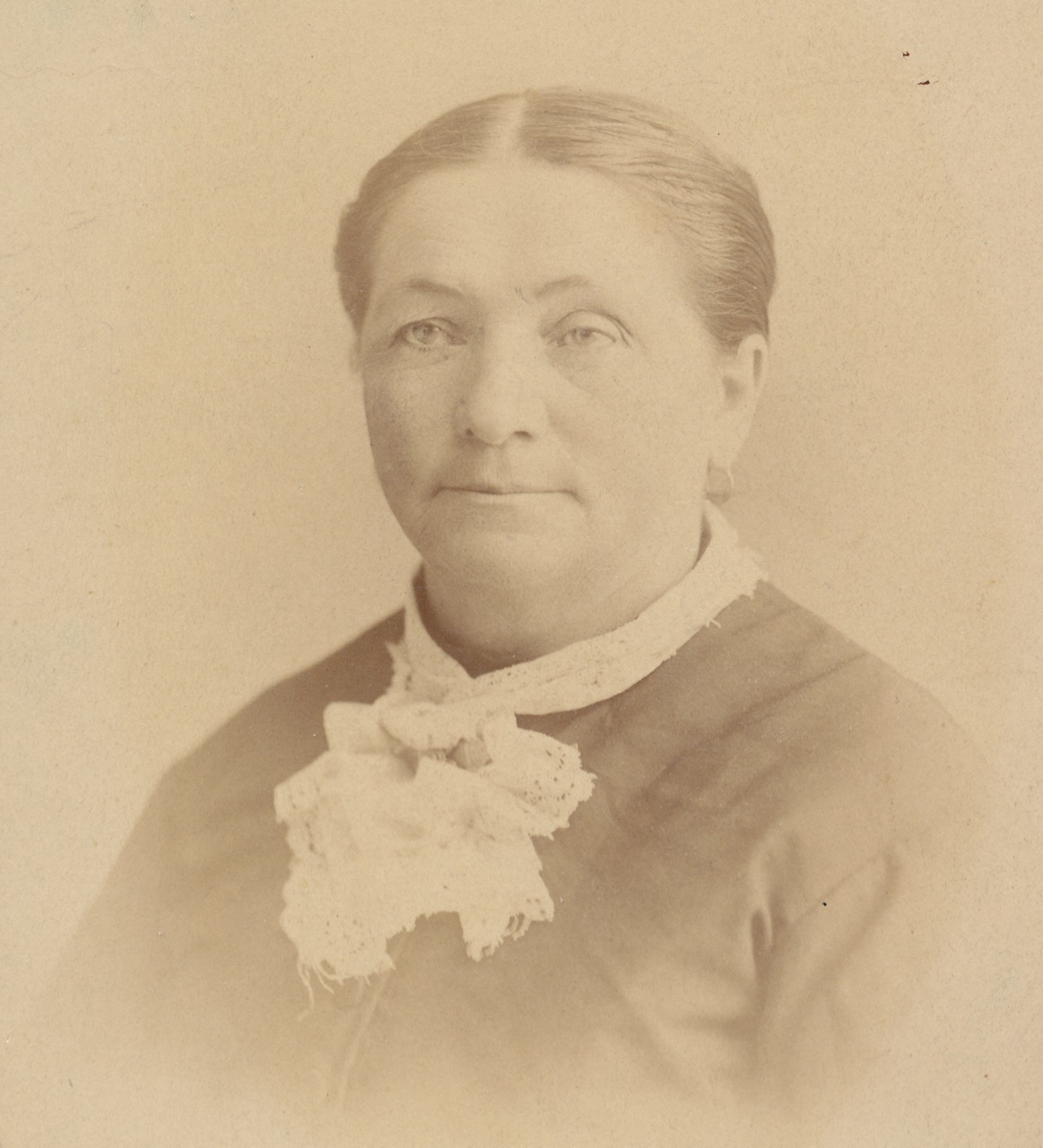
Agnes Hahn Gerling-g-g-grandmother

Agnes Hahn Gerling Koersches

Note: There seem to be even more ads lately attached by WordPress to my posts. So sorry about that. I don’t have any choice about what ads are posted.
 

A Larger View

Reflections on death from one who has died:  As I was going through some papers in the basement, I found a newsletter article from the spring of 2002, written by my dear mentor in ministry, Rev. Victor Carpenter, who died last year in June.  I want to share his words for this coming week, his reflection on Easter and death and life.

Easter Week.  My attention turns to stories of death and the meaning of life. And not necessarily the Jesus story. Sometimes, that story, so overworked and layered with interpretations, shuts me down rather than awakens me.  Instead I commend a wonderfully imaginative perspective from a favorite novel, Barbara Kingsolver’s The Poisonwood Bible.

The novel concerns a missionary and his family in Africa (actually in the area of the Congo.) One of their daughters, the child Ruth Ann, dies. She assumes the form of a serpent in keeping with Congolese beliefs. As a green snake lying on a tree limb she watches her mother and her sisters who, after many years, return to the Congo to search for her grave. What she wishes she could tell them is, “Listen! Being dead is not worse that being alive. It is different, though. You could say the view is larger.”

I love that interpretation! As the great scholar of religion, Huston Smith tells us, all religions teach that after death one is aware of who one has been and who one is and adds that one’s work is not completed. Those who teach reincarnation hold that the soul returns to earth to take up unfinished business. Sometimes many rounds are required to get it all done. As Ruth Ann says, “The view is larger.”

As for what that remaining business is I have only guesses. Probably something along the lines of getting rid of all the false and misleading ideas that have hung us up during our physical lives. Acquiring a larger view. Whatever brings us to that larger view is to be welcomed. Happy Easter.  Warmly, Victor

I am thinking of you Victor, and imagining you in that space of those who have gone on before us, waking up to that larger view. Tree and sky