So the inauguration happened and everything is as horrific as we expected it to be, and on course to keep getting worse. I was feeling very discouraged by it all and brought all my feelings on my walk this morning. But here is the prayer that came into my heart.
Those greedy devils in power are stronger than I am, but they are not stronger than the Earth. As I walk along, I touch the Earth with every step. The Earth is strong, and I am part of the Earth.
Those hateful devils in power are strong, but they are not stronger than the Sun. As I walk along, I feel the warmth and brightness of the Sun reaching my face. The Sun is strong, and I am loved by the Sun.
Those lying devils in power are strong, but they are not stronger than the Wind. As I walk along, I feel the Wind stirring up the tree branches all along my street. The Wind is both strong and gentle, and I am blessed in its movement.
Those cruel devils in power are strong, but they are not stronger than the Spirit. As I walk along, the Spirit whispers in my heart. The Spirit is strong, and I am one with the Spirit no matter what happens.
We have now lived in our home in Portland for 7 years, and are gradually getting to know the plants around us. We have our share of invasive plants, but today I want to highlight a few of the beautiful native wildflowers that are blooming right now in our yard. They come up on their own, and Margy has encouraged them by pulling invasive species, and leaving certain areas alone as she mows paths around the back yard.
I believe our goldenrod might possibly be the solidago sempervirens, or seaside goldenrod, native to eastern North America. This identification fits with our sandy pine forest soil, and photos online look similar. But it is very difficult to distinguish between species of solidago. Solidago is considered a keystone species, and has been called the single most important plant for North American pollinator biodiversity. They are very loved by many bee and butterfly and moth species. We love them too.
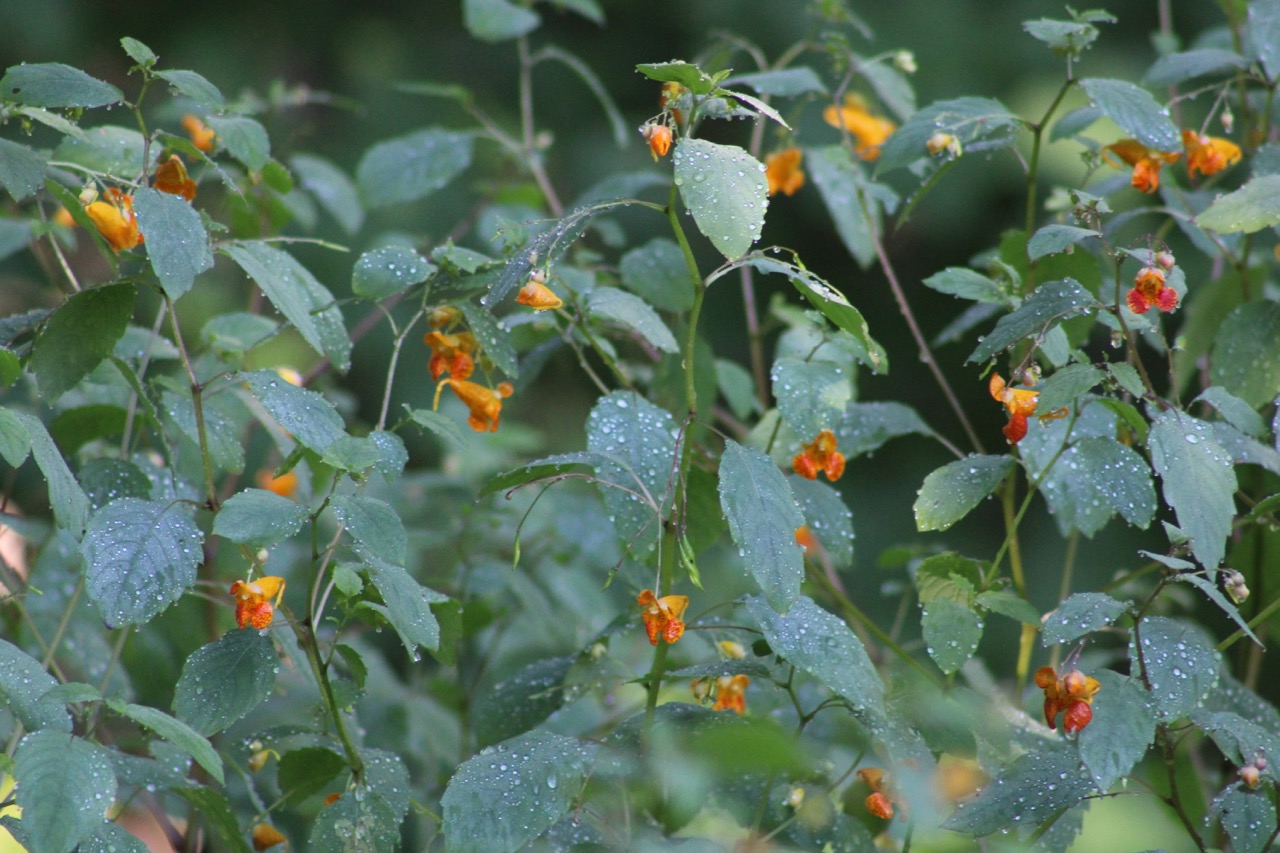
Jewelweed after a rain.
Jewelweed grows profusely at the back and sides of our yard. Impatiens capensis is also called touch-me-not, because of the way the ripe seeds pop open when touched. It often grows near poison ivy (which we don’t have) and has traditionally been used as a remedy to prevent the rash caused by exposure to poison ivy. This year it has gone a little crazy all around our old white pine, and in Margy’s mound bed nearby. Hummingbirds and bumble bees are their major pollinators.
Evening primrose in an old half wine cask container.
I got to know evening primrose last year, when it was the favorite plant for goldfinches after it had gone to seed. This year, it has self-propagated into two containers, as well as all around the patio and orchard. Oenothera biennis is a biennial plant, forming a small rosette the first year, and then in the second year shooting up to great height before blooming. It is native to eastern and central North America. Evening primrose oil is considered medicinal for a variety of conditions, though we haven’t tried harvesting it for such.
Evening primrose, closer look at the blooms.
What I love about these three species is that they grew on their own. We didn’t plant them, we just began to notice them and appreciate their presence. True gifts from the earth. There are many others we have begun to notice as well. It takes a while to learn about them and to identify them. It feels like such an important part of finding our way into earth community.
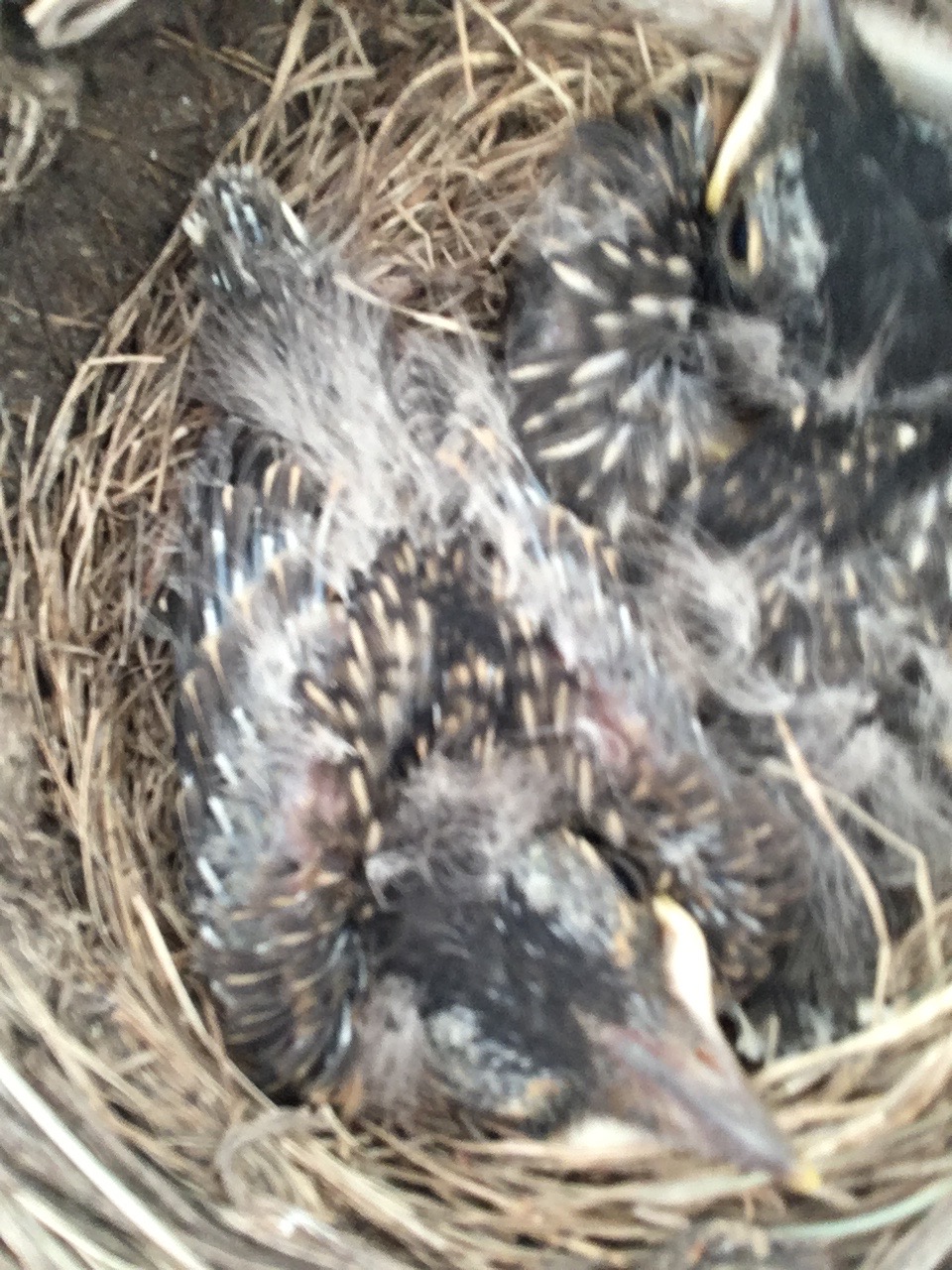
Two baby robins with open mouths waiting on parent.
I’ve waited to post about the baby robins because I didn’t want to presume anything or jinx it. But it seems after the mama robin laid three eggs in the nest on our back porch beam, we now have two babies who have feathers and are poking their heads up to be fed. They don’t make a sound, and most of the time they are hiding deep in the nest while the mom and dad go about getting food, or just sitting on top of them resting. When the parents were gone for a bit today, I snatched this “selfie” with my phone over the nest. We mostly try to leave them be and not make a lot of noise on the porch.
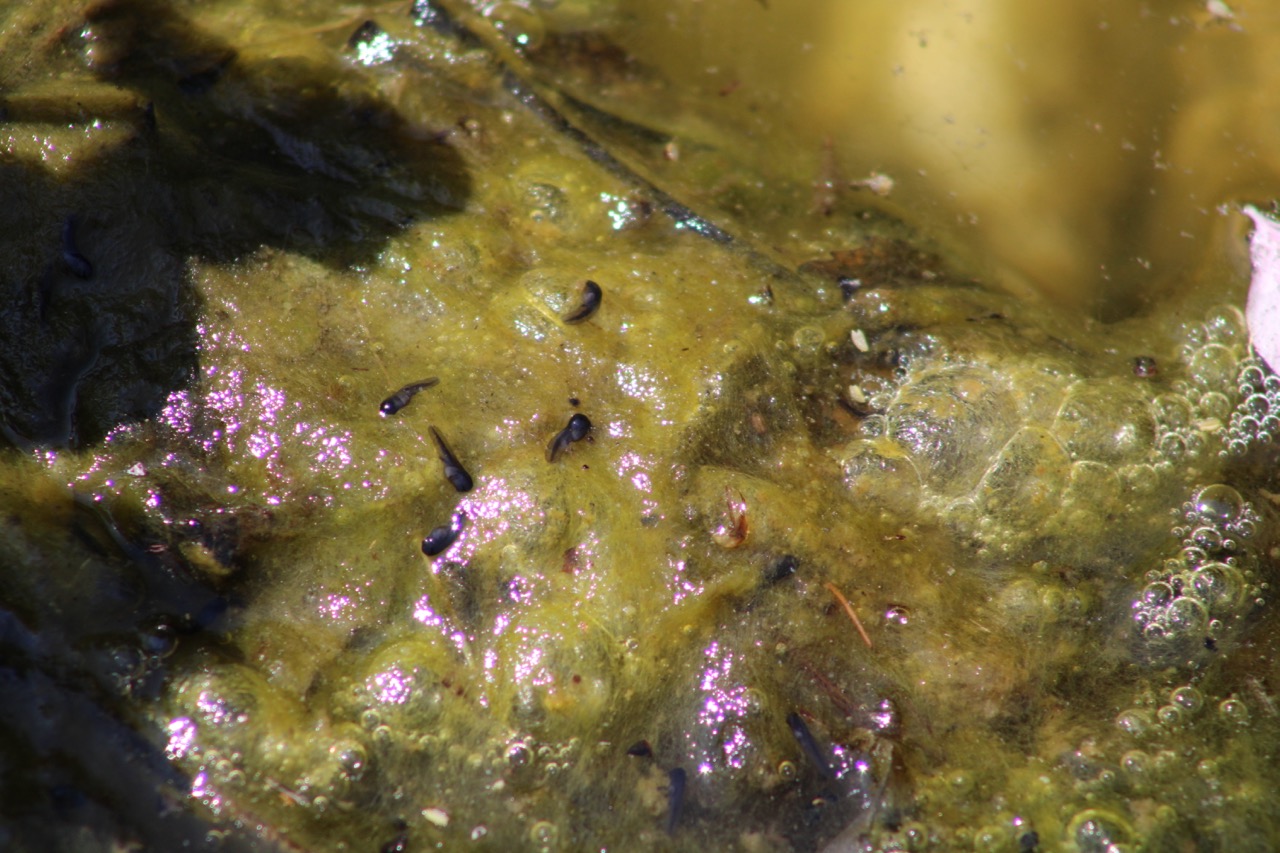
While not as photogenic, I also discovered we have tiny tiny tadpoles in the pond. I was lifting some algae with my net, and uncovered a whole group of them. Here is a close-up, but just imagine them about 1/4 inch from head to tail. Apparently they eat algae, so they must be happy where they are. Hurray! I would guess they are tree frog tadpoles, since the tree frogs have been singing, but I couldn’t find any confirmation of that in online searching–we’ll have to wait until they get a bit bigger.
Tiny black tadpoles in algae in the pond.
Finally, I planted some kale and lettuce and broccoli seedlings this morning, after adding more compost to raised bed, then using chopped leaves as a mulch. I put netting over them to deter animal neighbors–it doesn’t keep away cabbage moths, but seems to work for groundhogs and squirrels and such. Plant babies finally in the ground!
I needed this winter afternoon at the beach. We went to Kettle Cove, where it was windy, sunny, and warm–well, in the forties anyway. So now my heart is calmed and refreshed. There is a quiet that comes from the sound of waves and wind, the feeling of our feet walking on sand. We always say we should go more often, but it takes some push, some energy to get ourselves there. Funny that, because it always feels so good once we arrive.
Even though I am retired, I’ve been doing too many days of projects–still plugging away at the boxes for the archive, among other things. Don’t we need this other rhythm? The one of being in the presence of all that is bigger than we are?
And there was evidence that the wind and the waves had been bigger than the beach recently, maybe when the recent huge storm came through. The wooden walkway was broken apart, and there was erosion in parts of the shore. We are so small, and what we can build is so puny. But all of that is okay–it’s part of what brings the feeling of magic to our walks on the beach.
Broken walkway
So we come home again, and the great quiet is within, the mysterious gratitude for life, in the midst of all its challenges. Can you feel it? How does it come to you?
Almost Winter Solstice here! We got our first snow the other day, just a few inches, but enough to brighten the ground. It is good. It seems the long cold nights are infiltrating my spirit, and I feel weary. As I get older, it is harder to rejoice in the season of winter–ice has tripped me up on prior walks, and bruised my bones. COVID has limited our ability to welcome guests into our home, and it is too frigid for visits in the garden. Last week, our heat pumps suddenly stopped working, and we turned to our back-up boiler, but it seemed a little clanky from disuse, so we fired up our wood stove. That sounds cozy, but I find the wood smoke gives me headaches. (Thankfully, the heat pumps were repaired in two days.)
I feel old and cranky and tired with this season. It is ironic that pagan myths often assign this season to an old woman. I wonder if the winter crone is cranky? I am wrestling with how to find the magic of this cold dark season.
I didn’t really feel like getting a holiday tree. But Margy did, so we got this tree from our local food coop. I don’t feel guilty for it being cut, because it was grown for this purpose on an organic tree farm. Seeing how many seedlings try to grow into a new forest in our yard, I know that there can be an abundance of seedlings that naturally never grow up–so this one got to grow to eight feet and then be celebrated. I find myself surprised by how good it feels to have this little tree with us in the house, like a connection to the natural world during a time when that connection is harder to feel. I feel grateful to Margy for pulling us into its sweet magic.
That is my question. How to find the magic of this cold dark season? Can I quiet my mind, rather than merely entertaining it with stories in books or on screen? (though this has often been a season of stories) Can I open my heart, even if I am far away from most friends and family and other loved ones? (reaching out with letters and cards?) Can I embrace the sorrows and fears of age, of my age, my sorrows and fears, and give them a home in this moment? (hospitality has many forms) Can I embrace the silence? Let myself sink into it, floating down like a snowflake, bury myself in the silence like the plants are buried in snow? Silent night.
Catbird in the mulberry tree-a dark silhouette amid green leaves and berries
Two weeks ago, I had terrible cramping in my lower abdomen. Over a few days, it gradually localized to the lower left of my abdomen, particularly when I had to poop. My medical practitioner did some blood tests, and found high inflammation, but not infection, and scheduled a CT scan. They determined that I was having a bout of diverticulitis, which, even as it was diagnosed, thankfully began to ease up. It was scary and discouraging to have yet another illness keep me down for over a week, and add to the complications I already have with eating food. A little research showed that 50% of people over 60 in the US deal with this disease. We must have a cultural taboo against talking about it, because I was very surprised to realize it was that common.
After all that, I explored some herbal options for healing, and discovered that licorice root is one of the recommended herbs–which I have already been using for energy issues. This spring I harvested and dried some from the plant in our yard that I had planted a few years ago. (I use much more than that in a year, but it is exciting to be starting to harvest it here.) I have been drinking tea made by boiling a couple tablespoons of the root in a quart of water.
Dried licorice root-first harvest
Because of all this, I was feeling discouraged, and then I remembered the challenging wise words of Indigenous writer Paula Gunn Allen, in an excerpt from “The Woman I Love Is a Planet; The Planet I Love Is a Tree,” from her book, Off the Reservation.
“Our physicality—which always and everywhere includes our spirituality, mentality, emotionality, social institutions, and processes—is a microform of all physicality. Each of us reflects, in our attitudes toward our body and the bodies of other planetary creatures and plants, our inner attitude toward the planet. And, as we believe, so we are. A society that believes that the body is somehow diseased, painful, sinful, or wrong, a people that spends its time trying to deny the body’s needs, aims, goals, and processes—whether these be called health or disease—is going to misunderstand the nature of its existence and of the planet’s and is going to create social institutions out of those body-denying attitudes that wreak destruction not only on human, plant, and other creaturely bodies but on the body of the Earth herself….
“Being good, holy, and/or politically responsible means being able to accept whatever life brings—and that includes just about everything you usually think of as unacceptable, like disease, death, and violence. Walking in balance, in harmony, and in a sacred manner requires staying in your body, accepting its discomforts, decayings, witherings, and blossomings and respecting them. Your body is also a planet, replete with creatures that live in and on it. Walking in balance requires knowing that living and dying are two beings, gifts of our mother, the Earth, and honoring her ways does not mean cheating her of your flesh, your pain, your joy, your sensuality, your desires, your frustrations, your unmet and met needs, your emotions, your life.”
Paula Gunn Allen
It is so easy to identify events in the yard, or in my body, as beautiful or ugly, gifts or challenges, positives or negatives. But coming into a harmonious relationship with all beings of this earth requires letting go of that polarity–not denying the difficulties or pains, but going deeper with my responses. How can I embrace all that life offers, in the yard, and in my body?
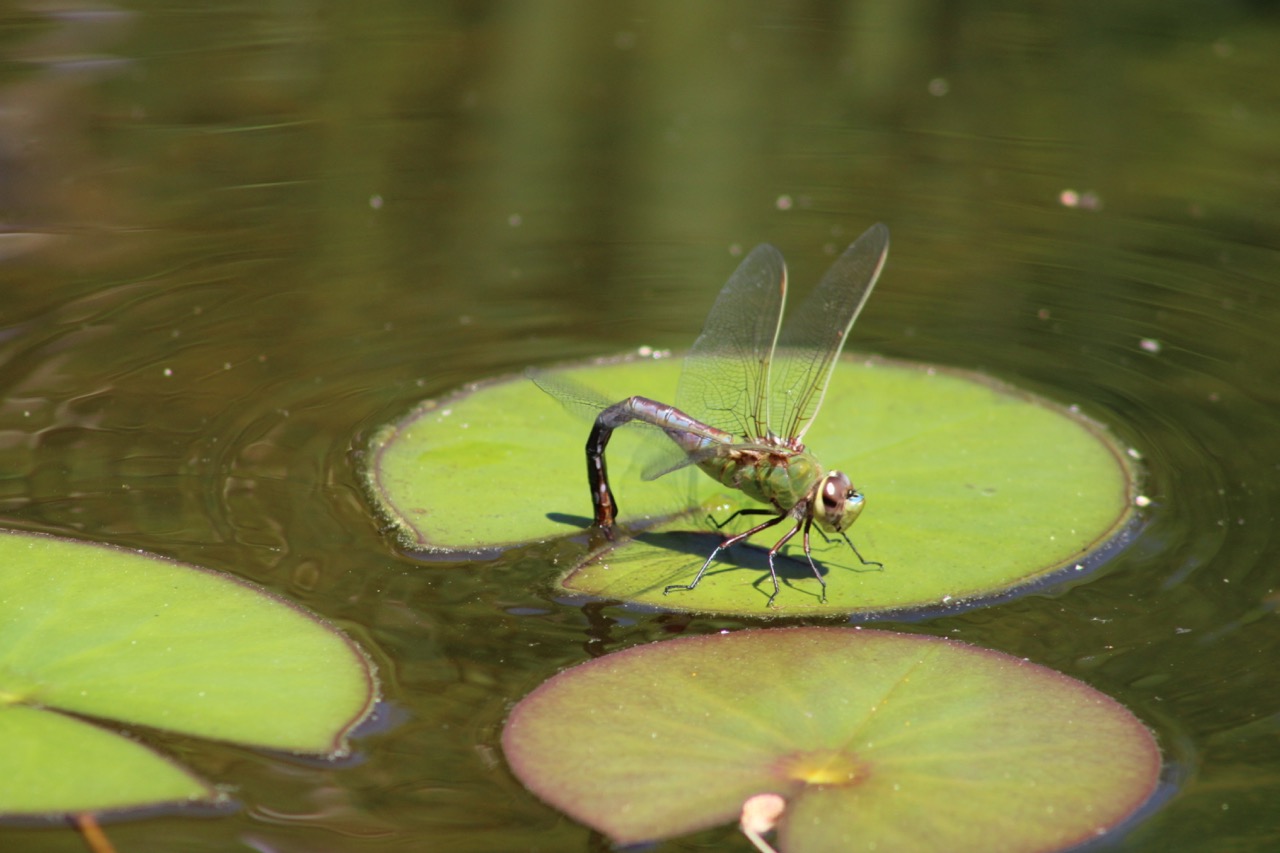
We have seen two frogs in the pond, one bold and the other cautious. Yesterday a neighborhood cat was stalking the pond. Today, I only saw the cautious one. Is the bold one gone? The cherries that appeared green in the trees are getting brown spots on them. The cardinal couple seems now to frequent the feeder every day. The robin that abandoned her nest, is back in the nest trying again with new eggs. Today I saw her partner bring her a bite to eat. A dragonfly was dipping her tail in the water, while perched on a lily pad–laying her eggs in the pond. Something took a few leaves off two of my kale plants, but did not destroy the whole plants. Can I begin to see all of it as wholeness, as beauty?
Dragonfly on a lily pad in the pond, dipping her tail in the water.
I have started to take short walks in the neighborhood–just 10-15 minutes each morning. It feels good to be moving again and hopefully building my strength. I especially get energy from the birds singing so exuberantly. There are cardinals all over the neighborhood.
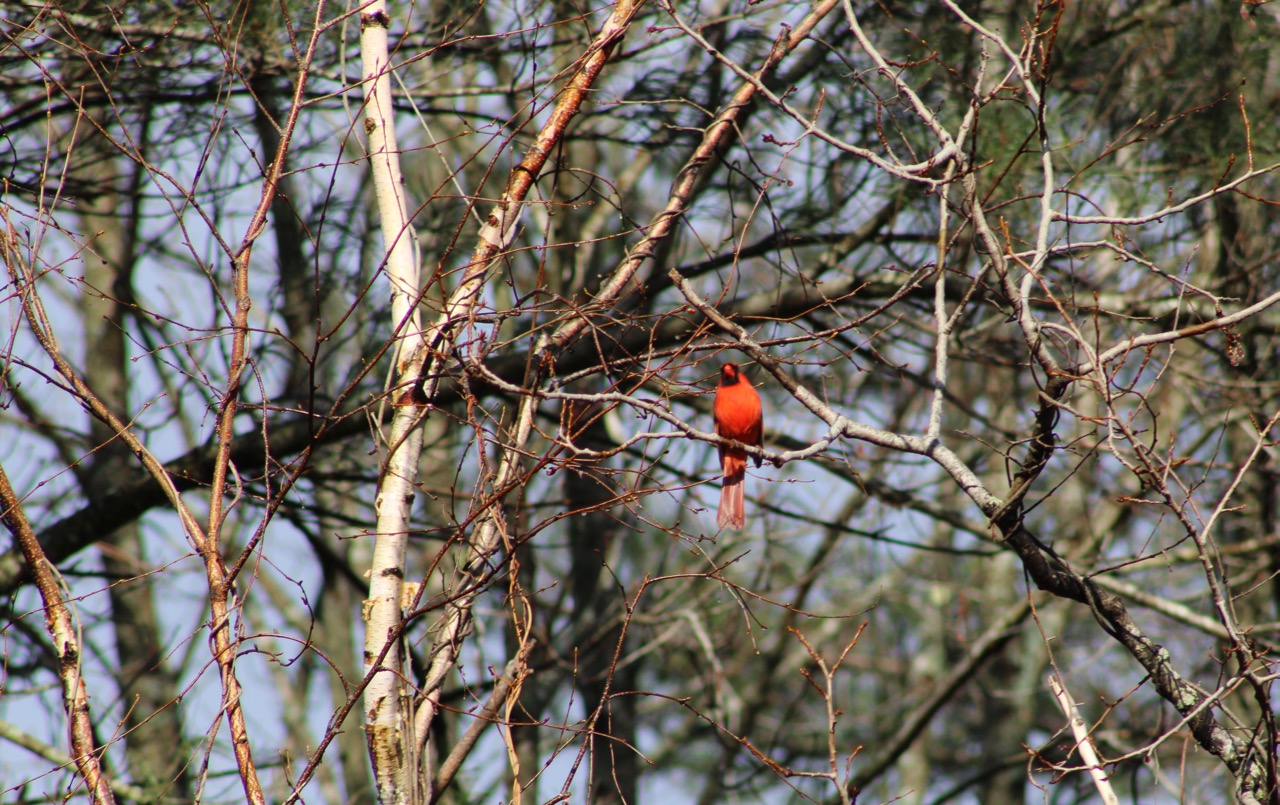
This morning, from our backyard I saw several cardinals chasing each other through some tangled branches. They especially like the plot of undeveloped land next to the back of our yard, that we call the “fairy field.” Sadly, it is filled with invasive bittersweet and multi-flora rose that Margy is trying to curb, but it does make for lots of brush up to higher branches, and the cardinals seem happy there. Perhaps they are young males trying to establish their own territory.
Or perhaps they, too, are merely feeling the exuberance of warmer air and brighter days, and can’t keep from singing.
More beauty: some of the pond plants are starting to green up. Especially the blue flag iris. No frogs yet, but I go back and check each day just to see when they might arrive. Only a few of the stones were dislodged during the ice of winter. When it rained the last couple days, there was flooding all along the back yard area beyond the pond, and an overflowing “drain.” But it didn’t seem to be a problem. I hope all of the plants from last year will come back. I am also hoping to add some Marsh Marigold when it comes in to our local nursery. This will be our first spring with the pond, and so it is all an adventure, a slow, curious, waiting kind of adventure.
Blue flag iris beginning to grow at the edge of the pond.
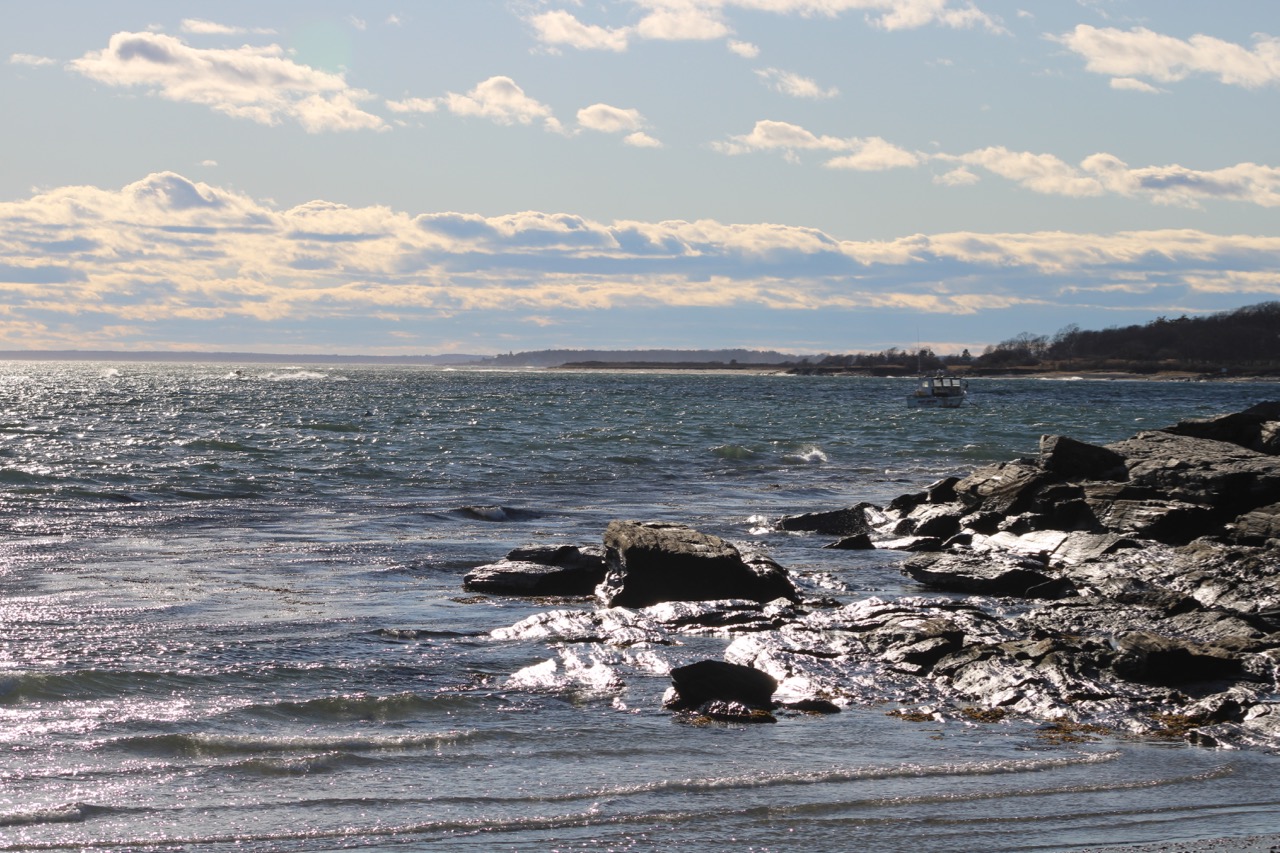
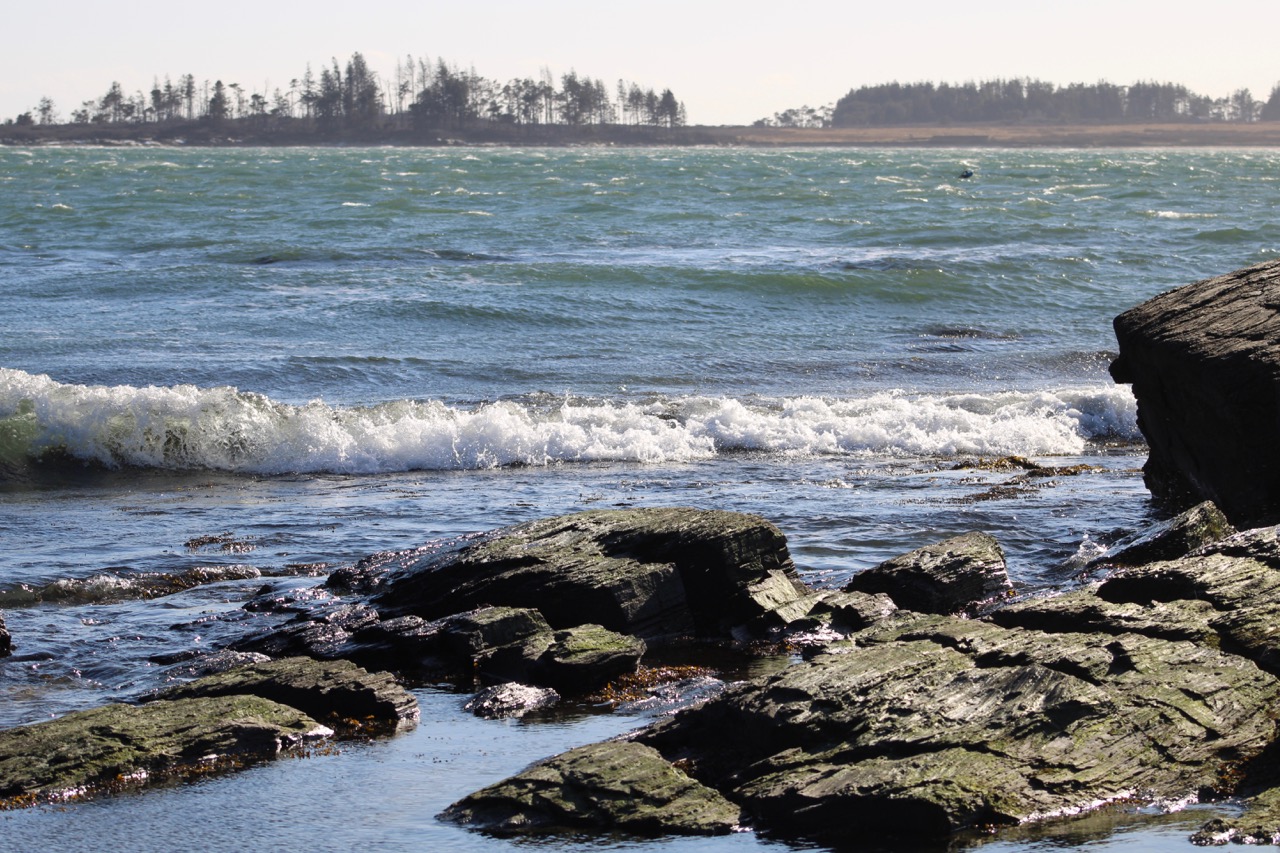
Photo: Kettle Cove: blue-green sea, white breaking waves, rocks near me, island trees at the back
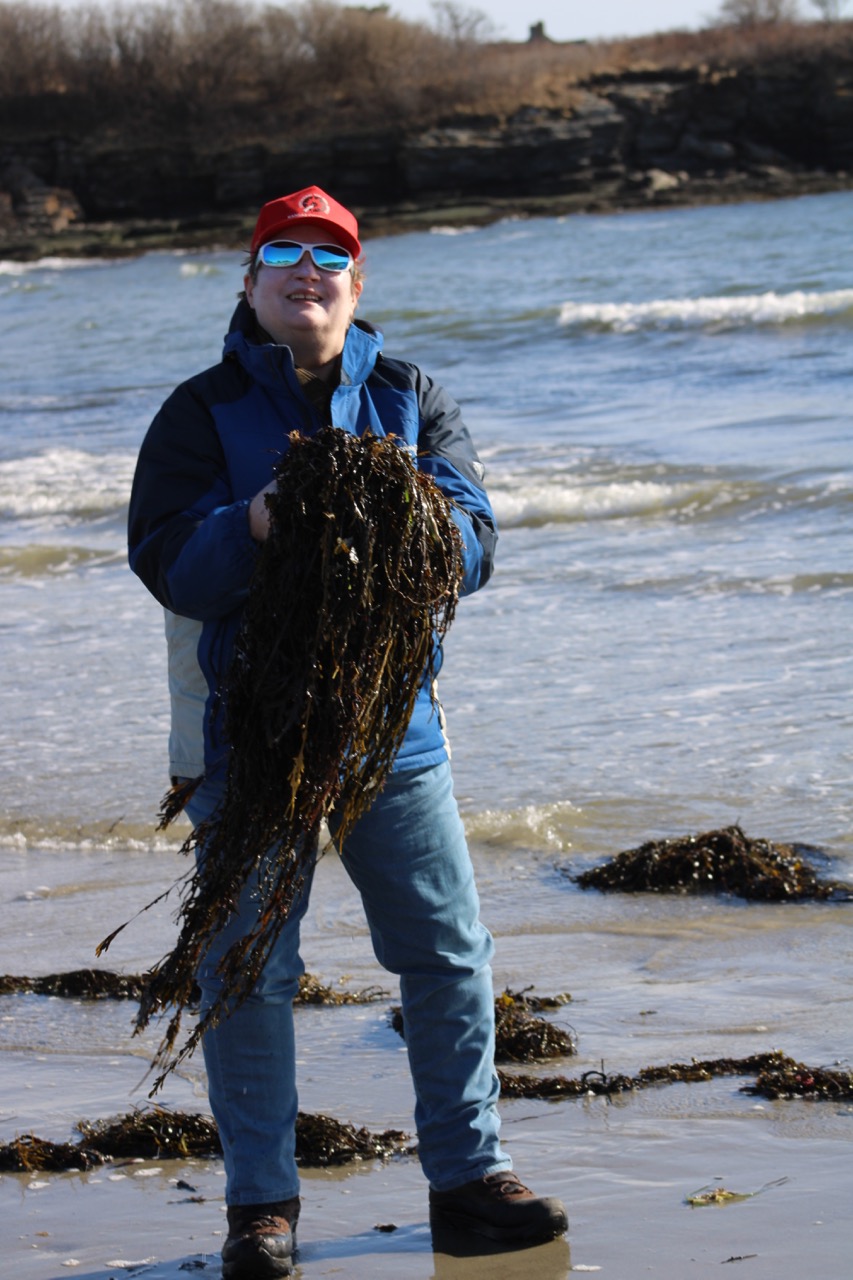
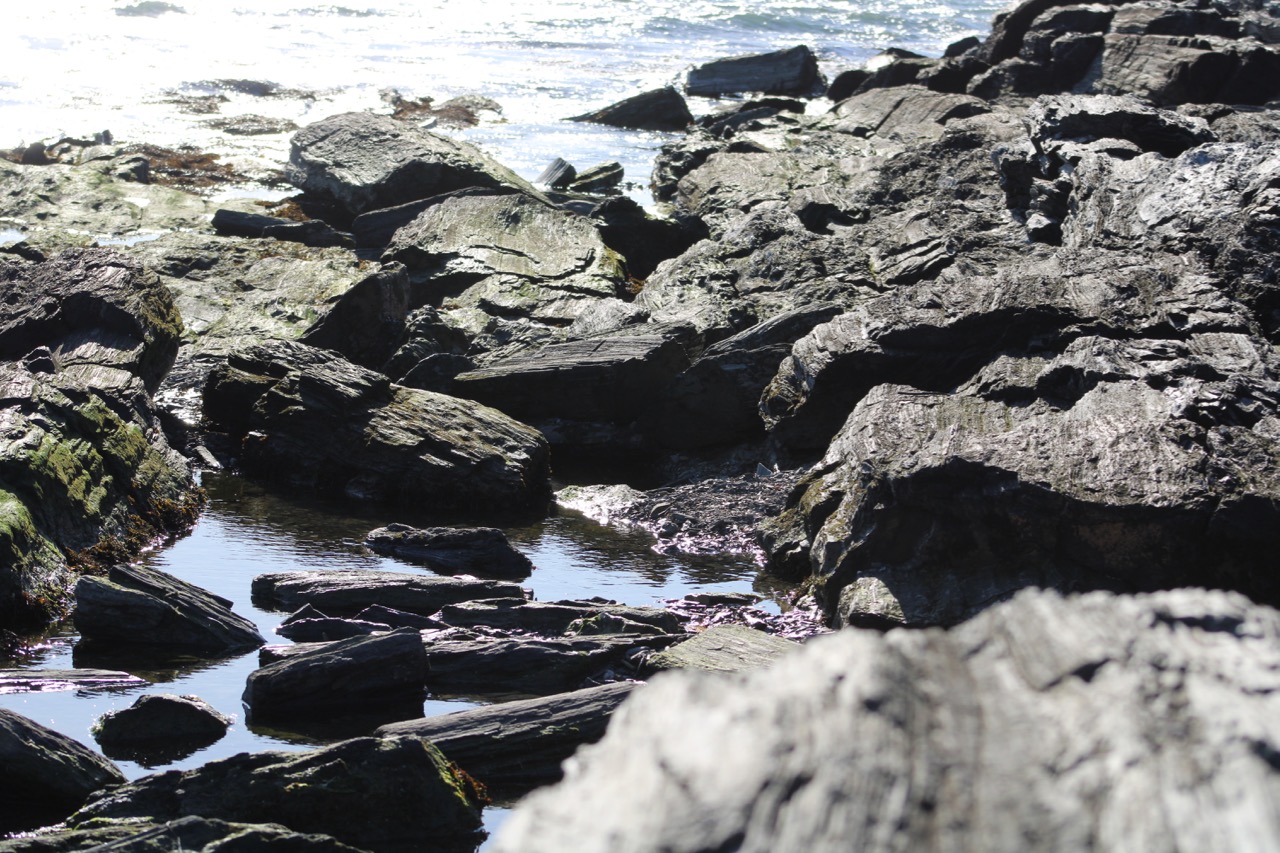
February in Maine, and it is 60 degree weather today. It isn’t really supposed to be like this. We went to Kettle Cove, where dozens of people were out at the beach. A few even went into the water in their swim suits–but not us. Margy was inspired to collect some seaweed for the garden. I decided to sit on a lovely rock, and take photos of the waves and rocks.
Margy holding seaweed at the beach.
Rocks to sit on, with tide pool.
It was so restorative–wind, sun, rocks, water–all the elements. And the sound of the waves calming the spirit like a deeper kind of silence.
I was thinking about climate change and how the weather has become so chaotic. Tomorrow we’re back in the freezing zone, between the teens and twenties, and Friday a snowstorm is on the way. But the message I felt from the sea was not about worry. It was to love the earth just as she is in this moment, to love the weather as it comes–not to always think on how it is supposed to be different, but to embrace the changes as they emerge, to embrace every amazing aspect of this beautiful planet.
I don’t fully understand this message, the activist that I am. So often I grieve for what is happening to the earth because of the greed and destruction of some human beings, all of us trapped in this pattern. And I still grieve. But the other side of that grief is this love.
The message was that we must never cease to love the earth in all of her mysterious flowerings, her beauty everywhere, even when we cannot perceive it. So what a joy when we can feel that beauty all around us. It was that kind of day, that kind of visit to the ocean.
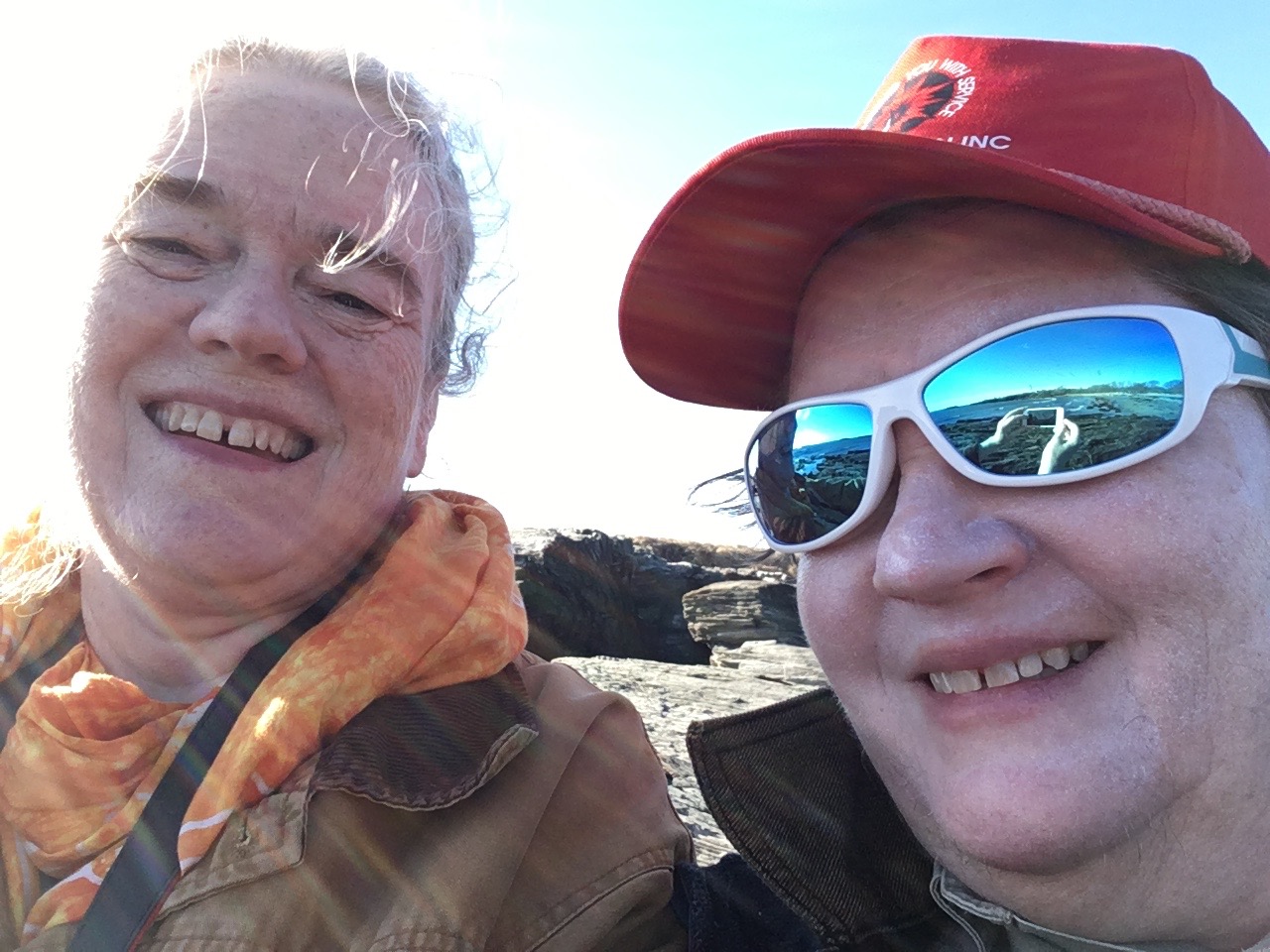
Myke & Margy smiling, with rocks behind us, and the ocean reflected in Margy’s sunglasses.
Tonight I feel grateful to participate in the virtual opening ceremony for the Healing Turtle Island gathering. Songs, prayers in Indigenous languages, stories of grief, woundedness, devastating loss, and yet, gratitude. How do we bring healing, bring back balance in our relationships, with each other, with the earth, with spirit? This weekend will be filled with many speakers… (anyone can join on Facebook, or on Zoom, just follow the link). I don’t have a lot of words right now but one of the strange blessings of the pandemic is that because this gathering is virtual, I am able to participate. I was present for the very first gathering here in Wabanaki land, the eastern door. There will be 21 gatherings all together.
This photo is of two deer whom we sighted in our backyard on Tuesday–there were four all together. They were a gift in the midst of a painful week. I found myself just sitting on the back porch watching as they took their time amidst the trees and brush. Sitting still and watching. I feel the presence of such a compassionate Spirit through these visitors from the natural world.
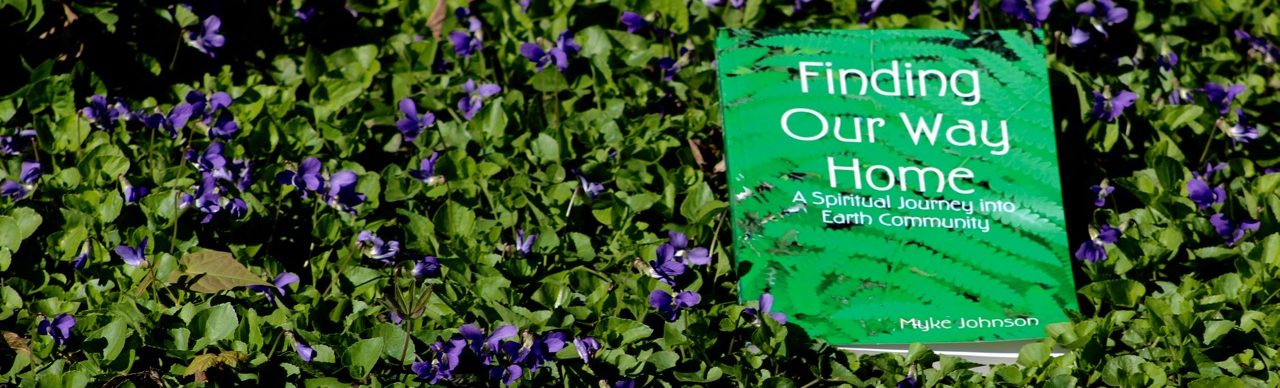









 Finding Our Way Home